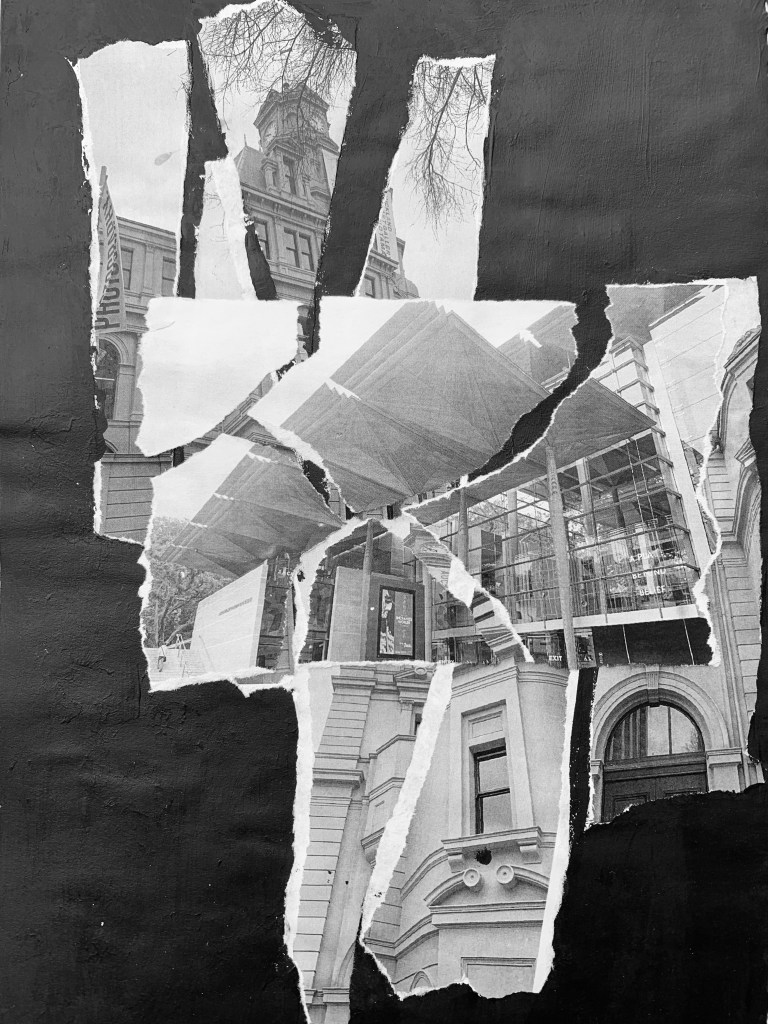
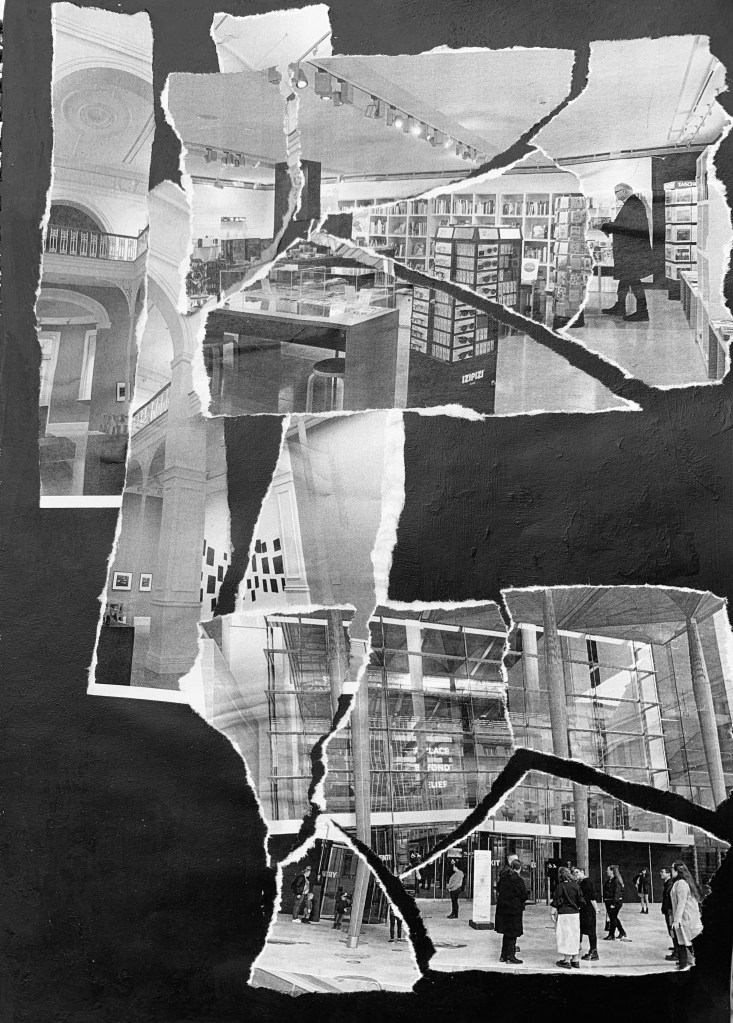
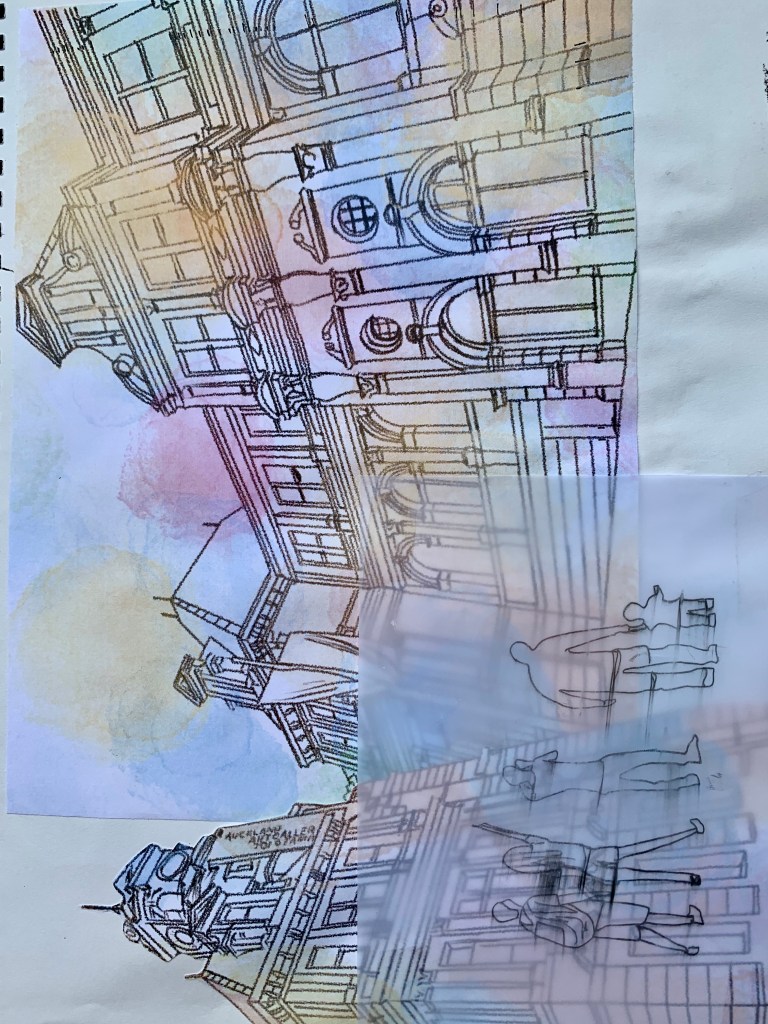
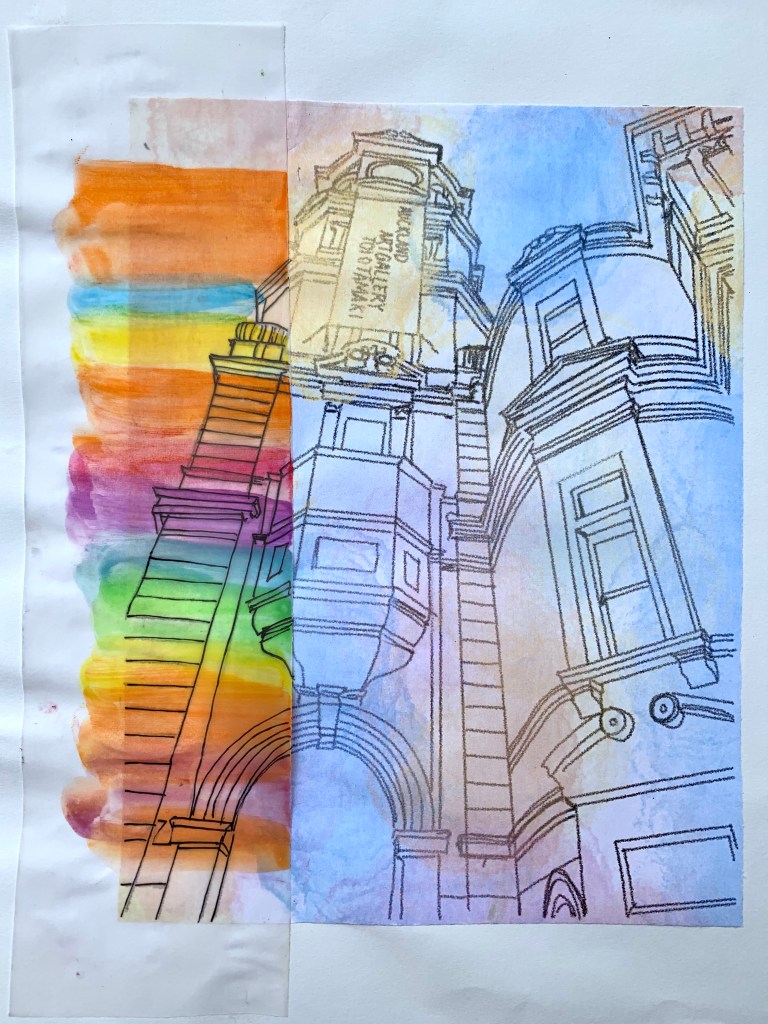
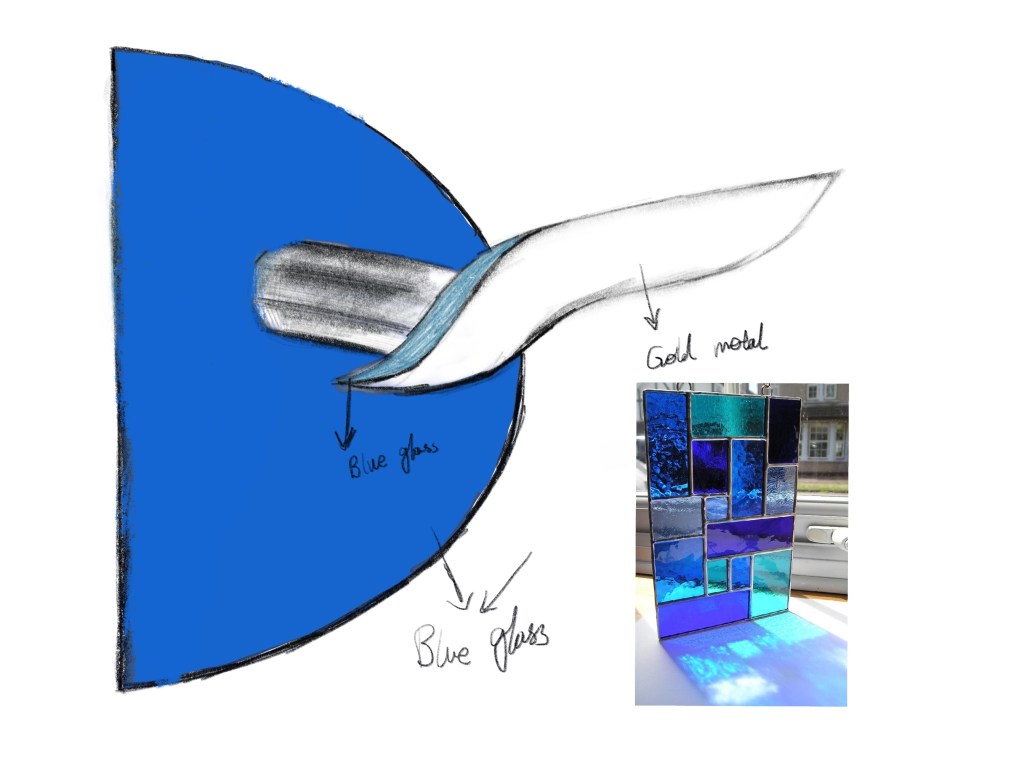
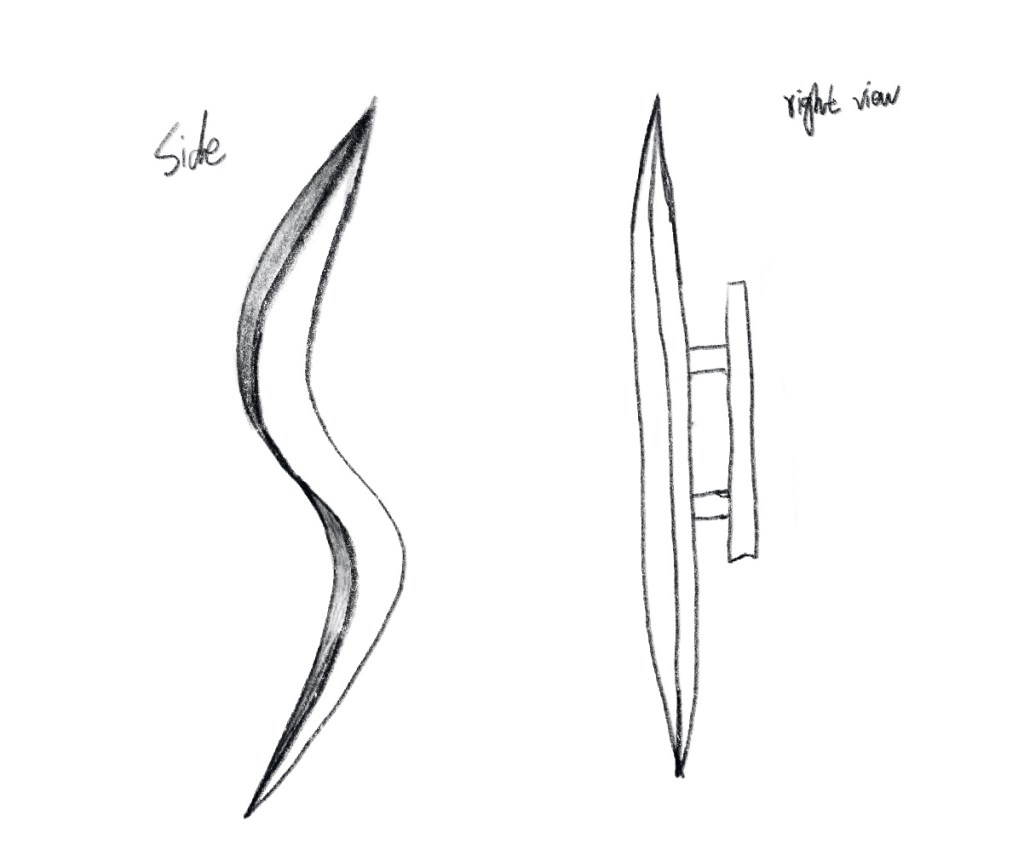
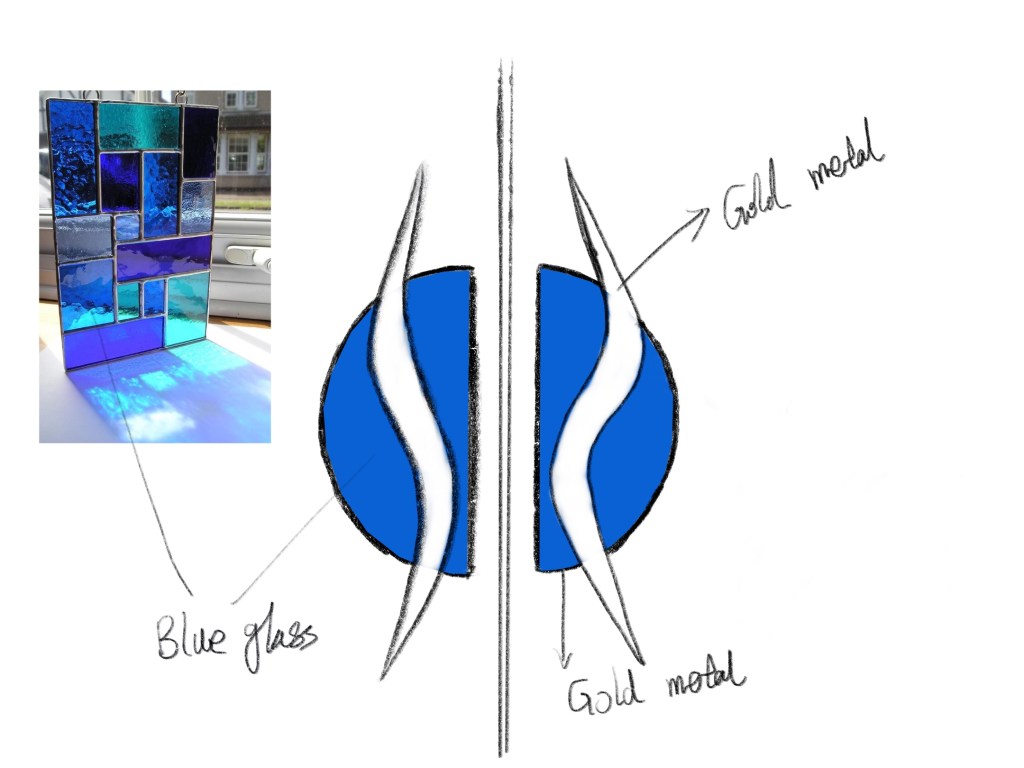
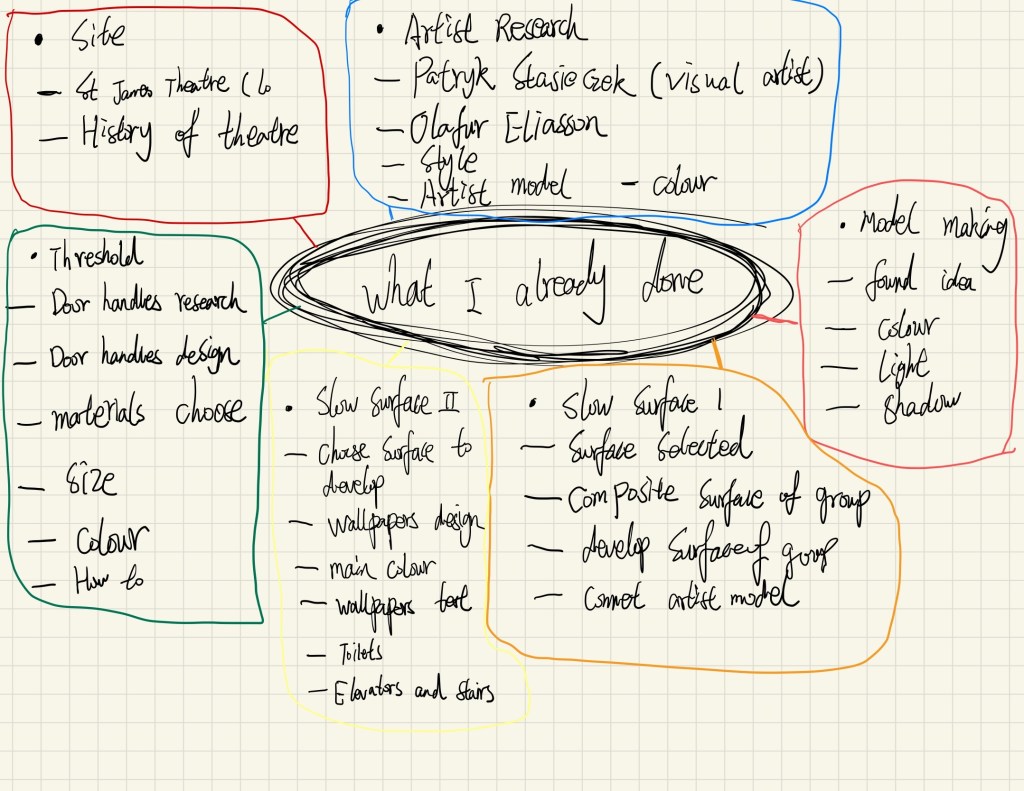
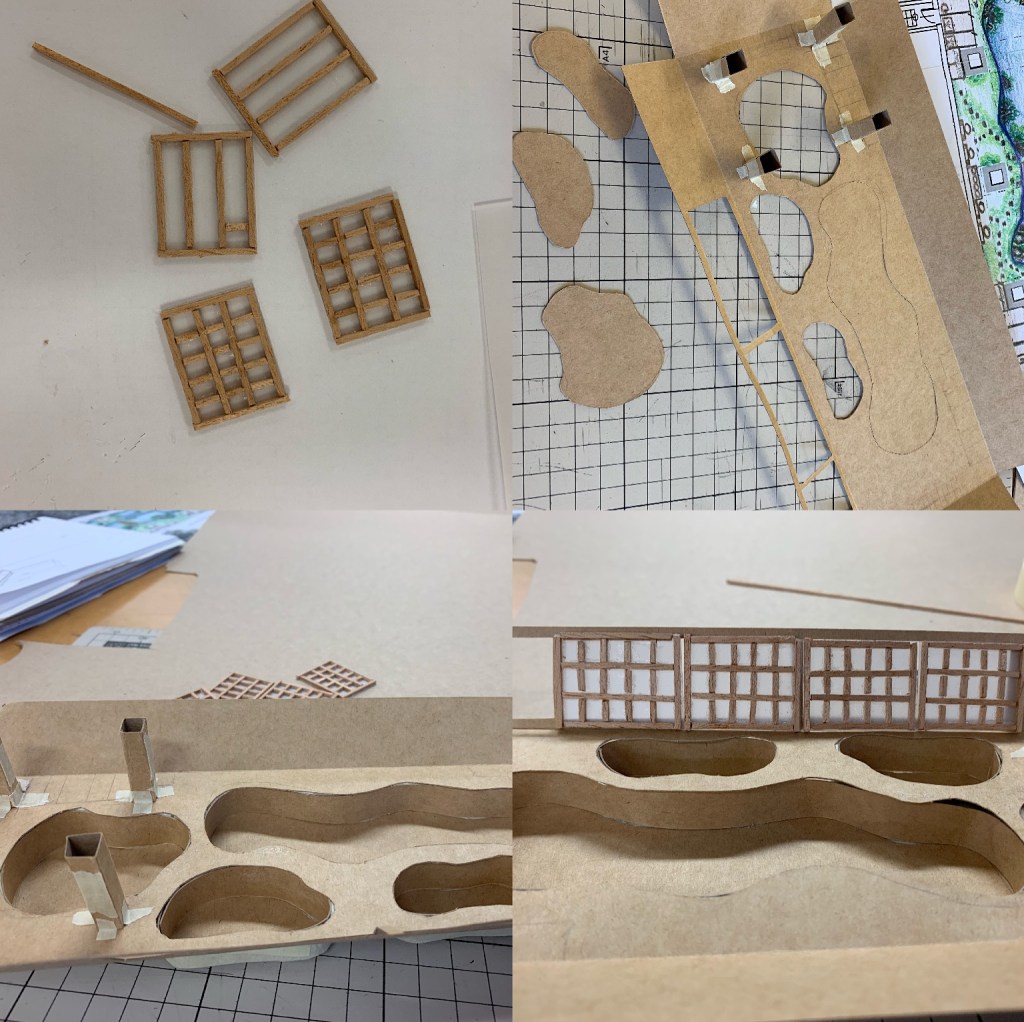
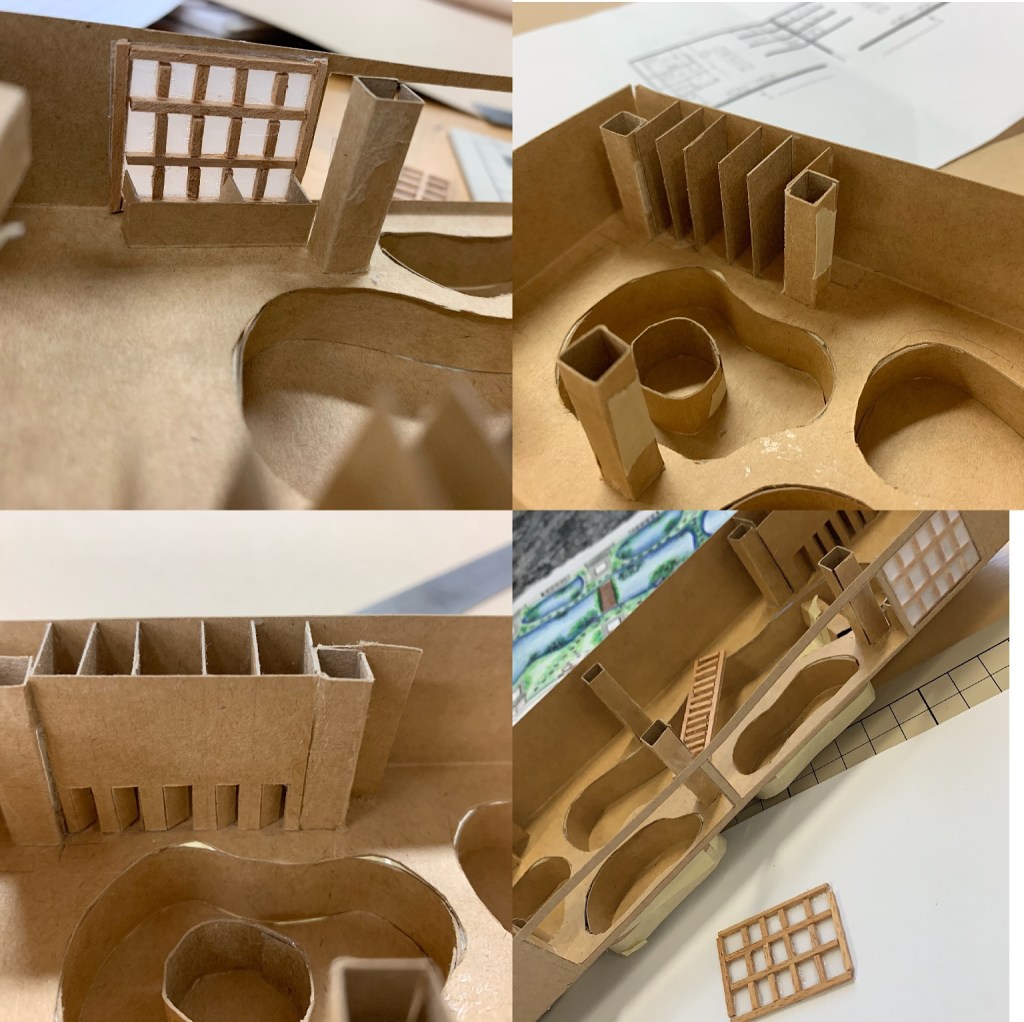
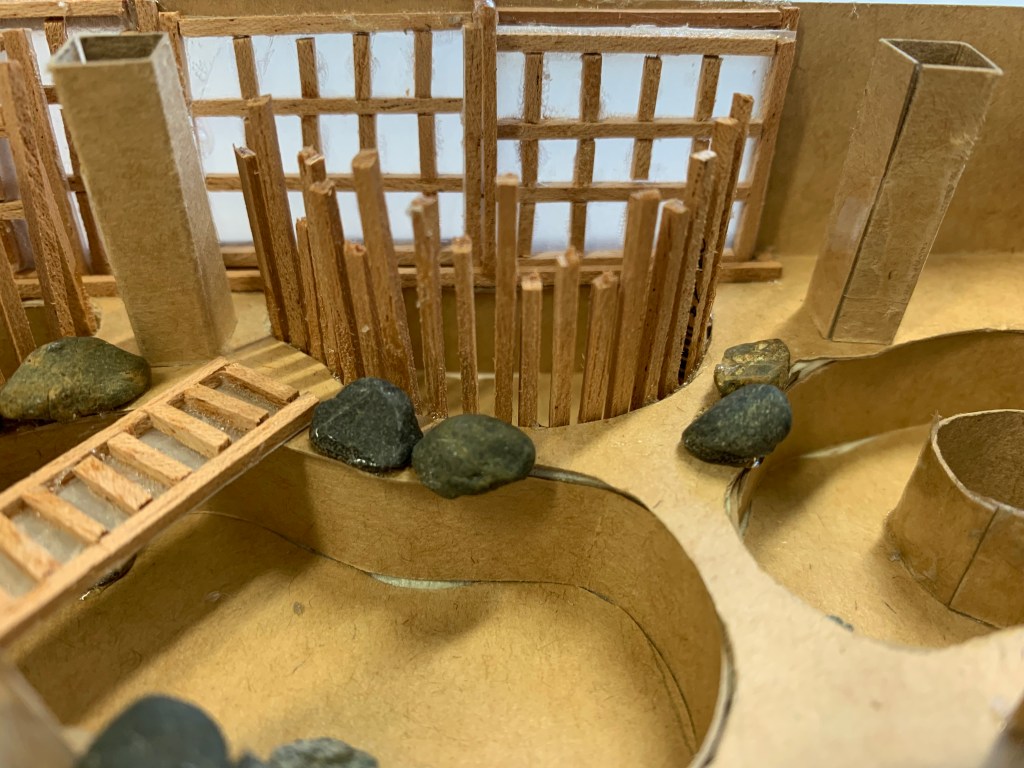
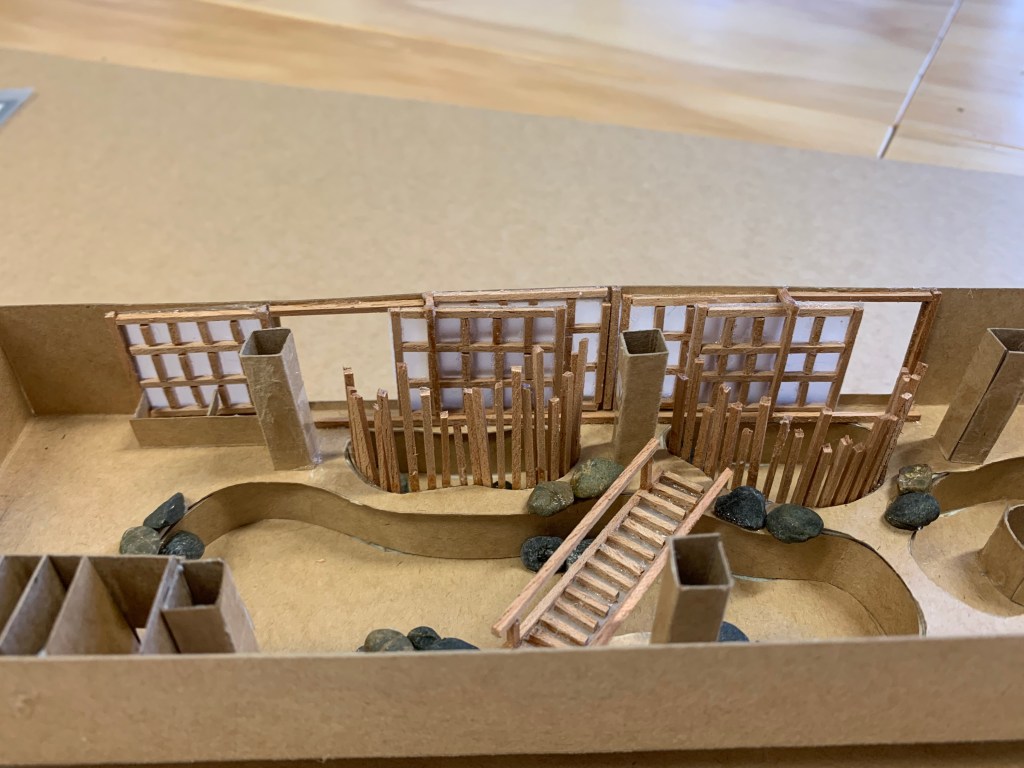
Spatial Design Studio III Sem 2 2021

URBAN ITINERARY: CINEMATIC SPACE
Week 1: Site Cinematic Device and Site Visit
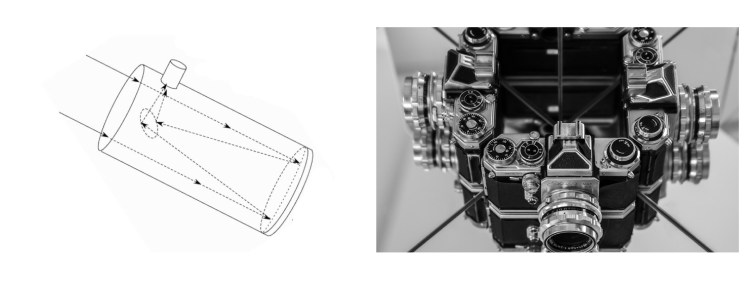
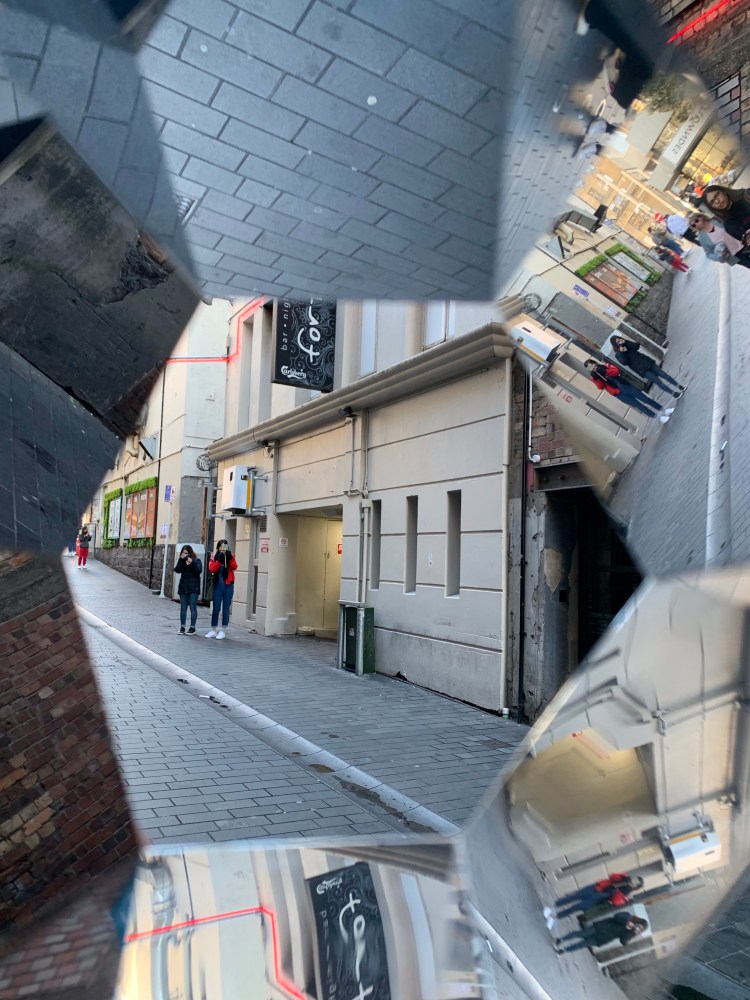
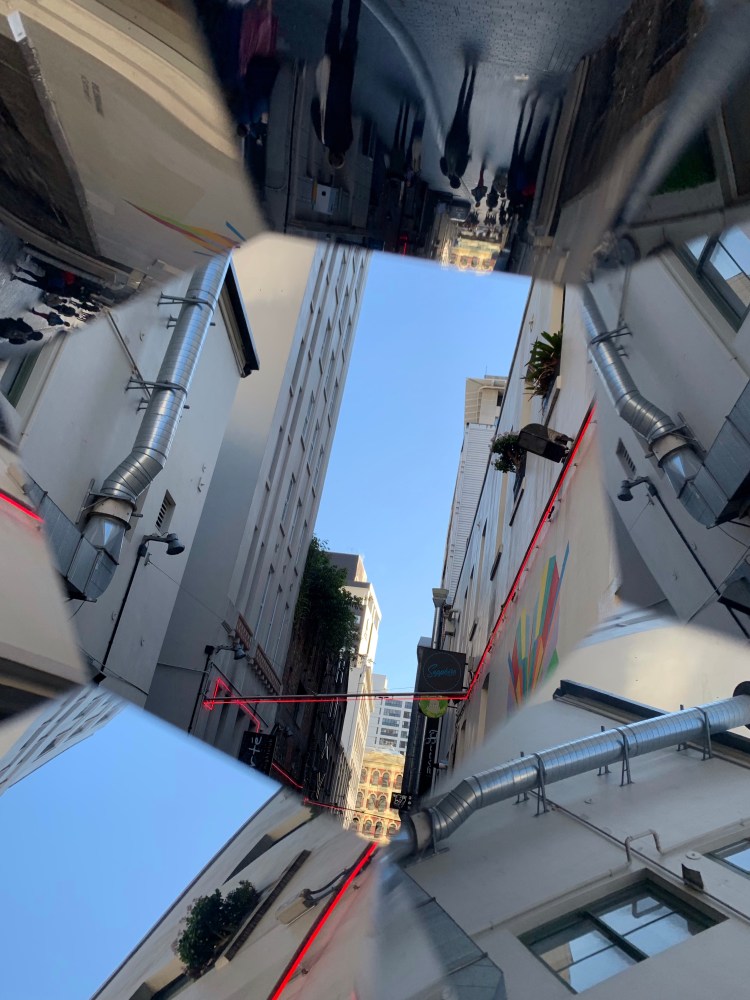
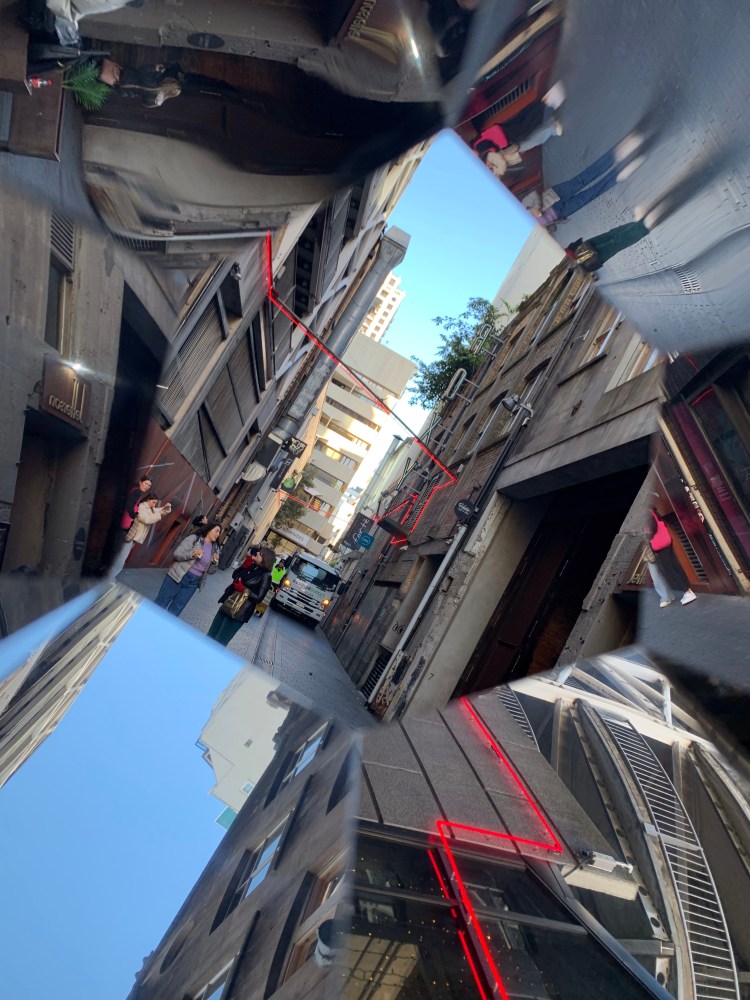
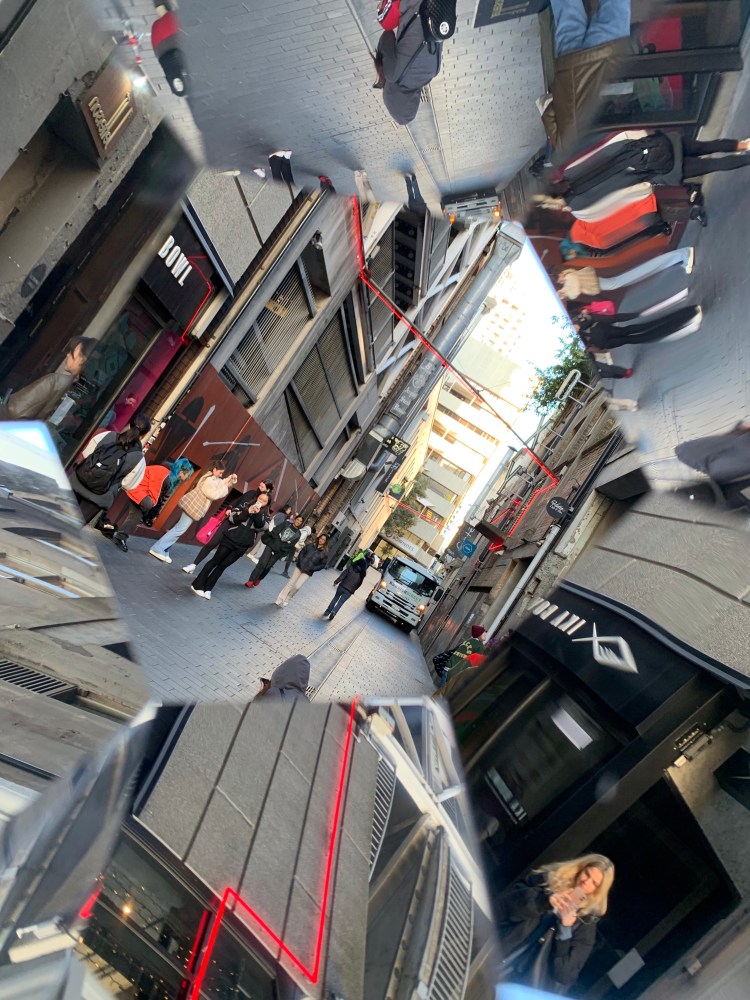
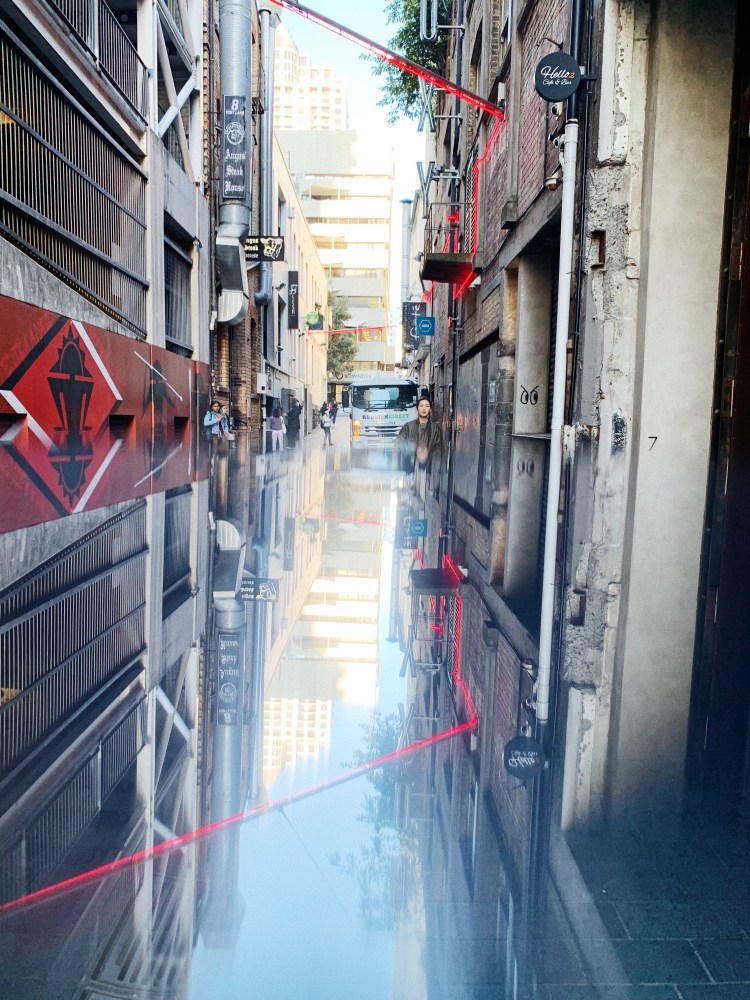
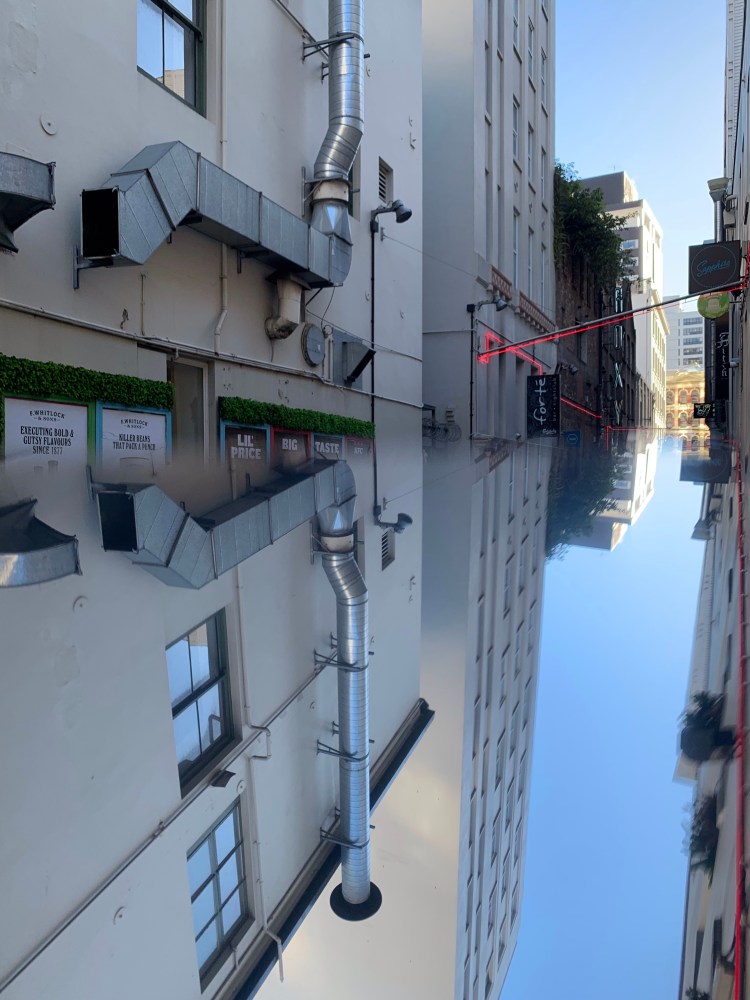
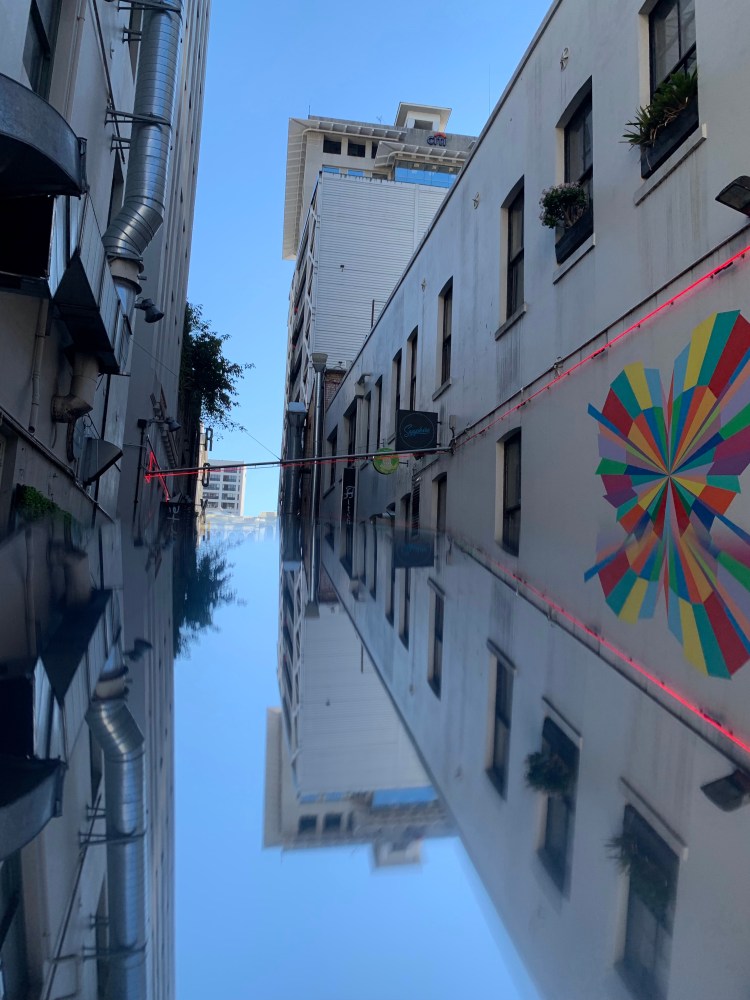
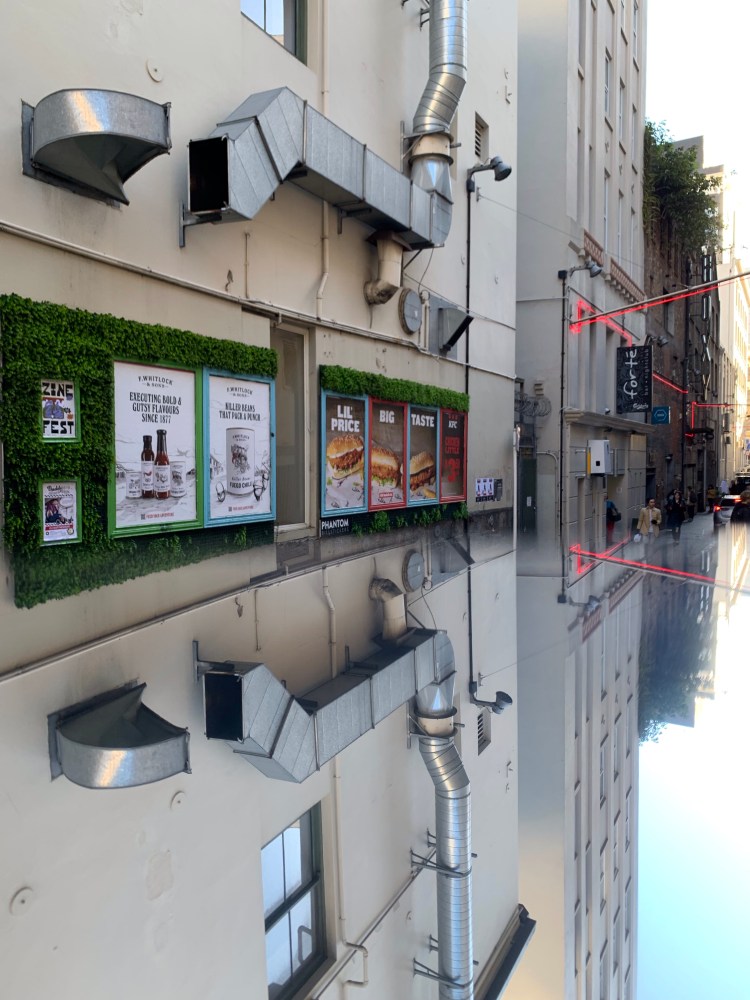
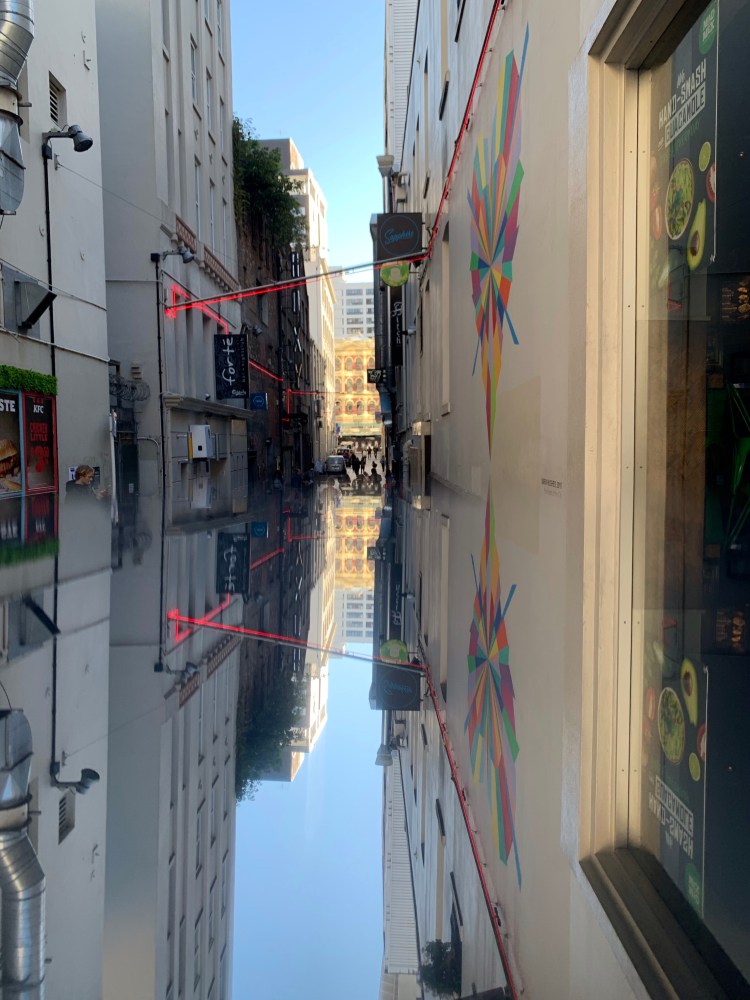
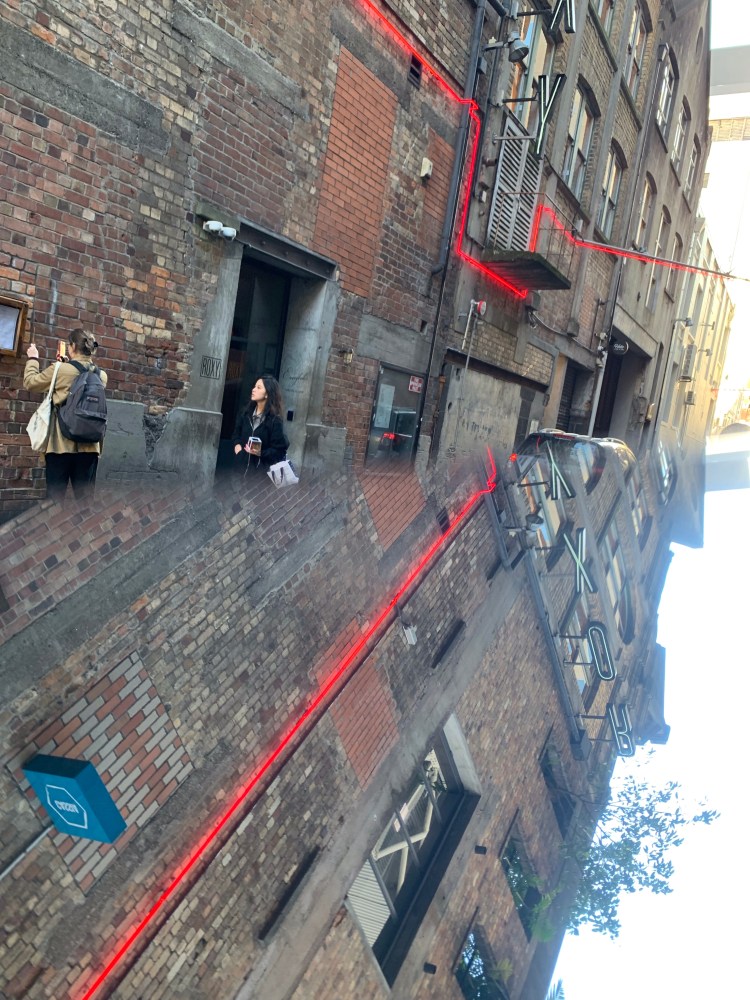
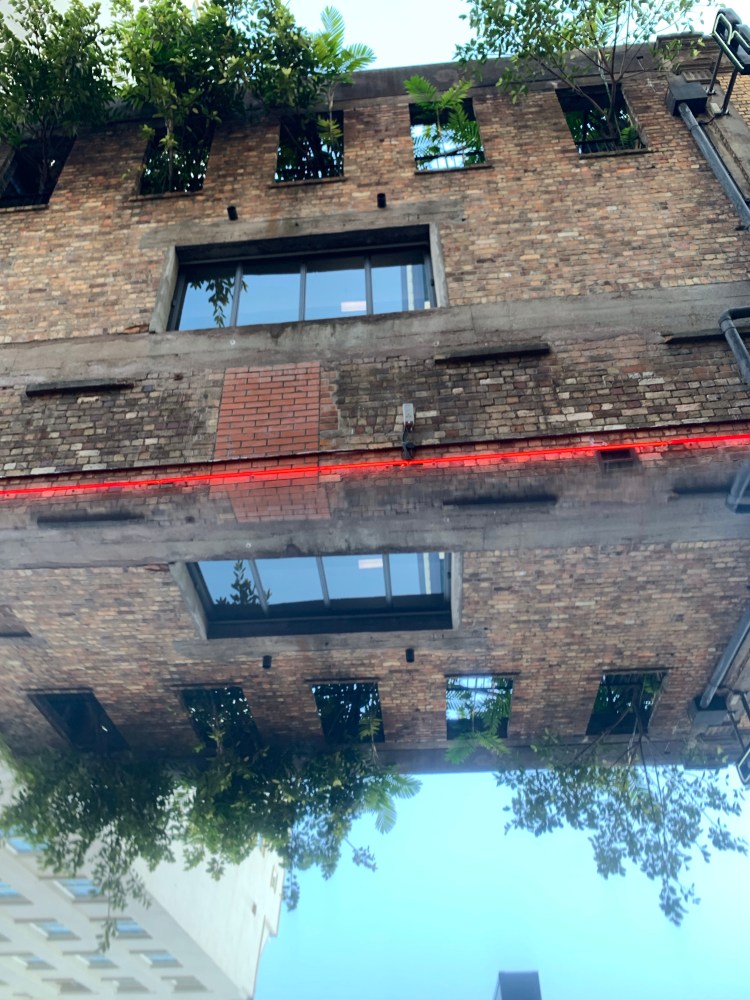
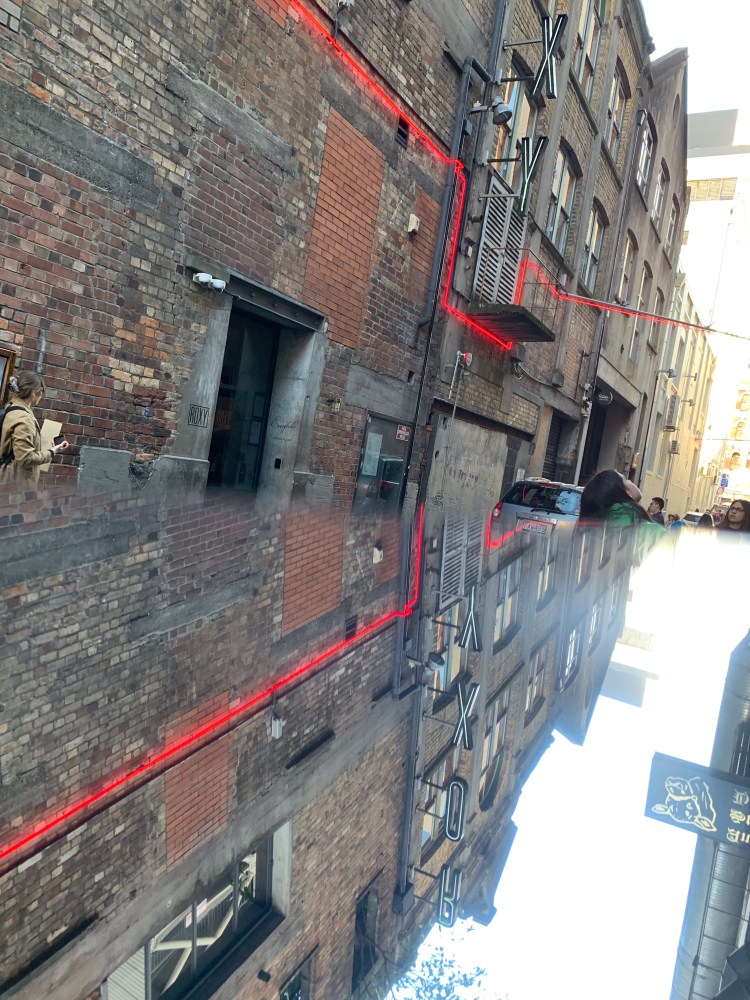
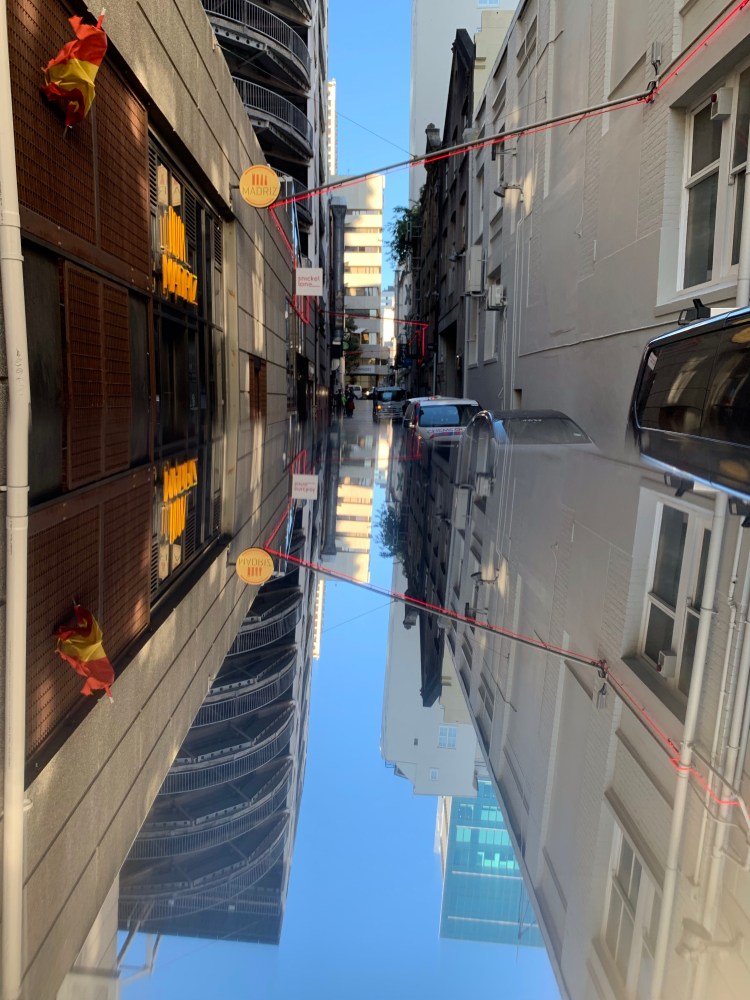
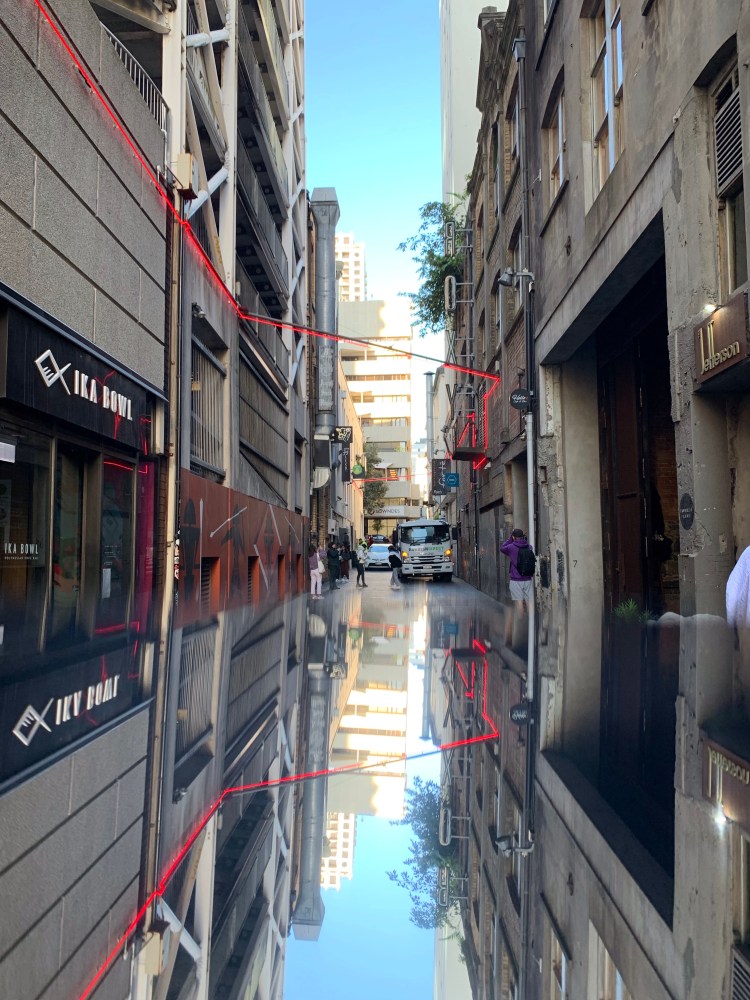
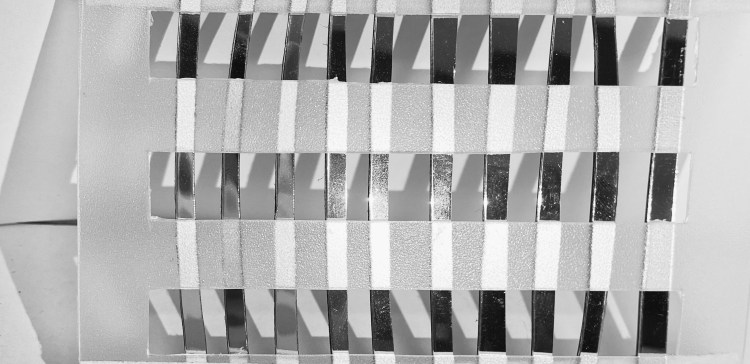
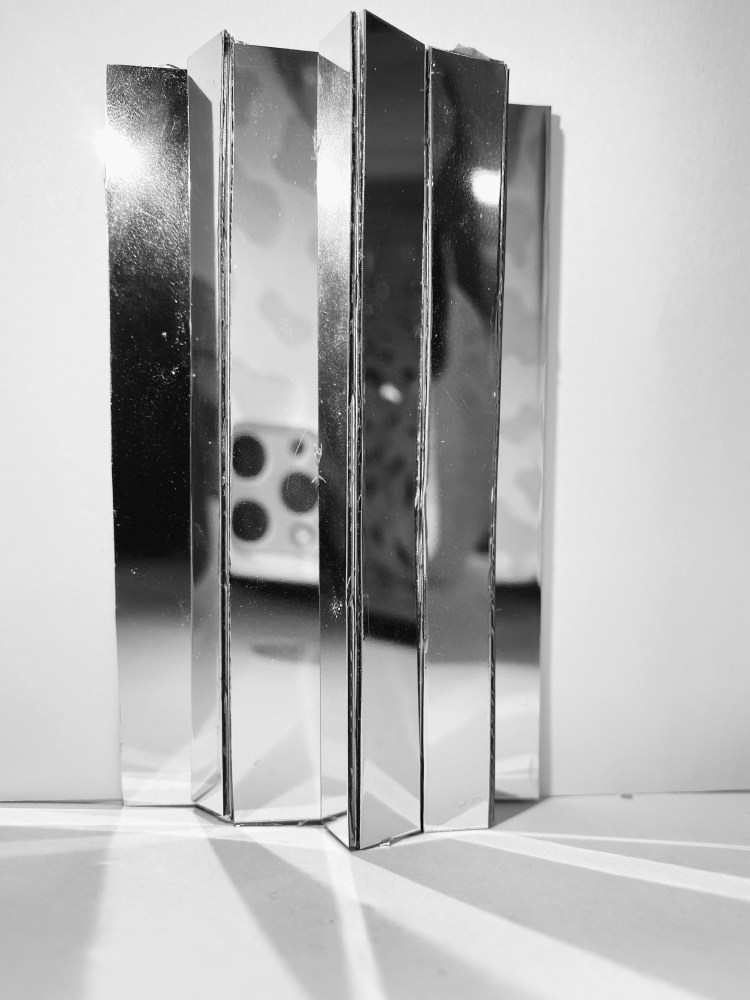
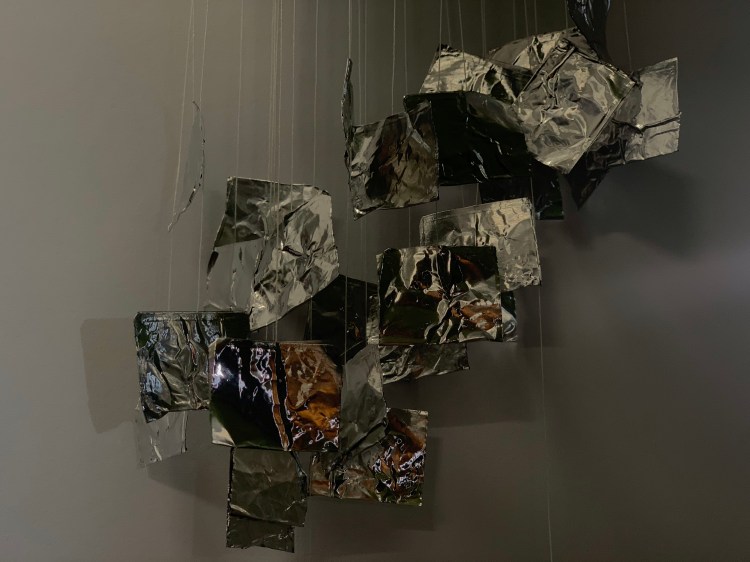
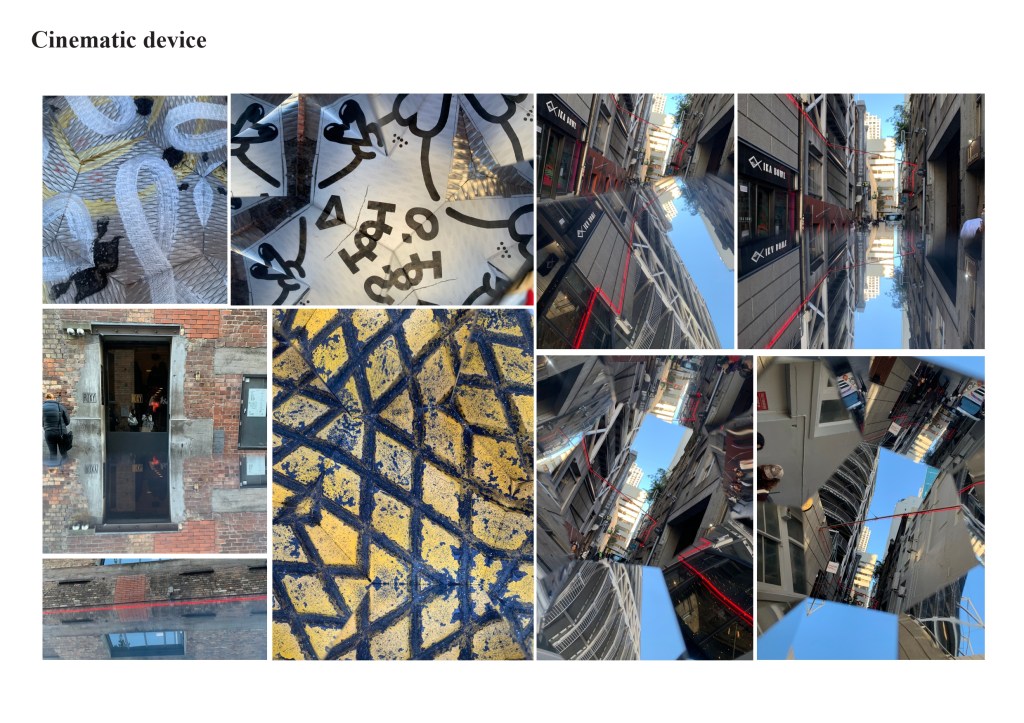
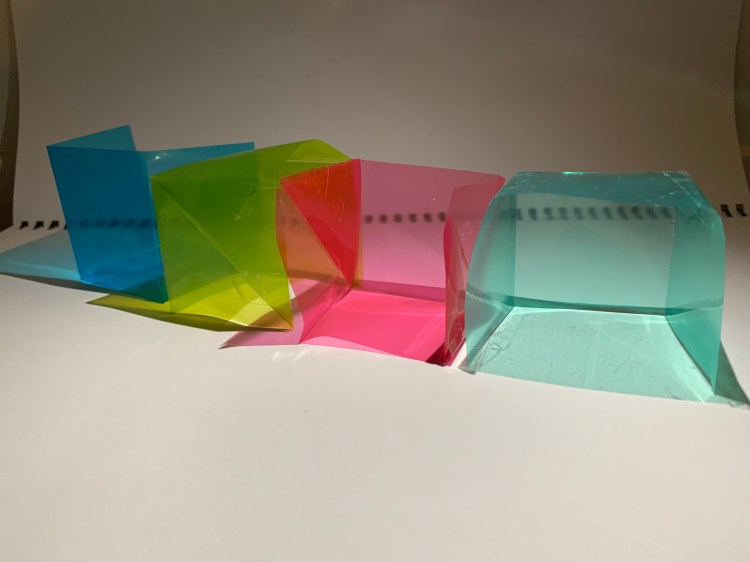
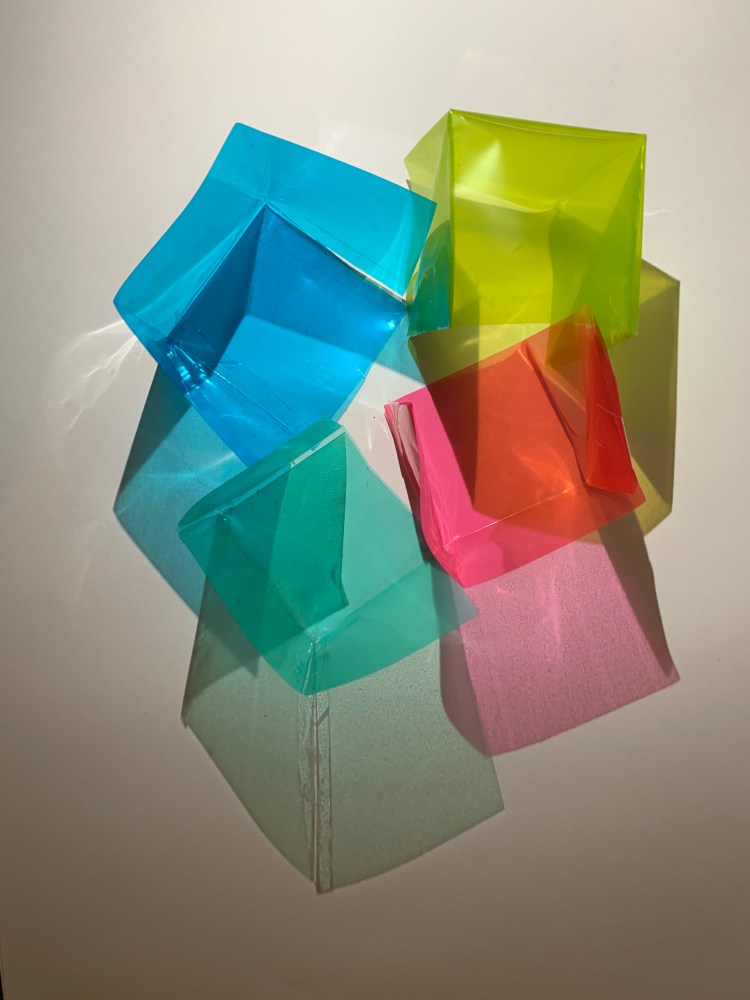
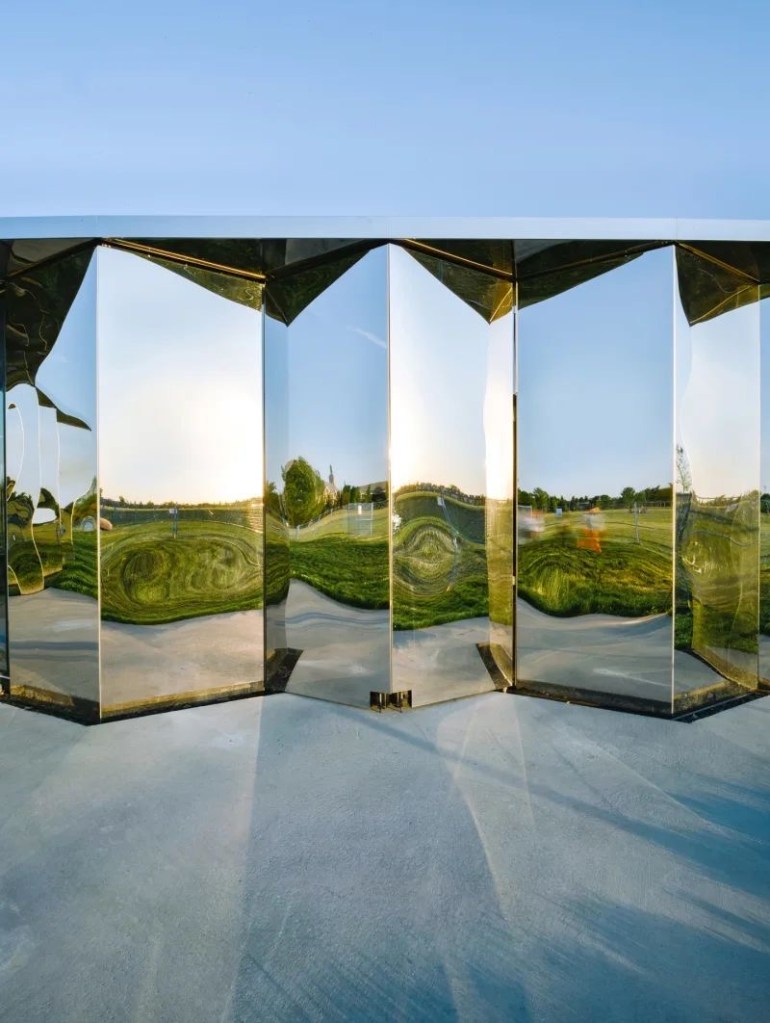
When people look into a mirror, they see an image of themselves behind the glass. That image results from light rays encountering the shiny surface and bouncing back, or reflecting, providing a “mirror image.” People commonly think of the reflection as being reversed left to right; however, this is a misconception. If you face north and look straight into a mirror, the east side of your face is still on the east side of the image, and the same is true for the west side. The mirror does not reverse the image left to right; it reverses it front to back. For example, if you are facing north, your reflection is facing south.
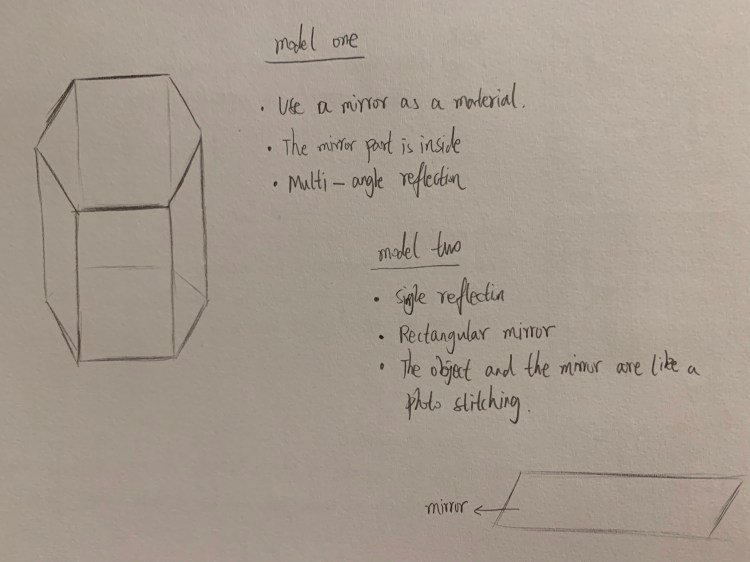

Week 2: Scene Transitions

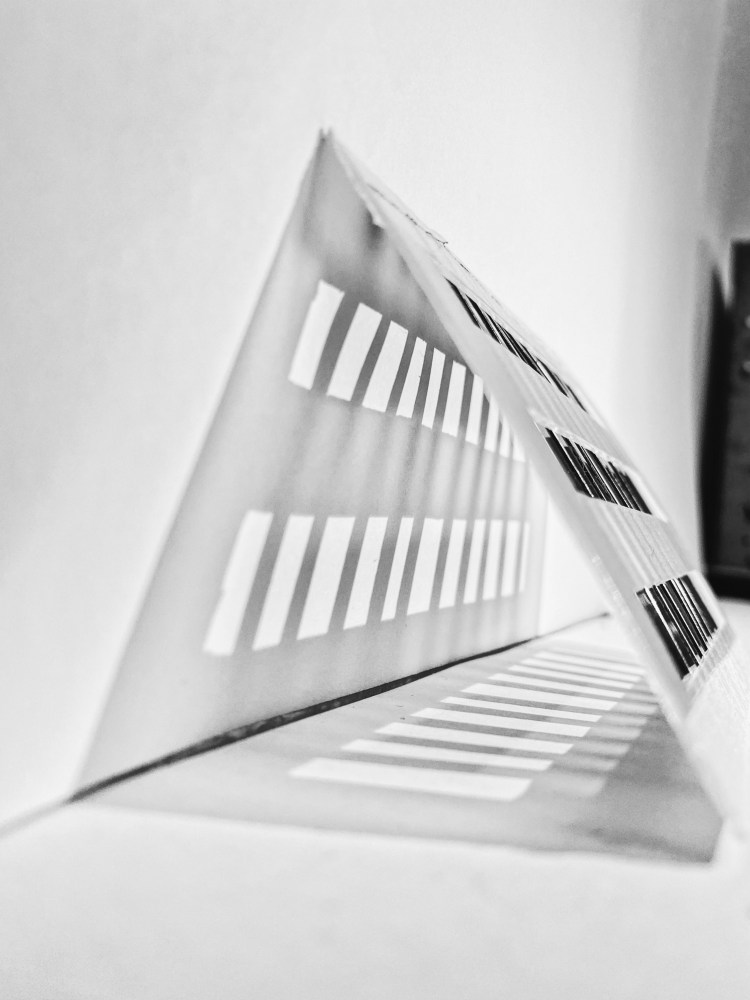
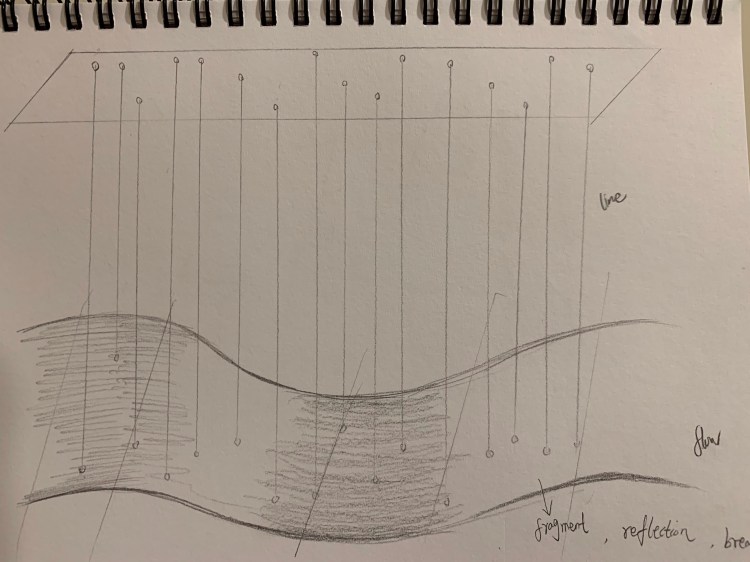
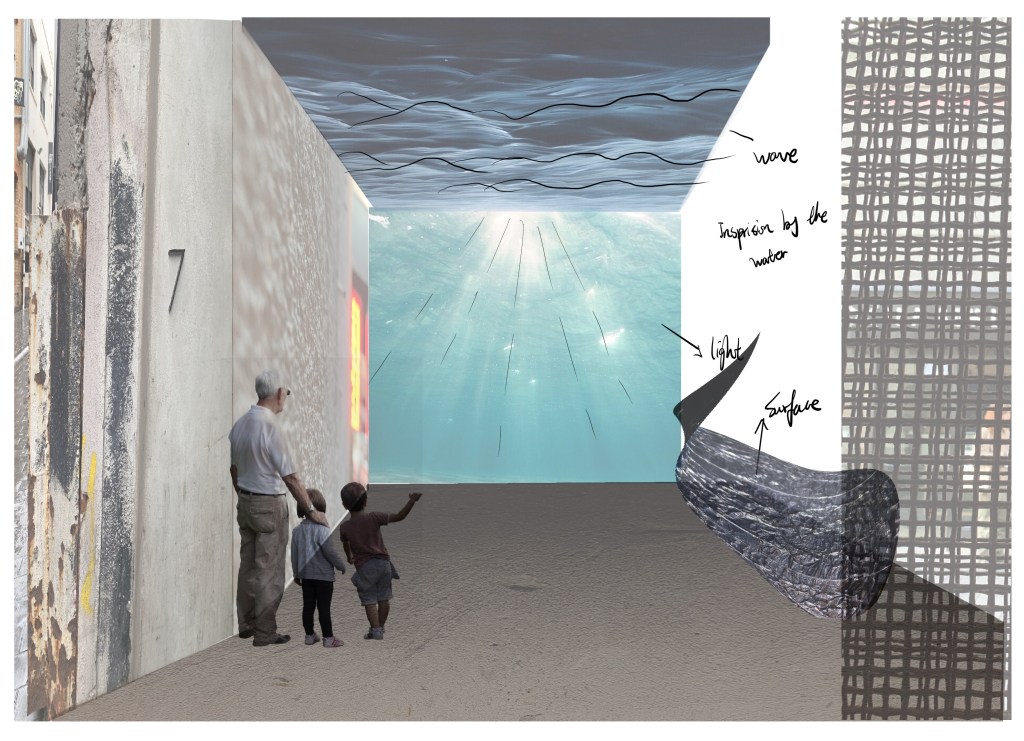
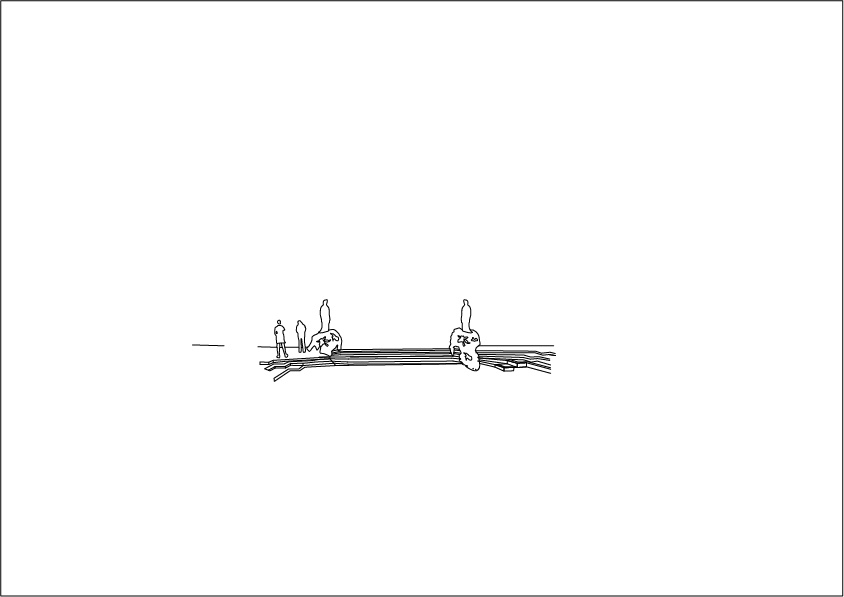
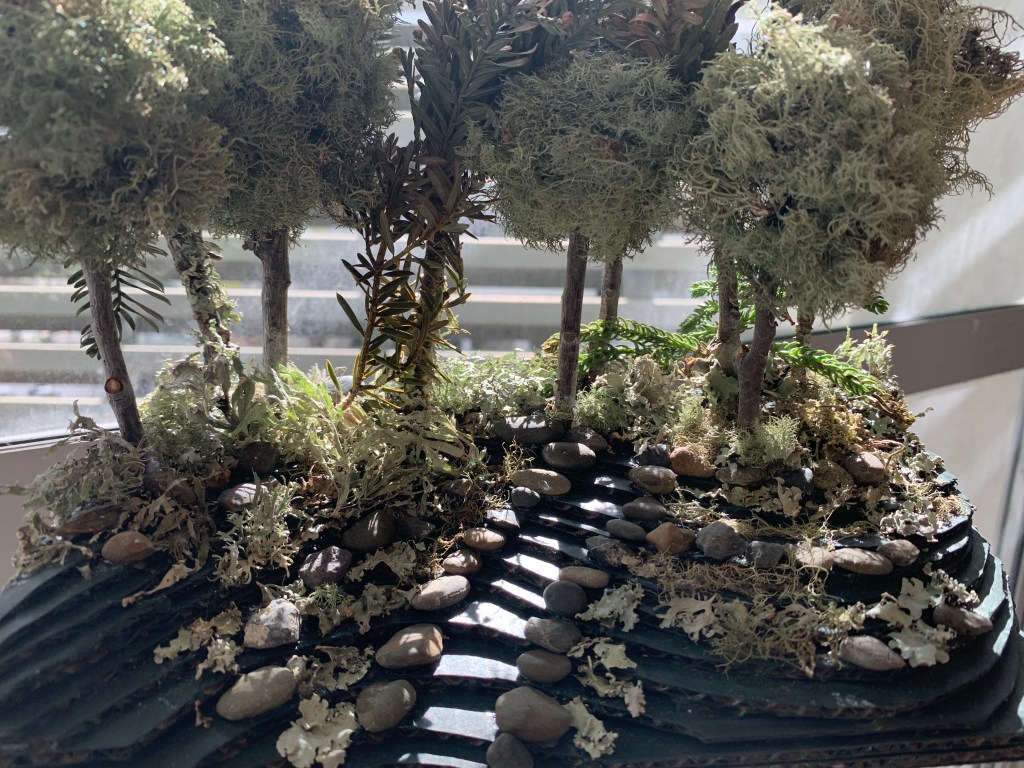
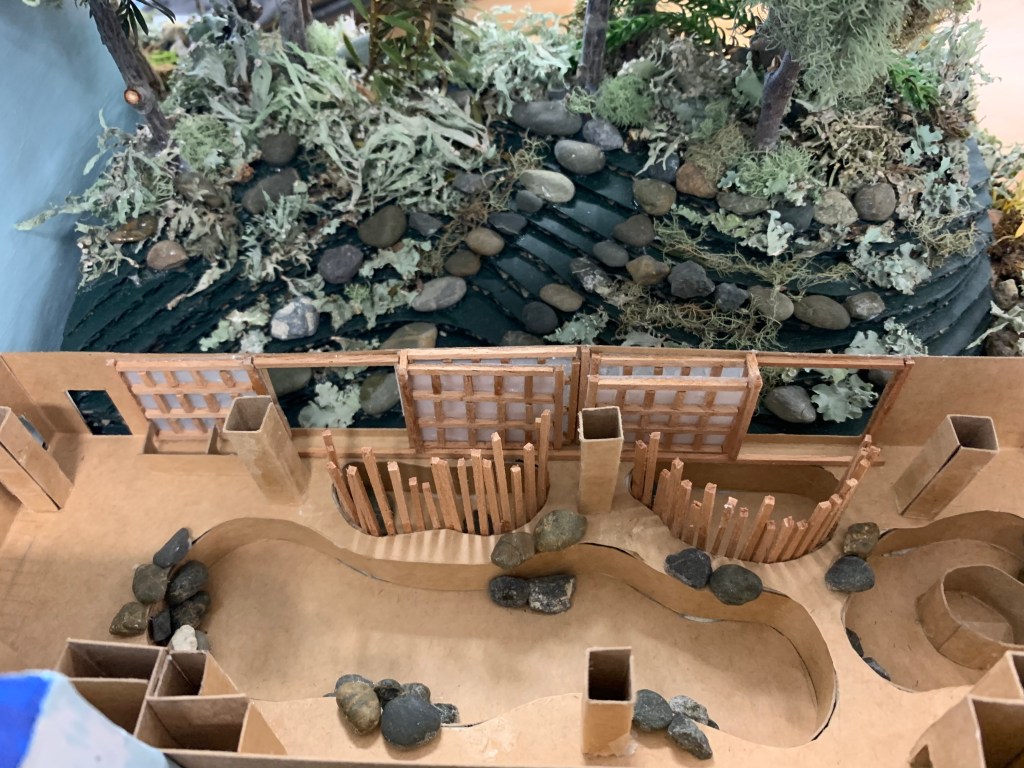
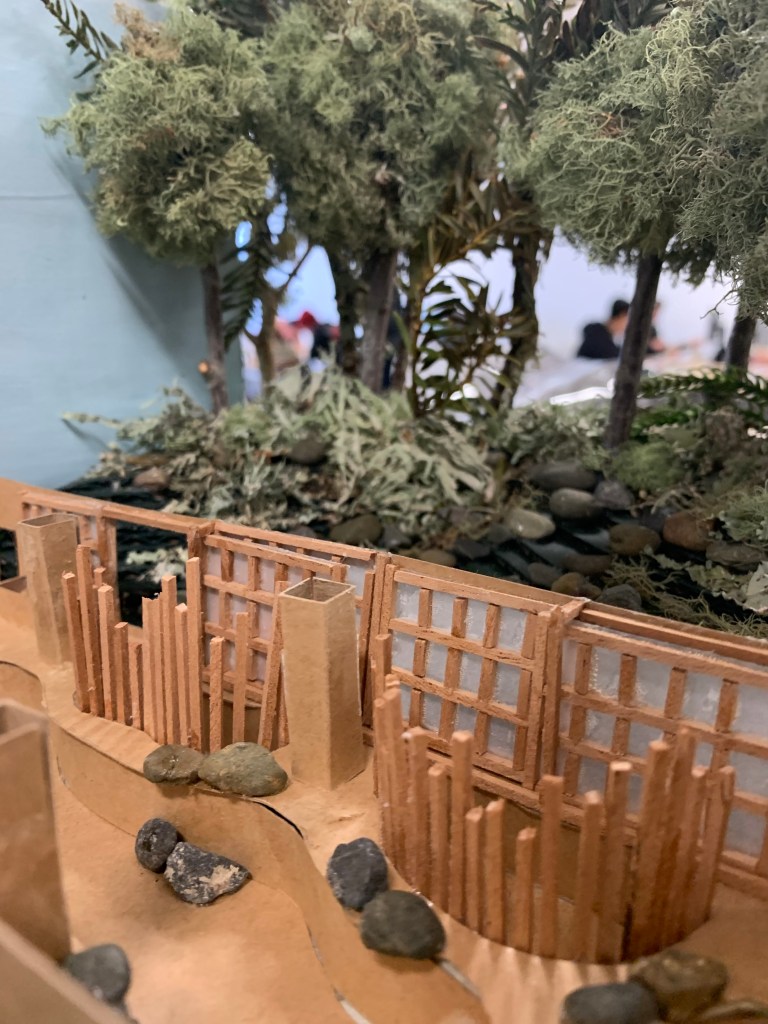
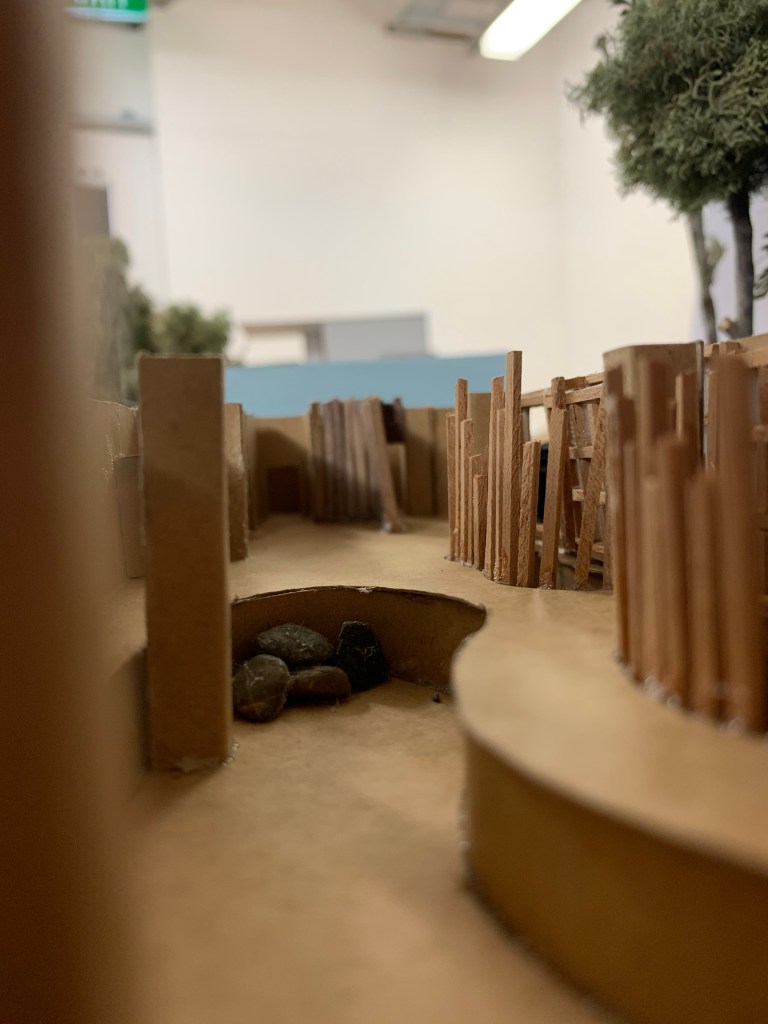
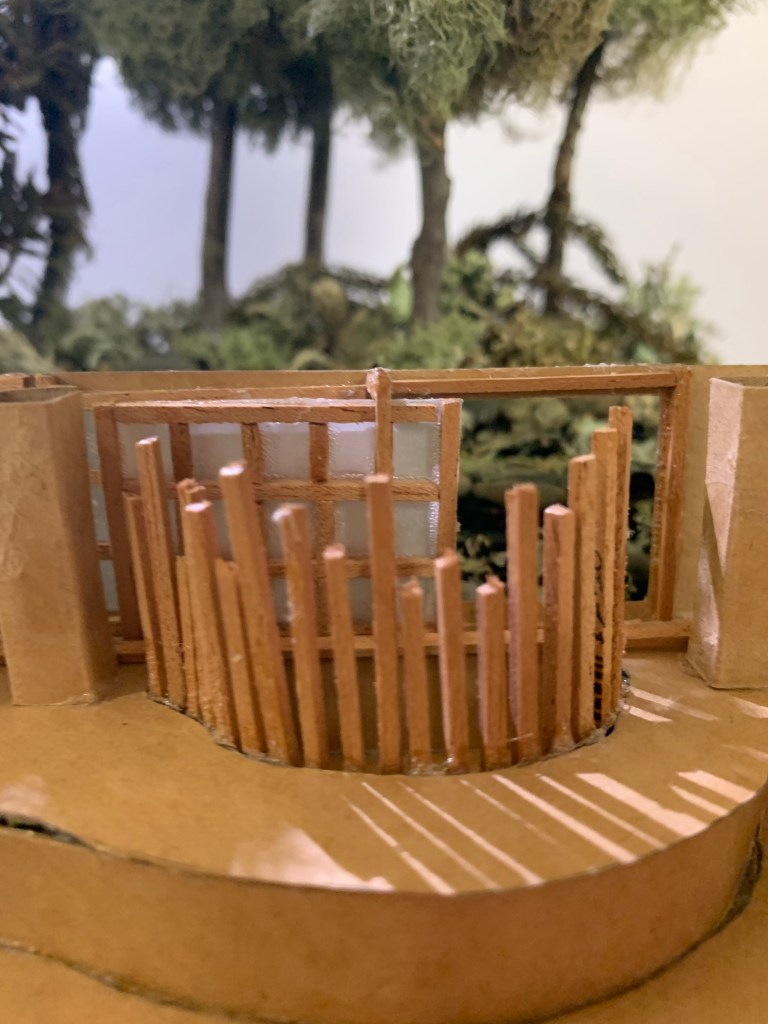
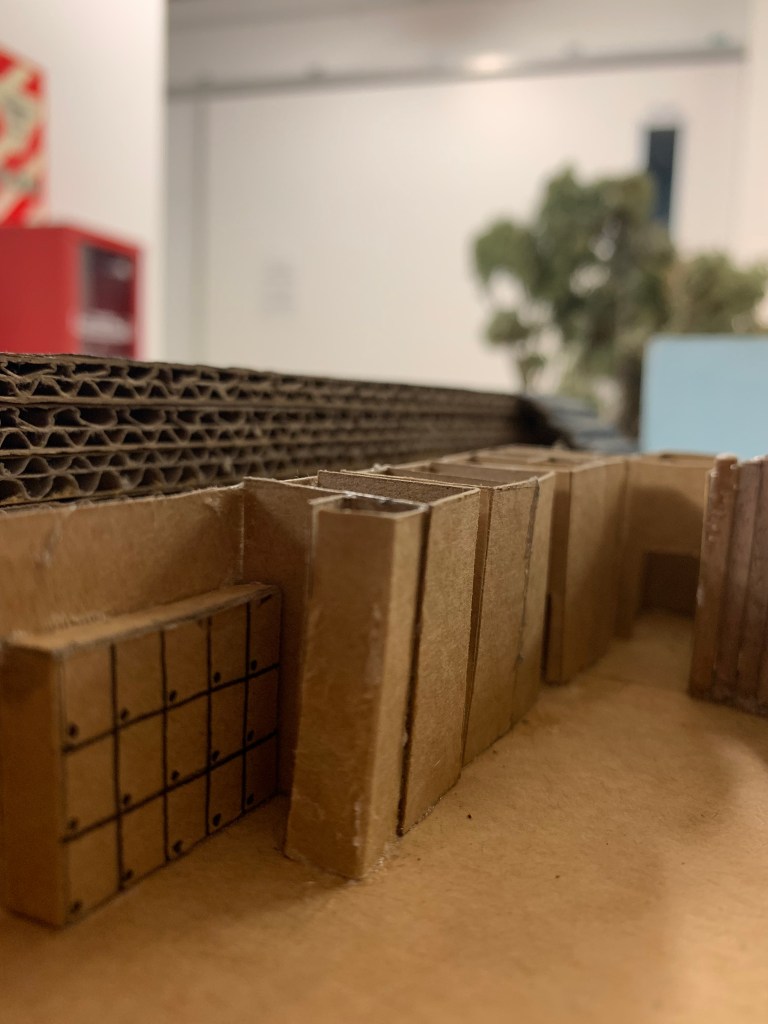
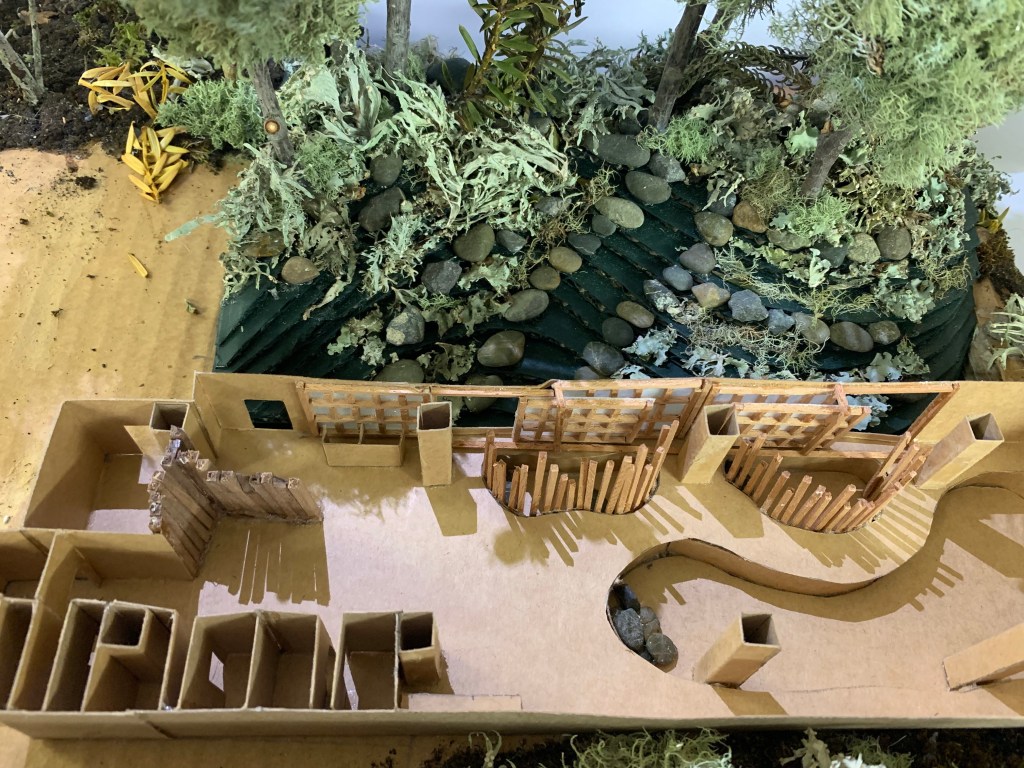
I tried to combine my model with the space. The curved plane at the bottom is like sea level, and the upper line is like sunlight shining into the sea.

Site Research

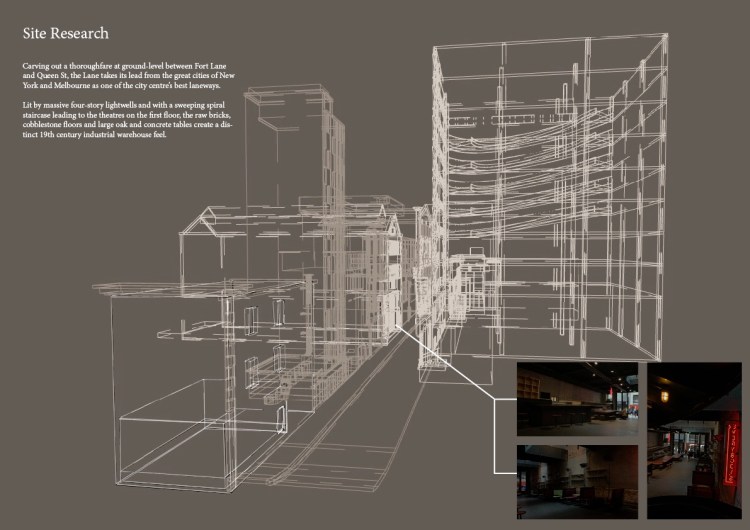
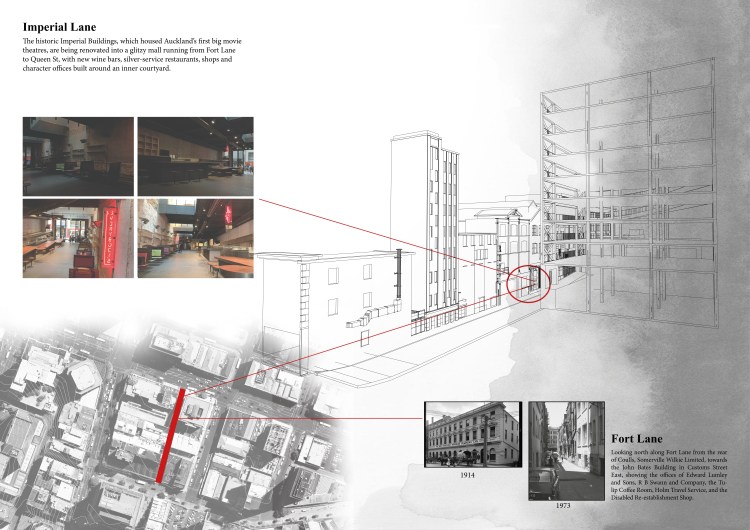
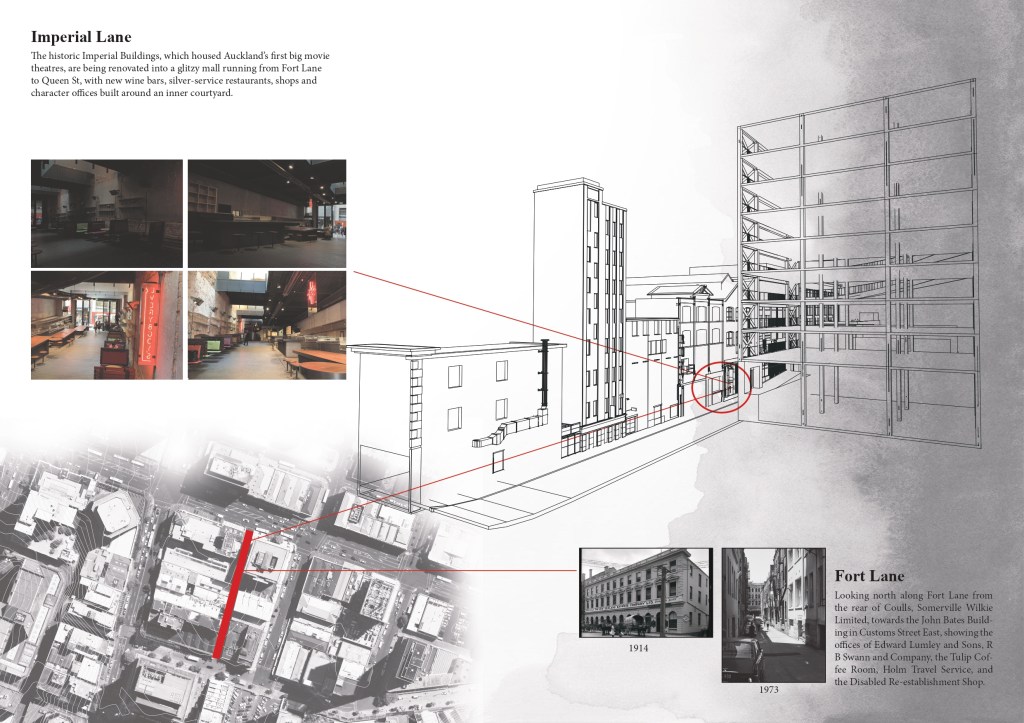
Carving out a thoroughfare at ground-level between Fort Lane and Queen St, the Lane takes its lead from the great cities of New York and Melbourne as one of the city centre’s best laneways.

Lit by massive four-story lightwells and with a sweeping spiral staircase leading to the theatres on the first floor, the raw bricks, cobblestone floors and large oak and concrete tables create a distinct 19th century industrial warehouse feel.

Imperial Lane
Week 3: Scipt

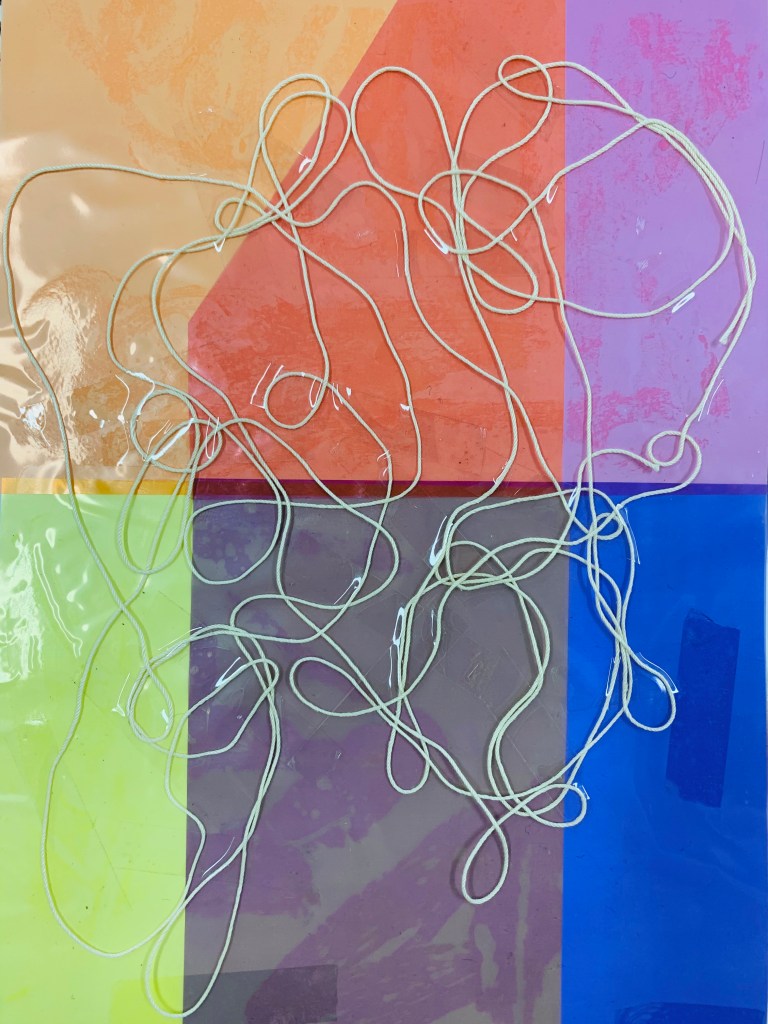
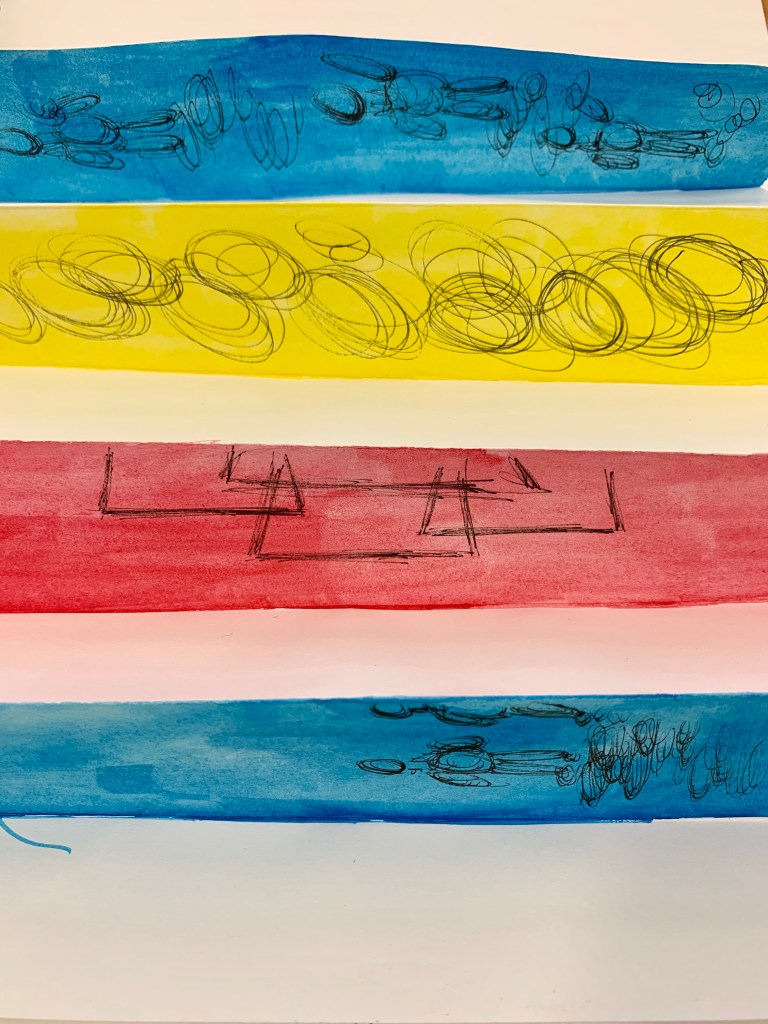
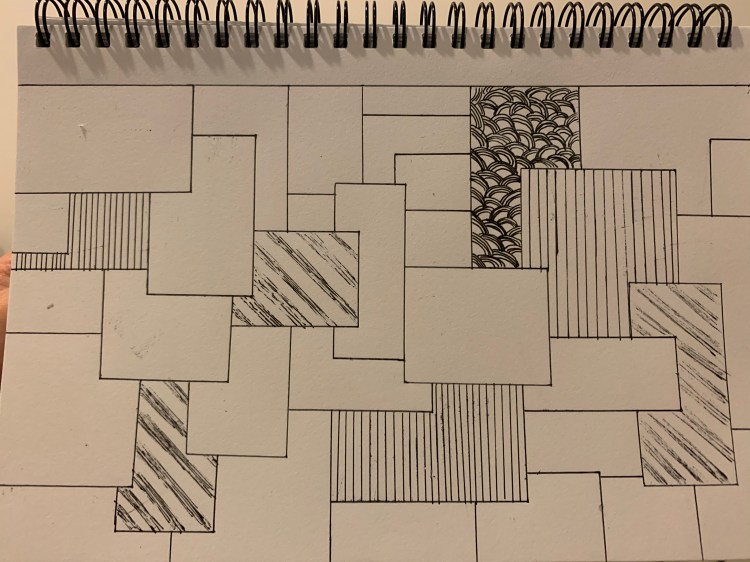
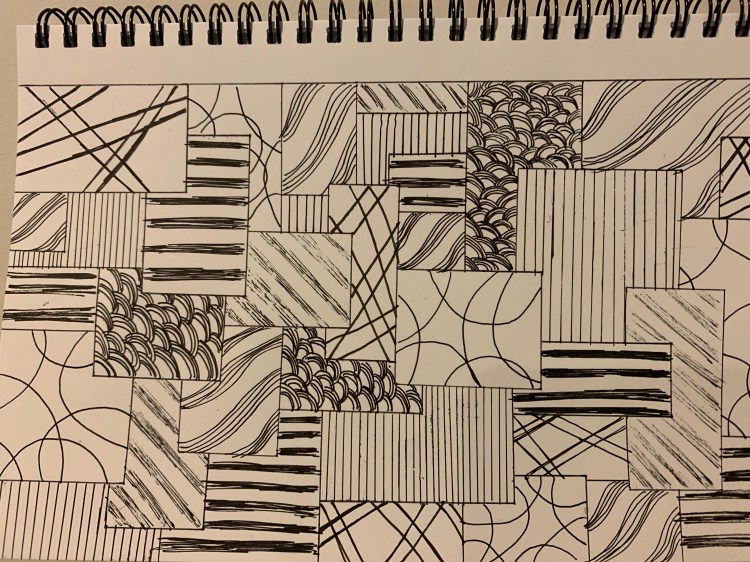
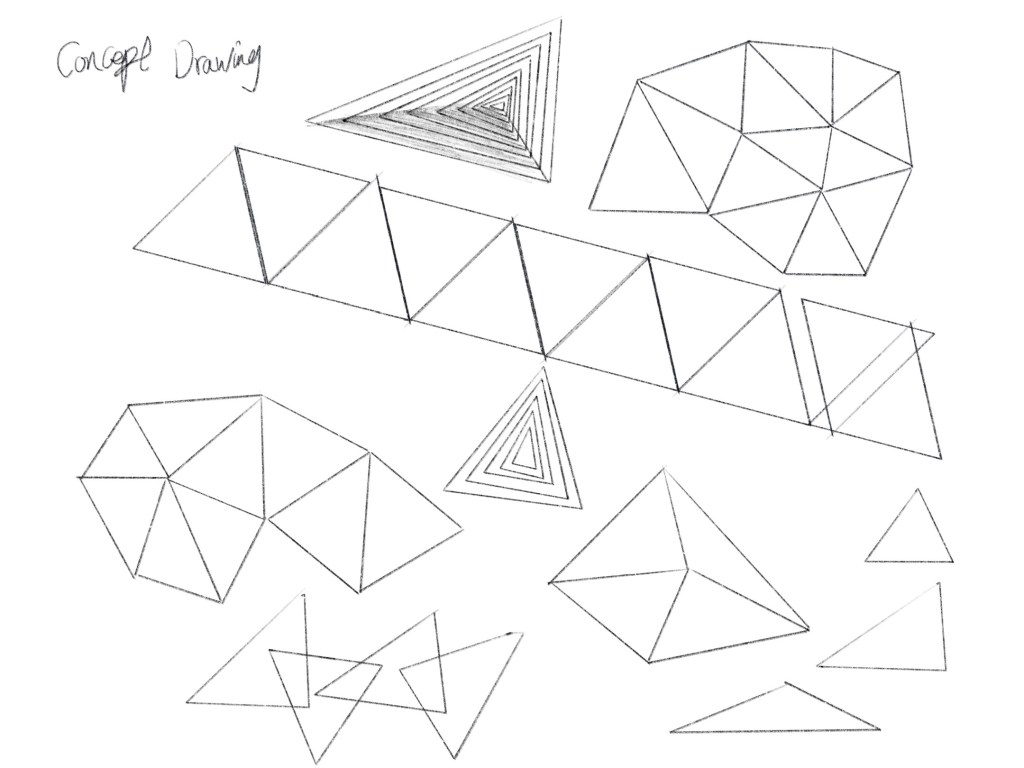
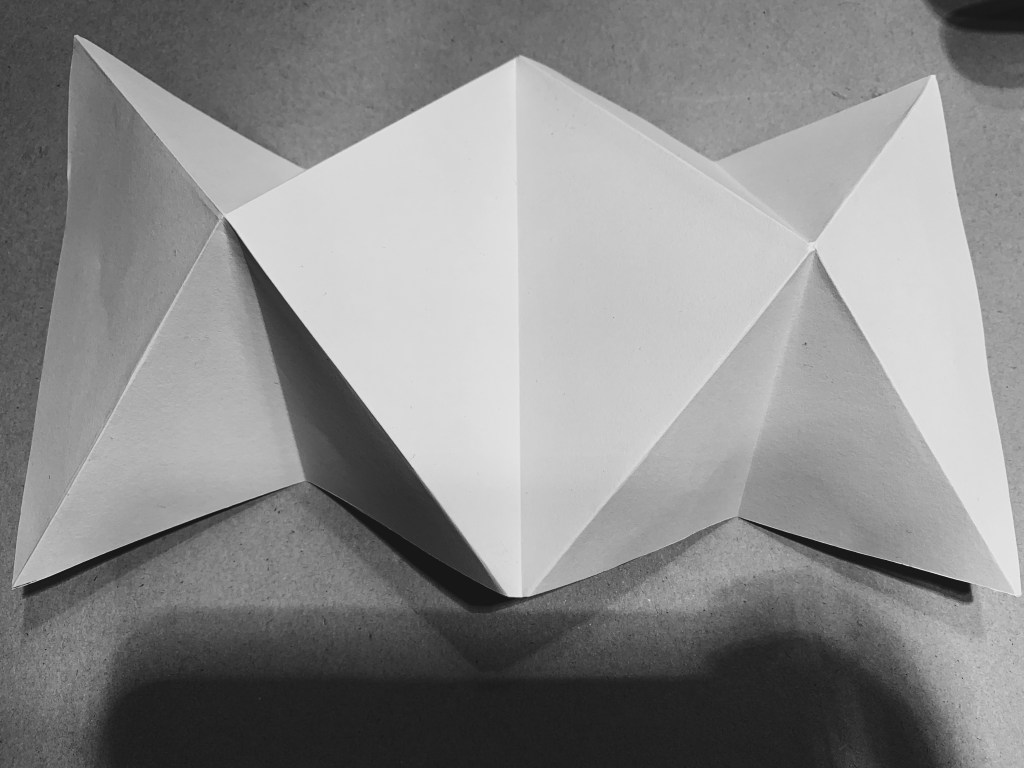
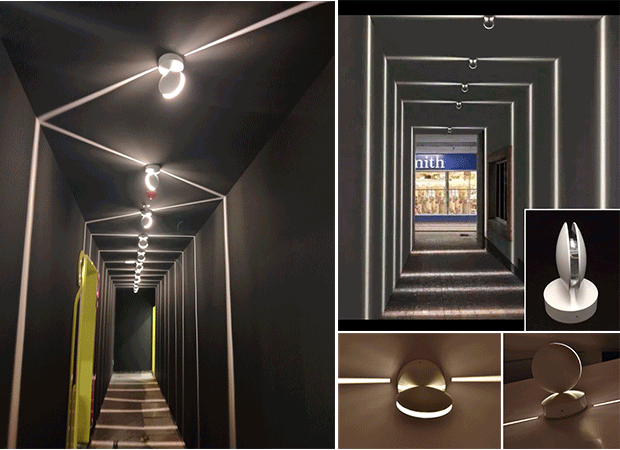
In this scipt, I mainly want people to notice the lines, I think it is very interesting to create with simple lines. Feel the feeling that different lines bring to people.

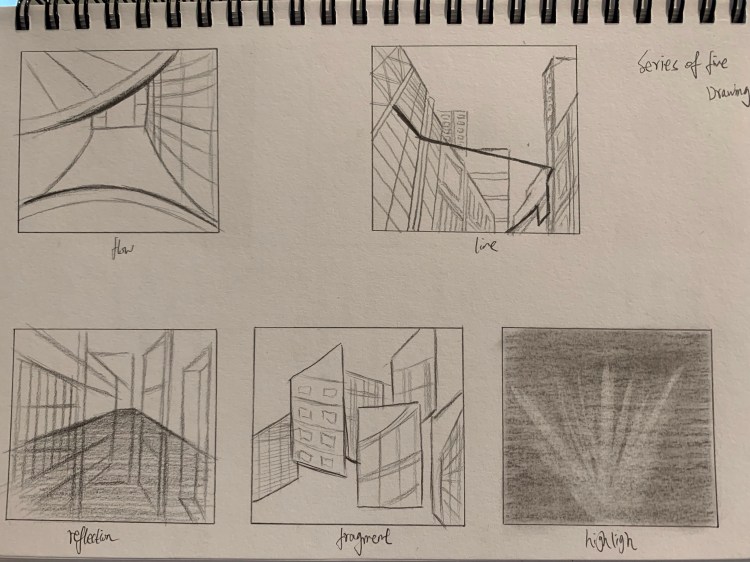
5 Key conceptual terms

Flow

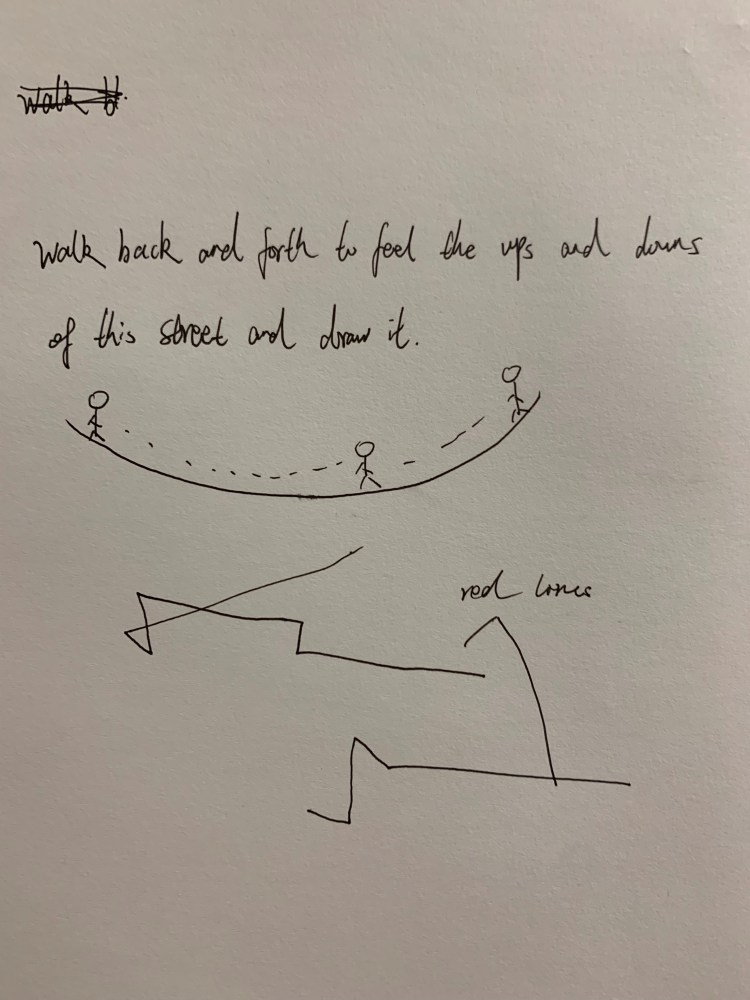
Flow not only refers to the mobility of the crowd, but what impression me is that I feel the undulating lines on this street. The lines on the ground are soft, not only in the external streets, but also in the interior spaces. This reminds me if sea level combined with the historical, I think flow can express this space very well. Whether it is the crowd or the lines in the space, there is a sense of flow.

Line

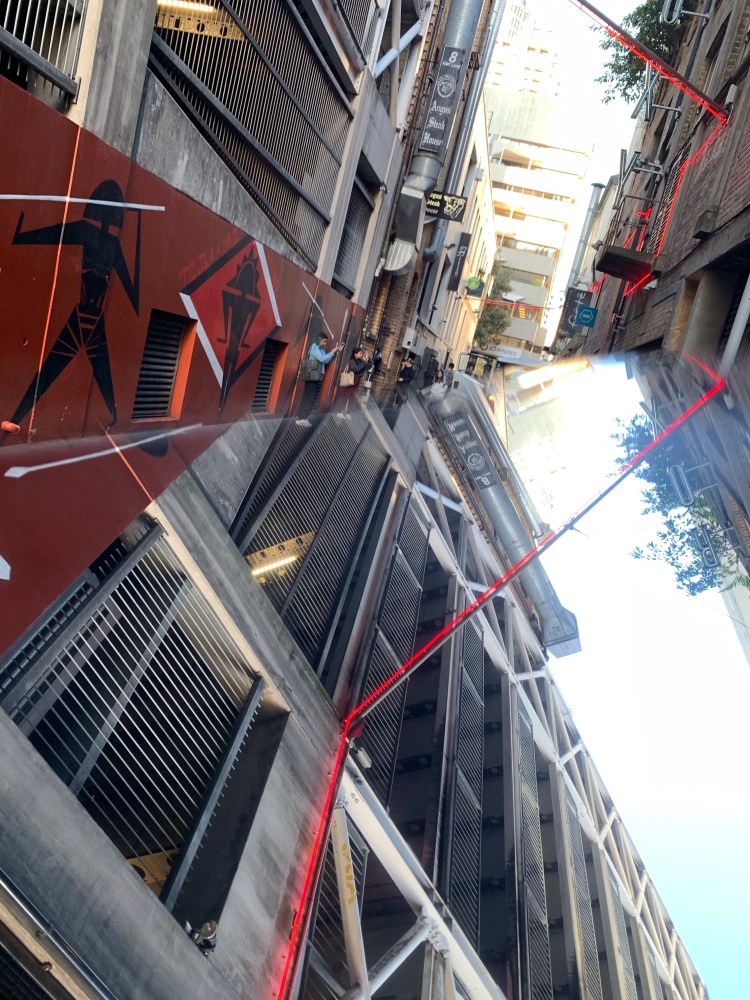
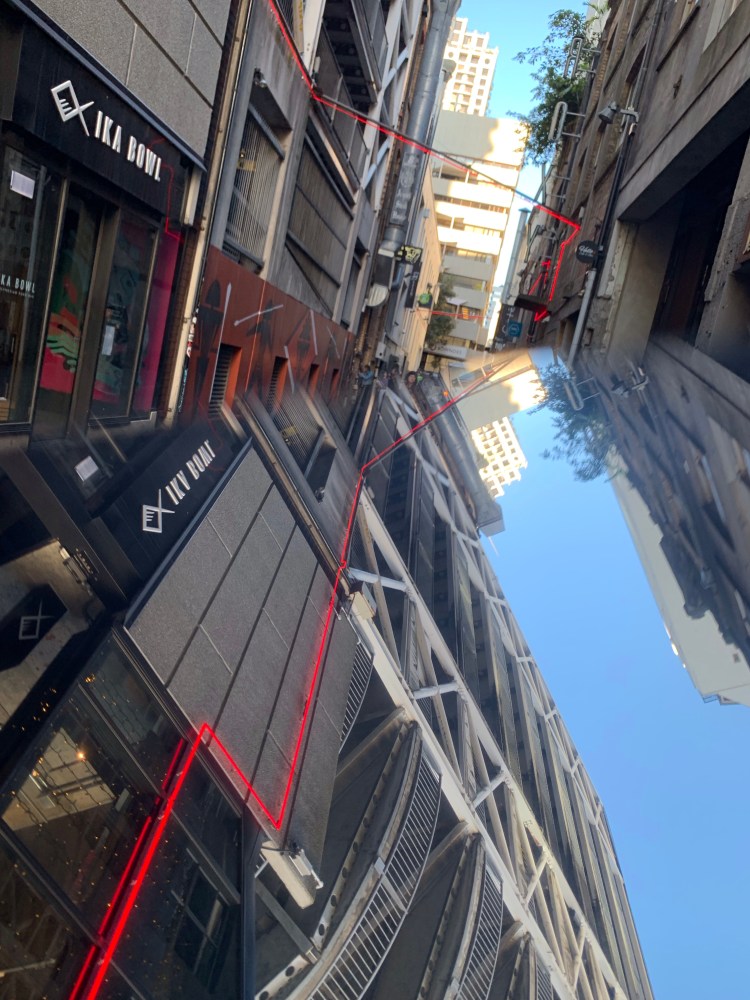
Observing the architecture lines and connecting them together. I found that these lines are very tough. Including the most eye-catching red neon lights in the middle of the street. I like to look at buildings in a fuzzy way. I think these lines are characteristic of this street,so I used a lot of lines in my model. What kind of effect will the combination of the same lines produce?

Reflection

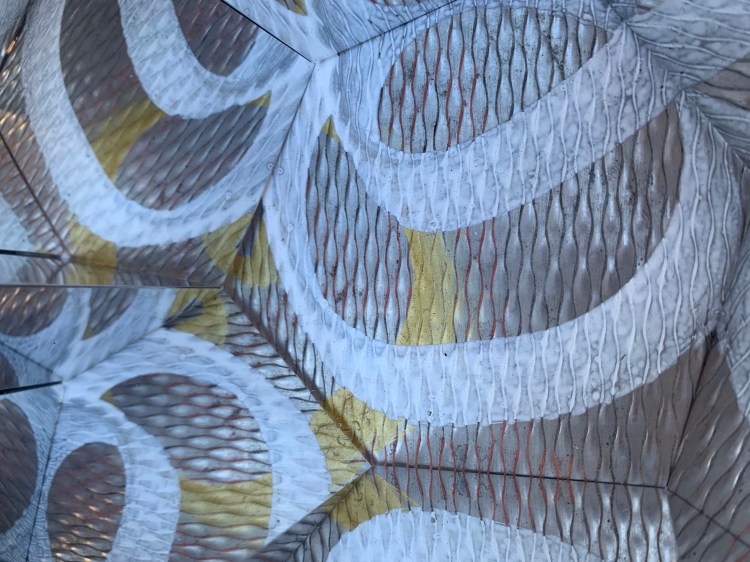
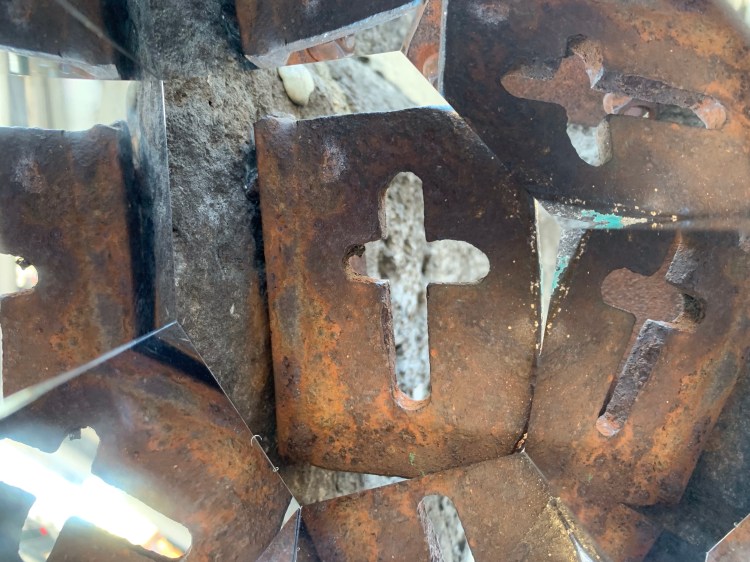
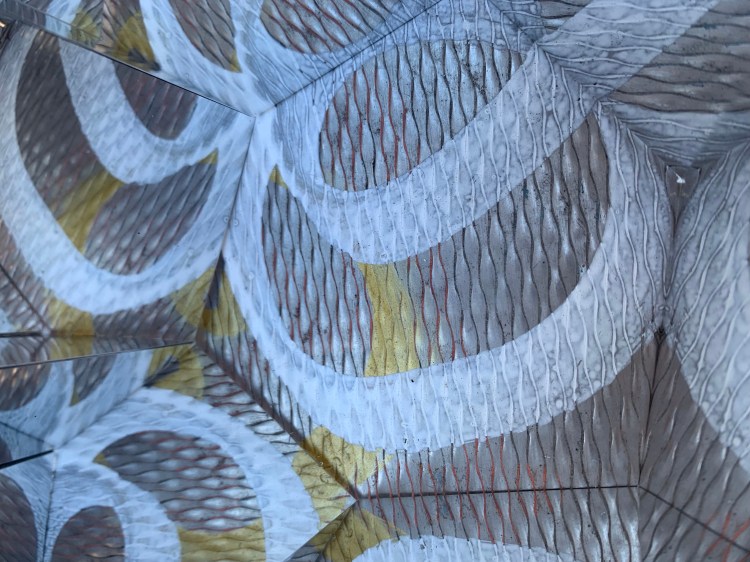
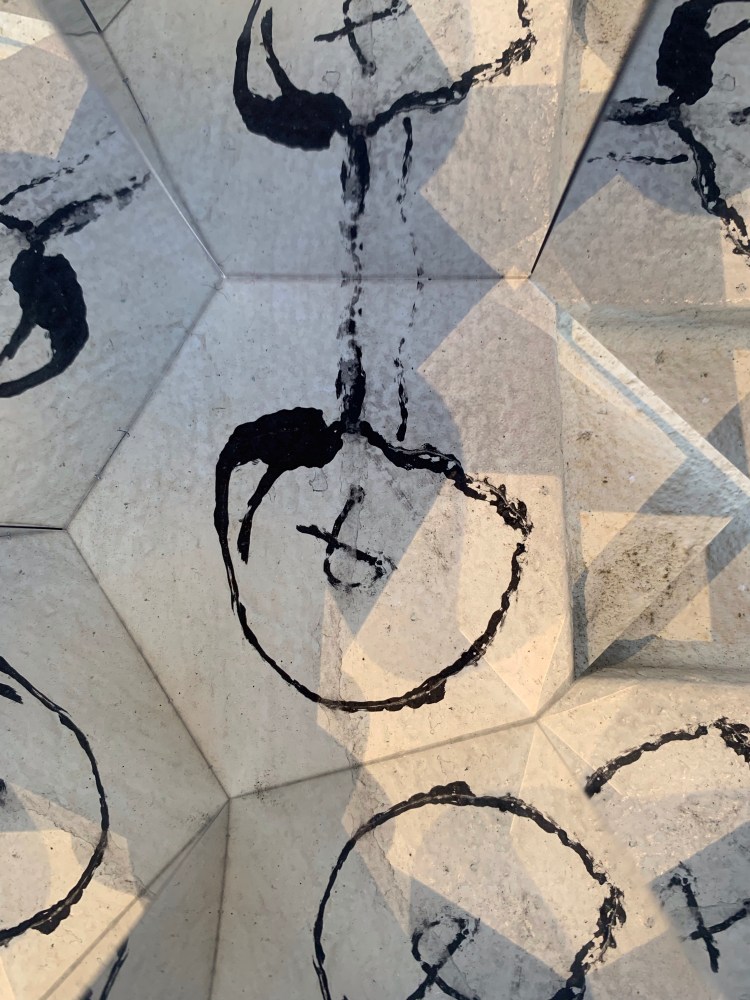
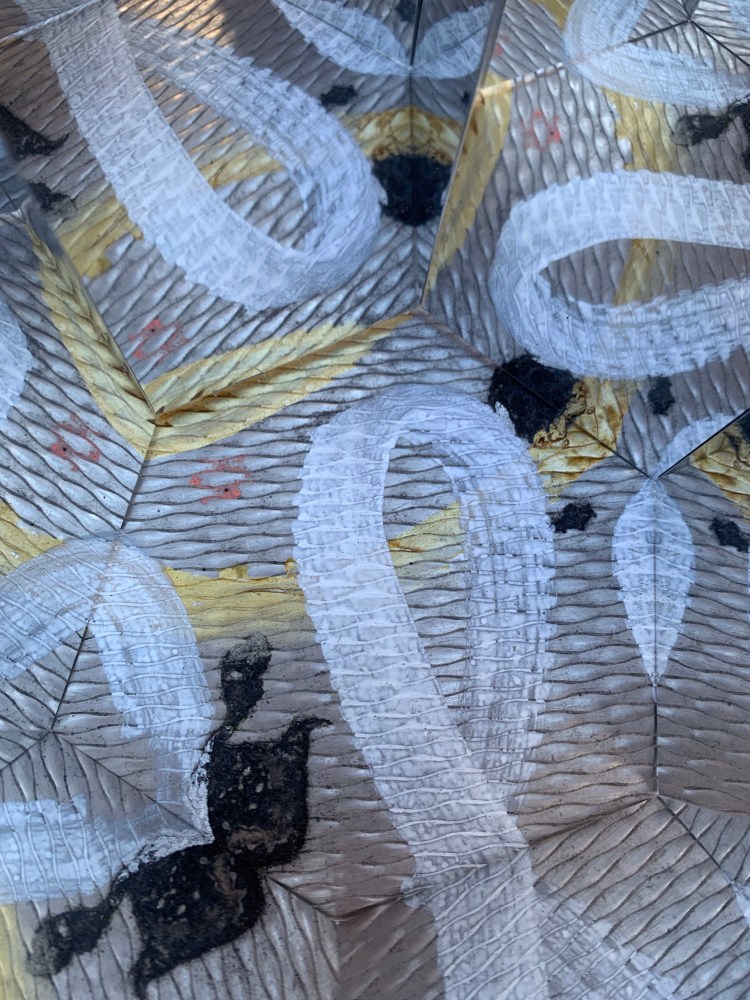
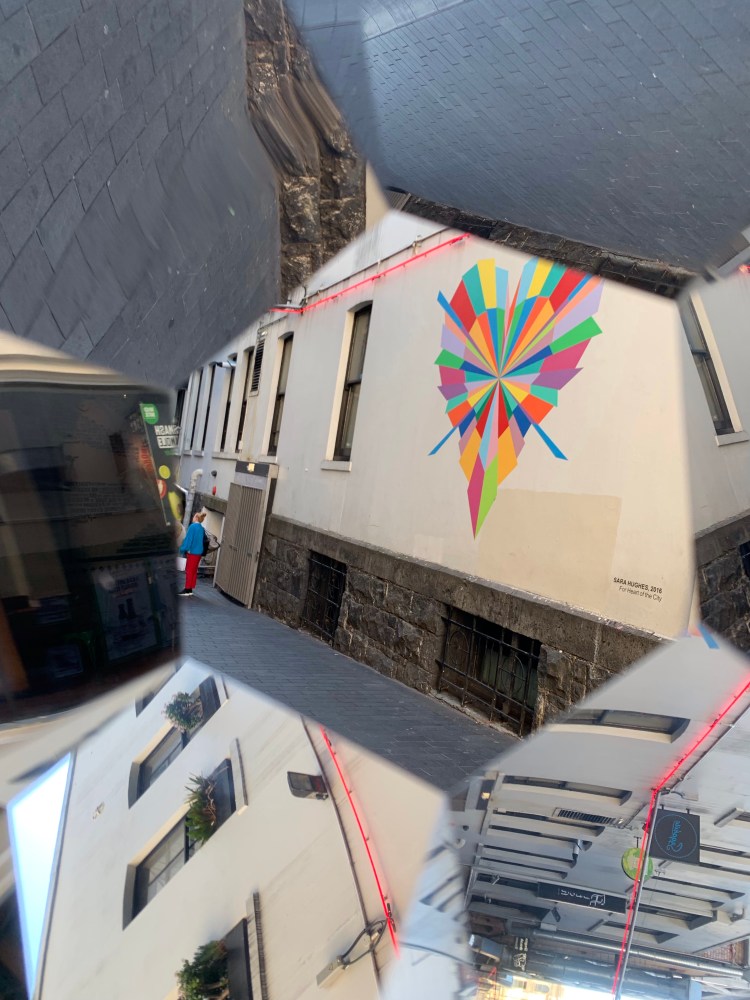
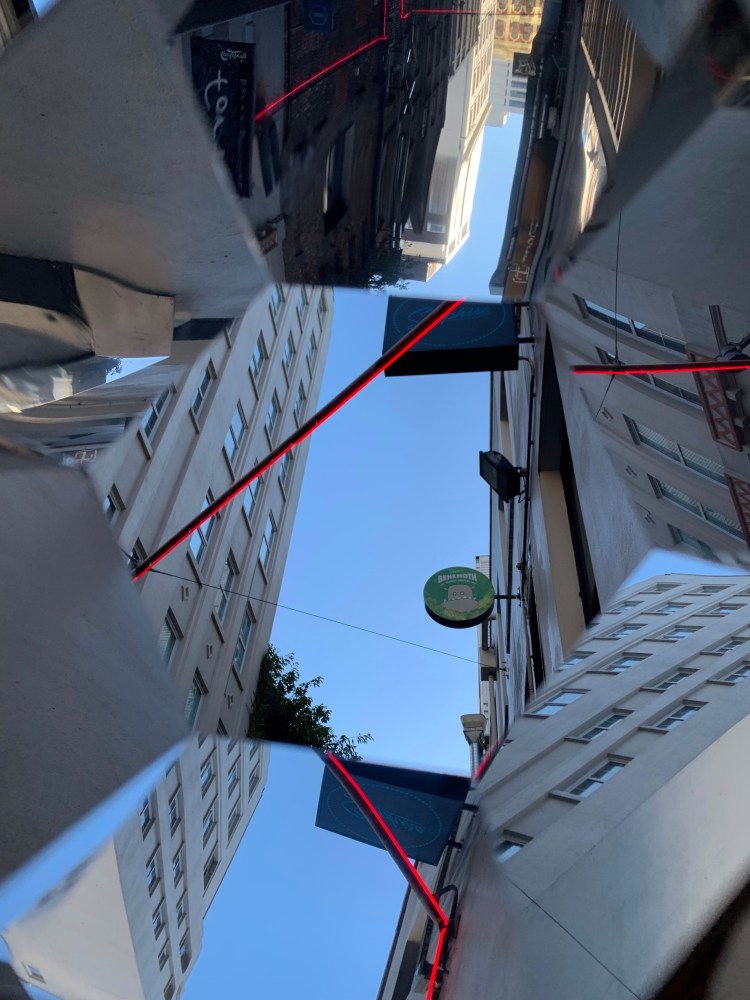
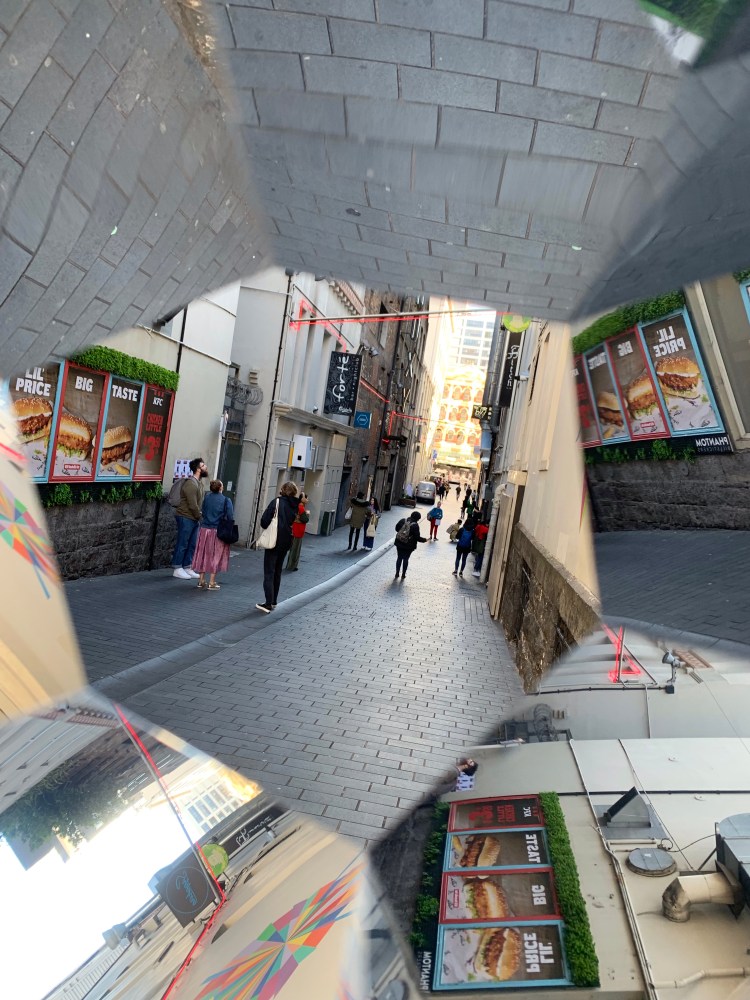
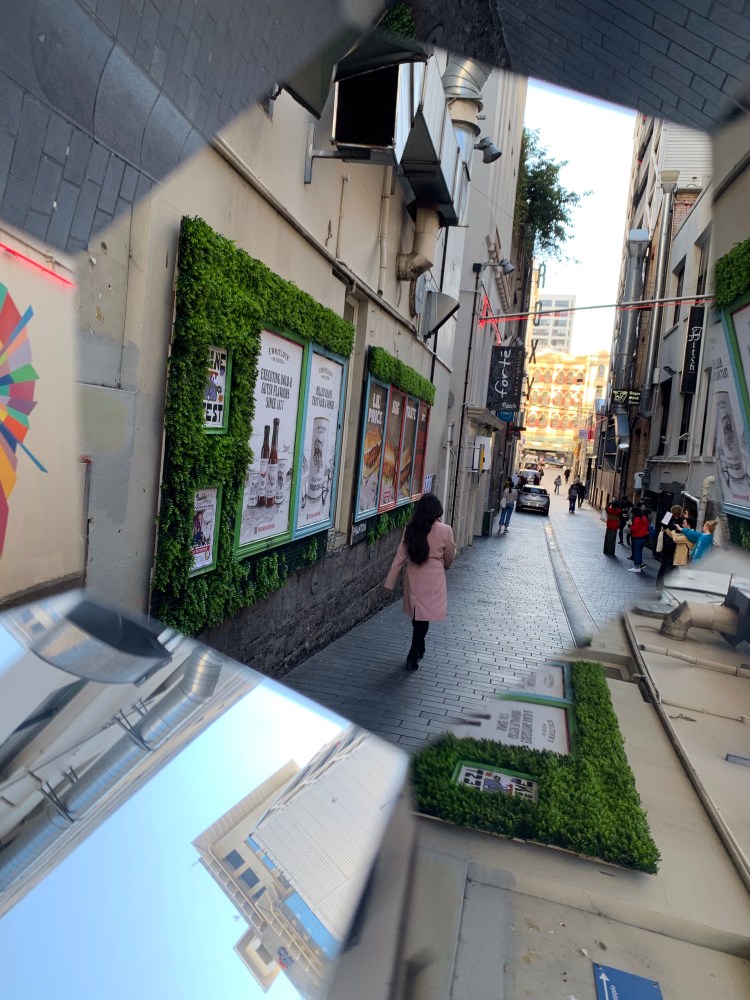
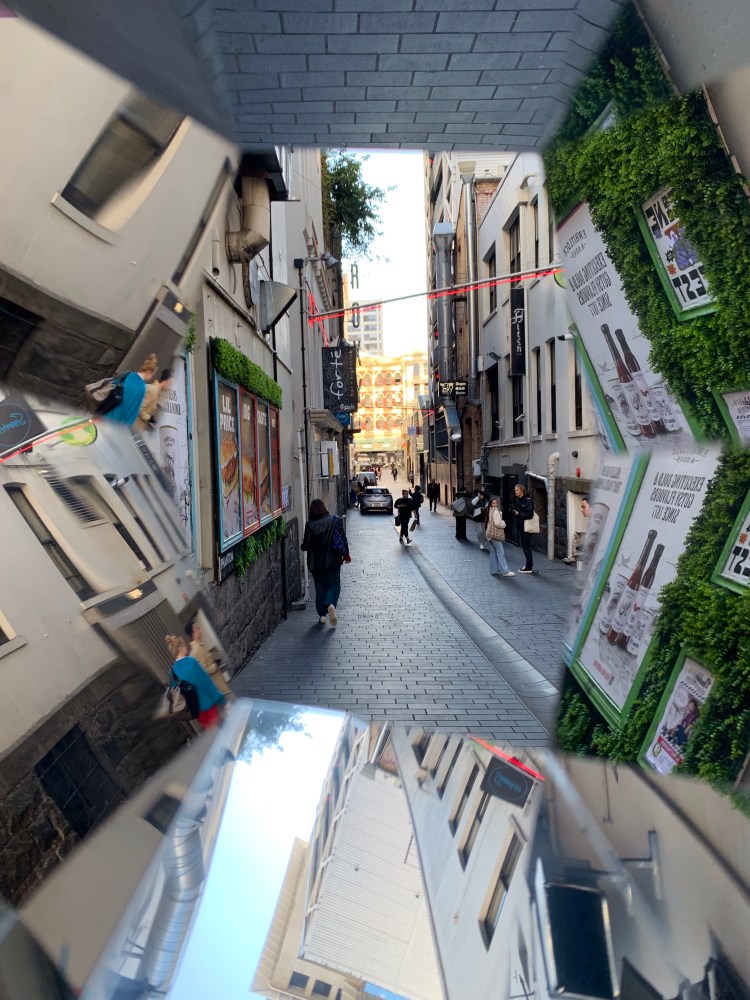
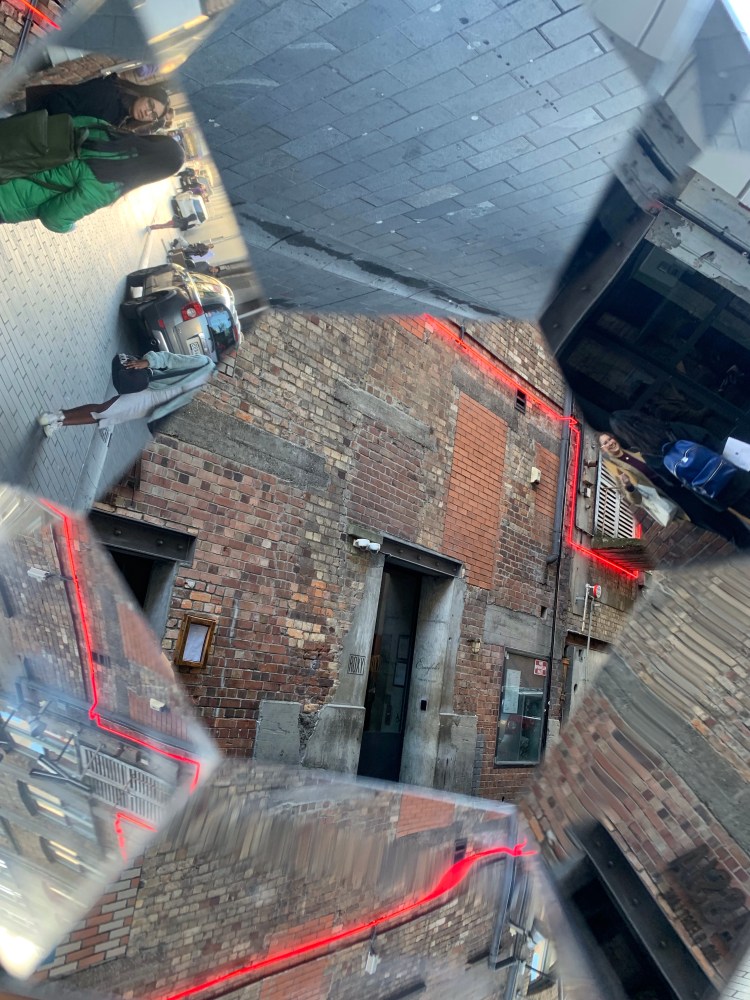
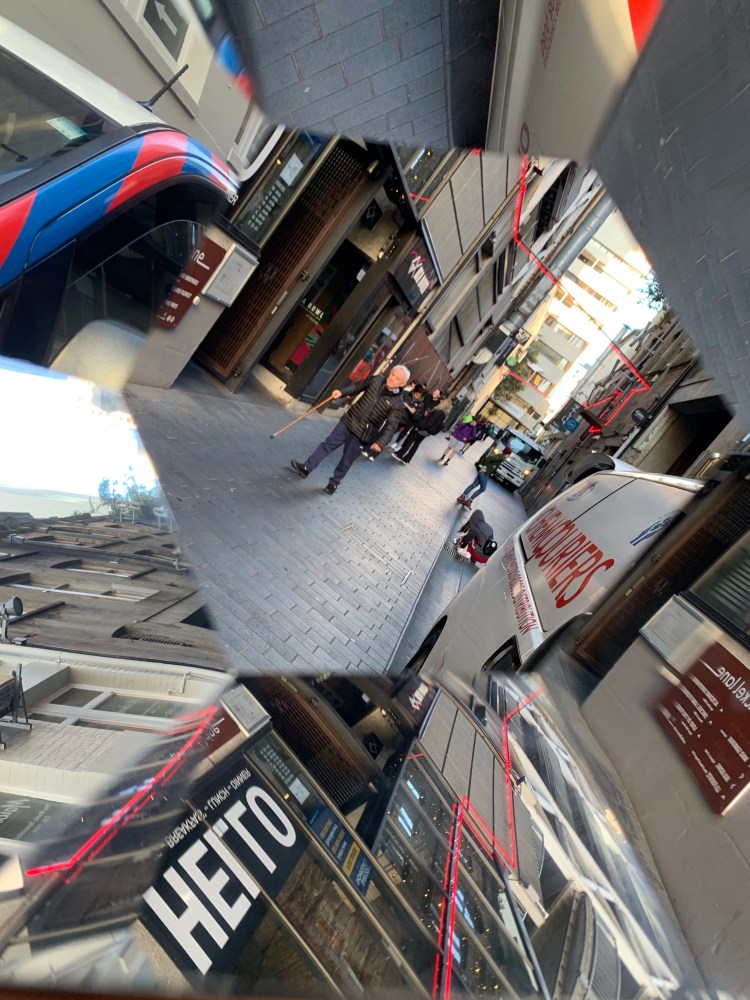
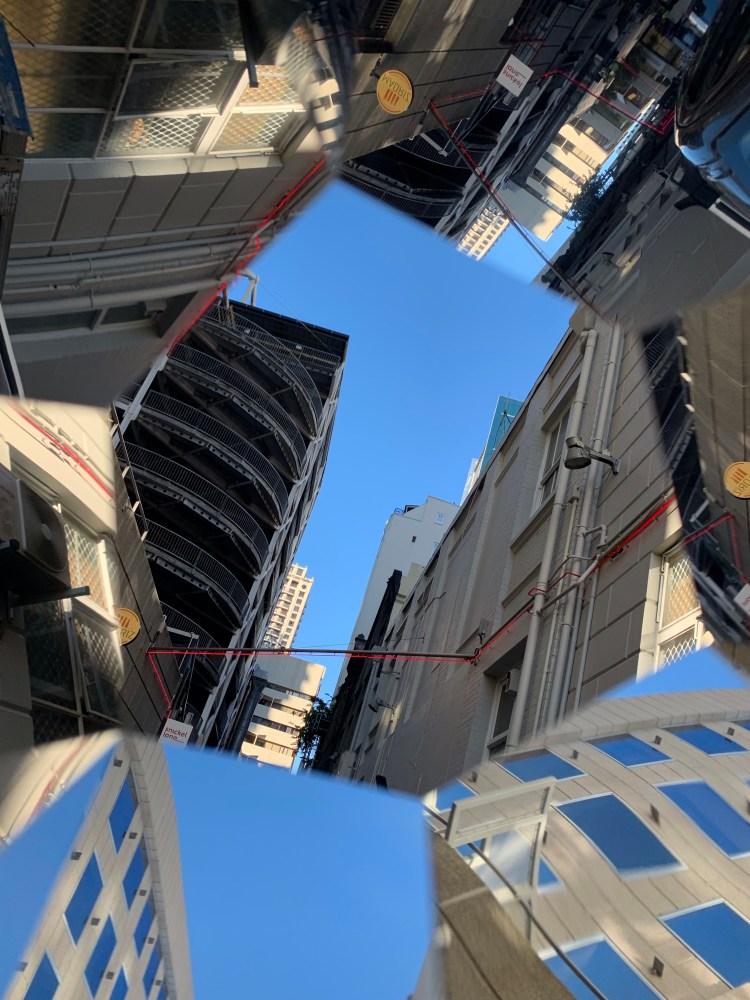
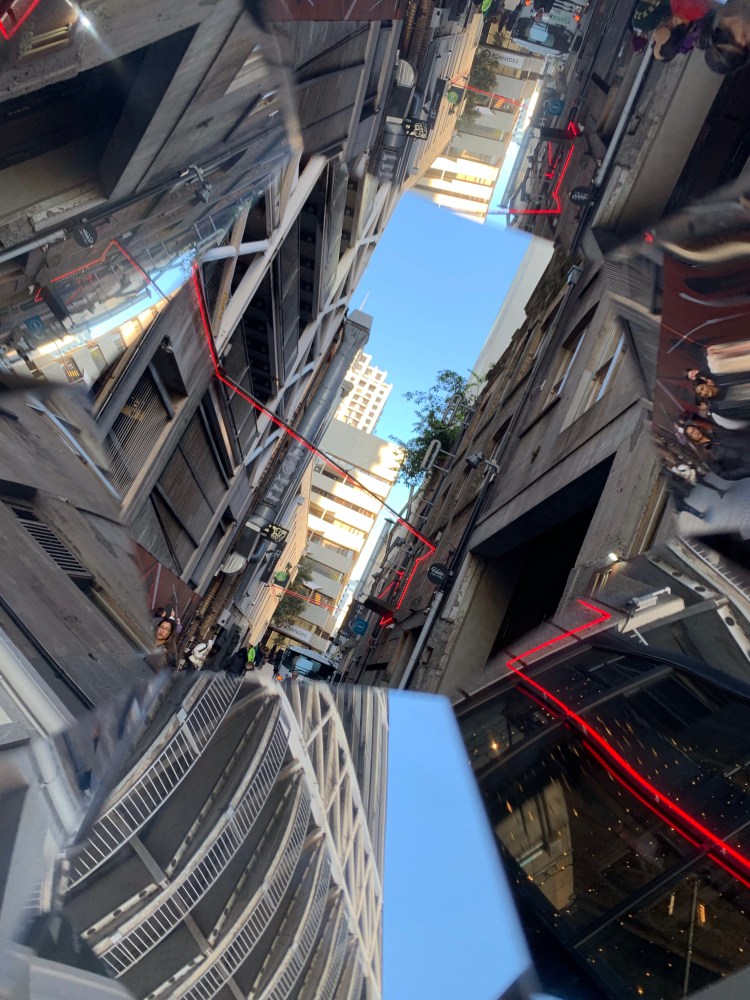
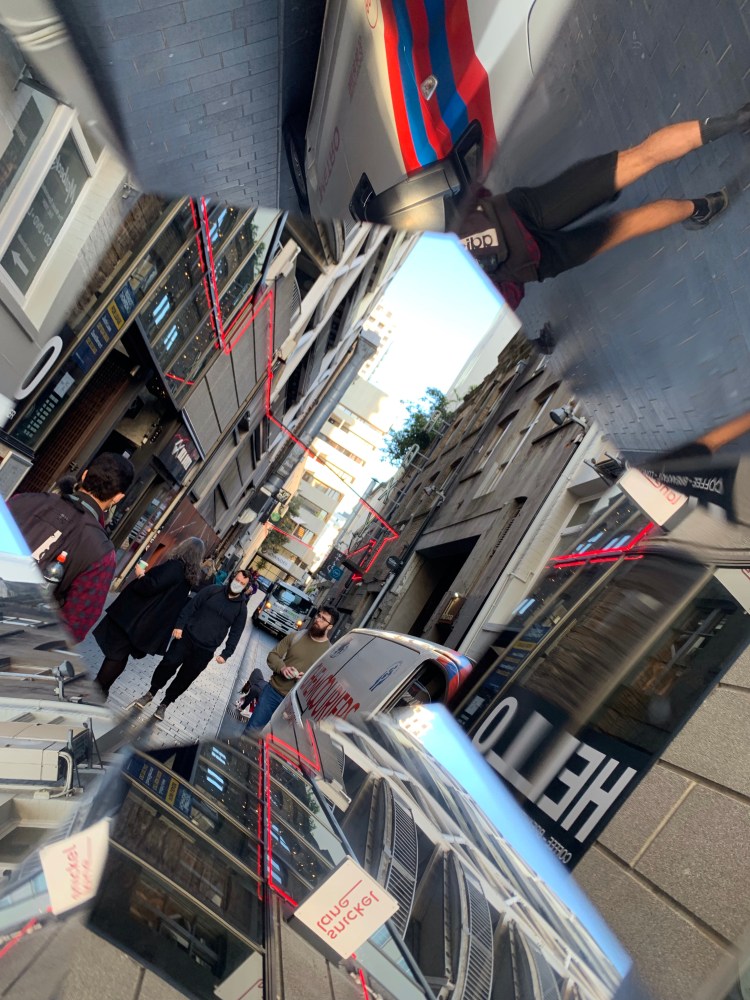
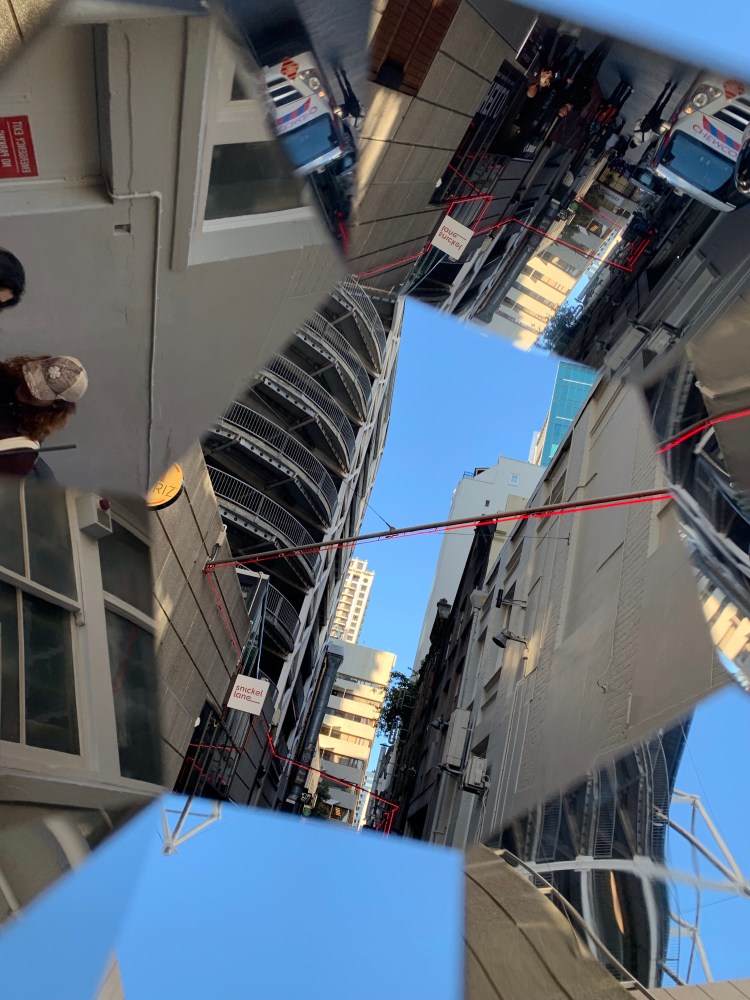
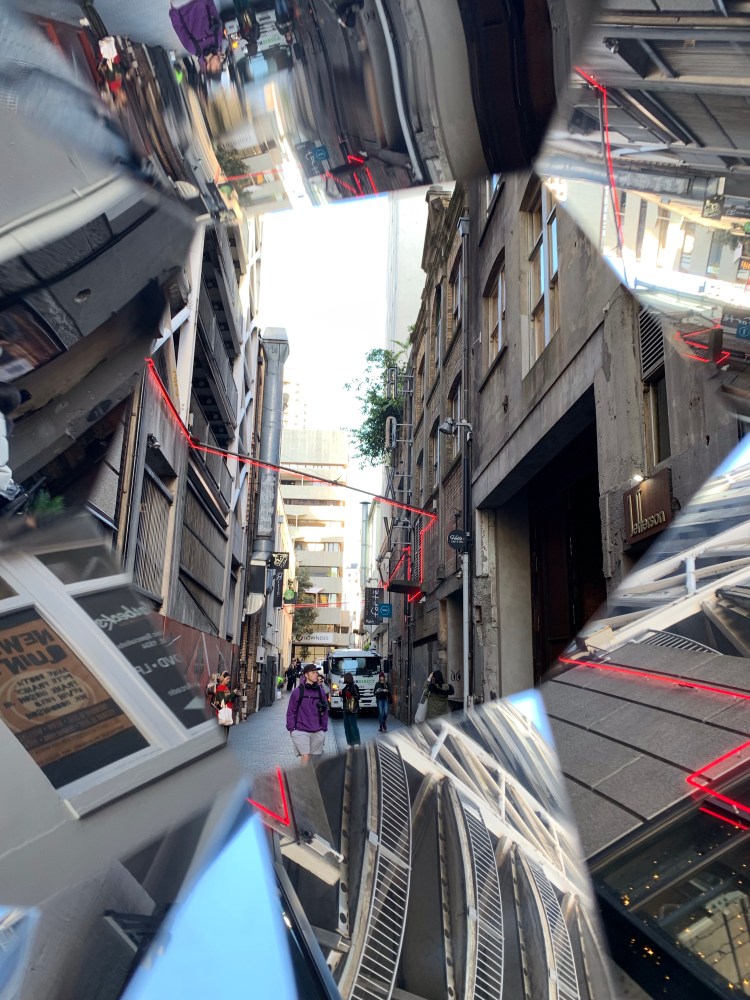
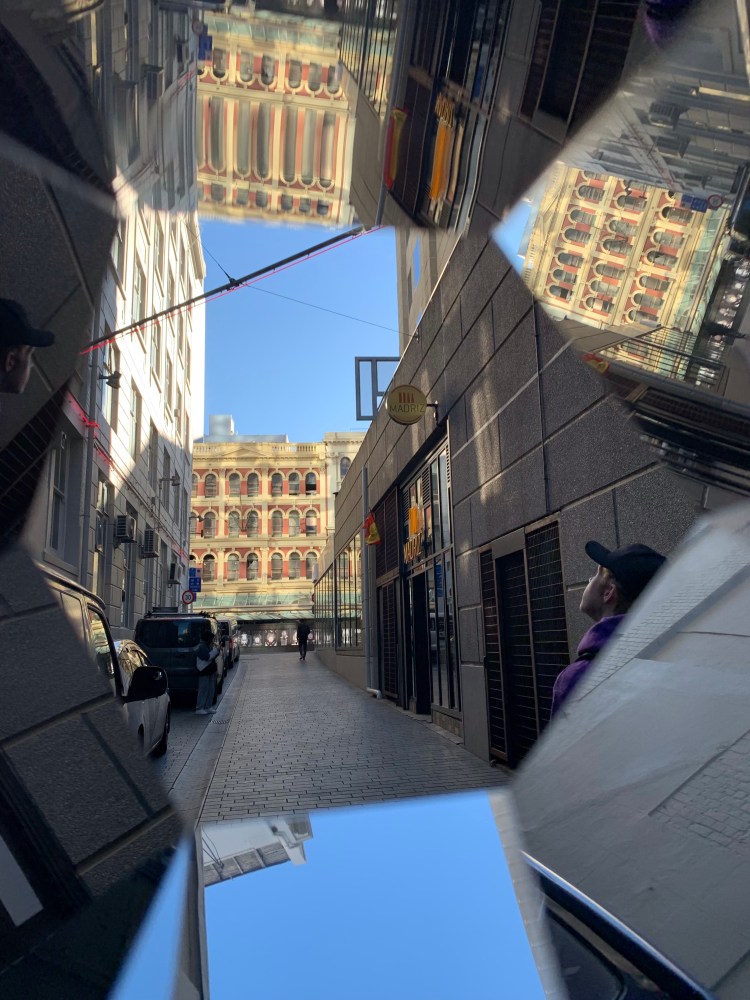
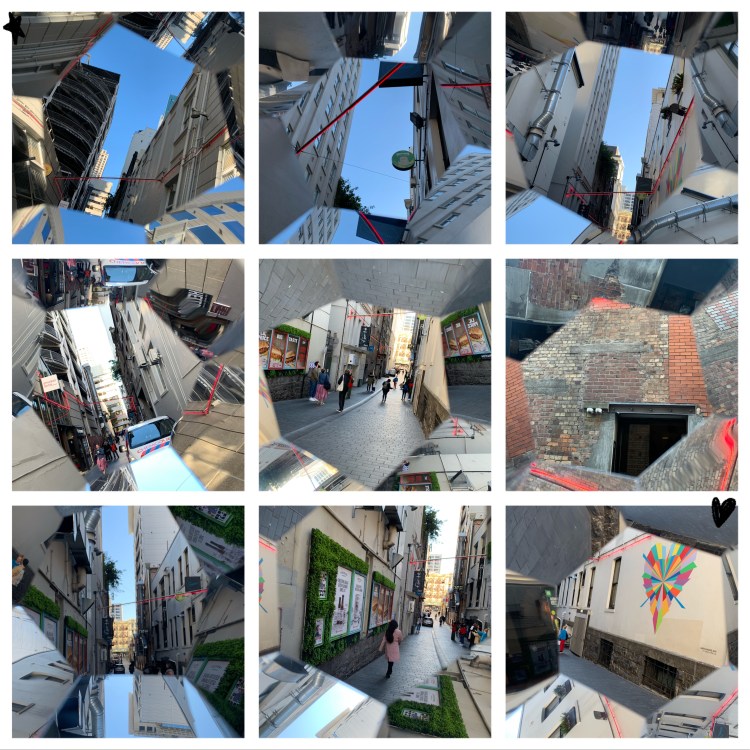
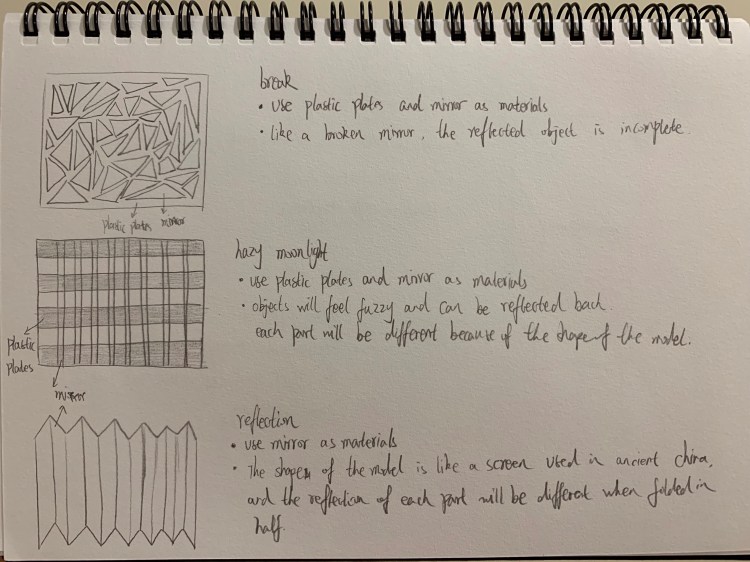
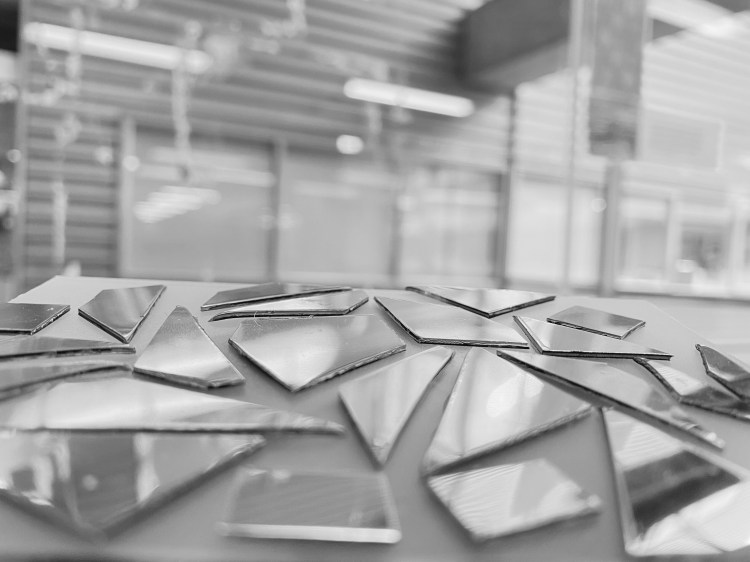
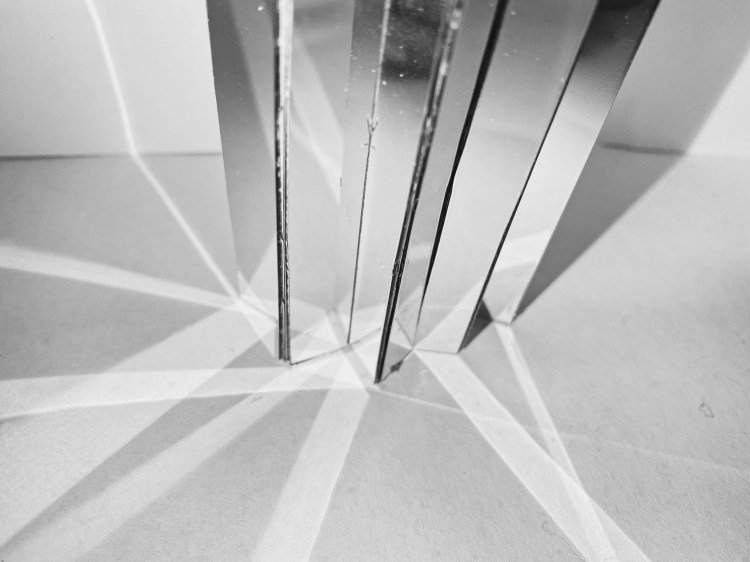
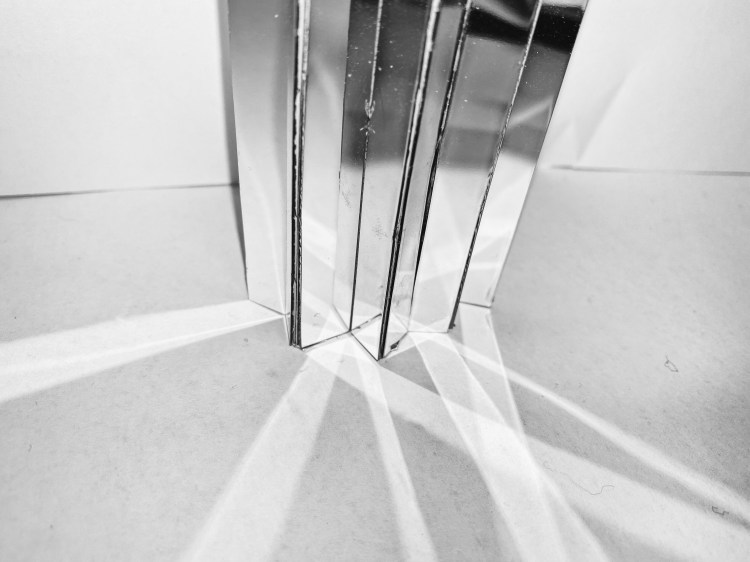
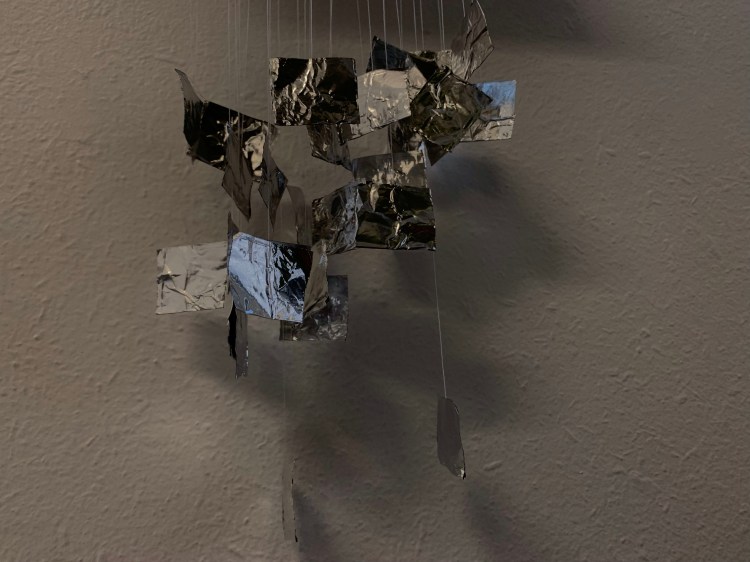
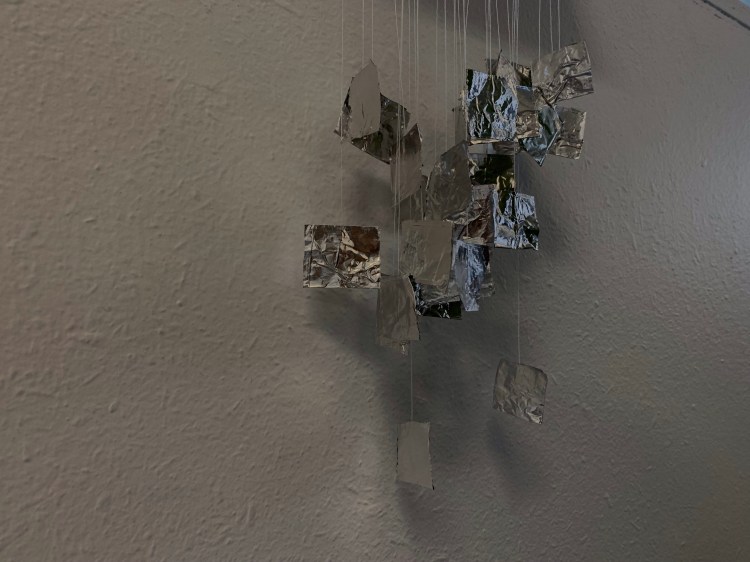
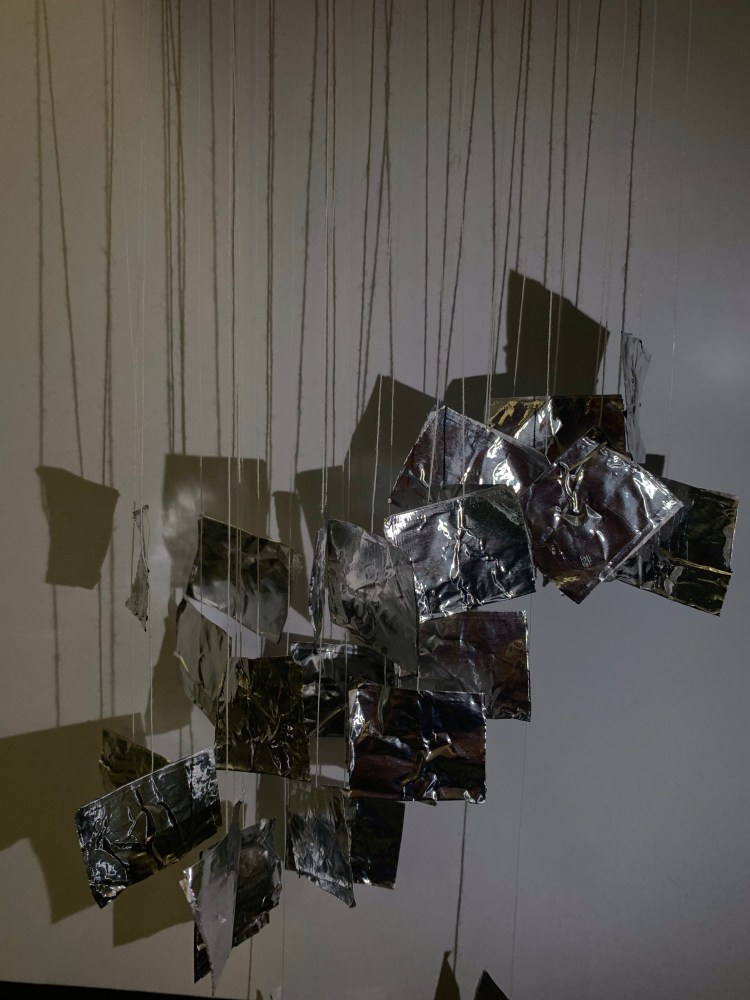
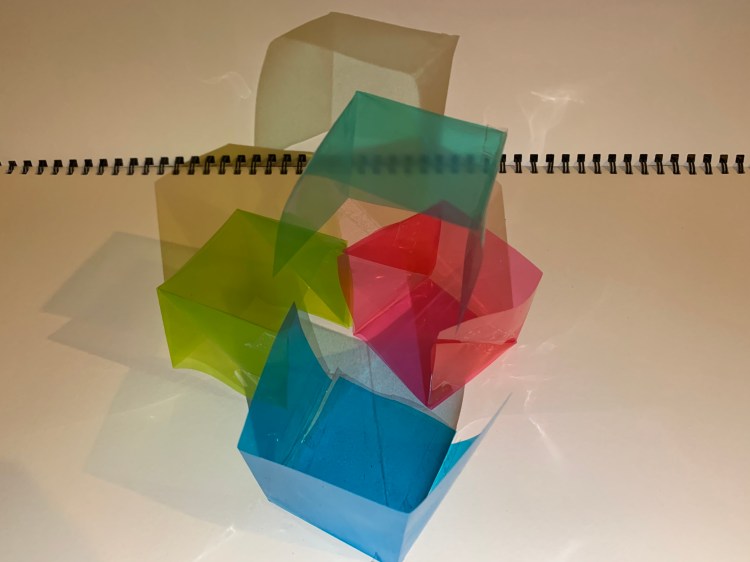
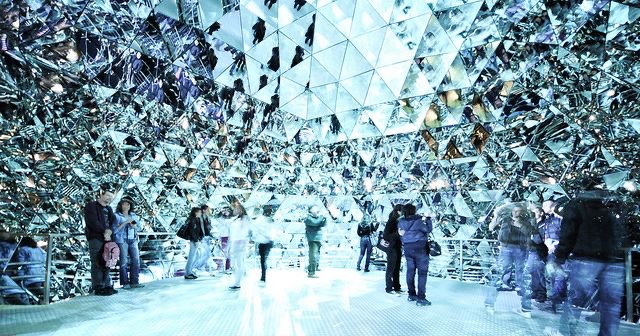
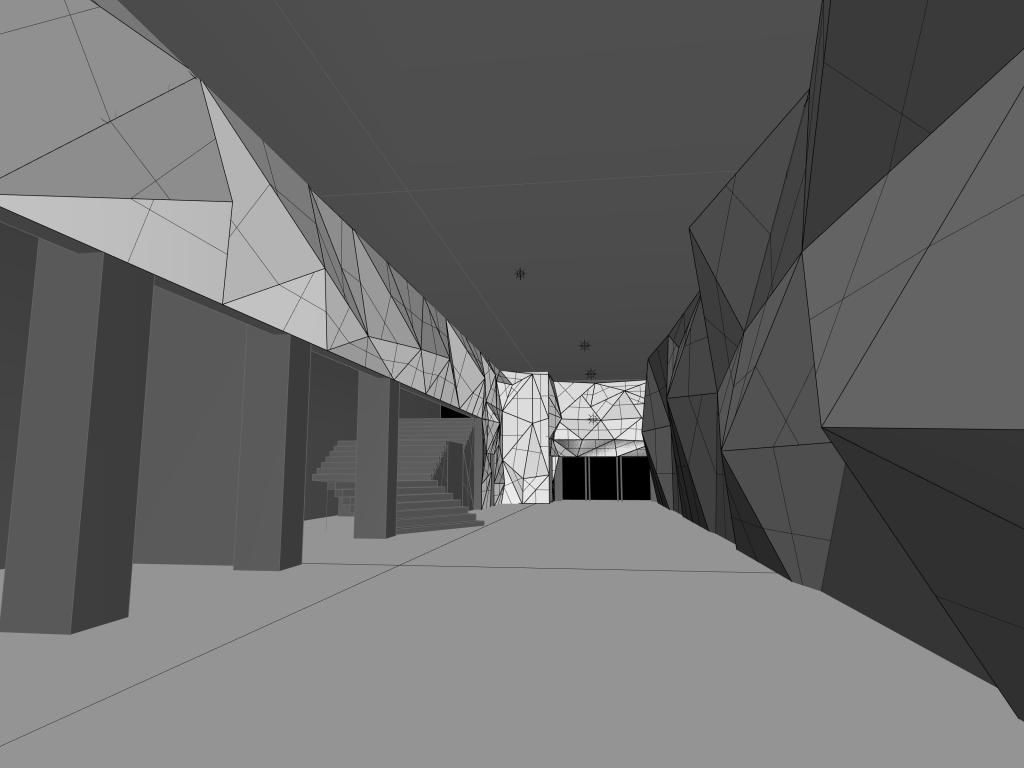
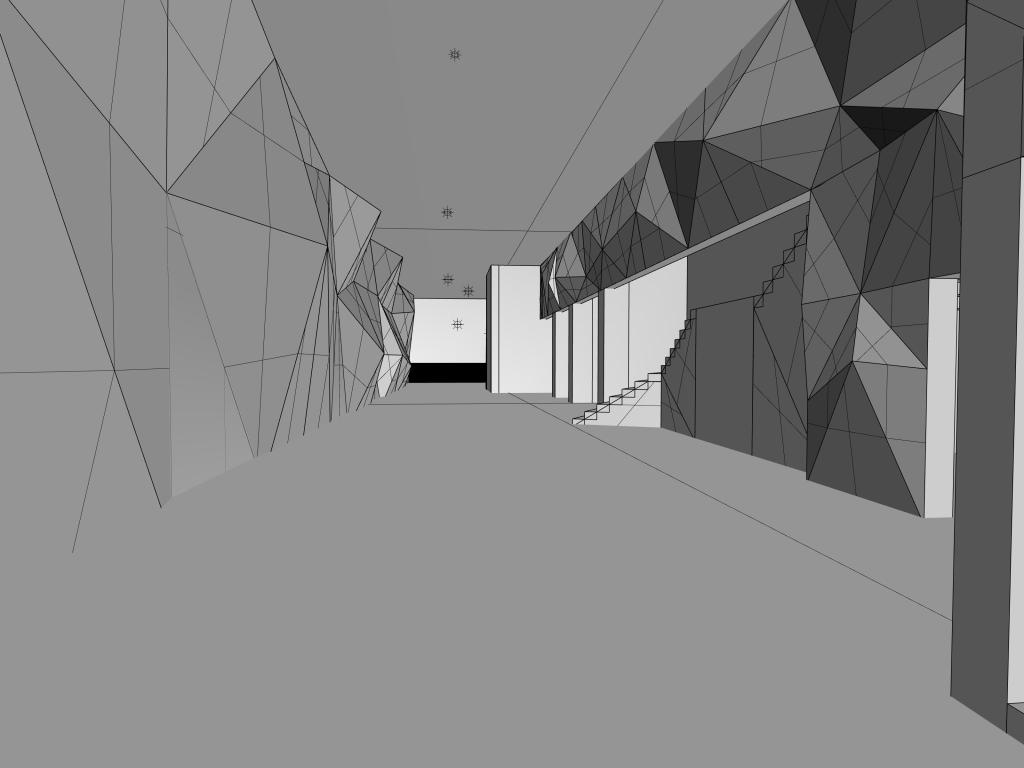
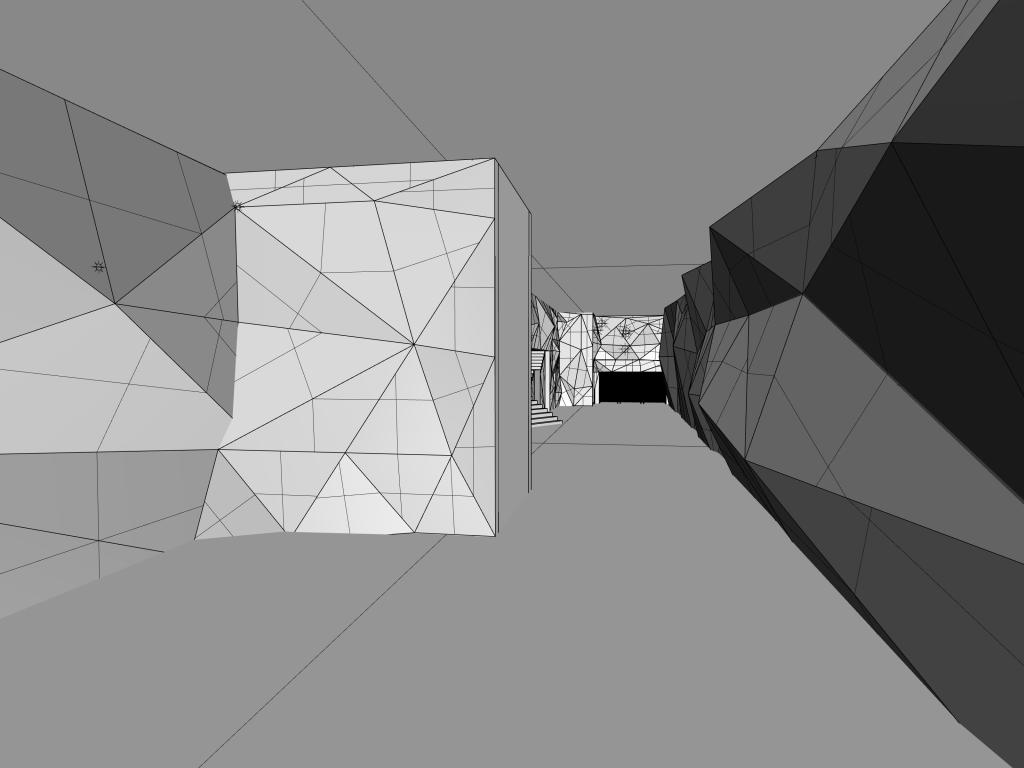
In my first model, I used a mirror as a materials. I made two different models, one is single reflection and the other one is multi-sided reflection. Second is more interesting, although it looks messy and you never know what part of the other sides are reflected. This kind of unknownness is very attractive to me.

Fragment

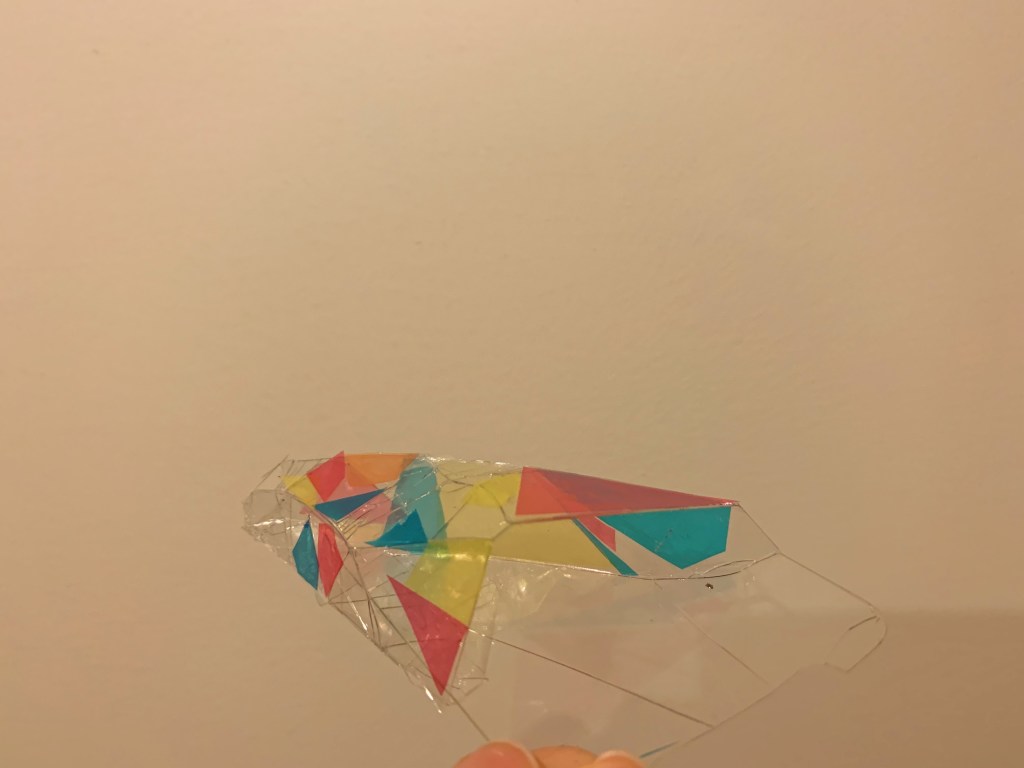
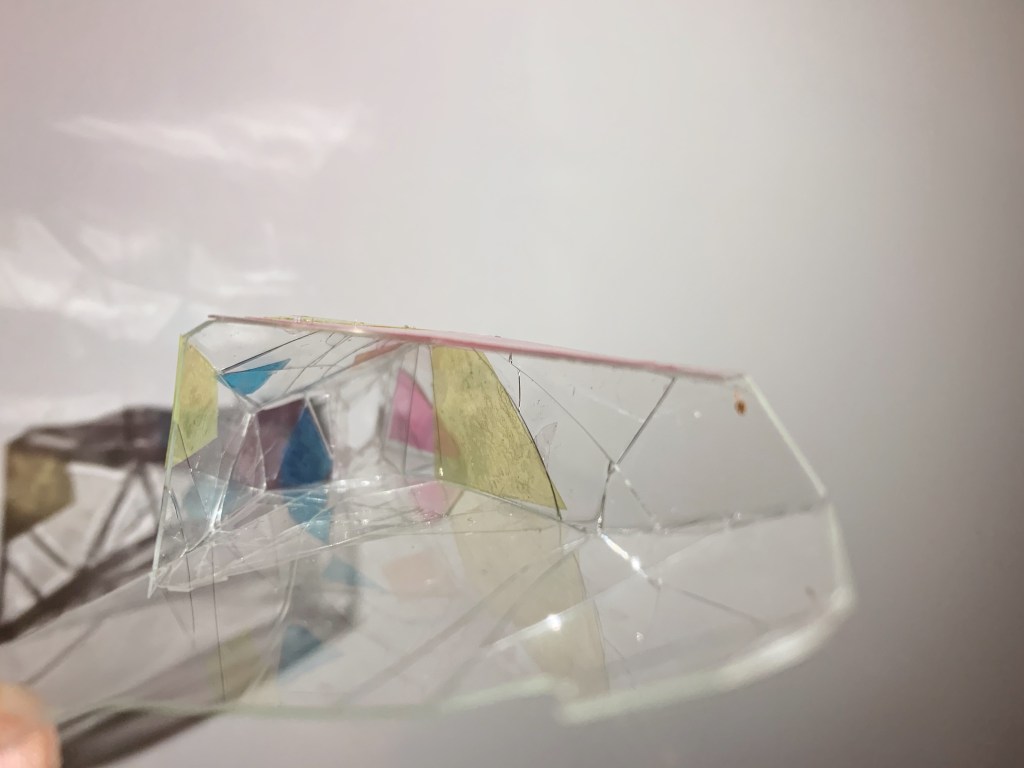
This words comes from the second model. Observing the site from my model, I found that every picture is fragmented. Because I broke the mirror and put it together, so every part is incomplete and the reflected object has only one part. Maybe a window, a door, a line, etc. Just like human memory, the memory of a place maybe food, history, humanities, experience,etc.

Highlight

Sometimes highlight an important, conspicuous, memorable, or enjoyable event, scene, part. It’s easy to find highlight in my models and photos. It’s like the sun shining on the surface of the sea, shining things always attract people’s attention.

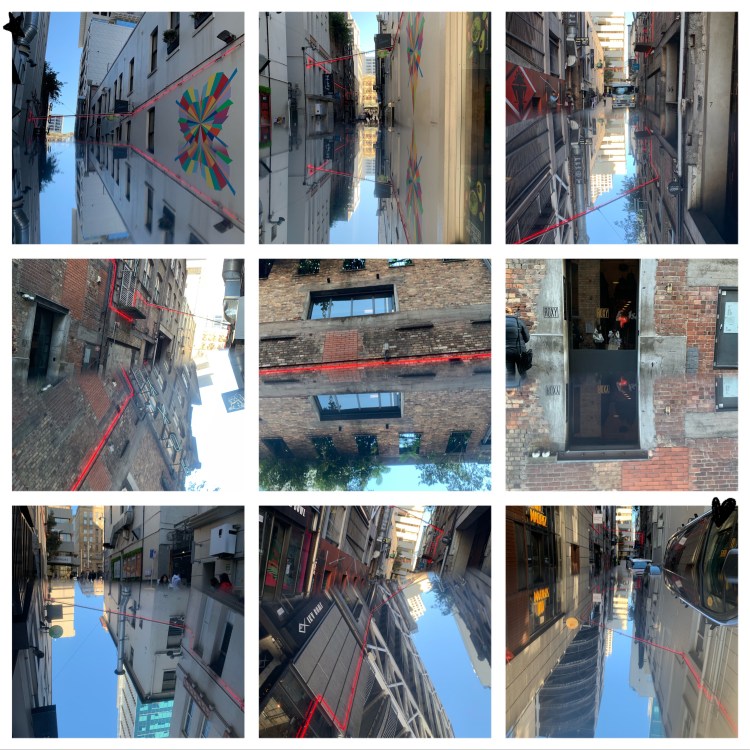
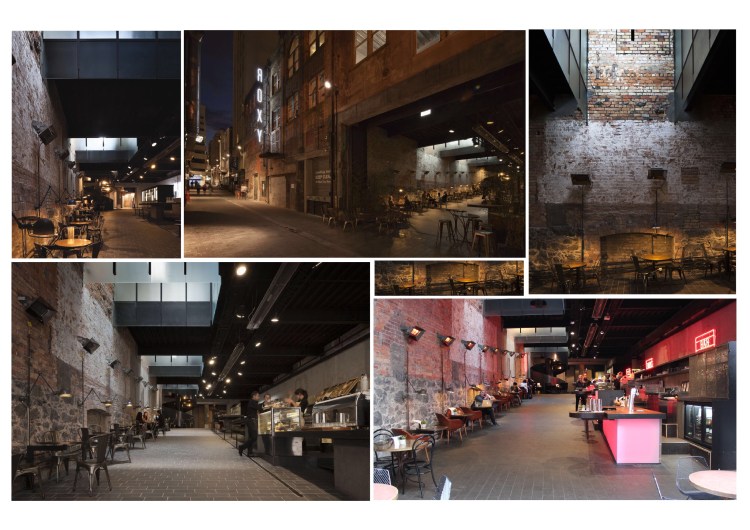
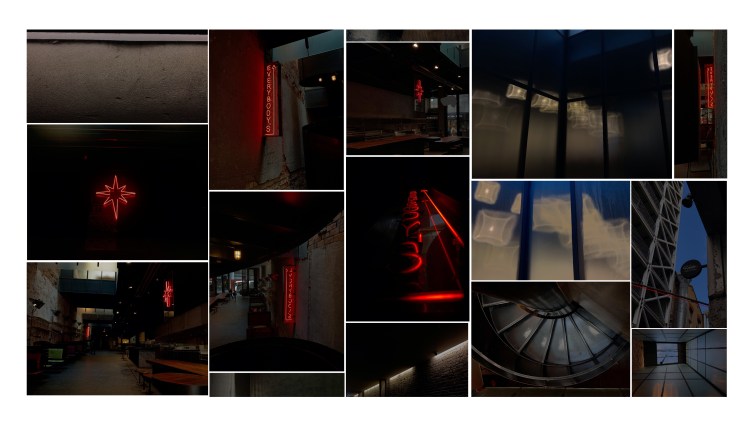
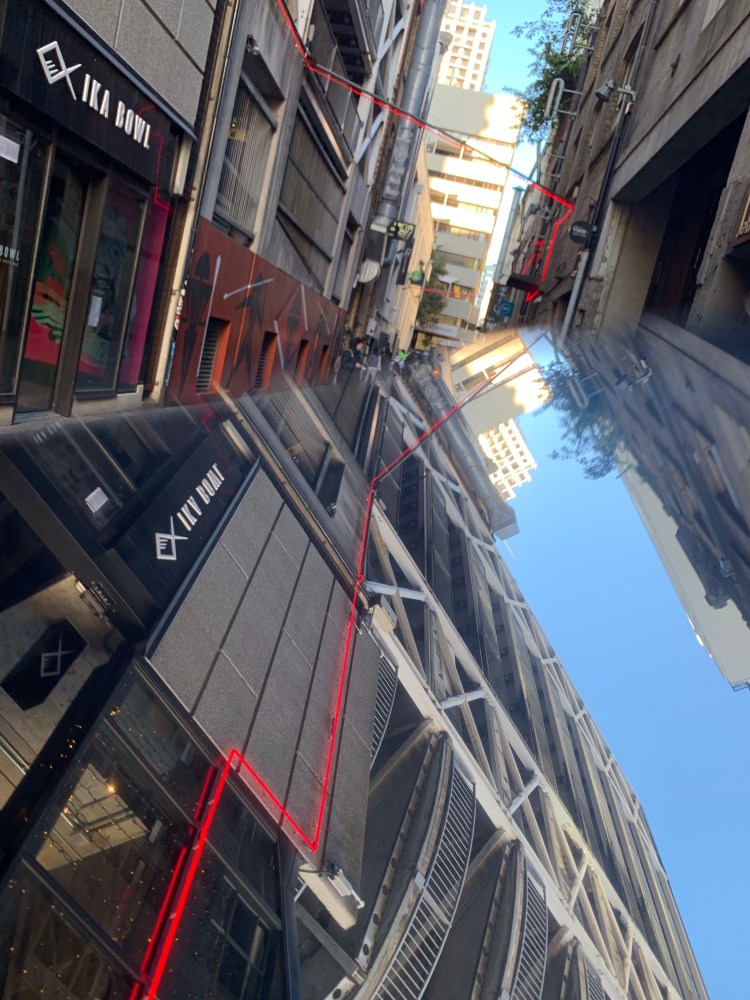
This is a photo taken after retuning to the site again. Carefully observe that each of this group of photos has its own highlight part. The hue is very dark. This is the feeling that this street brings to me, because it is different from the noise of the main street, so it looks particularly dull. So I think the highlight is very important. I want to design the highlight that belongs to this street with its history and story.

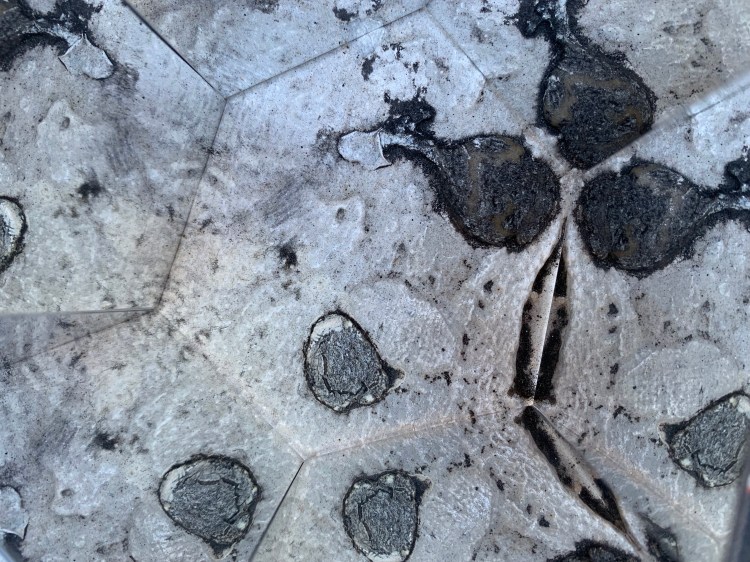
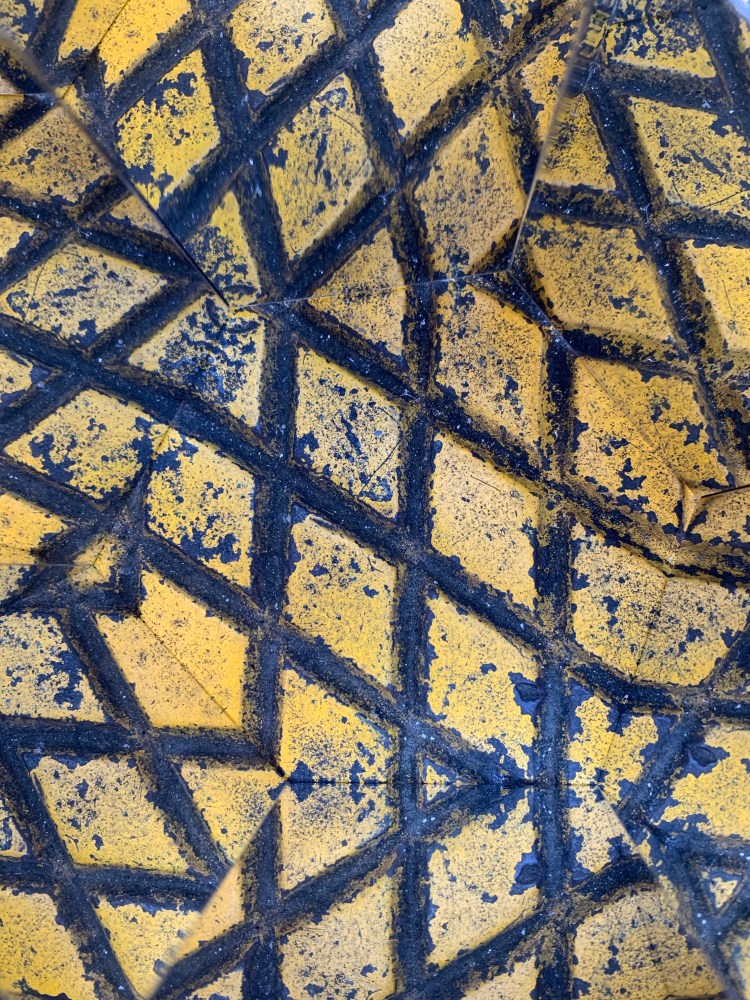
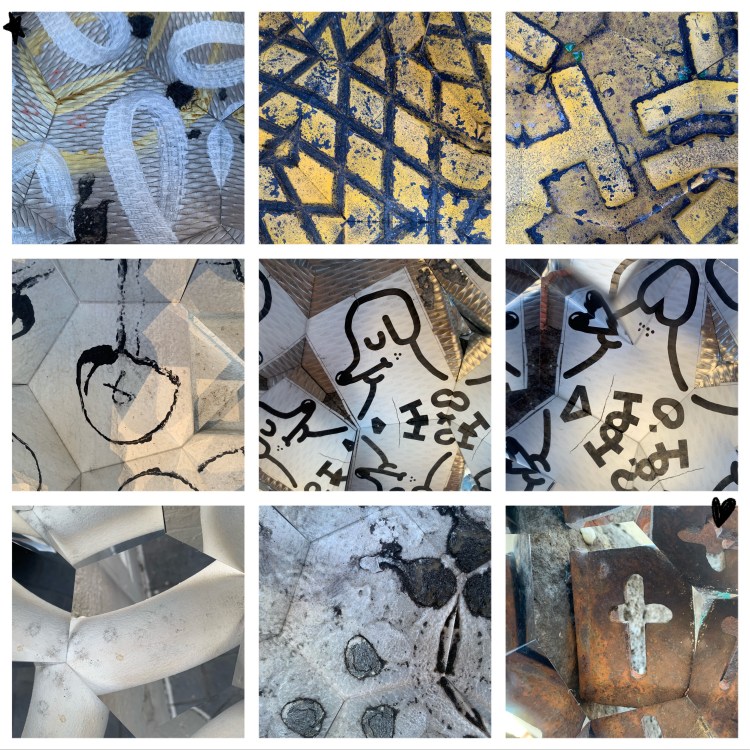
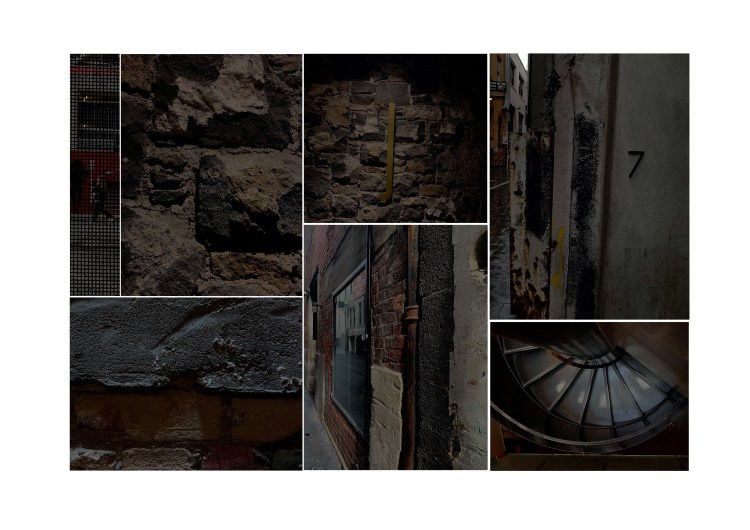
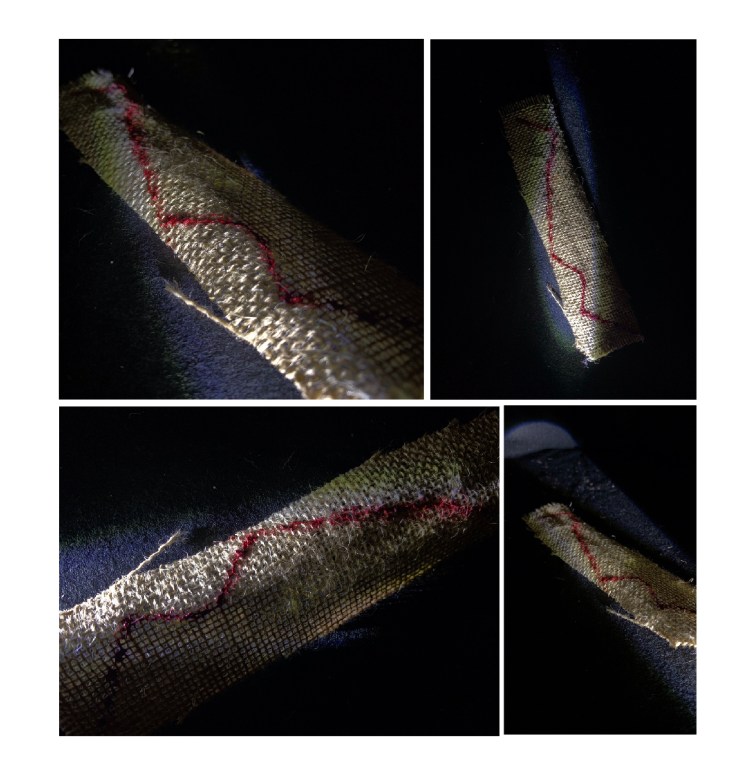
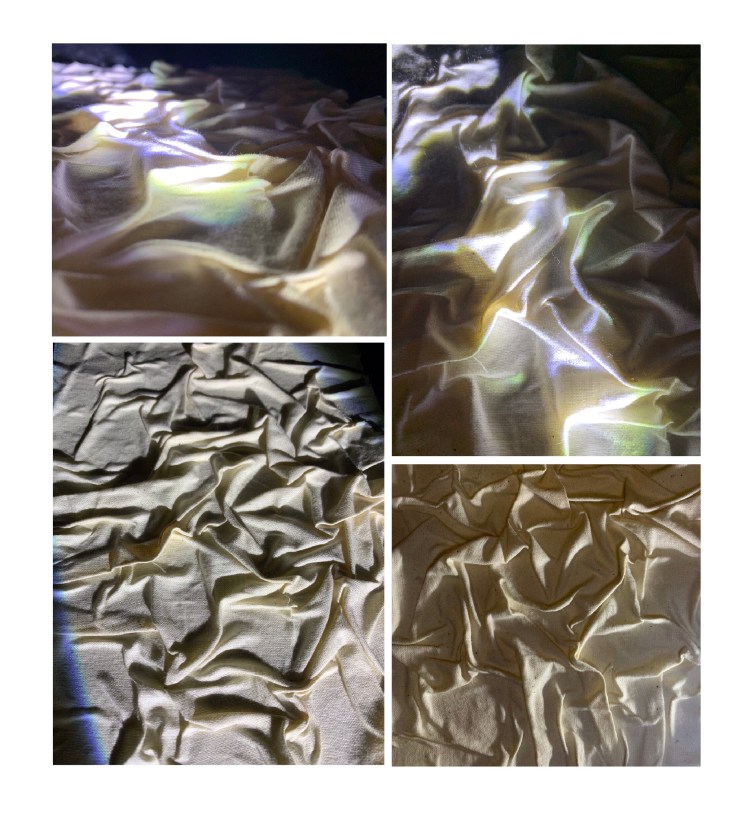
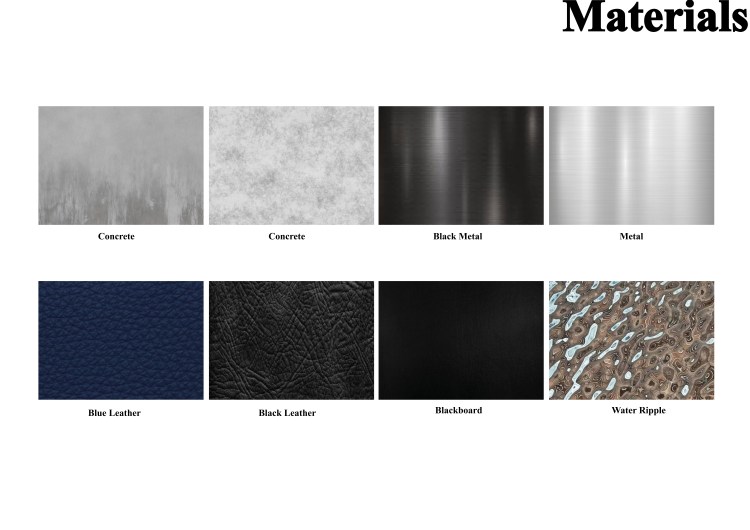
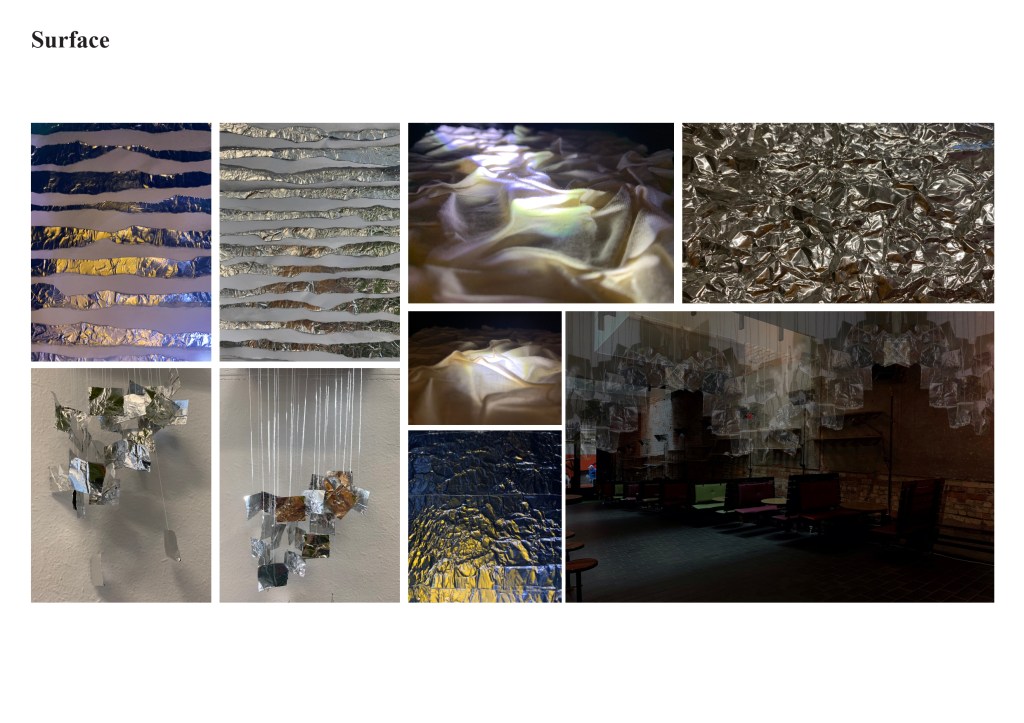
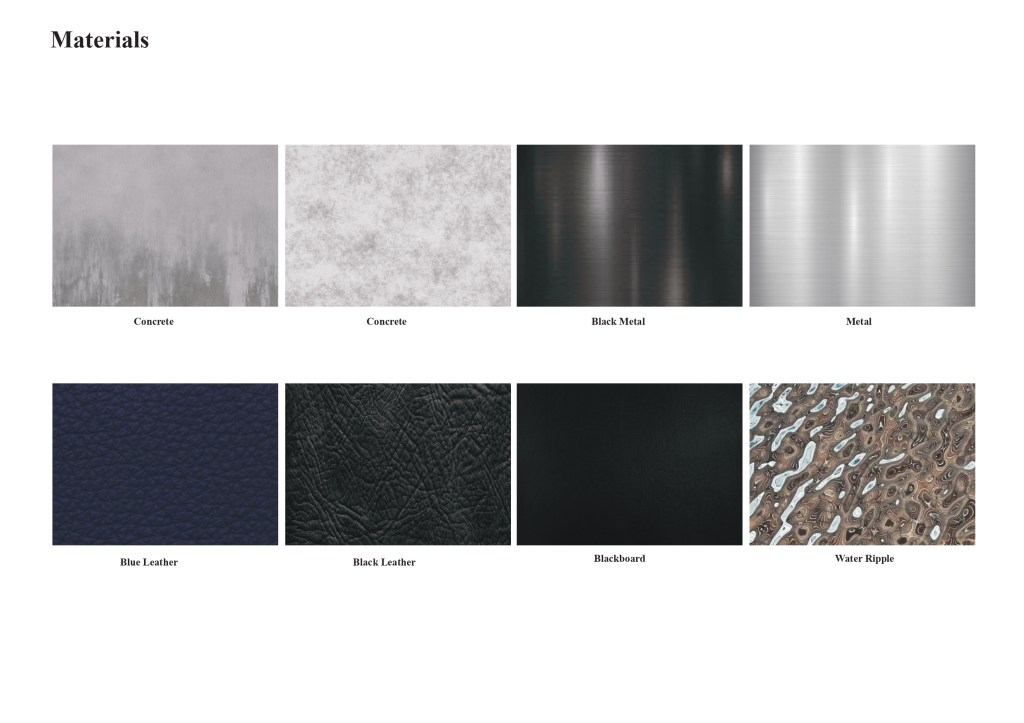
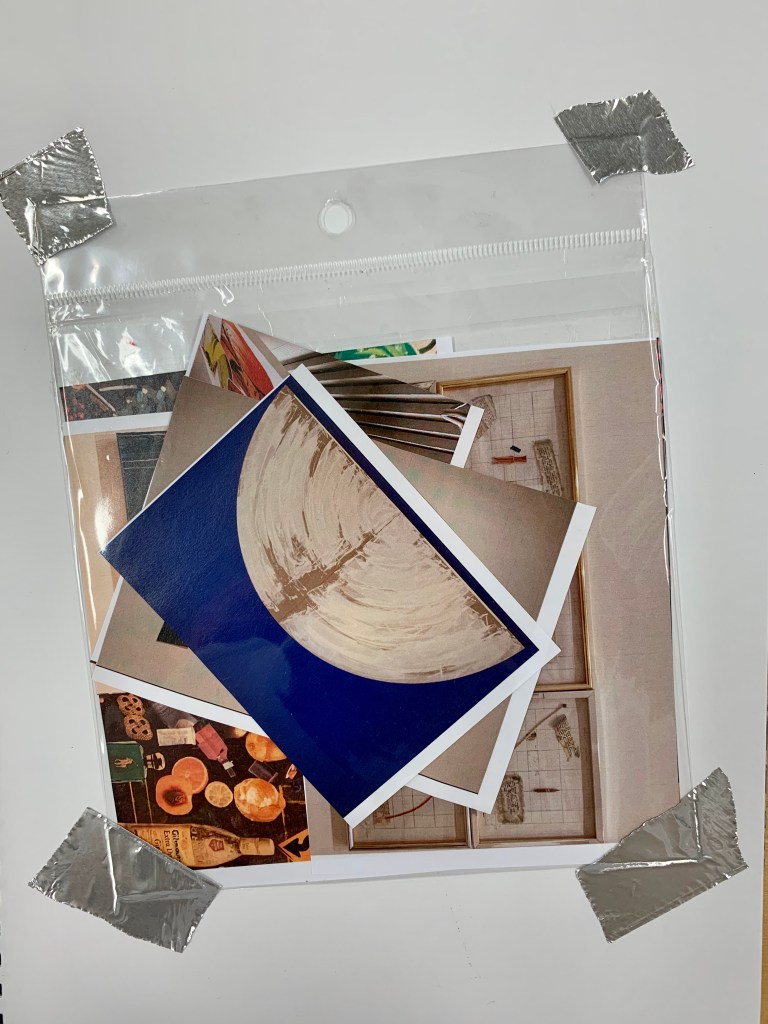
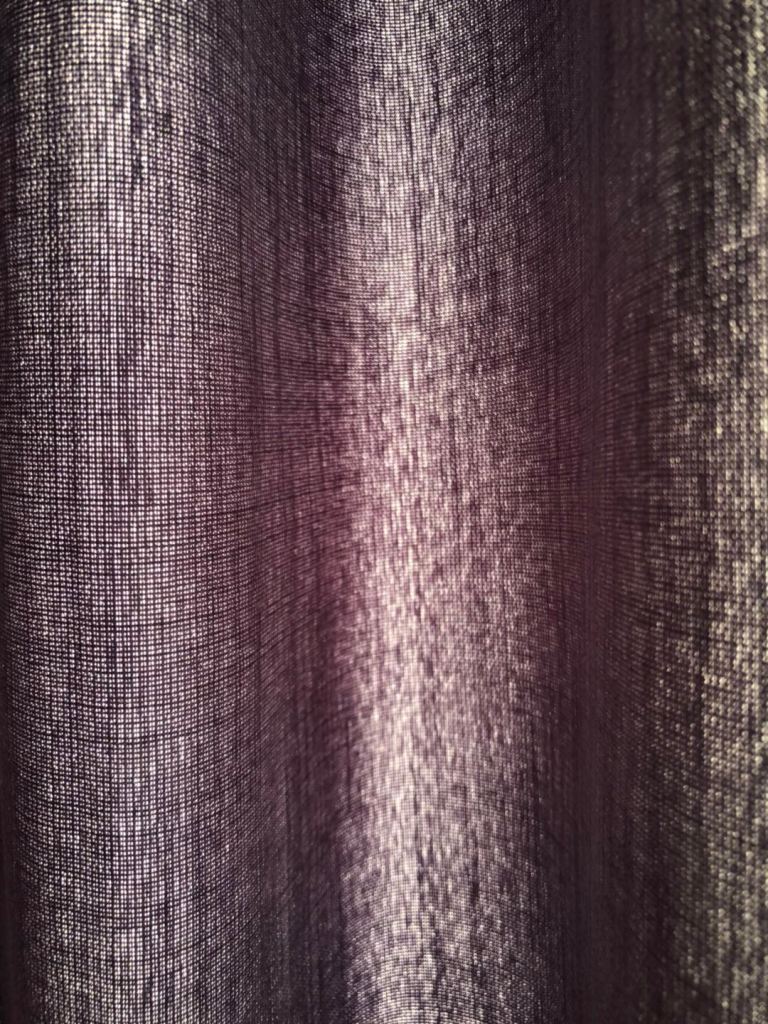
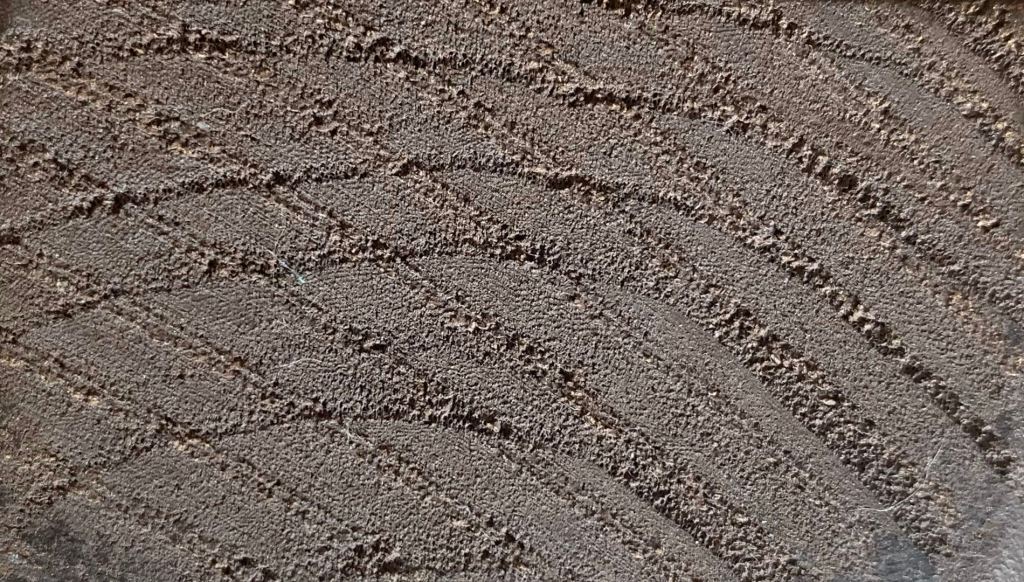
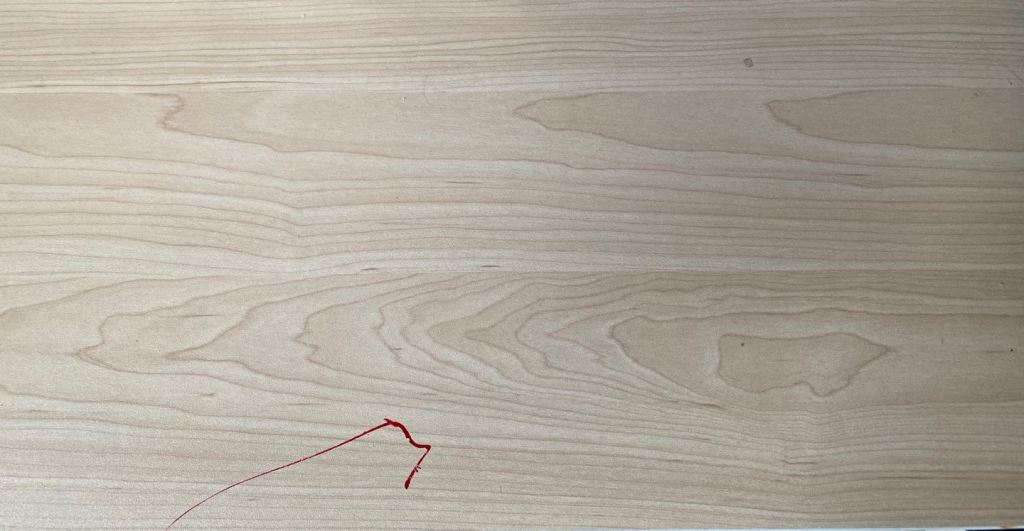
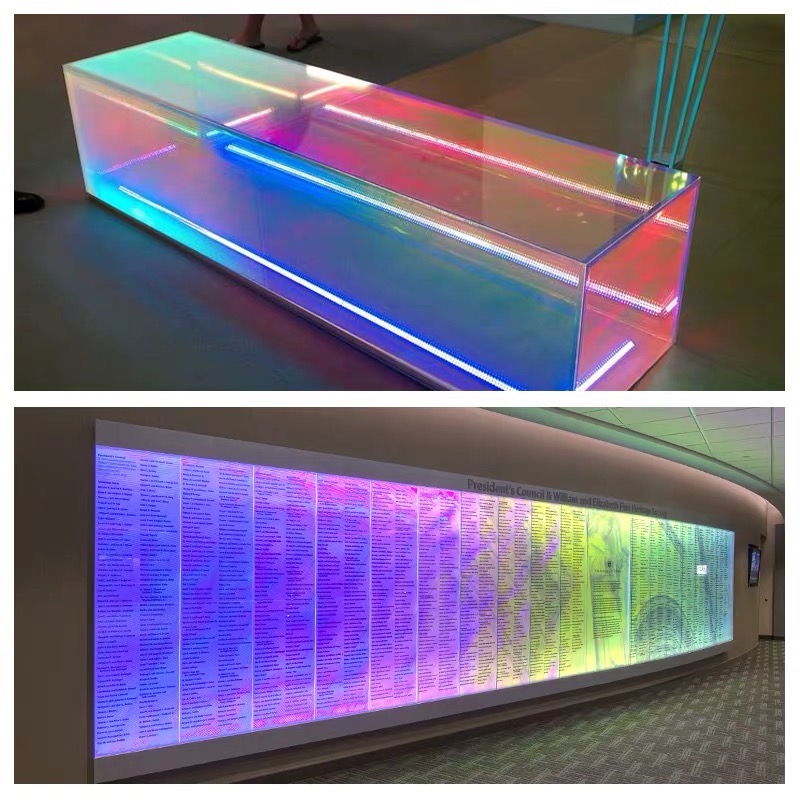
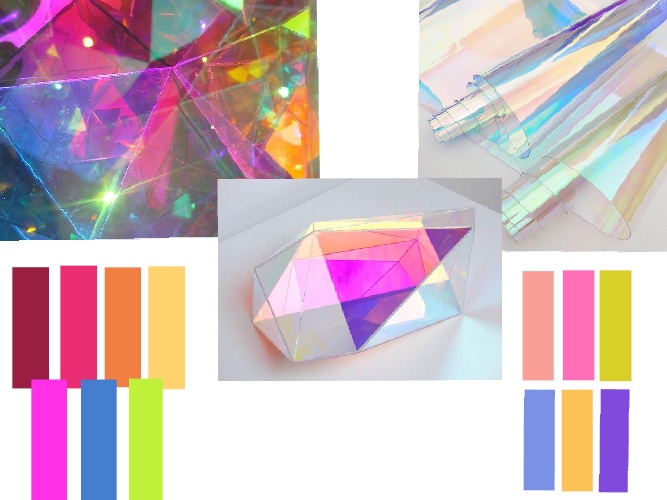
This is a set of pictures about materials. What fascinates me is their surface. The texture is different, the material is different, but the combination is also very suitable.

Series of Five Drawings
Week 4: Material Narrative+Surface
Sketch
Artist research

Yasuaki Onishi studied sculpture at University of Tsukuba and Kyoto City University of Arts. He has had solo exhibitions throughout Japan and internationally, and his work was included in Ways of Worldmaking (2011), at the National Museum of Art, Osaka (NMAO). His most recent solo exhibition in the United States was in 2012 at the The Marlin and Regina Miller Gallery at Kutztown University in Kutztown, Pennsylvania. In 2010, Onishi was the recipient of a United States-Japan Foundation Fellowship that included a residency at the Vermont Studio Center, as well as a grant from The Pollock-Krasner Foundation Inc., New York.

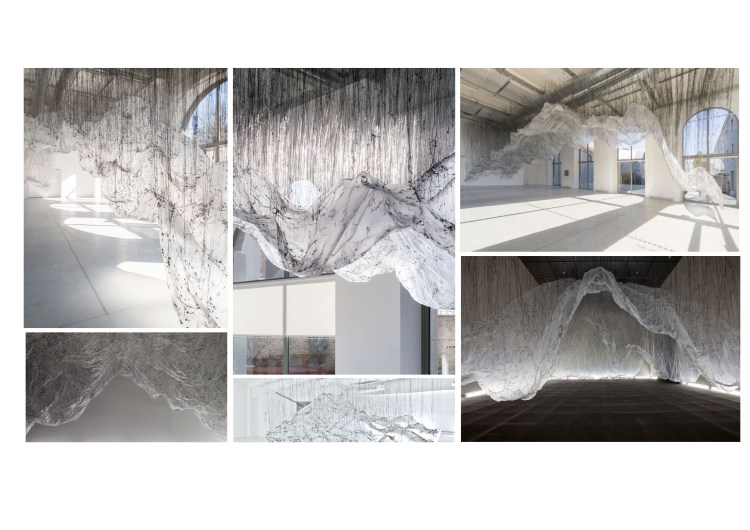
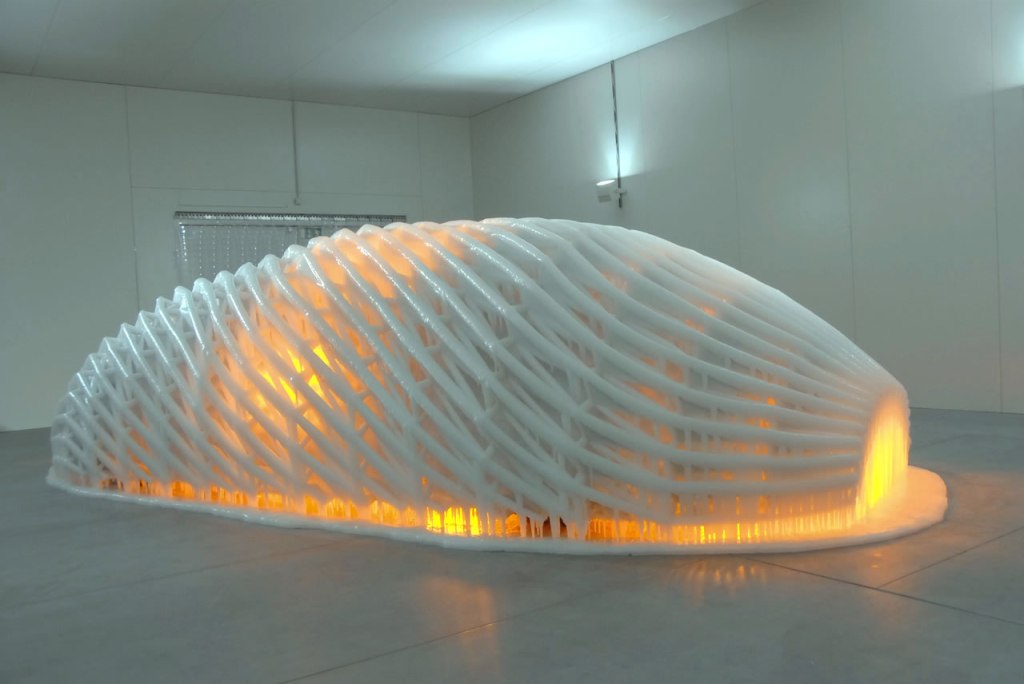
In his installation, reverse of volume RG, Yasuaki Onishi uses the simplest materials — plastic sheeting and black hot glue — to create a monumental, mountainous form that appears to float in space. The process that he calls “casting the invisible” involves draping the plastic sheeting over stacked cardboard boxes, which are then removed to leave only their impressions. This process of “reversing” sculpture is Onishi’s meditation on the nature of the negative space, or void, left behind.

Onishi wanted to create an installation that would change as visitors approached and viewed it from outside of the glass wall to inside the gallery space. Seen through the glass, the undulating, exterior surface and dense layers of vertical black strands are primarily visible. At first glance, standing in the center of the gallery’s foyer, it appears to be a suspended, glowing mass whose exact depth is difficult to perceive. Upon entering the gallery and walking along the left or the right side, the installation transforms into an airy opening that can be entered. Almost like stepping into an inner sanctum or cave-like chamber, the semi-translucent plastic sheeting and wispy strands of hot glue envelop the viewer in a fragile, tent-like enclosure speckled with inky black marks. Visitors can walk in and out of the contemplative space, observing how the simplest qualities of light, shape, and line change.

Yasuaki Onishi’s works

Rob Ley is the founder of Rob Ley Studio. His studio’s history of experimental work includes installations at the Storefront for Art and Architecture (New York), the Taubman Museum of Art, the Materials & Applications Gallery (Los Angeles), as well as commissions for many public and private organizations including the Martin Luther King Hospital (Los Angeles), the Eskenazi Hospital (Indianapolis), the O’Hare Airport (Chicago), the Oregon Zoo (Portland), and the Seattle Fire Department.

Rob Ley’s work

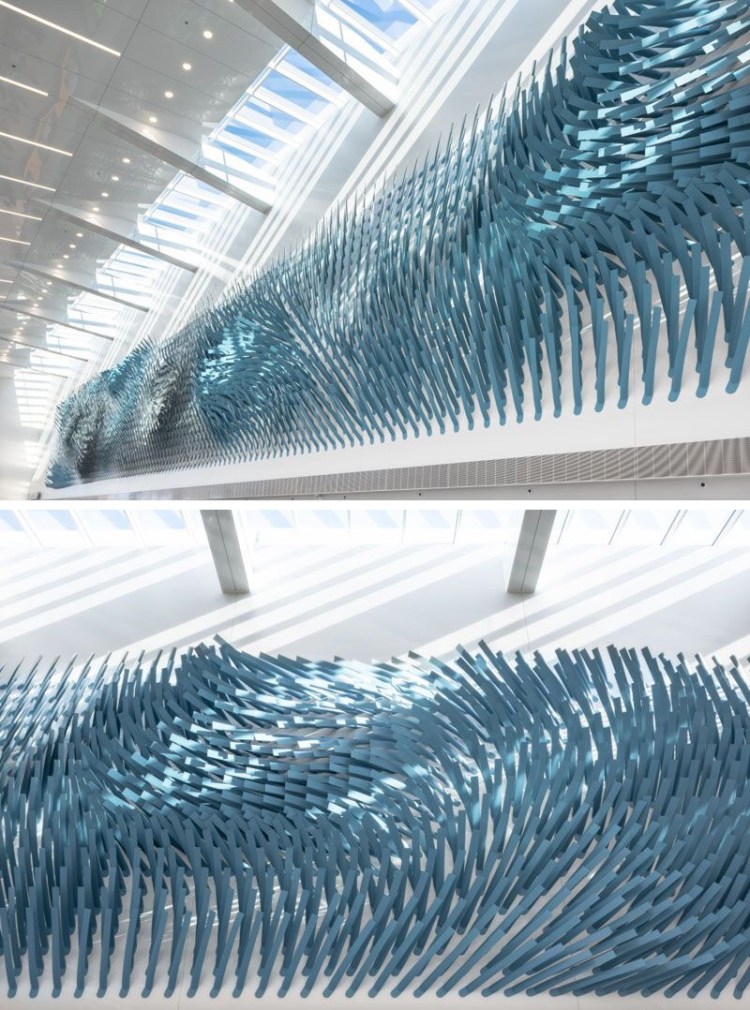
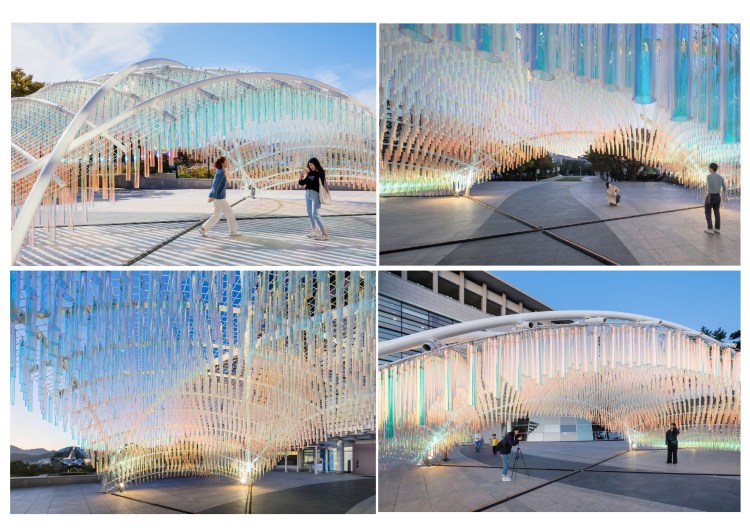
Ripple Pavilion is the annual outdoor pavilion project at Gyeongnam Art Museum in South Korea.  Thousands of pixels – acrylic tubes with mechanical joints – span across a waving canopy while scattering light and colour in constantly changing expression. 

It is an interactive installation where people’s movements transform the appearance of the pavilion at different moments in time.  The overall effect of the pavilion begins from a small contact with a tube, which swings other pixels in the vicinity to create rippling phenomenon.  Then the physical movement translates into refracted colours transforming whole installation into a moving iridescent field.     

The concept of the pavilion was conceived as a responsive environment. A small initial input, such as a child’s touch, could propagate into unexpected patterns on the whole array of pixels like a butterfly effect. The playfulness of pavilion invites people at all ages to participate and to create their own moments. The geometry of the pavilion paid special attention to maximizing interaction.  The waving double curvature optimizes contact point at different heights for different users.  To fine-tune the interactive points in the 3d geometry, several iterations of parametric model was shared with other consultants.  Then collaborative feedbacks helped reaching the final form.   As a result, there are moments of pavilion suitable for standing users while crawling is the best way to experience in other areas.  The mix of concave and convex spaces also allow diverse array of colours to be perceived at any view point.

Ripple Pavilion
Week 5: Formative Presentation

Pitch

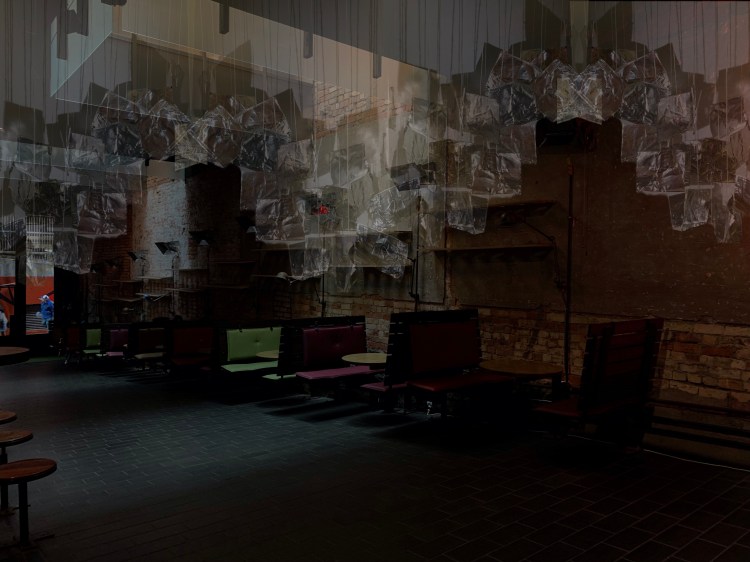
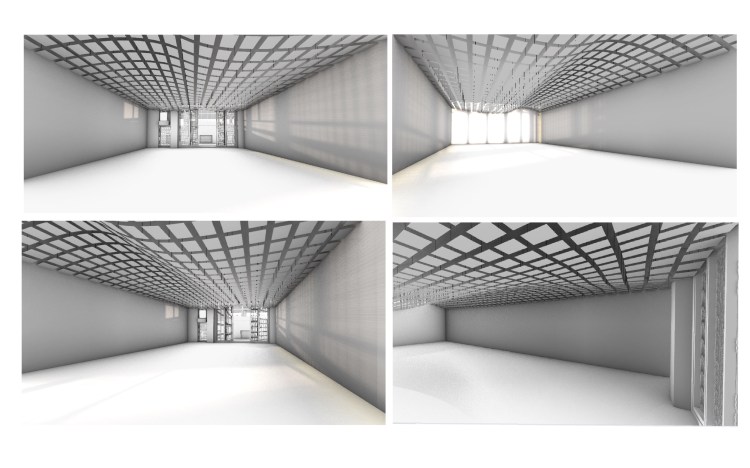
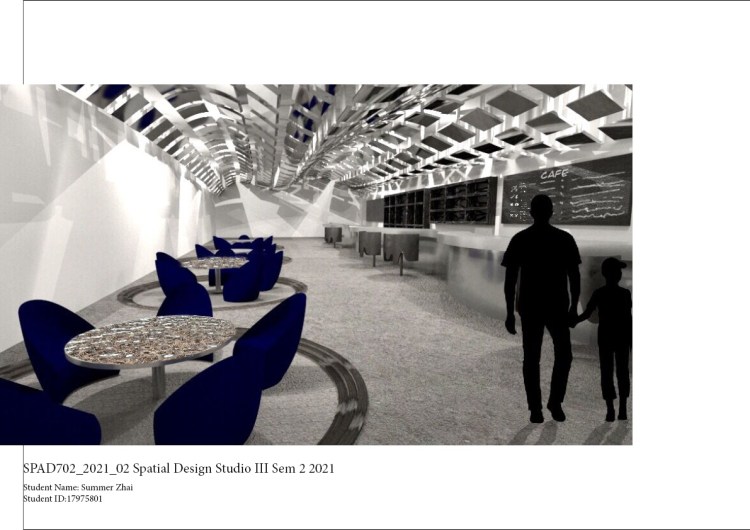
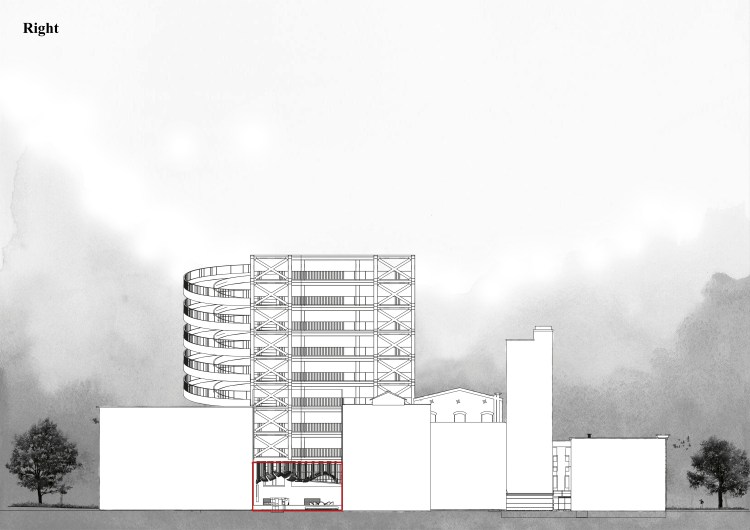
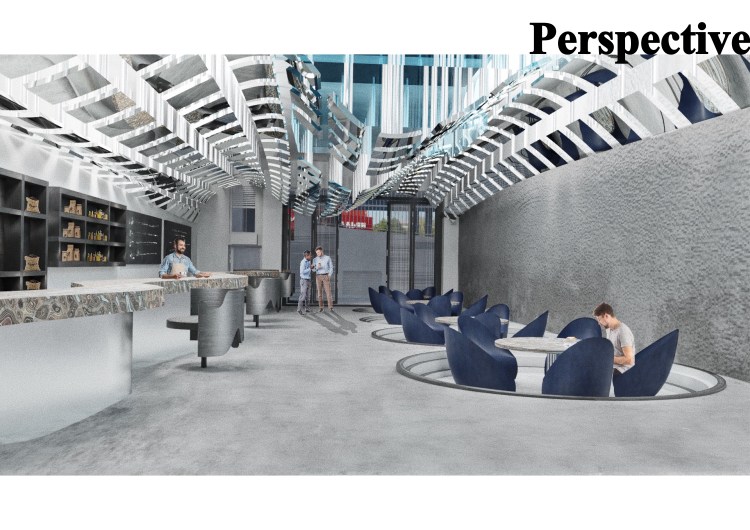
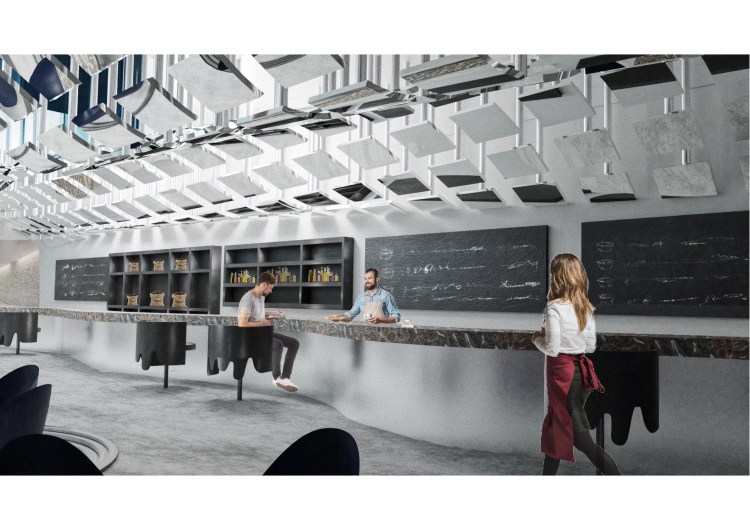
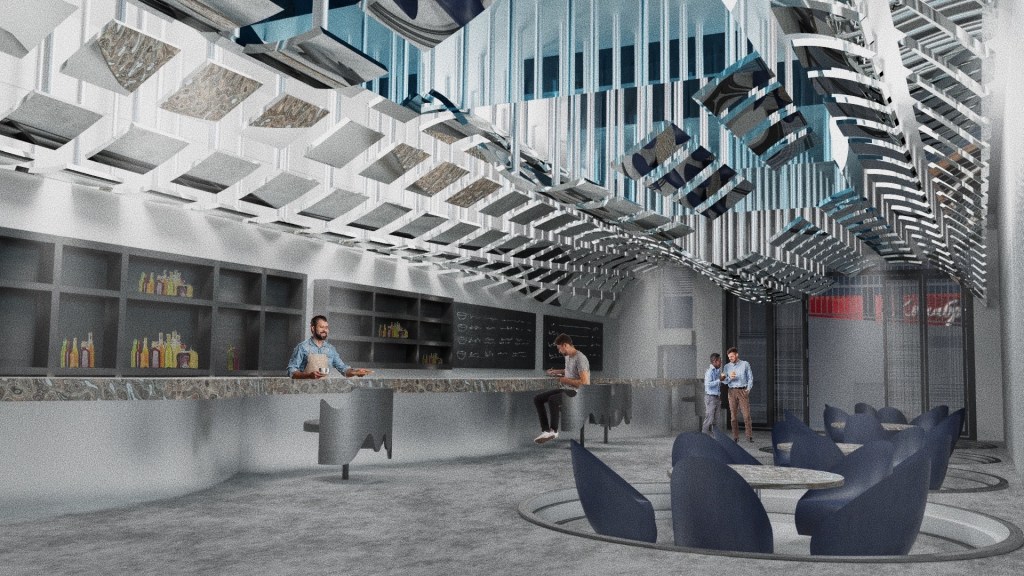
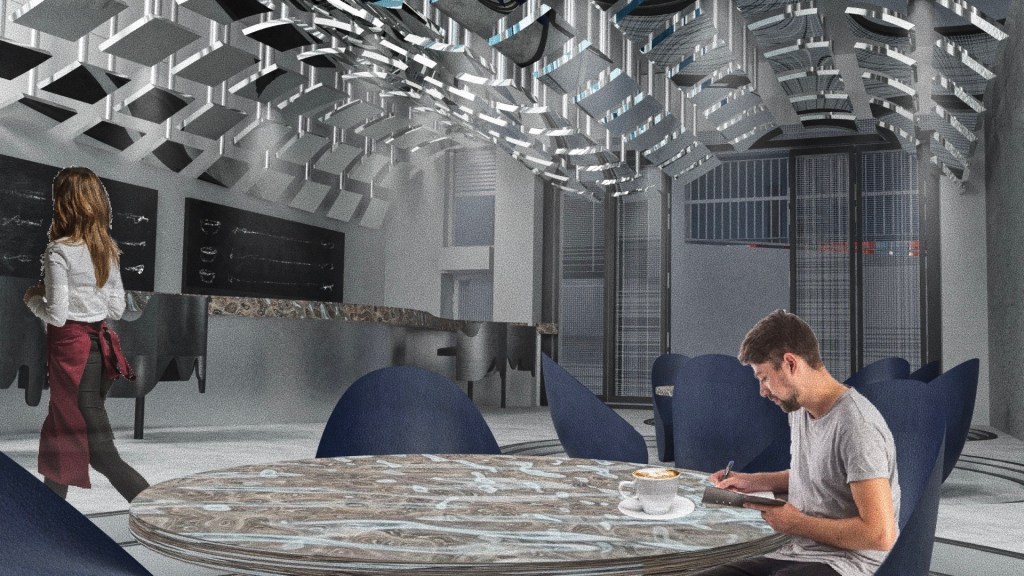
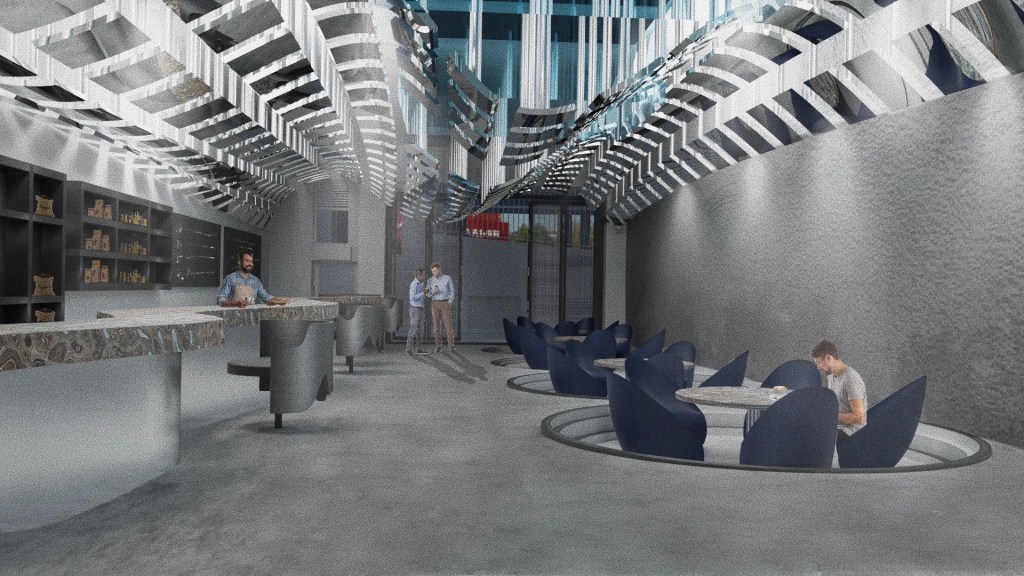
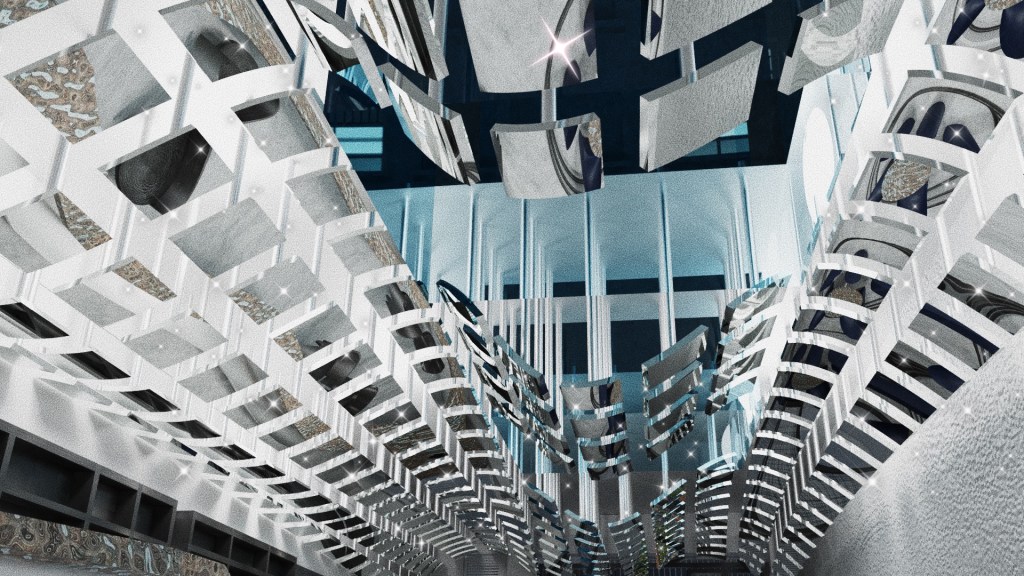
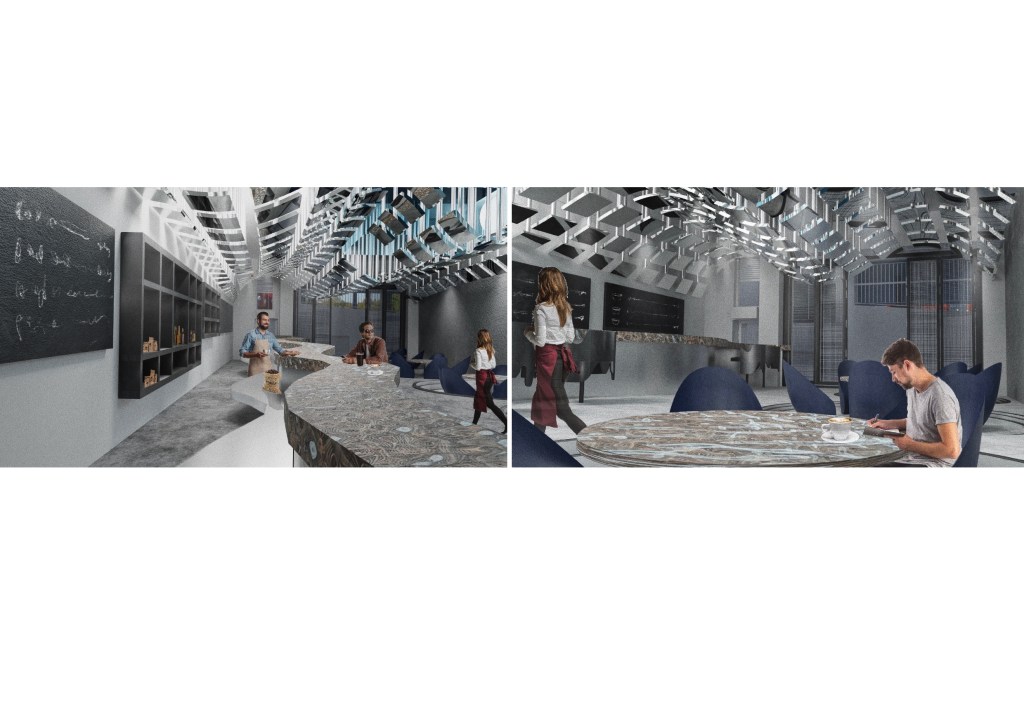
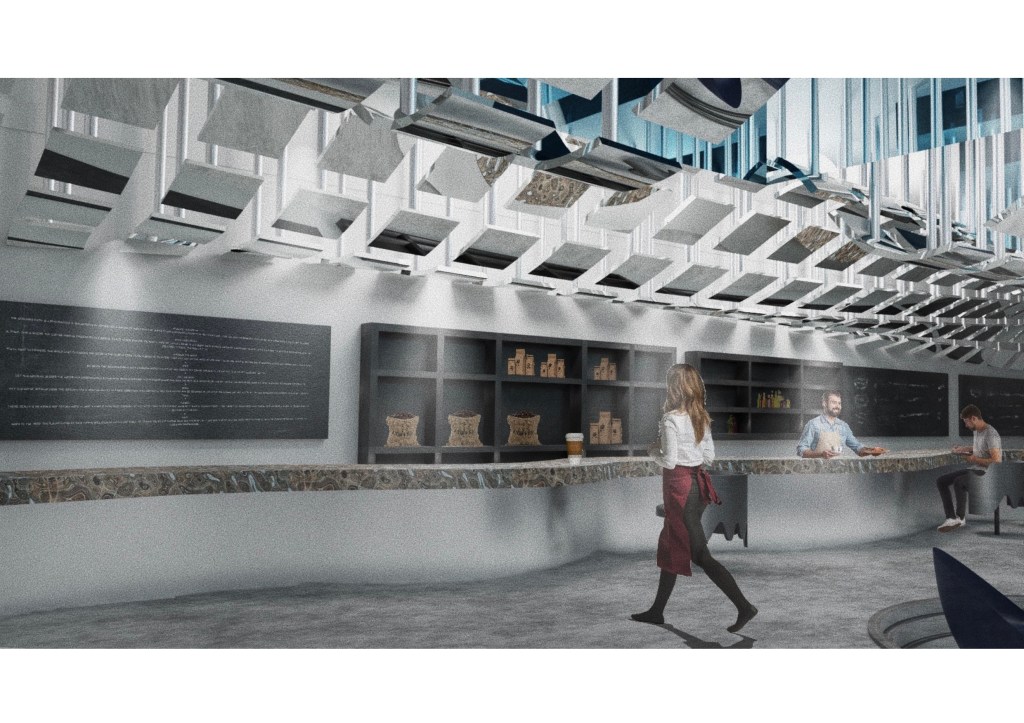
The space I chose was a cafe, and my concept is creative a highlight of the street . When I visited this street for the first time, I felt very dull. This is different from the noise and prosperity of the main street. So I want to bring sparkling things into this street and change the atmosphere of the street through color and light. The main part of the design is the roof inside the cafe. The entire plane will be undulating and there will be many lines with different heights. My inspiration comes from the sea level, which is related to the history of the street, and I will focus on various water ripples. Through these texture to design, I will use some reflective materials, the refraction of light will produce highlights, when a lot of light gathers together, it will shine. The line part is still inspired by the sea. When the sun crosses the sea level and enters the sea, you will see beams of light. It will still be a quiet space and neighborhood, but there are more interesting stories or spaces waiting for people to discover and explore in this neighborhood. I hope this space will attract more people.

Script

The space I chose is a cafe, which will be a space open to the public all day long. This is a quiet neighborhood and not noticeable. I will install some devices on the roof and use some materials that reflect light. Let this neighborhood quietly exude its own highlights.

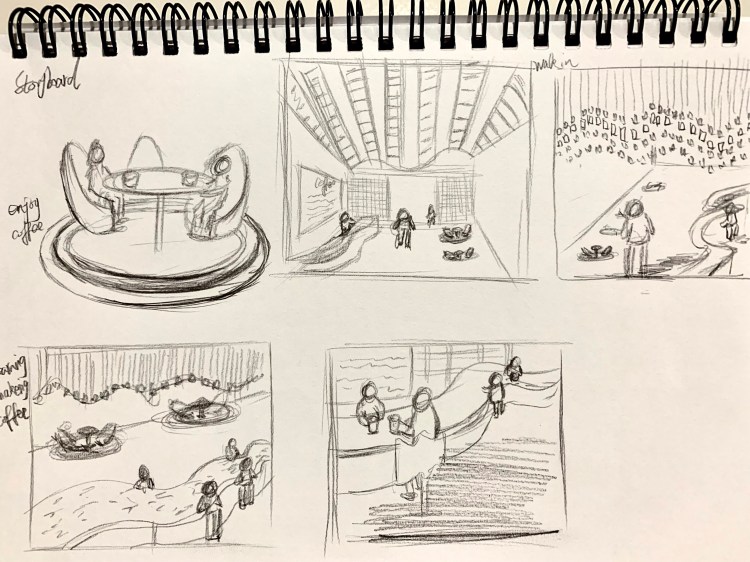
Week 6 :Storyboard
Suspended/Hanging

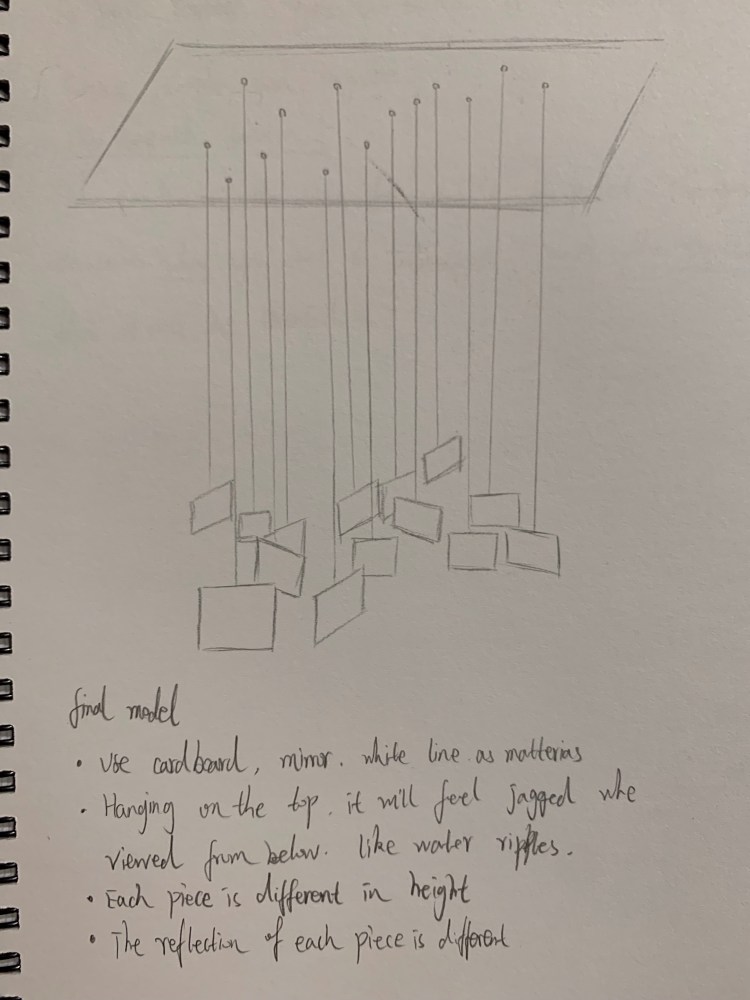
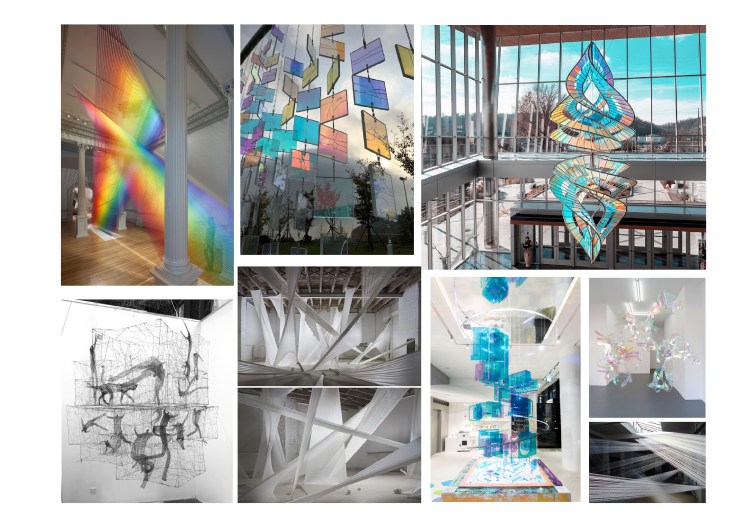
The technique of hanging an artwork, typically sculptural, from the ceiling, or suspending a series of objects in space, giving the effect of them floating in air. The development of the technique is linked with a number of different modernist avant-garde practices: Marcel Duchamp hung readymades such as a shovel and hat rack from the ceiling, while Alexander Calder’s iconic mobiles were delicate “drawings in space” susceptible to subtle movements of air. Playing with concepts of visual perception and interactivity, Jesús Rafael Soto’s Penetrables consist of thin hanging tubes that permit viewers to enter the space of the sculpture itself. The hanging of objects from above has become common in contemporary installations, especially in works that seek to create an immersive or engineered effect.

Draft sketch

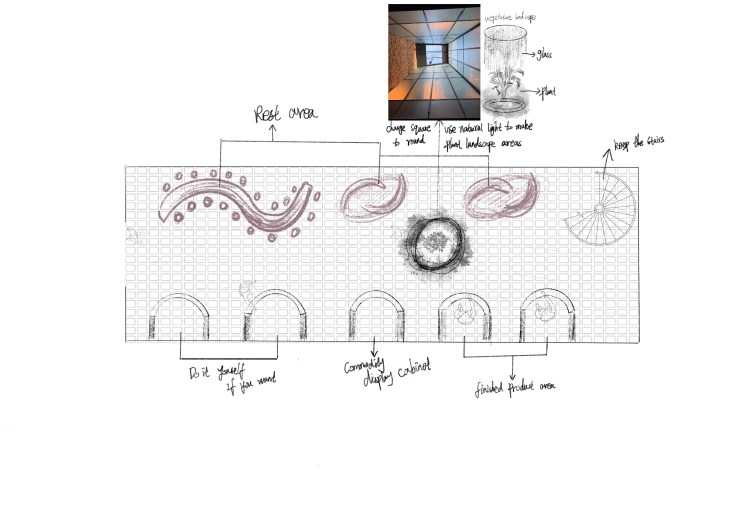
This is the first sketch I drew after lockdown. In the picture I marked the function of each area.  This is just a process of starting an idea, it still has many problems.  After I talked to Chris for the first time, he made a lot of suggestions to me, and I tried to make improvements.  But I always think this draft lacks some important things, and it is messy in short.  I didn’t want to understand where did these things come from?  Why is it designed like this?  I think I should calmly think about this space.

Week 7:Communicating Your Design Narrative
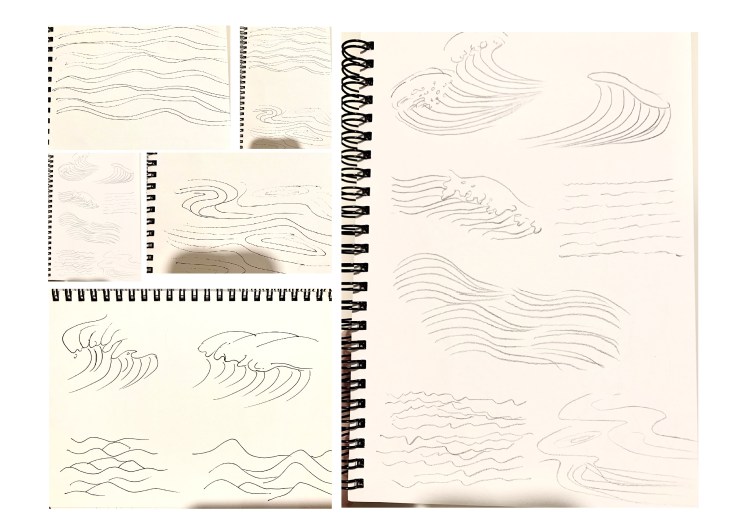
Water ripples

After the lockdown, I gradually became confused because I could not be sure why my space existed?  For whom?  What kind of space is this?  I still have no answers to many questions.   Chris provided me with some ideas.  To find these answers, I decided to start again from the original idea.  Water is my source of inspiration. I relied on water to design four surface. This is a good start.  So I drew various water ripples to try to find answers through them.  Carefully observe the texture, direction, line, etc. of each water ripple that’s provided me with new ideas.

Hand Drawing

This is my second hand-drawn draft, which is completely different from the first one. I think all the design of my space should be related to water, because water gave me more inspiration when I investigated the historical background. In this draft, I tried to express several different forms of water. Various water ripples, the shape of the water droplets, the waves generated by the gathering of water, and so on. I think this is a good start, but there are still many details that I need to study in depth. Unfortunately, I cannot start modeling because of lockdown, and I am applying for a laptop. Hope to start working soon.
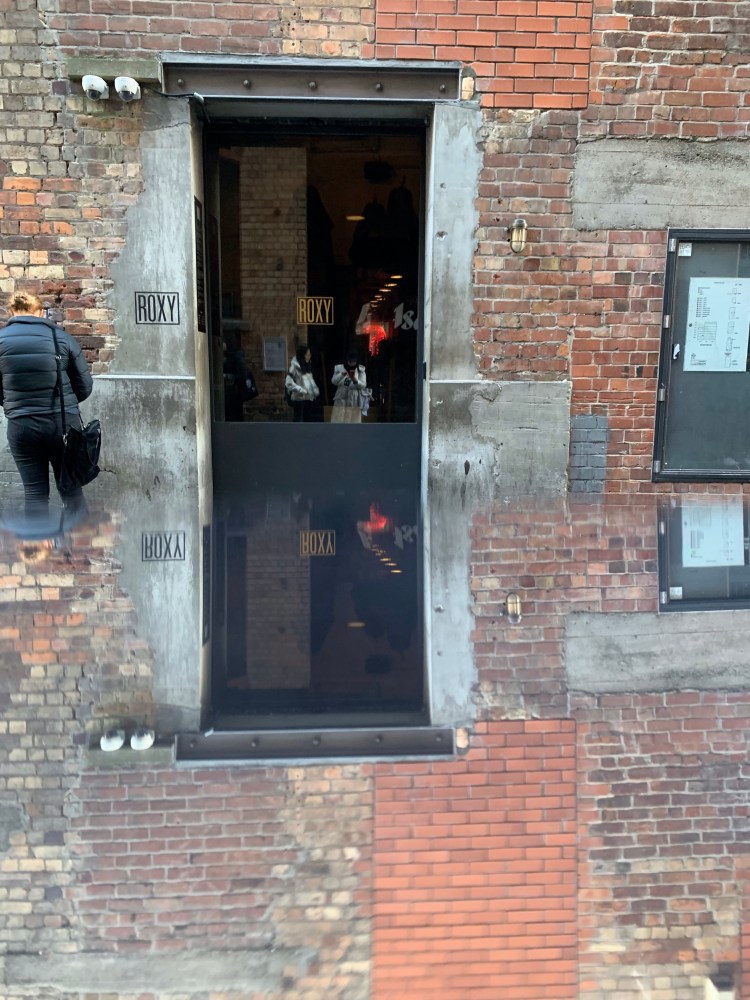
collage

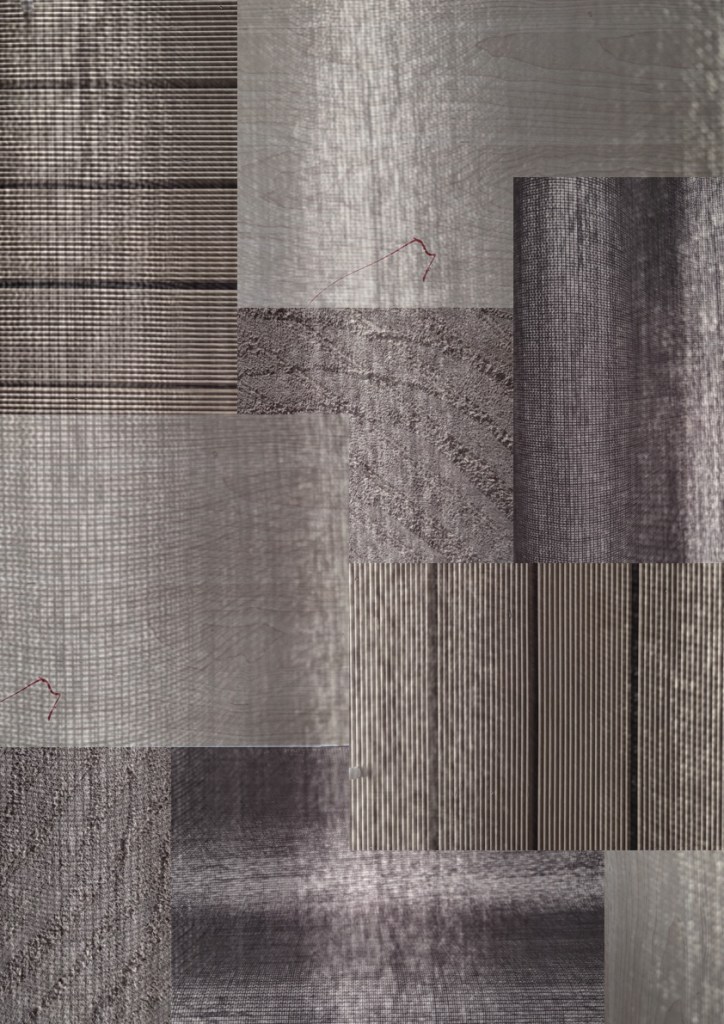
This is a mosaic of inspiration. I try to create my space through these mosaics. Sea-level roofs, concrete walls, stainless steel bars, etc. I want to use pictures to show the situation in the house and feel the atmosphere I want. This is a new perspective. I can express my ideas in different ways. I think this is a success. I will continue to develop my design.

Model Making
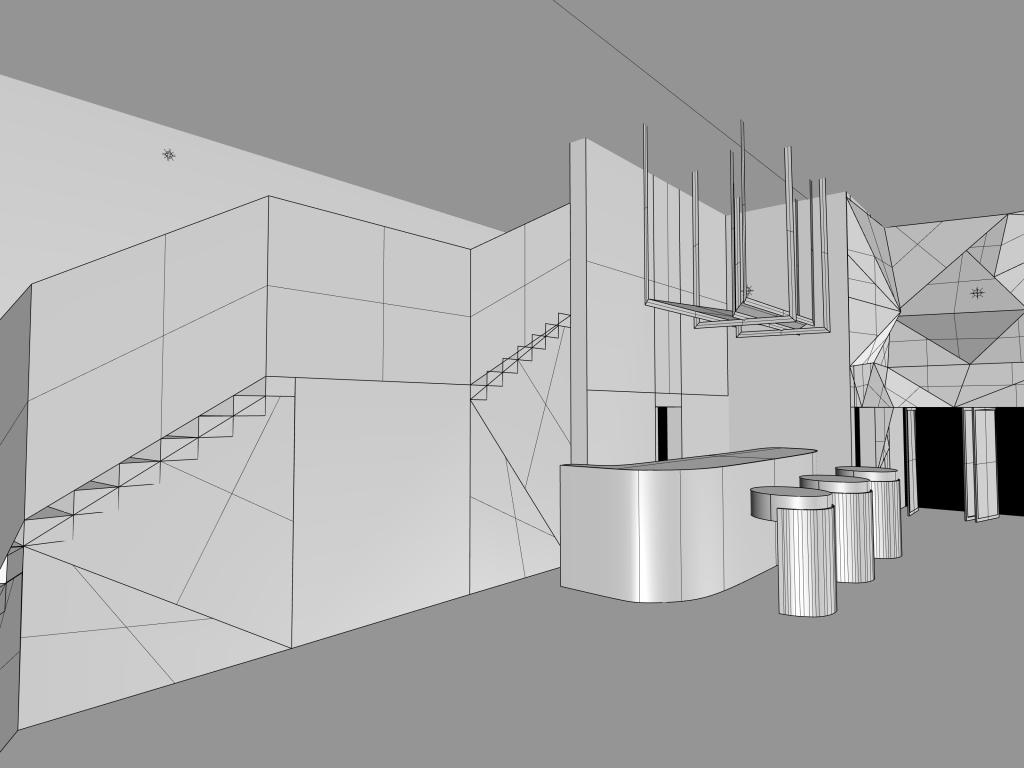
Model in rhino

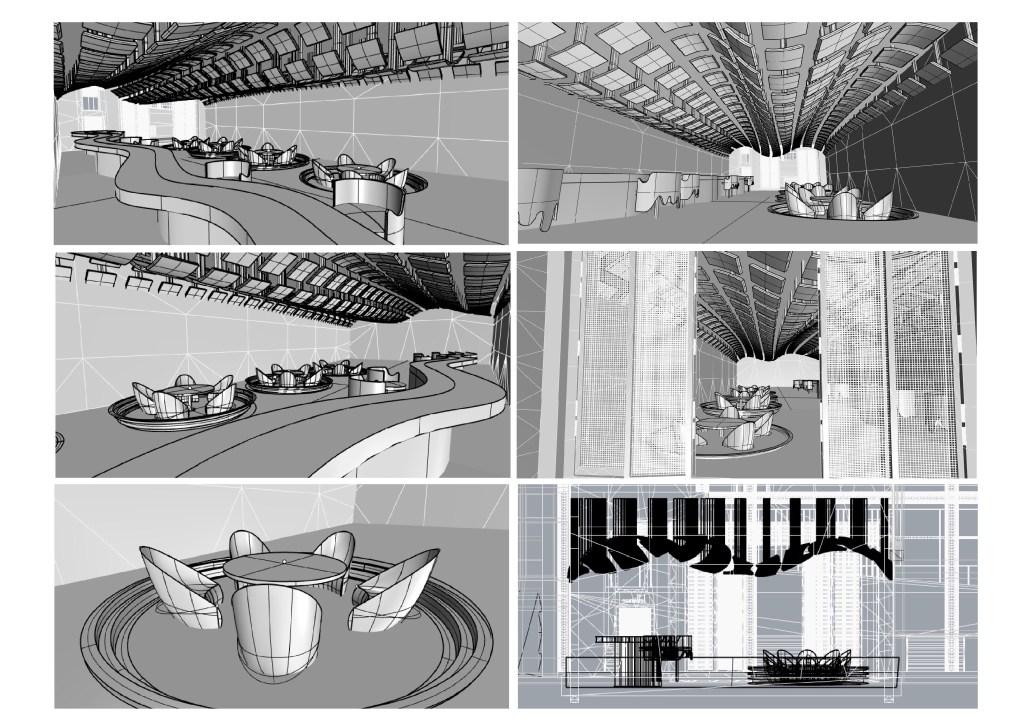
I started to use rhino to make models. This is just the beginning.  There are still many details that need to be explored and learned.

Week 8: Detailing
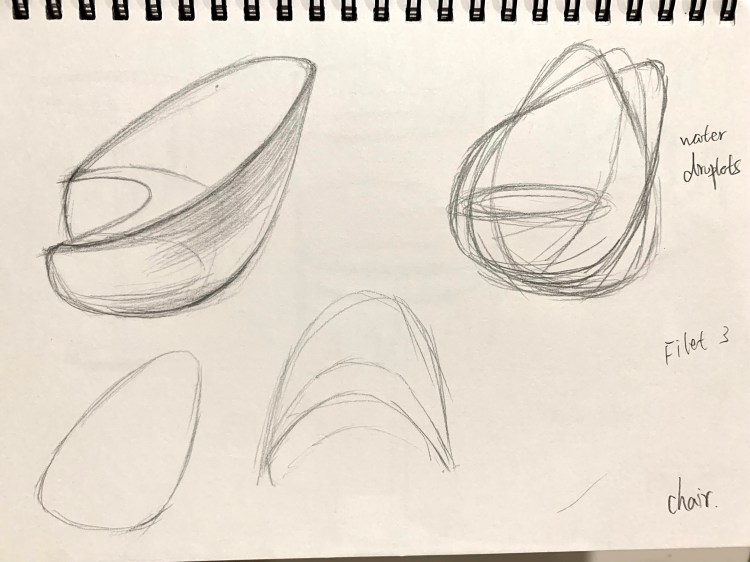
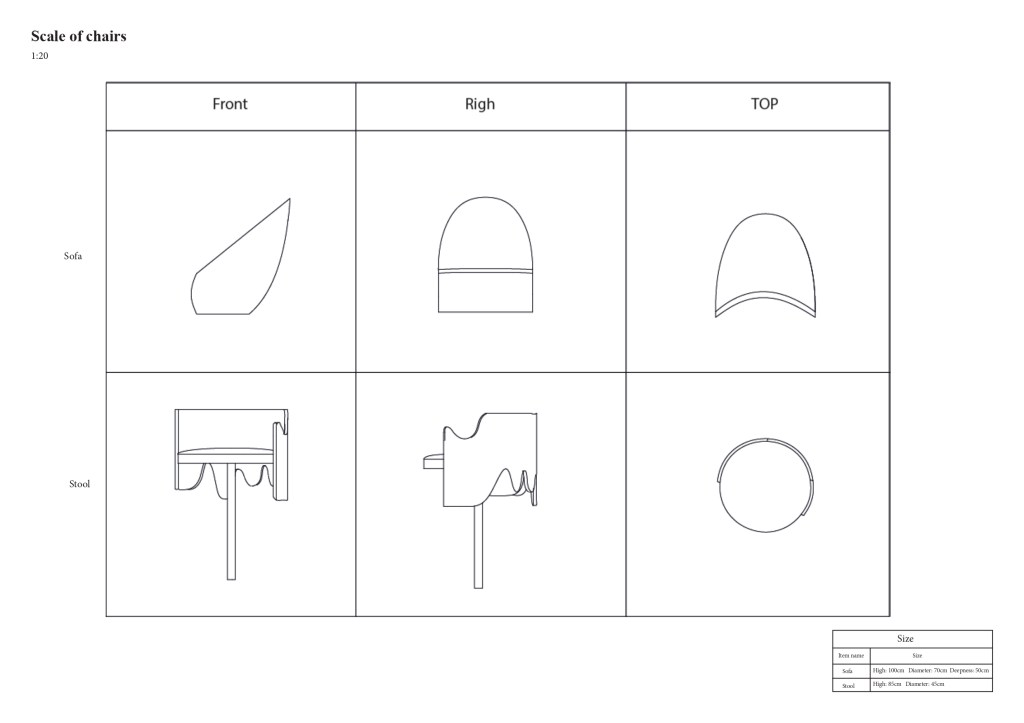
Chair detail

I designed the seat in the shape of water droplets. At the beginning, I just arranged the water droplets in different directions.  This is a whimsical design, when I was conceiving the space.  I suddenly had this design in my mind, so I immediately drew it down.

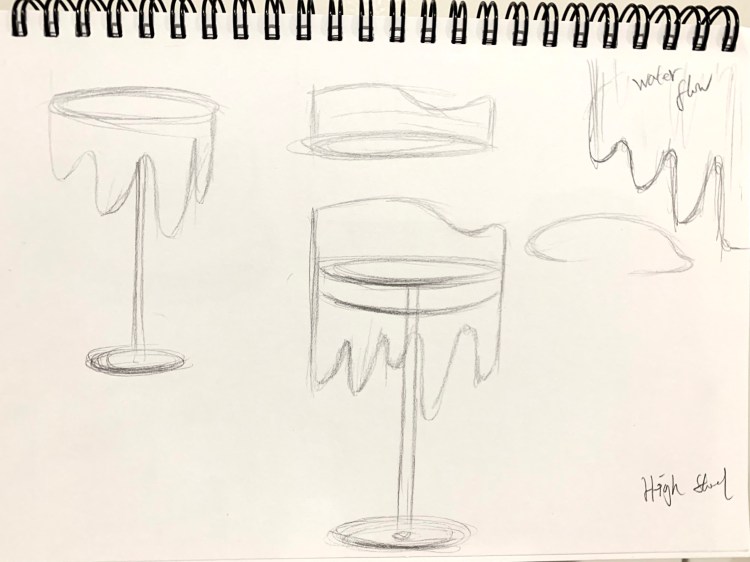
High stool detail

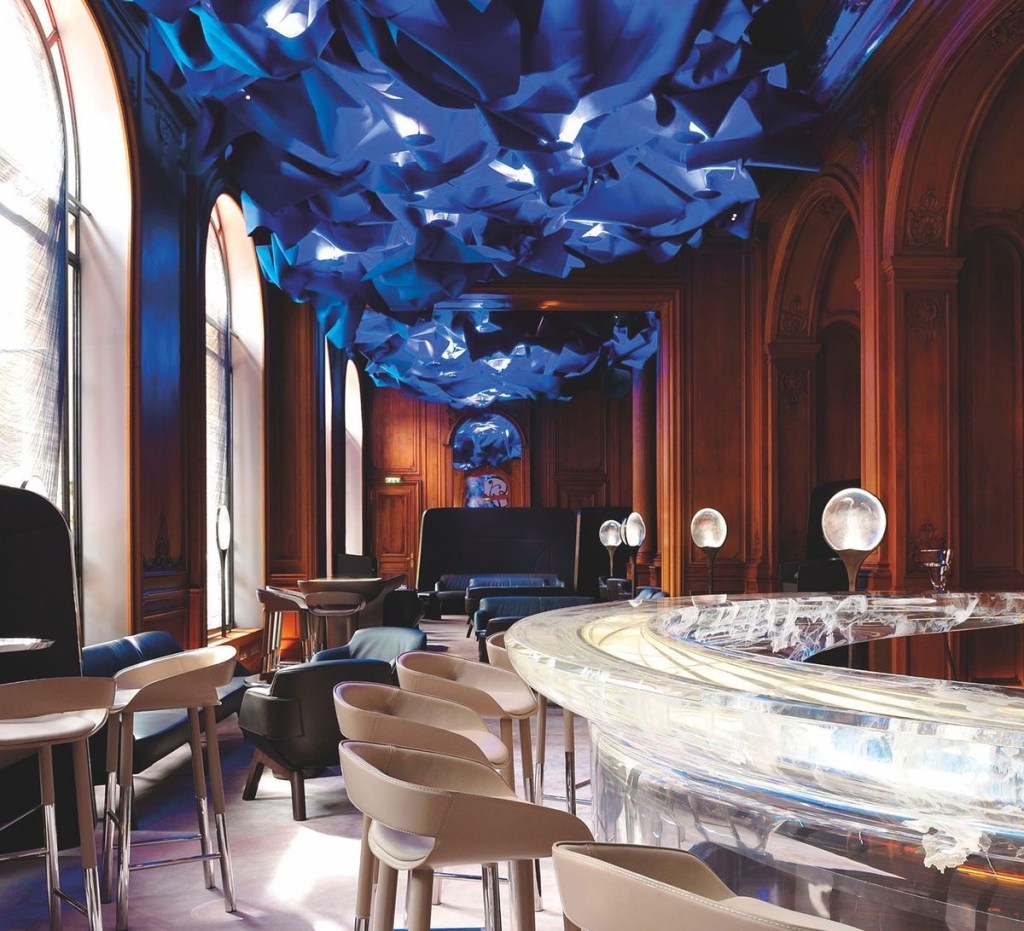
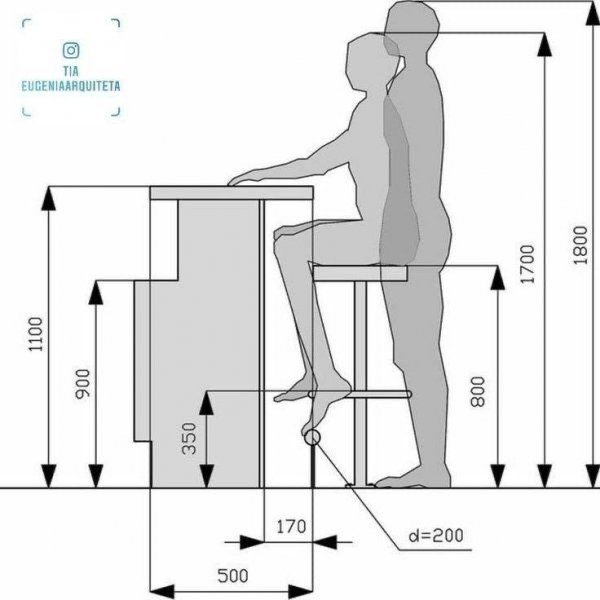
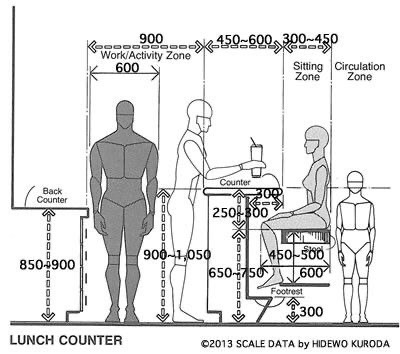
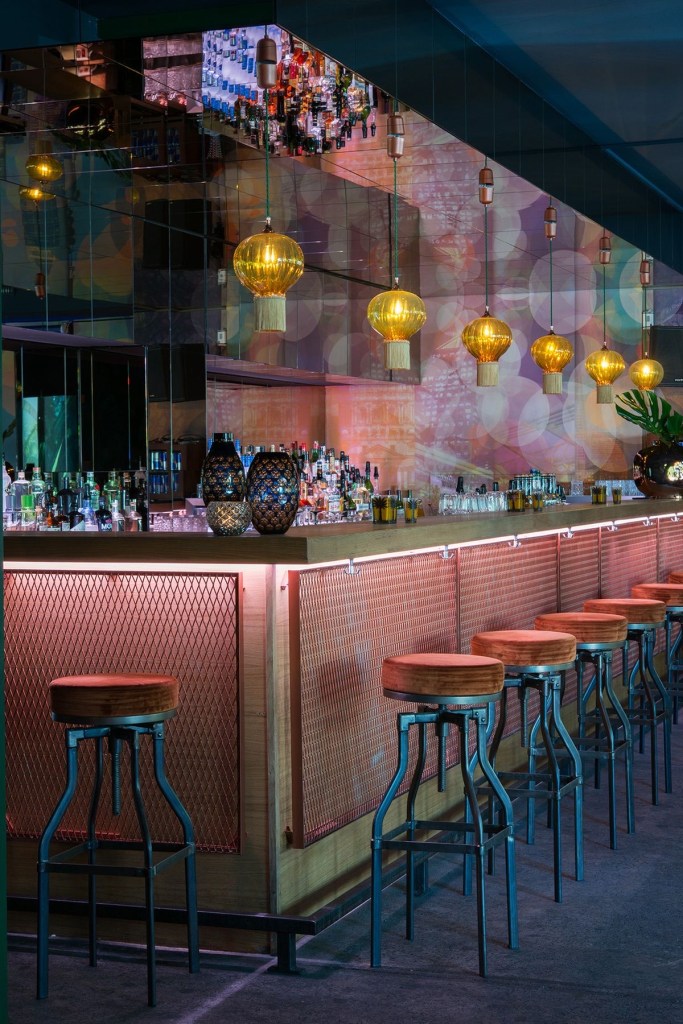
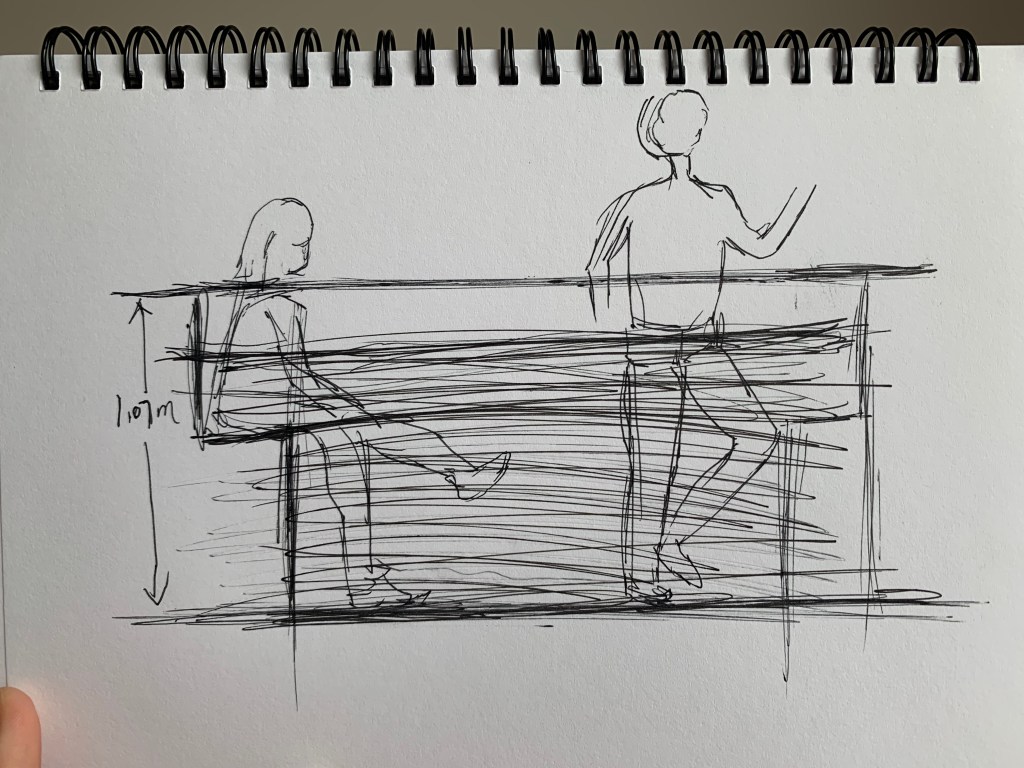
This is a high stool designed in accordance with the pattern of the water flow. It will be recessed in the left hand direction for the convenience of placing the arm.

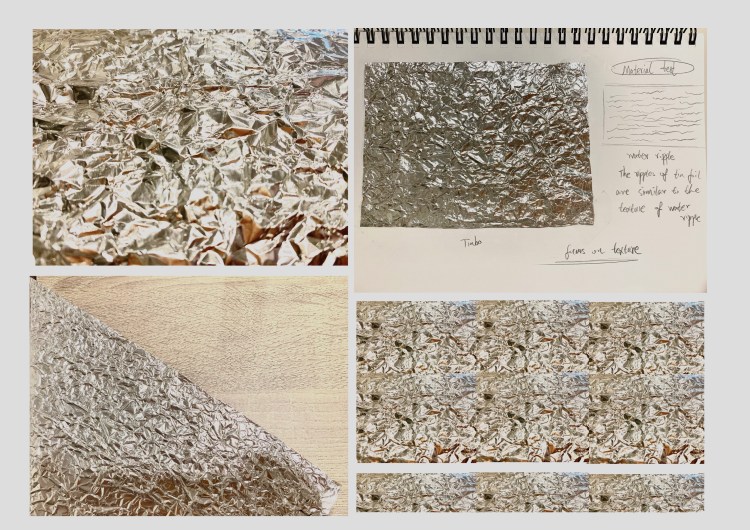
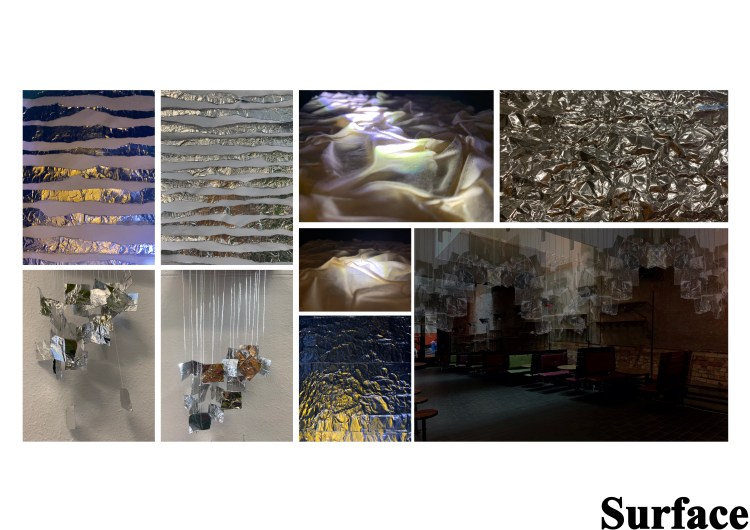
Material test

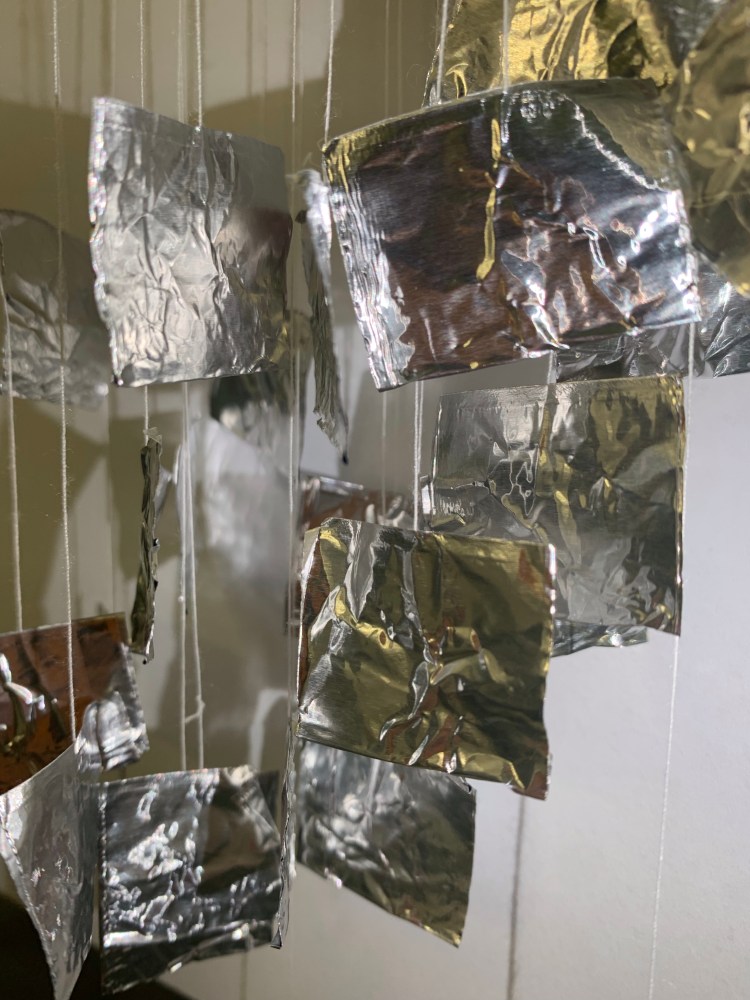
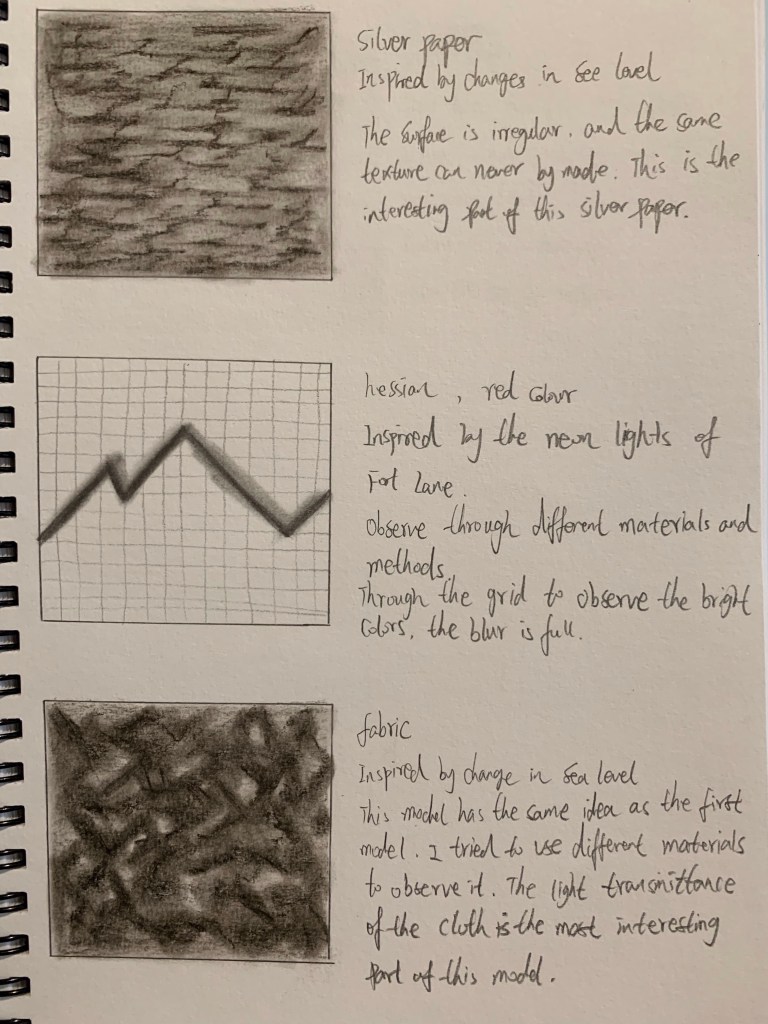
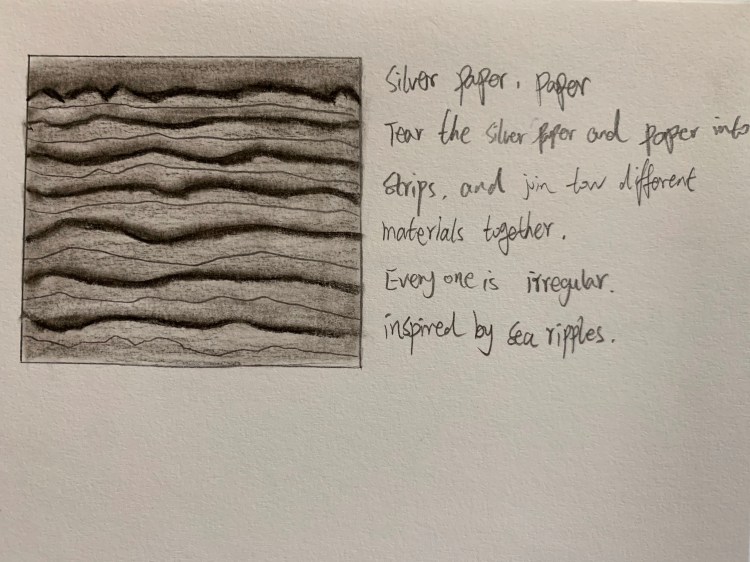
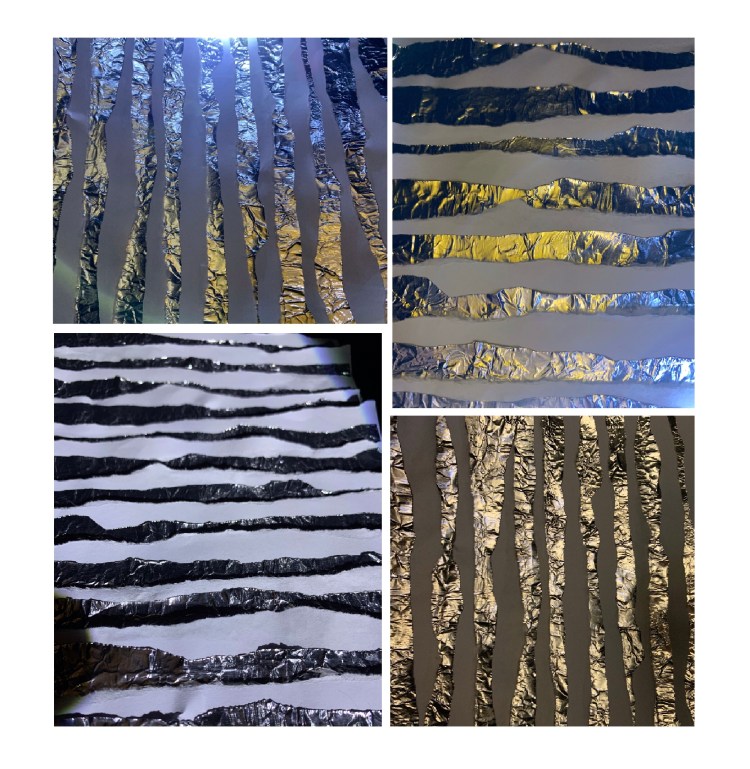
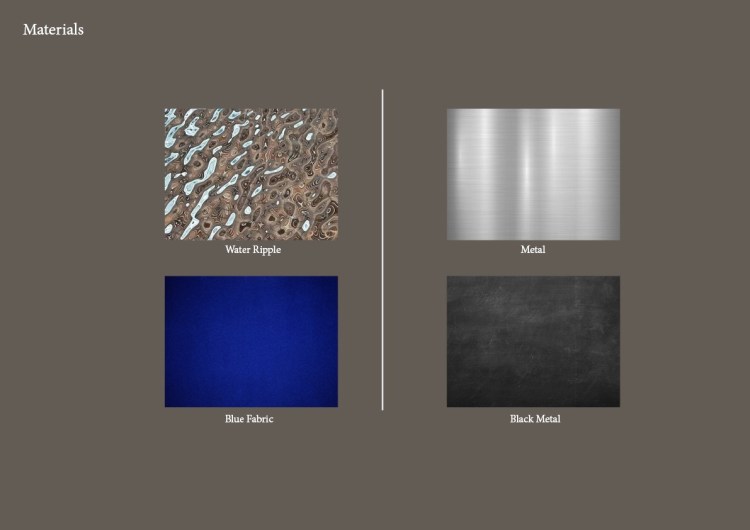
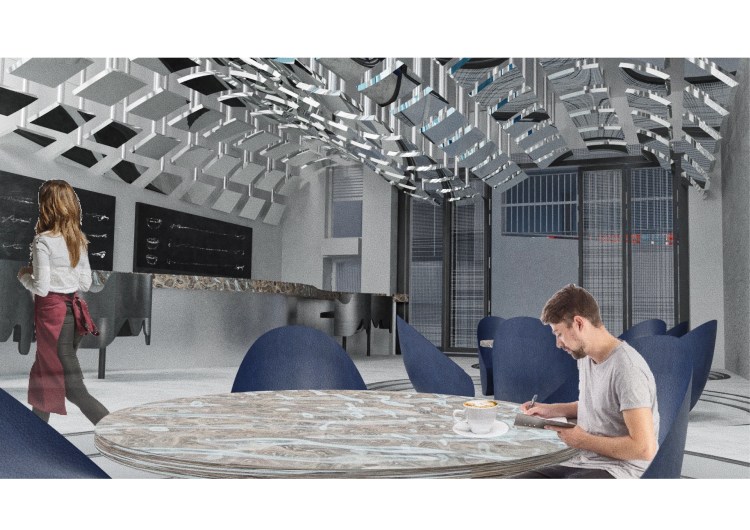
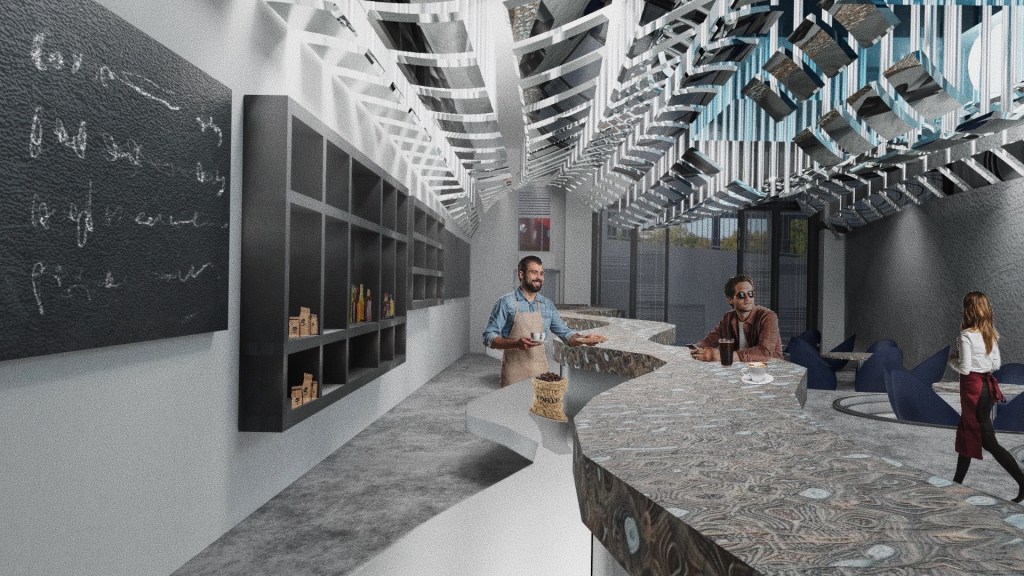
This is a material test. I use tin foil as a material and stick it on the table to observe its texture.  I like this material very much, it will make my space brighter.  The table in my space will have this texture, and I will look for similar materials.

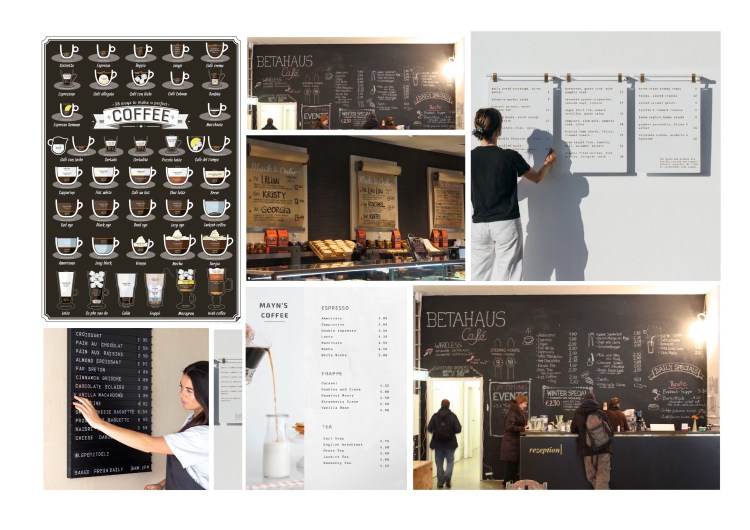
Menu research

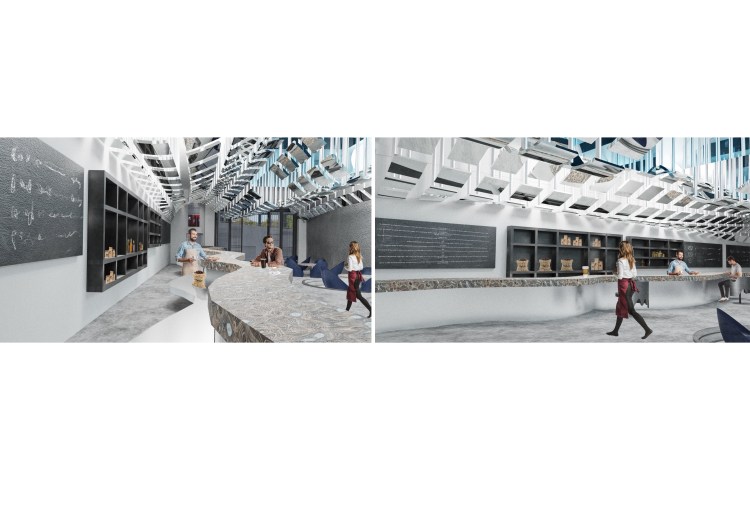
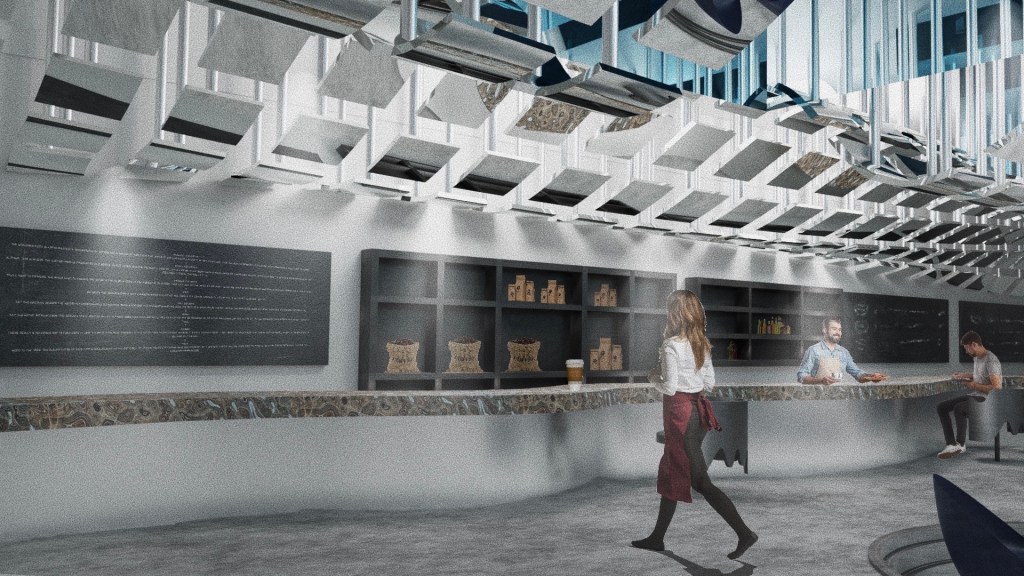
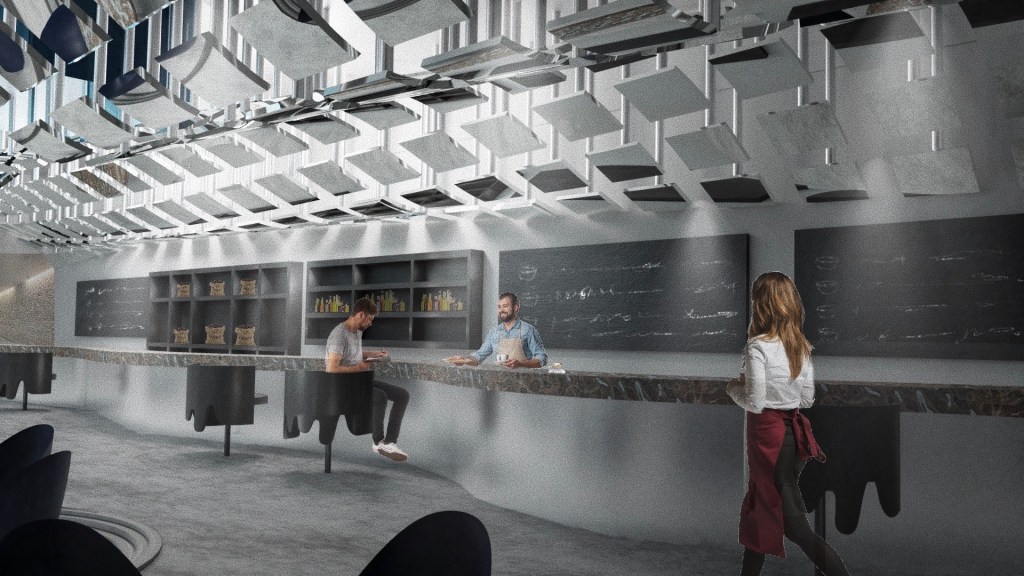
I checked various menus in different styles and finally decided to use the blackboard as the background. The first blackboard will be the cafe menu. The second blackboard will introduce a variety of different coffees for guests to understand. The third blackboard at the end will introduce the coffee making process, and consumers can learn how to make coffee in this area.

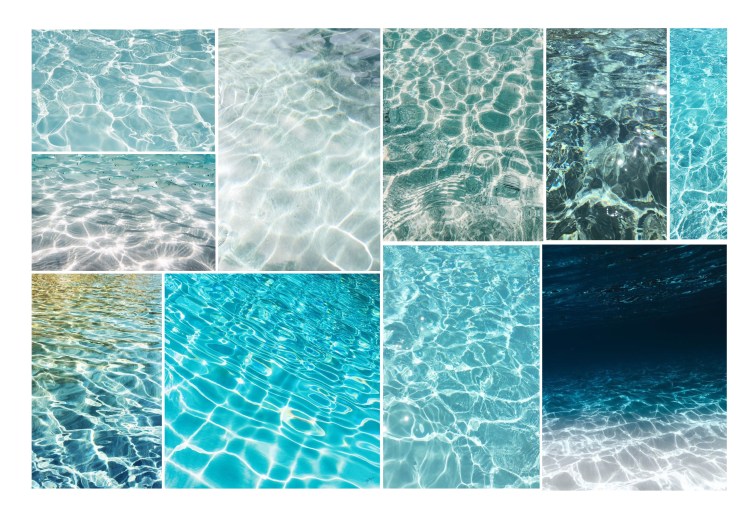
water ripper

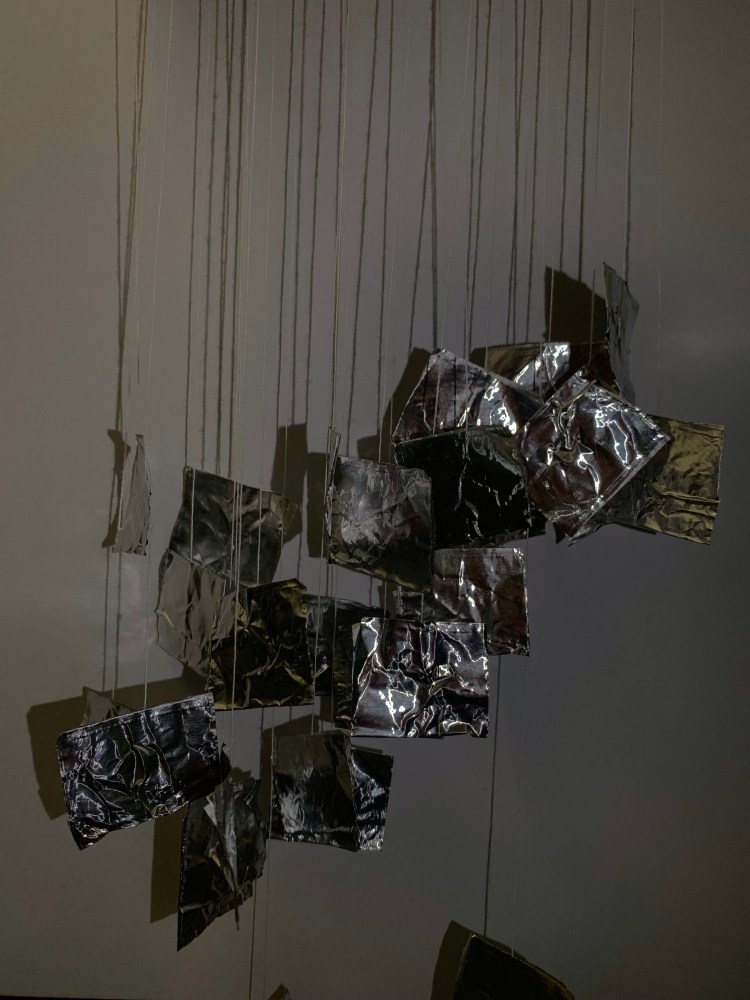
The material of the installation on the roof is similar to a mirror, and it also emits a shining light, just as dazzling as the sea level. So I collected a variety of different sea level photos to compare their differences in different environments.

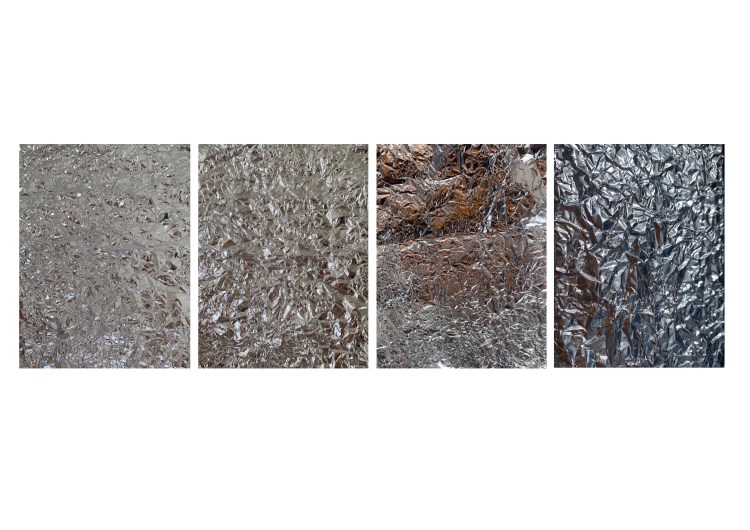
Material test

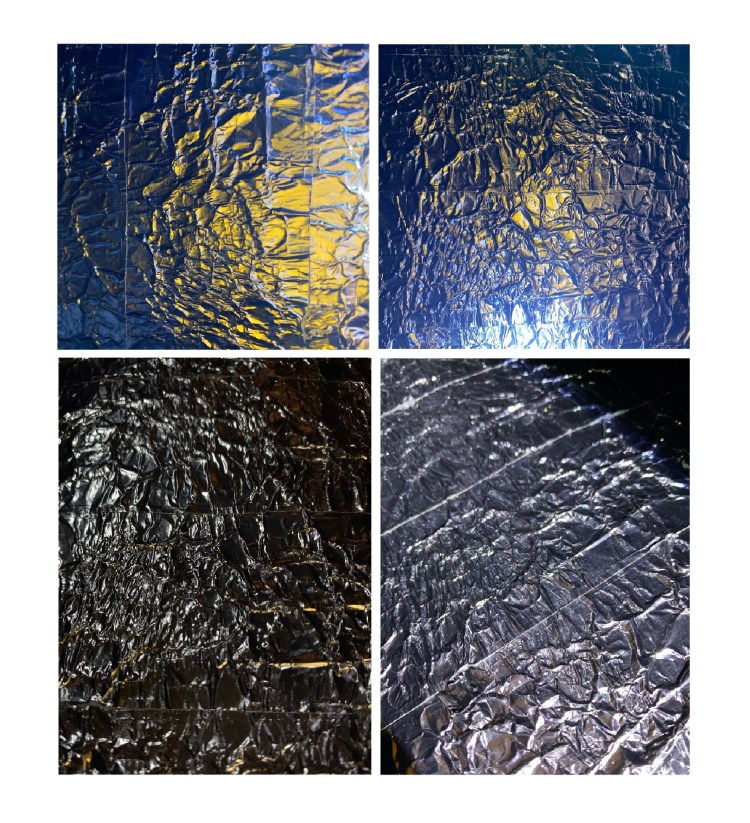
This is still a test to see how the tin foil reacts under different light. Because this is similar to the tabletop material in the cafe, I am thinking about whether the tabletop will change with the change of light. The conclusions reached are subject to change. When the light is brighter, the desktop will be brighter, and when the light is dark, the desktop will also become darker. This is a very interesting change.

Week 10: Design Workshop

This is an informal presentation, and I prepared my work very carefully. But because time is limited, it is not very complete. I am very happy that I got some feedback. 1. The picture is not clear enough, I should try to use blender and other software to make my work look more complete. 2. The section lines are too messy and should be adjusted. 3. The color contrast is not clear enough. 4. The possibility of continuing to try other materials. 5. The overall atmosphere is too dark.
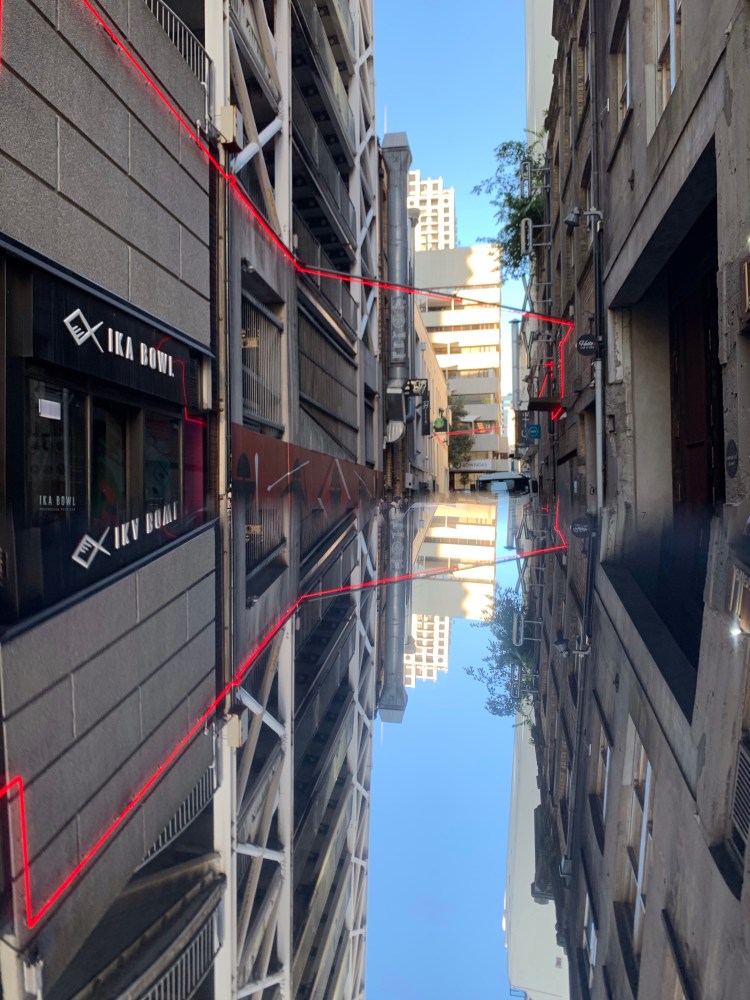
I am very happy to get your feedback, and I will continue to improve my work. I will use blender to complete the rendering, which I think will make my design clearer. At the same time, I will continue to try to use other materials and use Photoshop and other software to improve my design.

Week 12: Final Design Presentation
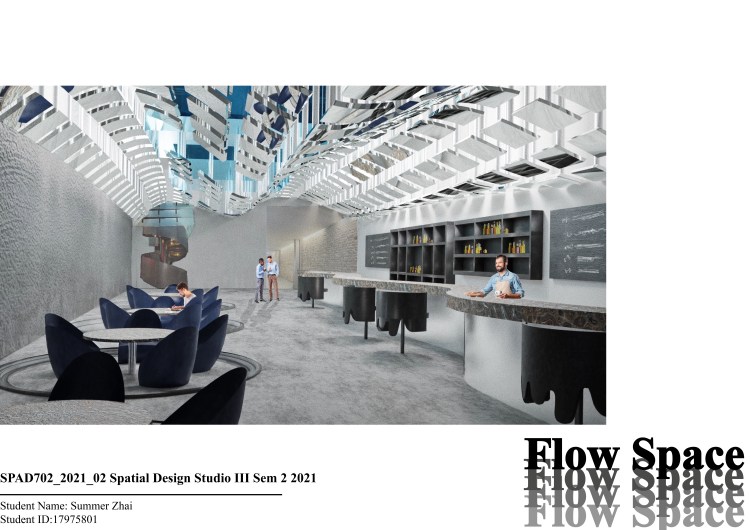
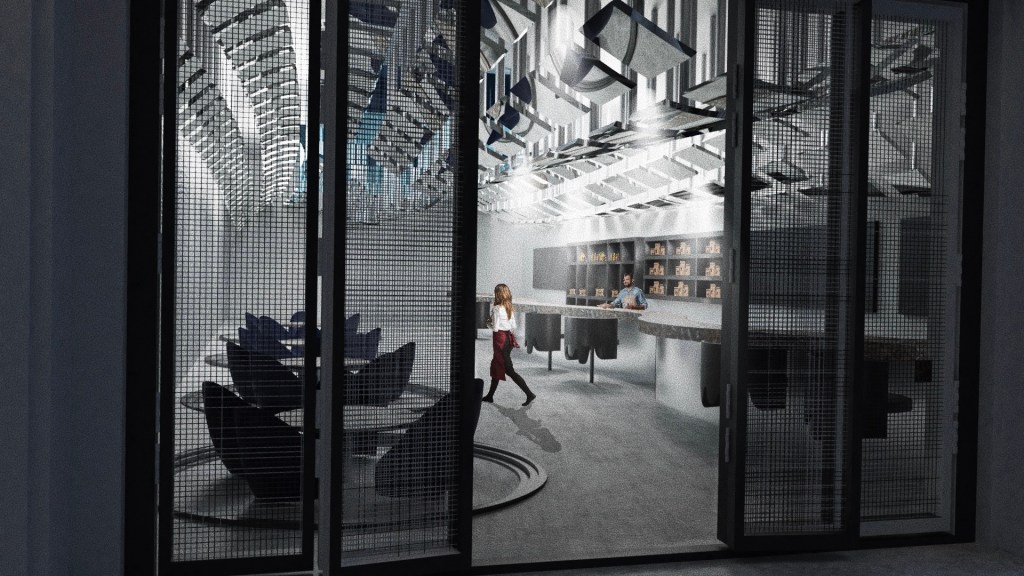
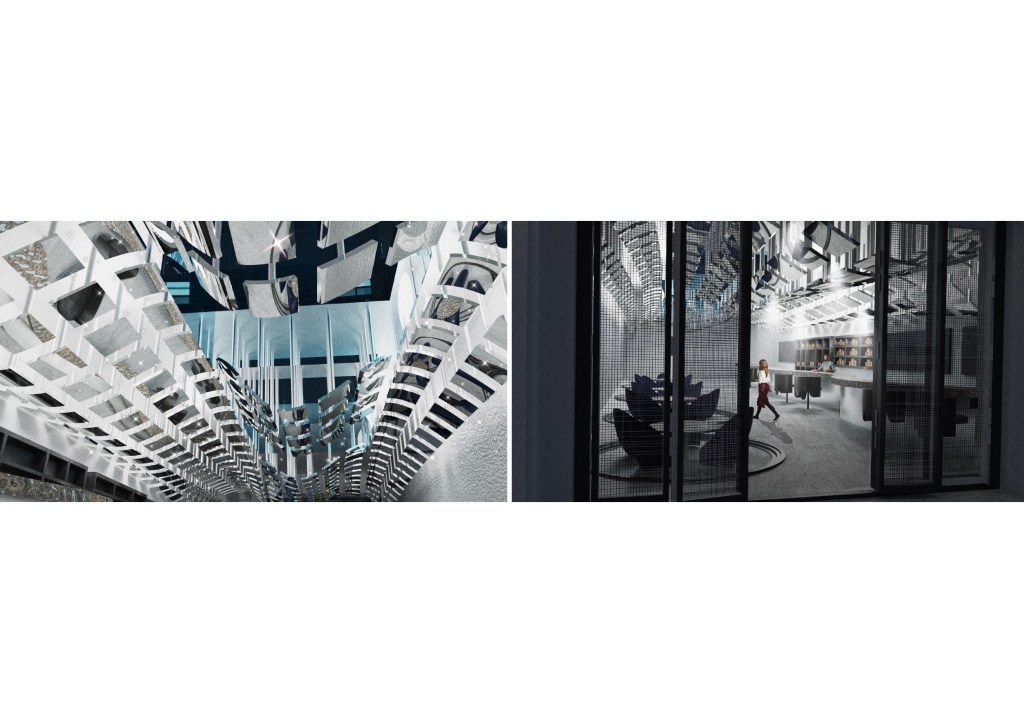
In this presentation, I got some very important feedback. 1. The room is too bright and the original environment is very dark, which is difficult to change. 2. Some materials still need to be improved and explored. 3. The pictures of the interior should be displayed only when the exterior is seen. 4. The roof device would be better if it can shake. 5. Keep the typesetting font size consistent. 6. Clear the size.

Develop
The bouni beach bar
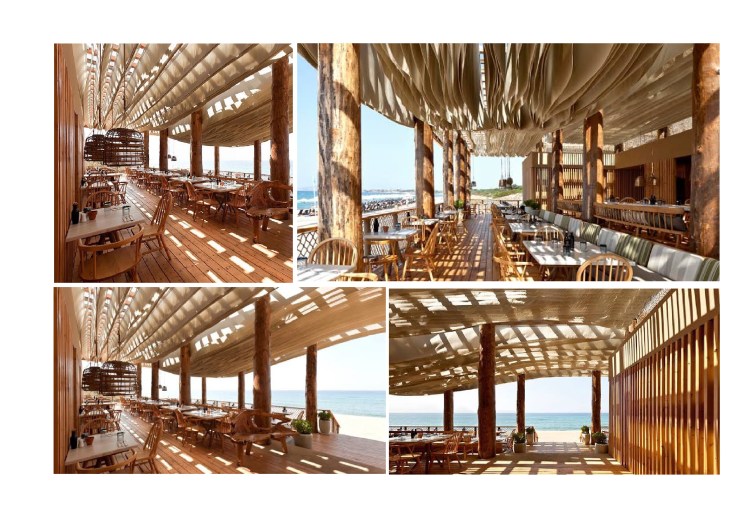
The bouni beach bar

“It is echoing exactly the landscape. So when there’s loads of waves this is quite an animated ceiling and other times it’s quite slow so it’s quite fun,” says Karampatakis. “[The architects] wanted to allow the wind to animate and play with the building in the same way that it animates and plays with the water surface, so that the building and the sea are in tune with each other and connected by the movement of the wind from moment to moment,” says Sbokou-Constantakopoulou. “The architects took inspiration for the Barbouni roof from the dynamic and hypnotic movement of the waves of the sea in front of the restaurant,” Costantza Sbokou-Constantakopoulou, the Senior Architect at TEMES, the developers behind Costa Navarino, tells CNN Travel.

This is a very interesting design. The designer hangs the fabric on the roof to make the fabric sway through the wind. This is also a water-related design. A design that is unforgettable after a glance. Unfortunately I cannot upload the video.
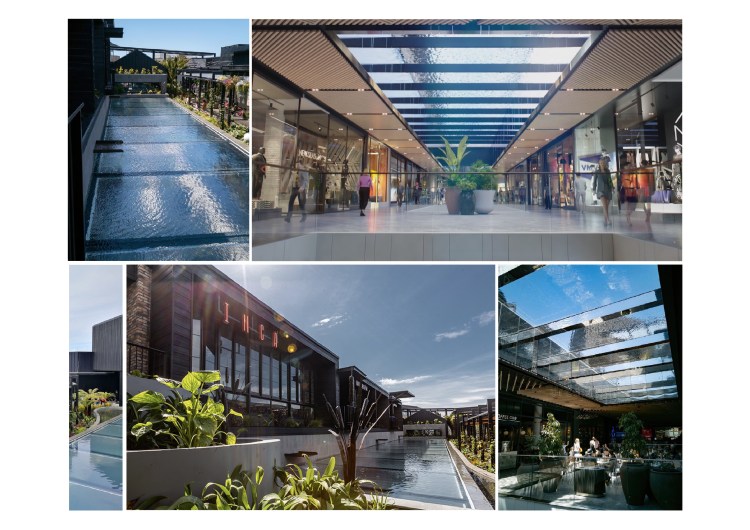
Westfiled newmarket

There is a flowing water design on the roof of the newly built westfiled newmarket. The glass roof is combined with the flowing water, and different water ripples and highlights can be seen under different light and shadow. This is a design worthy of my study and reference.

The second blackboard content
Different types of coffee
Black

Black coffee is as simple as it gets with ground coffee beans steeped in hot water, served warm. And if you want to sound fancy, you can call black coffee by its proper name: cafe noir. Since it isn’t doctored up with milk or sugar, the quality of coffee is especially important. Treat yourself to a coffee subscription box to find your favorite style.

Latte

As the most popular coffee drink out there, the latte is comprised of a shot of espresso and steamed milk with just a touch of foam. It can be ordered plain or with a flavor shot of anything from vanilla to pumpkin spice. (Here’s how to make a copycat Starbucks pumpkin spice latte.)

Cappuccino

Cappuccino is a latte made with more foam than steamed milk, often with a sprinkle of cocoa powder or cinnamon on top. Sometimes you can find variations that use cream instead of milk or ones that throw in flavor shot, as well.

Americano

With a similar flavor to black coffee, the americano consists of an espresso shot diluted in hot water. Pro tip: if you’re making your own, pour the espresso first, then add the hot water.

Espresso

An espresso shot can be served solo or used as the foundation of most coffee drinks, like lattes and macchiatos.

Doppio

A double shot of espresso, the doppio is perfect for putting extra pep in your step.

Cortado

Like yin and yang, a cortado is the perfect balance of espresso and warm steamed milk. The milk is used to cut back on the espresso’s acidity.

Red Eye

Named after those pesky midnight flights, a red eye can cure any tiresome morning. A full cup of hot coffee with an espresso shot mixed in, this will definitely get your heart racing.

Galão

Originating in Portugal, this hot coffee drink is closely related to the latte and cappuccino. Only difference is it contains about twice as much foamed milk, making it a lighter drink compared to the other two.

Lungo

A lungo is a long-pull espresso. The longer the pull, the more caffeine there is and the more ounces you can enjoy.

Macchiato

The macchiato is another espresso-based drink that has a small amount of foam on top. It’s the happy medium between a cappuccino and a doppio.

Mocha

For all you chocolate lovers out there, you’ll fall in love with a mocha (or maybe you already have). The mocha is a chocolate espresso drink with steamed milk and foam.

Ristretto

Ristretto is an espresso shot. It uses less hot water which creates a sweeter flavor compared to the bitter taste of a traditional shot of espresso or a doppio.

Flat White

This Aussie-born drink is basically a cappuccino without the foam or chocolate sprinkle. It’s an espresso drink with steamed milk.

Affogato

The affogato is an excuse to enjoy a scoop of ice cream any time of day (and any time of year in my opinion). Served with a scoop of ice cream and a shot of espresso, or two. The affogato is extra delish served over a brownie.

Café au Lait

Café au lait is perfect for the coffee minimalist who wants a bit more flavor. Just add a splash of warm milk to your coffee and you’re all set!

Irish

Irish coffee consists of black coffee, whiskey and sugar, topped with whipped cream. Here’s an Irish coffee recipe that will warm you right up.

The third blackboard content
HOW TO MAKE THE PERFECT CUP OF COFFEE

Measure your coffee.
The standard ratio is approximately 2 tablespoons of coffee per 6 ounces of water. Don’t be afraid to add a few extra beans to be on the safe side – you can more approximately measure out your coffee using a scale after it’s ground.

Grind your coffee.
Alright, this is where the coffee-making process really begins. Go for a finer roast if you want a sweeter cup of coffee, or a coarser grind if you’re aiming for a satisfying, weighty bitter. Make sure the grinder is clean before using, then feel free to press the magic button.

Prepare the water.
You’ll want to prepare the water last, to ensure the water is the temperature you’re aiming for. Pour from the filter, and let the water sit off from the boil for about 30 seconds before immersing your coffee grounds in the French Press.

Pour.
Saturate the grounds evenly with a smooth, steady pour that will agitate the coffee grounds. Do not put the lid on top of the brewer just yet.

Soak and stir.
Let the grounds absorb the water for approximately 30 seconds before stirring – a few gentle motions using the back of a spoon around the top layer of the mixture and along the sides, to immerse any grounds that are stuck.

Brew.
Let the water extract from the grounds for 2 minutes and 30 seconds. Less than that, and you’ll find your coffee may be too sweet or even sour. Any longer, and your coffee will be over-extracted and unappetizingly bitter – so, set a timer.

Plunge.
There really is no wrong way to push here – just a simple, even push-through of the filter down to the bottom. However, it’s not a clogged toilet – don’t exert too much force or, of course, your coffee will splash. Or you may break the machine, if it’s glass.

Pour.
Word to the wise: The flavor notes of your coffee will change as the cup cools. If at first you’re not tasting what was intended, let it continue to setup. What you taste when it’s piping hot is not what you’ll taste when it’s cooled to a lukewarm temperature.

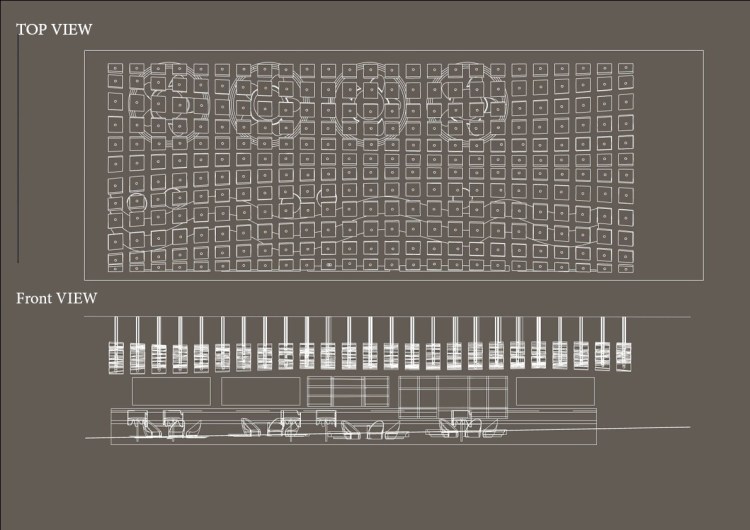
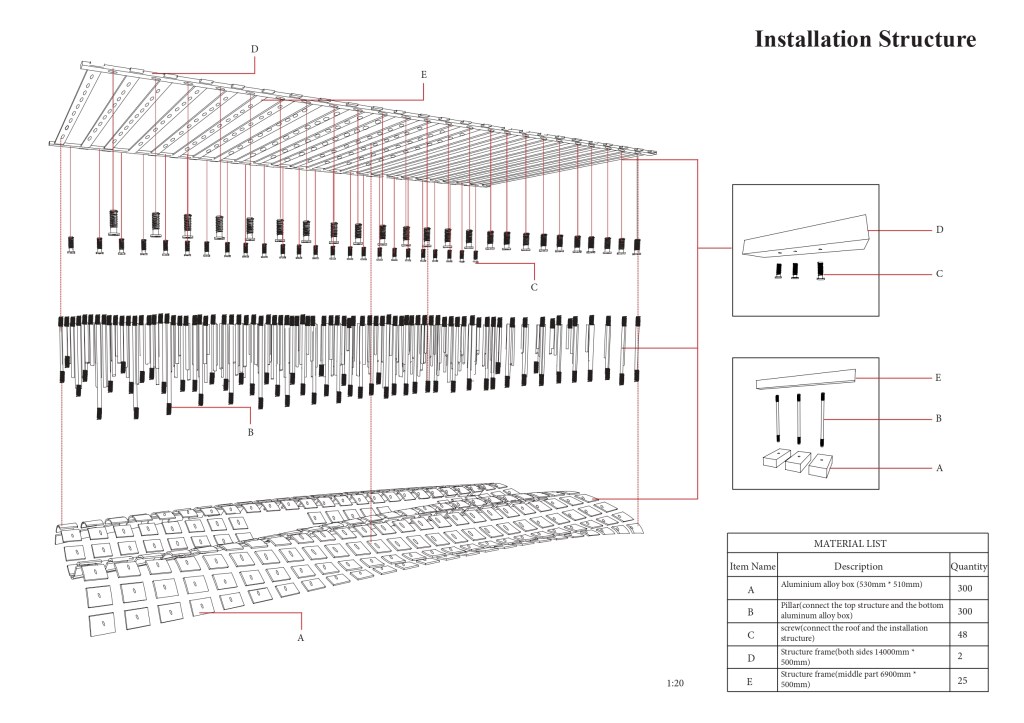
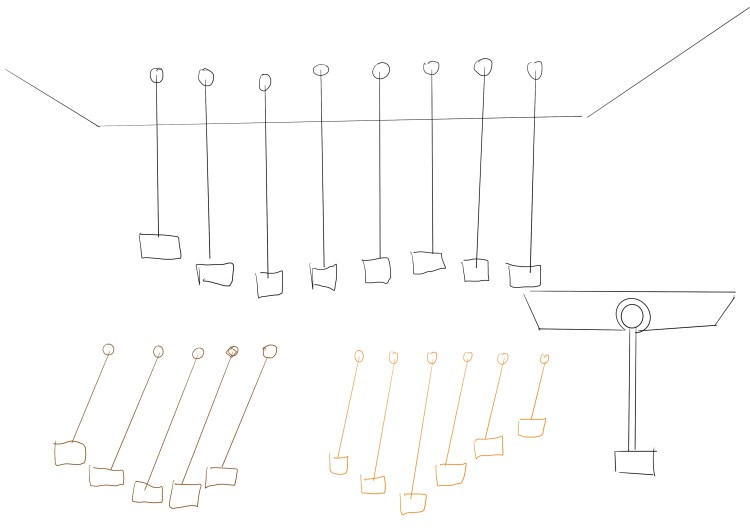
Installation can be move
Draft structure

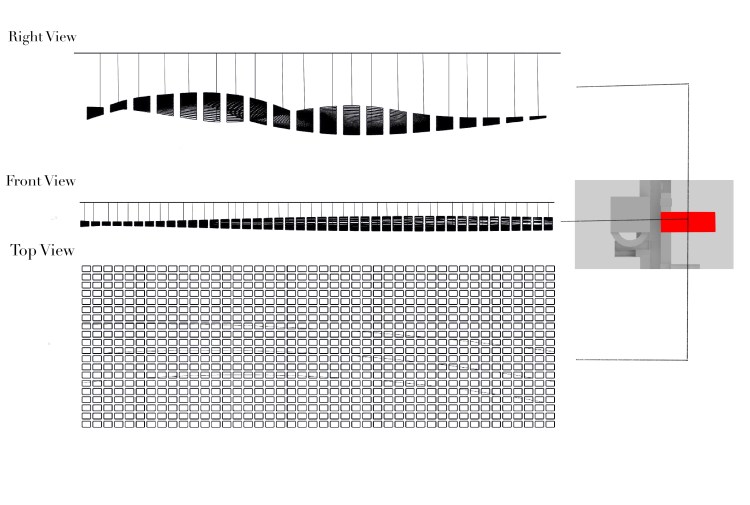
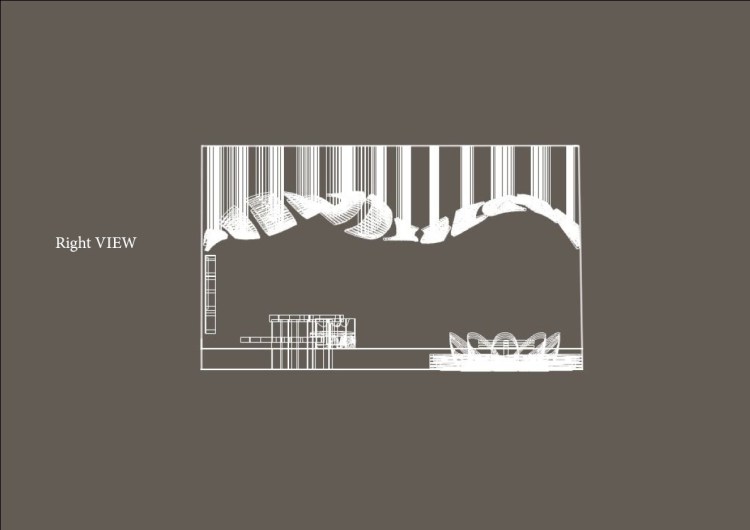
If the structure of the upper part of the device is changed, the device on the roof will shake with the wind, and the greater the wind, the greater the shaking. The circular structure can make the device shake.

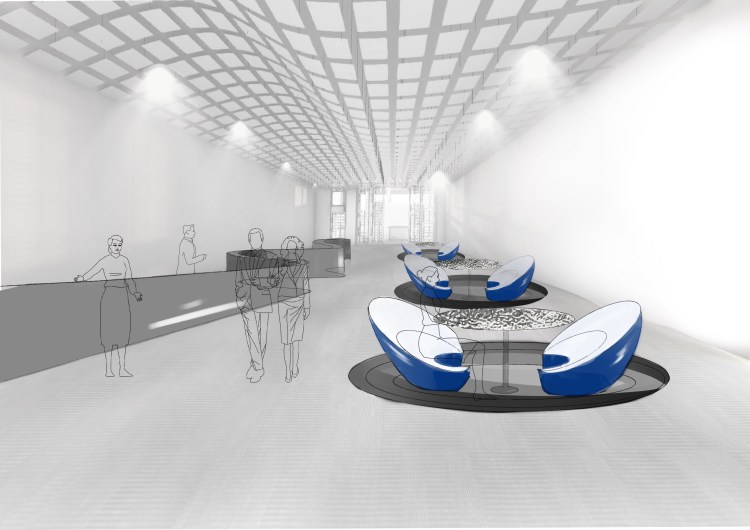
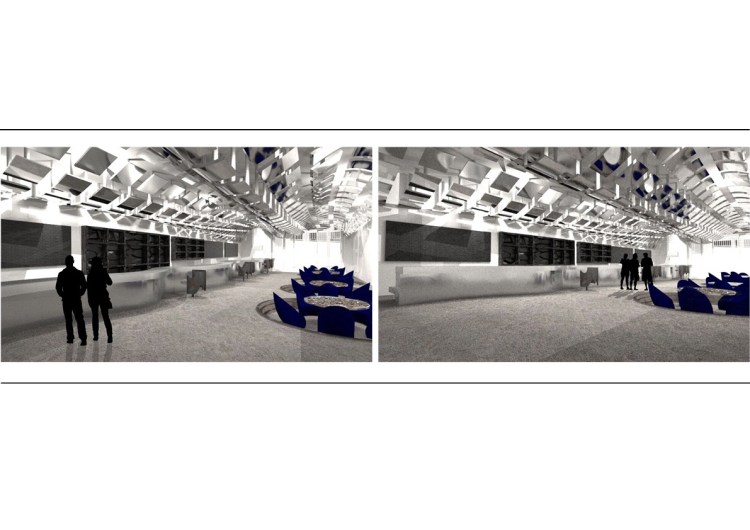
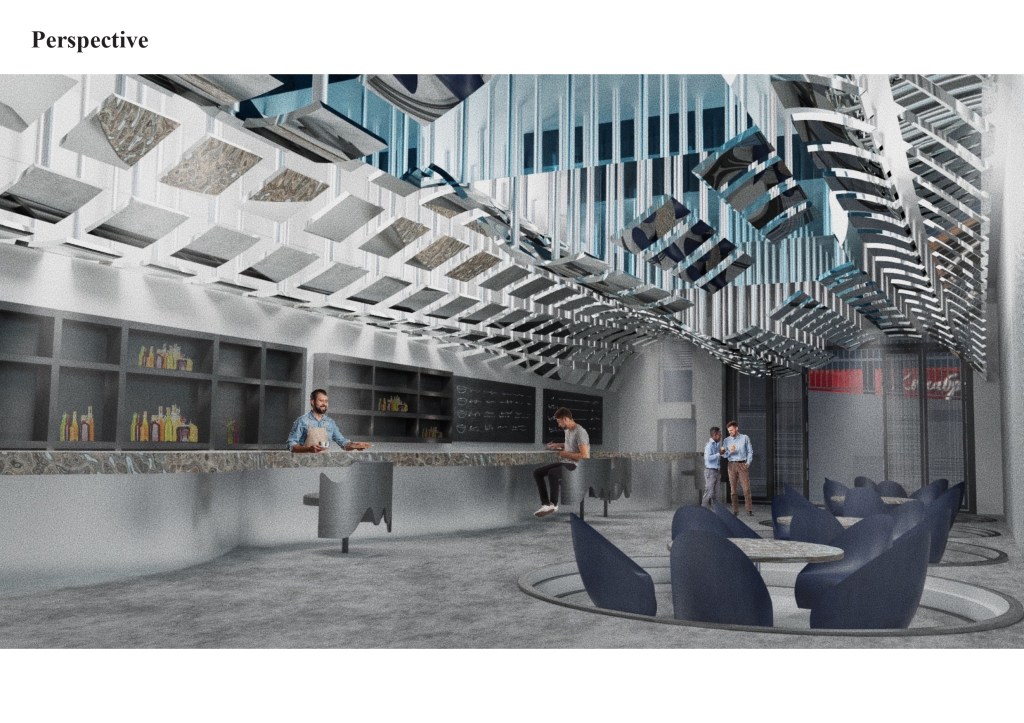
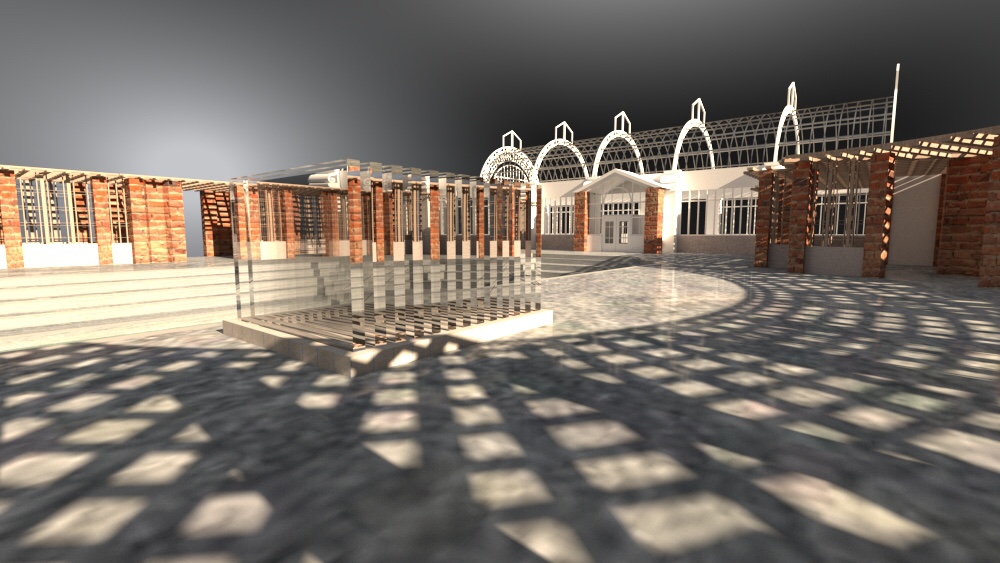
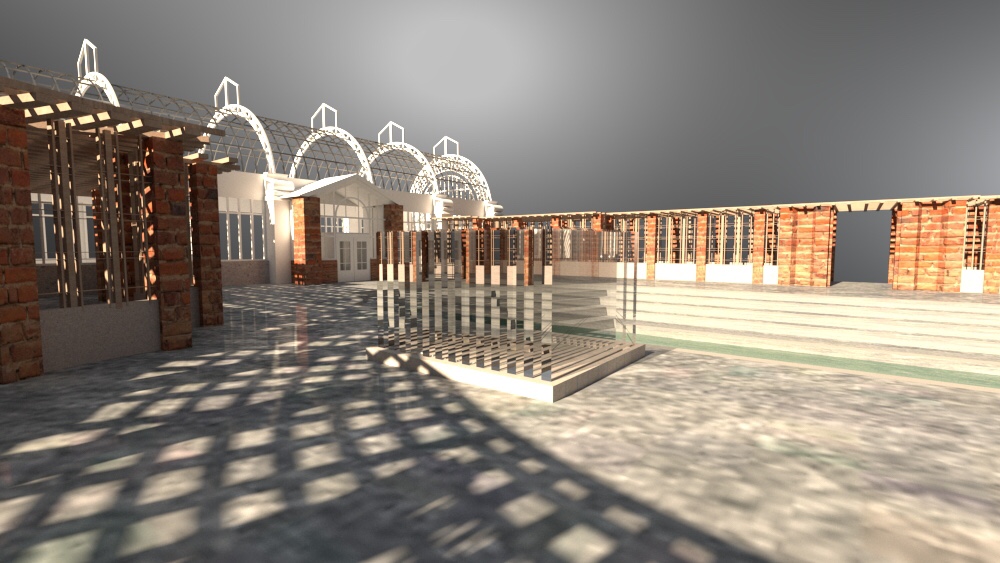
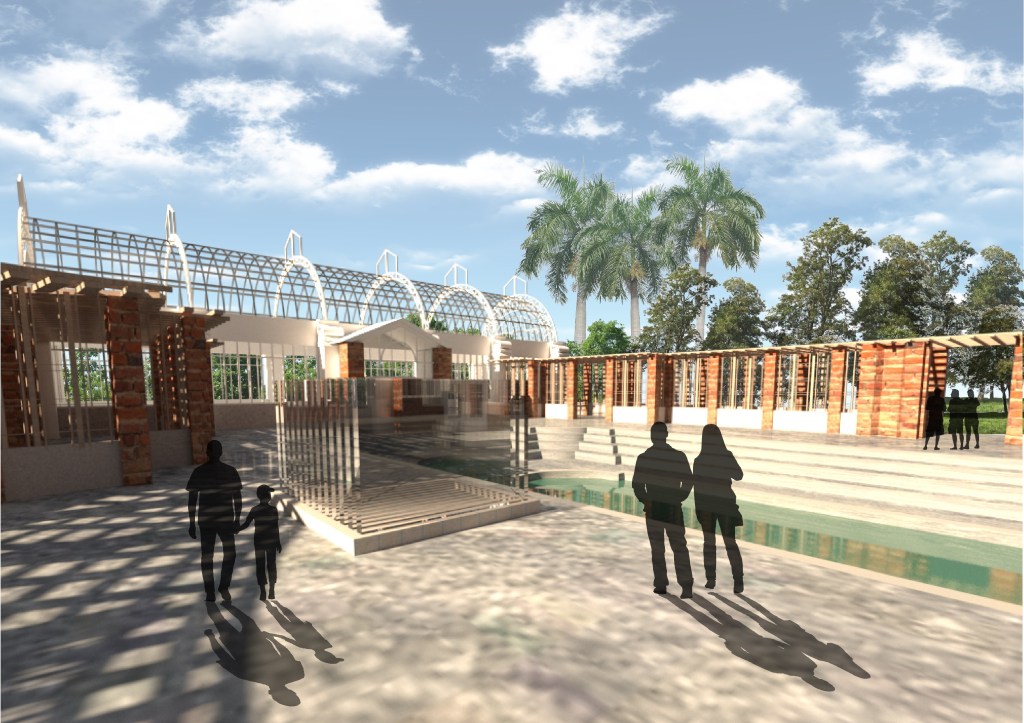
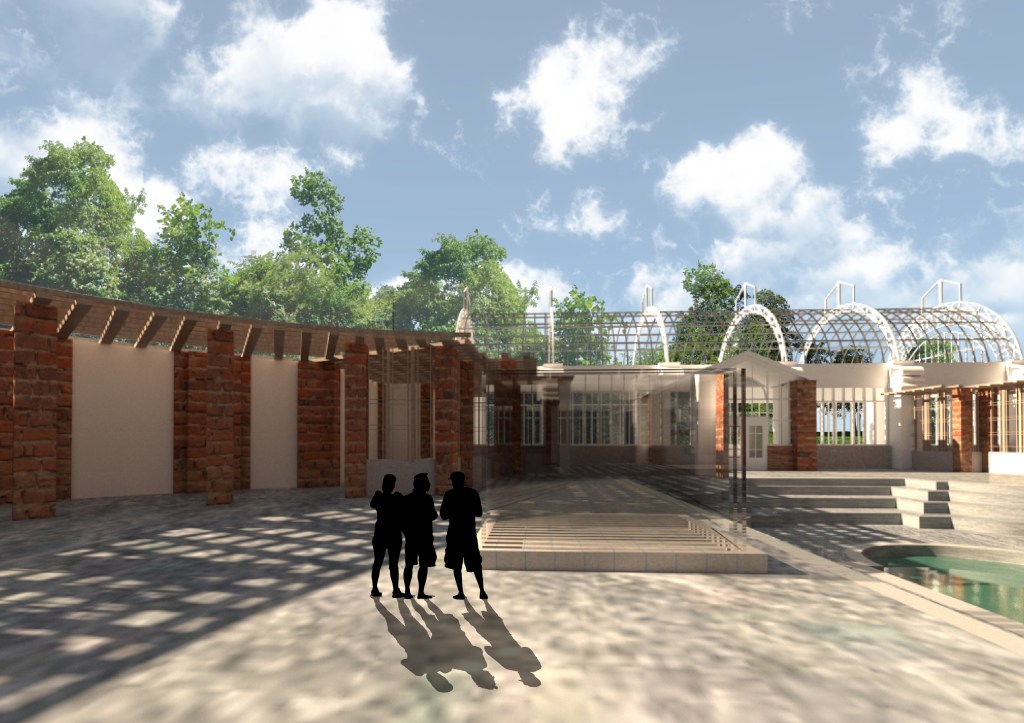
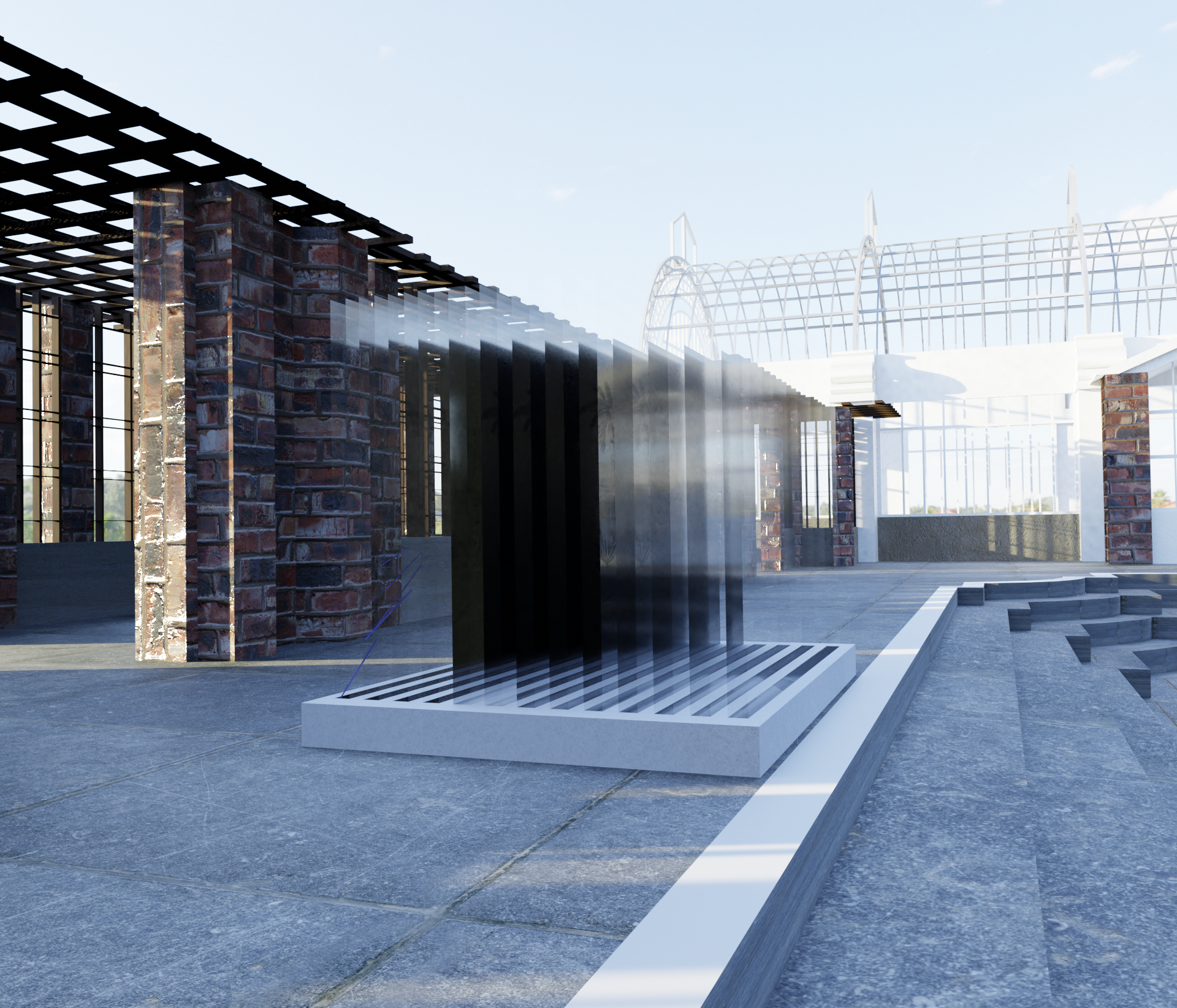
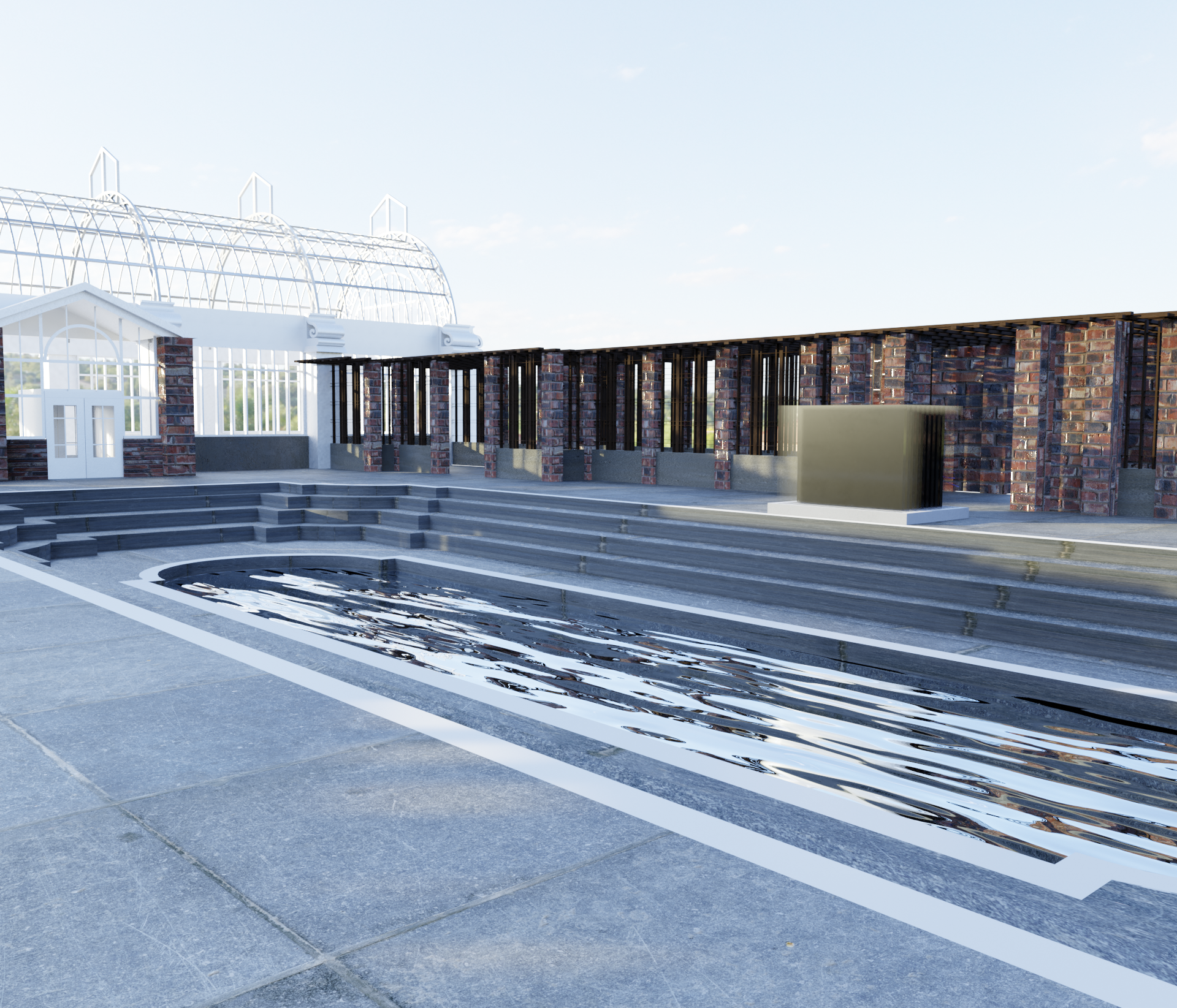
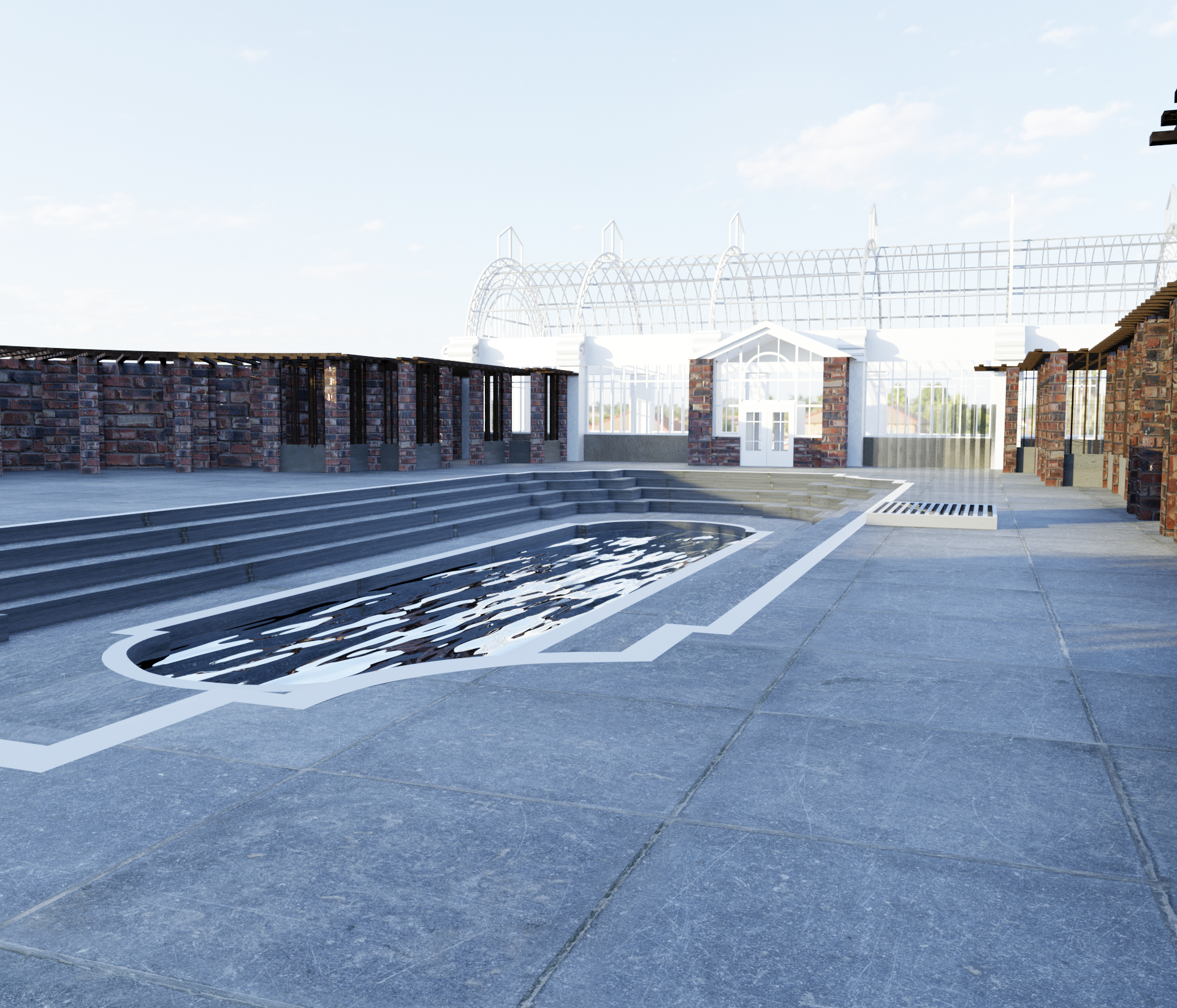
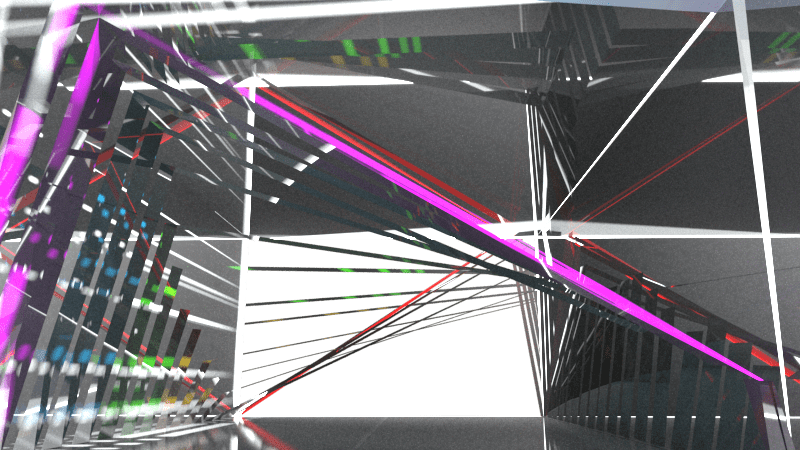
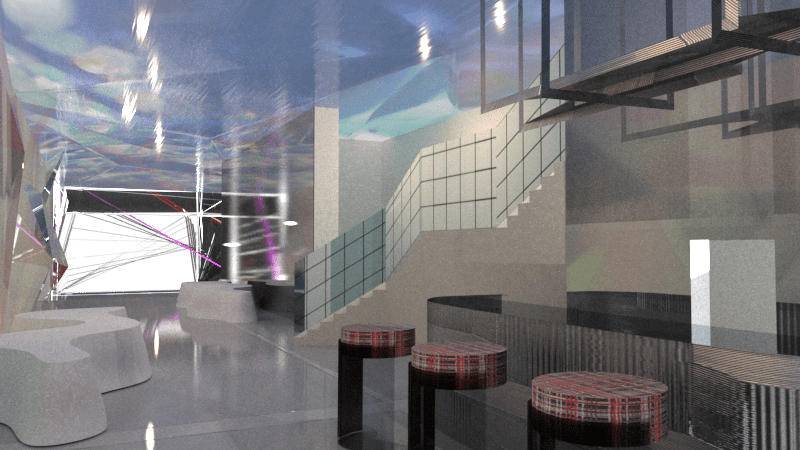
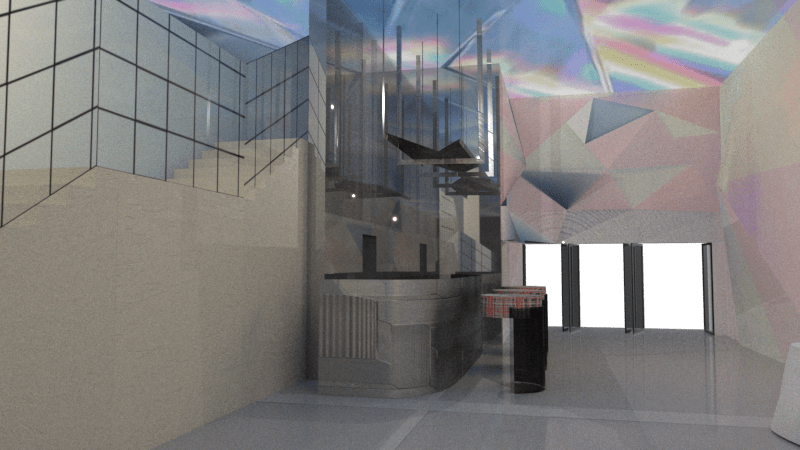
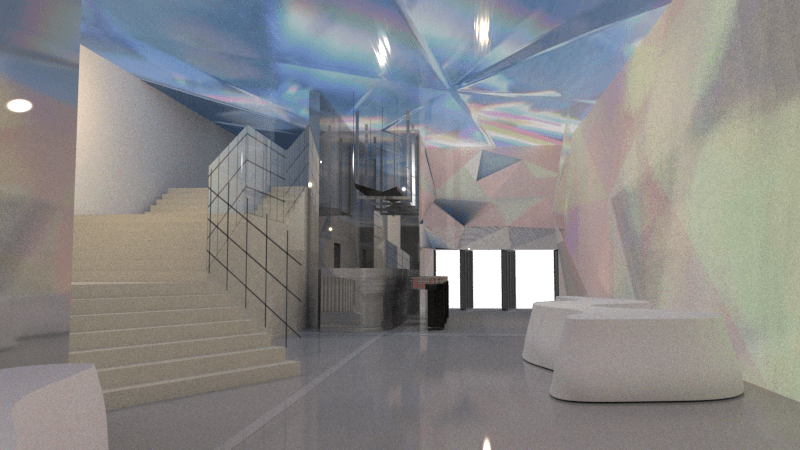
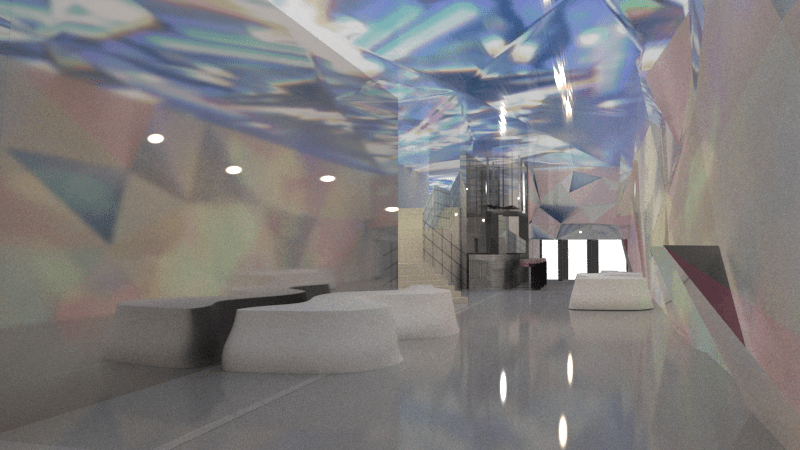
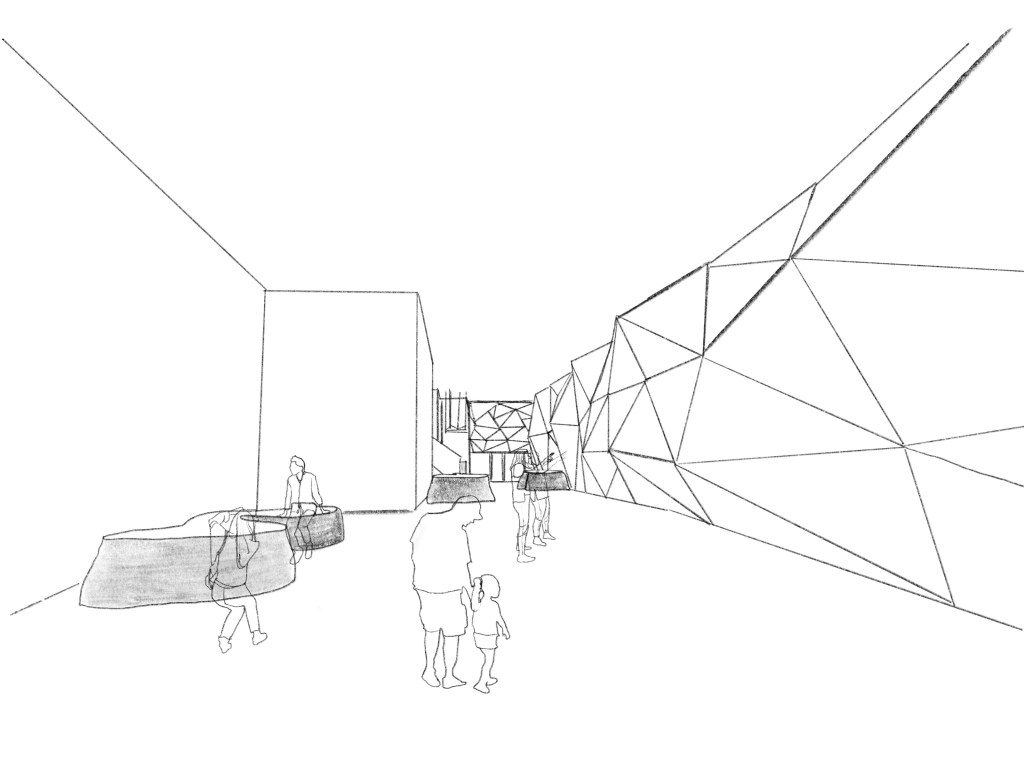
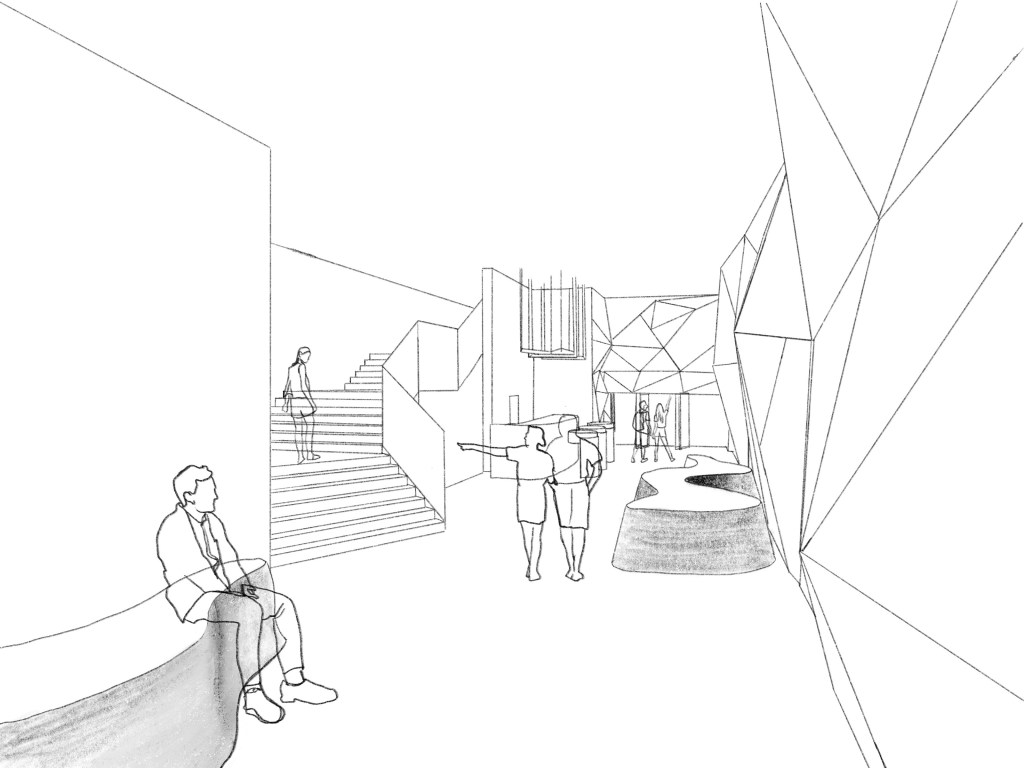
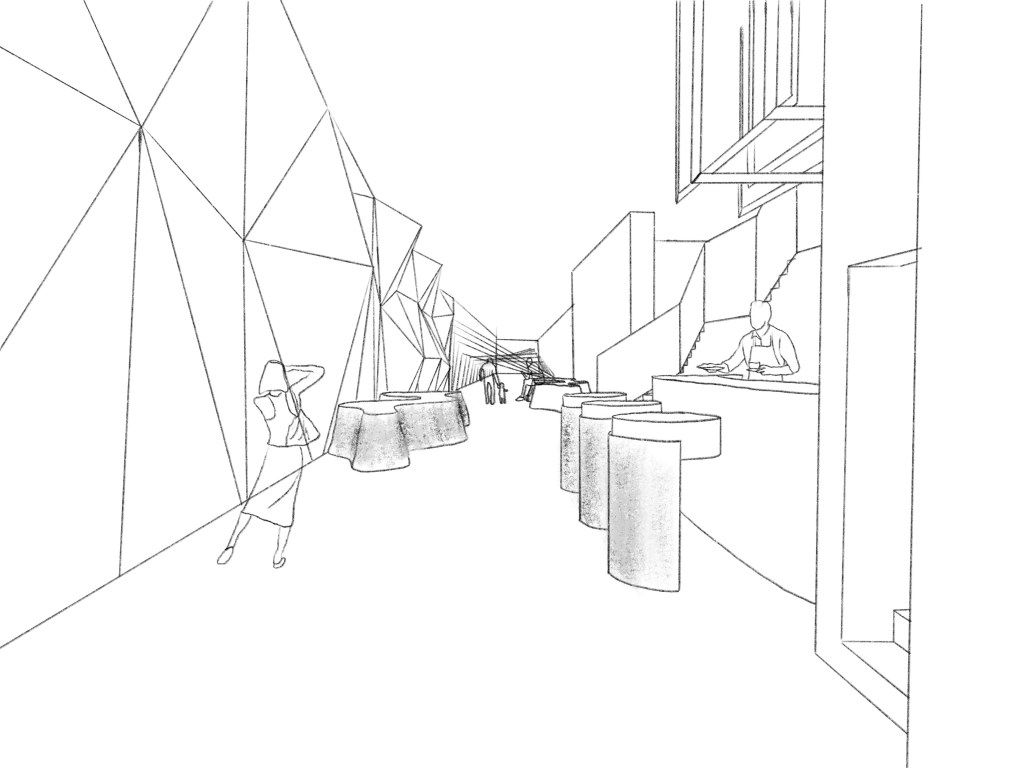
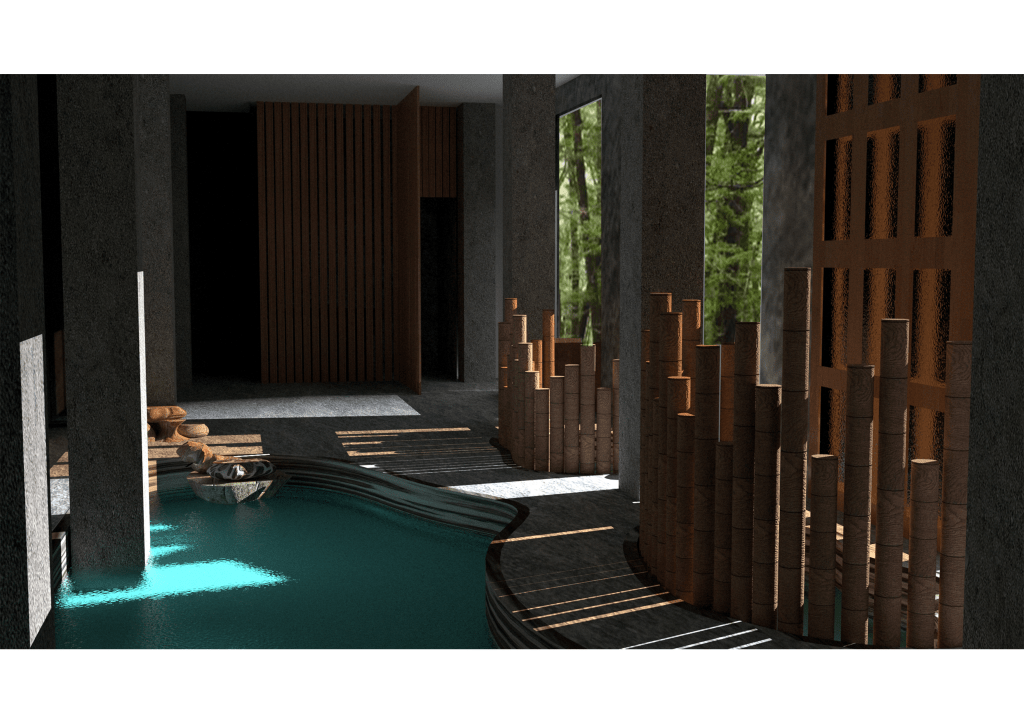
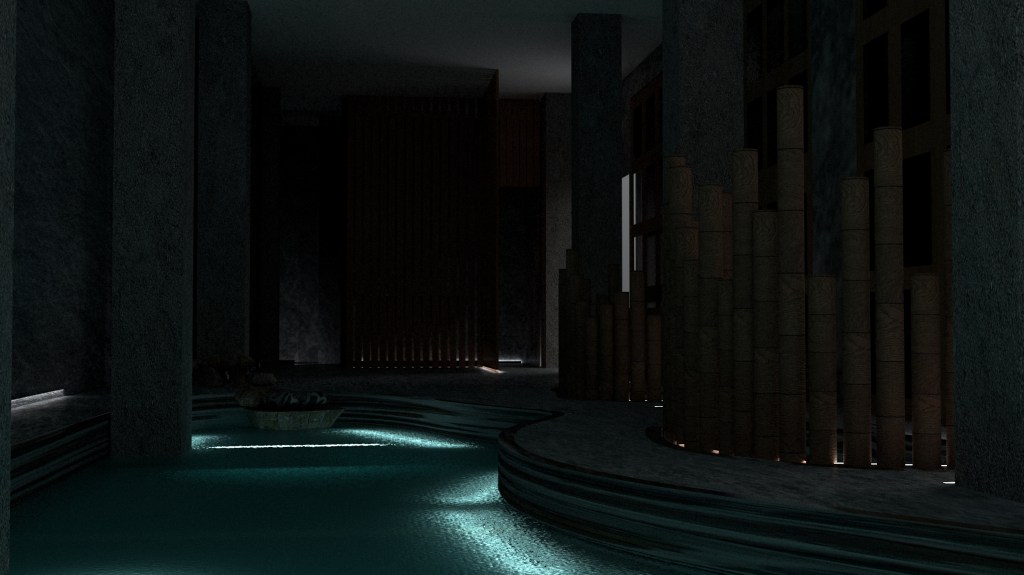
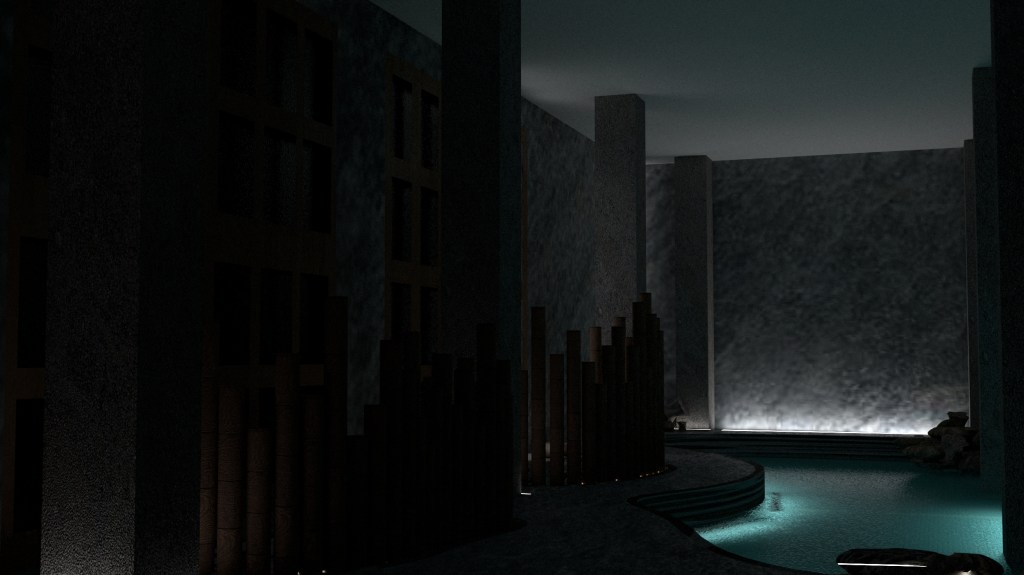
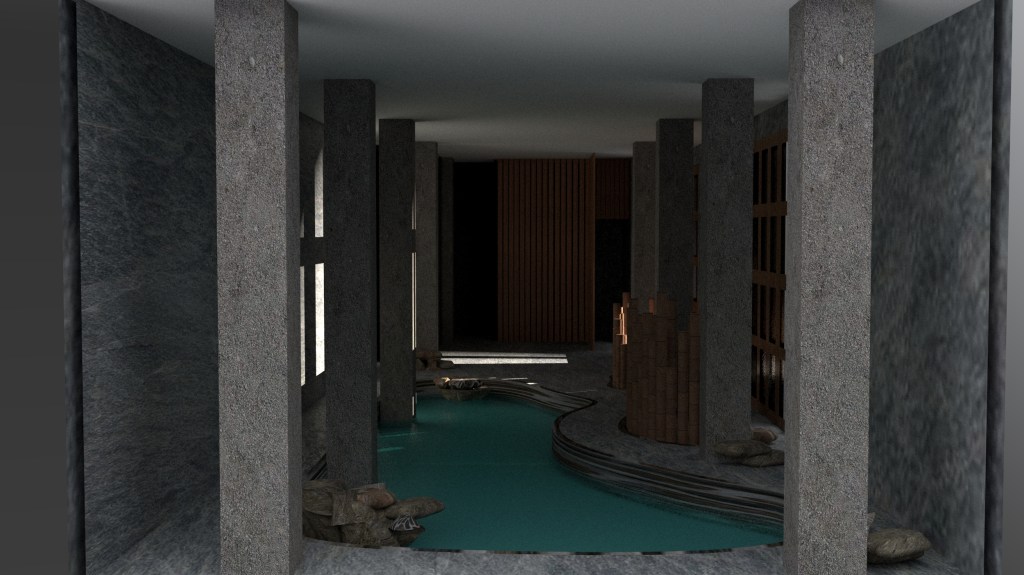
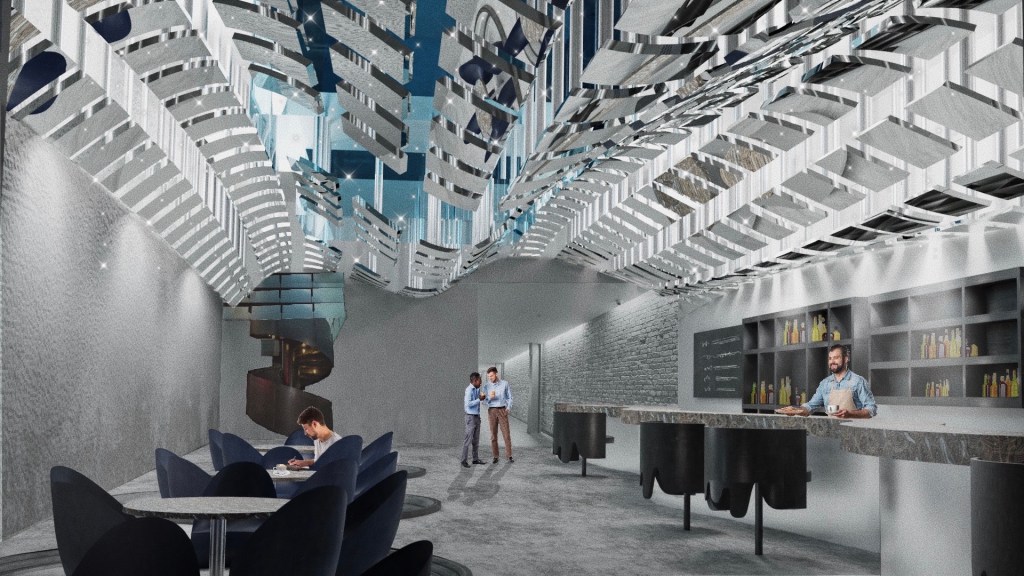
Render Image
Final Portfolio

Introduction

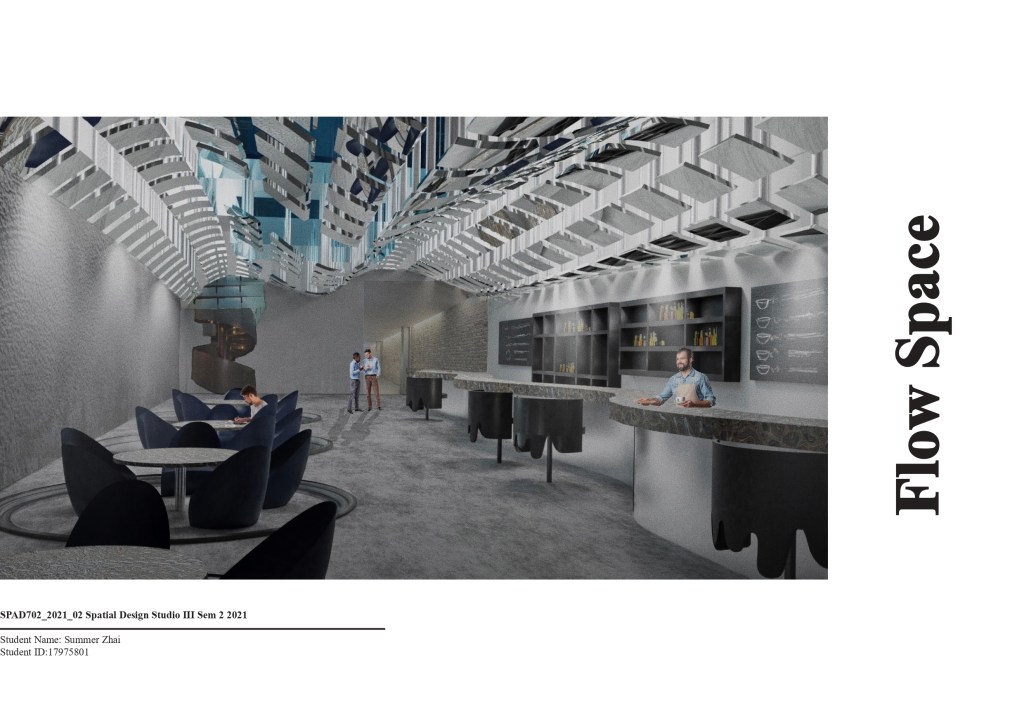
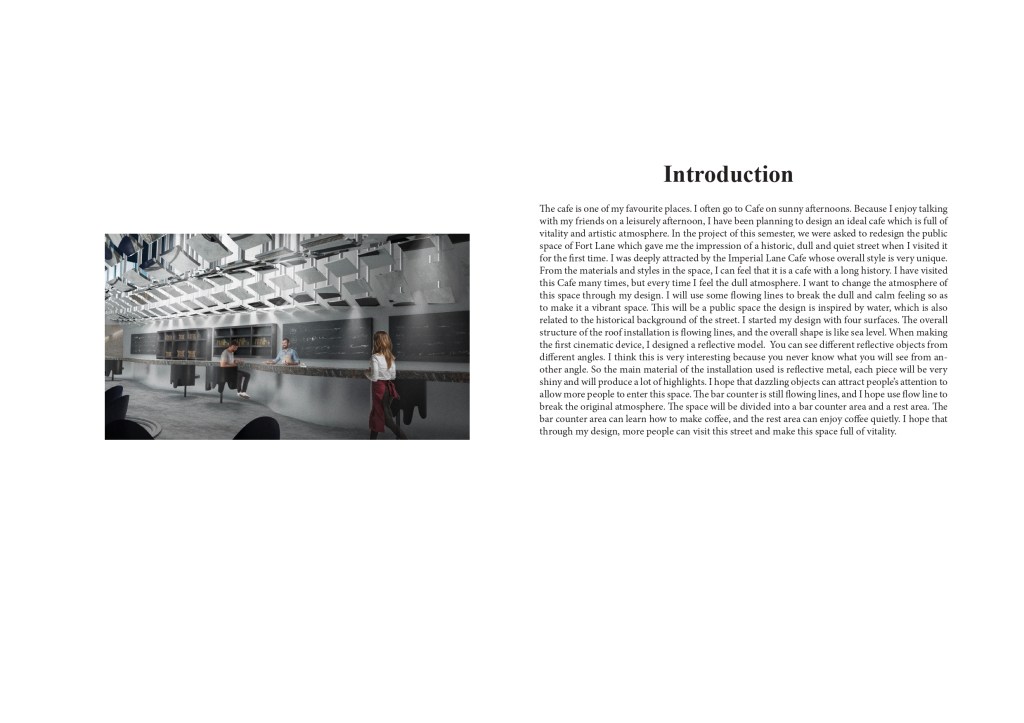
The cafe is one of my favourite places. I often go to Cafe on sunny afternoons. Because I enjoy talking with my friends on a leisurely afternoon, I have been planning to design an ideal cafe which is full of vitality and artistic atmosphere. In the project of this semester, we were asked to redesign the public space of Fort Lane which gave me the impression of a historic, dull and quiet street when I visited it for the first time. I was deeply attracted by the Imperial Lane Cafe whose overall style is very unique. From the materials and styles in the space, I can feel that it is a cafe with a long history. I have visited this Cafe many times, but every time I feel the dull atmosphere. I want to change the atmosphere of this space through my design. I will use some flowing lines to break the dull and calm feeling so as to make it a vibrant space. This will be a public space,the design is inspired by water, which is also related to the historical background of the street. I started my design with four surfaces. The overall structure of the roof installation is flowing lines, and the overall shape is like sea level. When making the first cinematic device, I designed a reflective model. You can see different reflective objects from different angles. I think this is very interesting because you never know what you will see from another angle. So the main material of the installation used is reflective metal, each piece will be very shiny and will produce a lot of highlights. I hope that dazzling objects can attract people’s attention to allow more people to enter this space. The bar counter is still flowing lines, and I hope use flow line to break the original atmosphere. The space will be divided into a bar counter area and a rest area. The bar counter area can learn how to make coffee, and the rest area can enjoy coffee quietly. I hope that through my design, more people can visit this street and make this space full of vitality.
Spatial Design

Year Three-Semester One

Brief

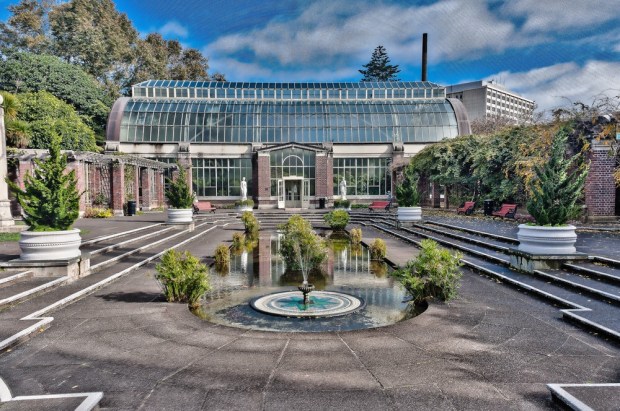
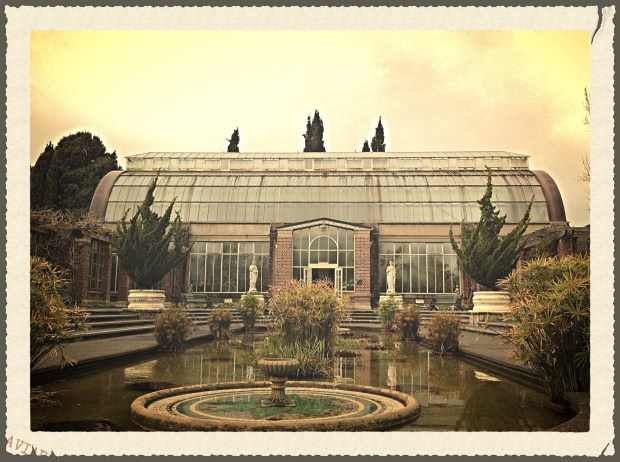
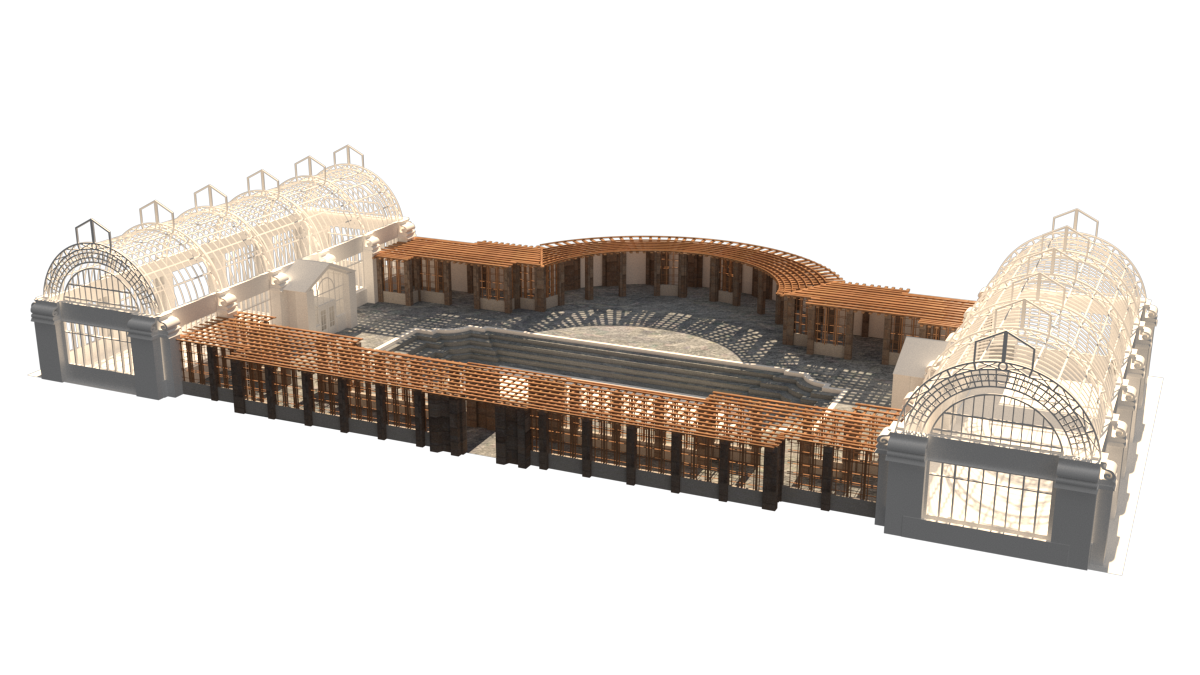
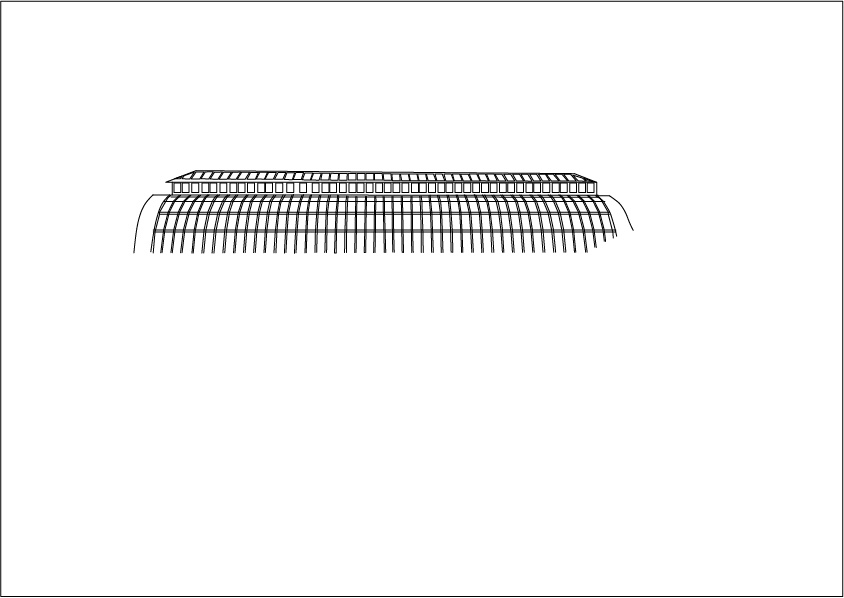
You are asked to propose a scheme for a refurbishment or temporary retrofitting of the Auckland Domain Winter Gardens, designed by Gummer and Ford and built in stages between 1916 and 1928. The gardens consist of two barrel-vaulted steel glasshouses (the Temperate House and the heated Tropical House), joined
by a courtyard and pergolas that back onto the Fernery (built into a former quarry). The complex is a Category 1 Heritage Site, so it’s highly protected, and therefore must be respected (you cannot demolish).

Week 1: Possibility

For this project we are to propose a scheme for a refurbishment or temporary retrofitting of the Auckland Domain Winter Gardens. In the early stage of the project, we will focus on research, find more information to get design inspiration, etc.

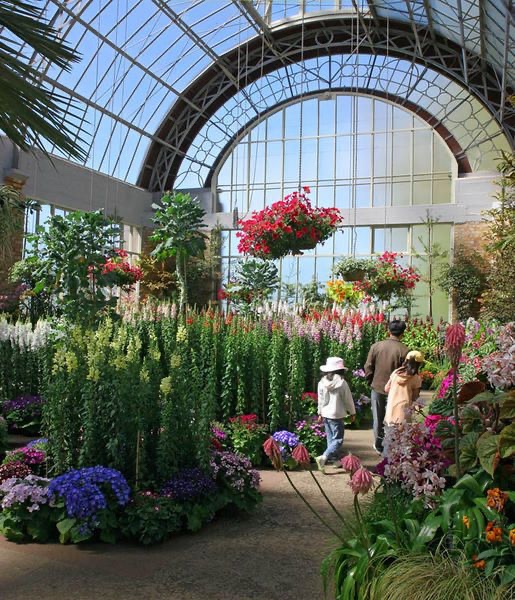
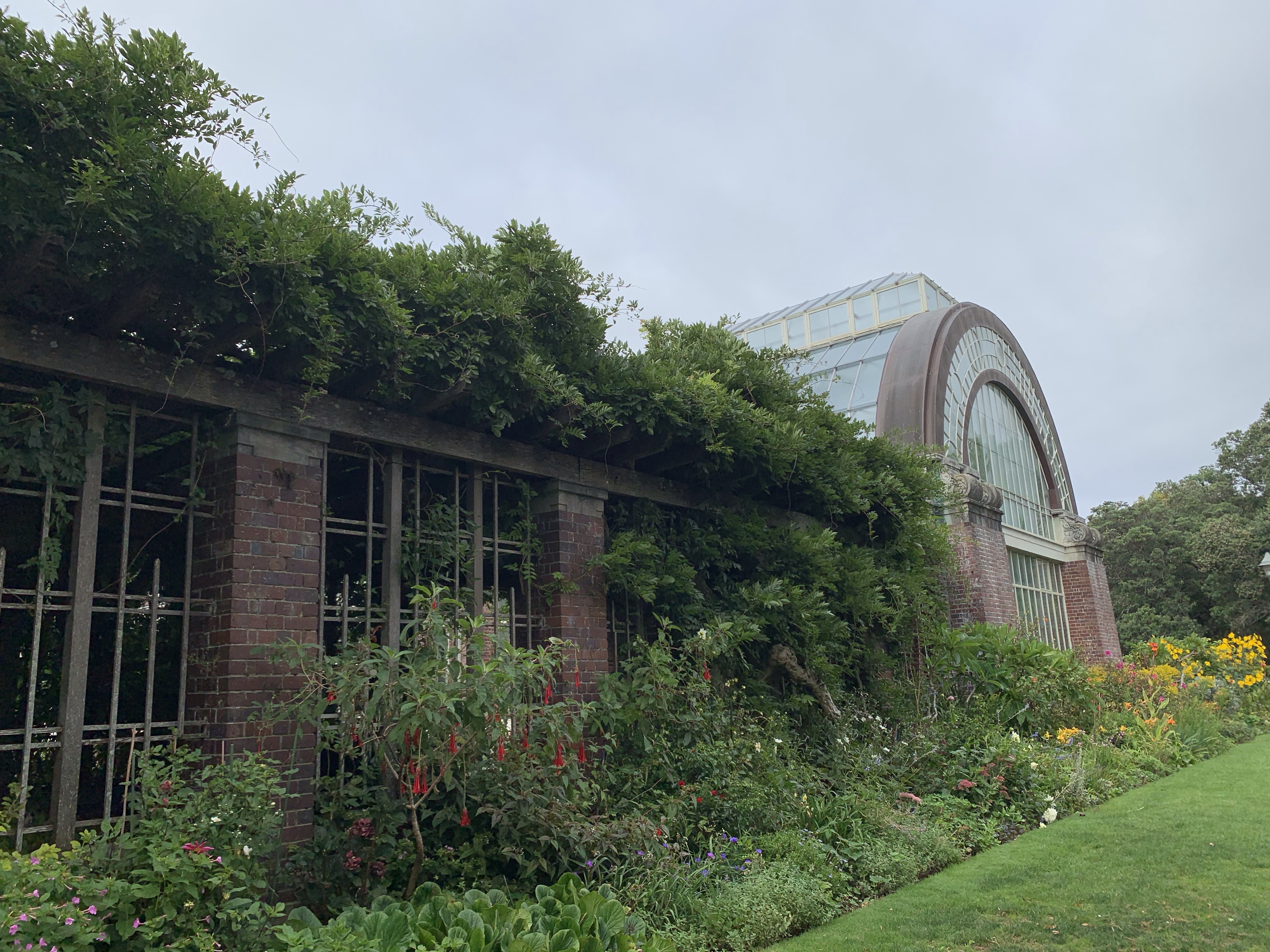
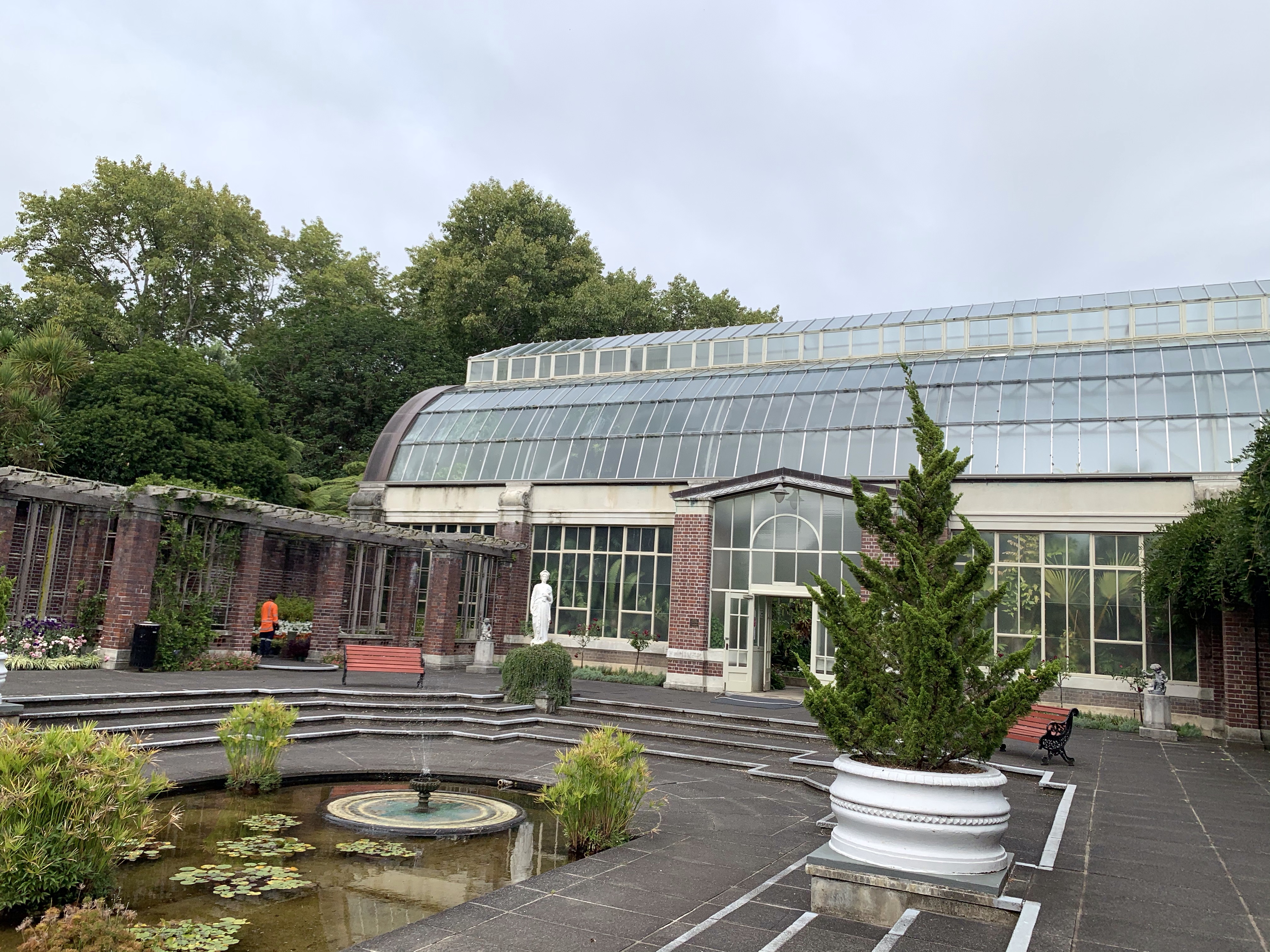
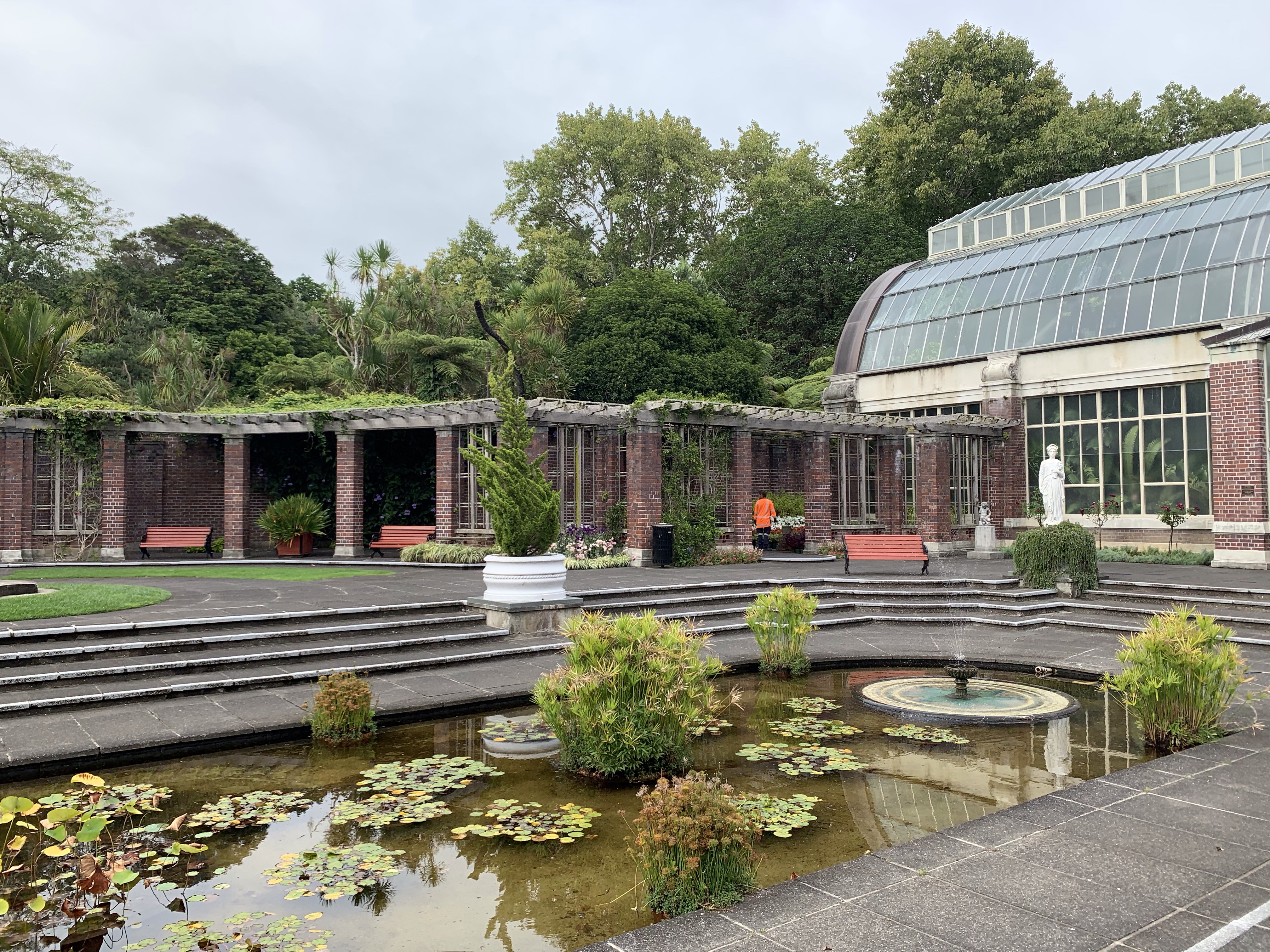
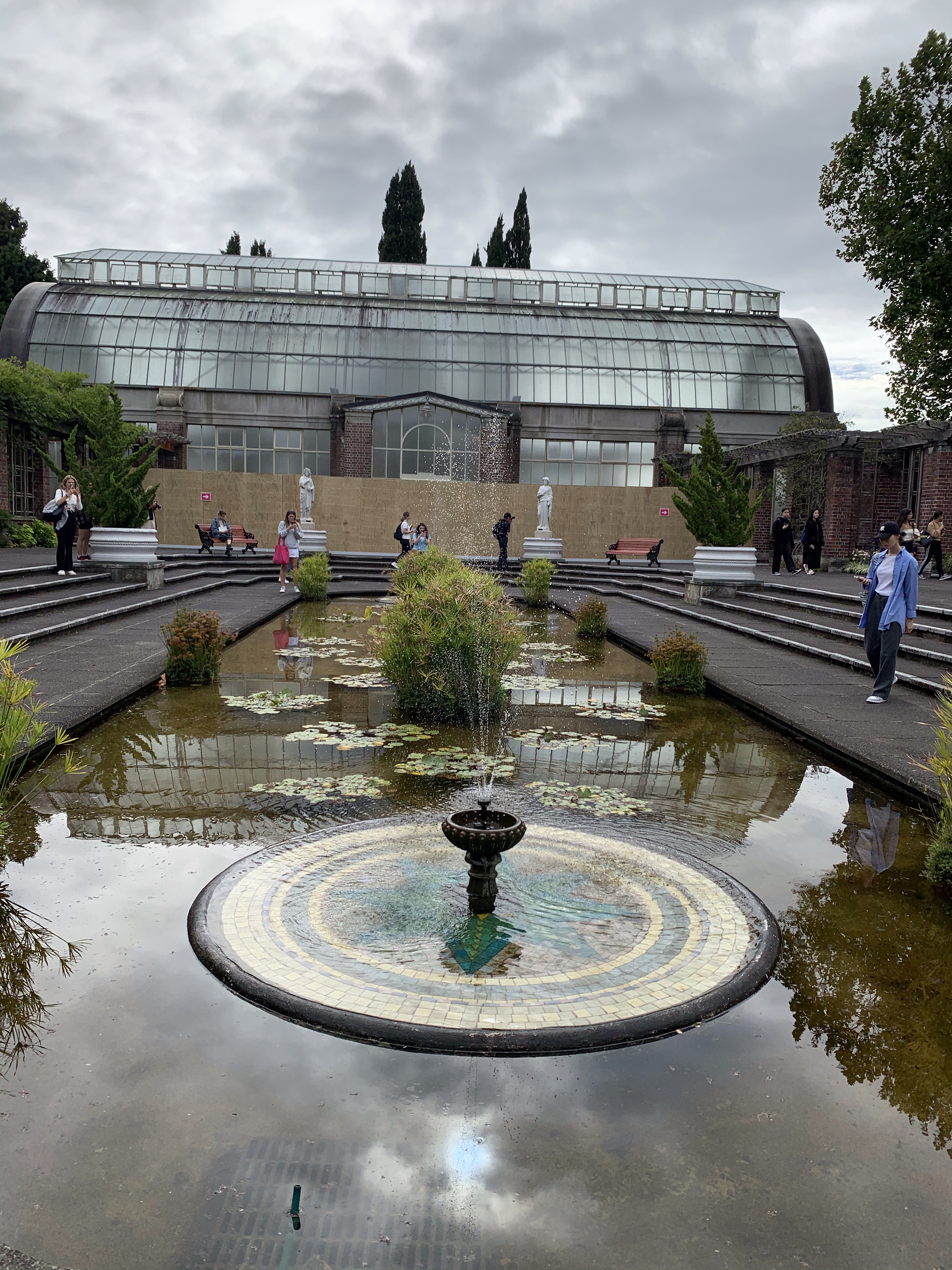
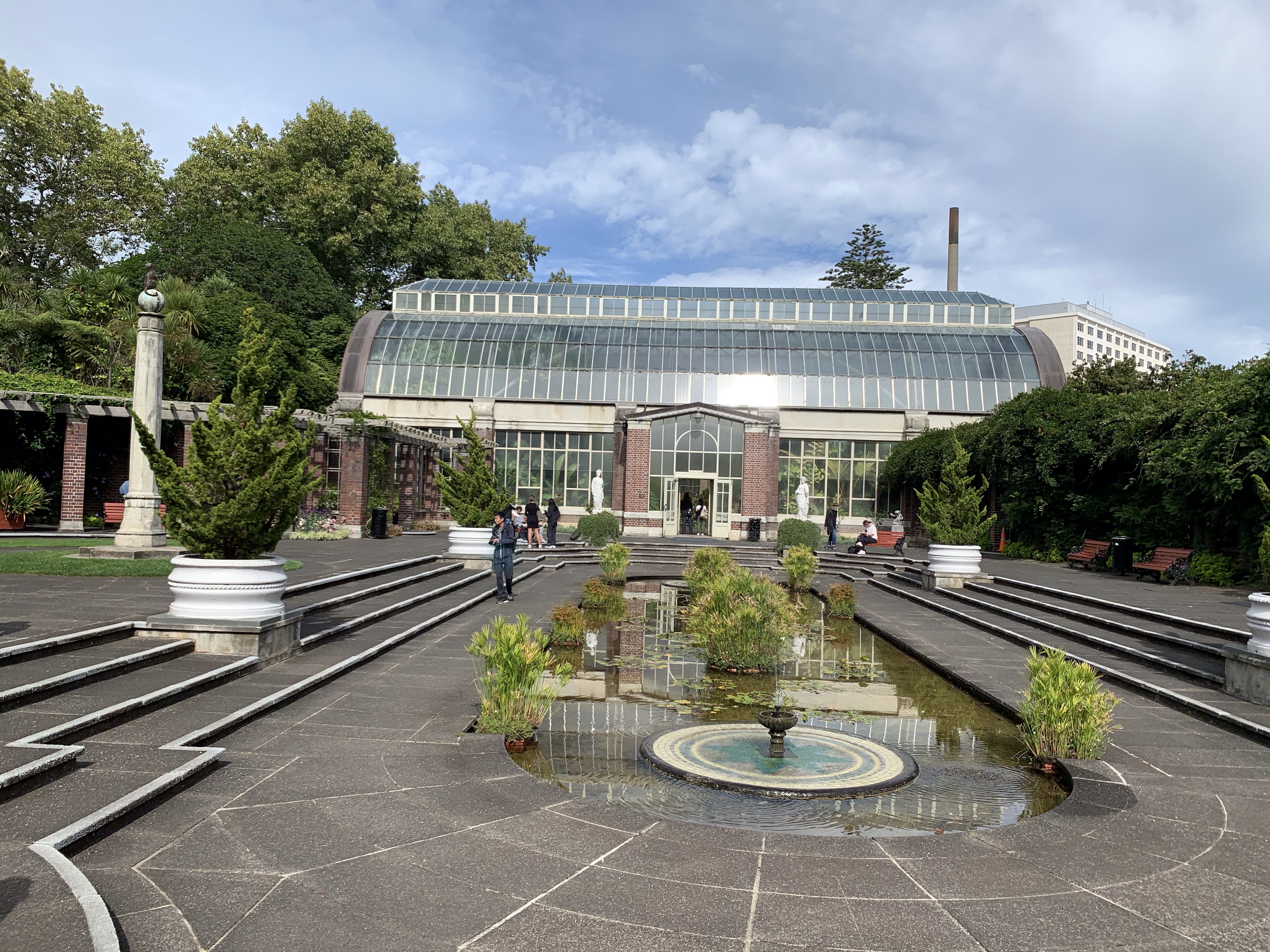
The Wintergardens consists of two large glasshouses: one non-heated Temperate House and one Tropical House. In between the two glasshouses there is an ornate courtyard with sev“eral neoclassical statues and a sunken pond in the centre. Off to one side is the Fernery which is situated within the site of an old quarry.

The complex consists of:

– two display glasshouses (temperature averaging 20 degrees Celsius), one containing temperate plants, the other containing tropical plants
– a formal courtyard with a pond in the centre
– a fernery within an old quarry.

History

The Domain Wintergardens were constructed following World War I with funds generated from the Industrial, Agricultural and Mining Exhibition of 1913-1914.

The gardens were designed by Gummer and Ford, Initially only the Temperate House was built. This was opened and presented to the people of Auckland on 12 October 1921.

The courtyard, the Tropical House, and the Fernery were added later in the 1920s. 

The Mayor of Auckland City, George Baildon, officially opened the completed Wintergardens on 2 May 1928.

Many of the statues in the courtyard were added in 1945, and the sunken pond in the centre of the gardens was installed in 1954.

A significant reconstruction project was undertaken during 1993 and 1994 to renovate the Wintergardens.

On 1 December 2013, the Tropical House of the Wintergardens became the first place in New Zealand to have the giant Amorphophallus titanum in flower.

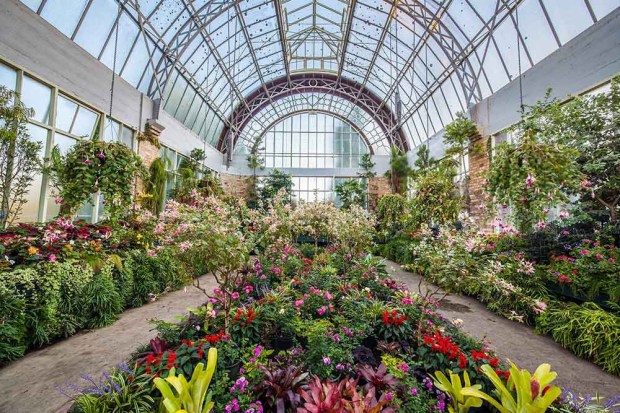
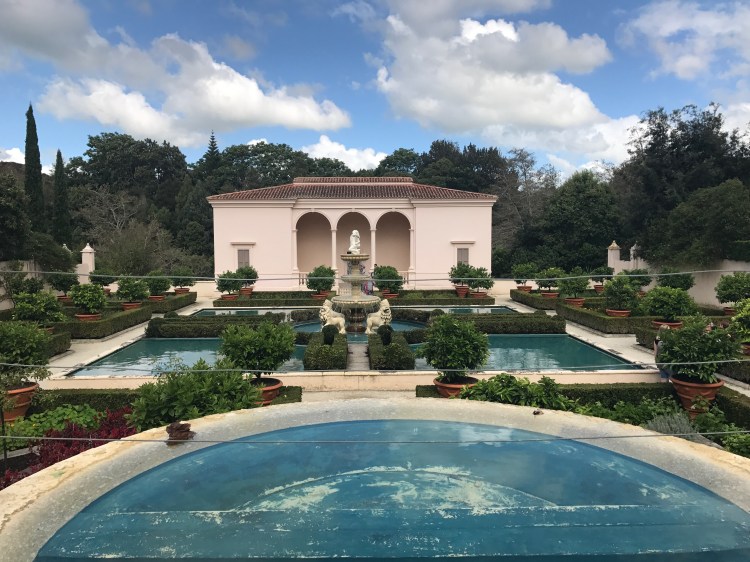
Hamilton Gardens is a public garden park in the south of Hamilton owned and managed by Hamilton City Council in New Zealand. The 54-hectare park is based on the banks of the Waikato River and includes enclosed gardens, open lawns, a lake, a nursery, a convention centre and the Hamilton East Cemetery. It is the Waikato region’s most popular visitor attraction, attracting more than 1 million people and hosting more than 2,000 events a year.

Hamilton Gardens is described in popular culture as a botanical garden, but does not technically qualify as a botanical garden. Instead, the site features 21 gardens representing the art, beliefs, lifestyles and traditions of different civilisations or historical garden styles. These gardens are grouped into the Paradise, Productive, Fantasy, Cultivar and Landscape garden collections, and there is space for gardens which are still in development.

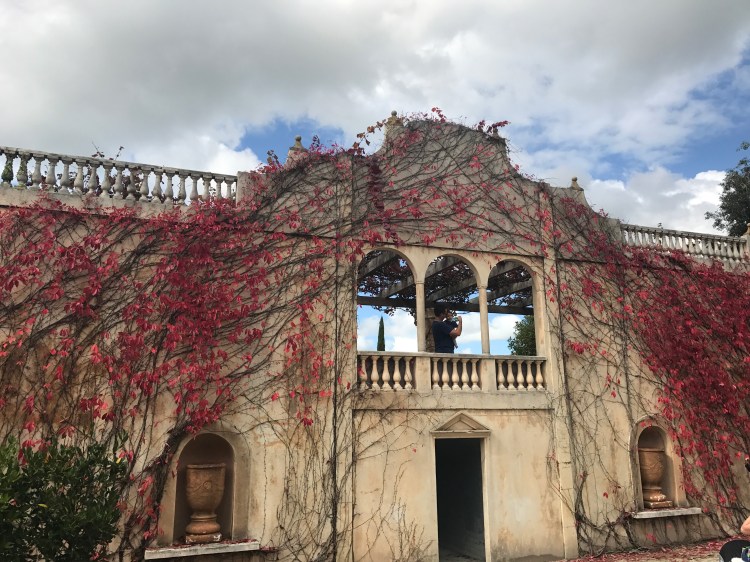
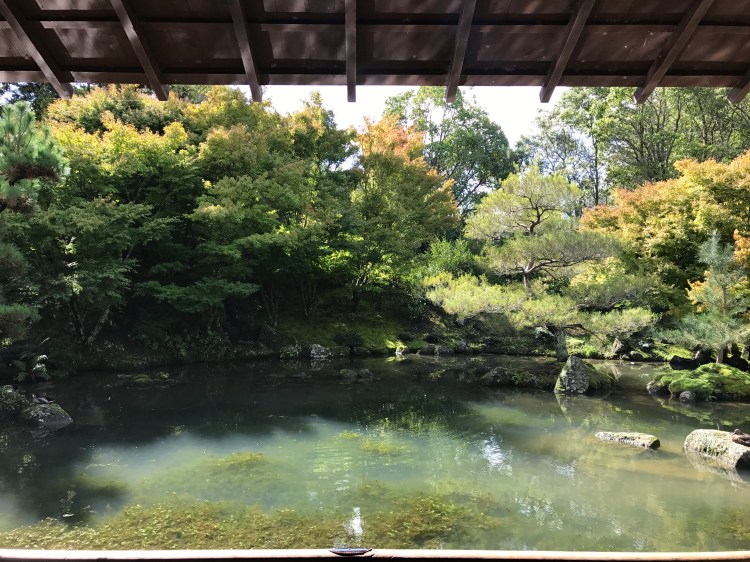
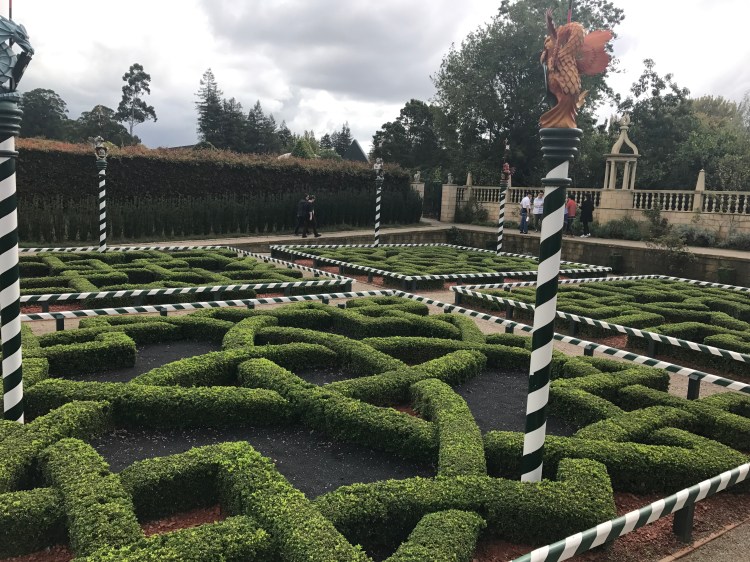
Hamiliton gardents is located in the North Island of New Zealand. It is the first garden I visited in New Zealand. It has a different planning and design from a traditional botanical garden, which is more like a fairy tale world. I was very shocked. First, it is very large. Second, it has many areas and more interesting. Each area has its own theme, such as Chinese garden, Italian revival garden, Indian garden and so on. The gardens of each country are very distinctive and have a strong national color, which made me feel the gardens of countries all over the world at once. The overall design revolves around the theme of the close relationship between people and the garden. It is a garden that is very worth visiting.

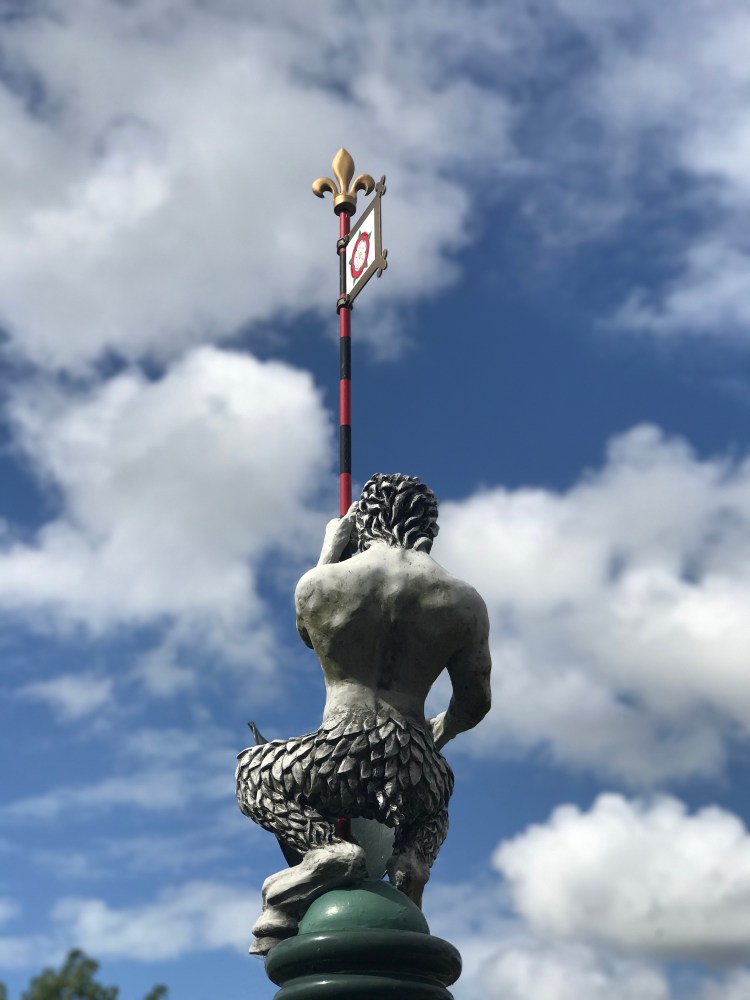
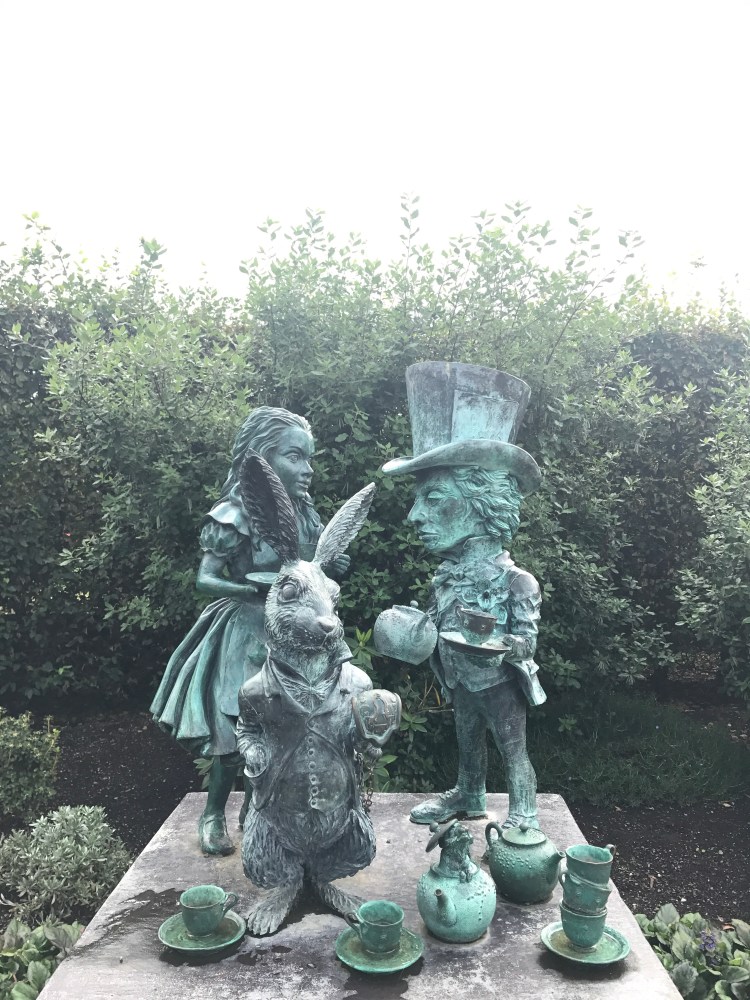
What surprised me more was that I could see different shapes made of plants, as well as some small sculptures. It was very interesting. Every scene seemed to break into a fairy tale world to attract tourists. The designer has successfully attracted many audiences through various shapes and elements and brought people into the world of plants.

Week 2: Site Visit

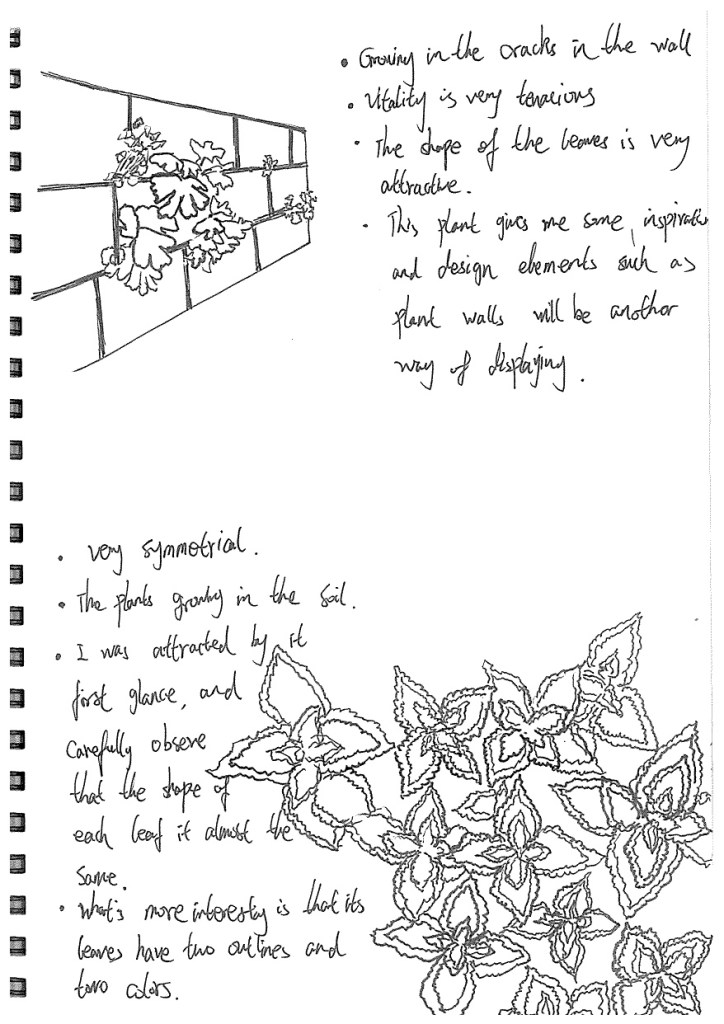
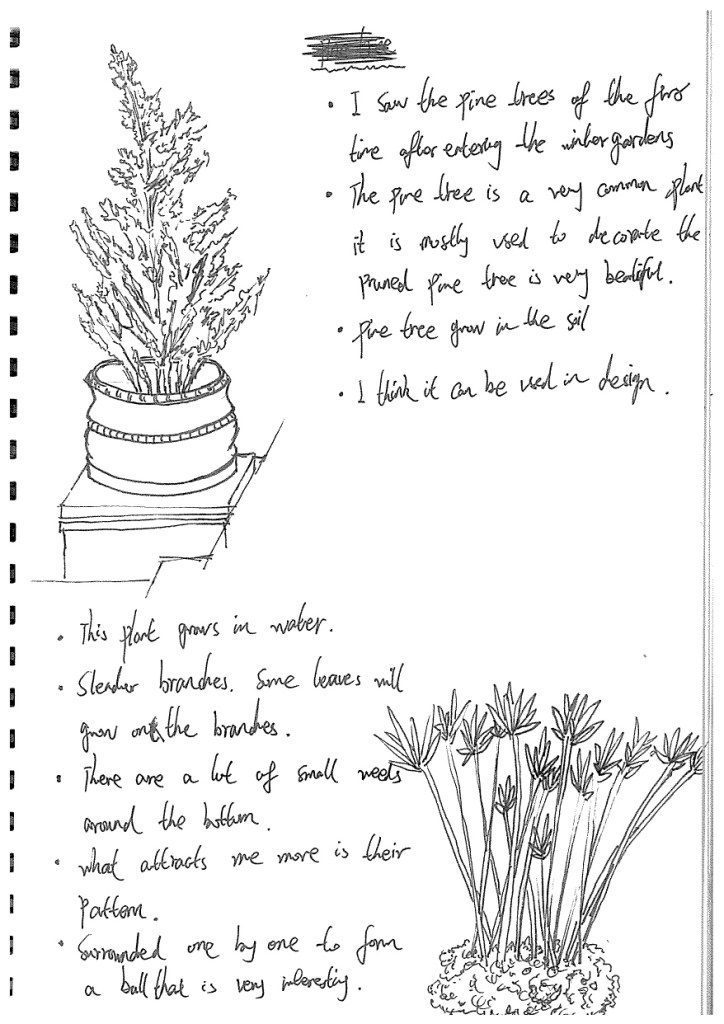
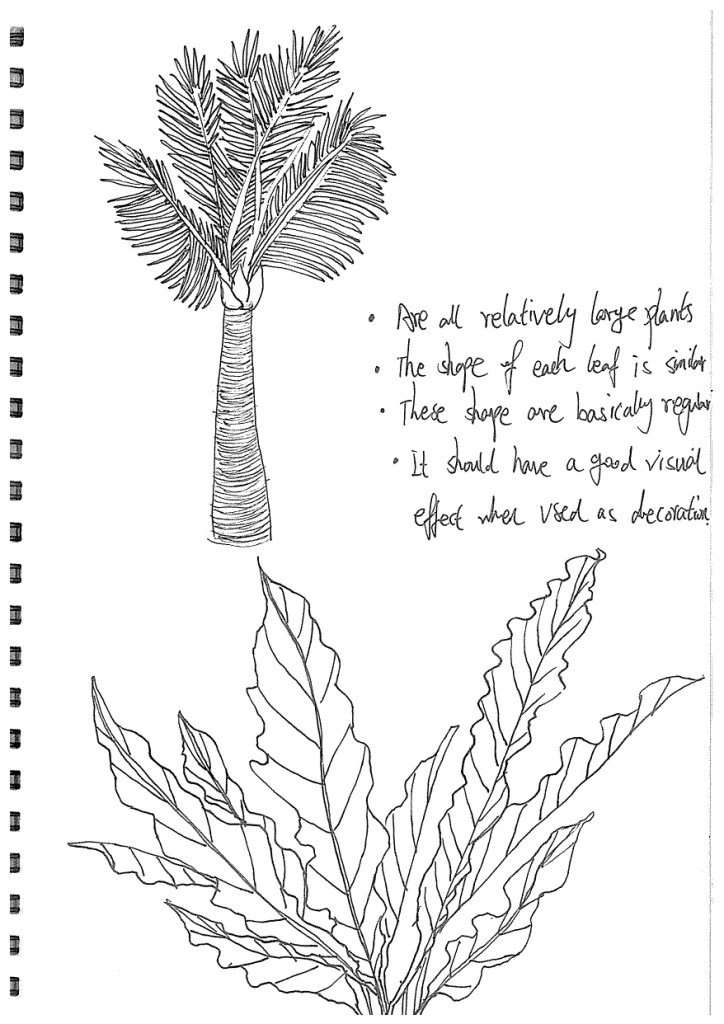
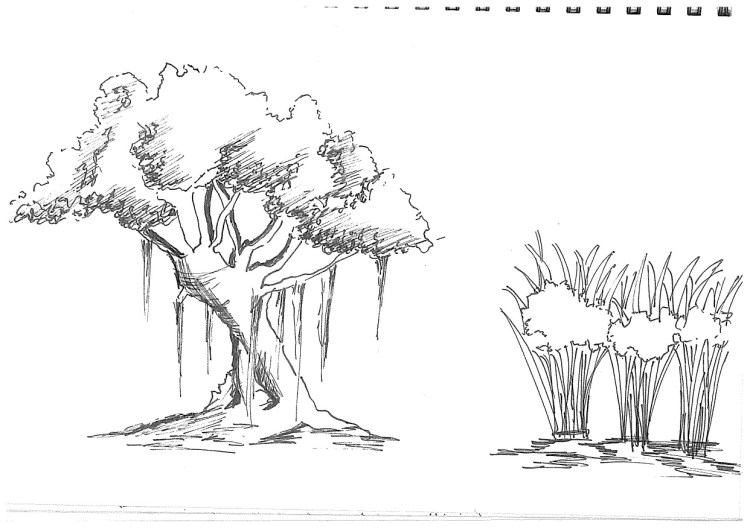
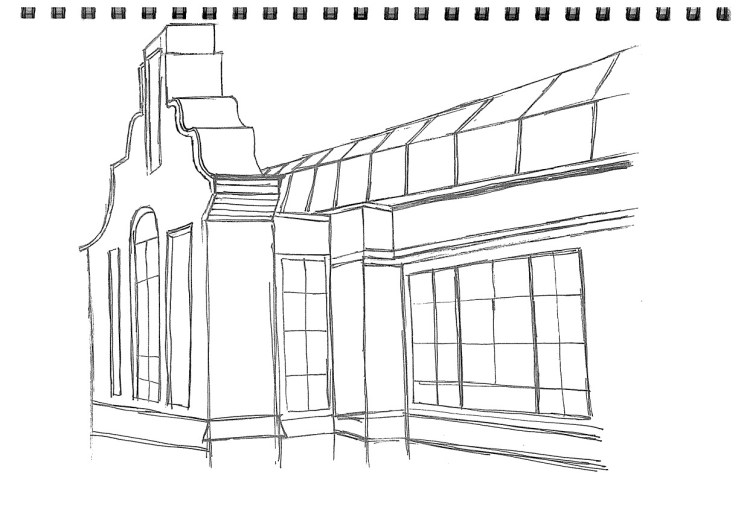
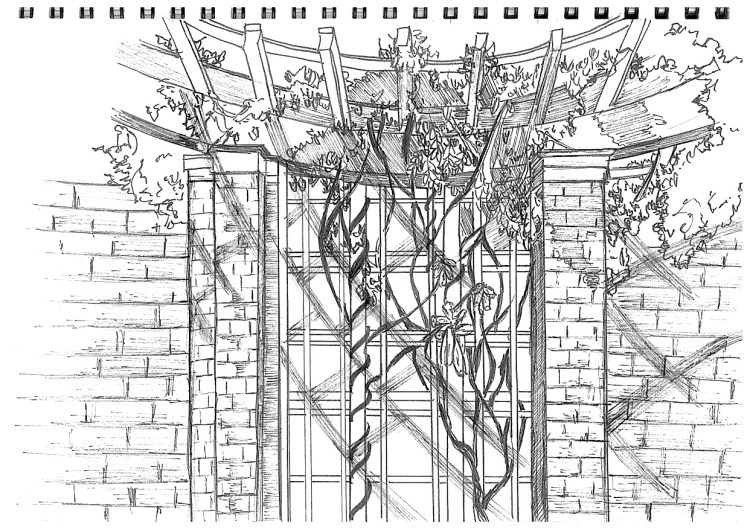
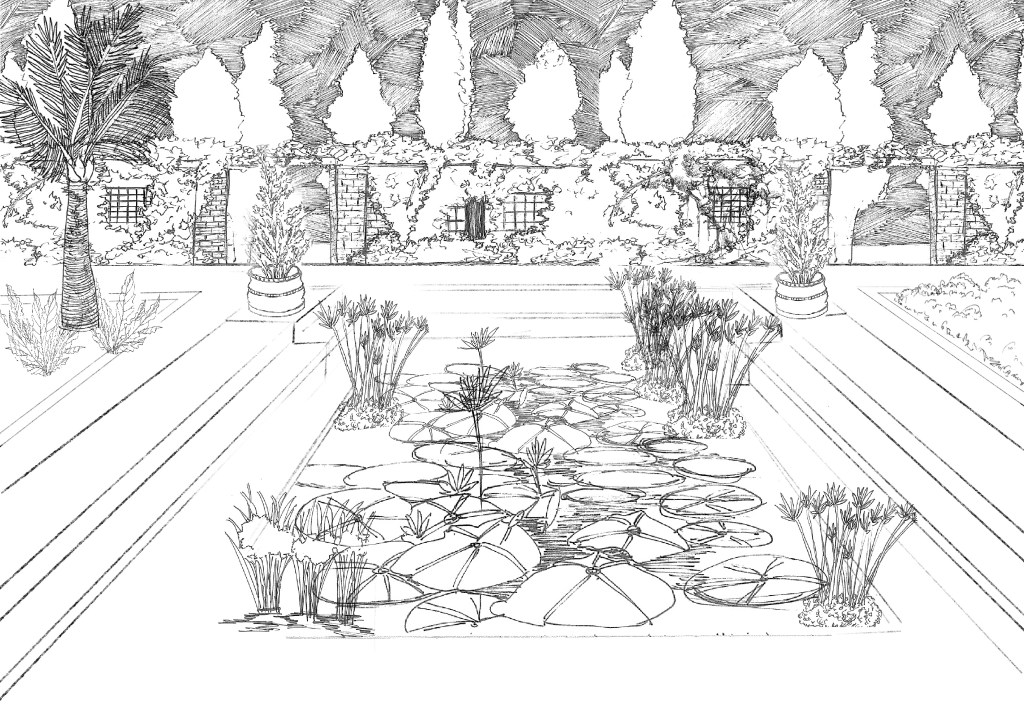
For me, painting is my most powerful way of thinking. When I draw an object, I think about its patterns, shadows, textures, colors, etc. What impressed me the most when I entered wintergardents was the different shape of each plant. And I drew them and found many ideas in the process, such as the difference between the plants seen through the window and the plants themselves, what is the difference between withered leaves and vigorous leaves, leaves under light and shadow, and leaves in dark corners. What is the difference and so on.

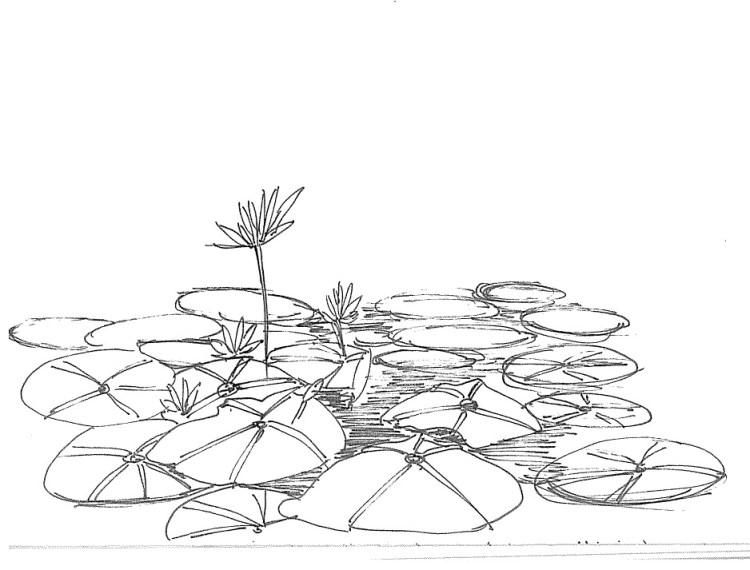
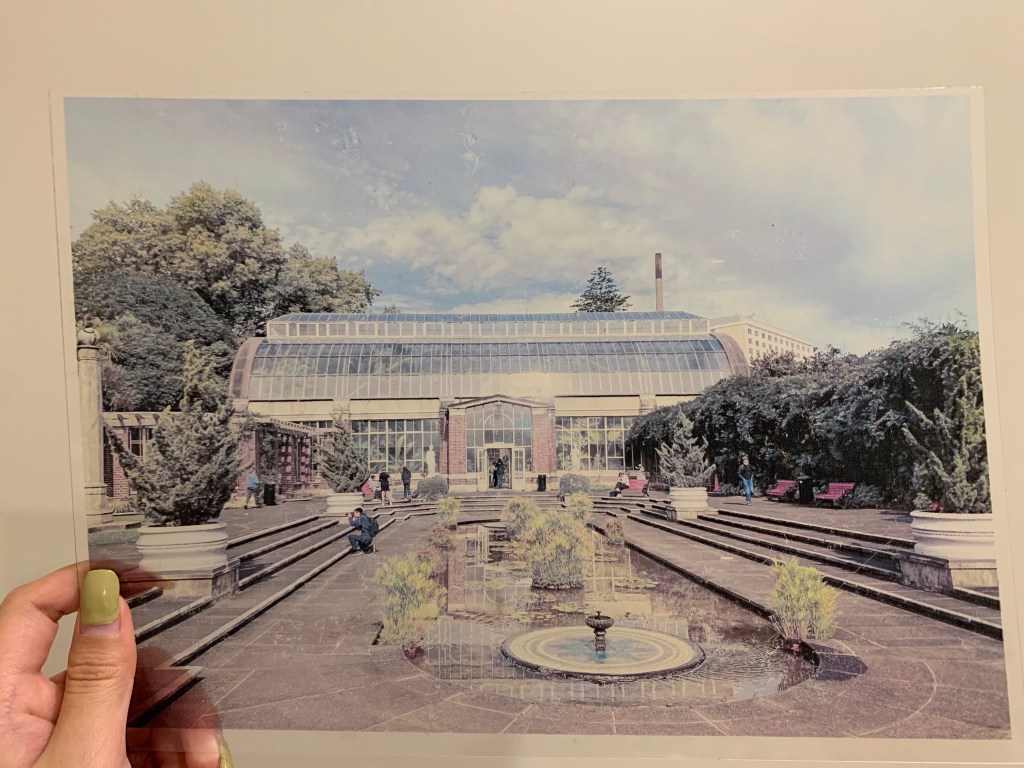
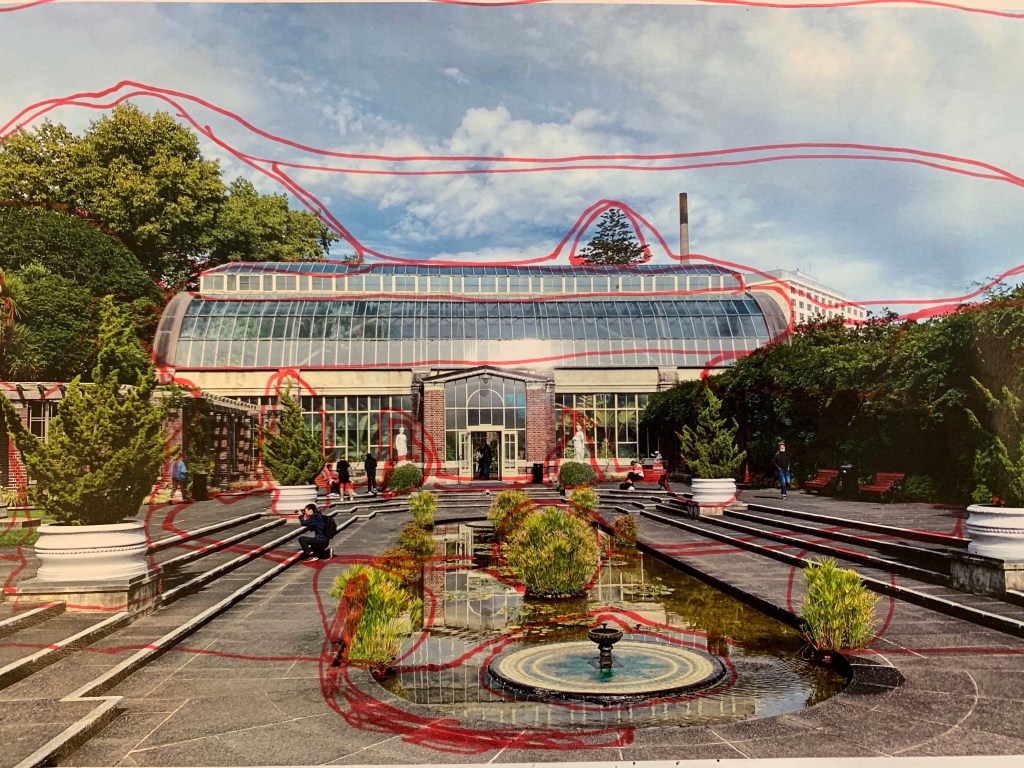
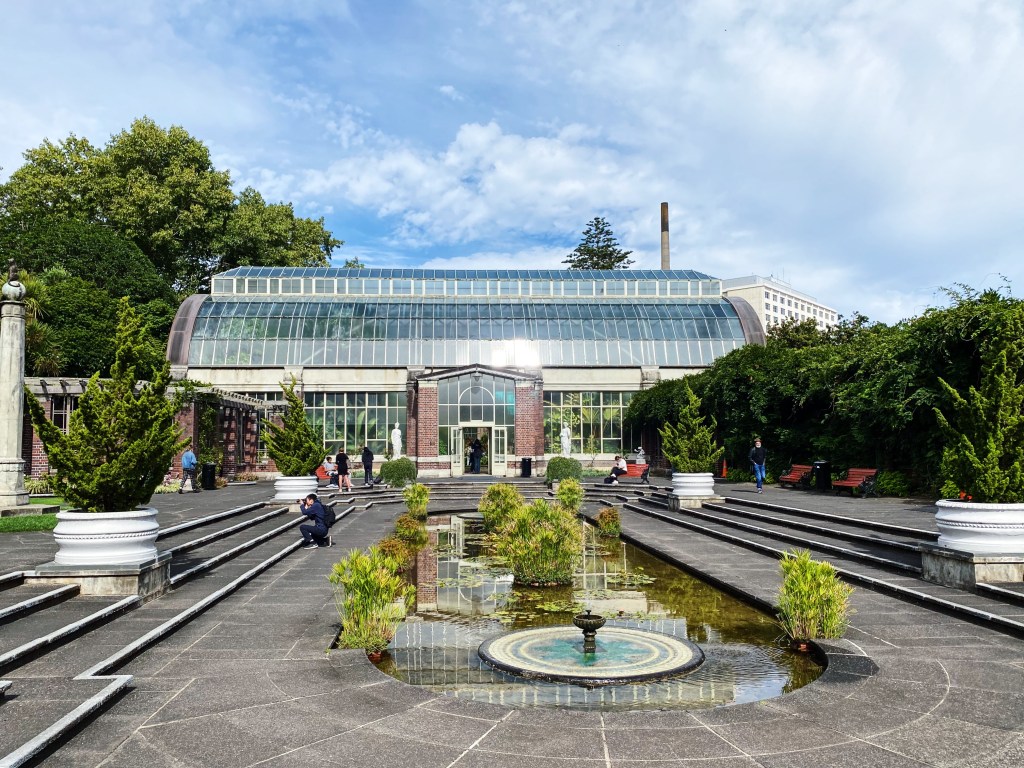
When I painted the lotus leaf painting, I found a very interesting point. There are a lot of reflections in wintergardens. For example, two identical glasshouses, corridors on the left and right sides, reflections in the pool, etc. These are completely symmetrical designs. It is interesting to discover interesting points in the garden through thinking and exploration. When I was painting, I observed the reflection of actual objects in the water, exactly the same but completely different. One is colored and the other is black and white. Splashes can change the shape of the reflection. I want to try to bring symmetry into my work.

Harmonious:A space where people and nature coexist in harmony

Vitality: The feeling that plants give me is a positive expression of vitality, vigorous vitality

Public: It is a public space open to everyone, providing a very good platform for people and plants

Romantic: the transparent glass top, roses, etc. These elements come together to always produce a romantic atmosphere. And it is called a romantic park

Nature: there are wide of plants and provide a good worth environment for tropical plants.

Week 3: Mind-Mapping and Workshop

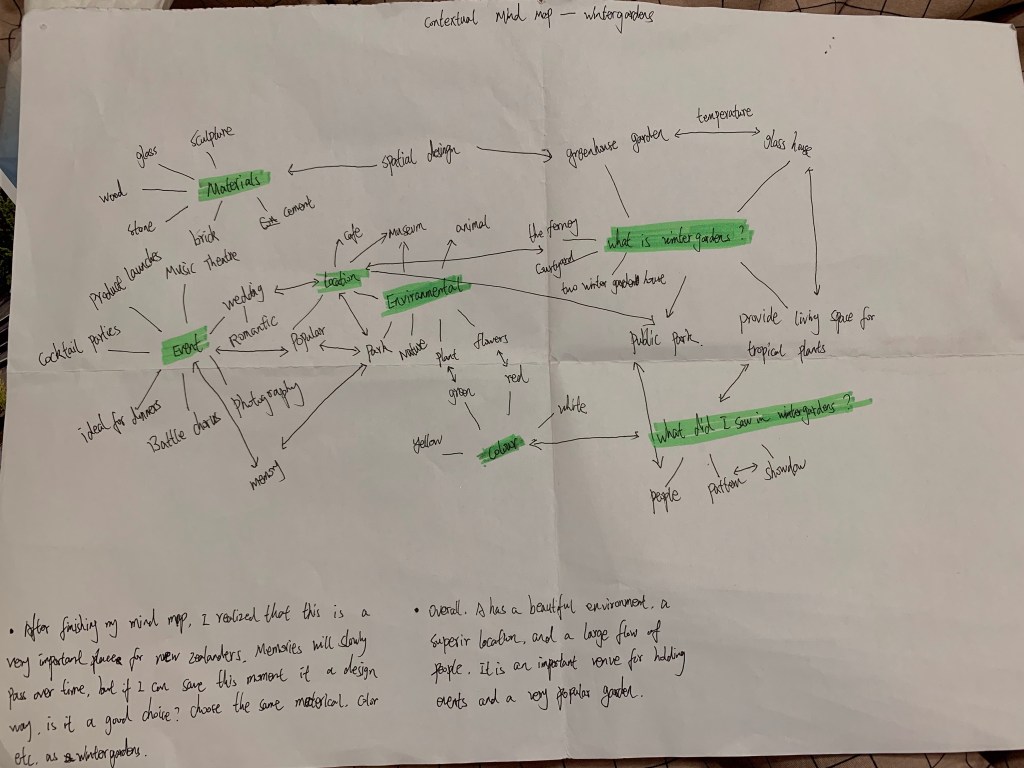
Mind-mapping

After finishing the mid-mapping, I found some connections, and the overall thinking became clearer. This is a very effective way of learning, the keywords in it can let me quickly open my mind.

I like simple lines, text, shadows, etc. So I can often see these keywords in my work, and I often use the simplest lines to create patterns in my other projects. In short, create the most attractive things in the simplest way. This is what I want to achieve, and I will observe their shadows.

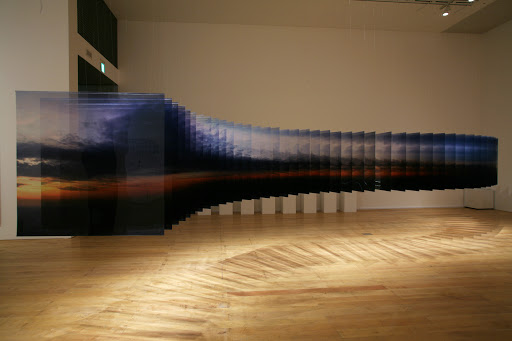
Research: Artist

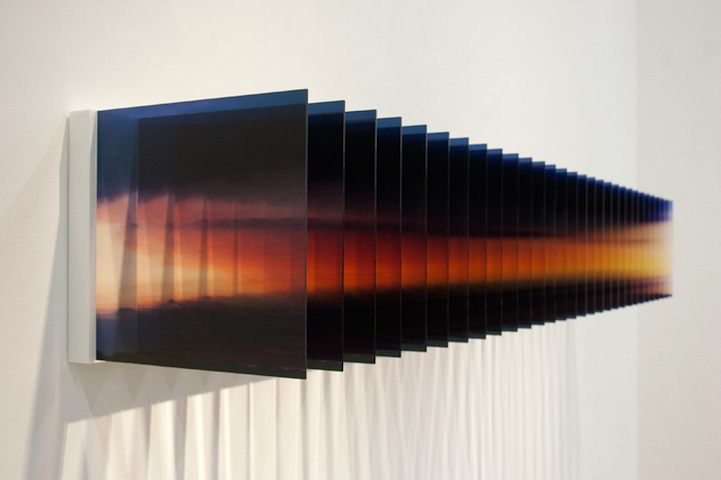
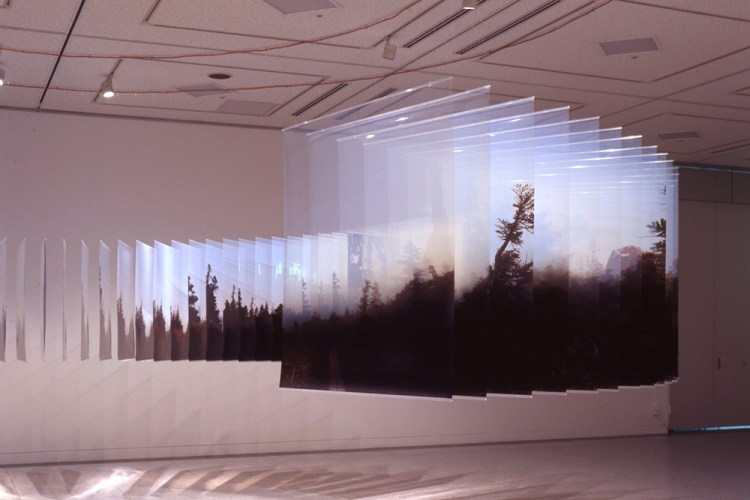
Nobuhiro Nakanishi was born in Fukuoka, Japan. He received a Bachelor of Fine Arts from Tokyo Zokei University and a Masters of Fine Arts from Kyoto City University of Art. Nakanishi lives and works in Osaka.
His work has been included in numerous solo and group exhibitions throughout Asia and Europe.
Mr Nakanishi’s work is a departure from what has traditionally been understood as sculpture making, which typically involves representing humans or objects in three-dimensional interpretations using media like wood, stone, clay or metal.
In his work, Mr Nakanishi distances himself from the weight, gravity and materiality of media related to sculpture. His expression deals with antithetical ideas of existence and absence, the material and the non-material, the visible and the invisible generated in space, the visually imperceptible, senses and conceptual territories such as consciousness, thoughts, memories and time, inviting the viewer into a mysterious experience.

https://www.laprairie.com/en-int/the-house-artist-nobuhiro-nakanishi.html

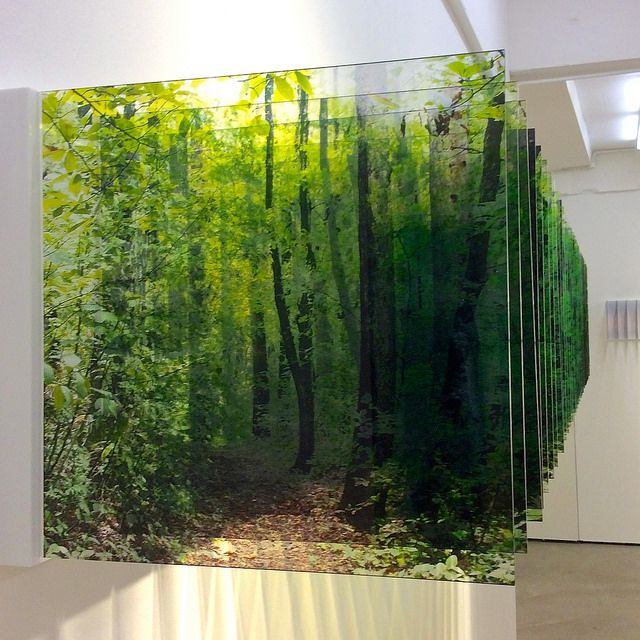
I think this is a very healing work, and the artist shows this scene in his own way. I like this way of presentation. What attracts me is that each piece is different, but combining them will bring new discoveries.

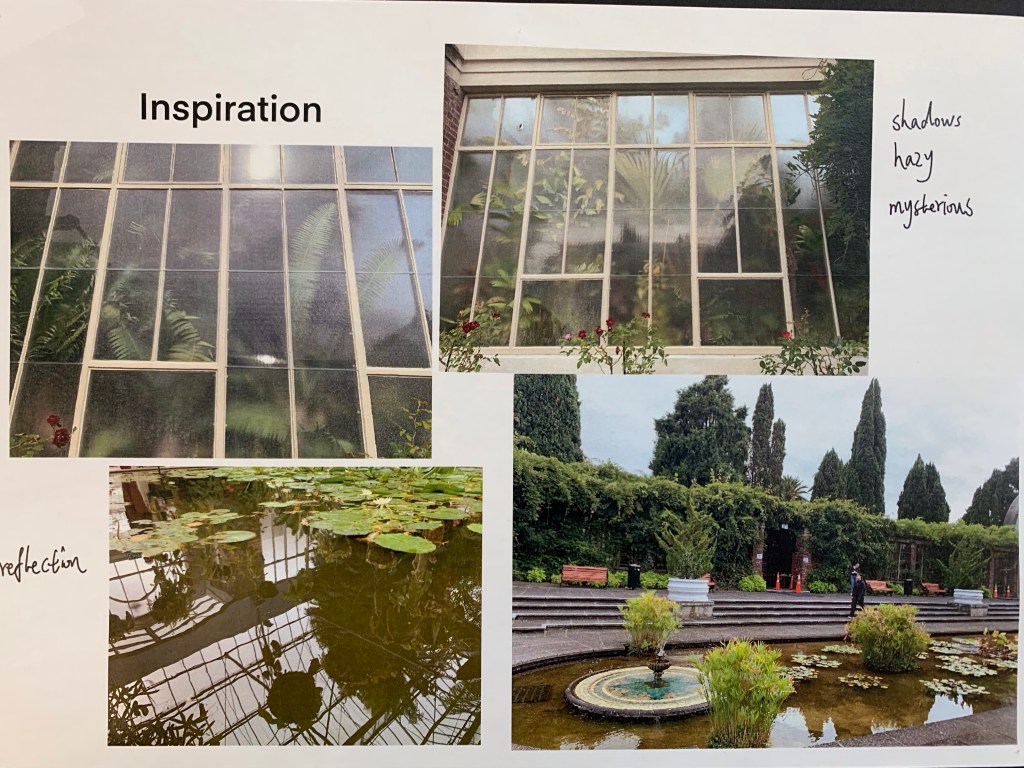
Inspiration

These pictures are what inspired me the most. I put them together and wrote keywords, reflections in water, blurry feeling of glass, patterns on glass, shadows and so on. These elements inspired me

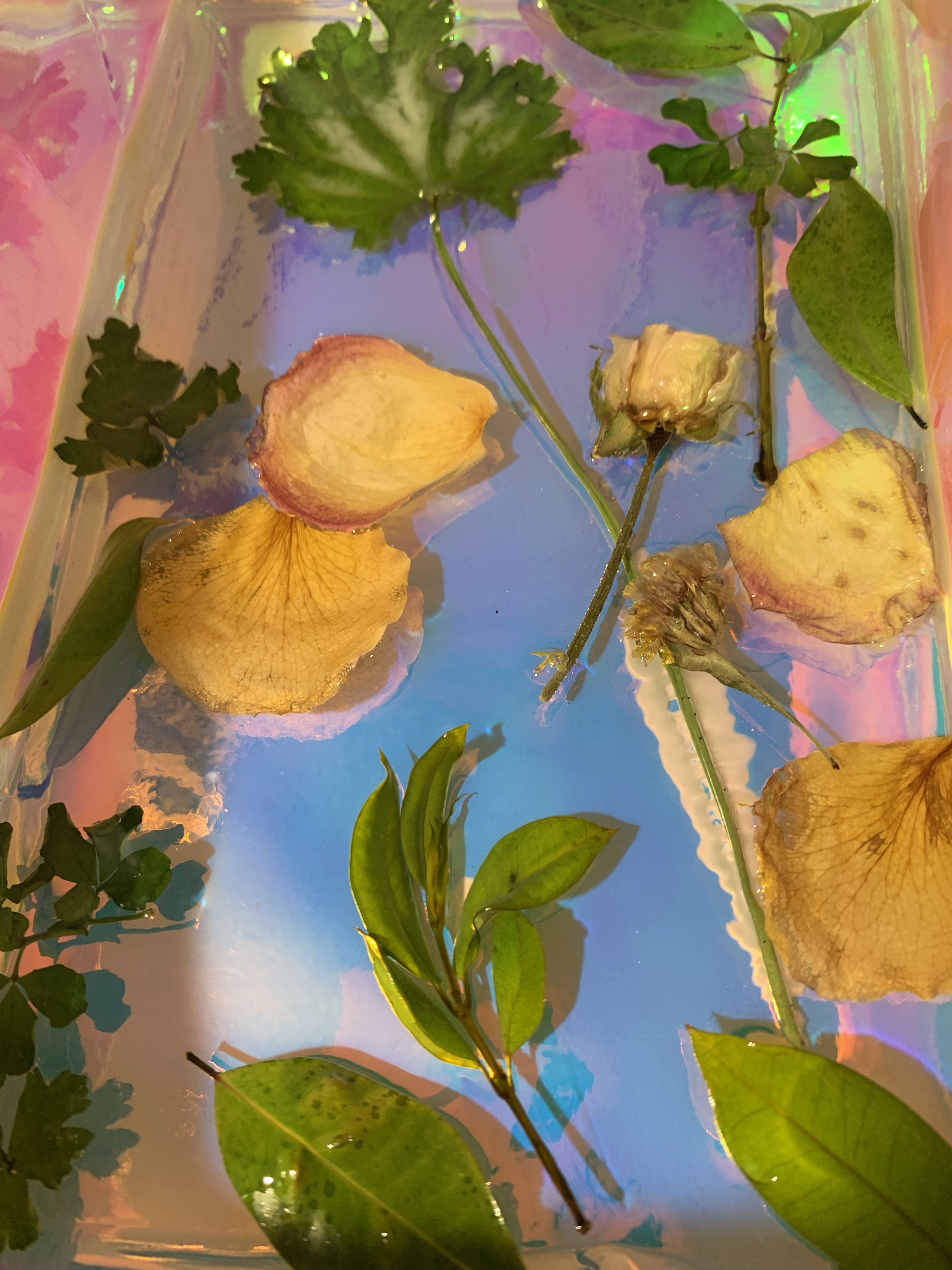
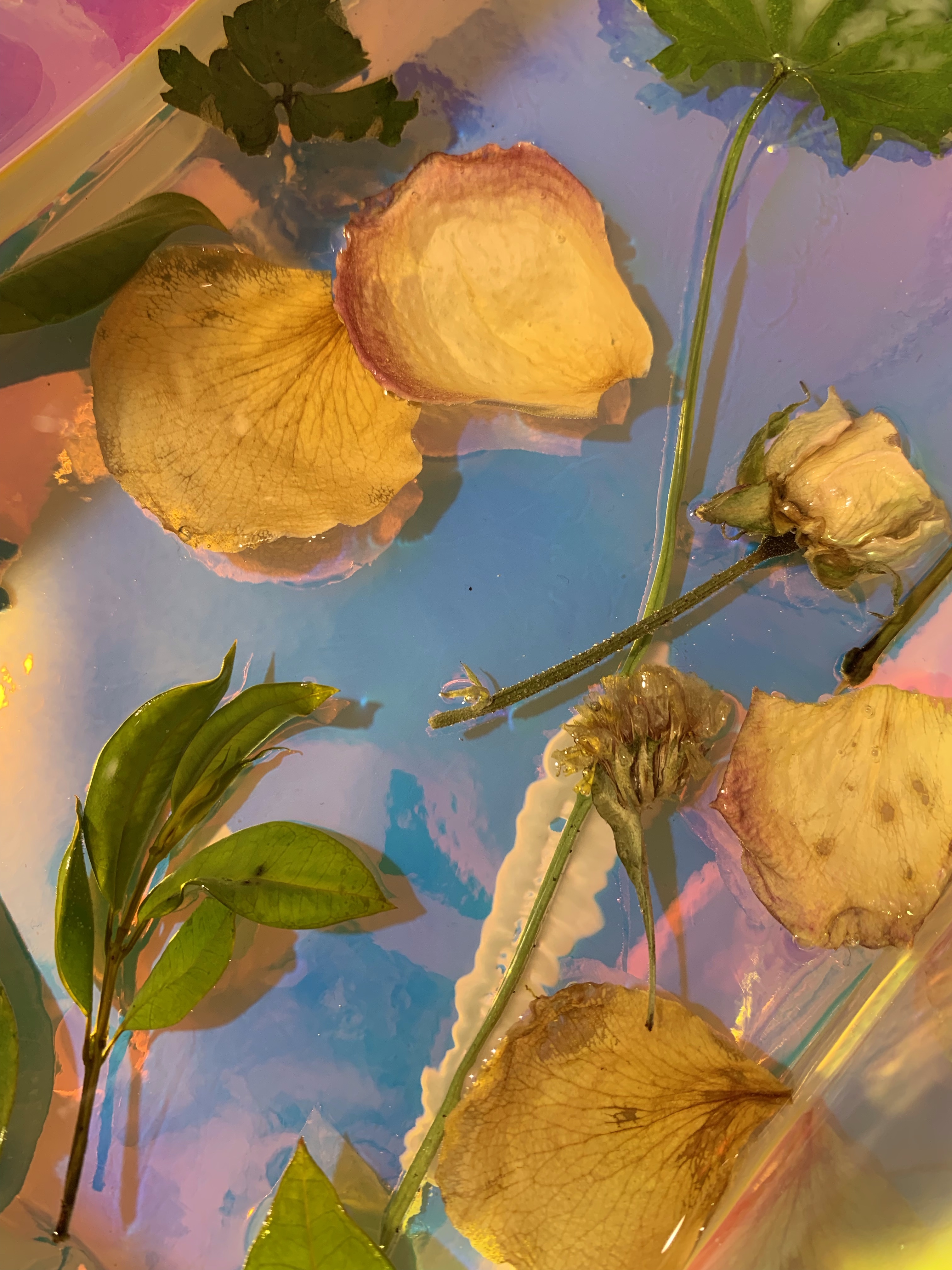
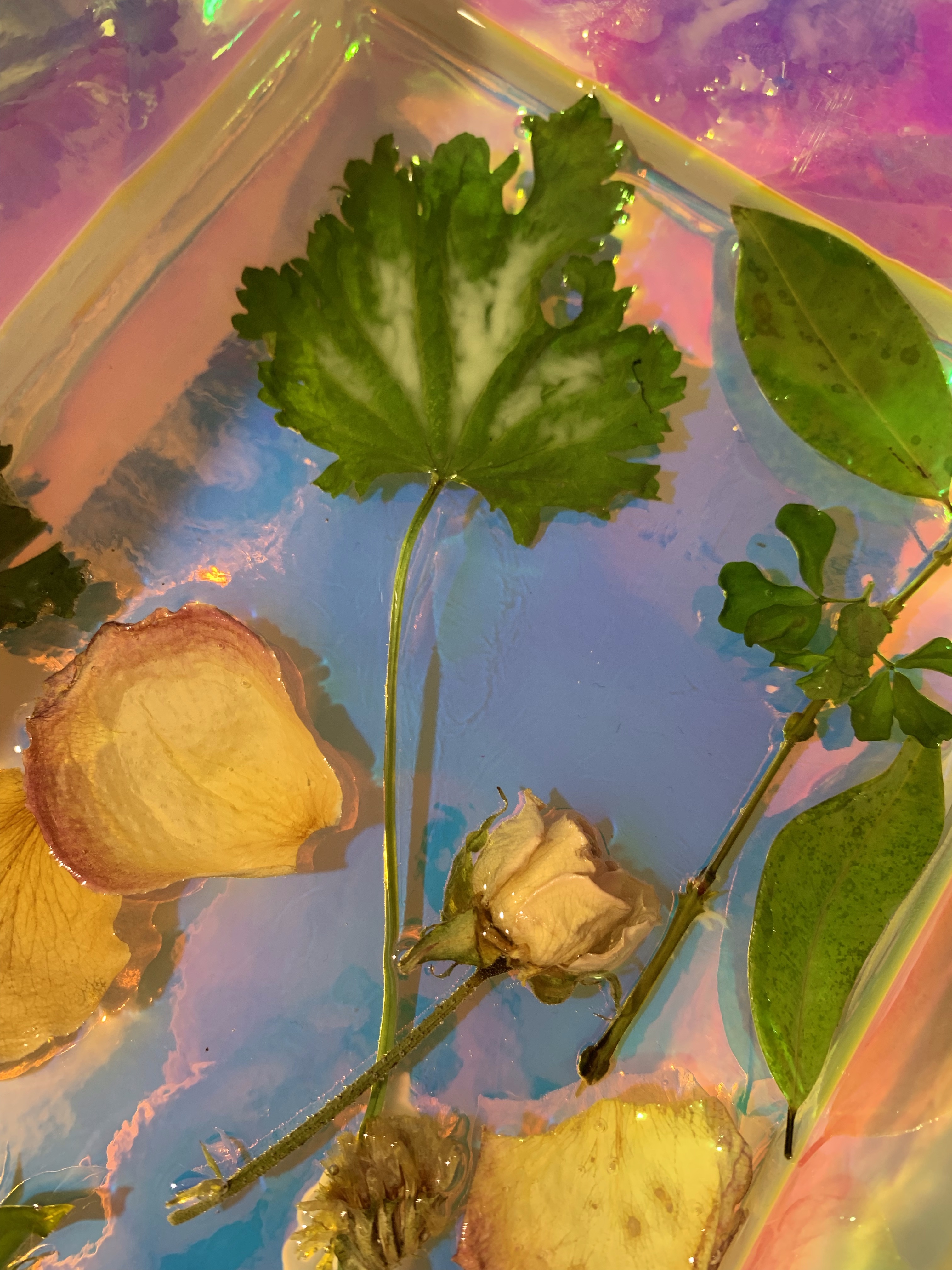
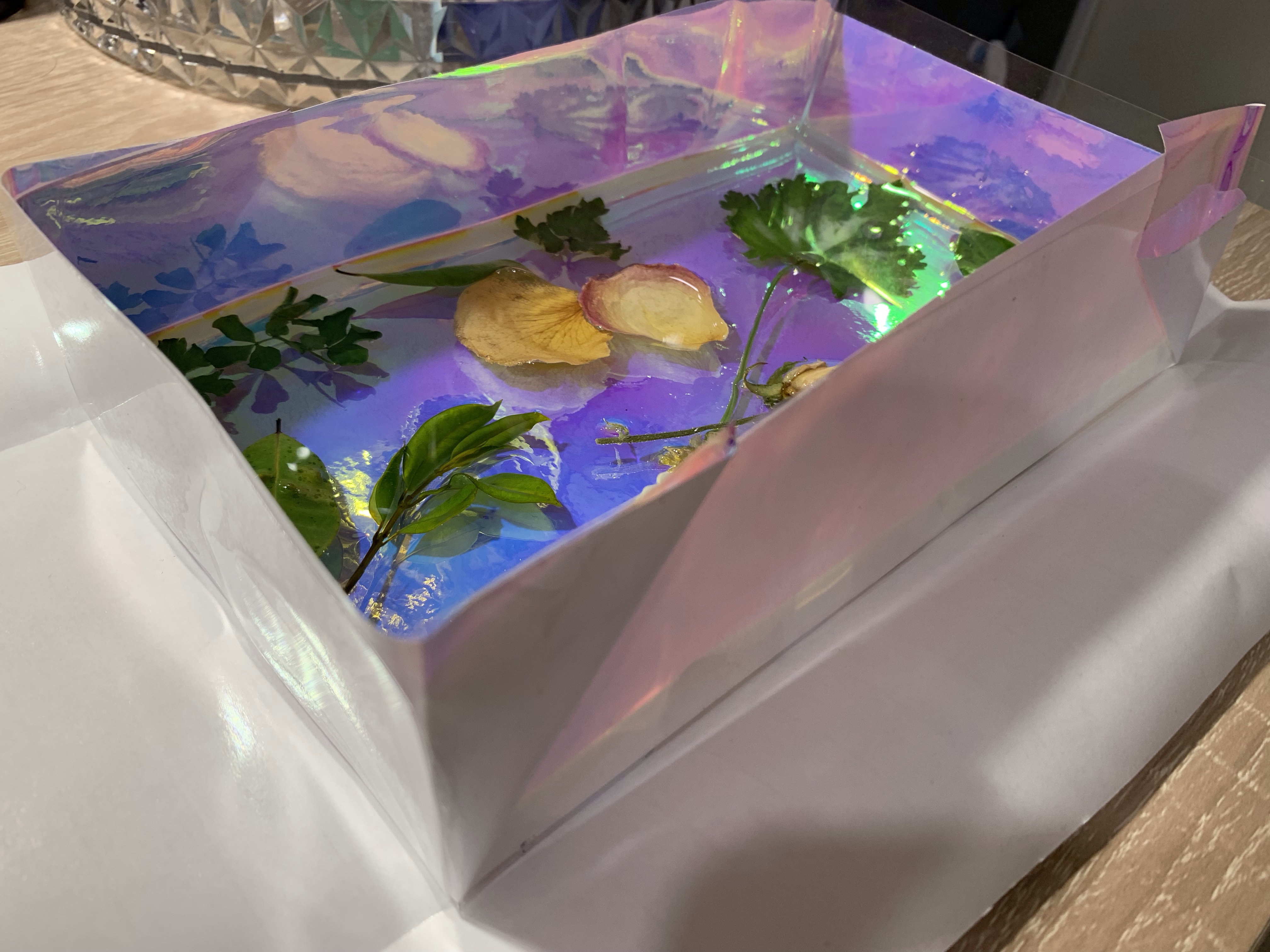
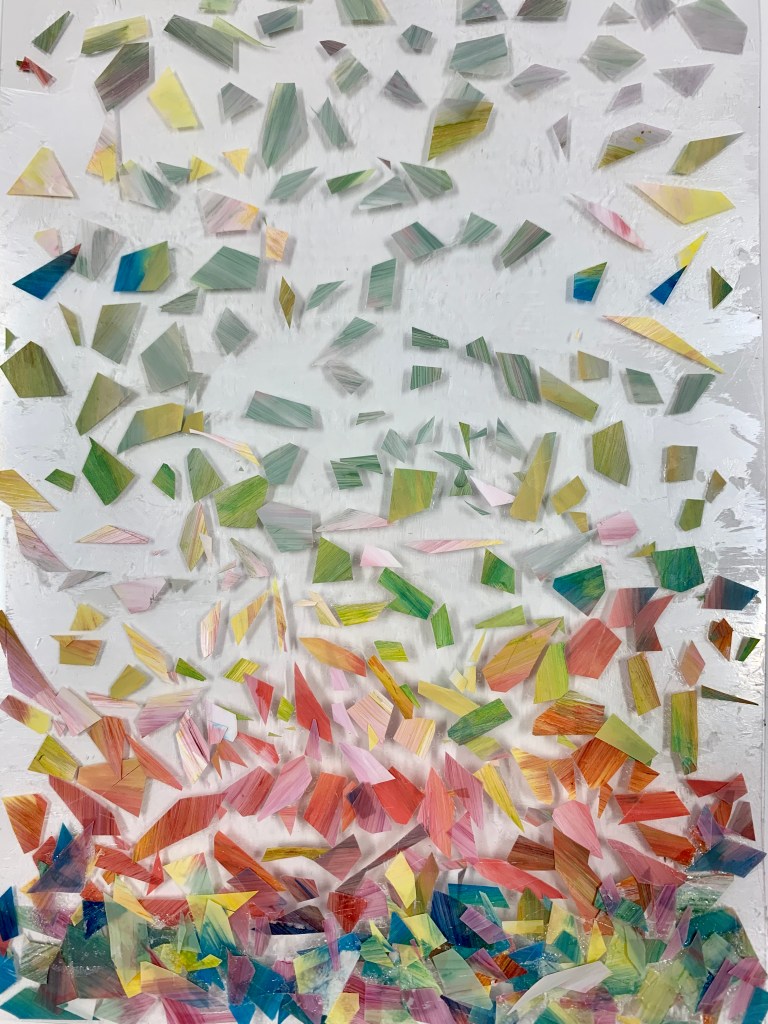
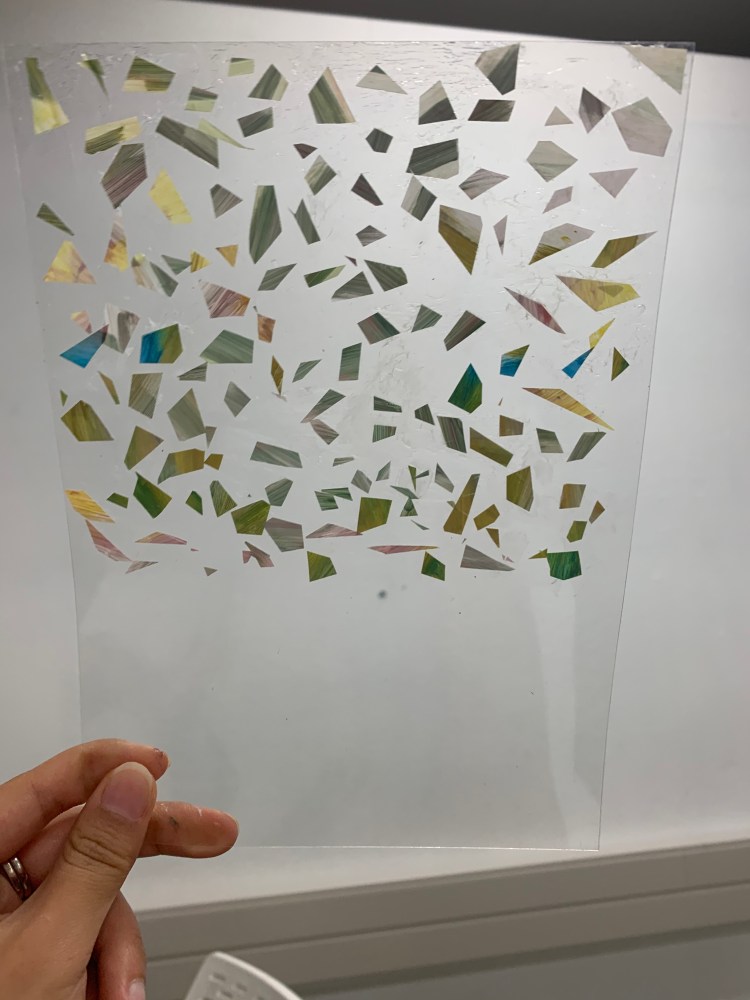
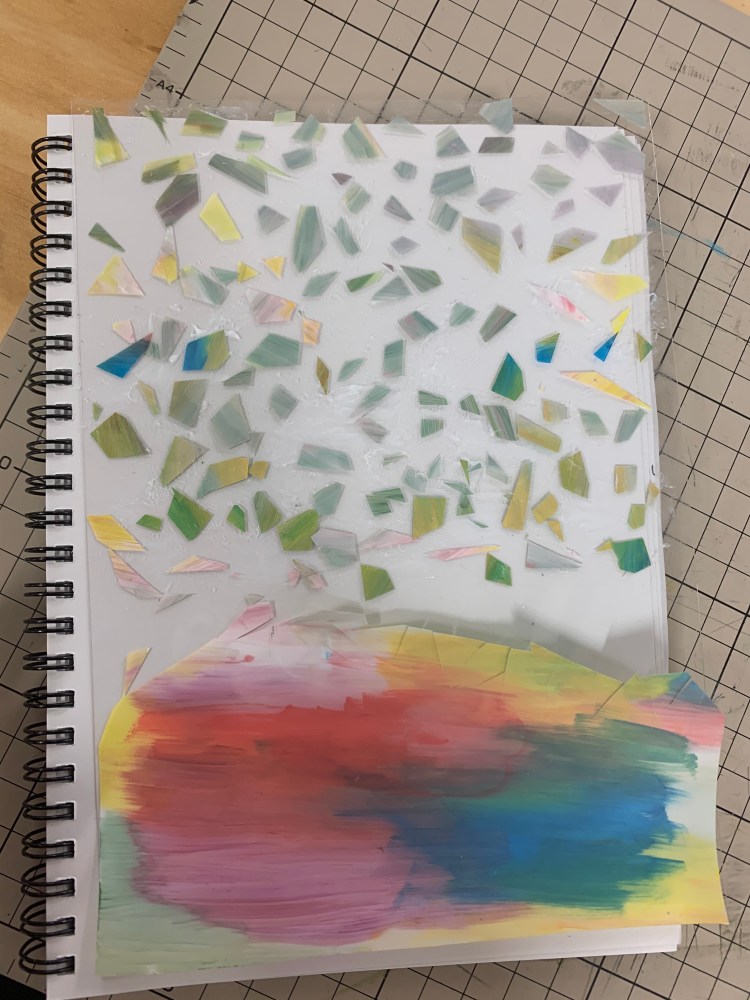
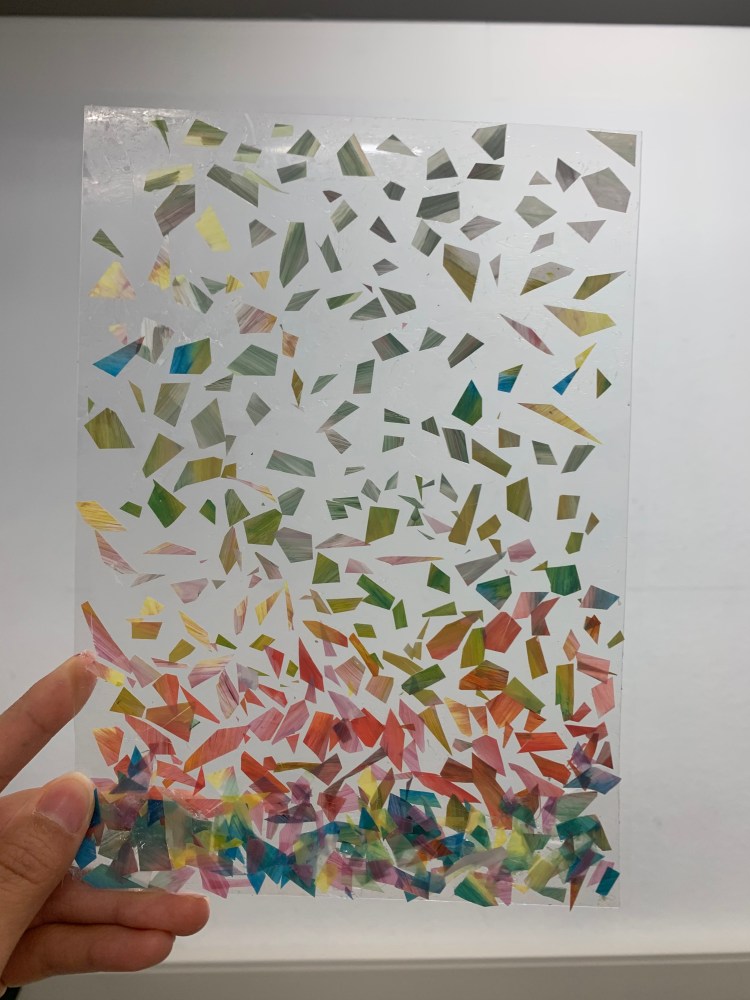
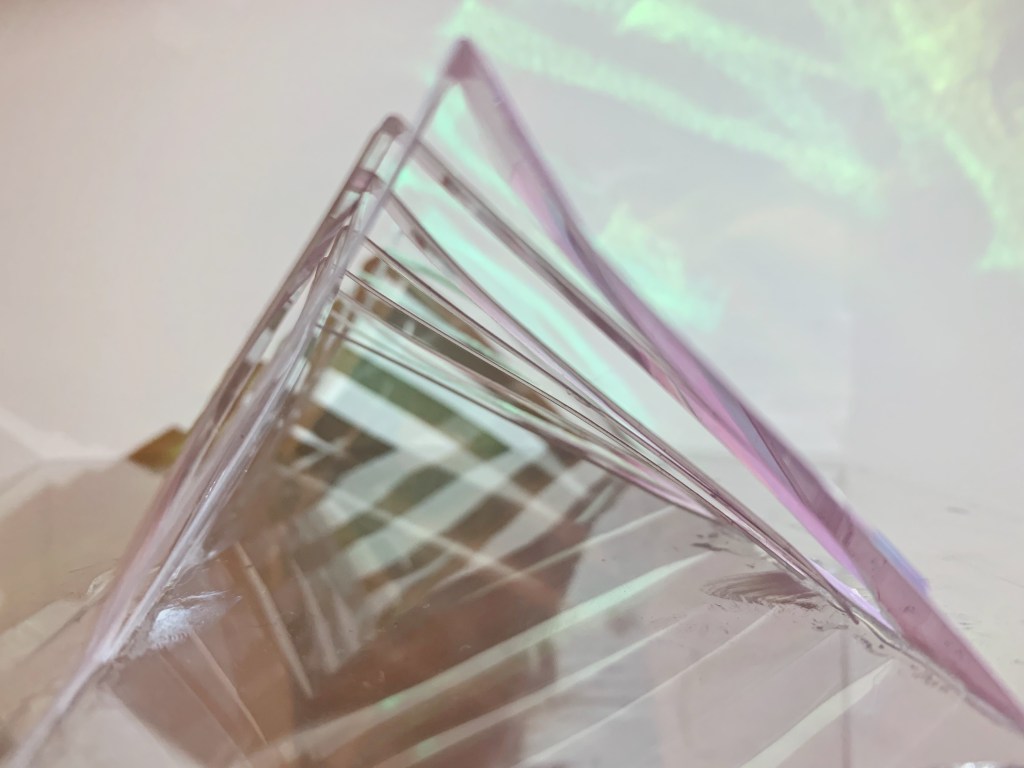
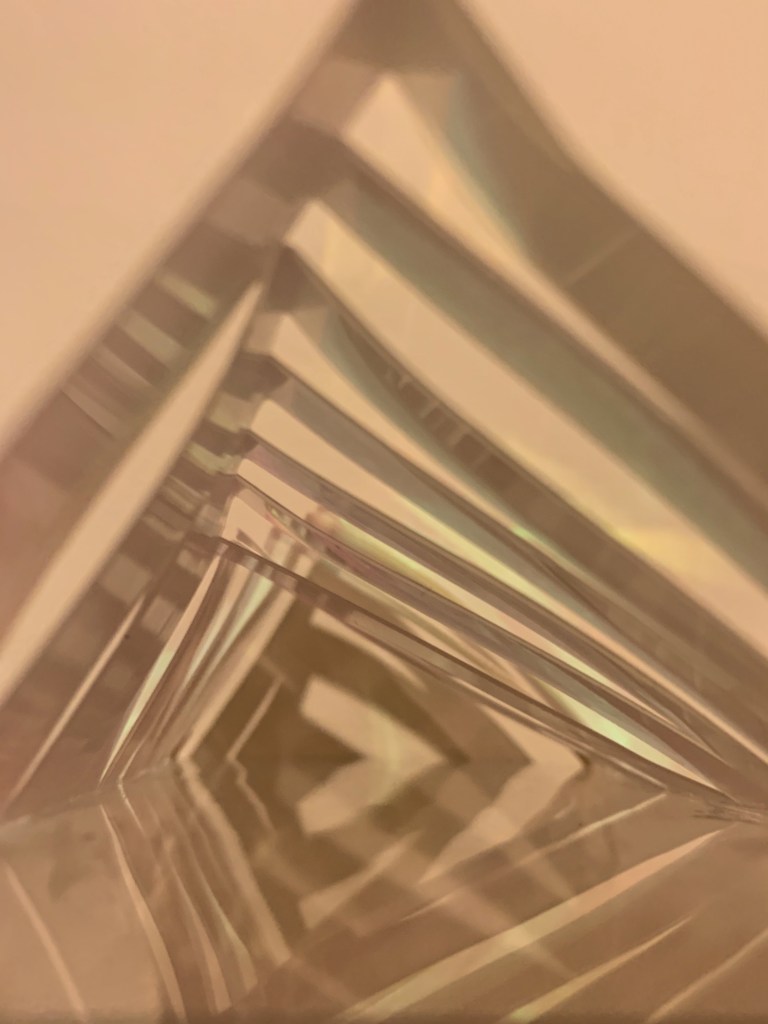
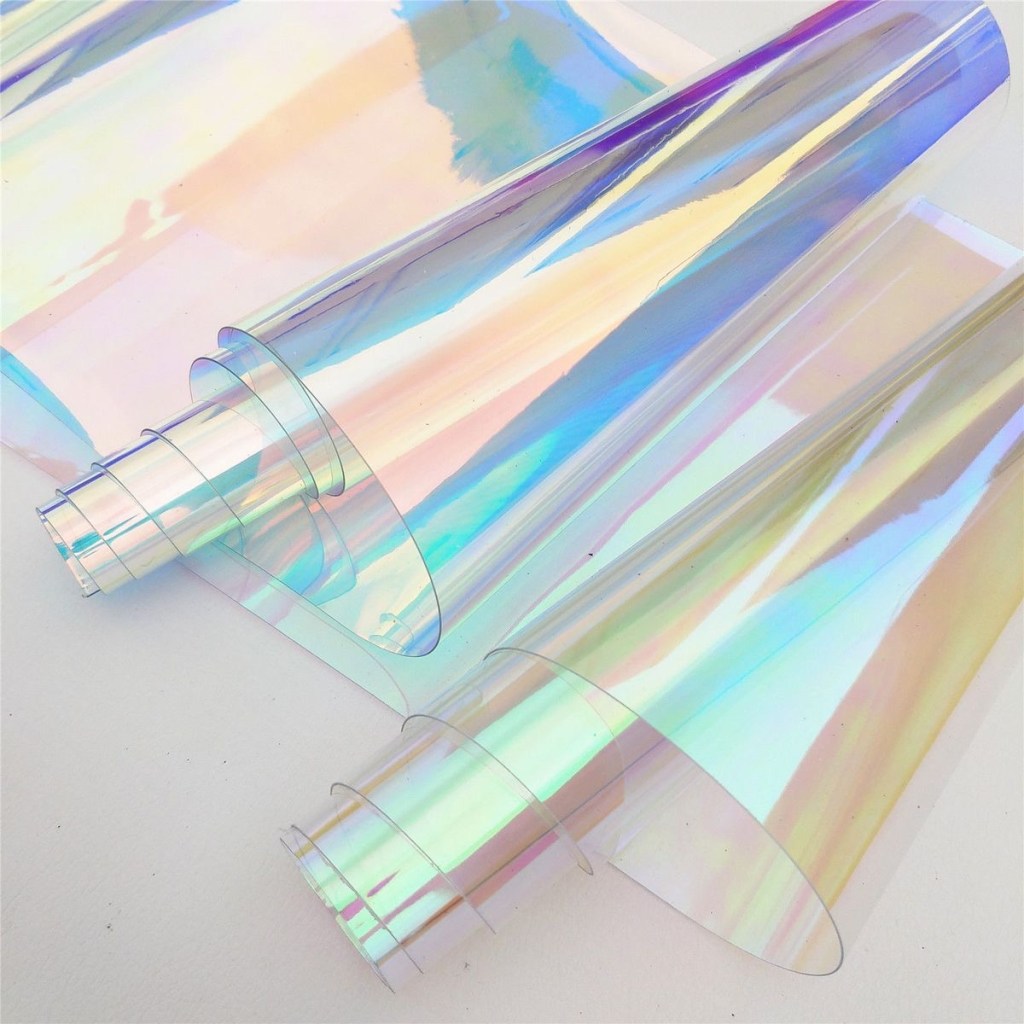
This is the model I made after seeing the pattern on the glass. This is just a process of thinking and observing. The laser paper in the background represents the glass, because the glass will shine with multicolored colors in the sun. In the middle part, I used glue because it is transparent and can seal objects. During the creation process, I was thinking about how to keep the model permanence? Or how to record this moment? I want to keep some moments in my model? More precisely, some impressive memory fragments.

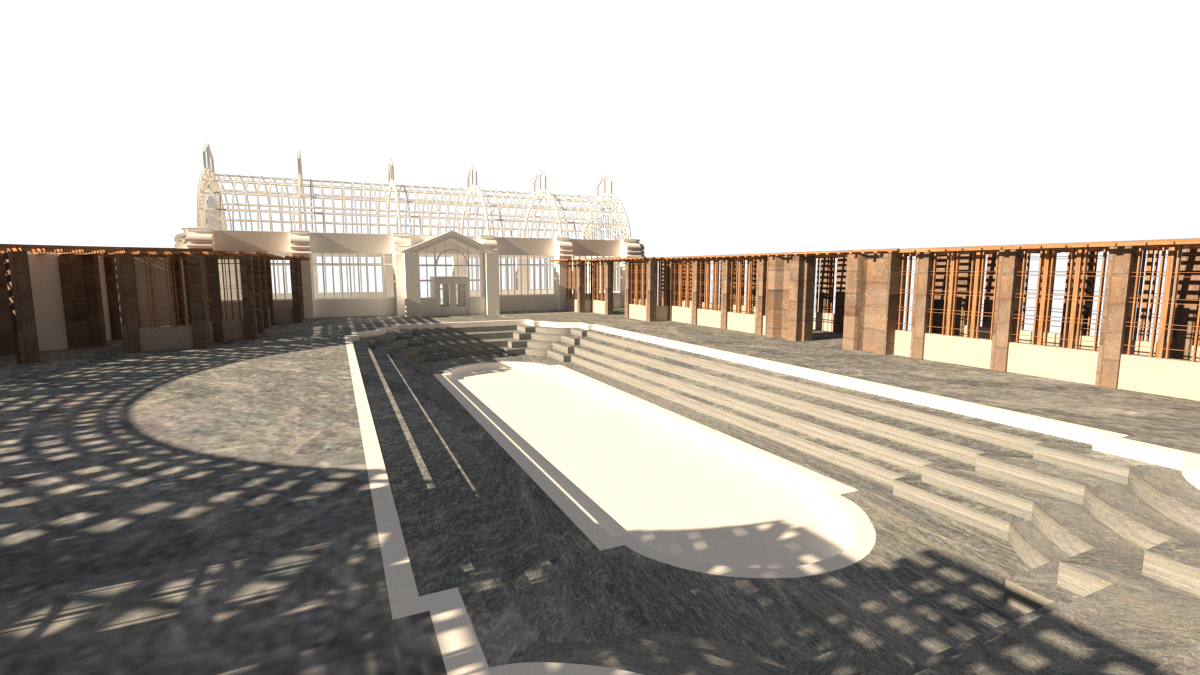
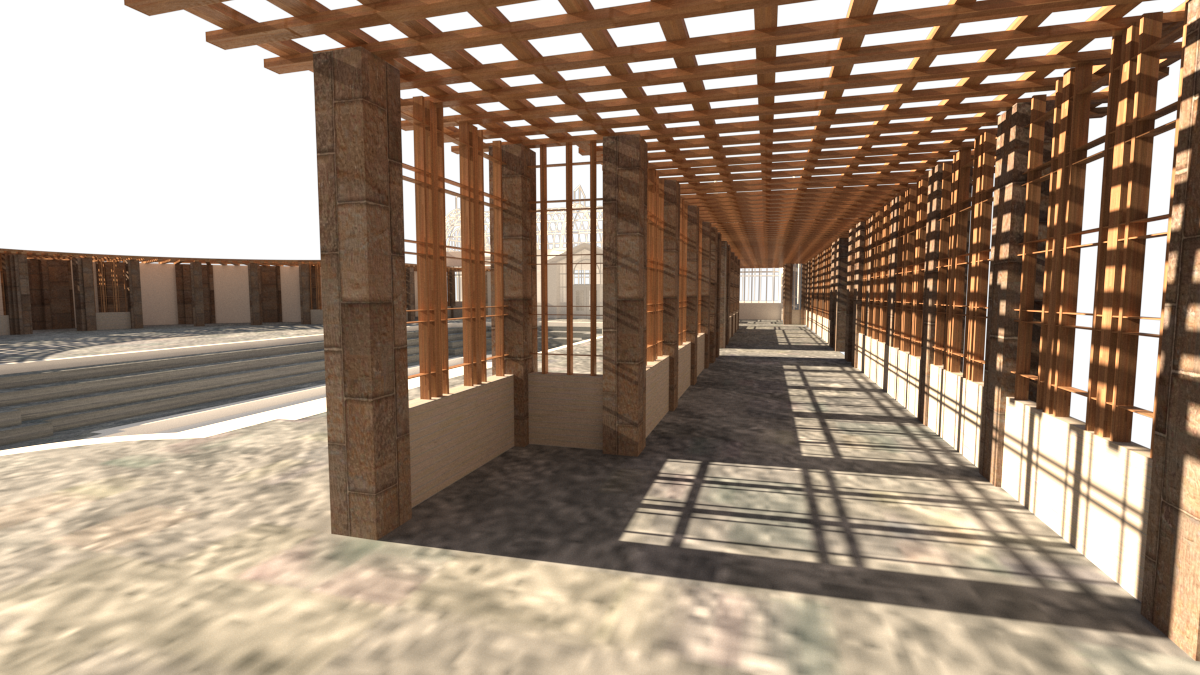
This is wintergardens made with rhino and revit, which is still a learning process. When making models, I often think about how to design? How to make it better? what should I do? and many more.

Statement

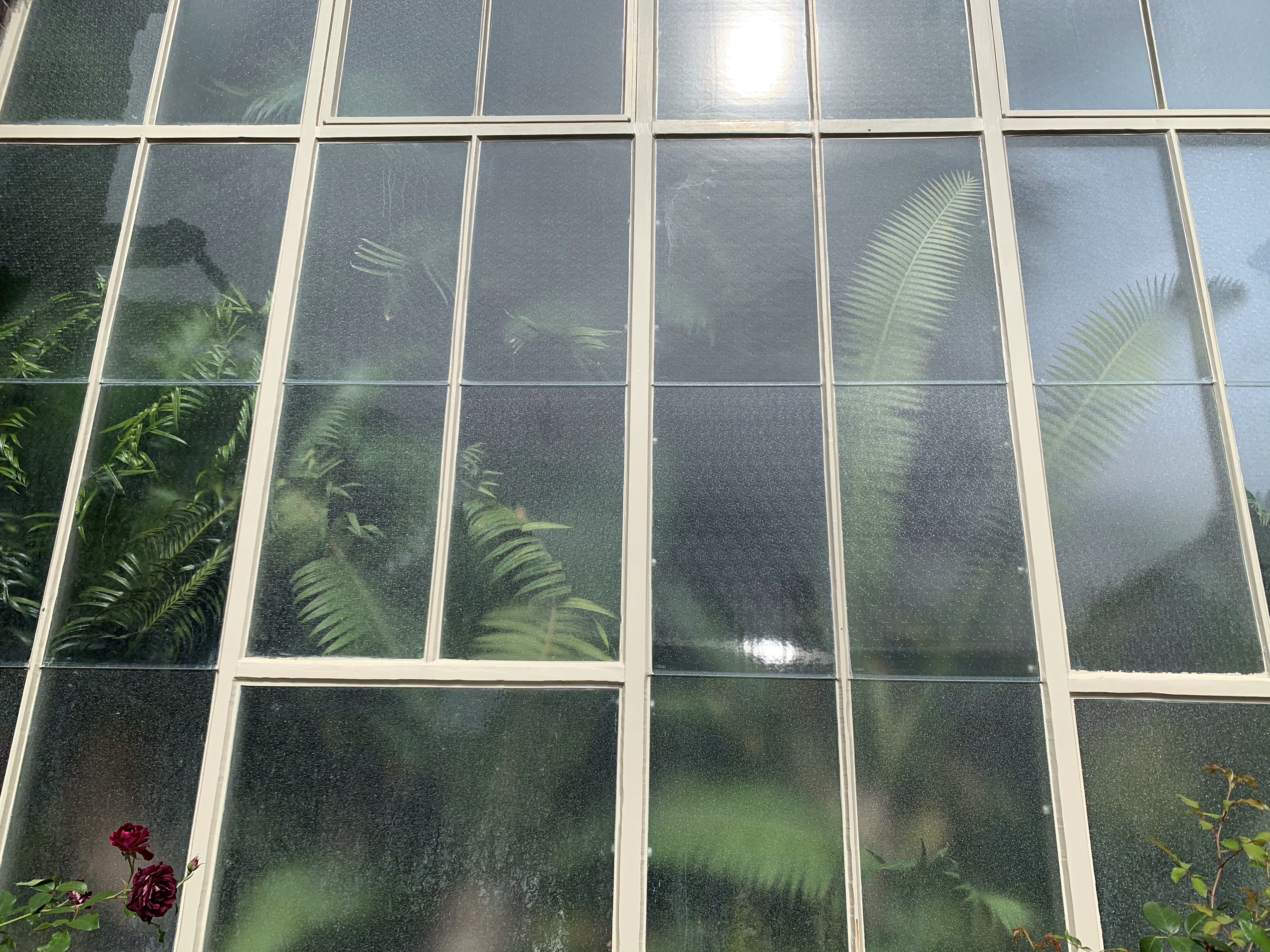
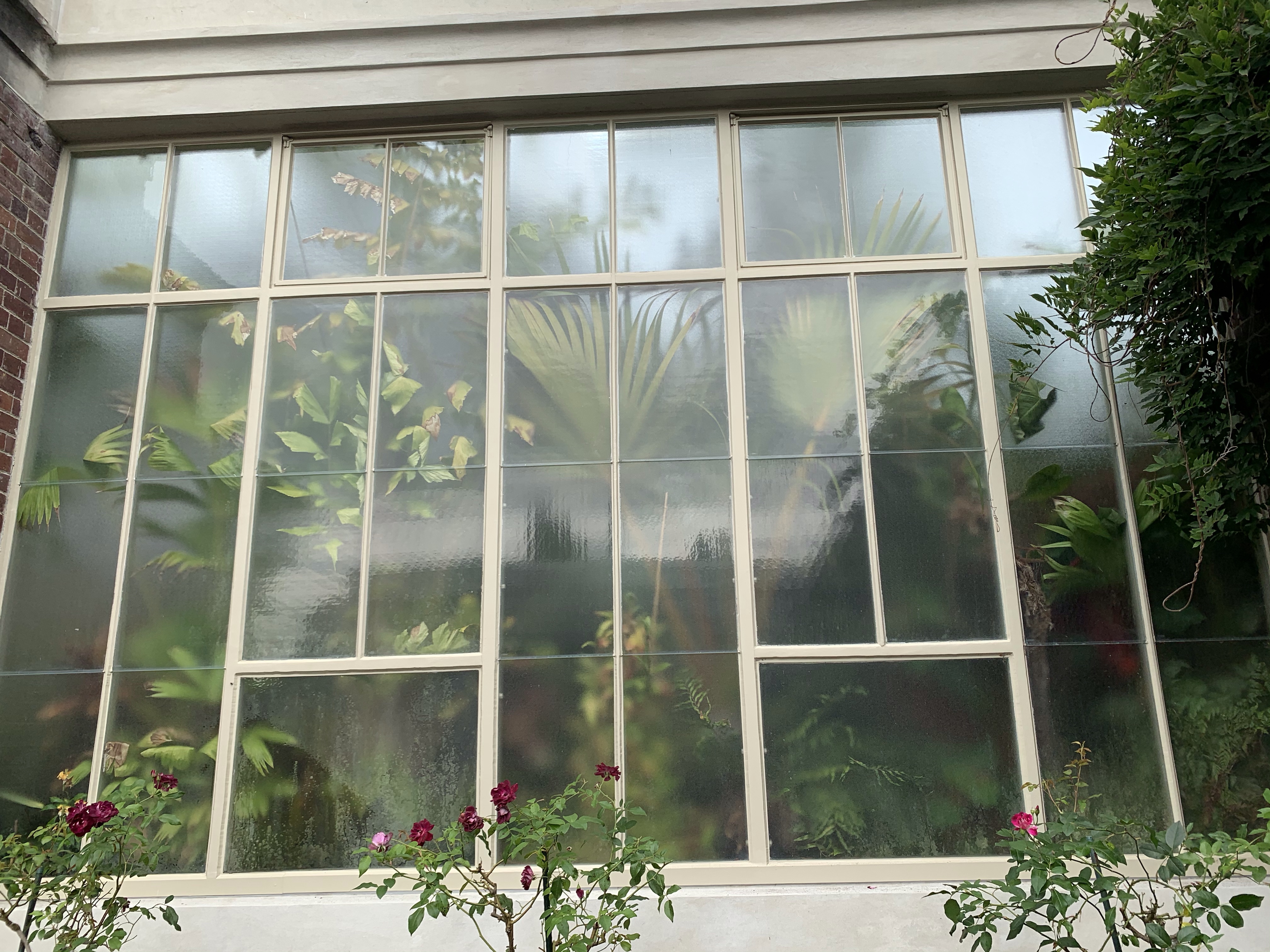
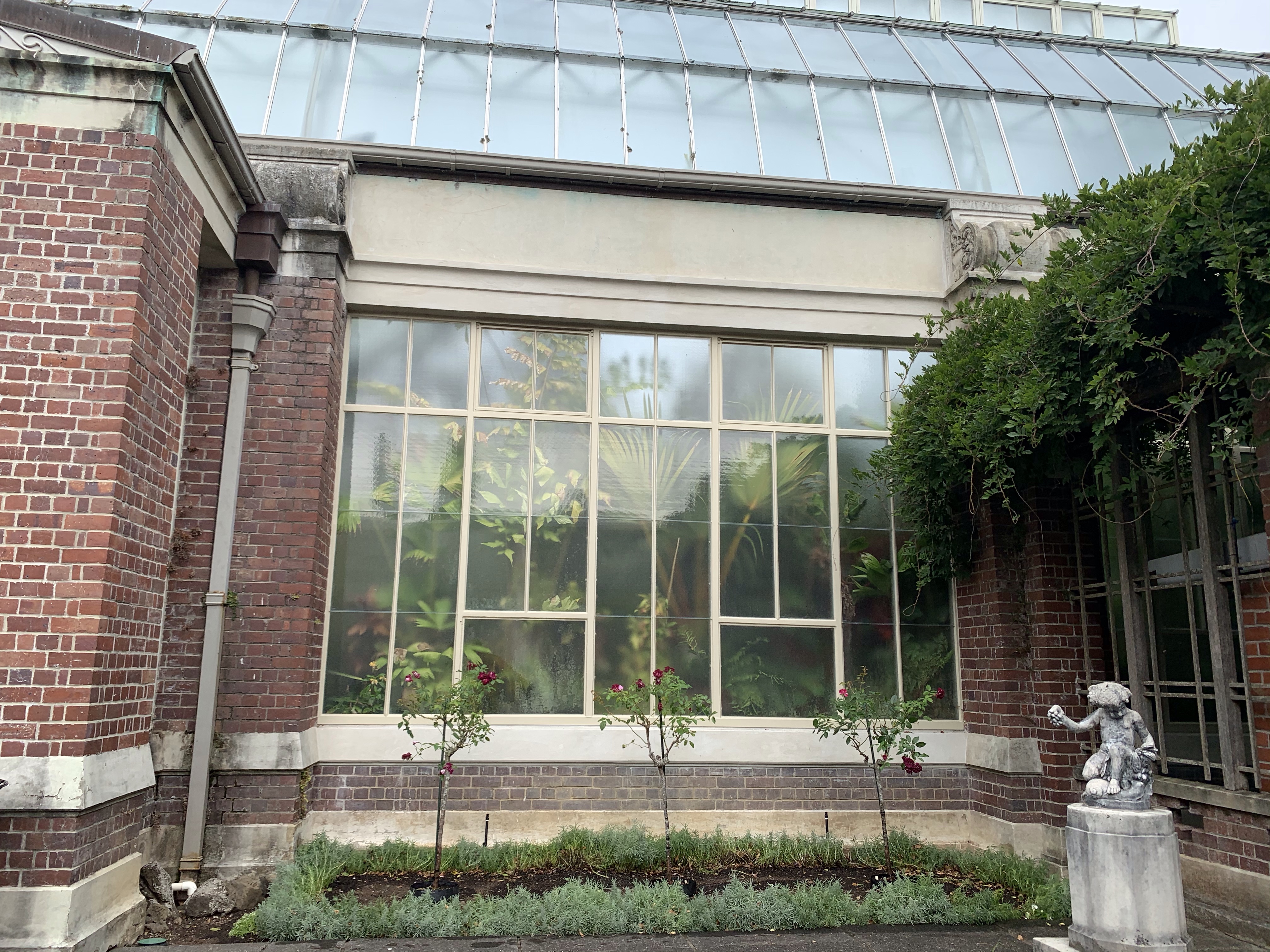
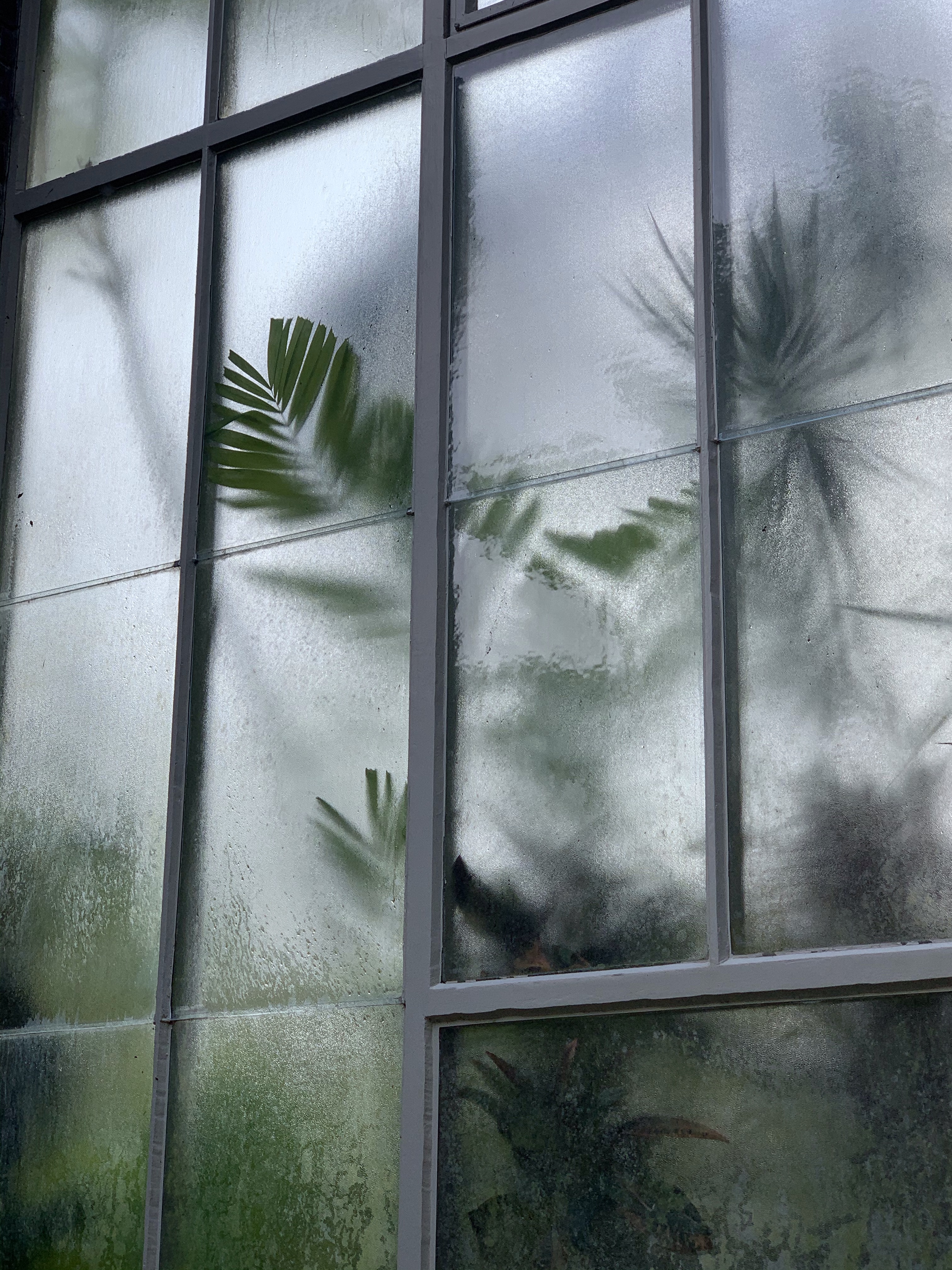
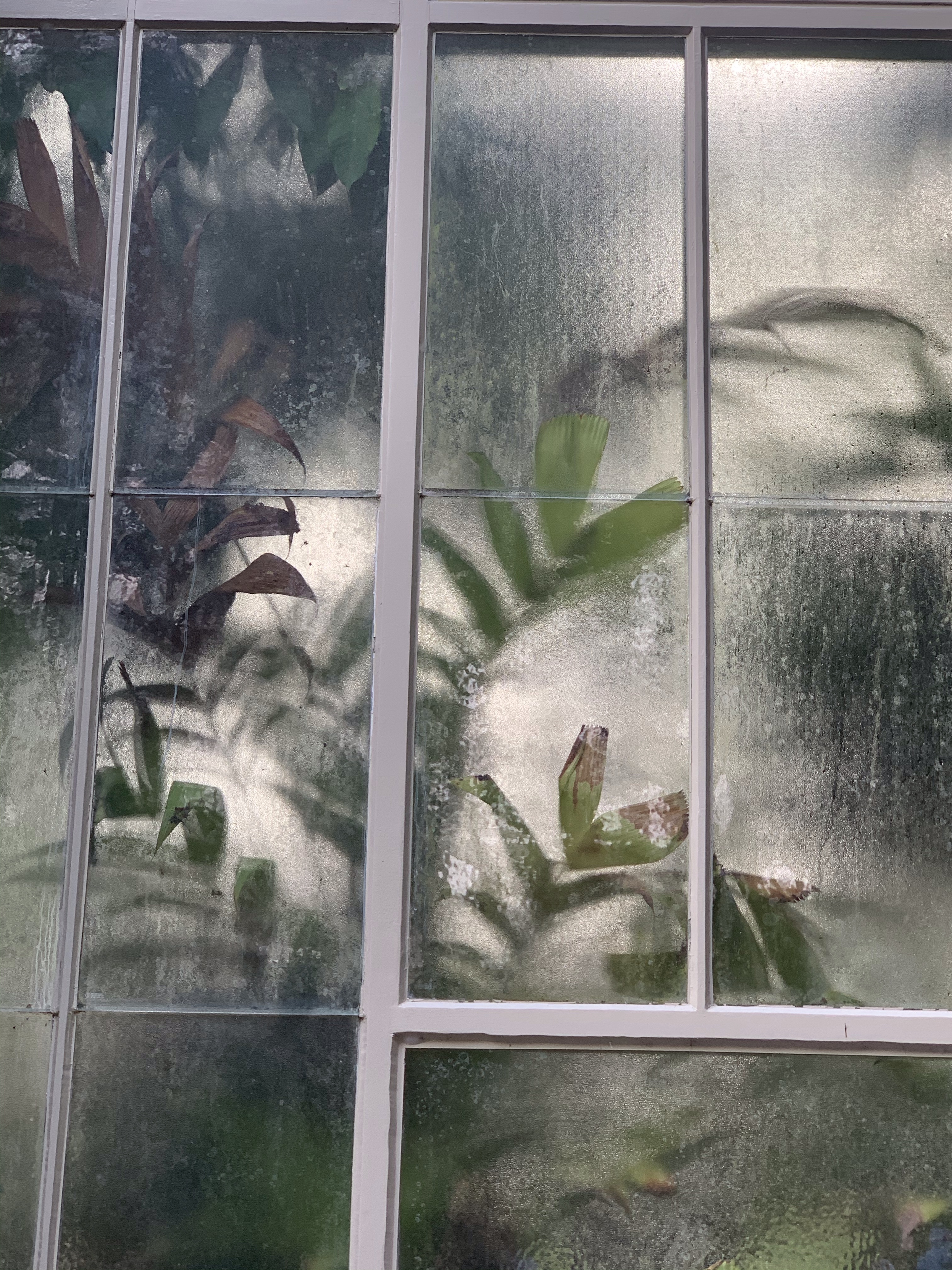
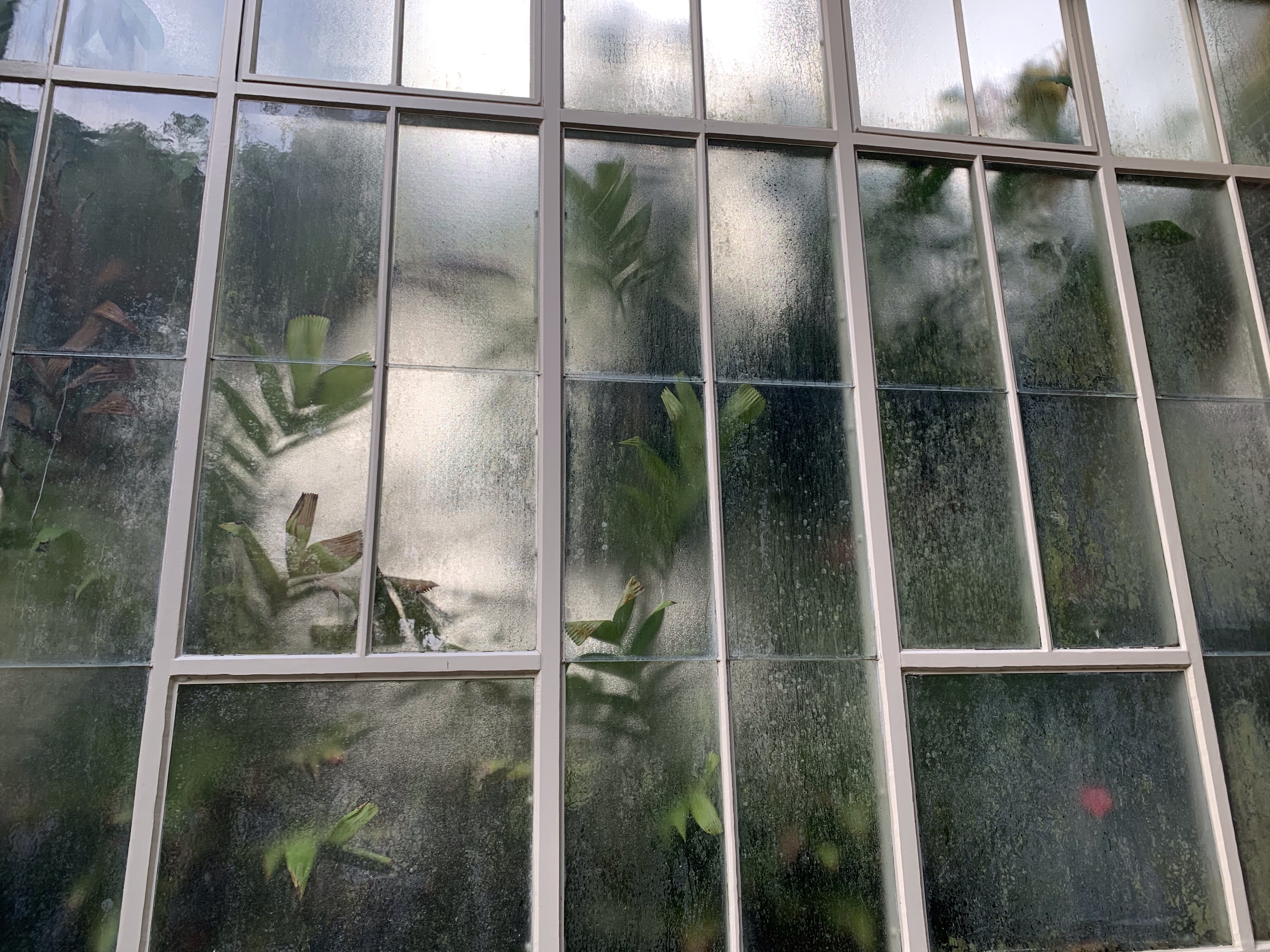
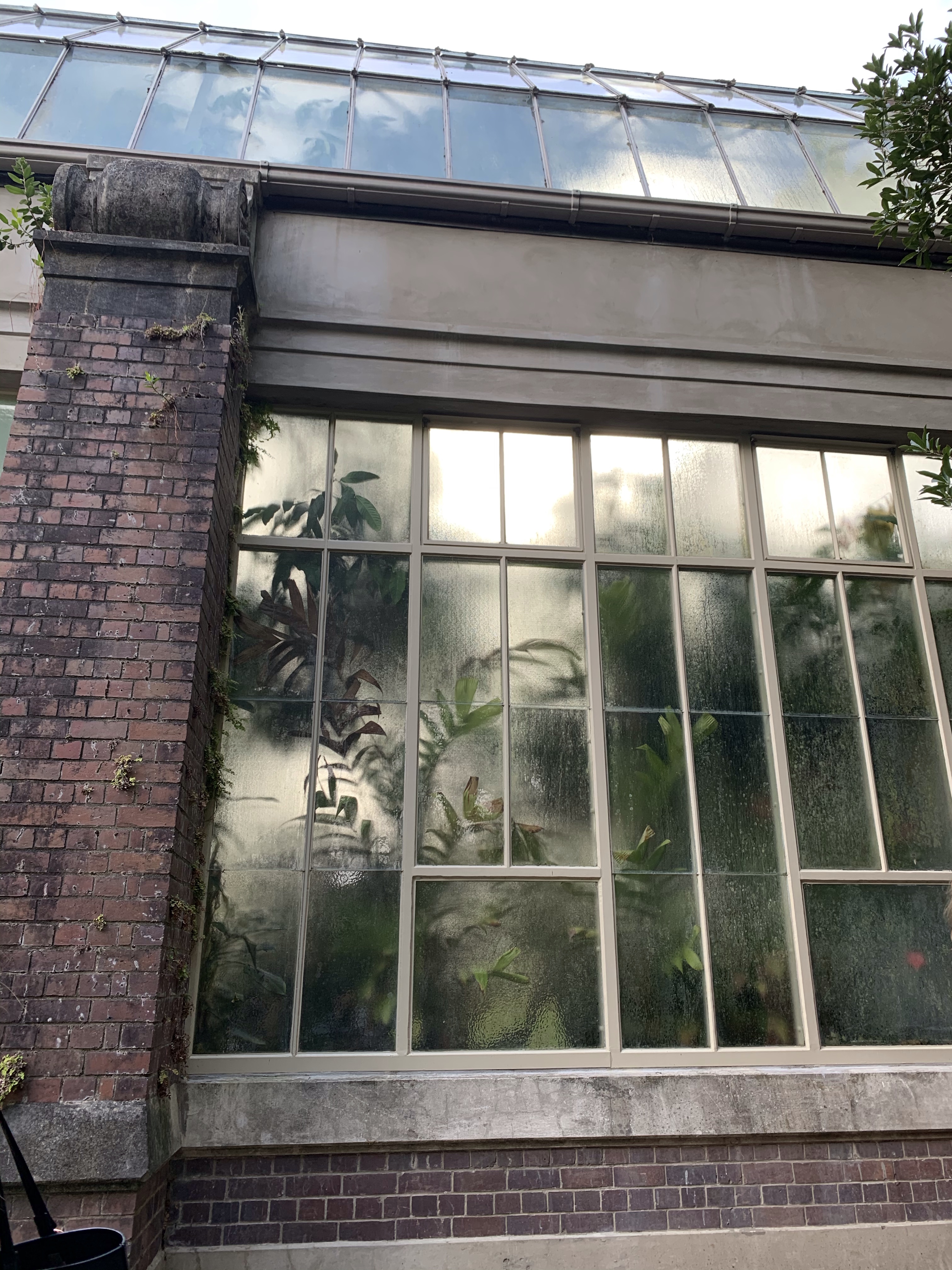
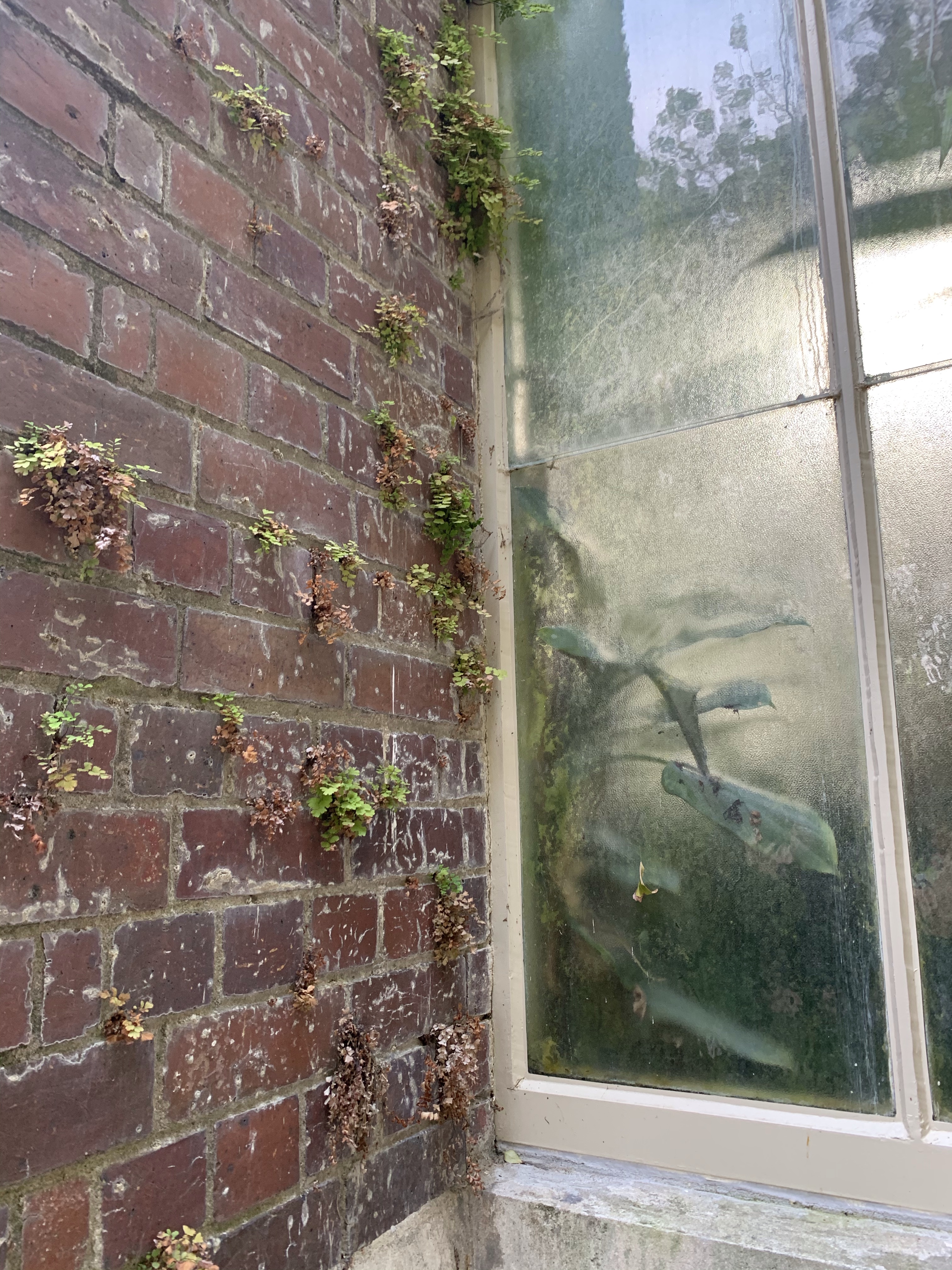
Taking history as a starting point, I was inspired by it. The glass material of the winter garden attracts many people and is called the most romantic park by the public. It is a very important place for the Aucklander, which carries many people’s memories and stories, etc. Some deep memories may be worth recalling for a lifetime. I am exploring how to combine memories with exhibition. When I visited the wintergardens for the first time, the most fascinating part was the outside of the glass. Through the glass, I could see the pattern of the plants inside. This is also the source of inspiration for my project.

In this project, I choose exhibition space. Usually people will recall a past, a place or a person through photos, words, paintings, songs and other situations. But these forms are very limited, and you must have these experiences before you can. Photographs are the most convenient and commonly used method, but its limit. My design is to achieve a three-dimensional space effect through layered landscape.

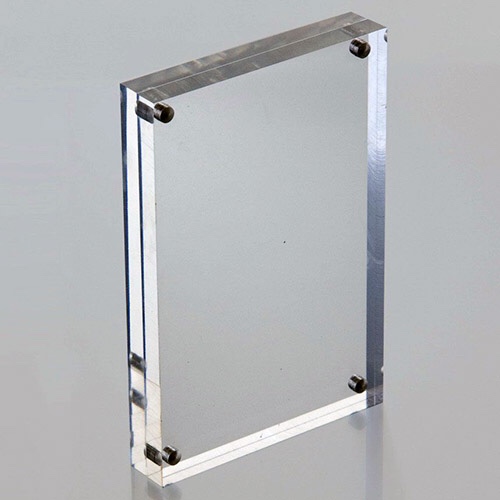
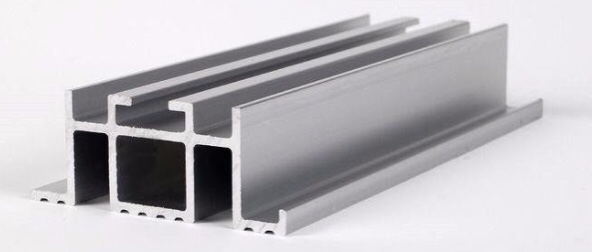
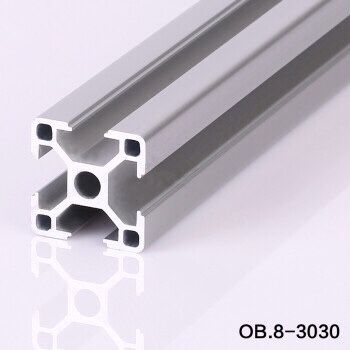
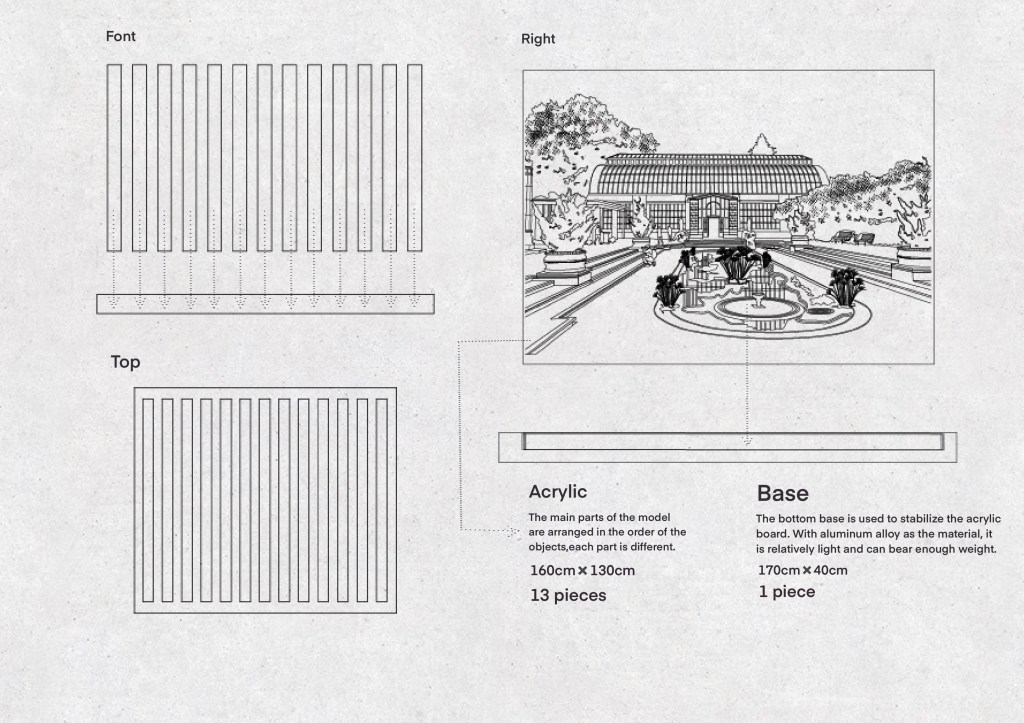
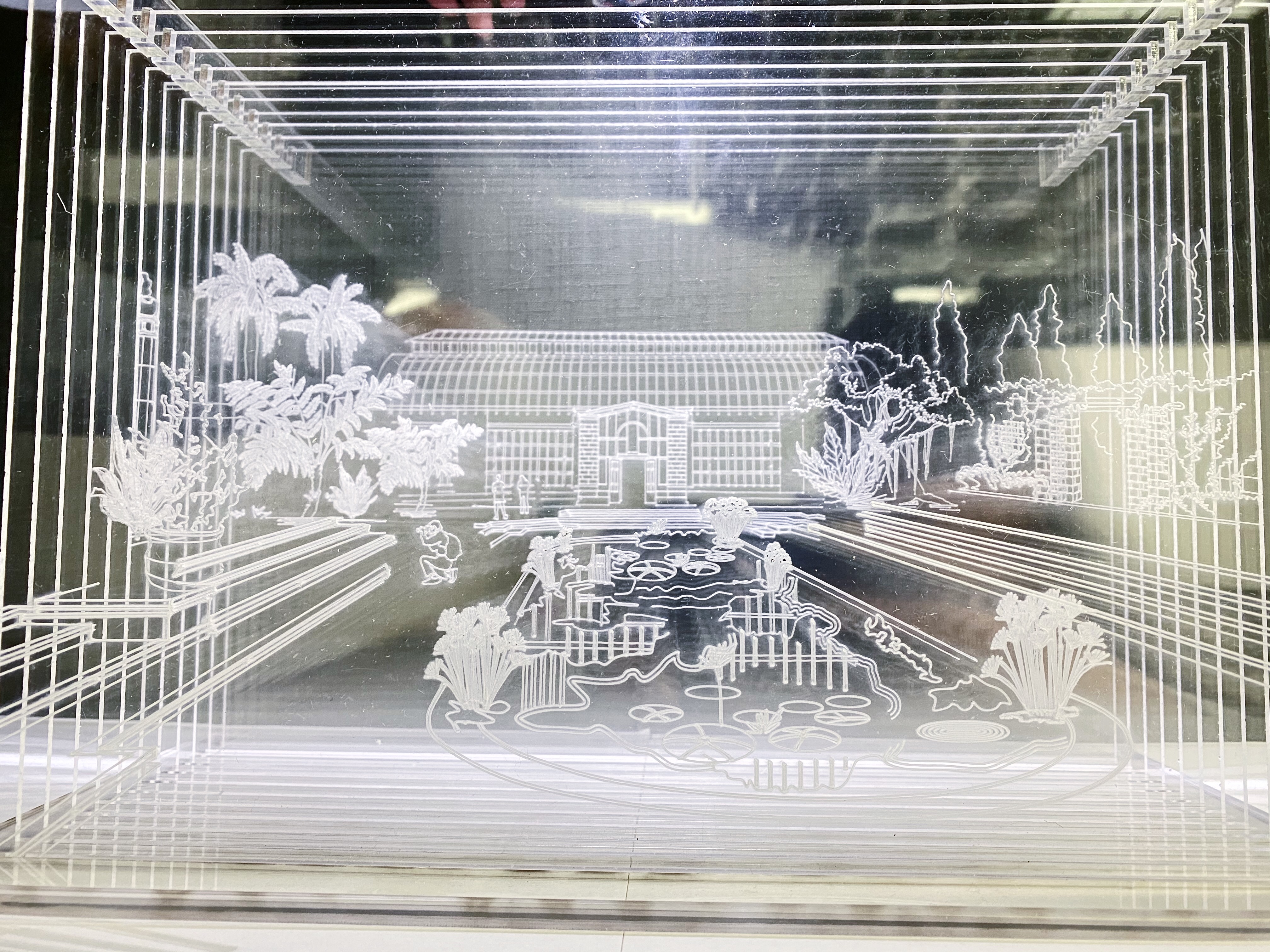
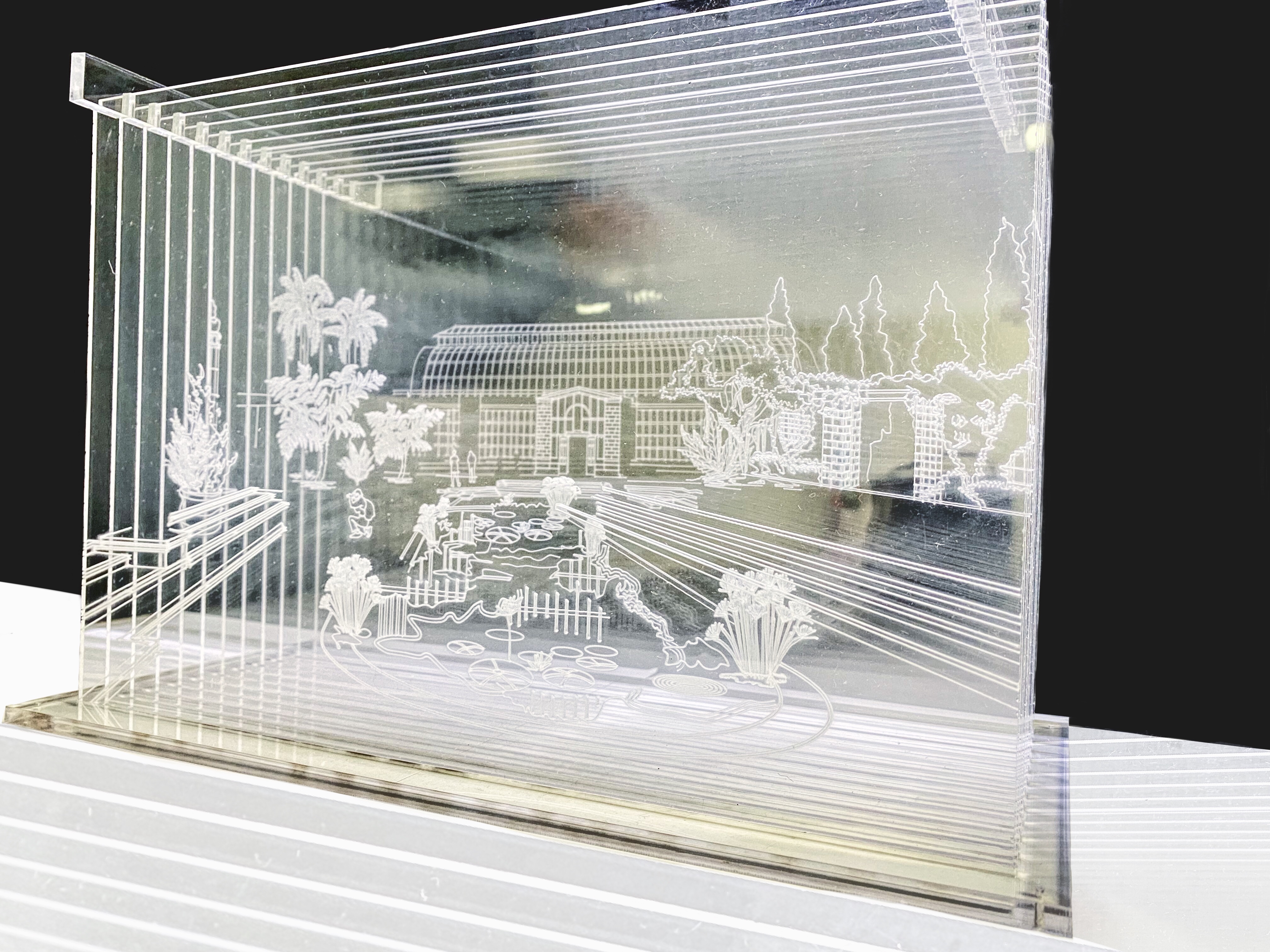
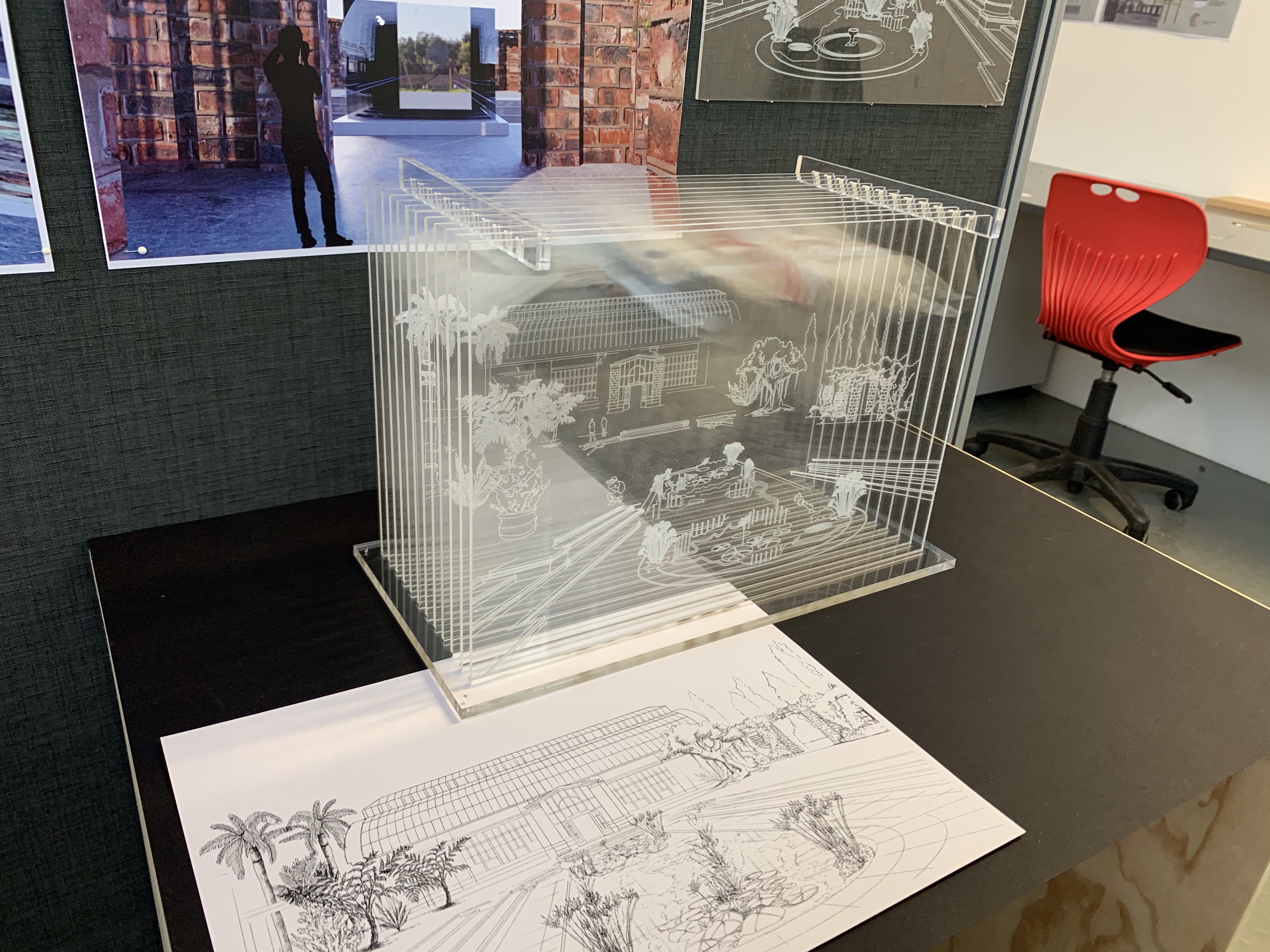
The main purpose of this work is to record a certain moment through exhibition. The attractive point is that it is three-dimensional. Through the design, visitors can feel the multi-faceted nature of the winter garden. This is an inclusive, public and romantic place. By showing a complete winter garden layer by layer, I try to bring colors in, which will make the work more complete. The original idea was to use laser cutting but it will be black and white. So I am studying whether I can achieve the effect I want by printing or other methods. Combining the winter garden materials, I use acrylic as material and aluminum alloy as the base to ensure the stability of the exhibition. Do not destroy the original nature of the garden, continue to maintain its romance.

I tried to use the printing method to complete, this is just a test. Obviously it suffers from failure, because the color is too heavy to reflect the sense of hierarchy that I want to show. The objects behind cannot be highlighted, and there is no three-dimensional effect when they are superimposed together.

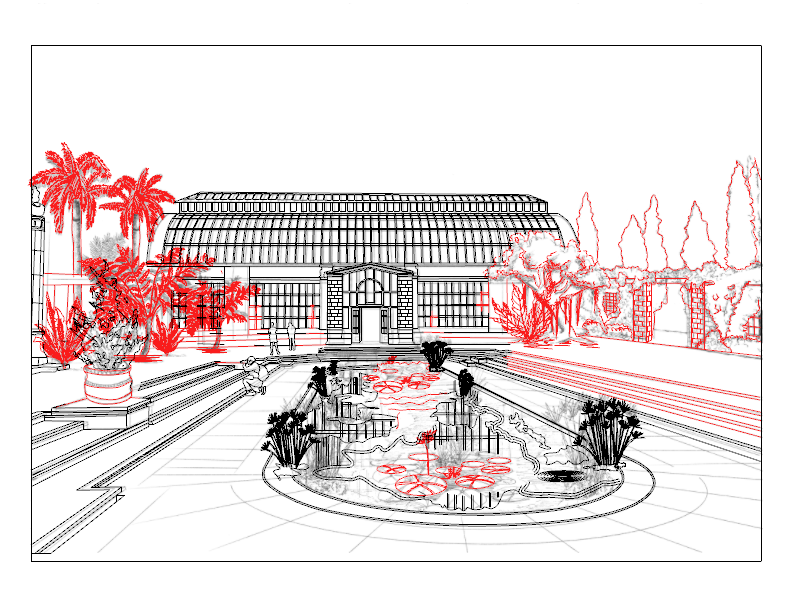
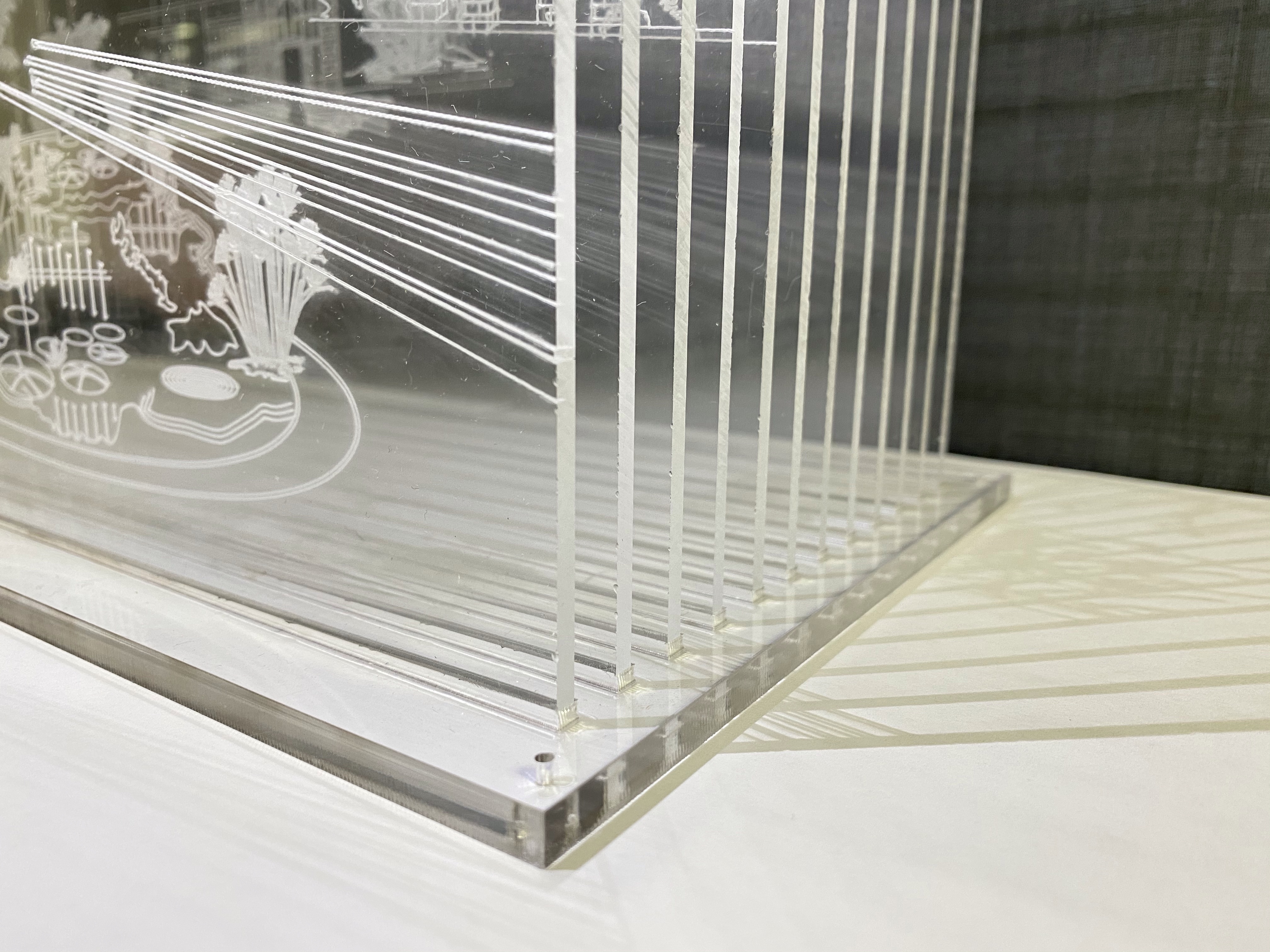
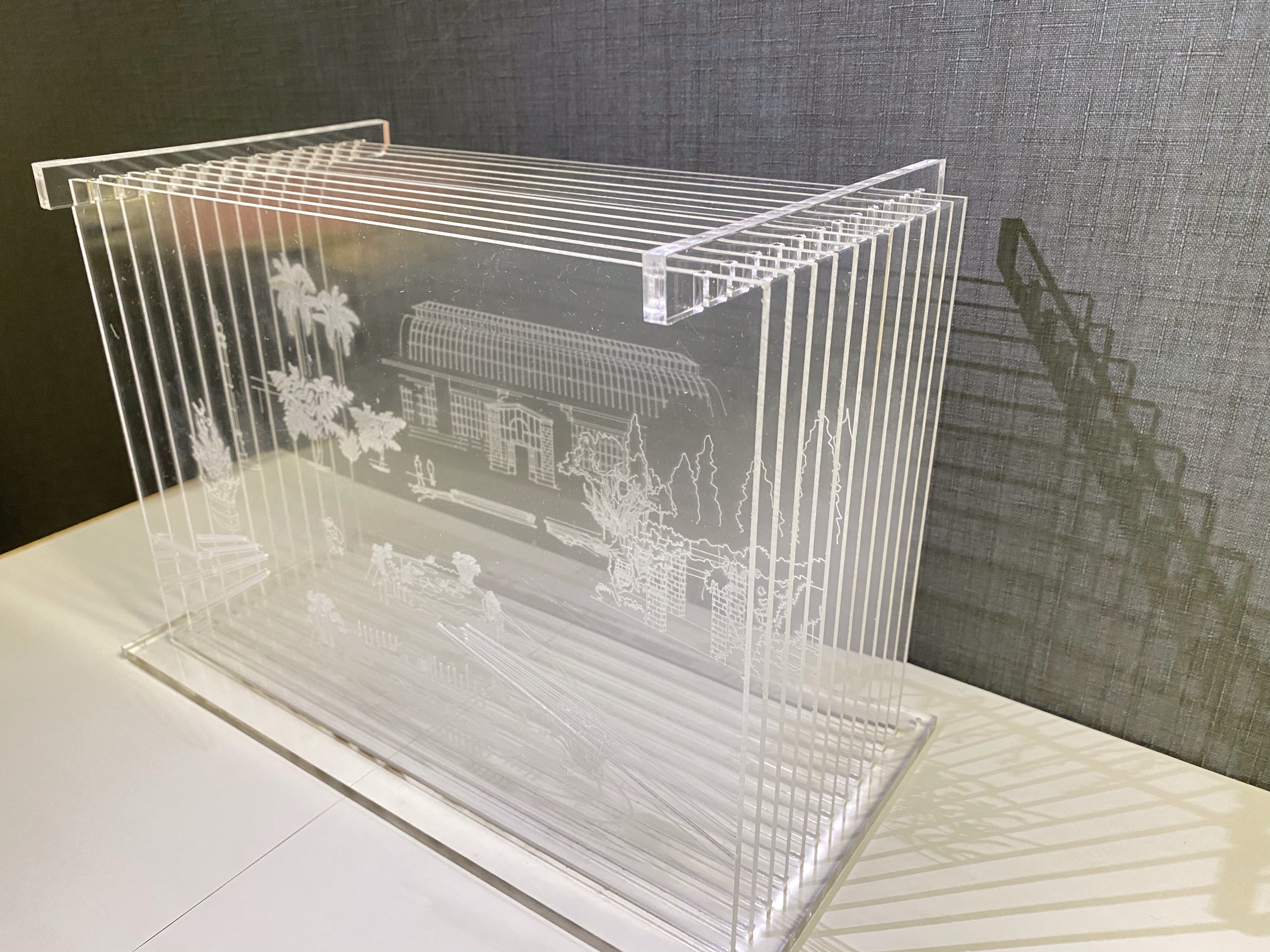
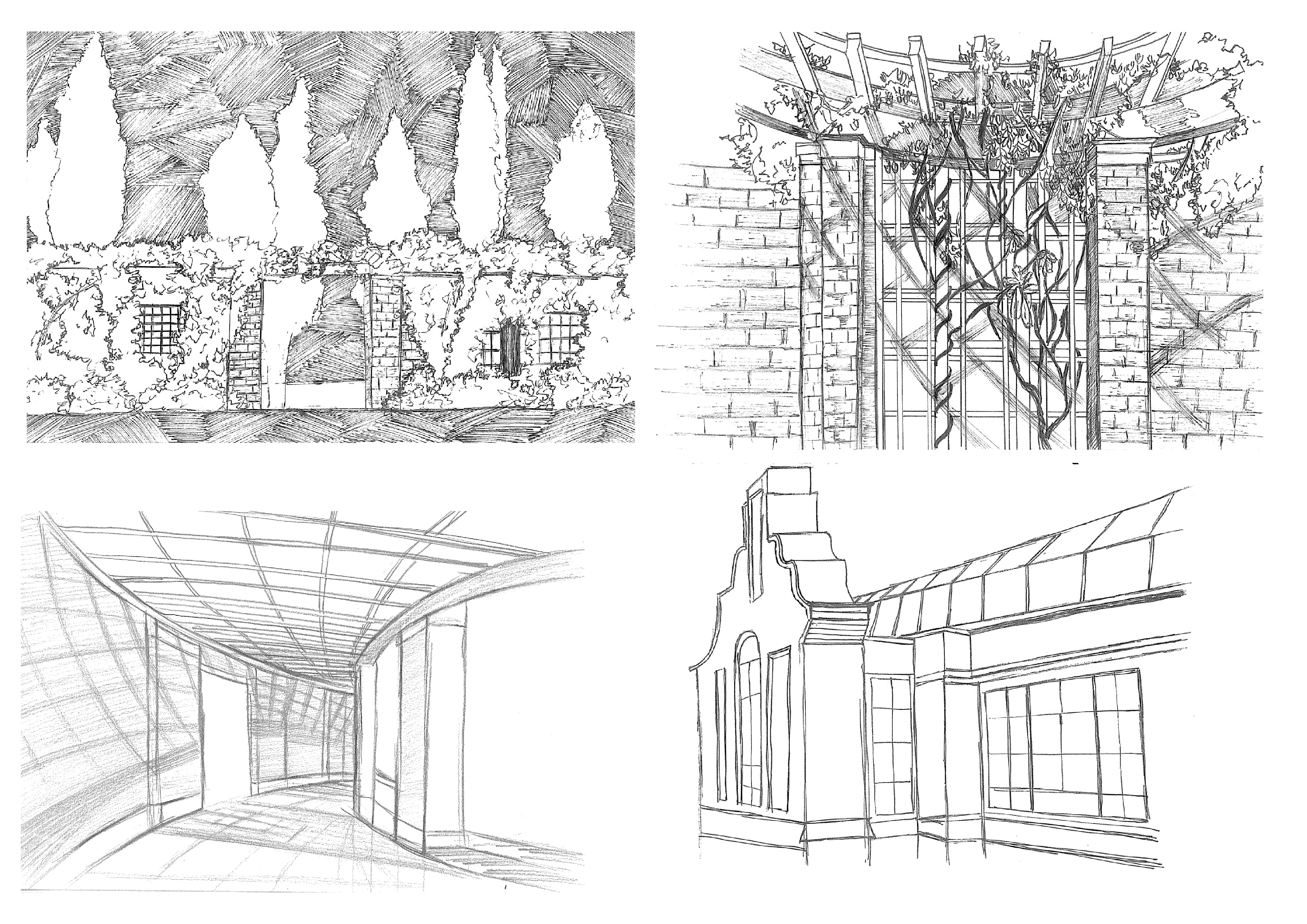
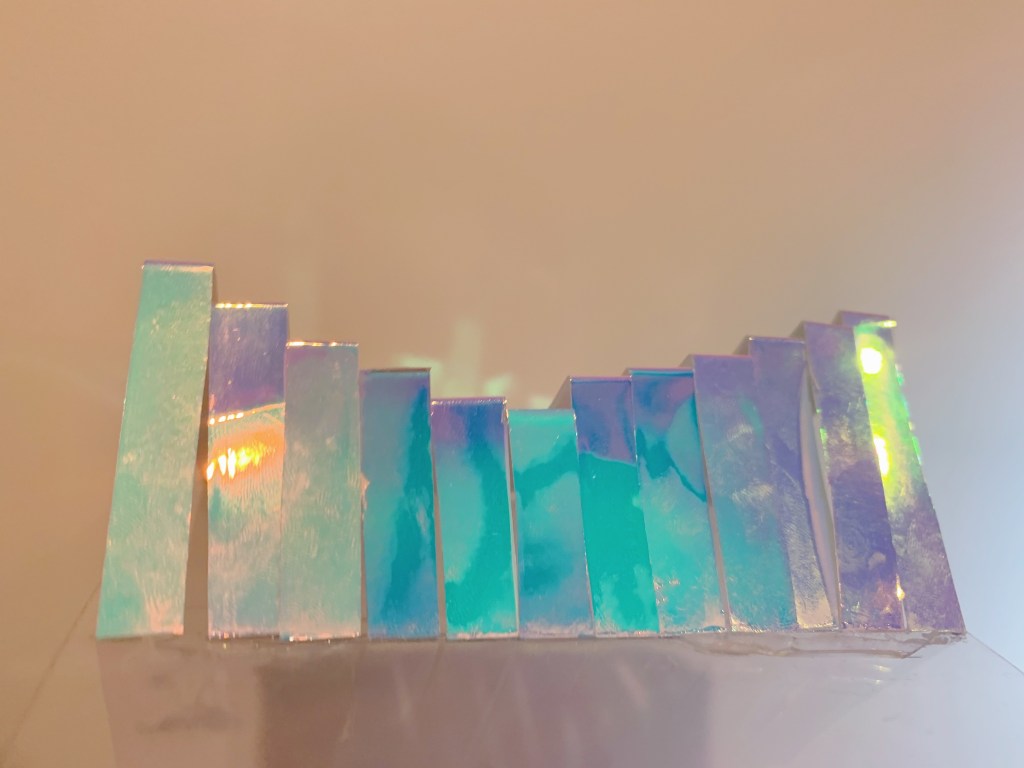
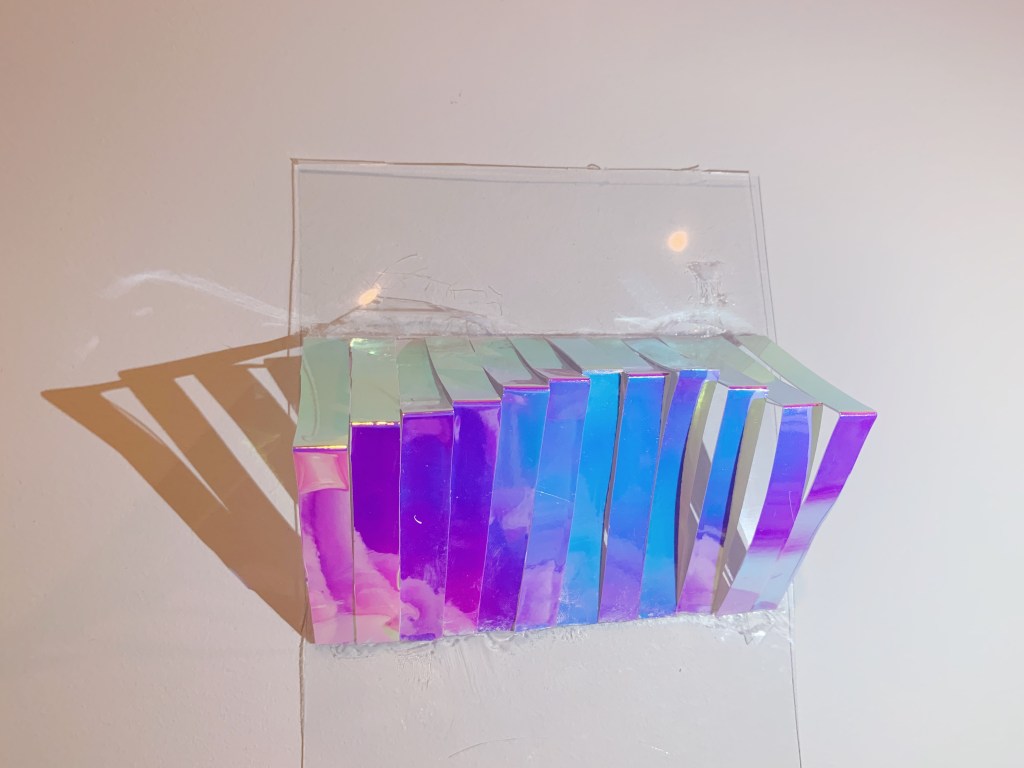
I drew this picture, and then separated it into 13 pieces from front to back in order to achieve a 3D effect by adding more layers together. The process is not complicated, but I try my best not to break the original effect, too much separation may cause the real scene to change. So I tried my best to maintain the symmetry of the left and right objects at the same latitude. The most headache for me in this process is that I painted this painting for a long time and I am not sure whether it was successful or not.

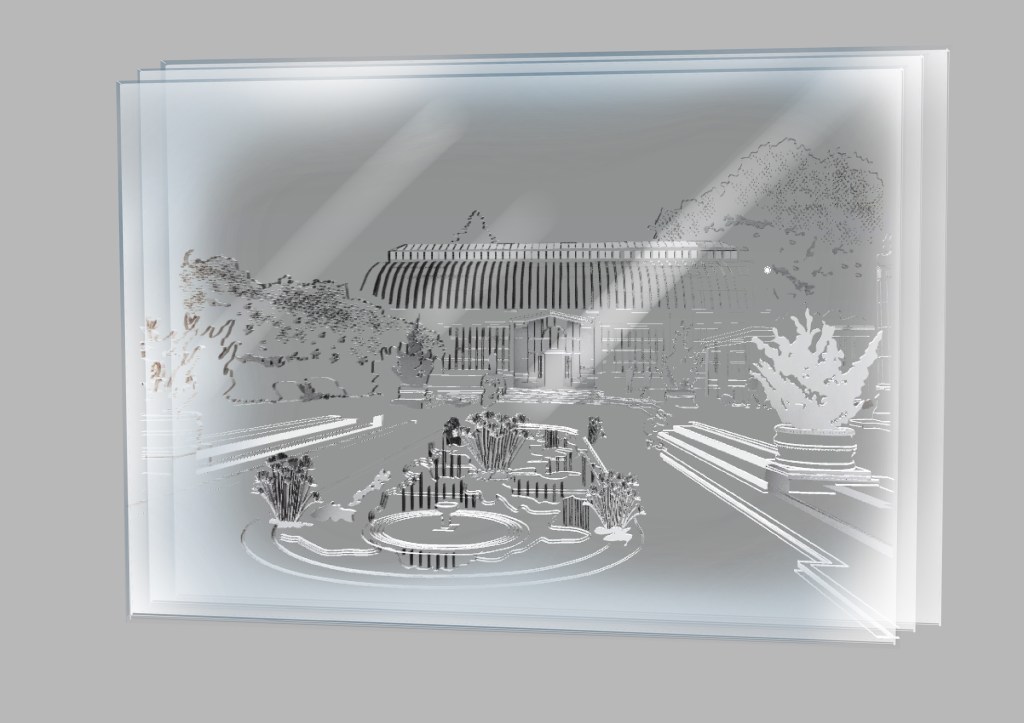
This is a model made in rhino, because the line color in acrylic is too light and the lines are too thin to be reflected in rhino. It can only be displayed by hand-made models.

Materials

Acrylic

Used extensively in signage and display, Acrylic is lightweight (half that of glass), strong (9 times stronger than glass), and can be used outside with confidence.

Acrylic is very versatile and is available in a wide range of colours, sheet sizes and thickness.

Acrylic has the versatility to be fabricated, folded or moulded into various shapes and sizes. Acrylic can be used for a wide variety of things from boat windows, feature panels through to lining walls.

Aluminum alloy

Aluminium alloys (or aluminum alloys; see spelling differences) are alloys in which aluminium (Al) is the predominant metal. The typical alloying elements are copper, magnesium, manganese, silicon, tin and zinc. There are two principal classifications, namely casting alloys and wrought alloys, both of which are further subdivided into the categories heat-treatable and non-heat-treatable. About 85% of aluminium is used for wrought products, for example rolled plate, foils and extrusions. Cast aluminium alloys yield cost-effective products due to the low melting point, although they generally have lower tensile strengths than wrought alloys. The most important cast aluminium alloy system is Al–Si, where the high levels of silicon (4.0–13%) contribute to give good casting characteristics. Aluminium alloys are widely used in engineering structures and components where light weight or corrosion resistance is required.

Laser cutting is a technology that uses a laser to vaporize materials, resulting in a cut edge. While typically used for industrial manufacturing applications, is now used by schools, small businesses, and hobbyists. Laser cutting works by directing the output of a high-power laser most commonly through optics. The laser optics and CNC (computer numerical control) are used to direct the material or the laser beam generated. A commercial laser for cutting materials uses a motion control system to follow a CNC or G-code of the pattern to be cut onto the material. The focused laser beam is directed at the material, which then either melts, burns, vaporizes away, or is blown away by a jet of gas, leaving an edge with a high-quality surface finish.

Model Making

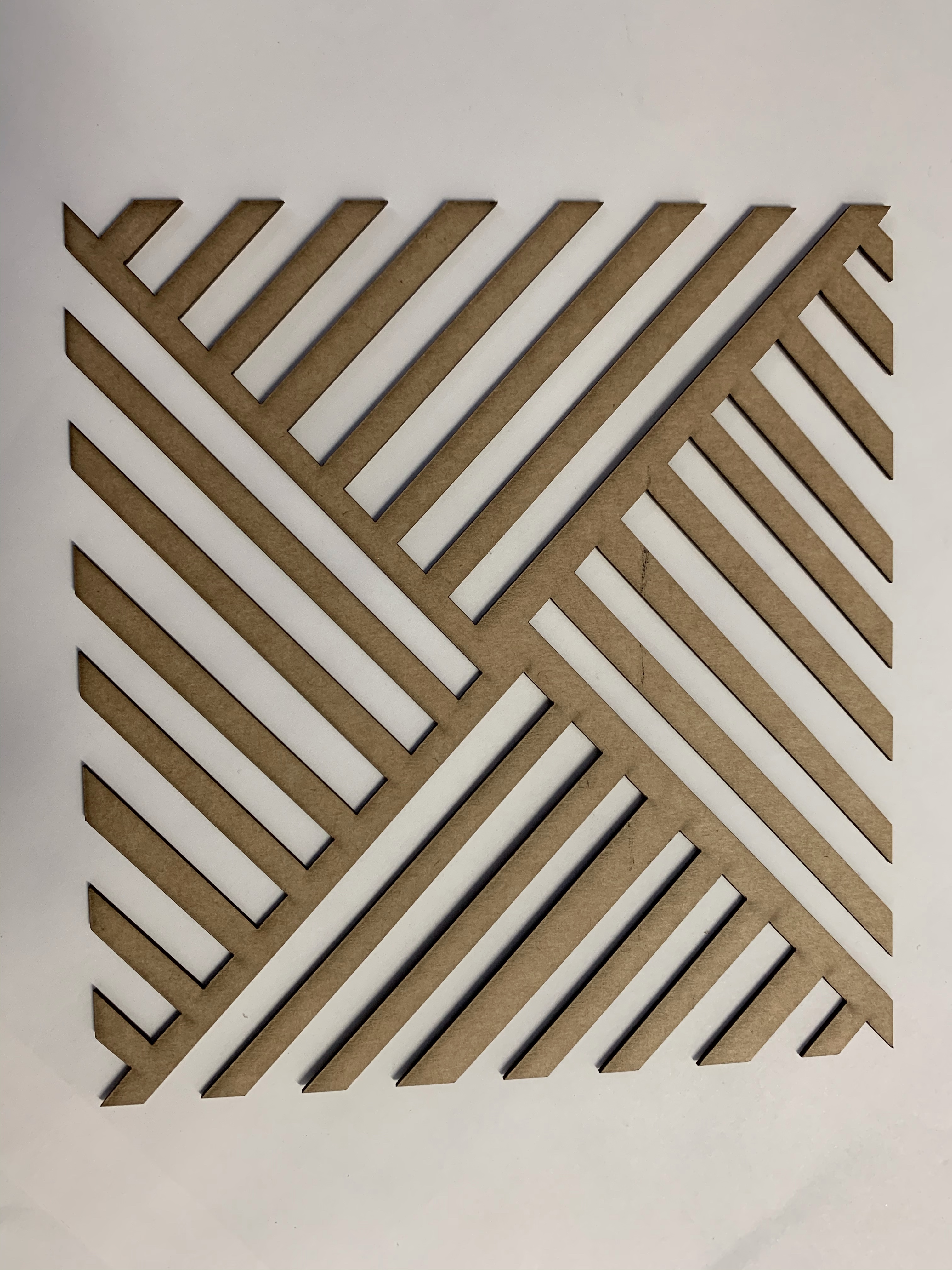
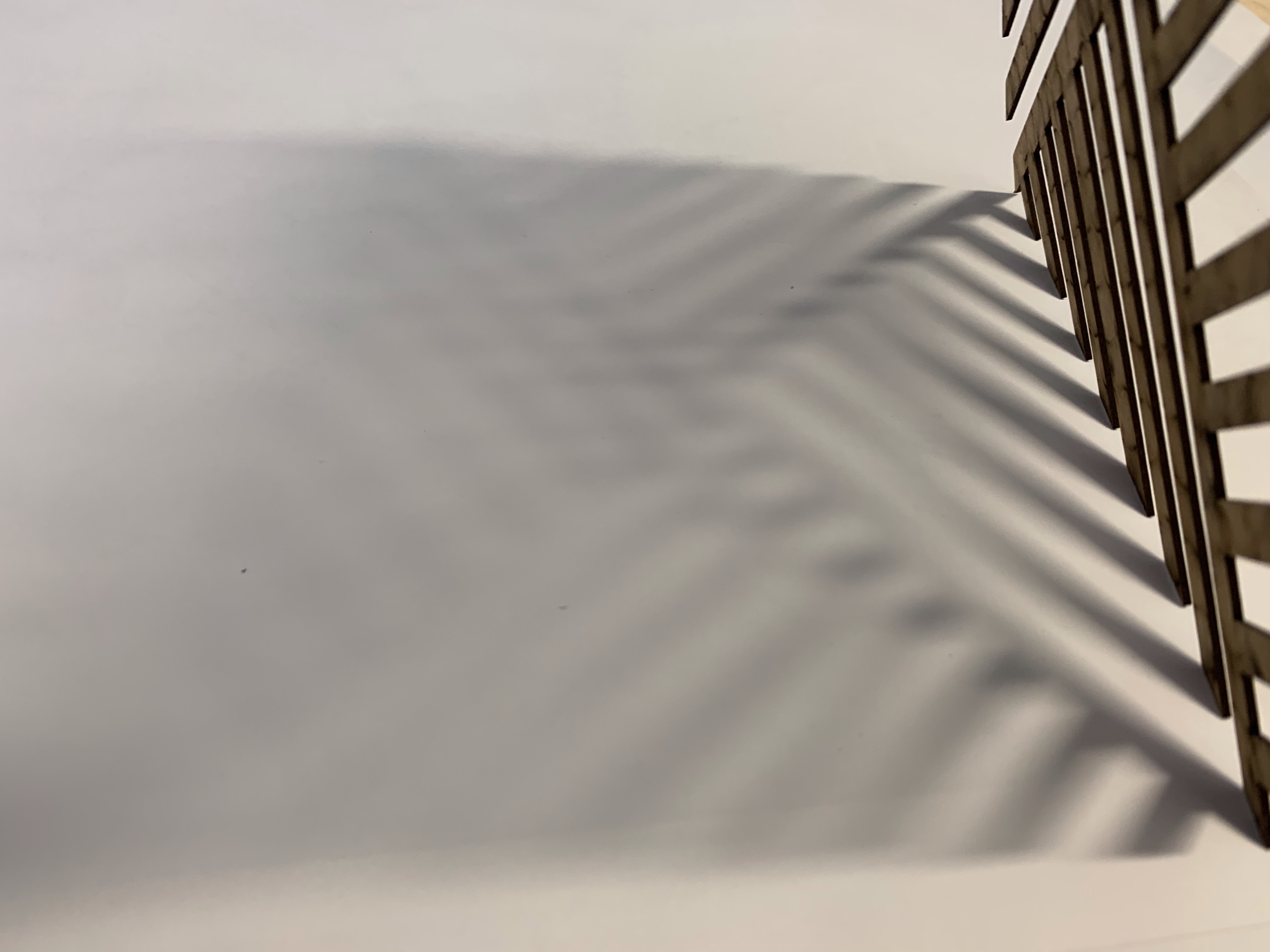
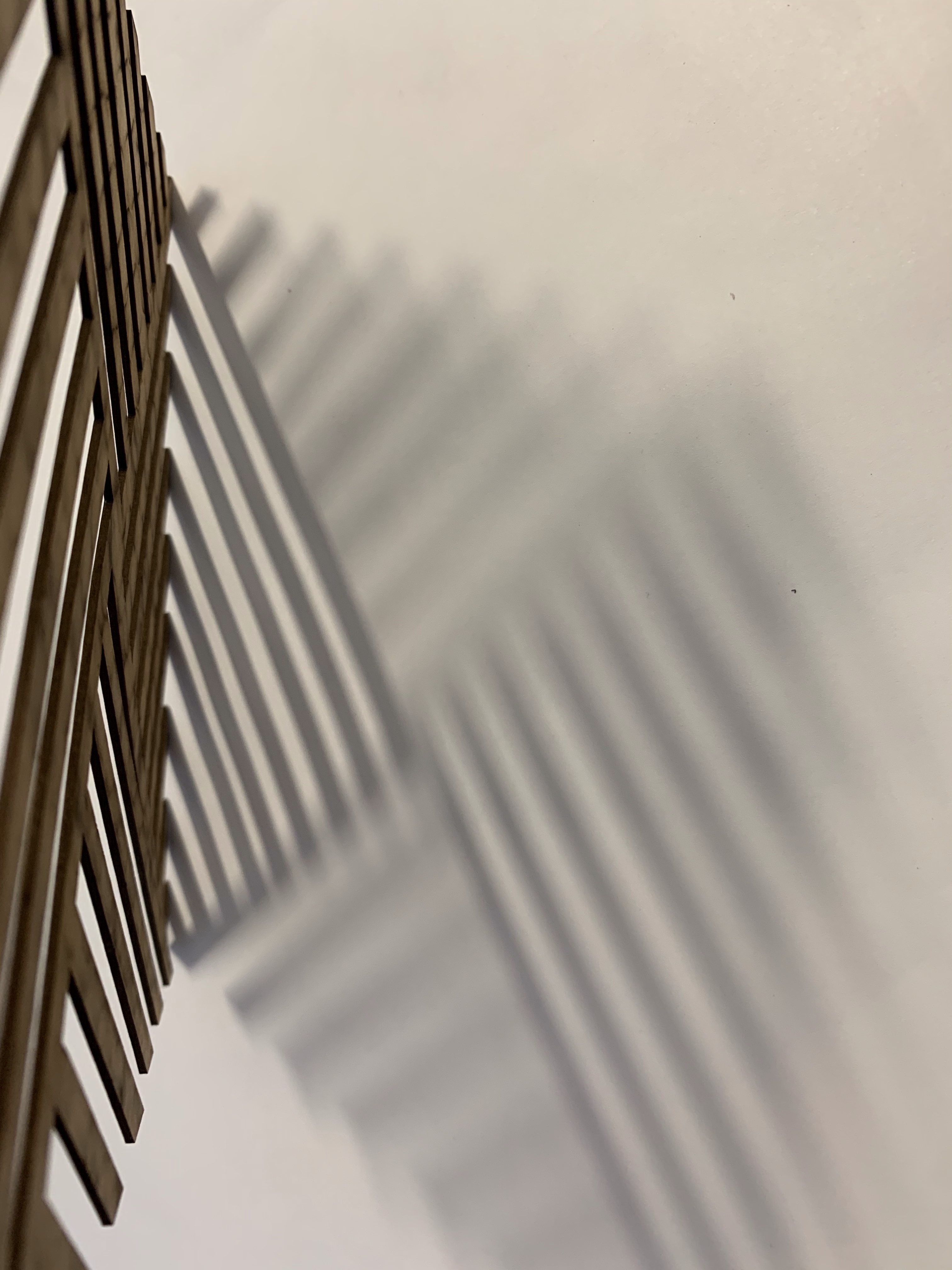
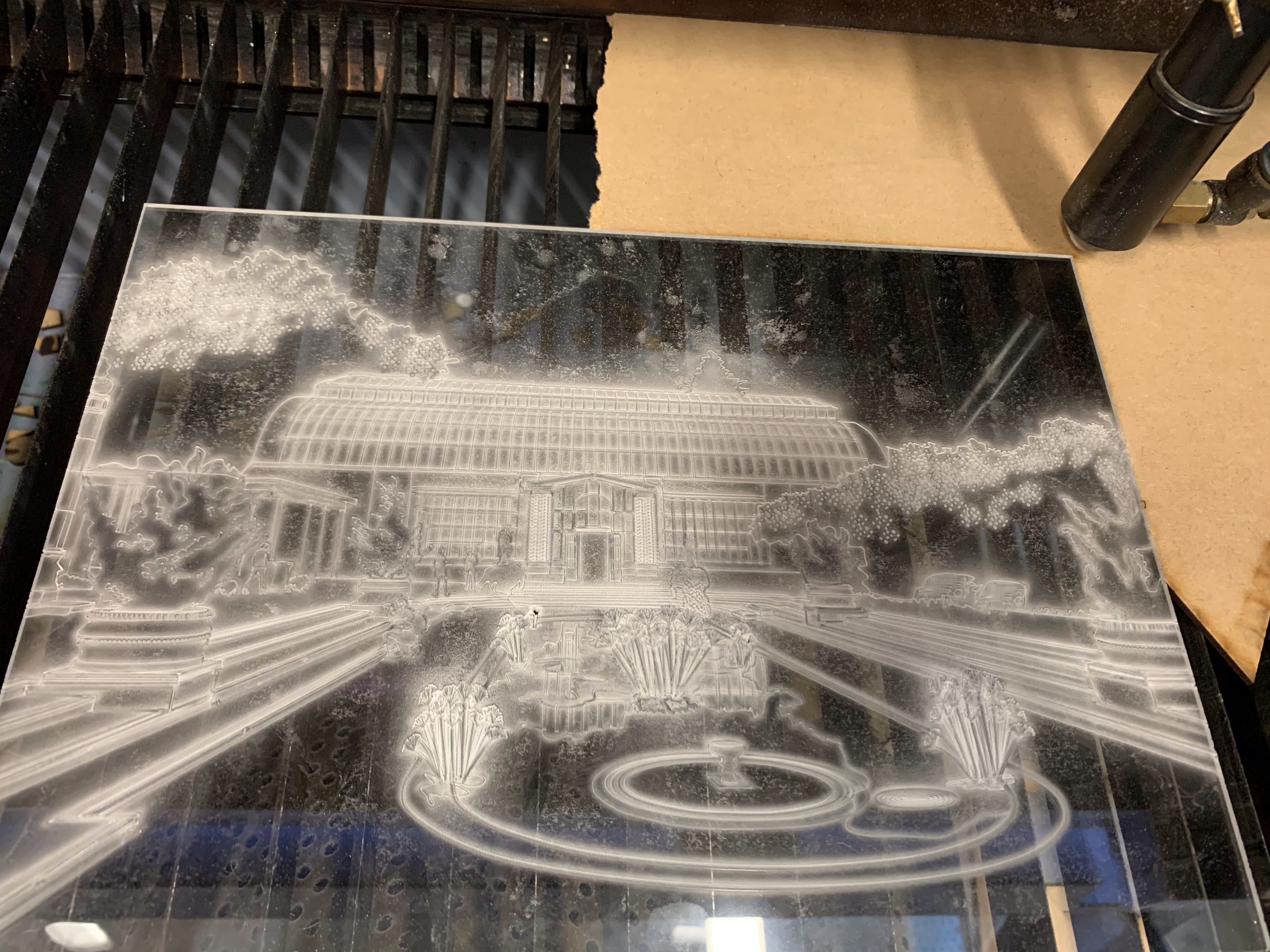
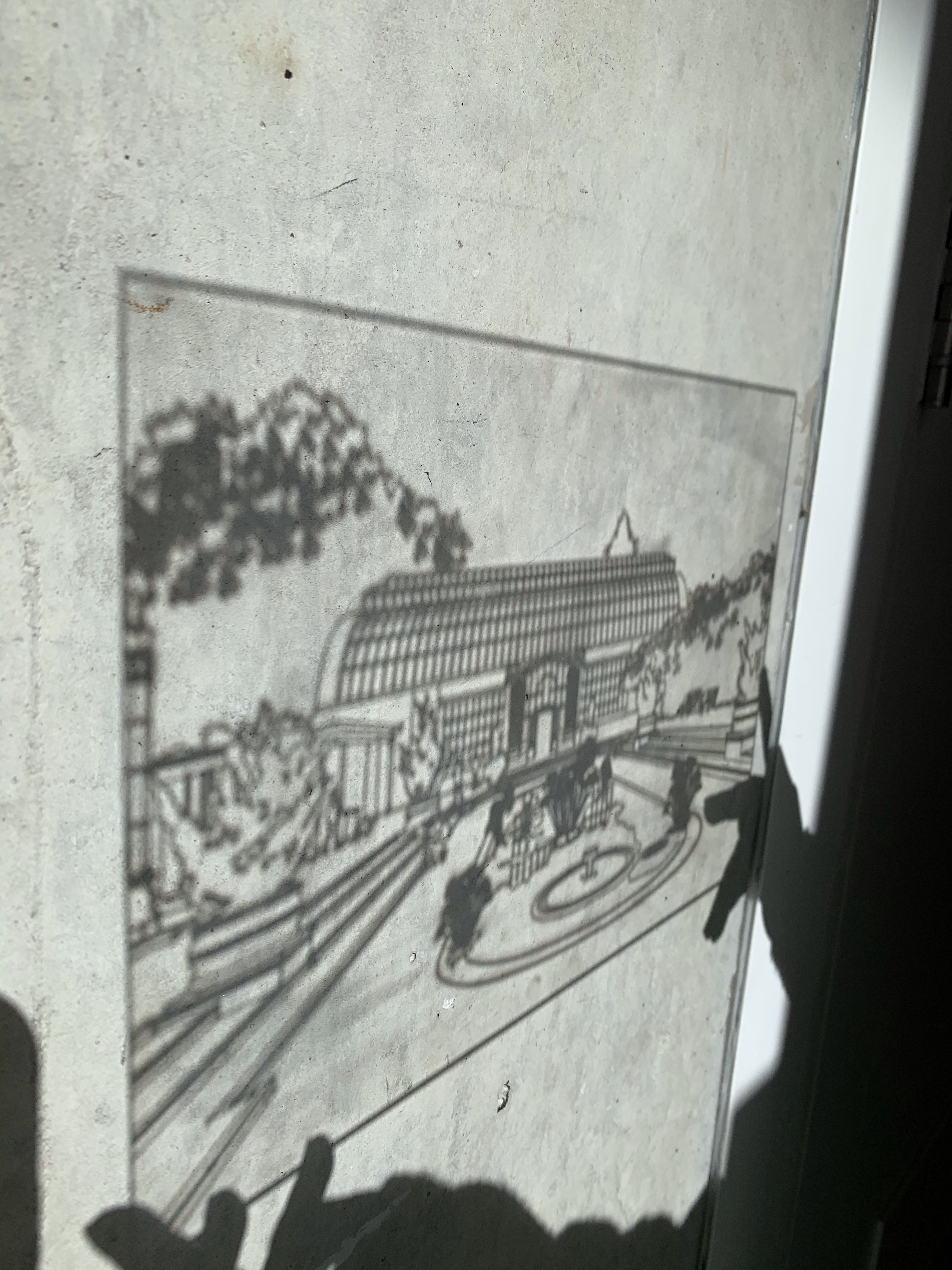
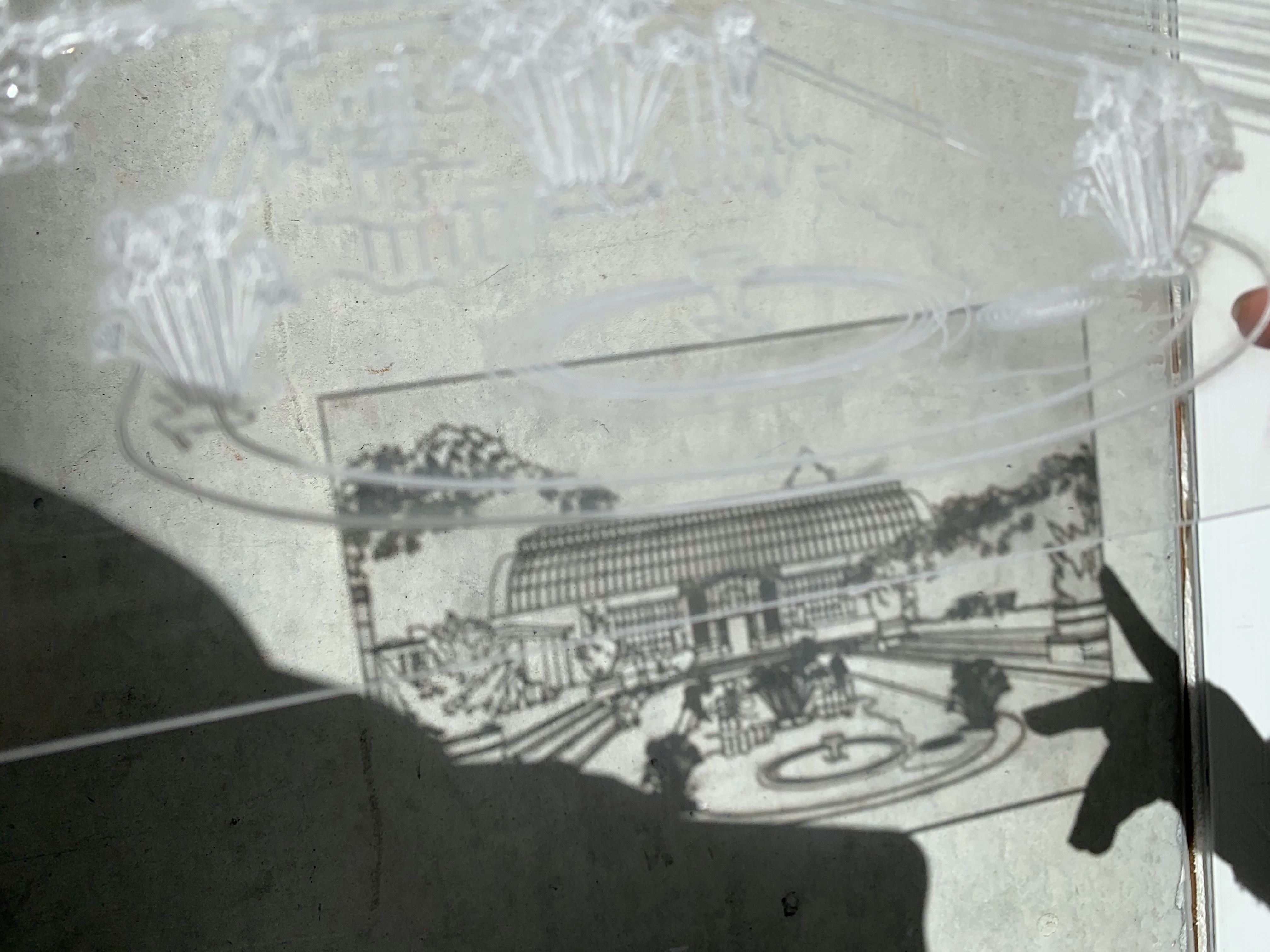
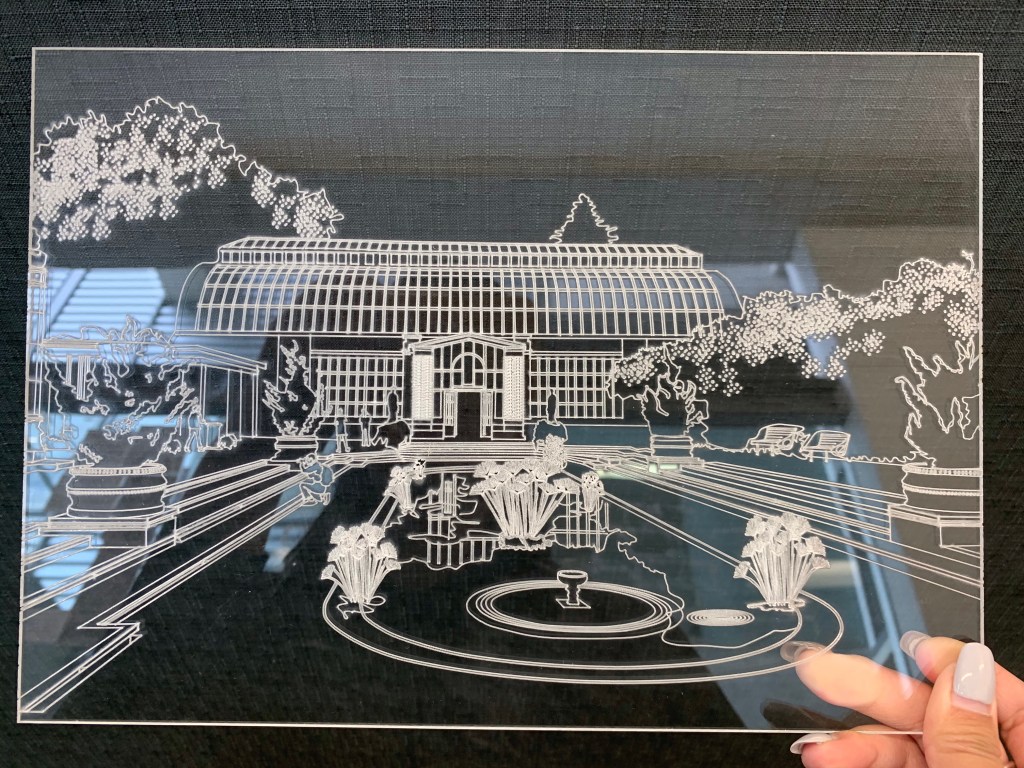
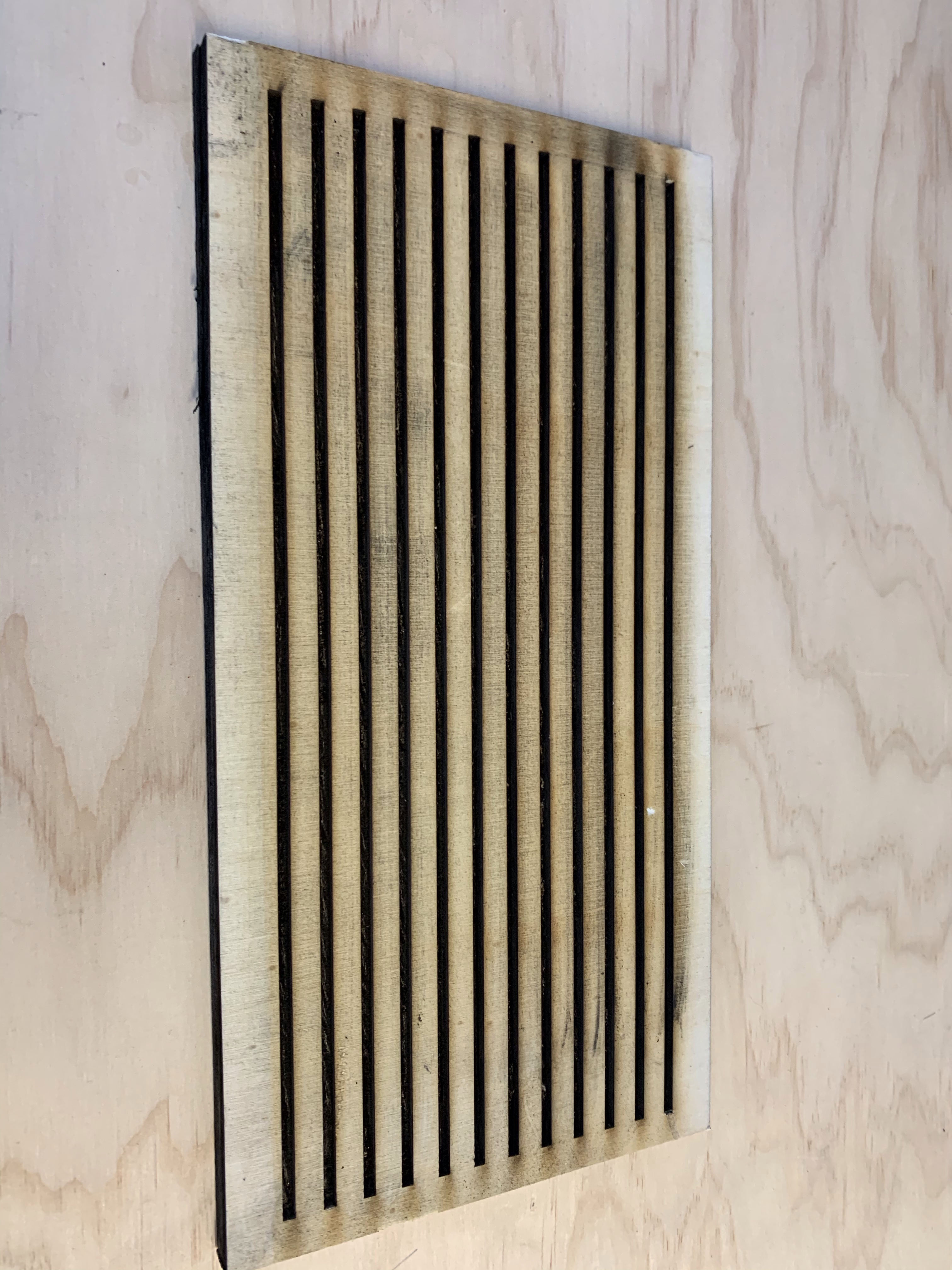
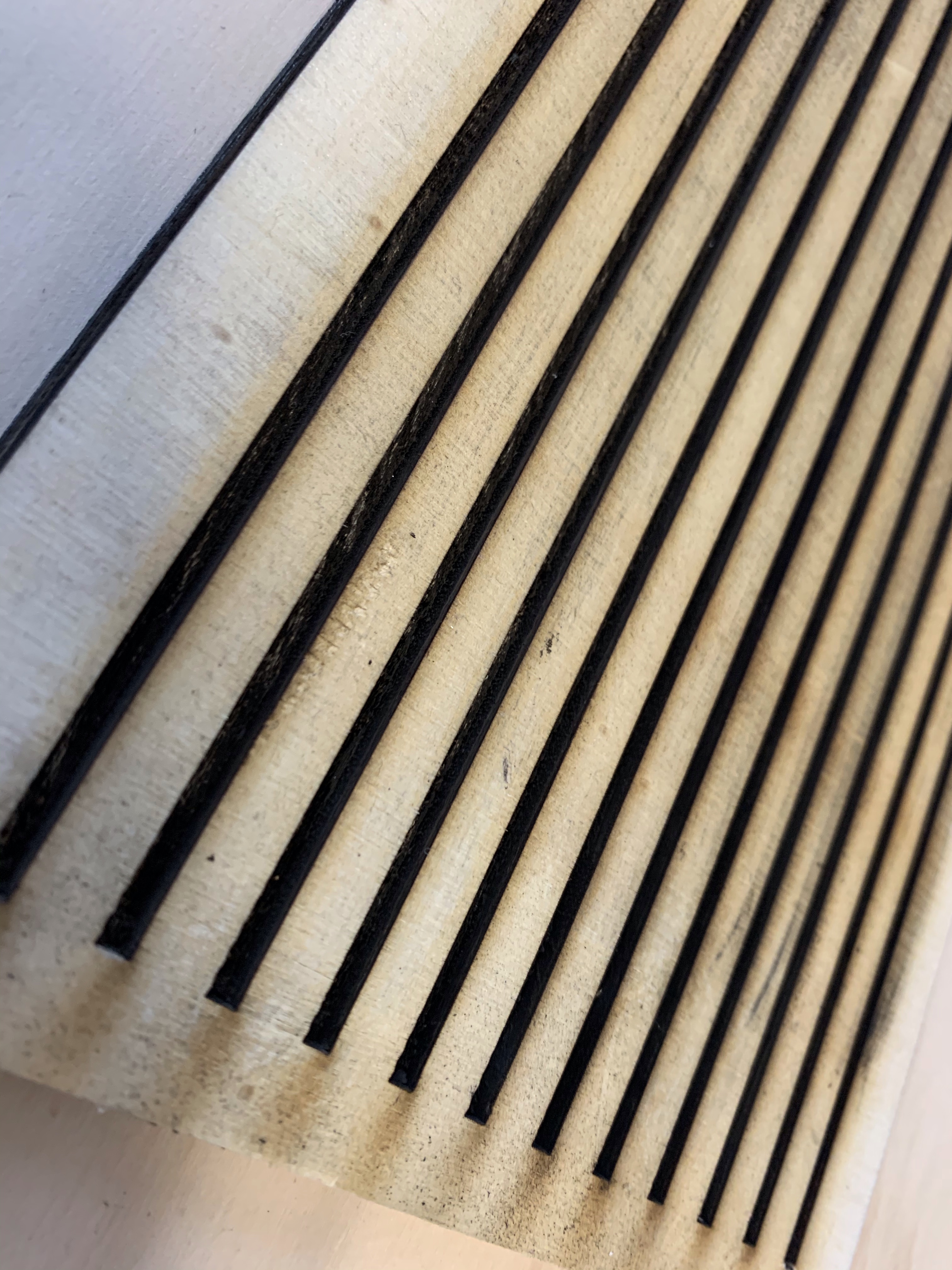
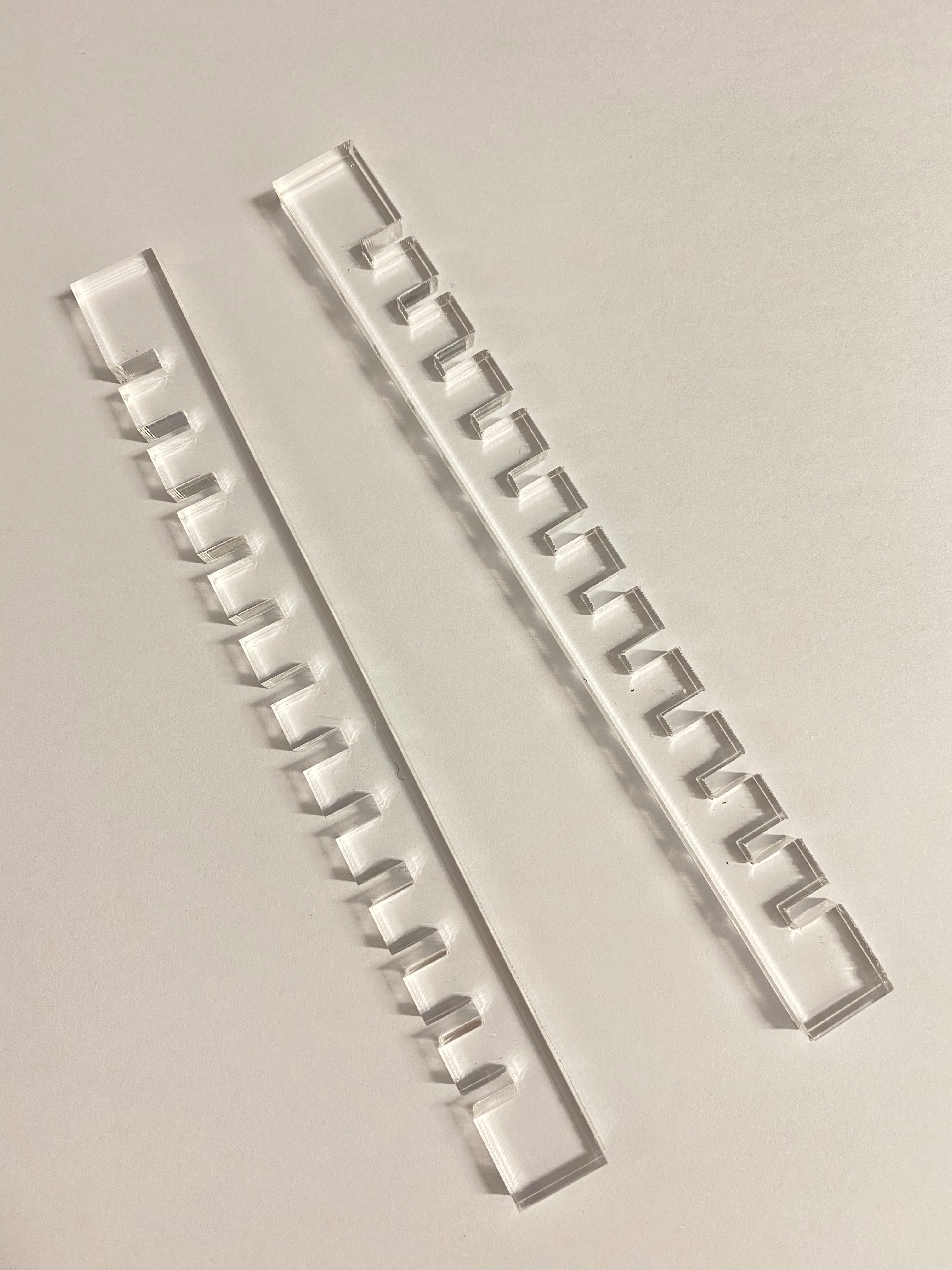
After drawing the picture in rhino, I used laser cutting to complete the model. The process was very long because of too many lines and too complicated. I encountered some problems in the production, because it is A4, so it is relatively small. In the process of drawing, I need to pay attention to details, too much detail will affect its effect. Because I want to keep the finished picture, the power cannot be too strong in laser cutting. What surprised me is that its shadow is also a complete wintergardens. If there is plenty of sunlight, its shadow can also be shown.

laser cut

Overall it is quite satisfactory. Because laser cutting can achieve the effect I want. I will separate this picture into 13 copies, as I did above. The final complete look of the arrangement from front to back is as shown in the figure above.

Model Structure

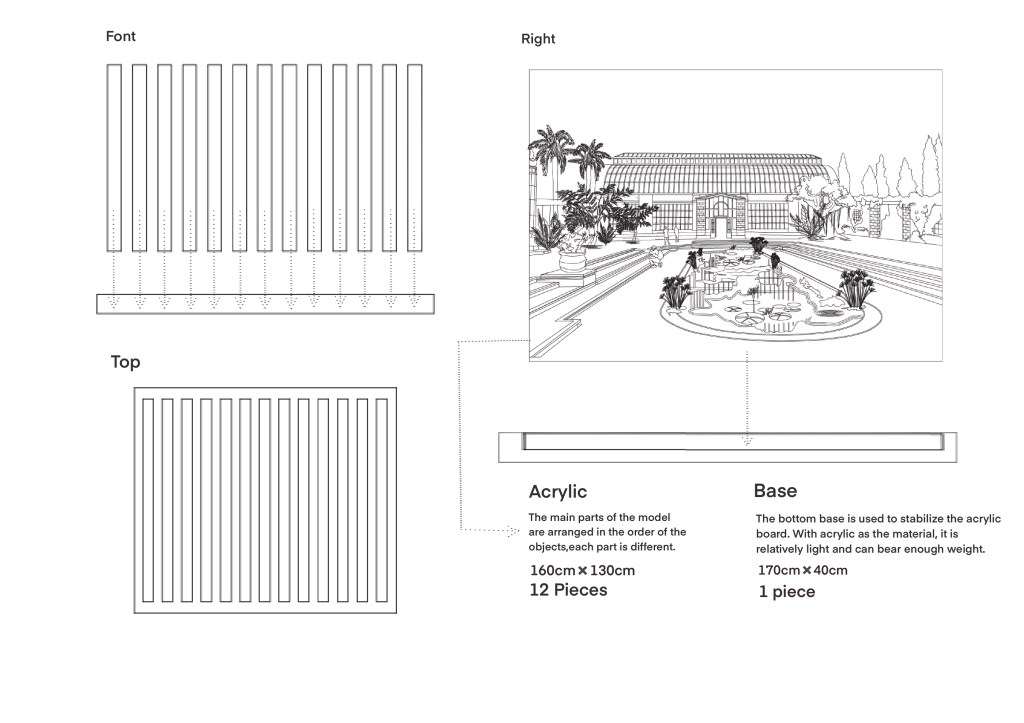
This is the structure diagram of the installation. There are 13 toilets in total, and there will be a base for fixing.

Formal Presentation

I got some opinions after the presentation. I should continue to develop my work in depth and continue to think about its best placement. I am thinking about how to make my work more complete? I think it is not deep enough now, and my statement is not strong enough. All in all, many problems need to be improved. Can I bring color into my work? Are there other techniques to complete my work? Can the overall picture continue to develop? I need to continue to explore and solve these problems.

Design Develop
Hand drawing

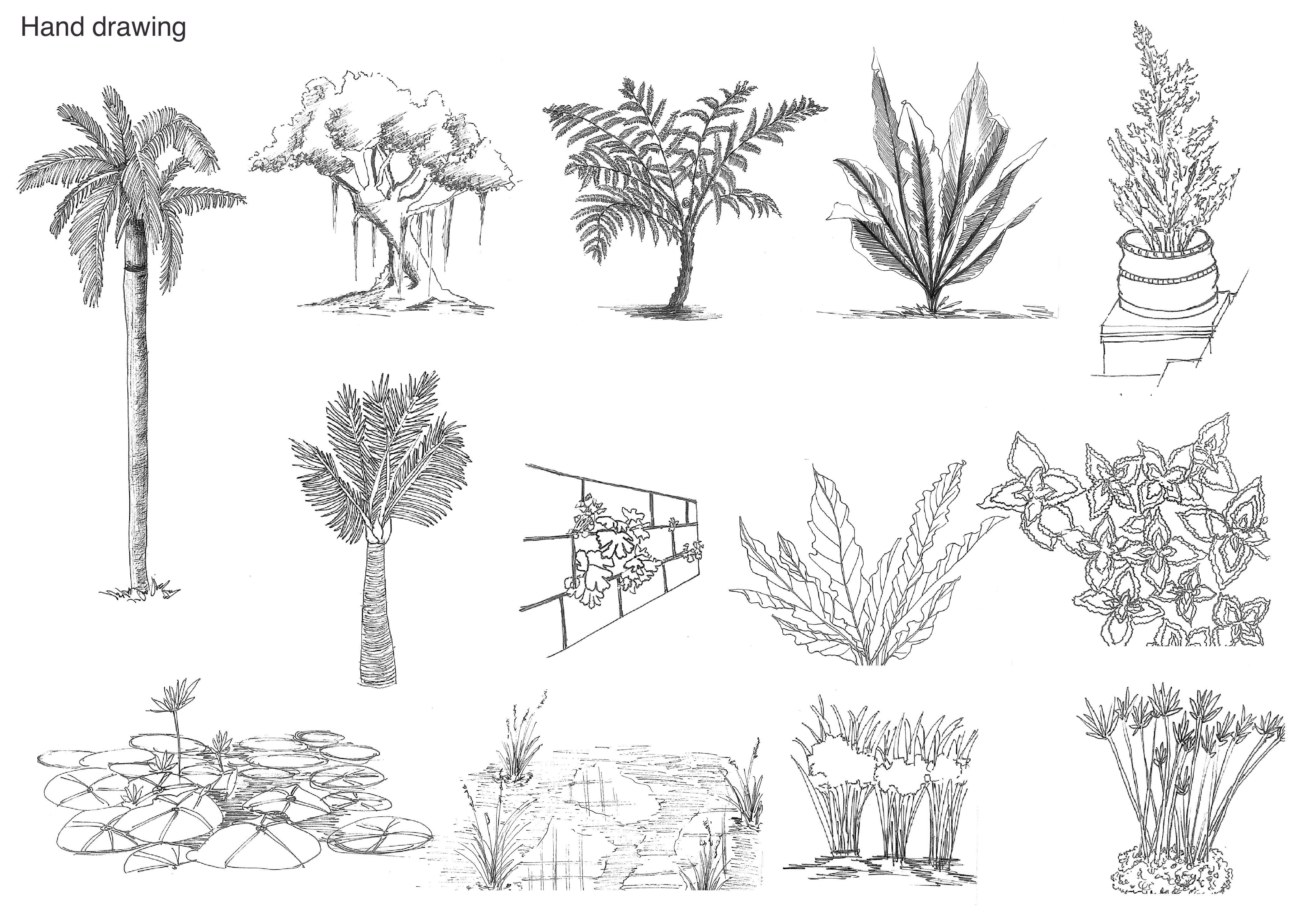
After thinking about it, I felt that I would paint the main building. In the process, I found that I could bring my own paintings into my model. There are plants on both sides of the main building. I painted a lot of plants that I am impressed with and some plant patterns that I am interested in. I will try to bring them into my model. I like hand-drawn works because I am thinking in the process of drawing. And these works carry my memory, my mood and so on.

Hand drawing

I used my own sketches for stitching, and I tried to use these sketches to stitch together a wintergardens that I remembered. This is a good attempt. I think I can continue to develop and explore the best way to display it.

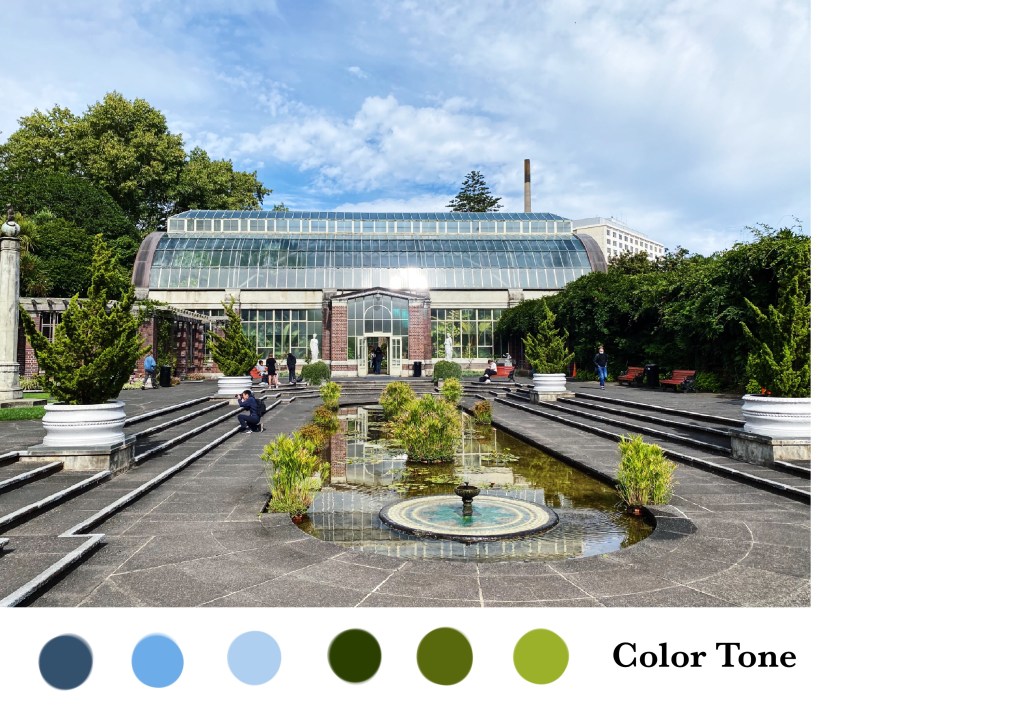
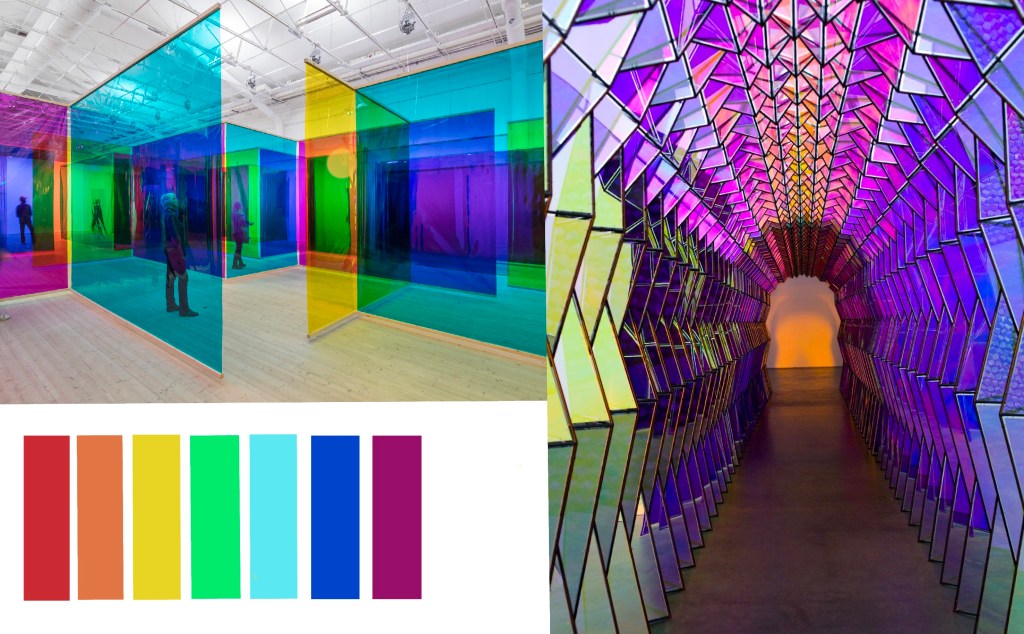
I want to bring color into my work, which will make the work more complete. I chose the main color from this photo. I will try different ways to test out the best way to show my work. Green is the main color in wintergardens. Almost every plant will have green. Blue is the background color and I think it is indispensable. Blue will bring out its vitality.
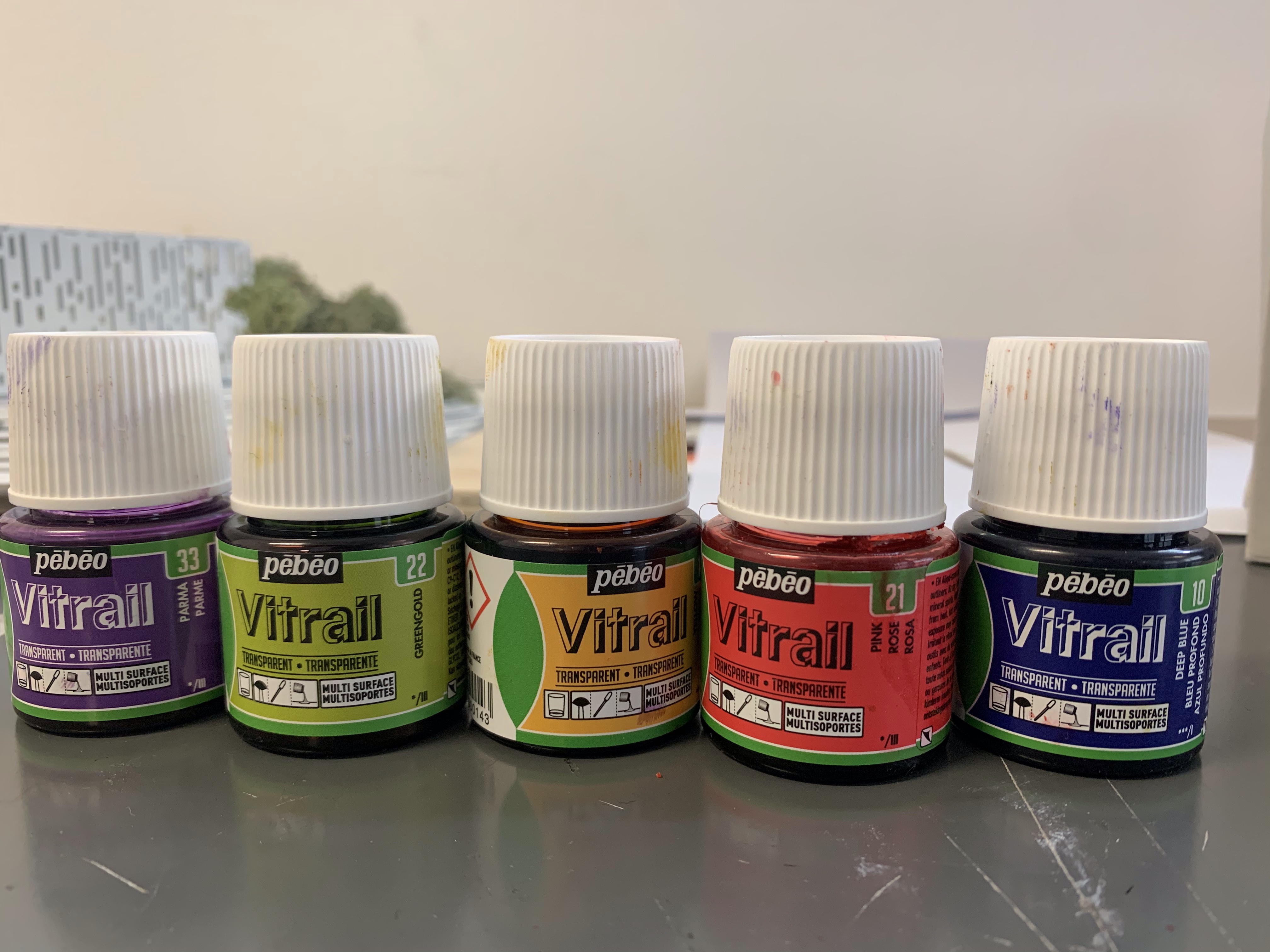
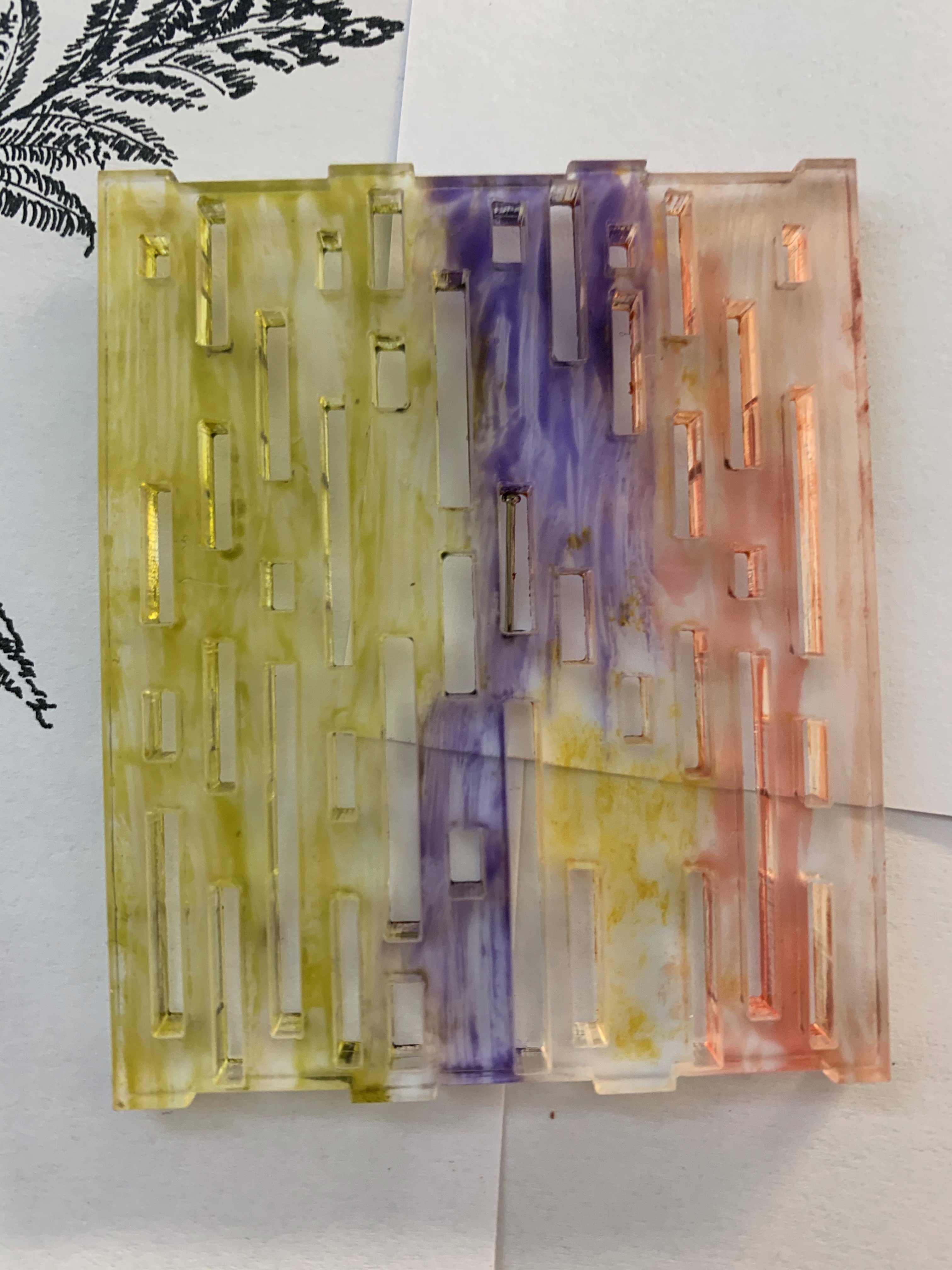
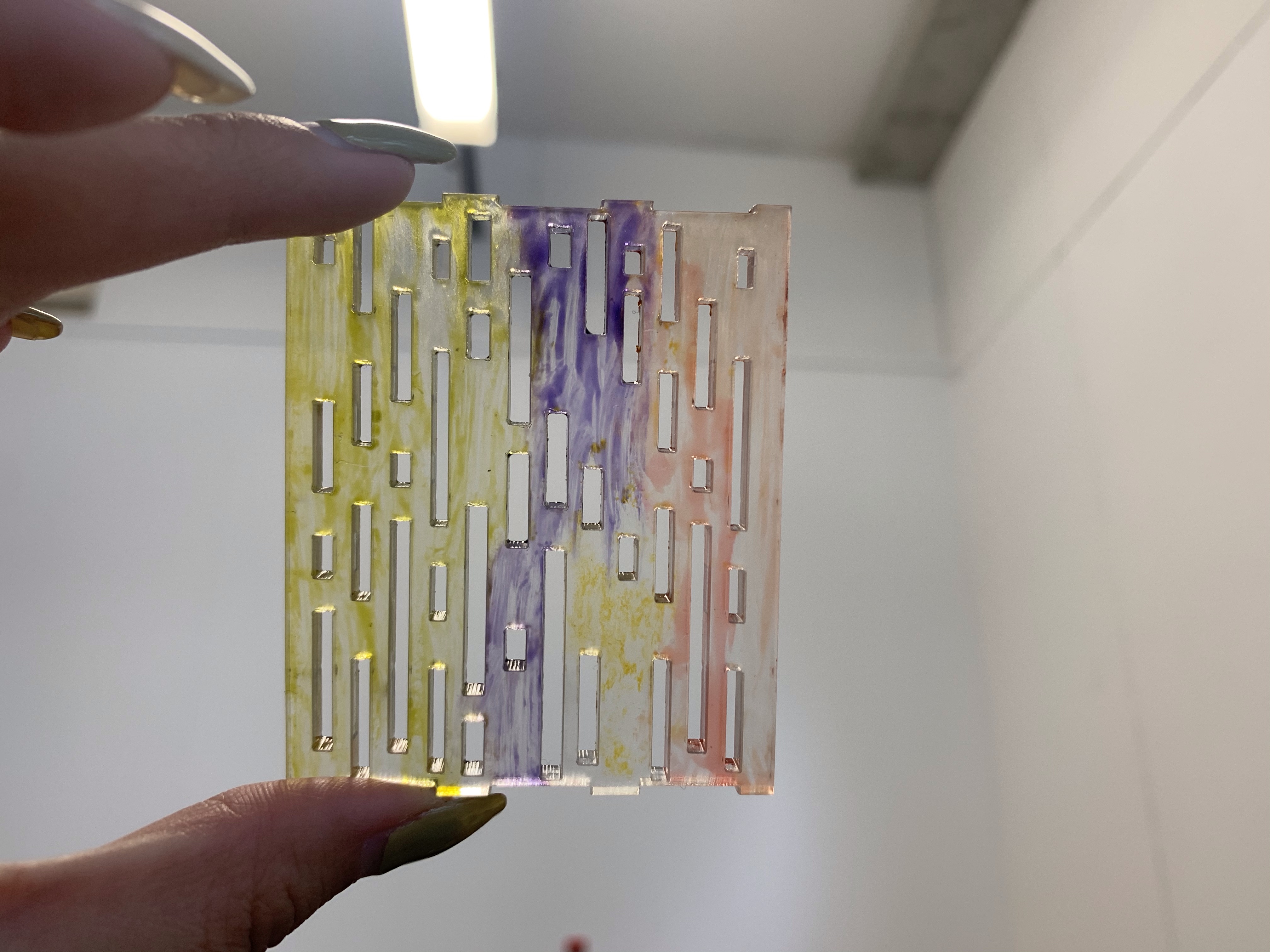
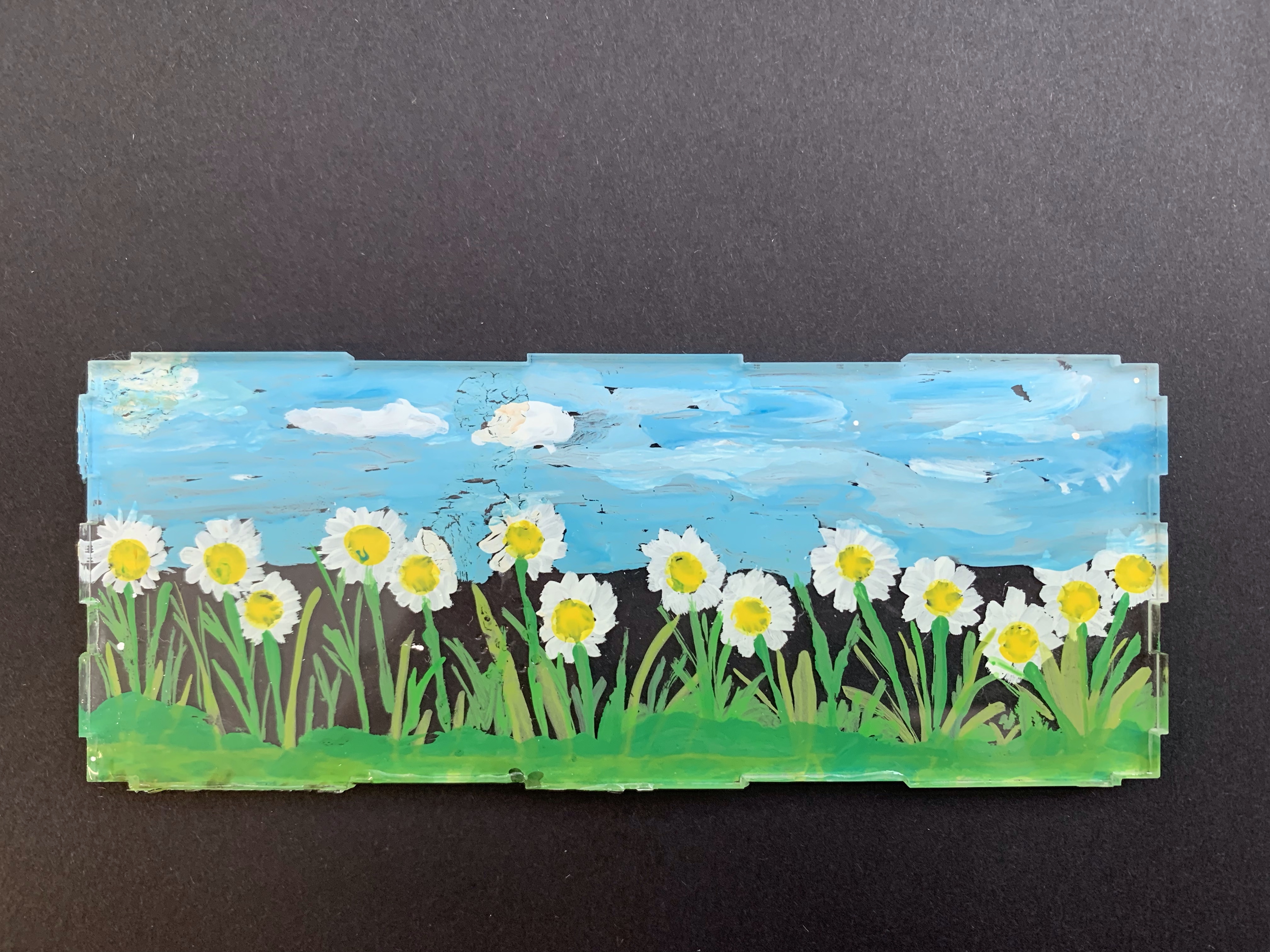
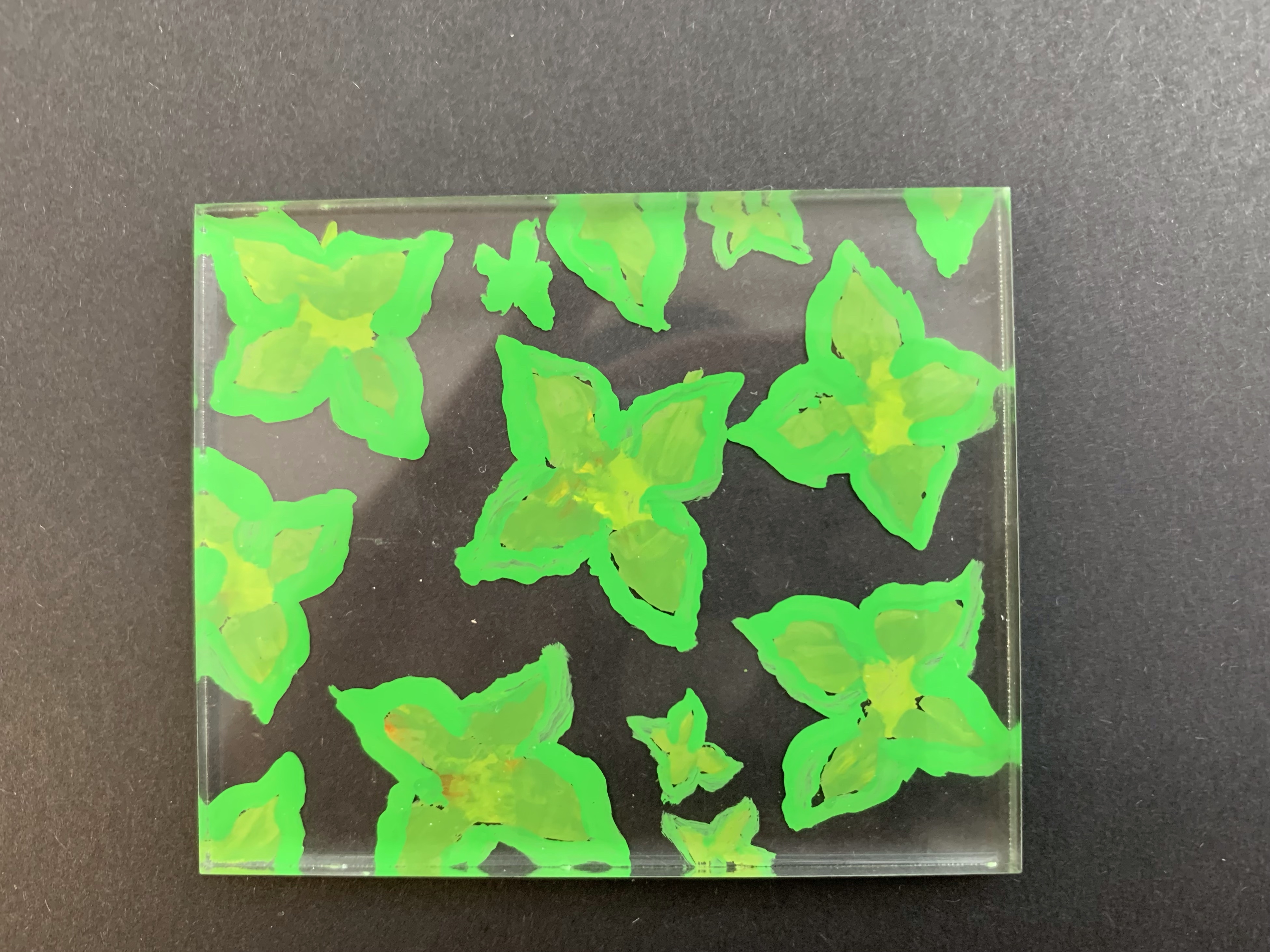
This is a pigment that can be used on glass. It has strong light transmittance, which can make the glass have a light color. But its disadvantage is that it is too viscous, and there is a certain degree of difficulty in the process of use. Large areas of smearing will break the overall picture. This is just a test, but unfortunately it failed. Because hand-painted paints cannot achieve flawless results.

This is the second test. I used watercolor to paint some plant patterns and small scenes, but unfortunately it still failed. Watercolor is not translucent, it completely obscures the objects behind it.

Rhino & Blender

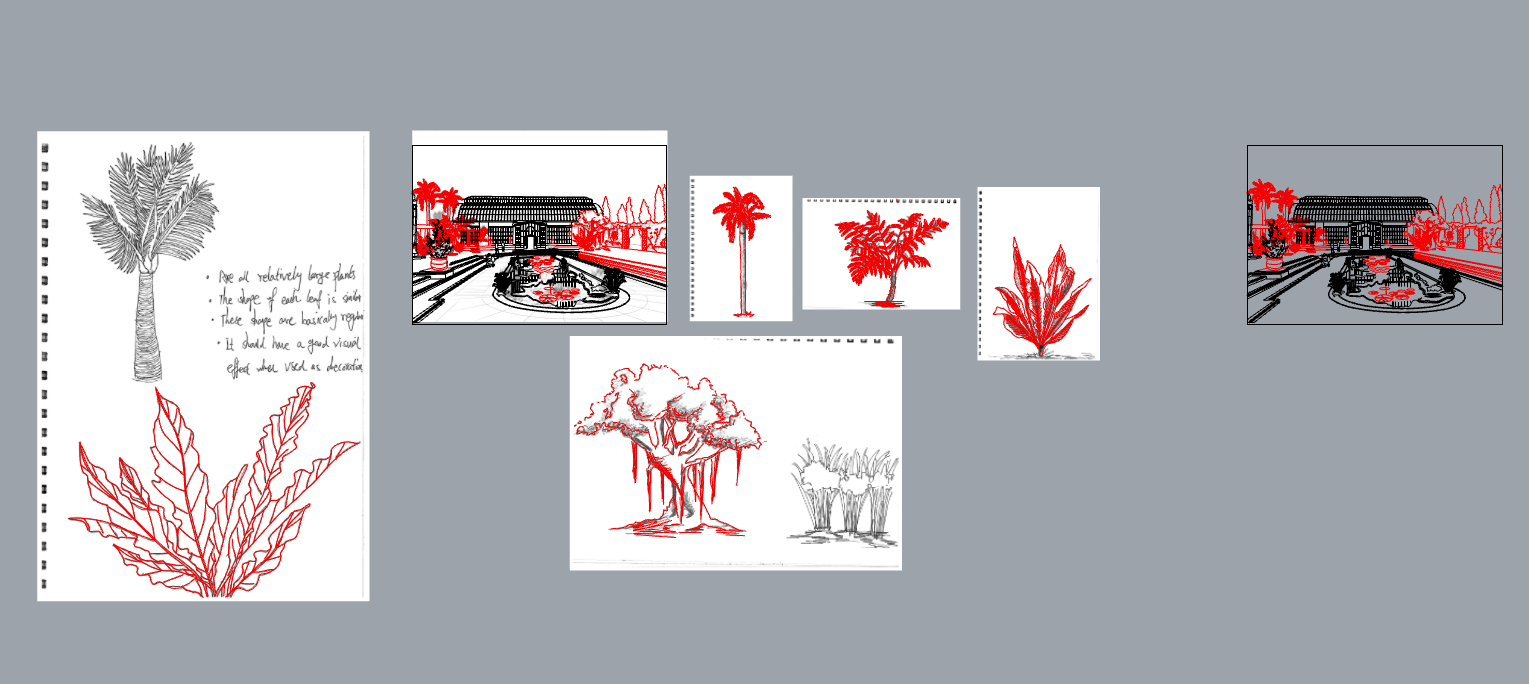
Put my drawing into rhino and draw the shape of that object. The black part is the main building and the red part is the plants.

Model Making

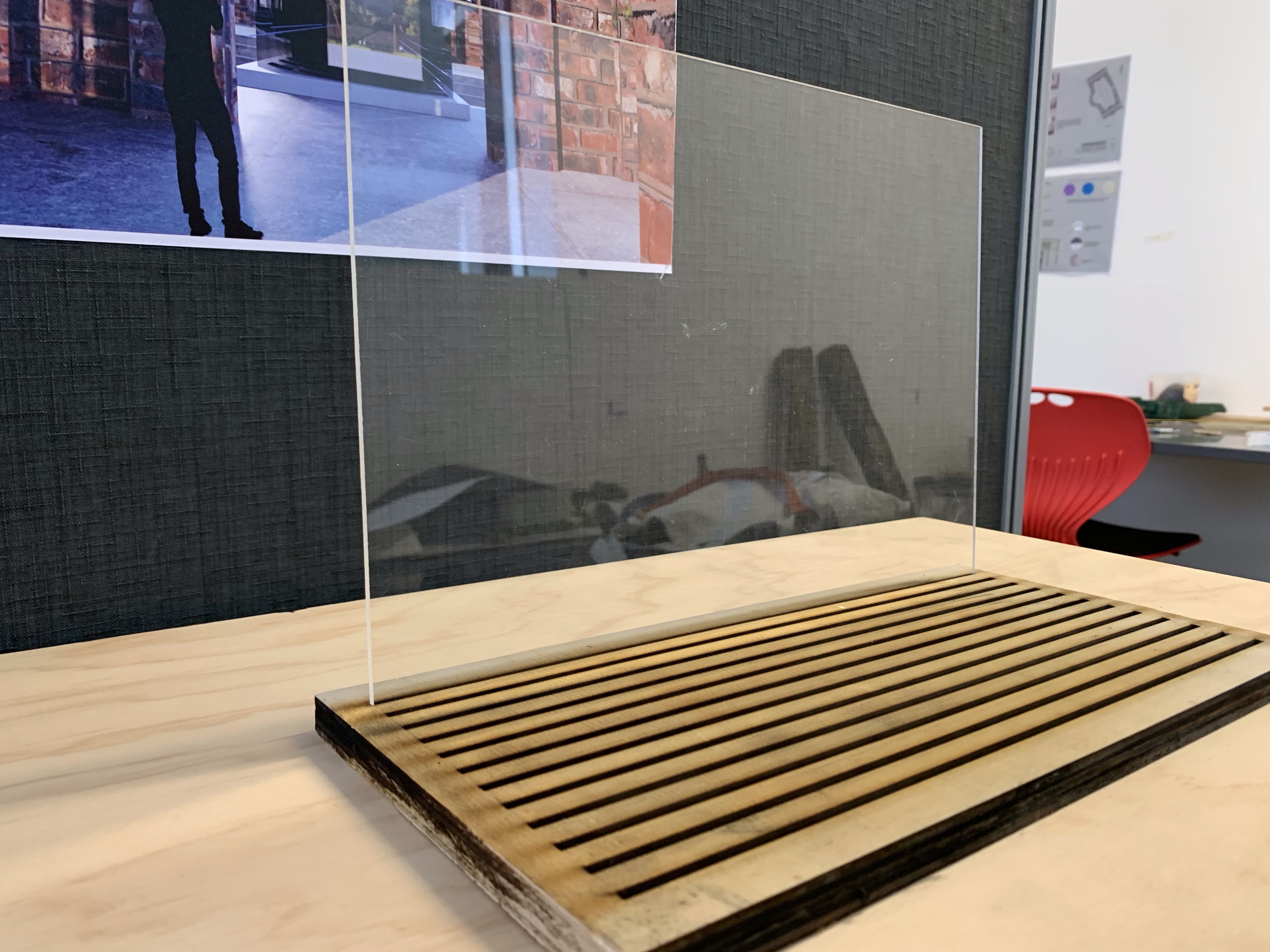
I want to use aluminum alloy as the material for the base, but the color of the acrylic board may not be suitable for the acrylic. And I think this will affect the aesthetics of the overall work. I tried to use wood as a base again, which still failed. After consulting the information, I found that the thickness of the acrylic sheet can be selected, and it can bear. So I chose acrylic sheet as the material because it has to bear some weight so it is thicker. I think this may be the best choice to maintain the unity of the work.

About Installation

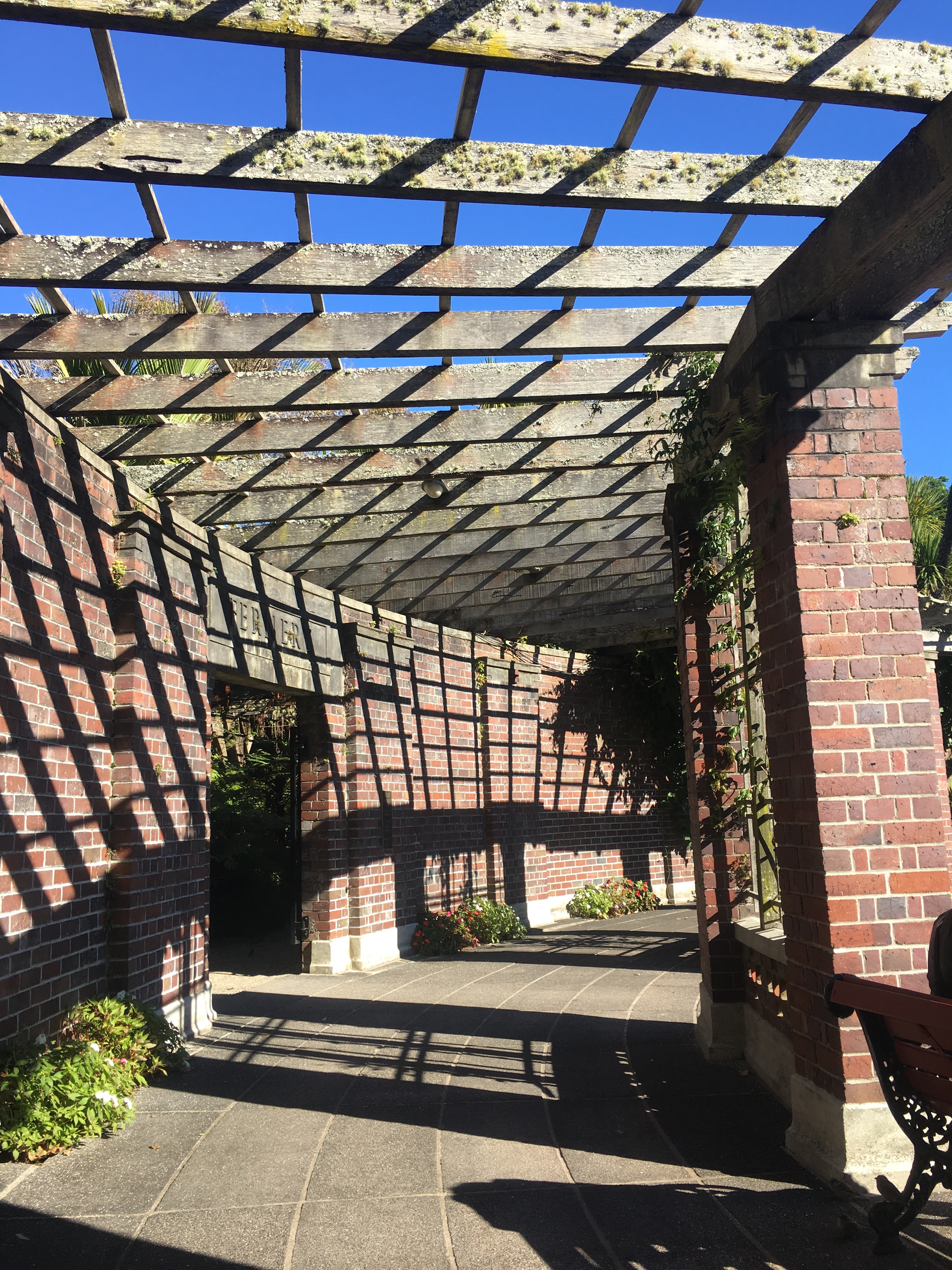
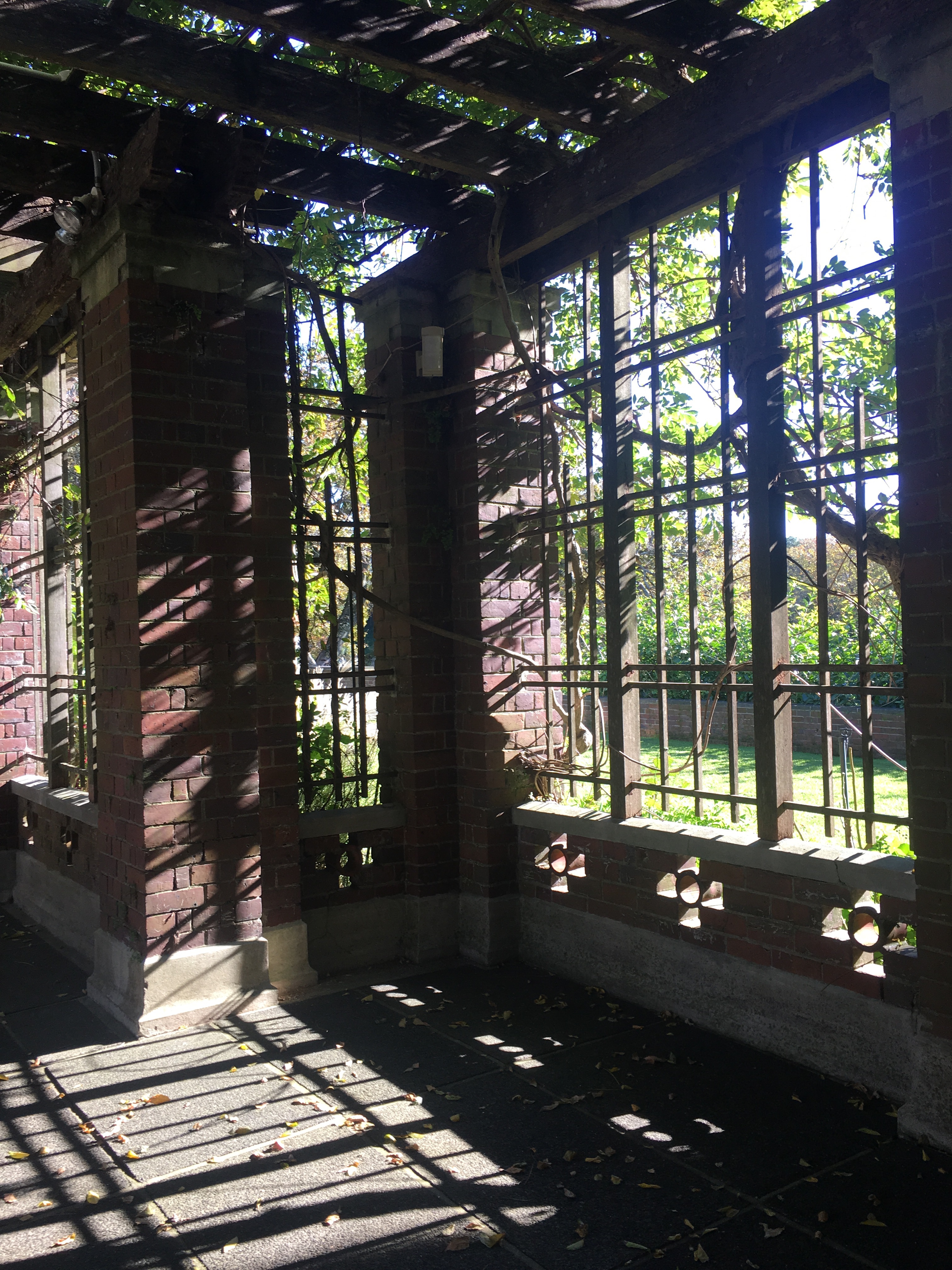
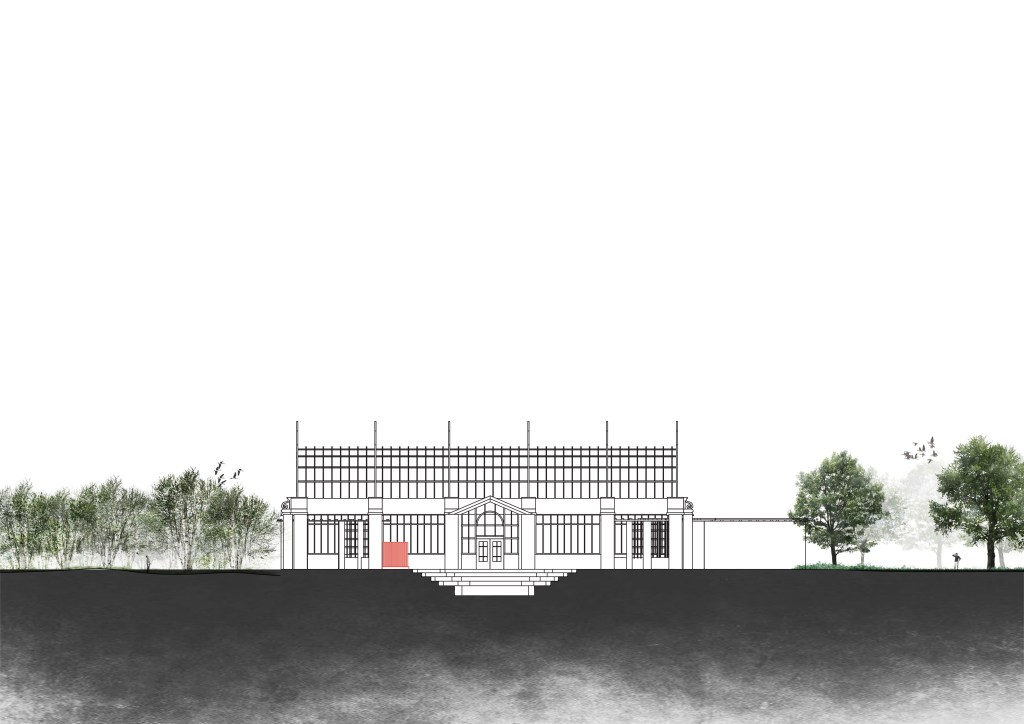
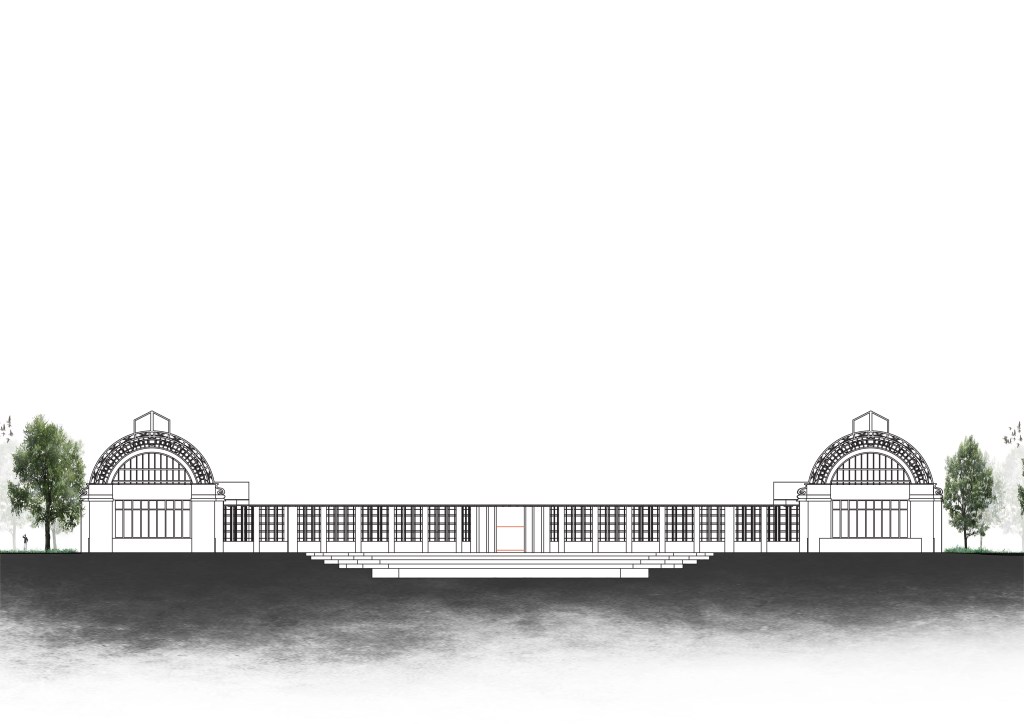
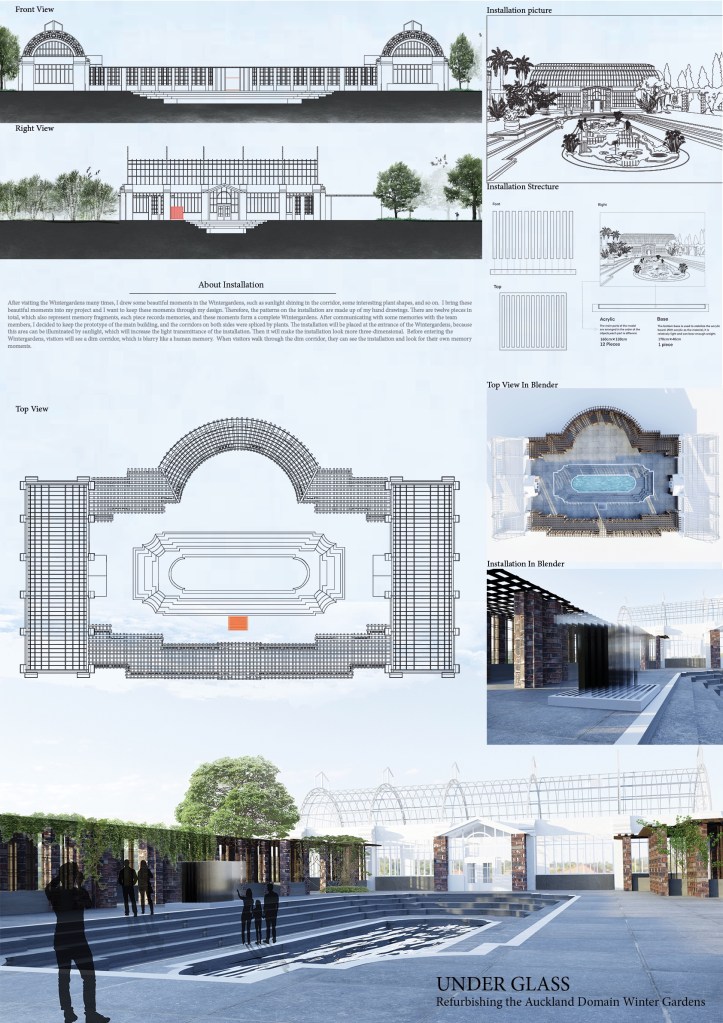
After visiting the Wintergardens many times, I drew some beautiful moments in the Wintergardens, such as sunlight in the corridor, some interesting plants shapes, and so on. I bring these beautiful moments into my project and I want to keep these moments through my design. Therefore, the pattern on the installation are made up of my hand drawing. There are twelve pieces in total, which also represent memory fragments, each piece records memories, and these moments form a complete Wintergardens. After communicating with some memories with the team members, I decided to keep the prototype of the main building, and the corridors on both sides were spliced by plants. The installation will be placed at the entrance of the Wintergardens, because this area can be illuminated by sunlight, which will increase the light transmittance of the installation. Then it will make the installation look more three-dimensional. Before entering the Wintergardens, visitors will see a dim corridor, which is blurry like a human memory. When visitors walk through the dim corridor, they can see the installation and look for their own memory moments.

Final Presentation

Statement

My inspiration is from the history of Wintergardens.  The Wintergardens is a meaningful place for the Aucklander, and is called the most romantic park by the public. Because it carries the memories and stories of many people. Some deep memories may be worthy of a lifetime. My project is to stitch these fragmentary memories together to complete the Wintergardents through my hand drawings, so that visitors can understand what the Wintergardens look like in others. The glass material of the Wintergardens attracts many people, including myself. When I visited the Wintergardens for the first time, the most fascinating part was the glass outside.  Through the glass, I can see the patterns of the plants inside.  This is also the source of inspiration for my project.

I often recall a certain period of time or a place because of hearing a familiar song or smelling a familiar smell. So in this project I want to design an installation that can increase other people’s interest in the memories of the Wintergardens. First of all, the Wintergardens have many different kinds of plants, and these plants grow in the tropics.  The second thing that impressed me the most was the glass houses on both sides. Because I like to use sketches to record a certain moment or some interesting patterns. So every time I visit the Wintergardens, I draw some plants or patterns that I find interesting. I think the hand- drawing has the feelings of the author, so I used my hand-drawings to complete the installation.

The main purpose of this project is to record some certain moments through the installation, allowing visitors to increase the memory of the Wintergardens. Visitors can feel the multi-faceted of the Wintergardens through this installation, to understand that it’s an inclusive, public and romantic place. The attraction of this installation is that it looks three-dimensional and looks different from every angle. It has a total of twelve layers and each layer has a different pattern. Superimposing them together will reveal a complete Wintergardens. It’s like a human memory, which is composed of fuzzy fragments for each memory. Each layer in the installation represents a fragment of memory. Combining these together is a complete memory. Two glass houses in the Wintergardens are considered the most romantic, so I use acrylic as the material, and the base part still uses acrylic to ensure the integrity of the installation. When the sunlight shines on the acrylic, the reflection is like glass, which looks gorgeous and colorful. This is also to not destroy the original nature of the garden and also continue to maintain its romance.

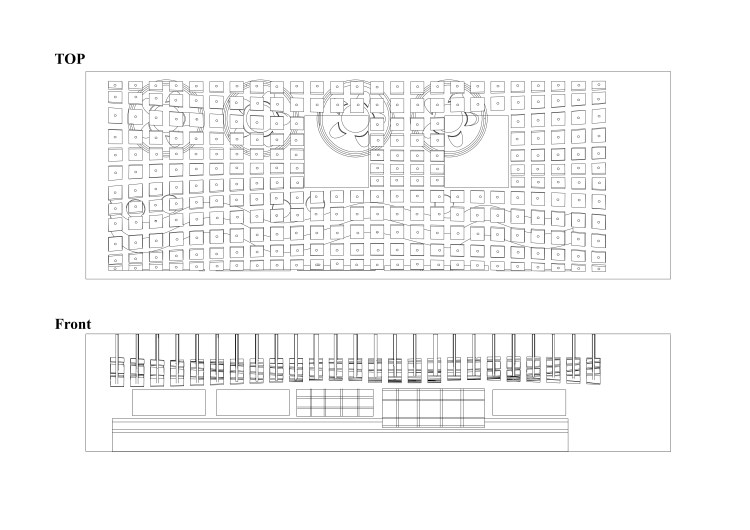
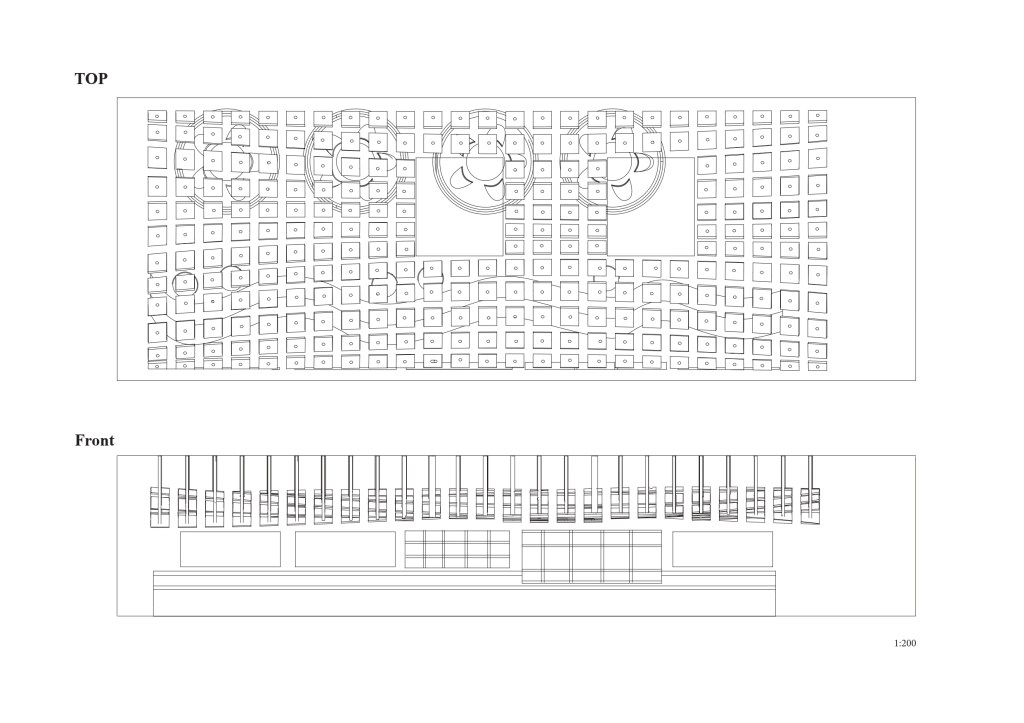
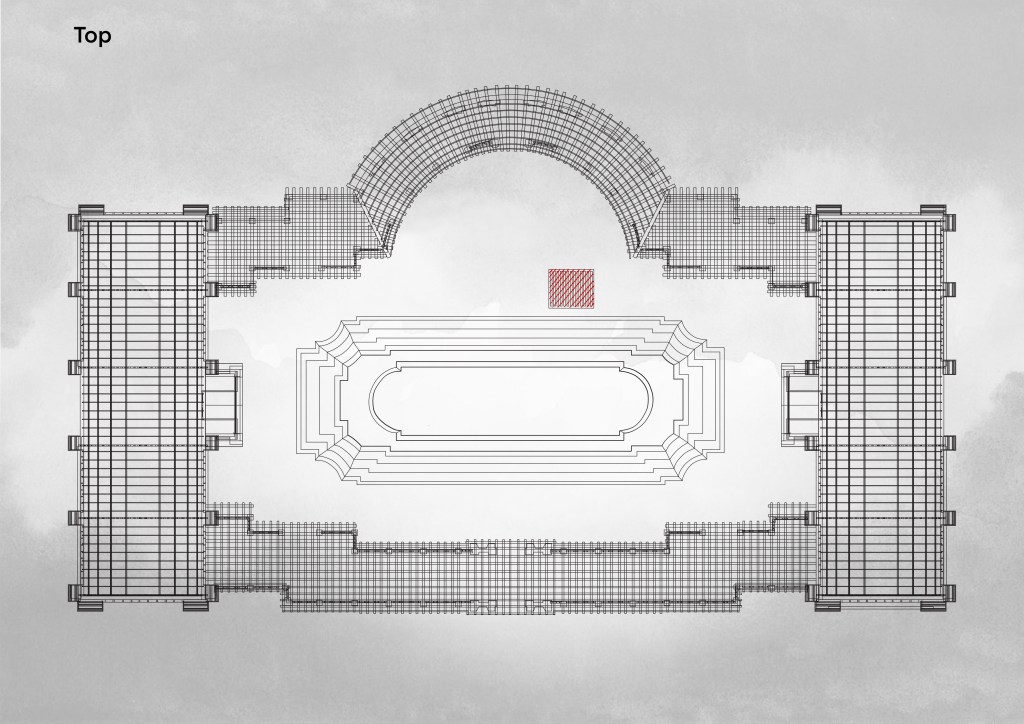
Top view
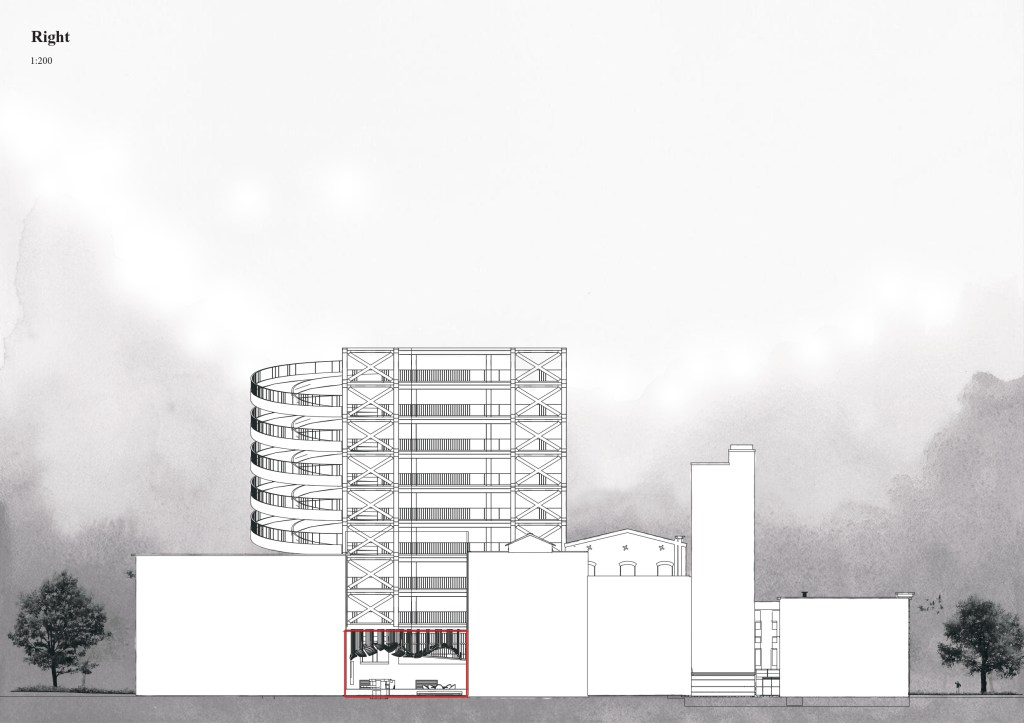
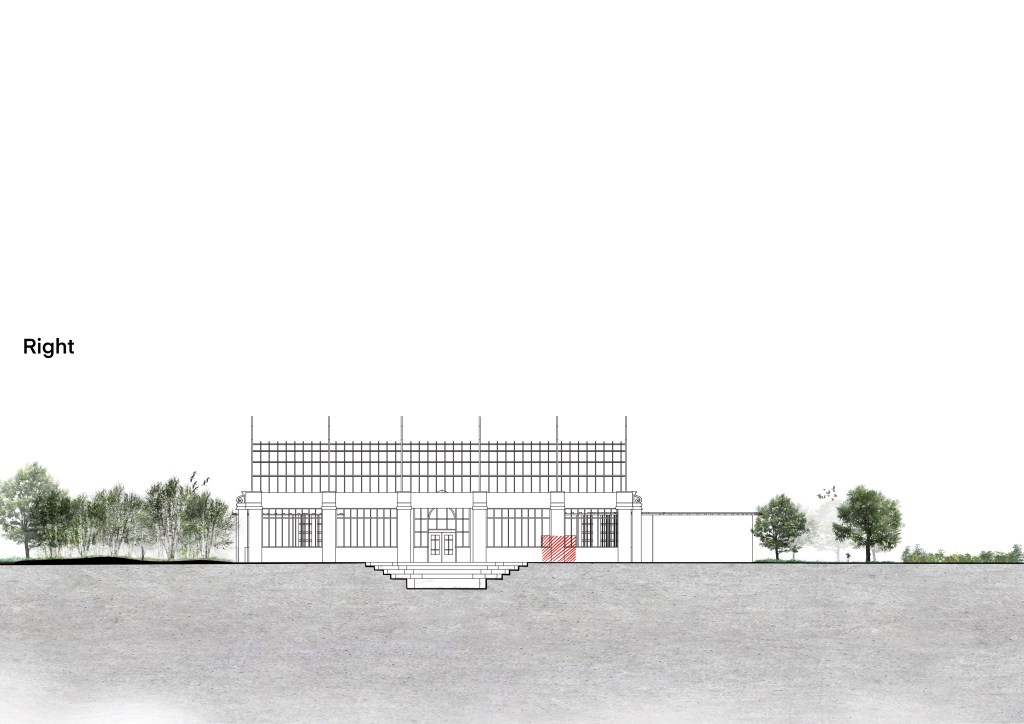
Right view
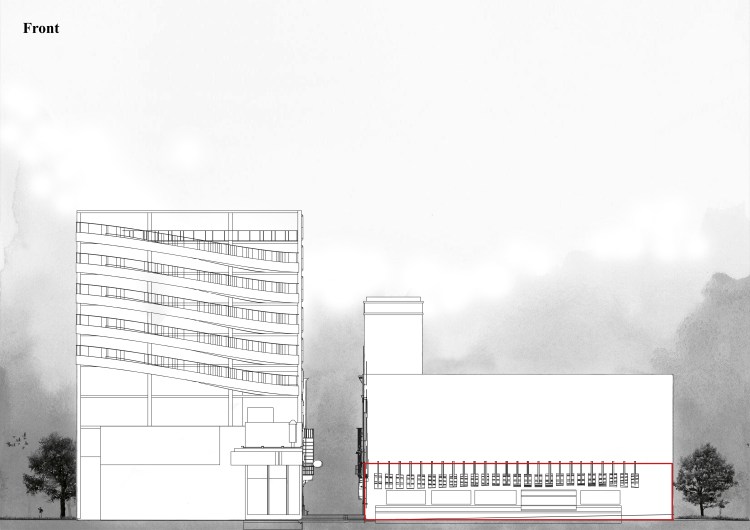
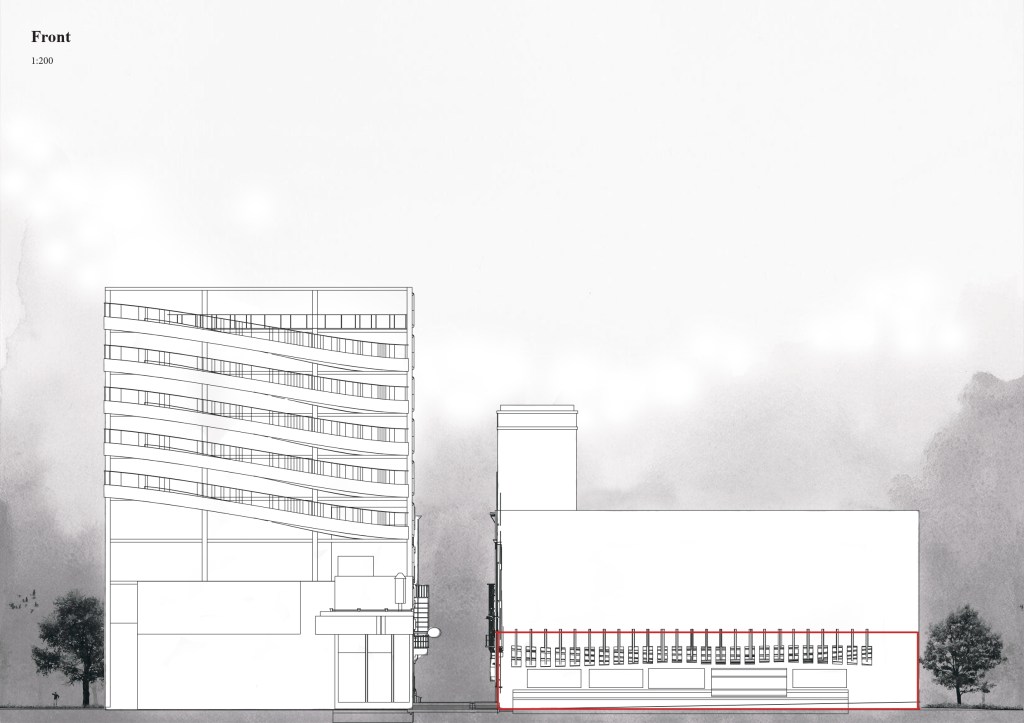
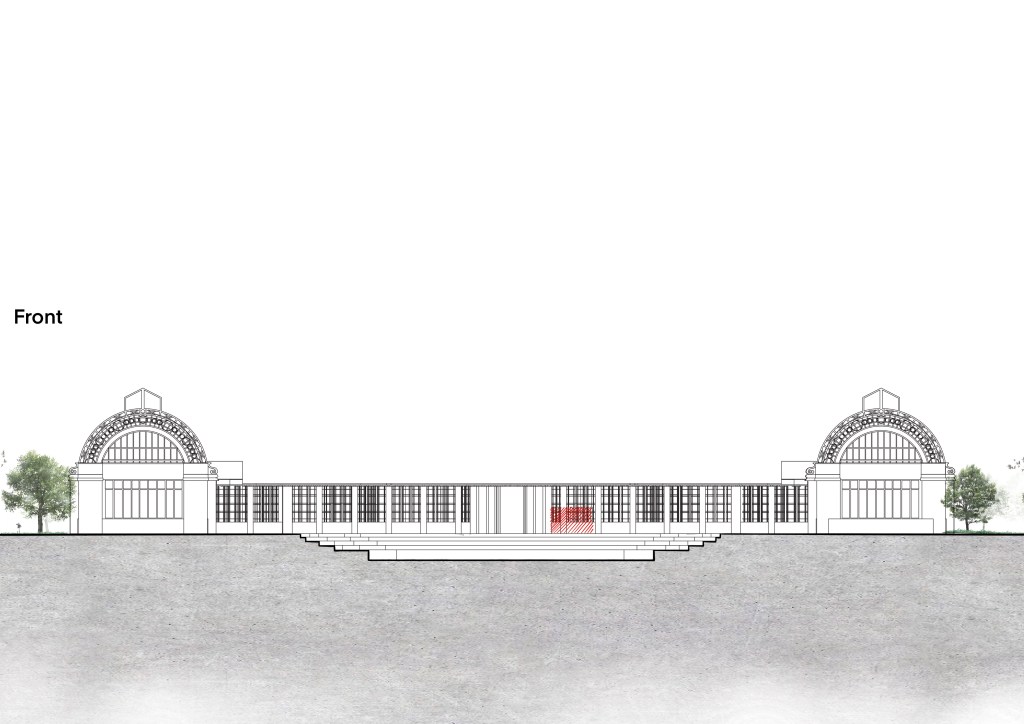
Front view
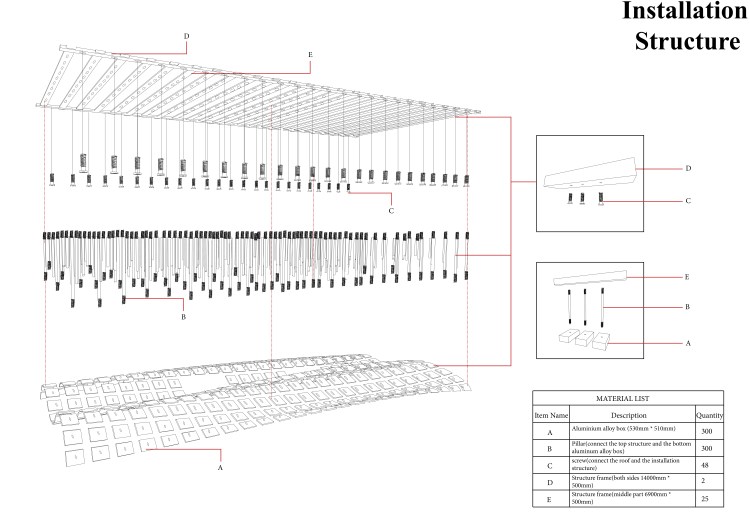
Installation Structure
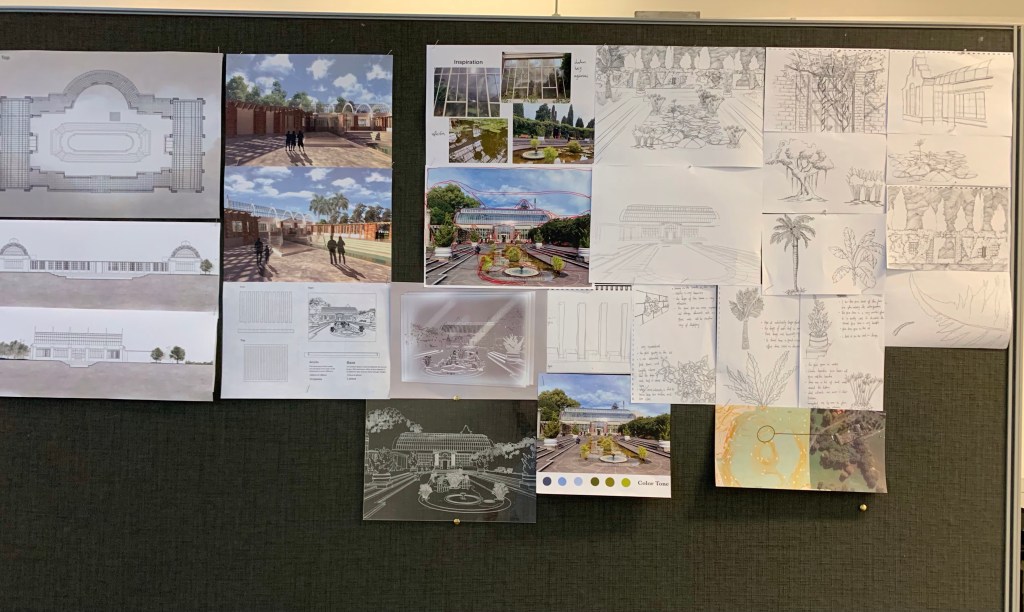
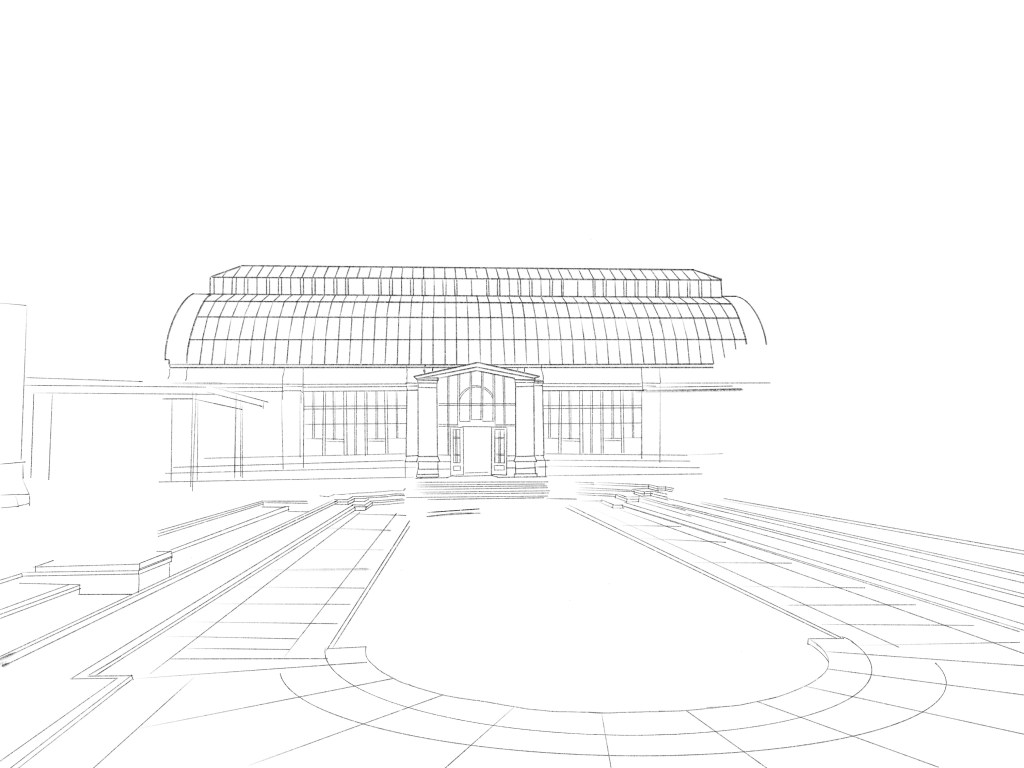
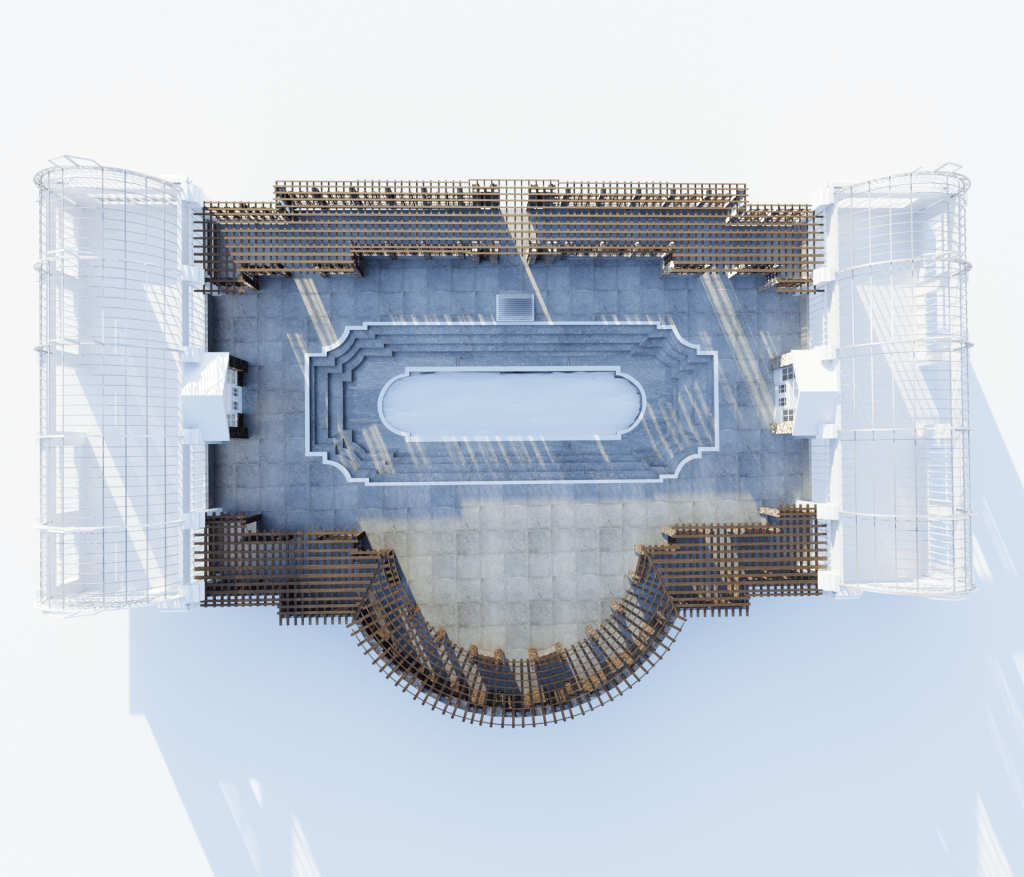
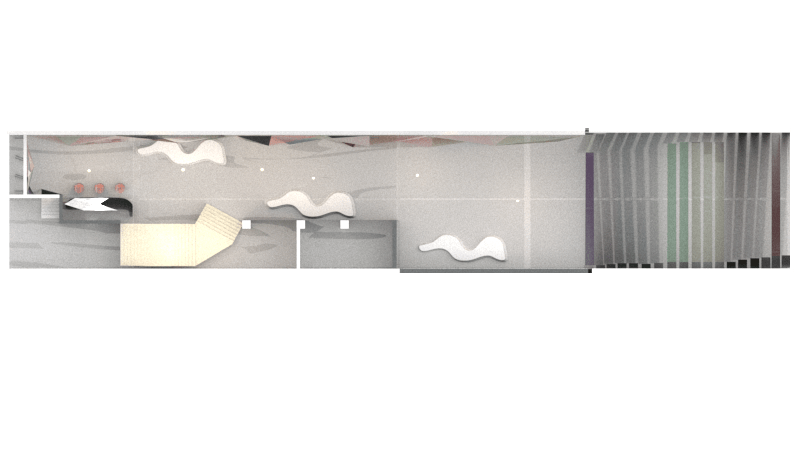
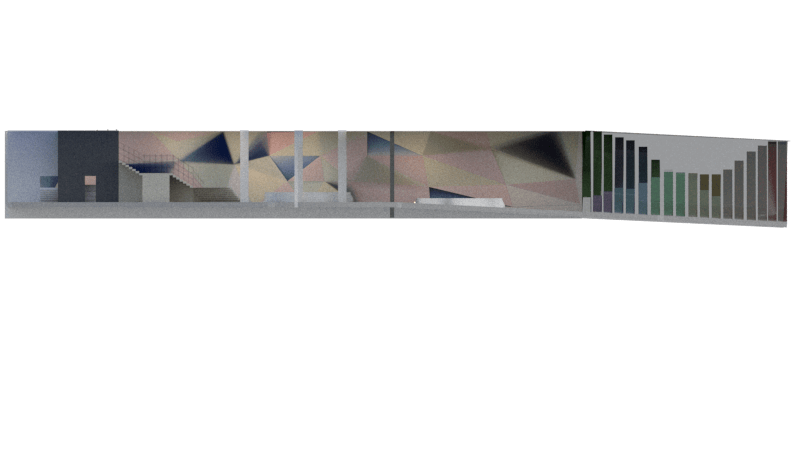
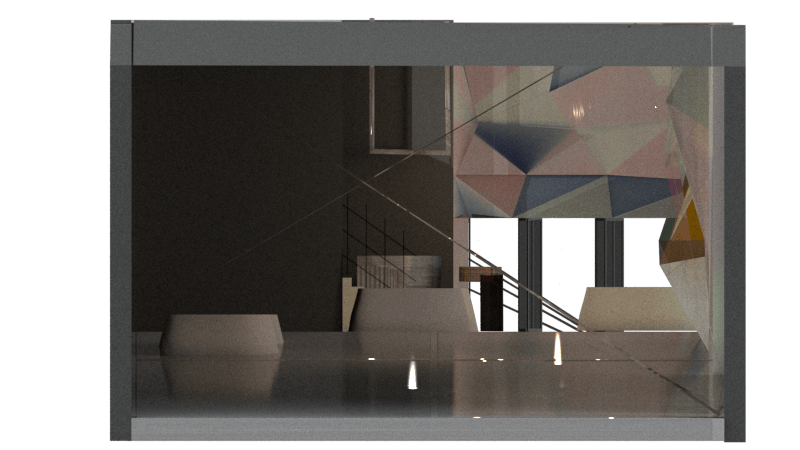
Floor plan, Section, perspective

Spatial Design Studio 2020 | Semester 2

PART ONE

Week 1: The Commons and Social Spaces

My social spaces:
  • WG Building
  • WA library
  • Auckland Art Gallery
  • Restaurant
  • Market
Restaurant
WA library
Auckland Art Gallery
WG building
Market

Where is the social space I chose?
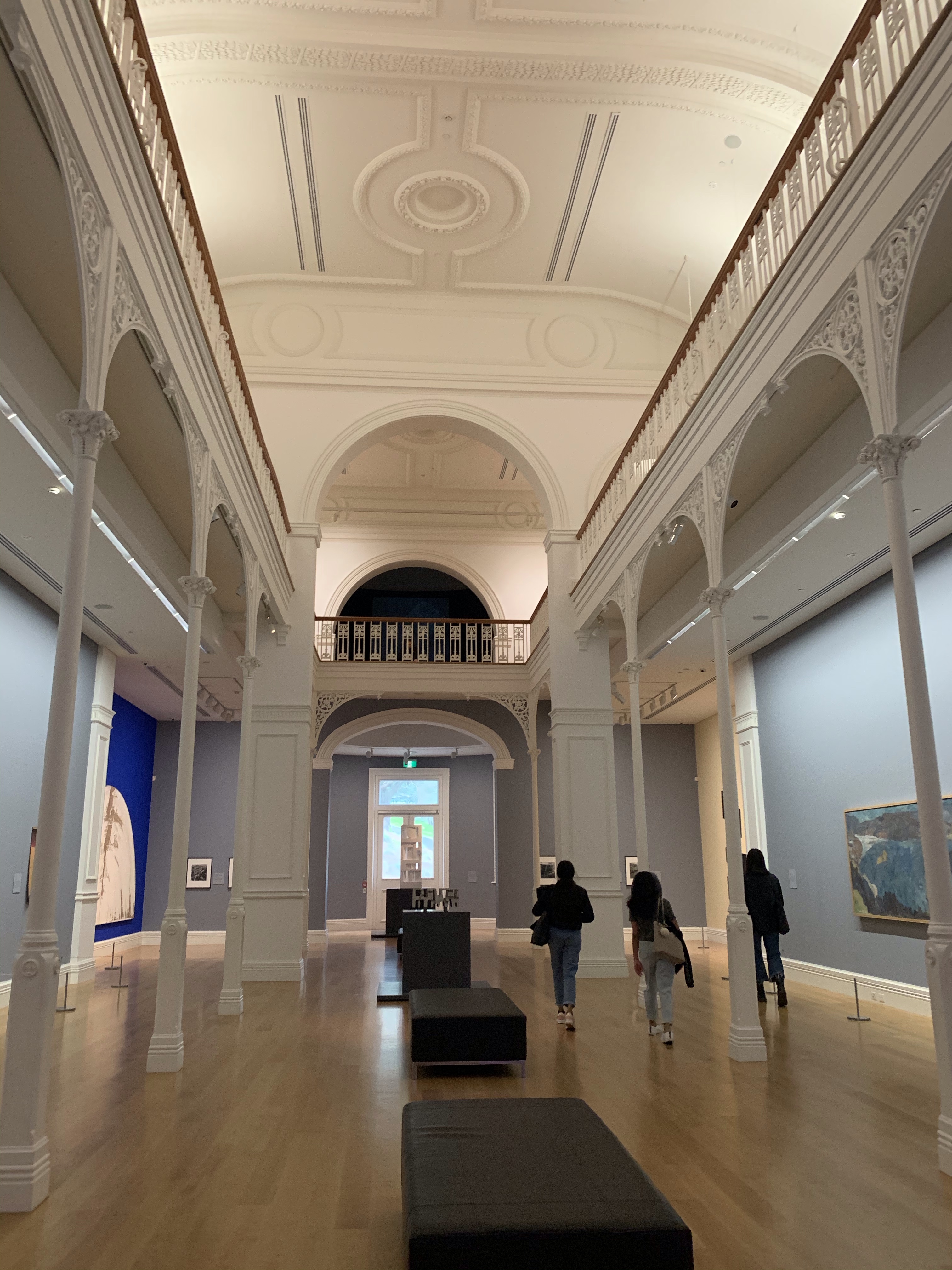
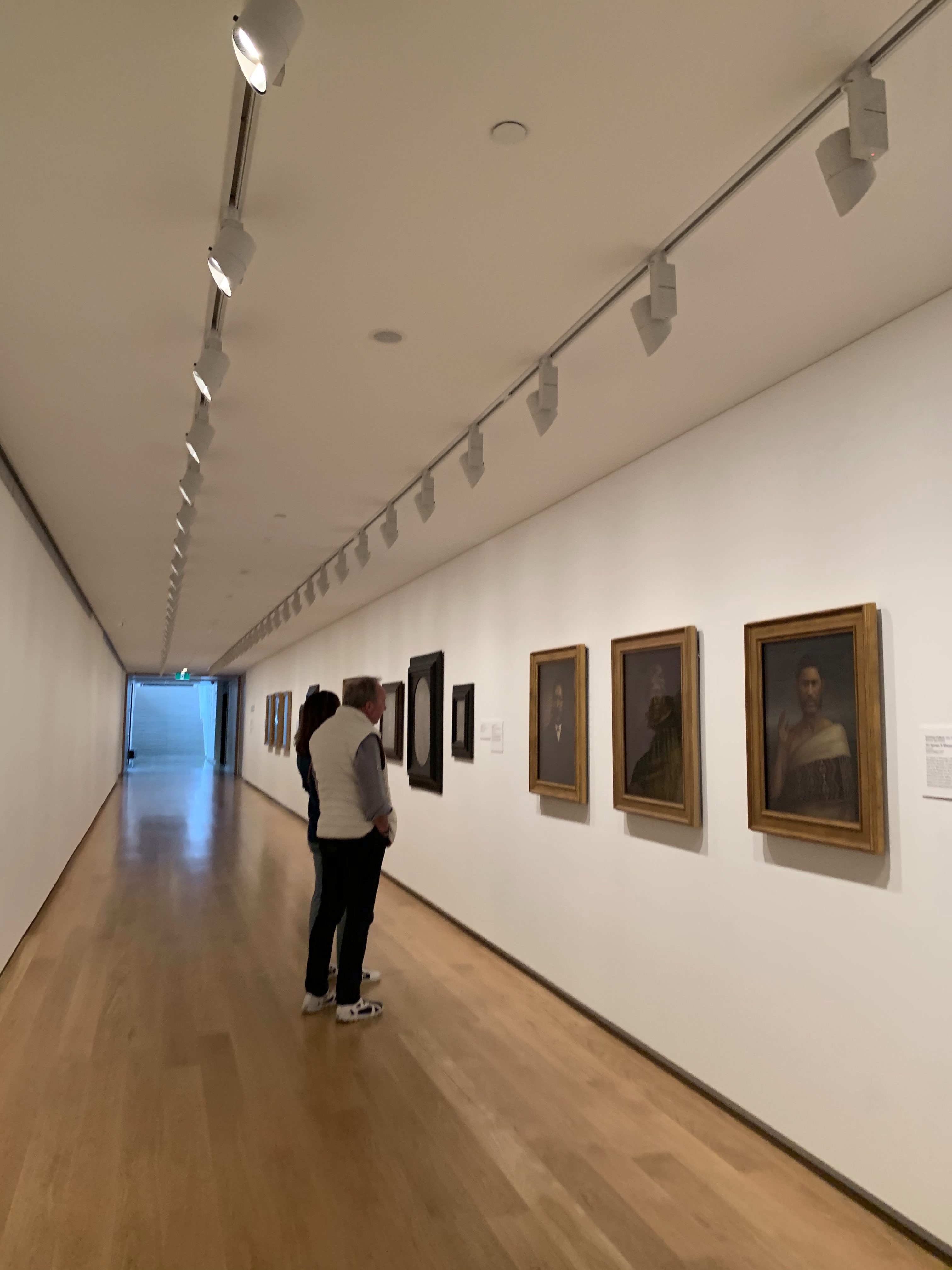
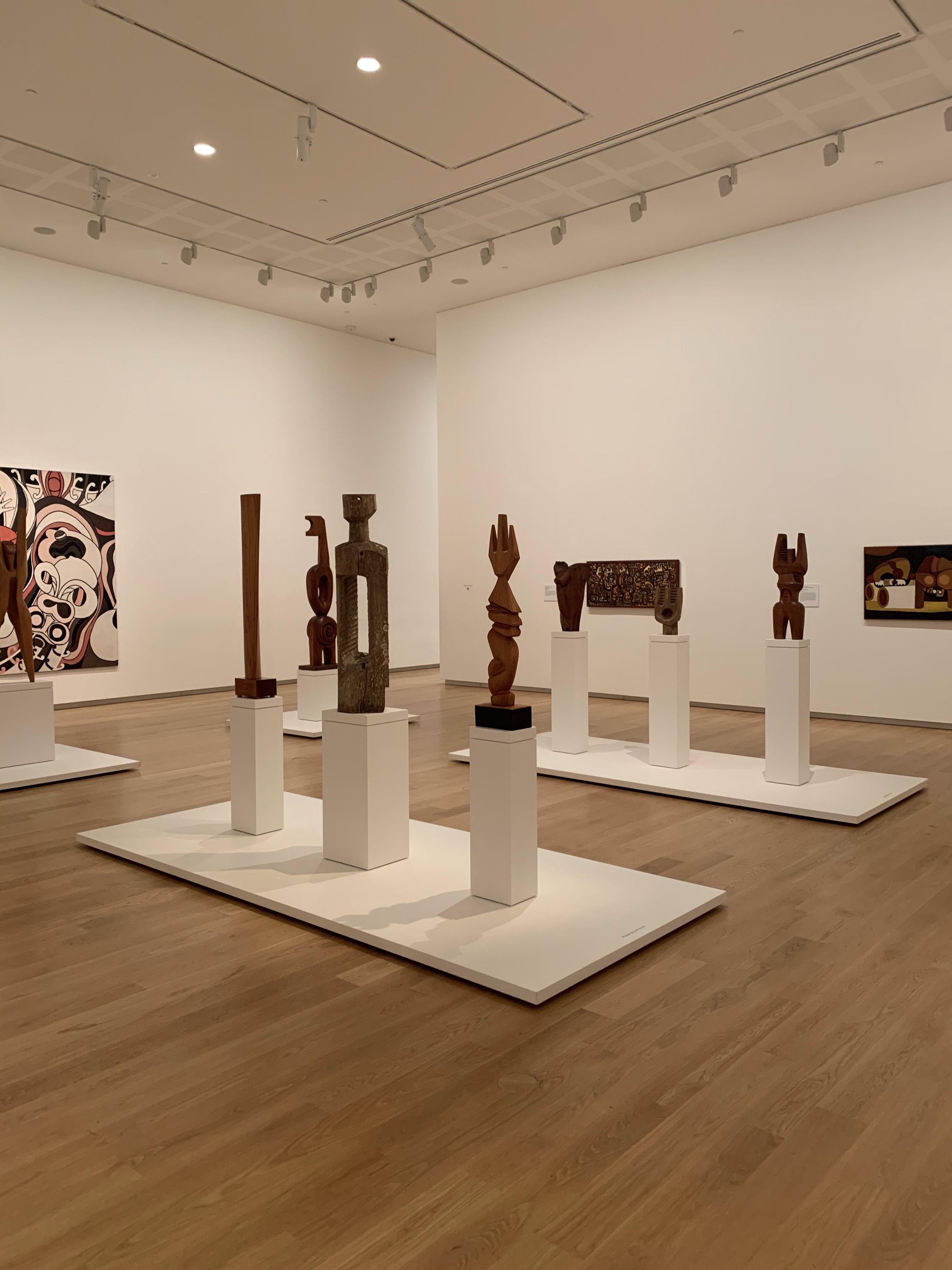
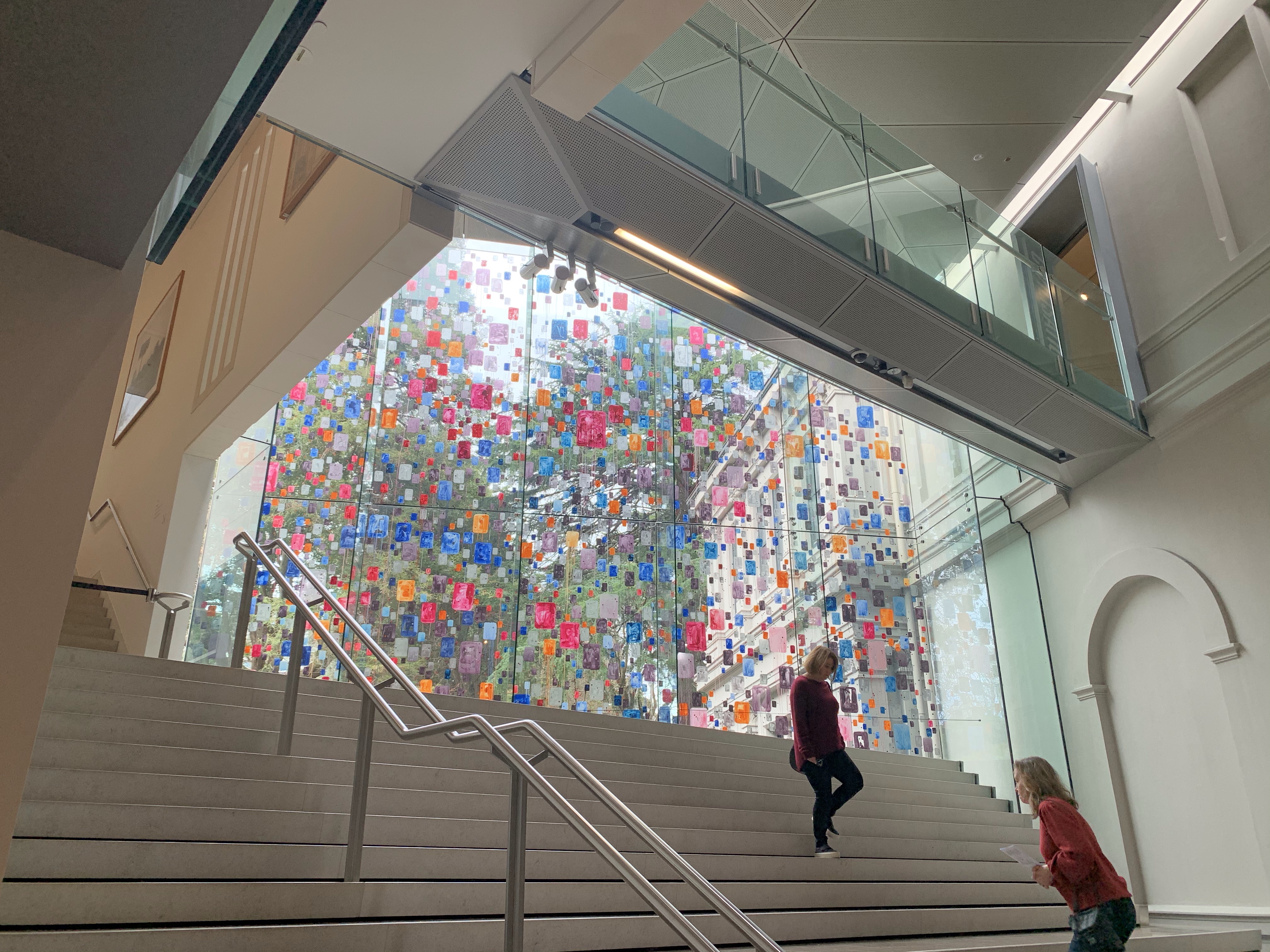
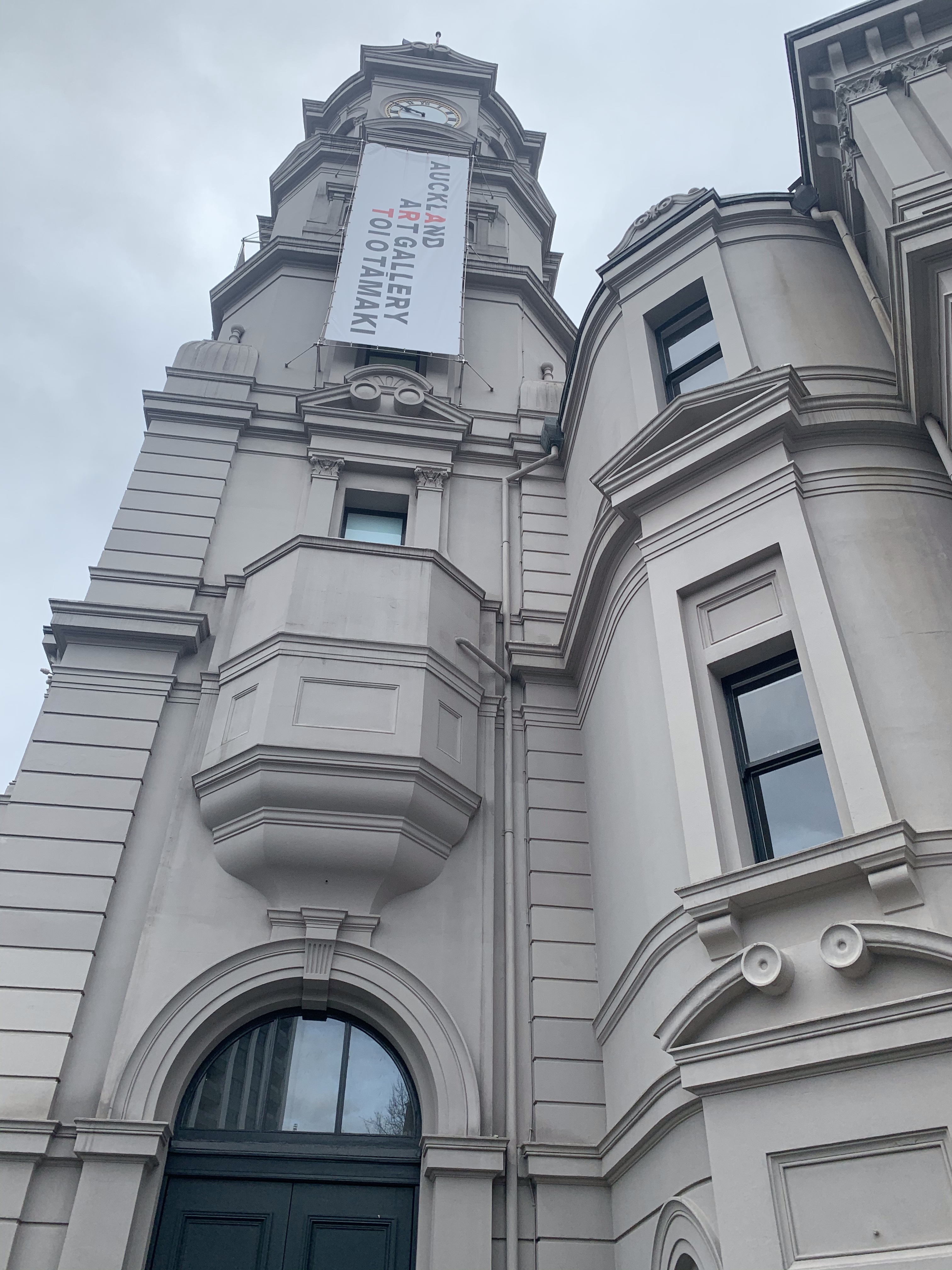
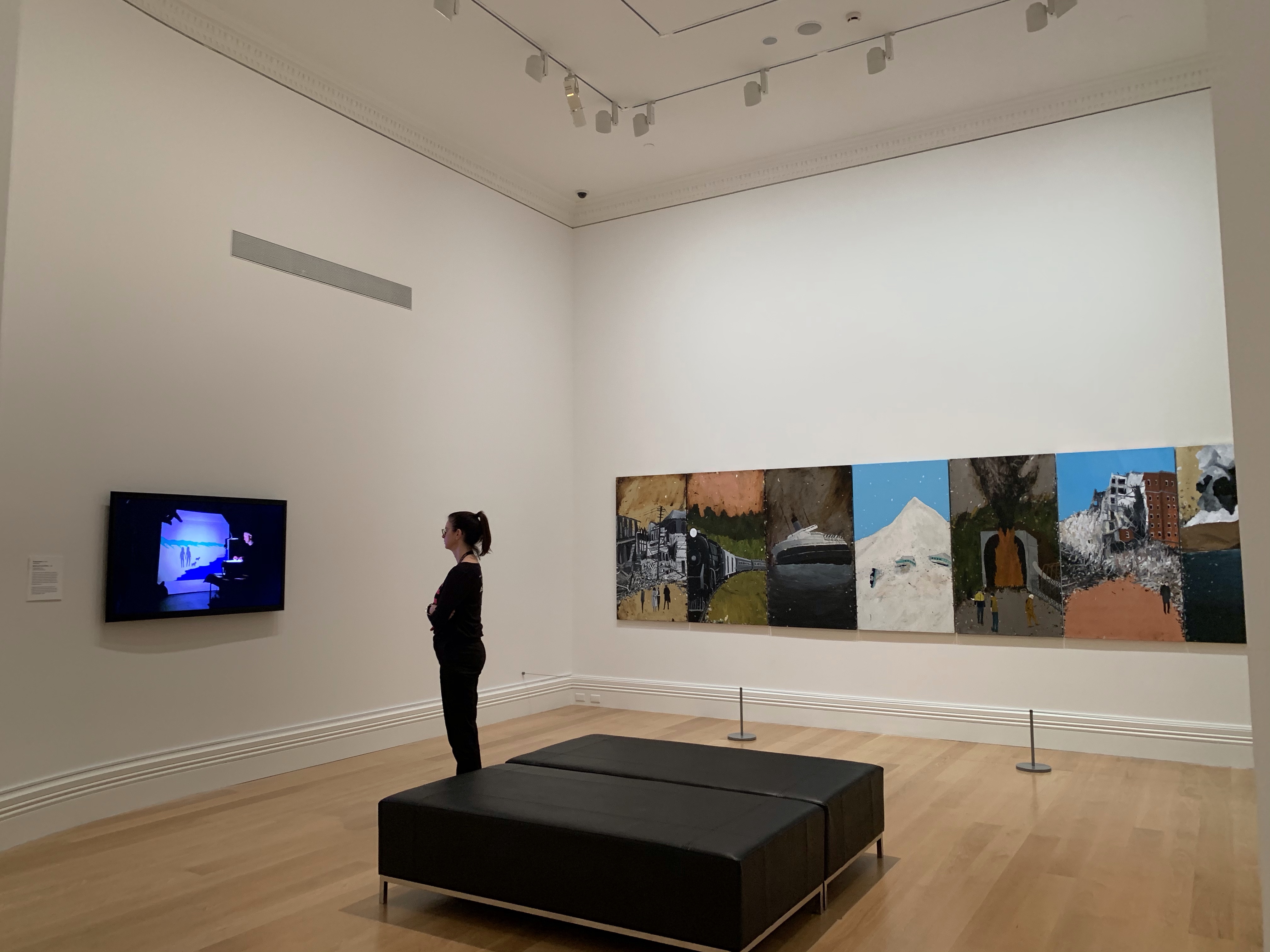
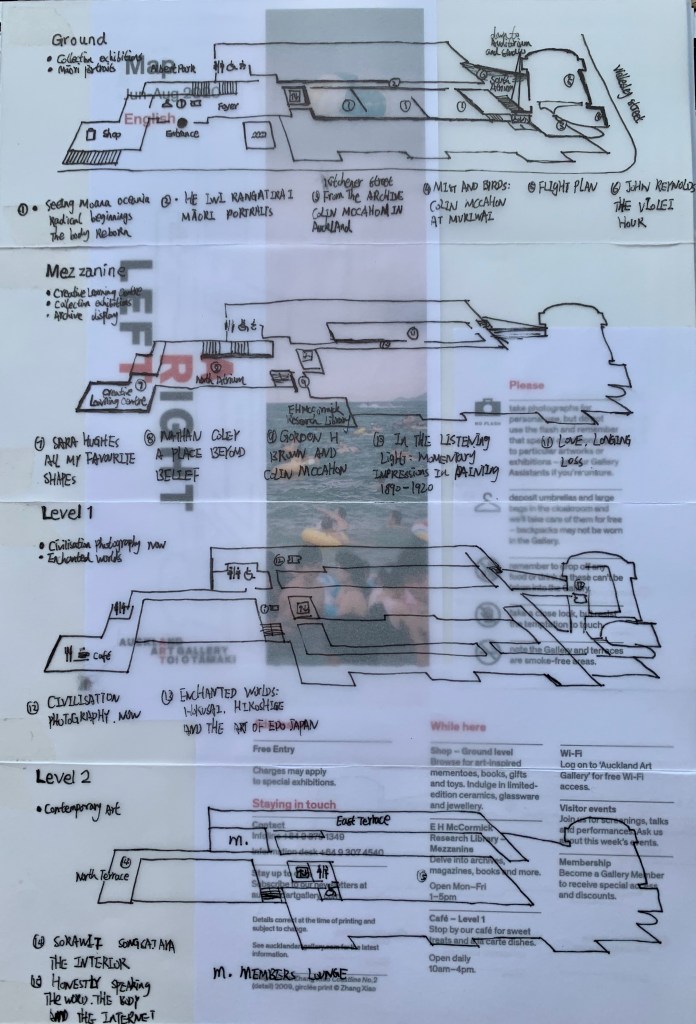
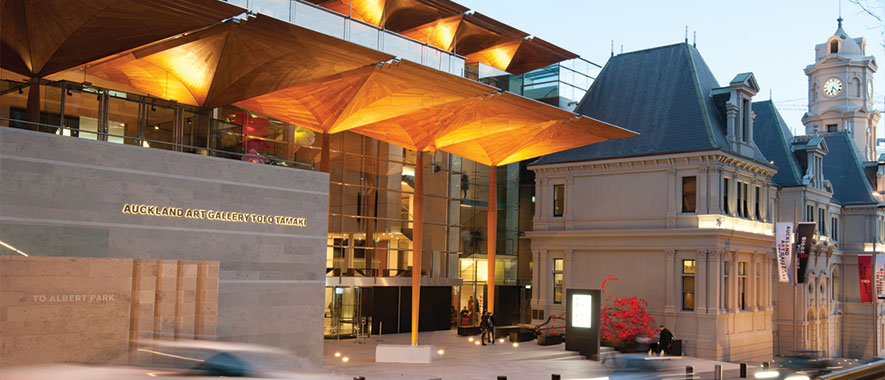
My social space is the Auckland Art Gallery.

Why is my social space is Auckland art gallery?
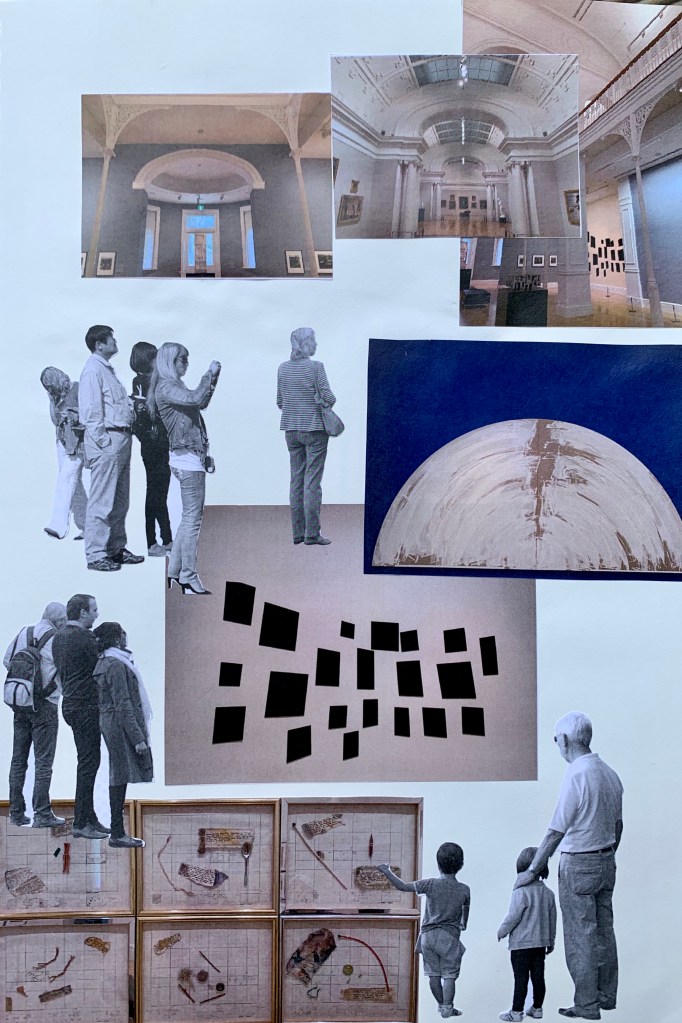
As a student who is studying design, visiting exhibitions is a very important way to gain knowledge. I want to improve my artistic aesthetics and appreciation skills in this way. And visiting the exhibition allows me to have more ideas such as using more methods and materials to show my works. Wait so I often visit different galleries. Auckland art gallery is the place I go most often, and it is also the place that provides me with inspiration.

As a participant and observer of the social space, how do I analyze?
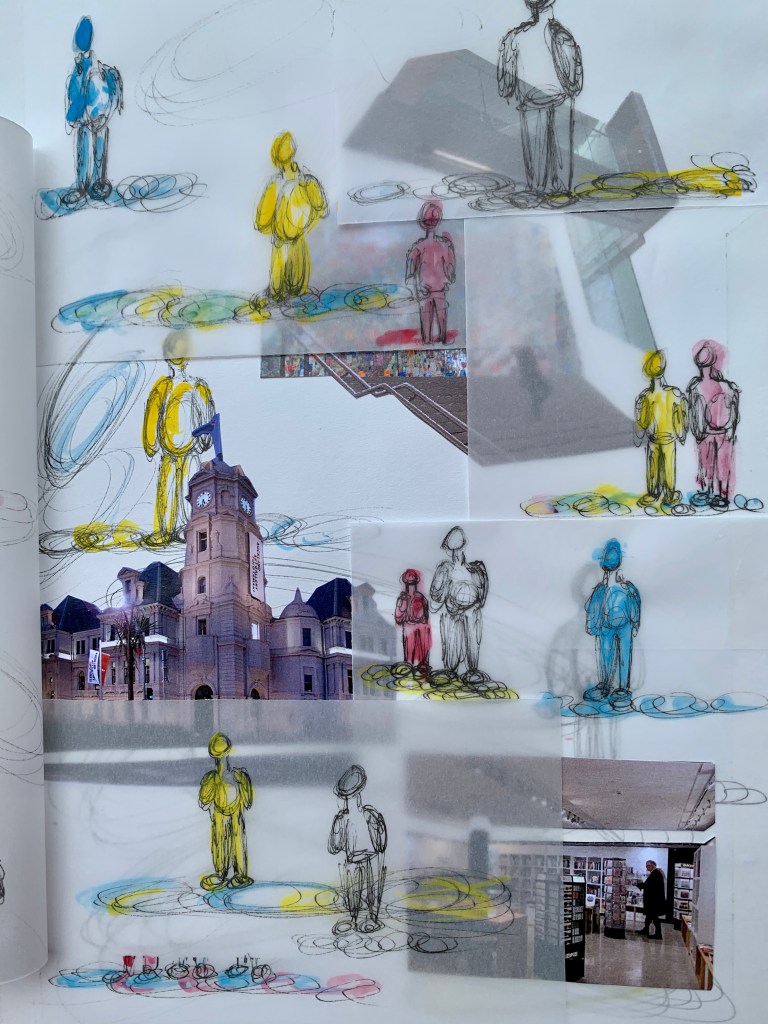
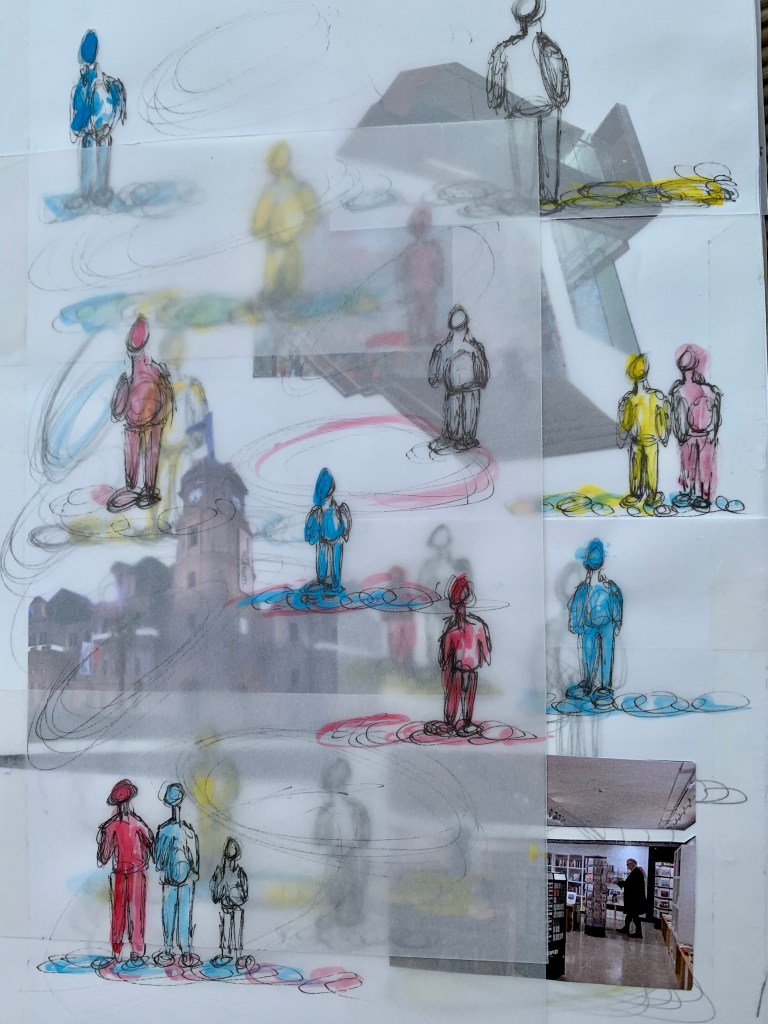
As a participant, I see myself as someone who visits the gallery. How did I begin to enter this space and how to join this space? Who did I communicate with? What does this space bring to me?
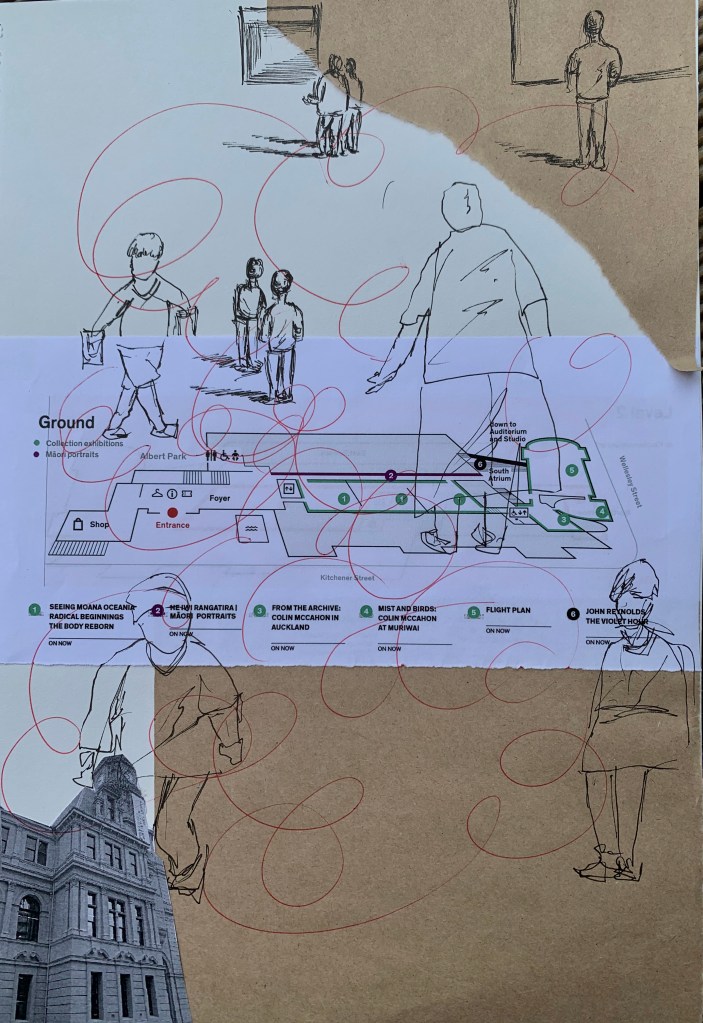
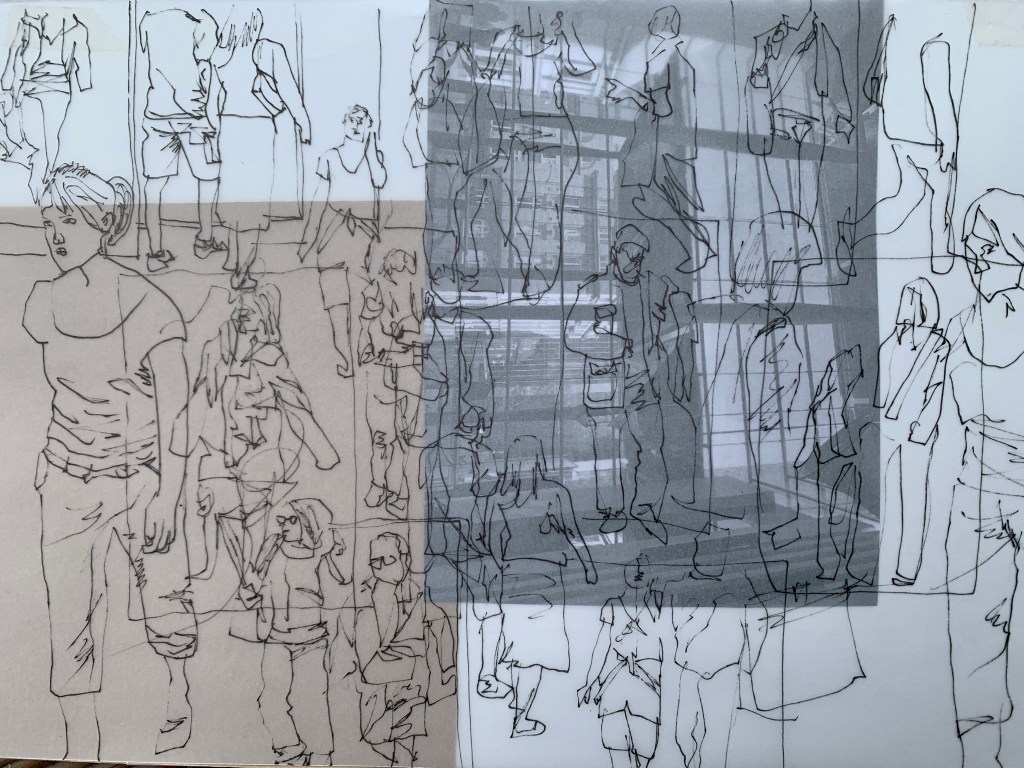
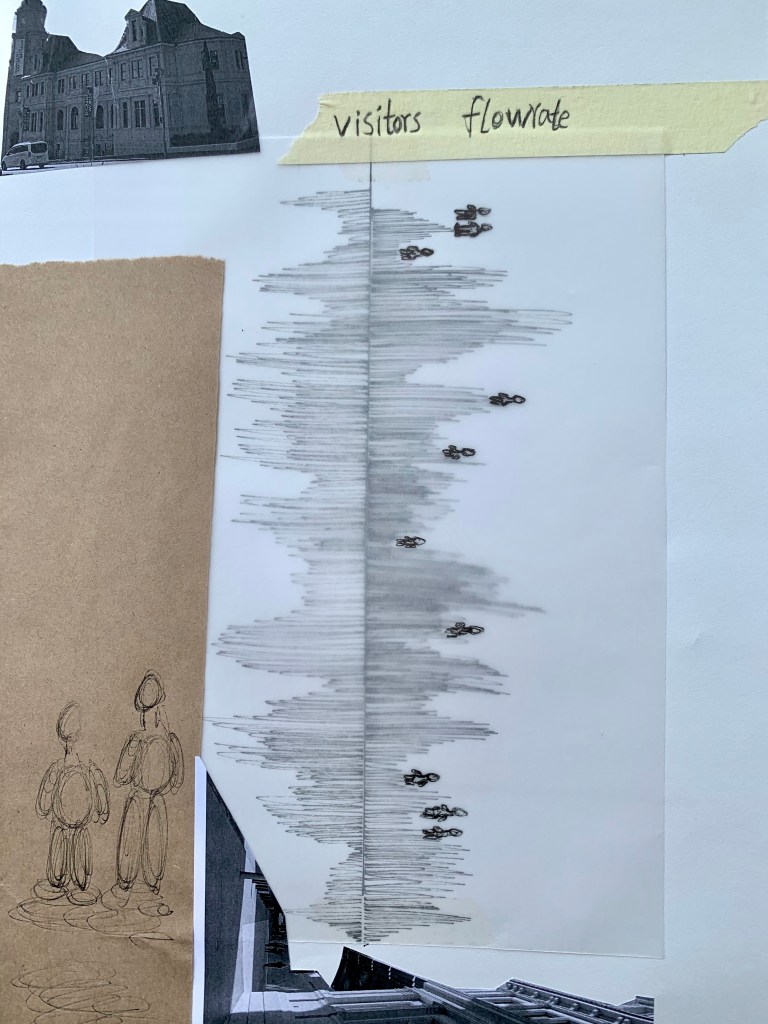
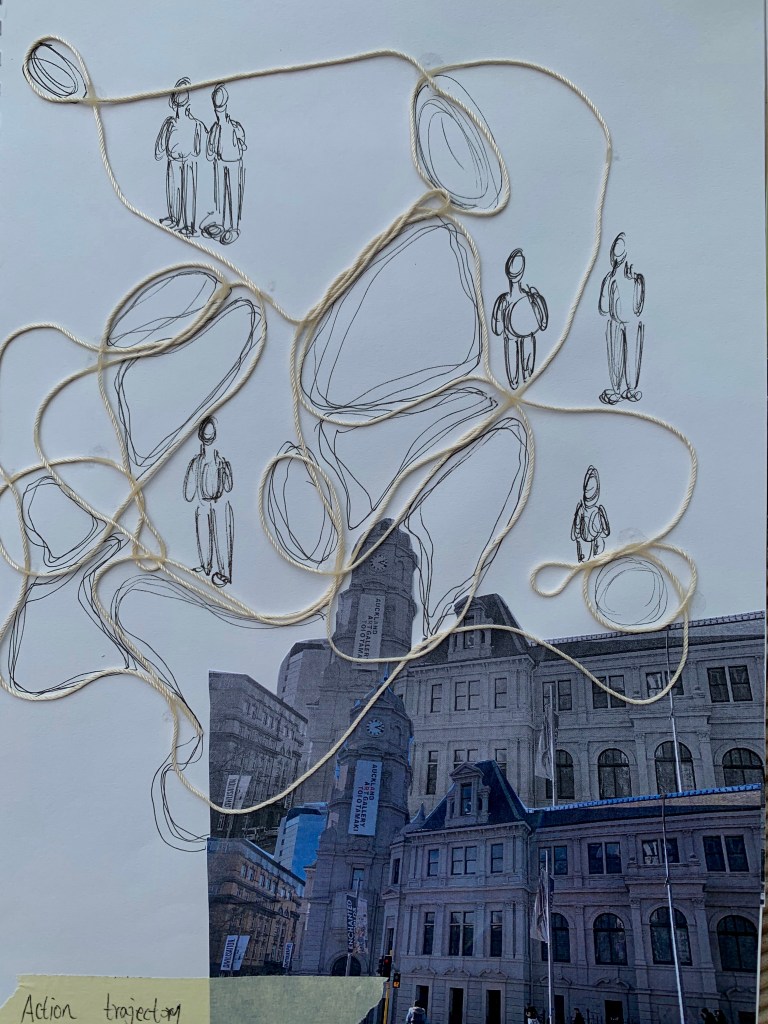
As an observer, I pull myself out of this space and observe the people who go to this space? Their purpose? The direction of action? Will they communicate with other people?

How do galleries constitute a social space?
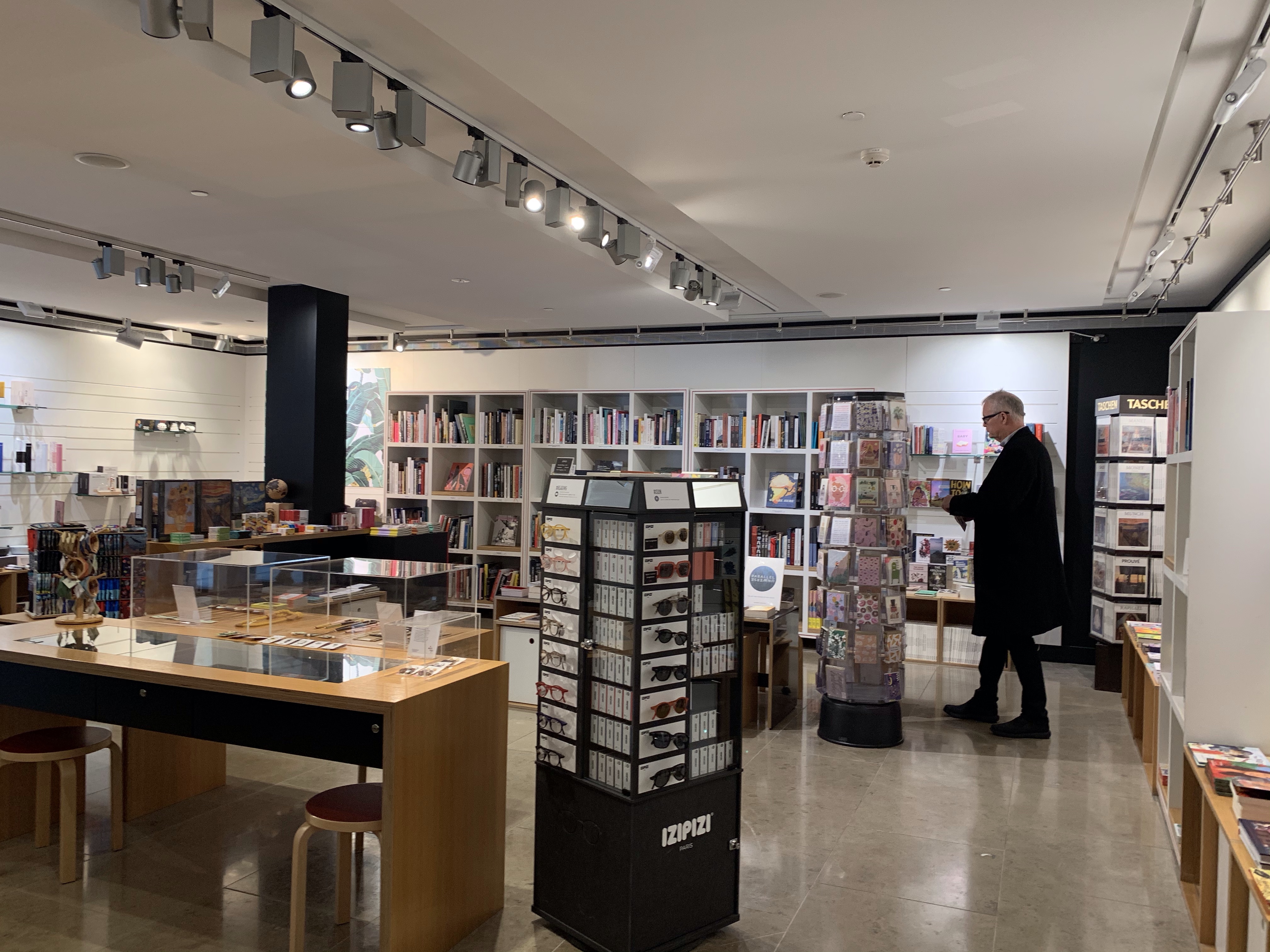
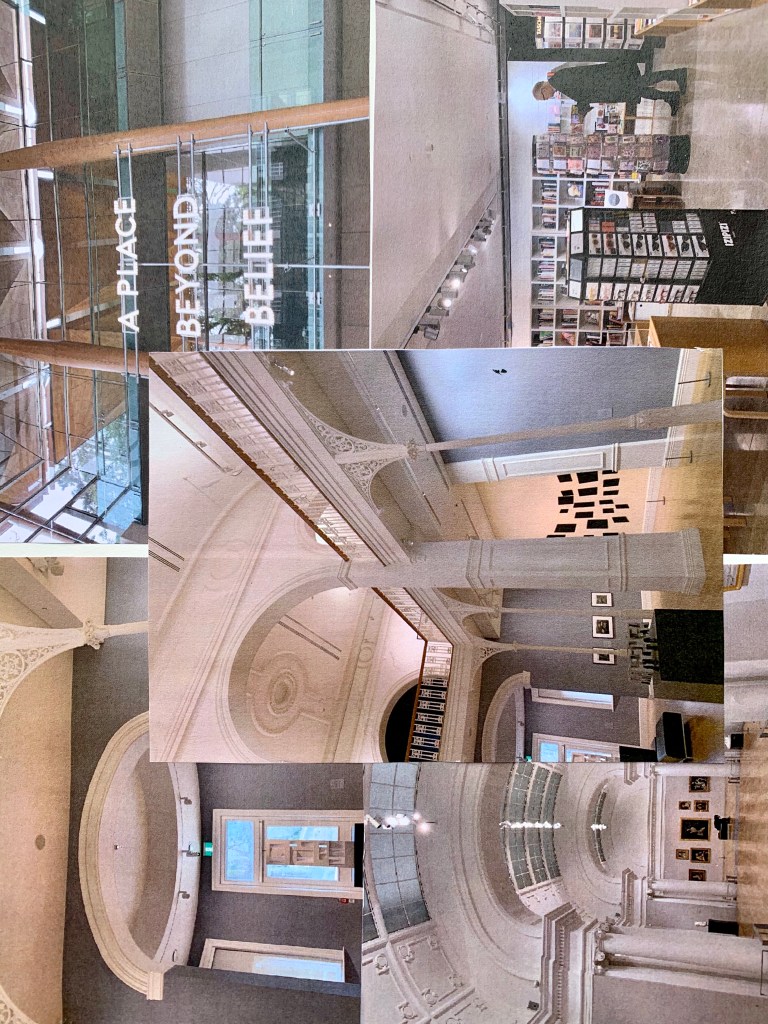
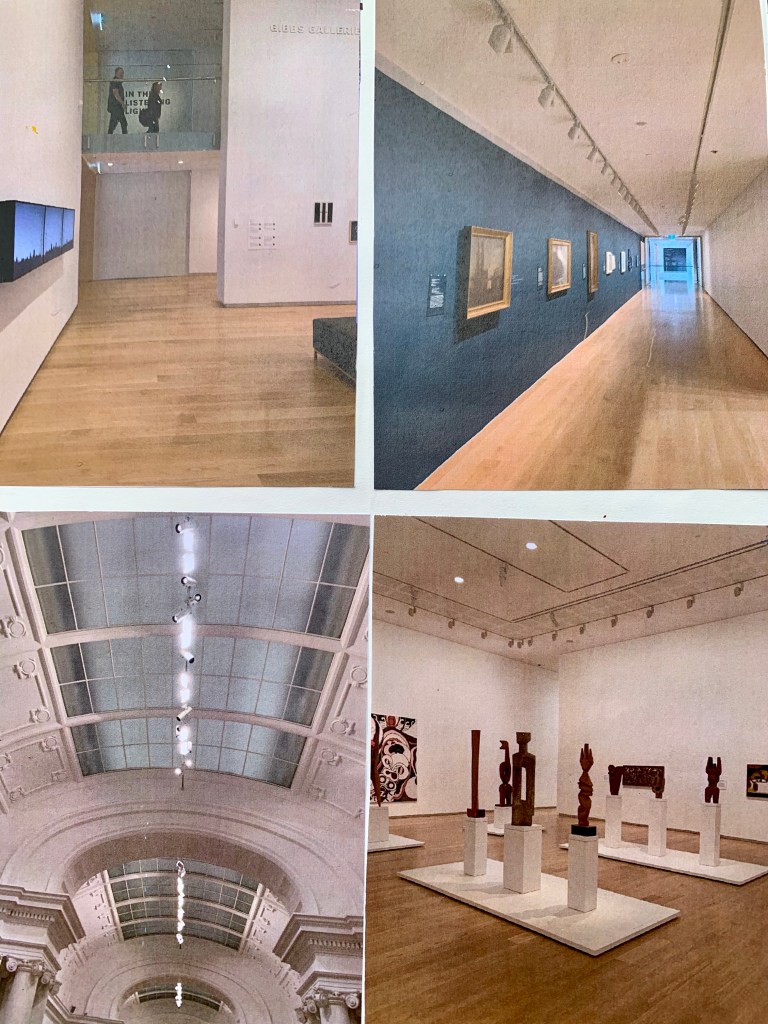
First of all, the gallery is a public space, which provides a rest area, exhibition area, coffee shop, gift shop and so on. The gallery will hold individual exhibitions of some artists from time to time. An art exhibition is a social event that brings people who are interested in art together to discuss, appreciate, buy, etc. together.

Final Work

Gravitational Pull

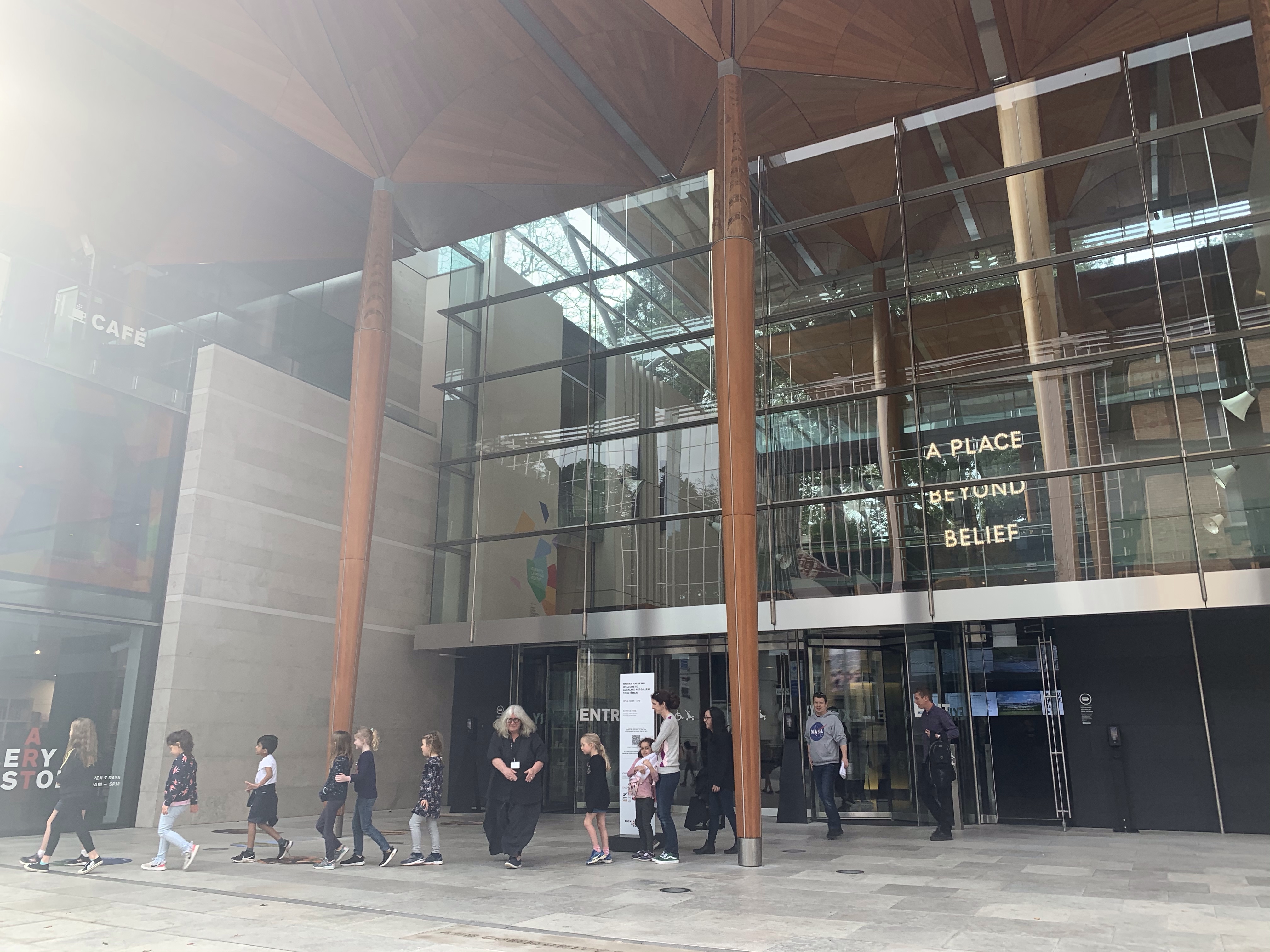
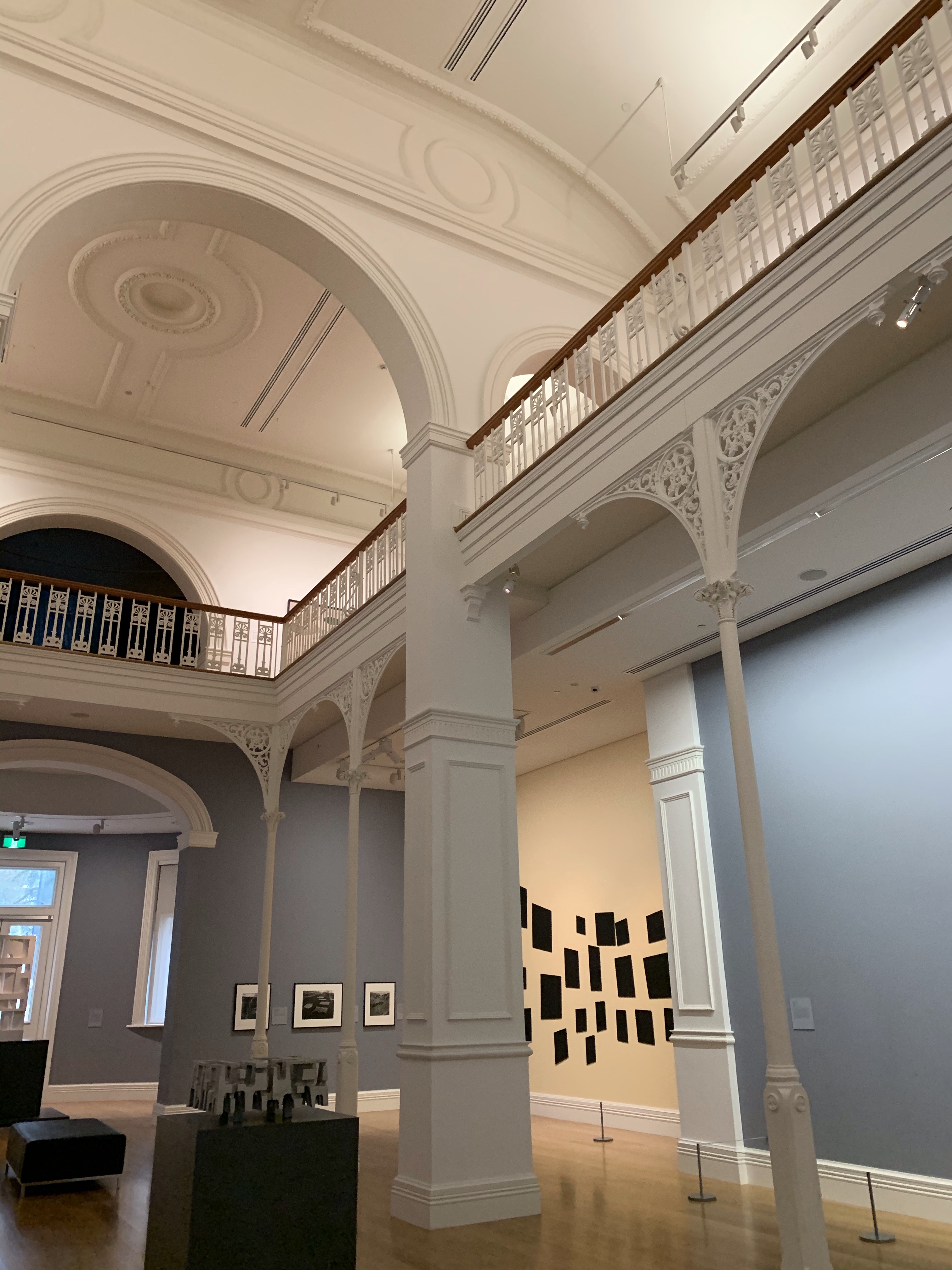
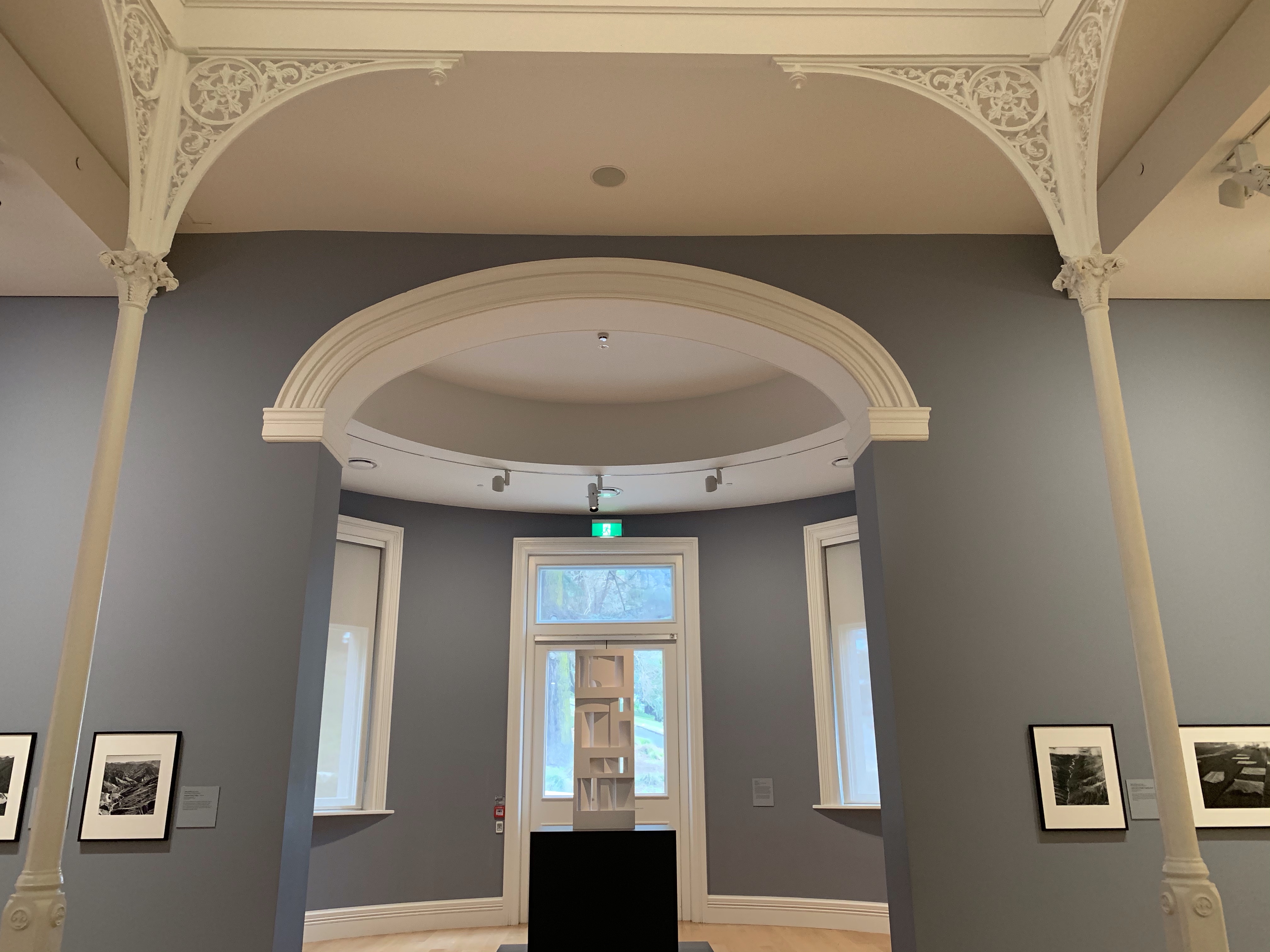
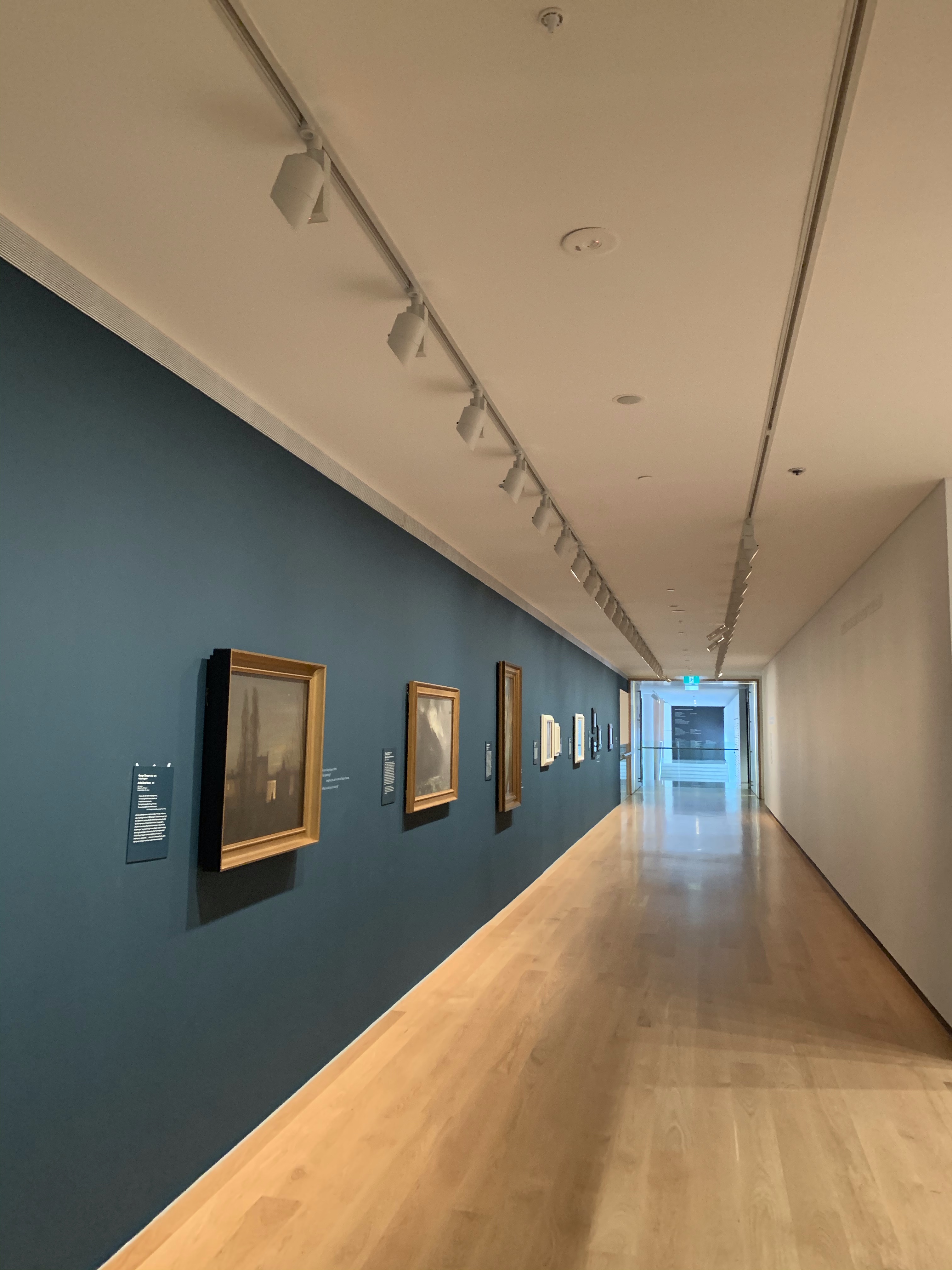
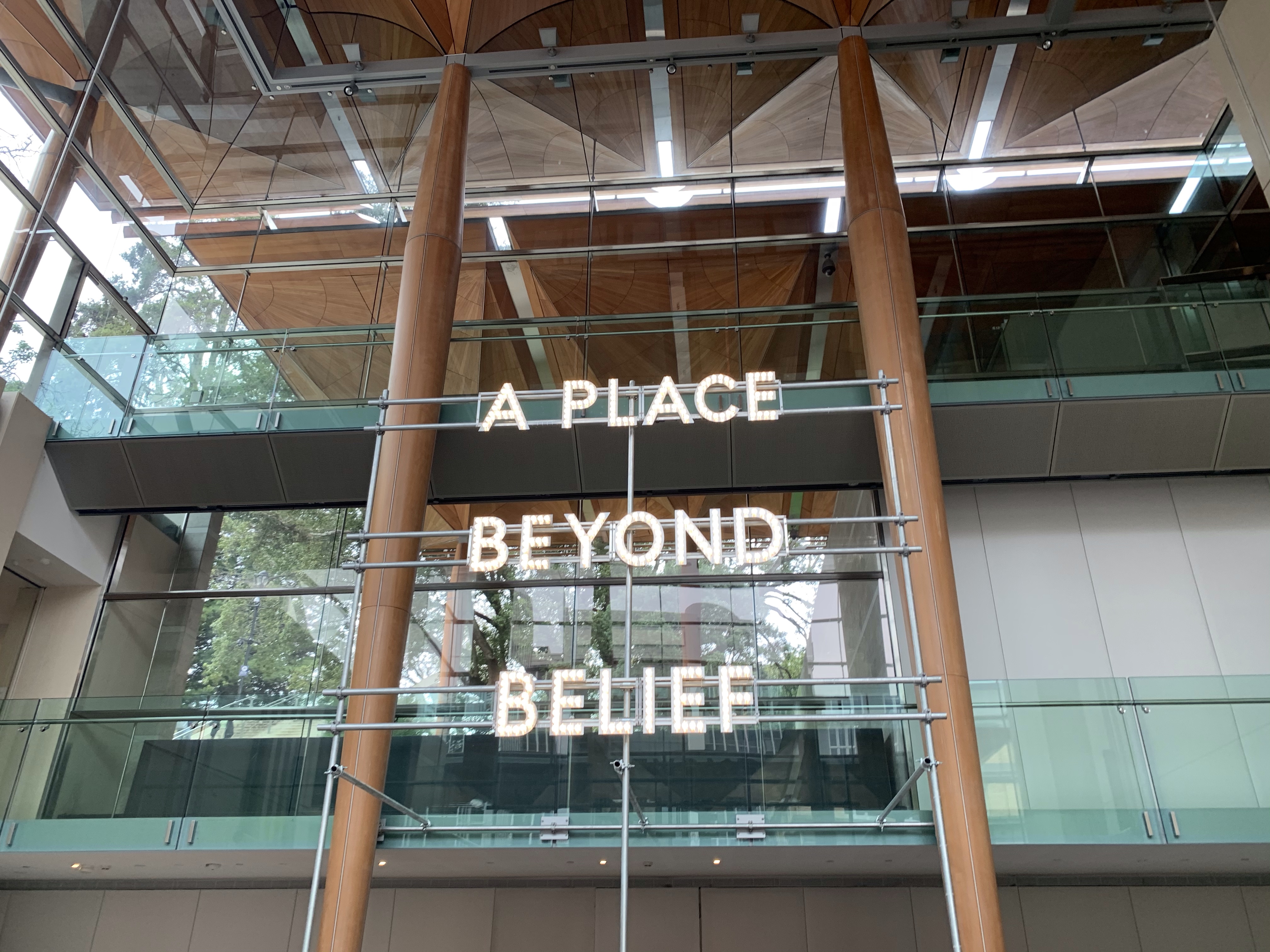
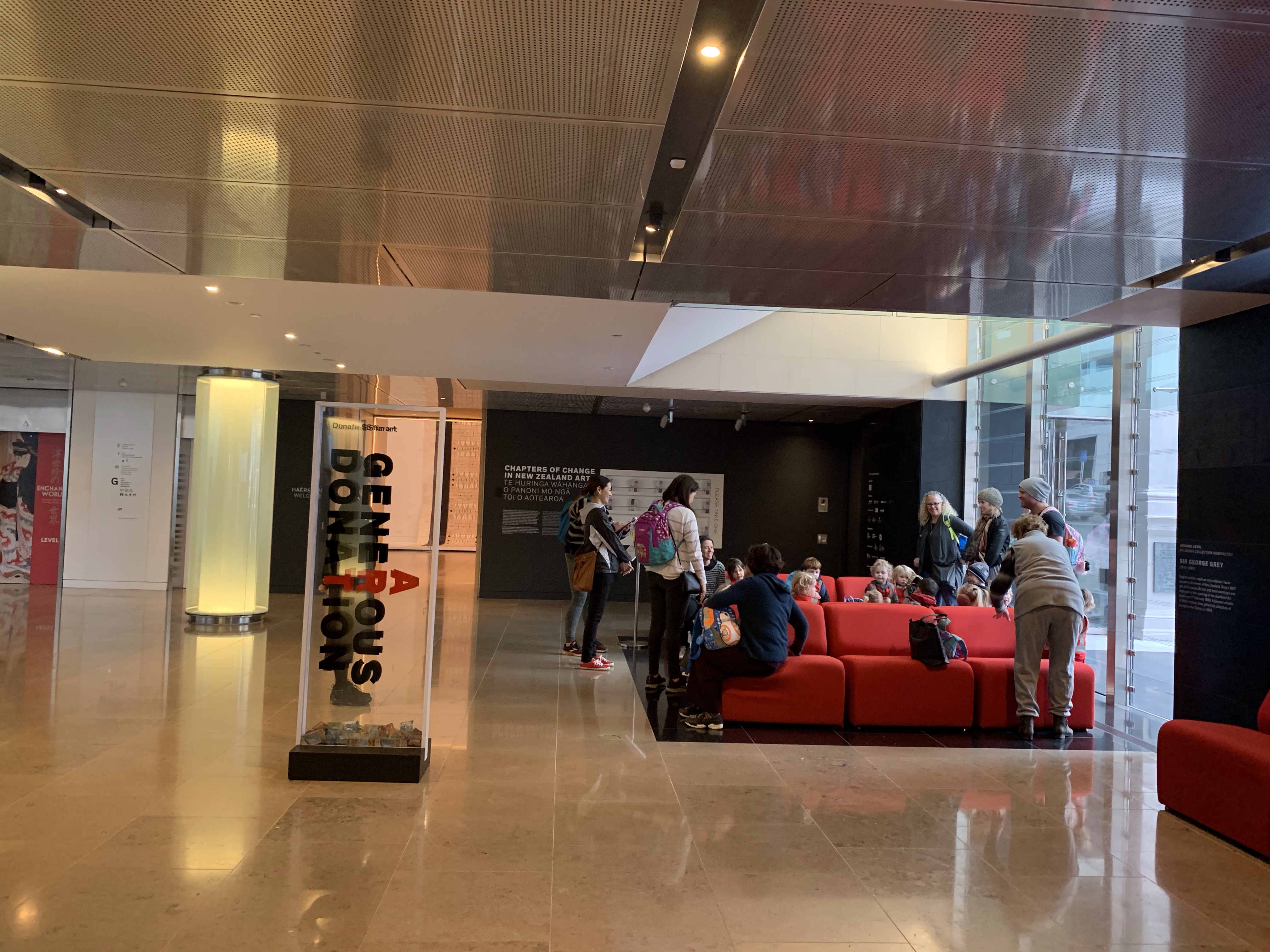
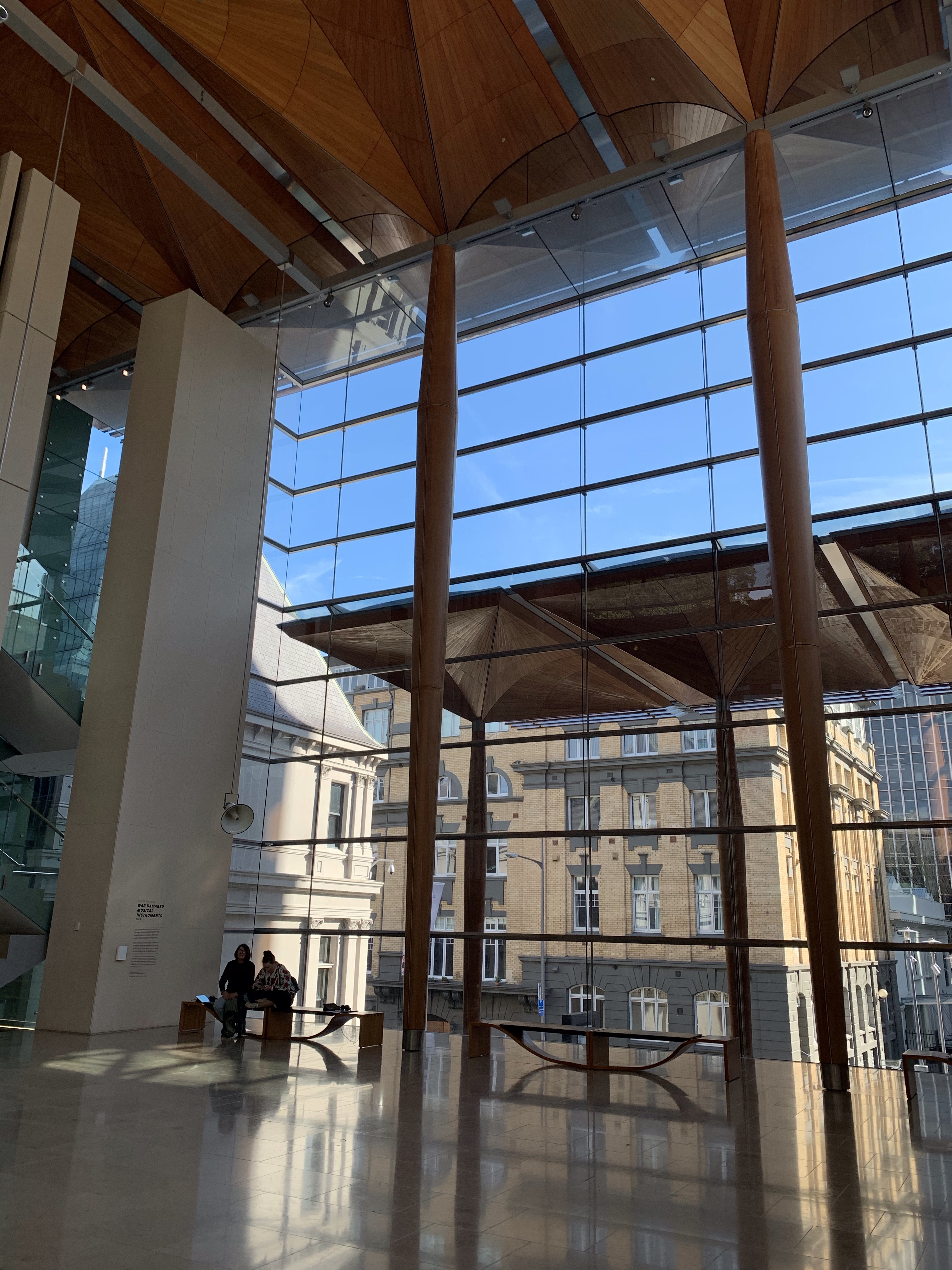
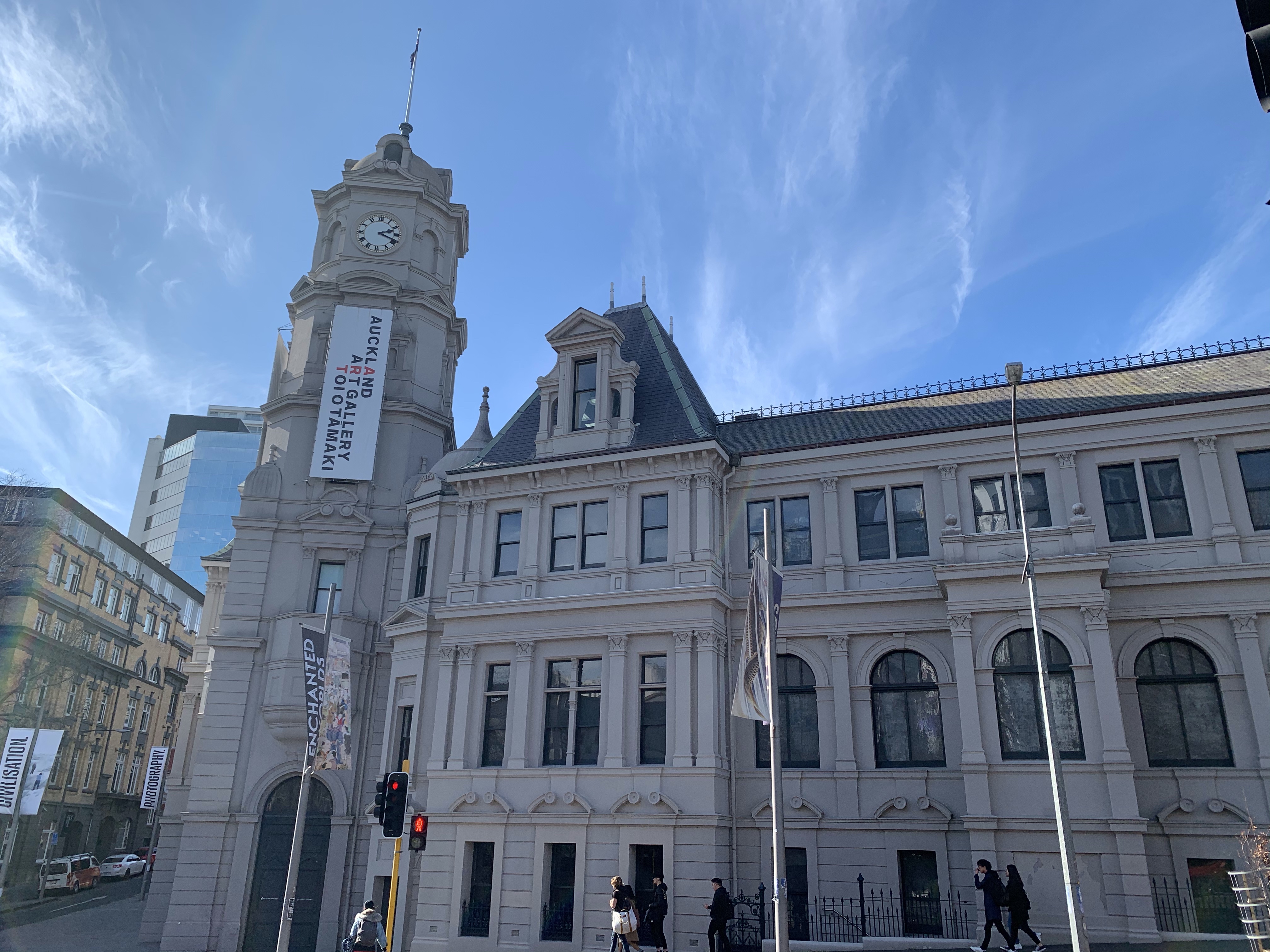
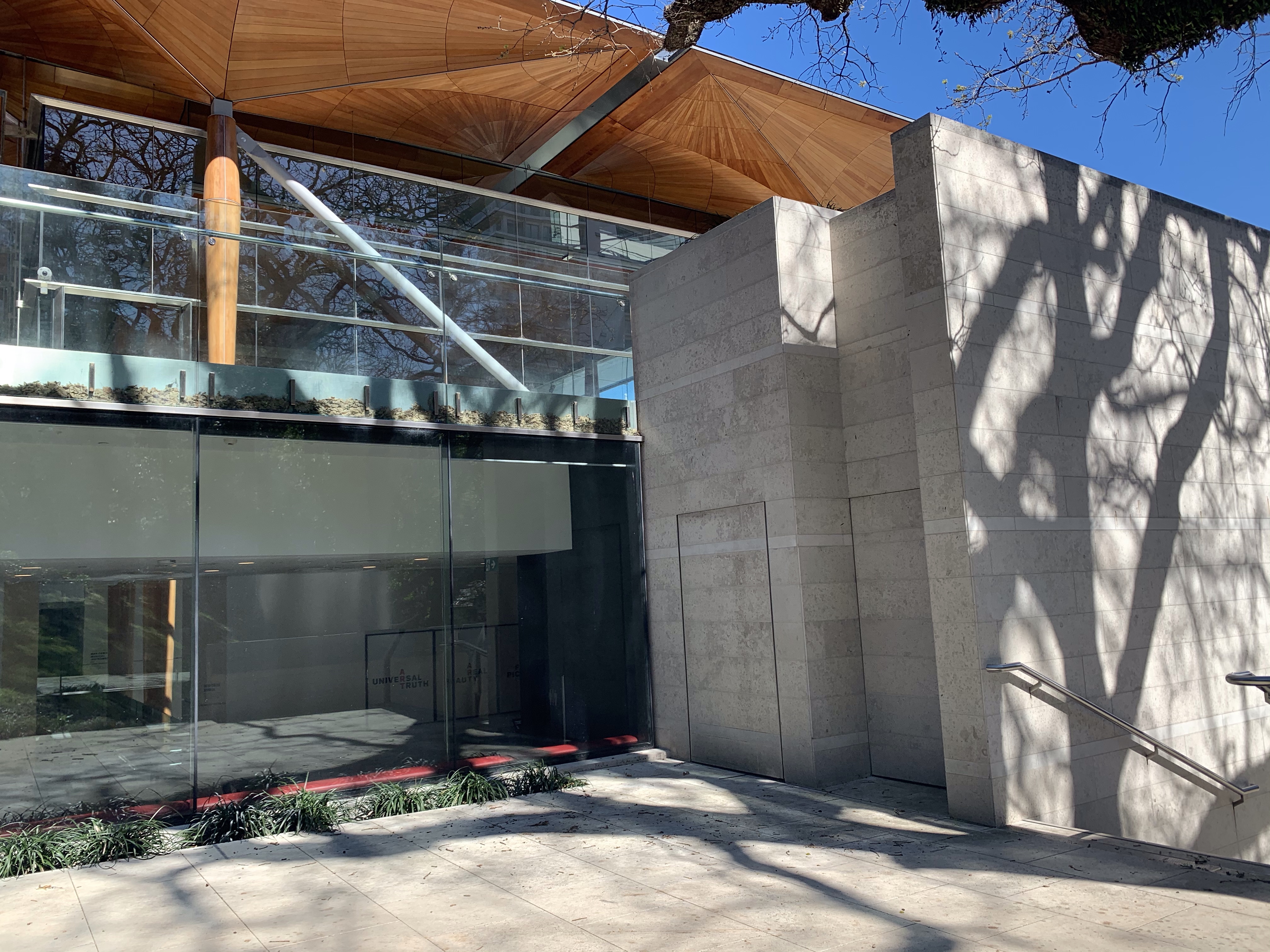
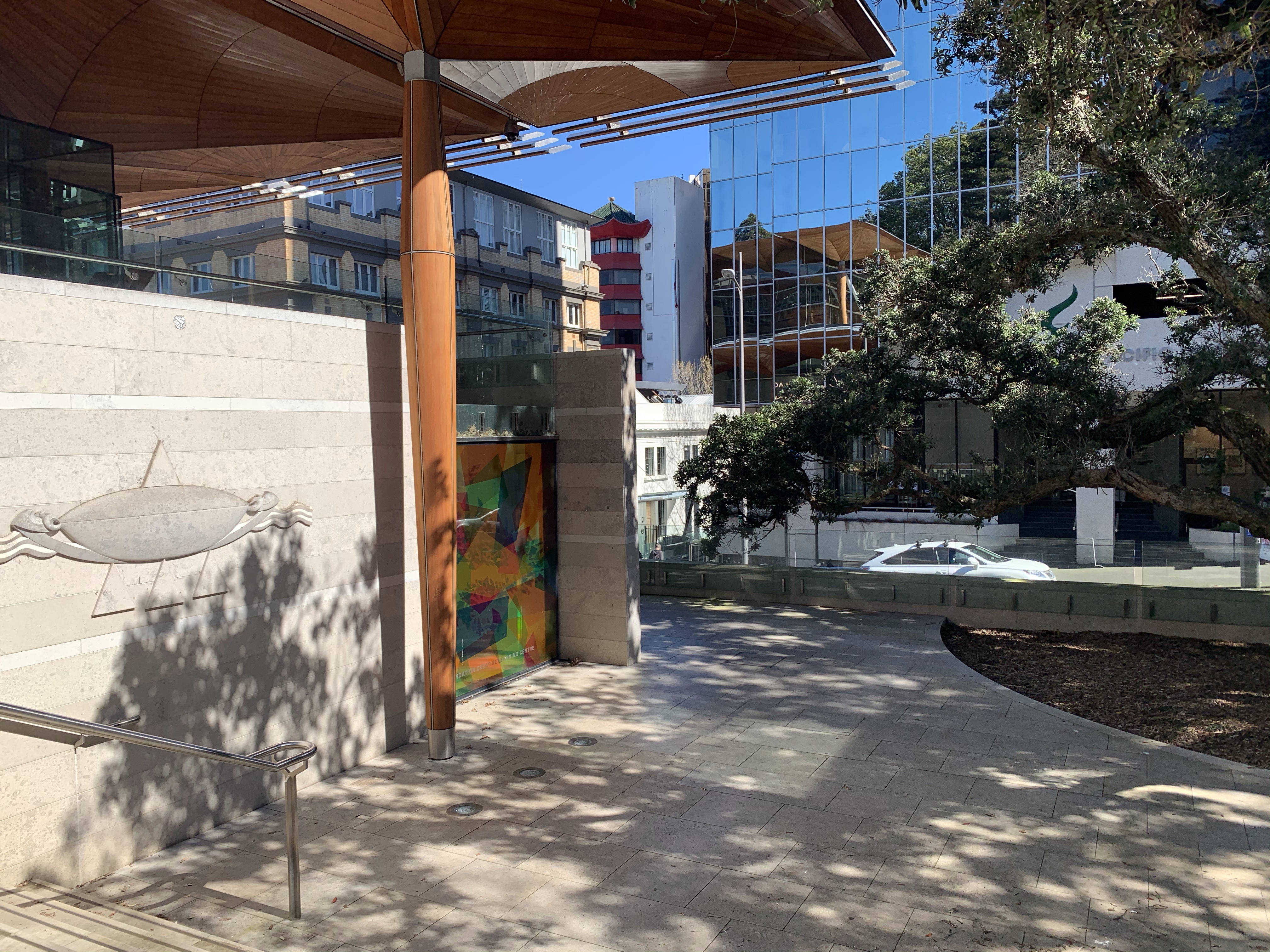
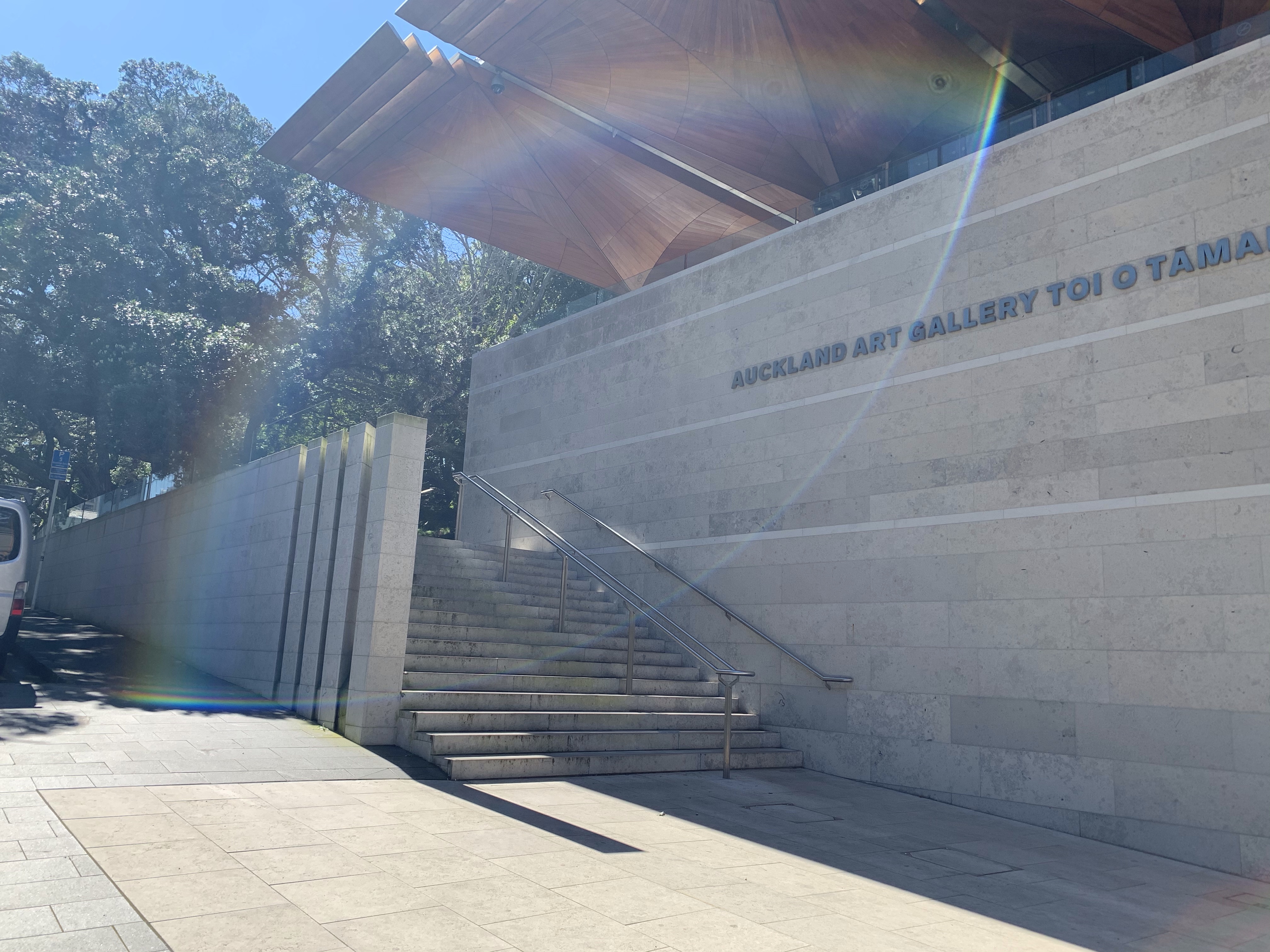
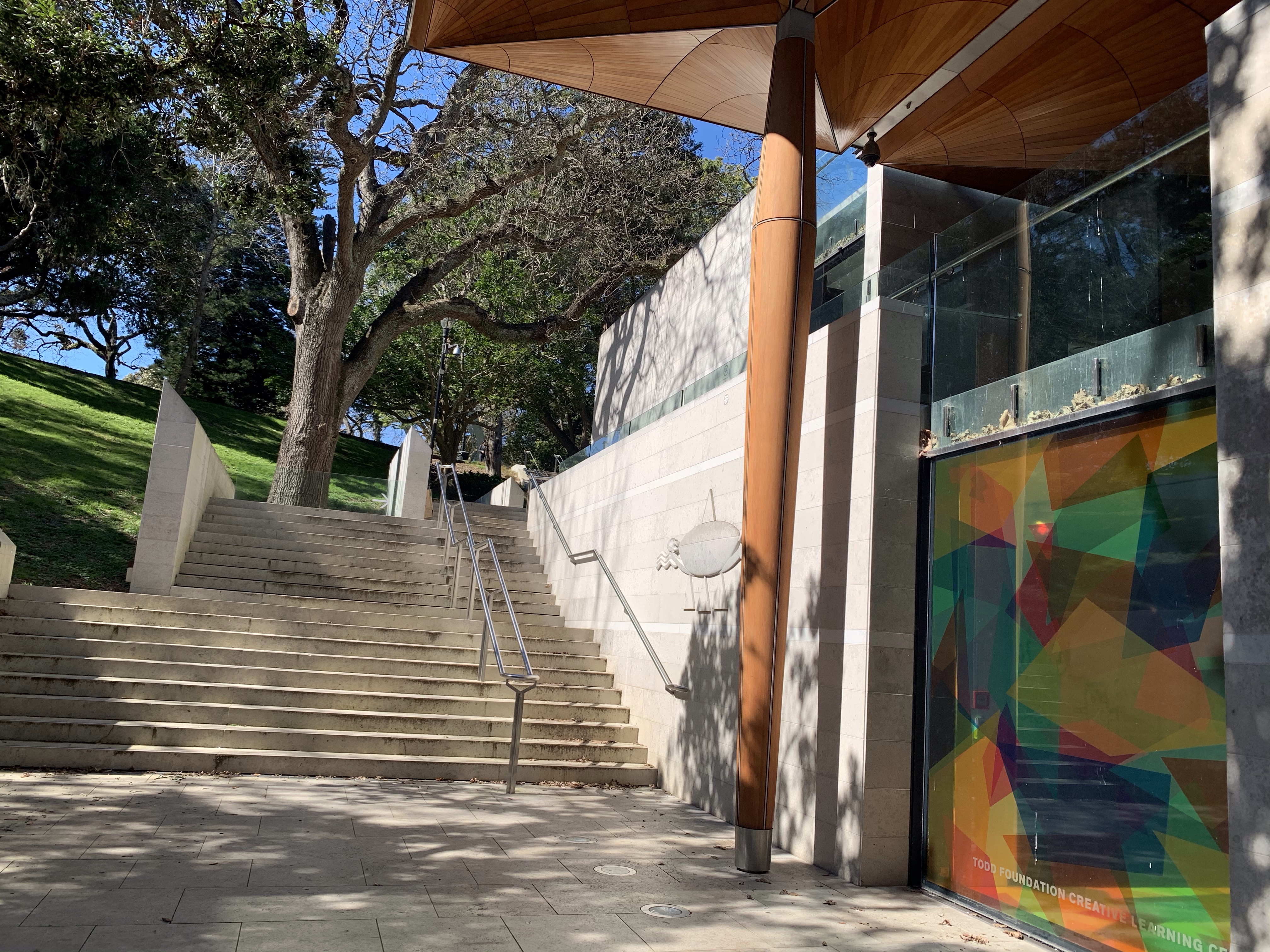
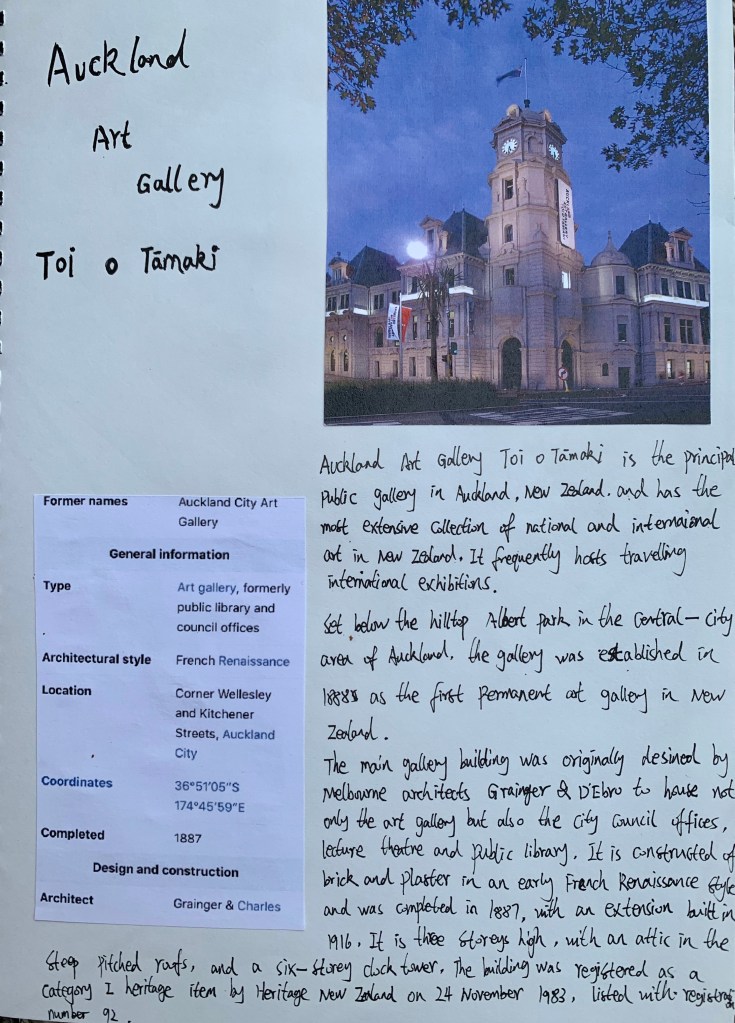
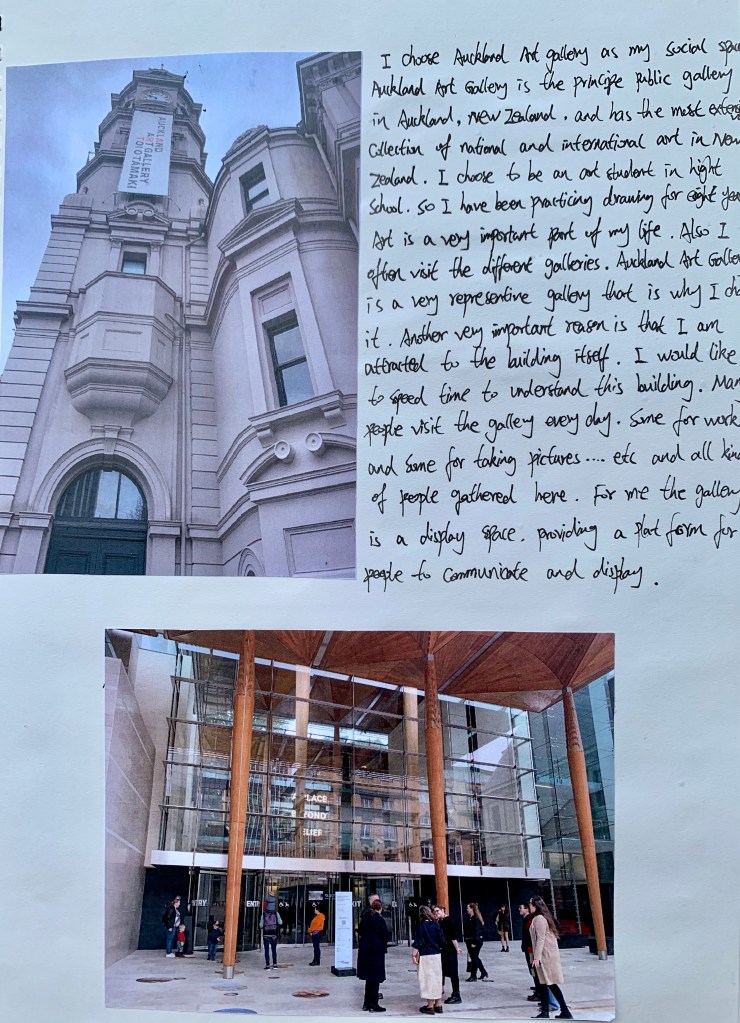
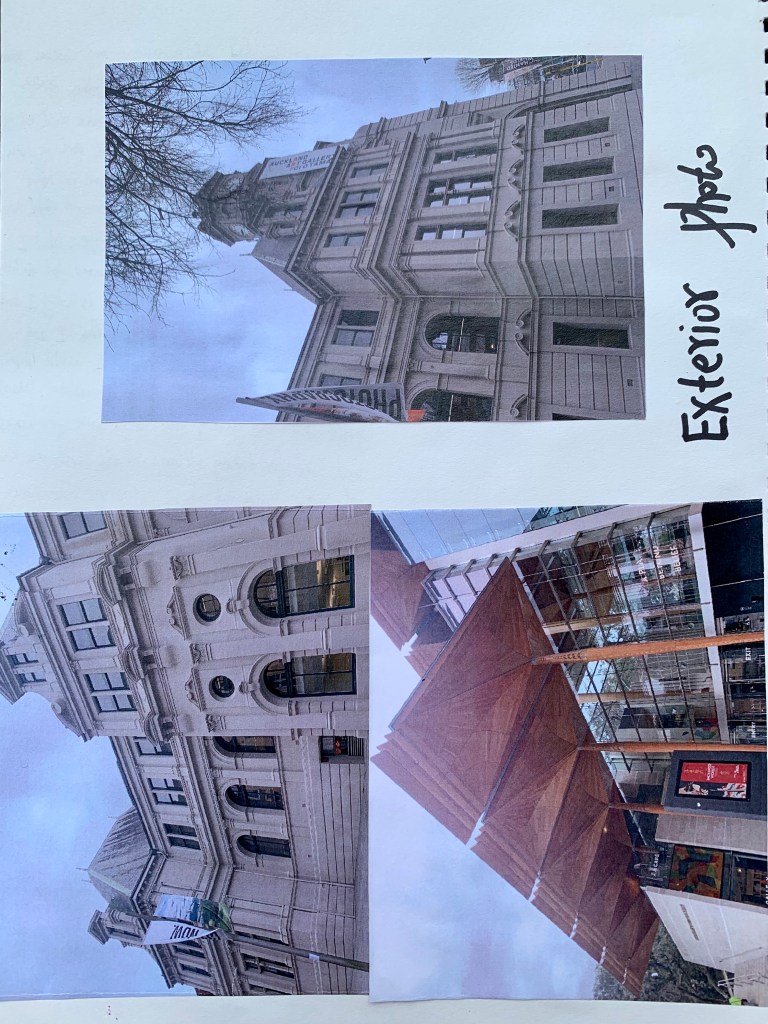
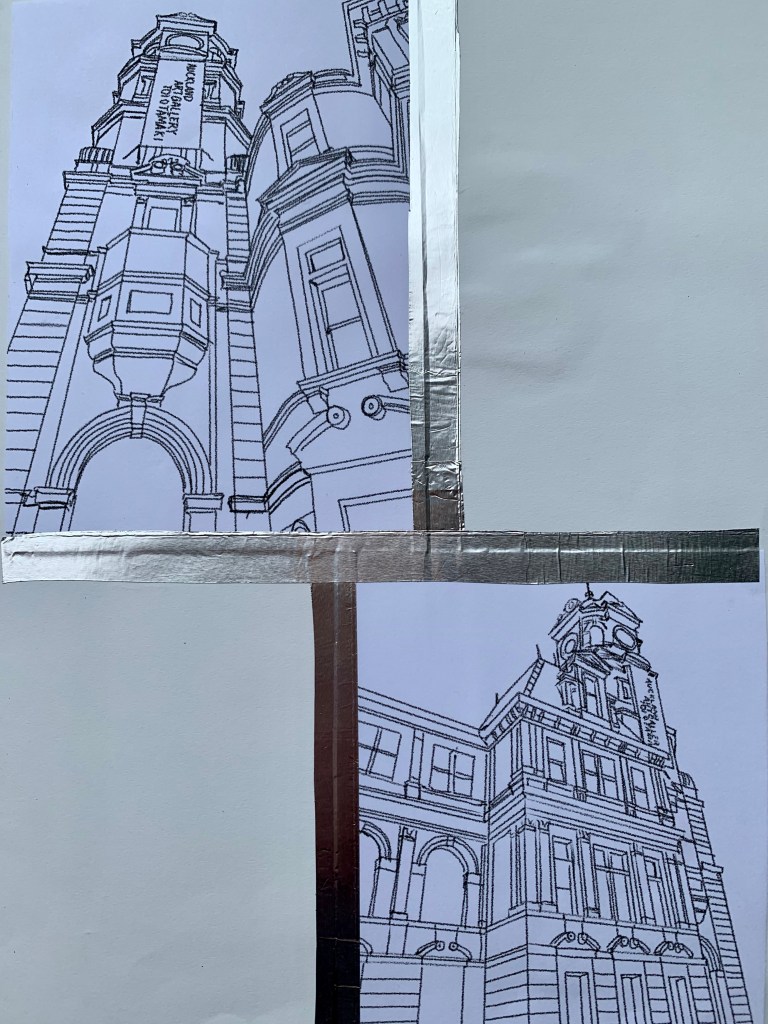
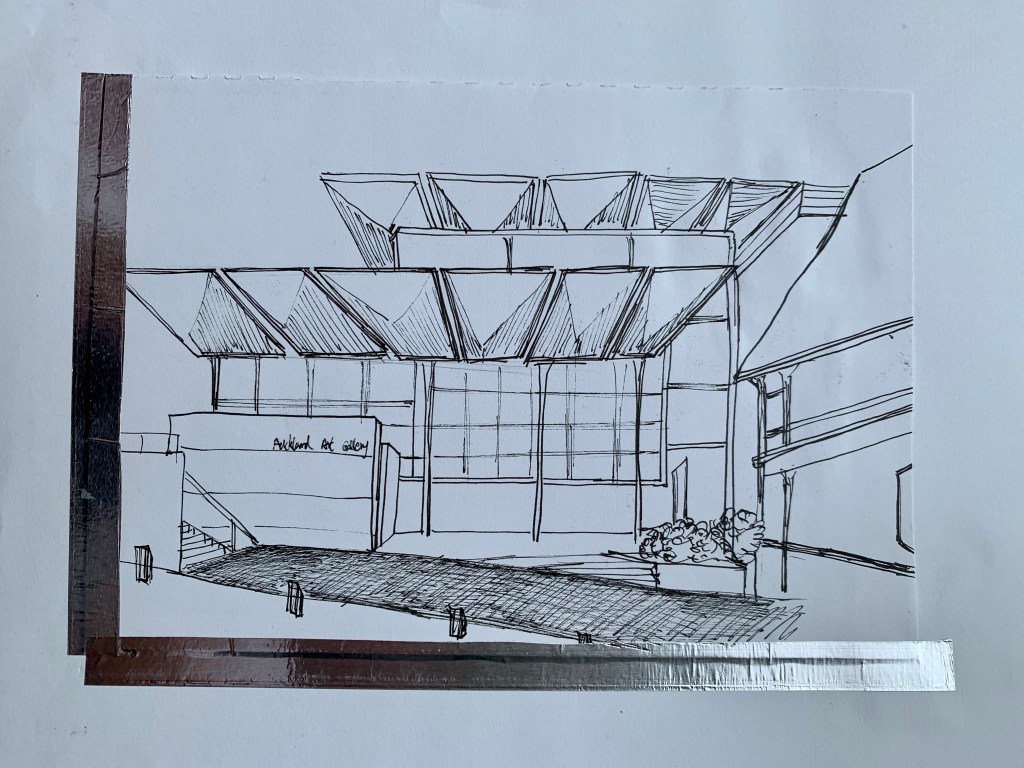
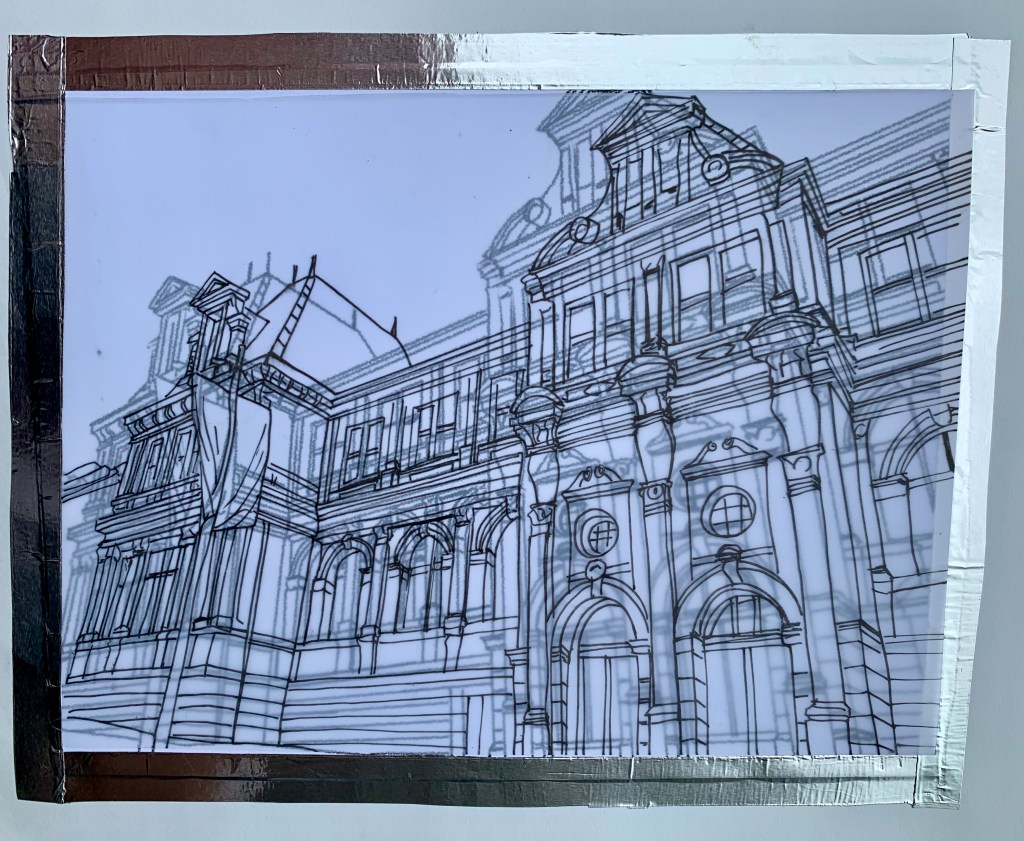
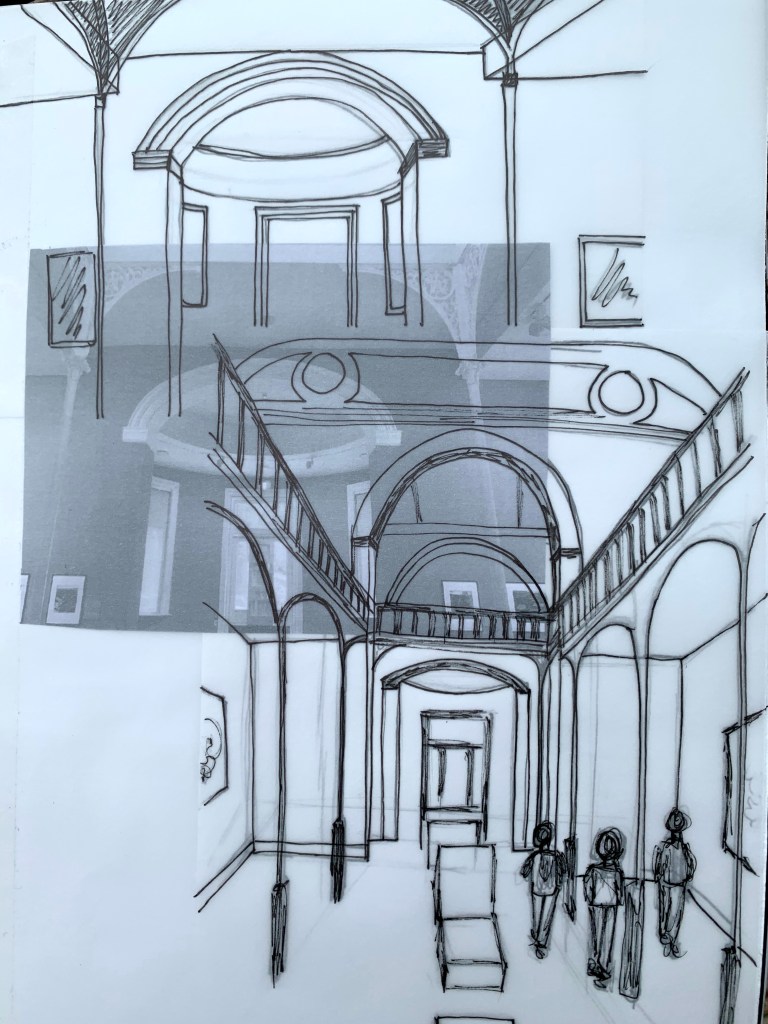
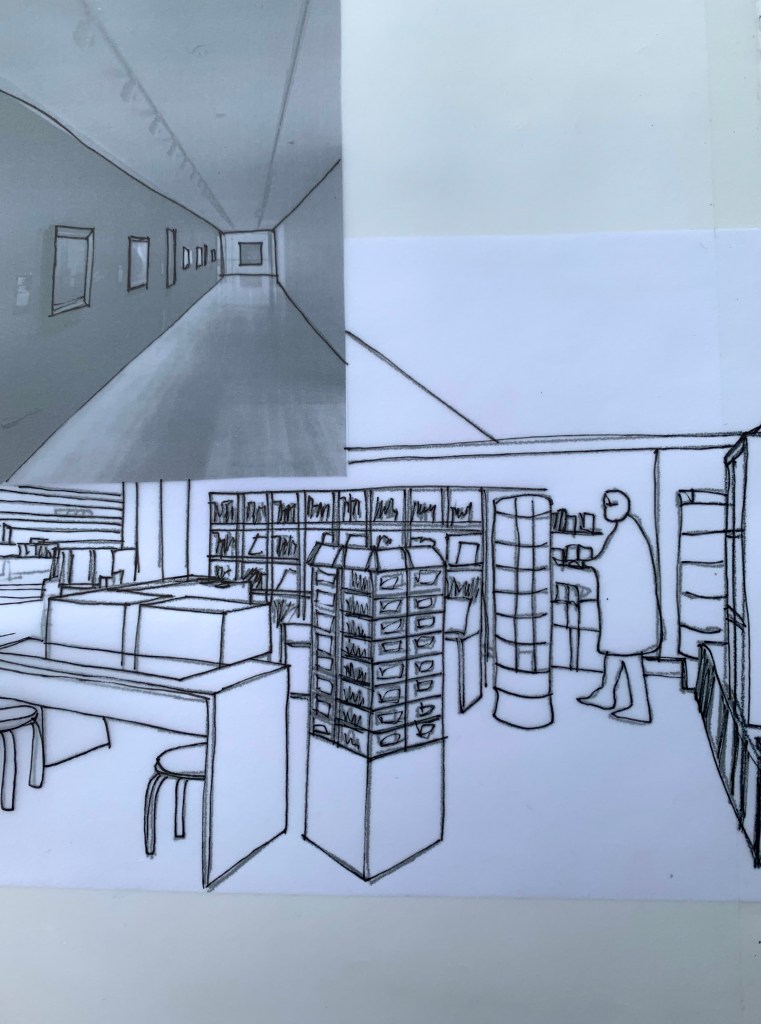
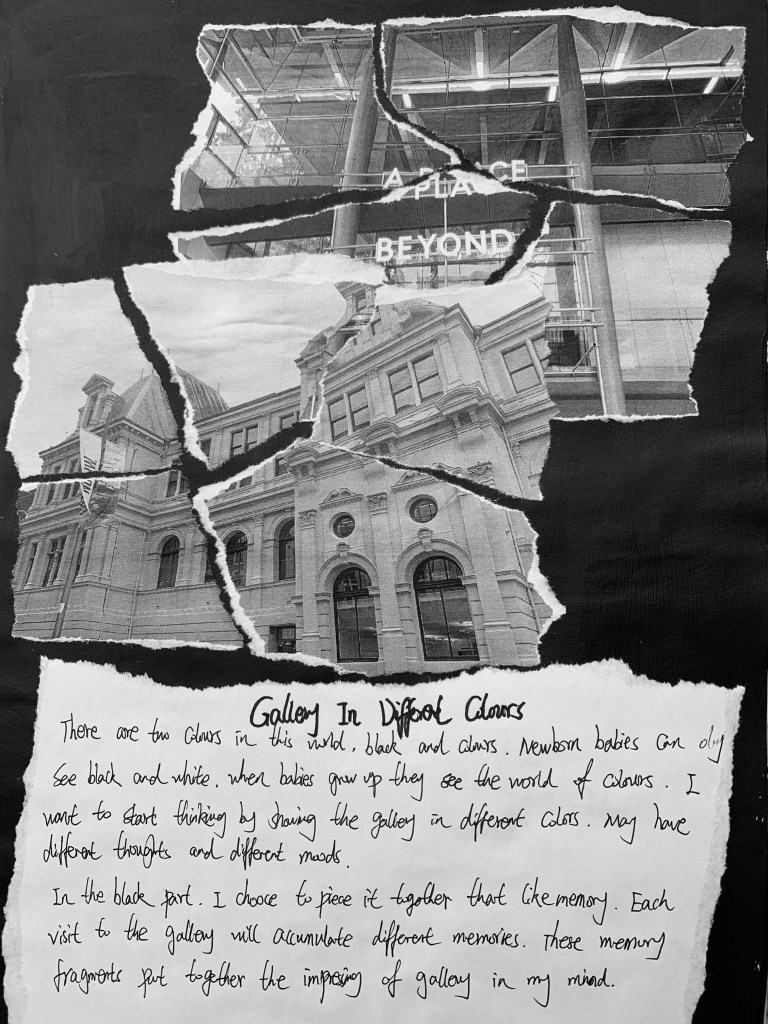
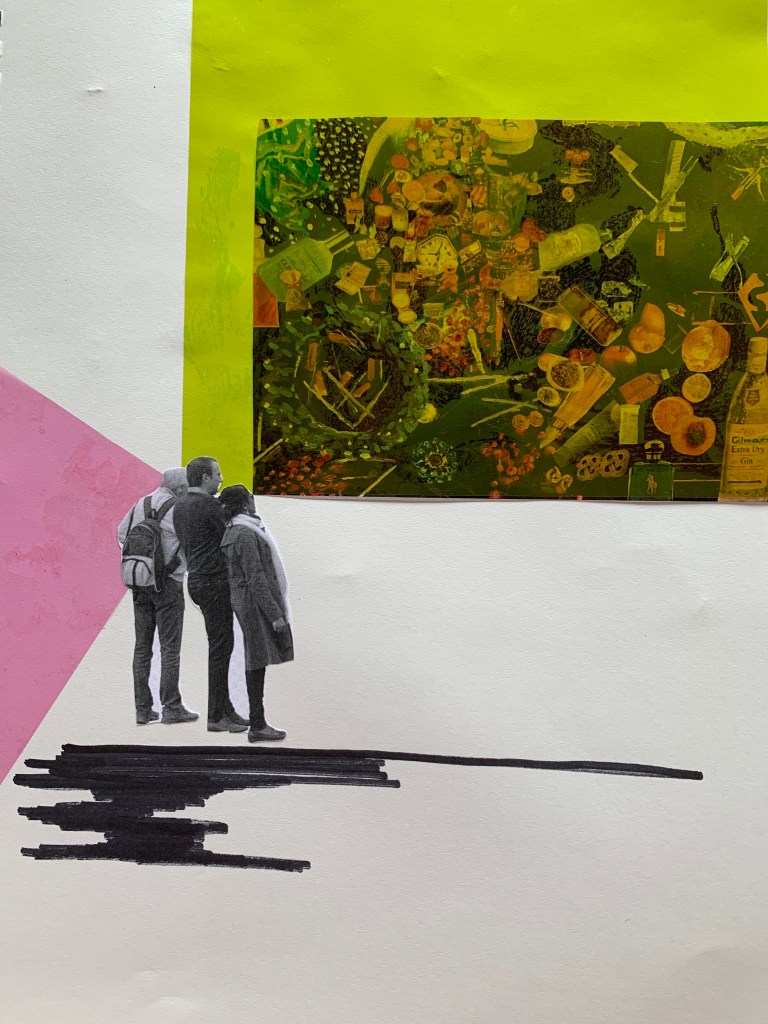
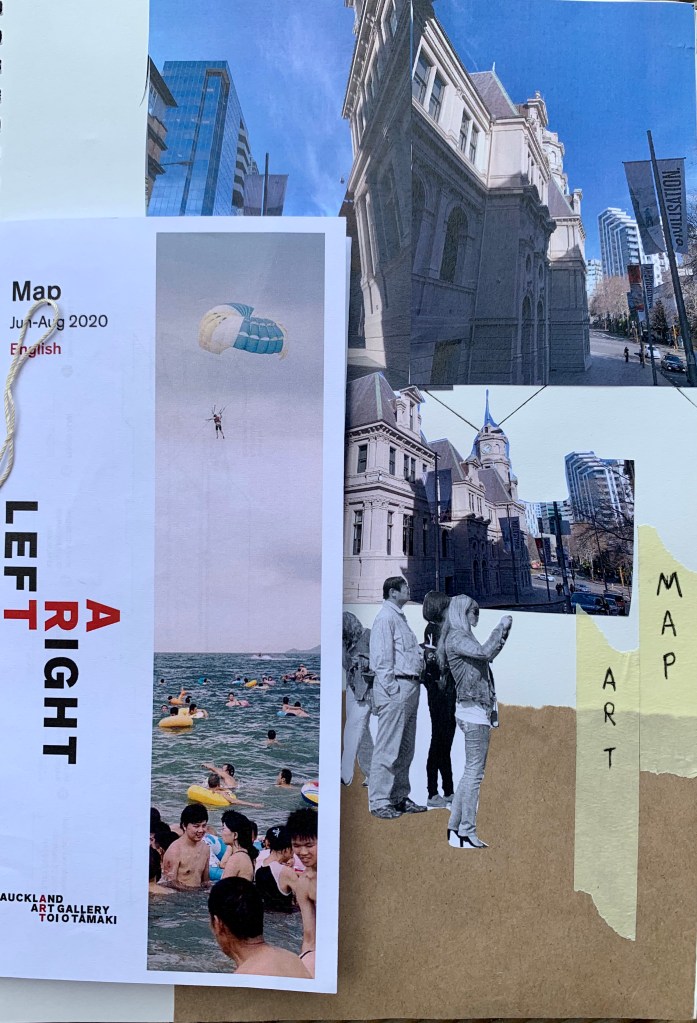
I choose Auckland Art Gallery as my social space. Auckland Art Gallery is the principal public gallery in Auckland, New Zealand. And has the most extensive collection of national and international art in New Zealand. It frequently hosts travelling international exhibitions. I choose to be an art student in high school, so I have been practicing drawing for eight years. Art is a very important part of my life. Also I often visit the different galleries. Auckland Art Gallery is a very representative gallery that is why I choose It. Another important reason is that I am attracted to the building itself. I would like to speed time to Understand this building. Many people visit the gallery every day and some people for works and some for take photo……etc. and all kinds of people gathered here. For me the gallery is a display space, providing a plat form for people to communicate and display.

Intuitive Map

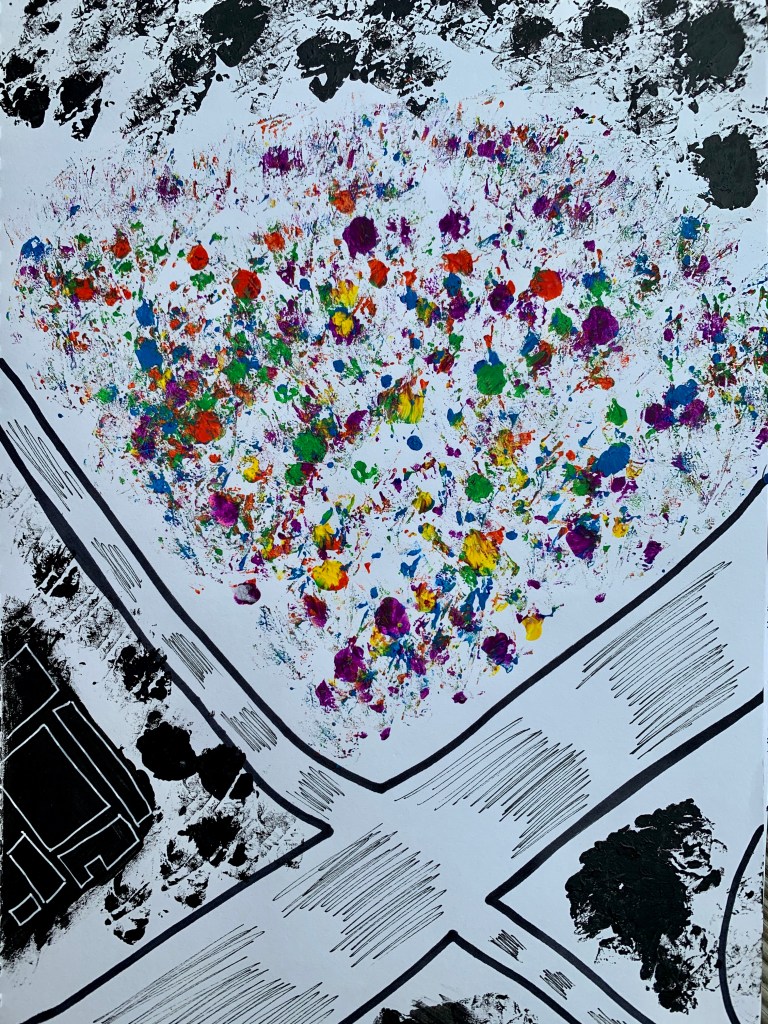
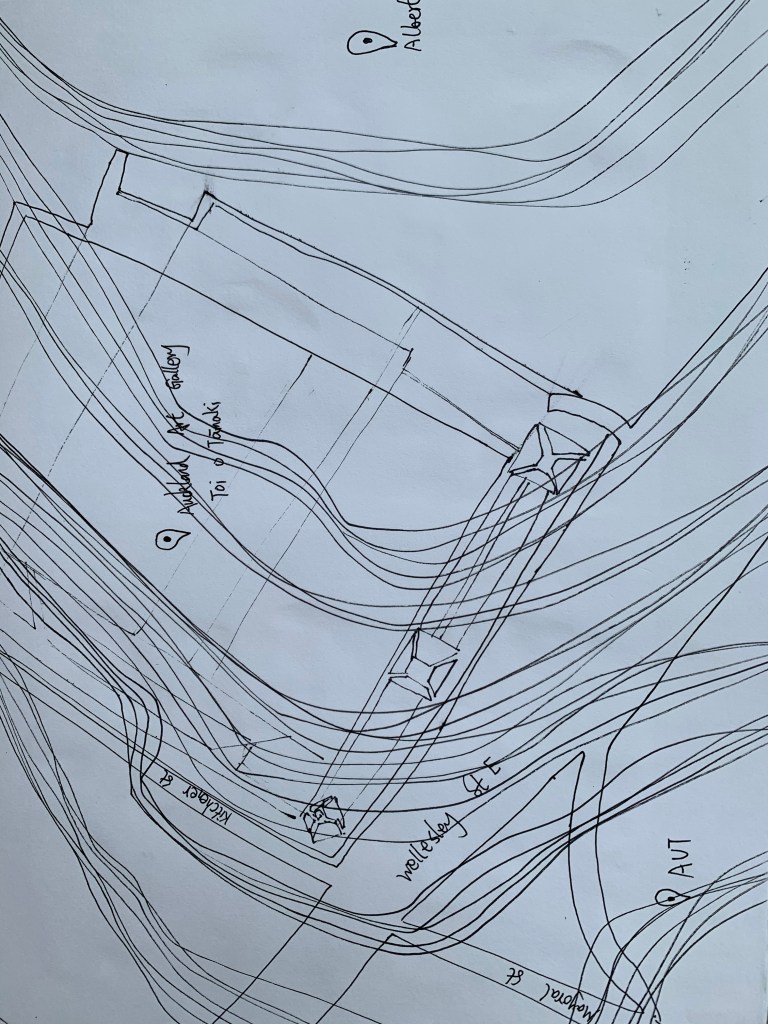
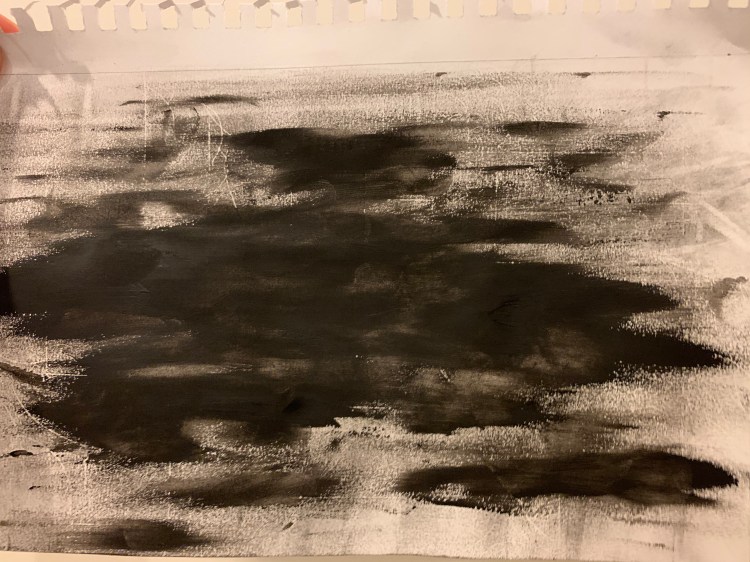
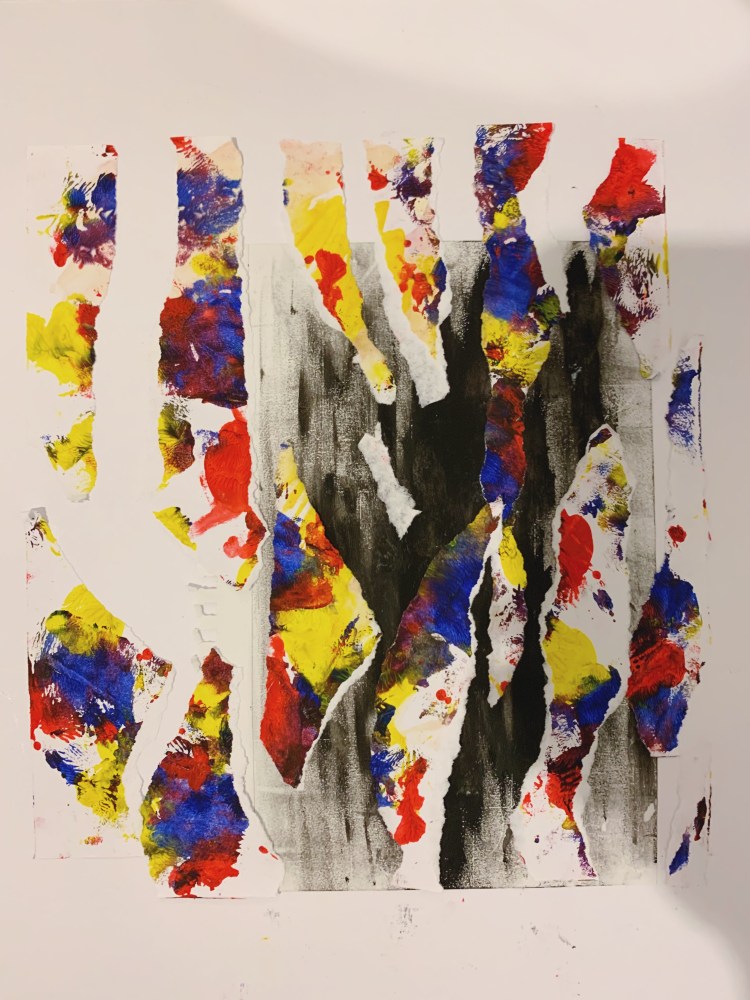
I use colours to explain my map. Different colours represent the various works in the gallery, the first impression of a work of art is always colourful. The back of the gallery is Albert park, the opposite of gallery is AUT and building. I use black to explain other places. Firstly I knead a piece of paper into a ball and then dipped black paint and pressed it on the map. Secondly I use white pencil to drawing the building. The is a wide main road and a side road crossing and the lines inside represent passing vehicles.

Feedback
Feedback

PART TWO

Interfering and Intervening

Why am I choosing the Auckland Art Gallery?

I think Auckland Art Gallery is the best space for art exchange. You will meet people of different identities in gallery. They all gather here because they love art.

What did I notice?

very stylish building and close to a beautiful park. Many people but all of different ages.

What does it mean to act-within the Auckland Art Gallery?

The building is managed by the municipal council, which means that is a key protected project. I must strictly follow the rules.

How will my intervention/interference affect other people?

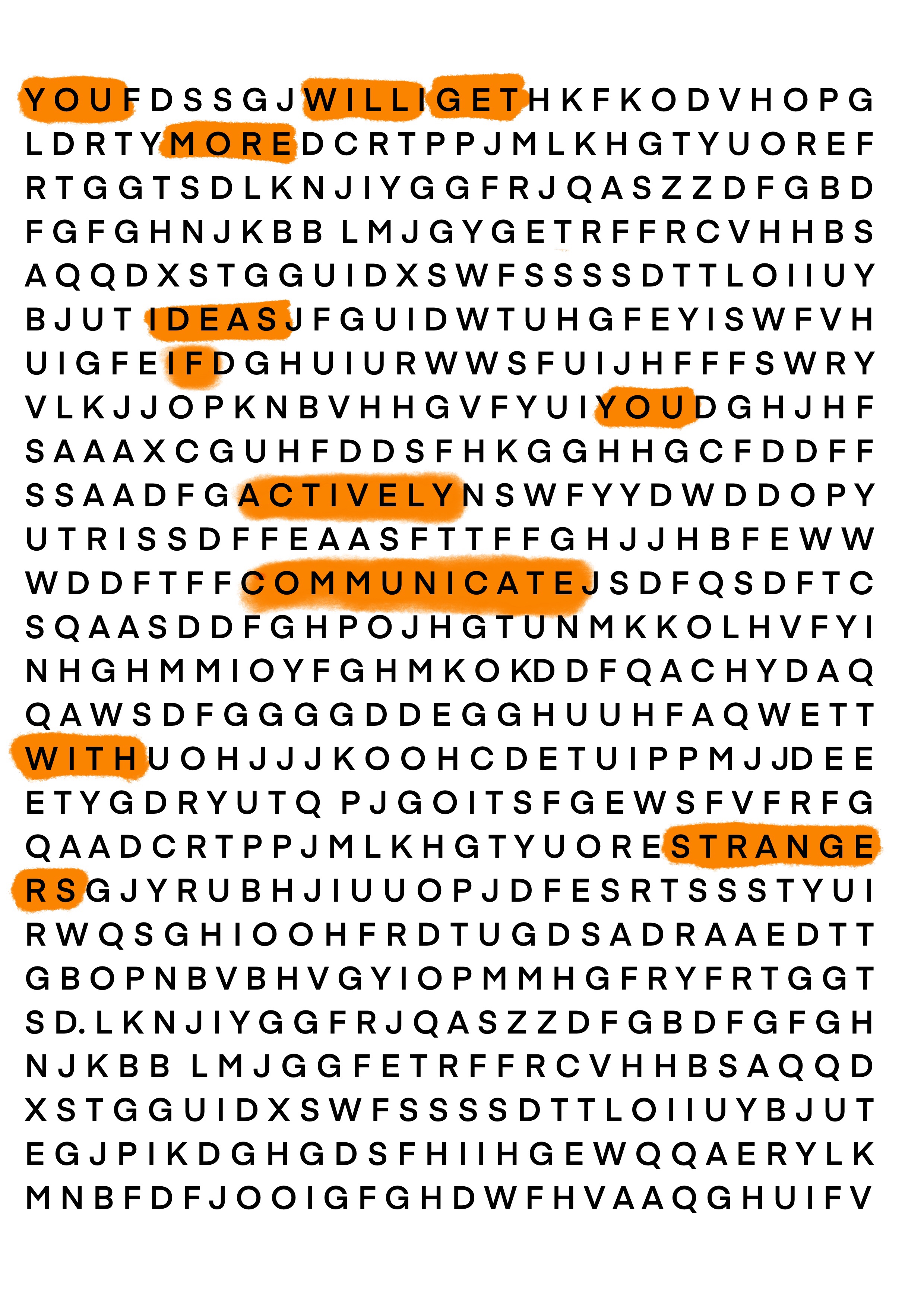
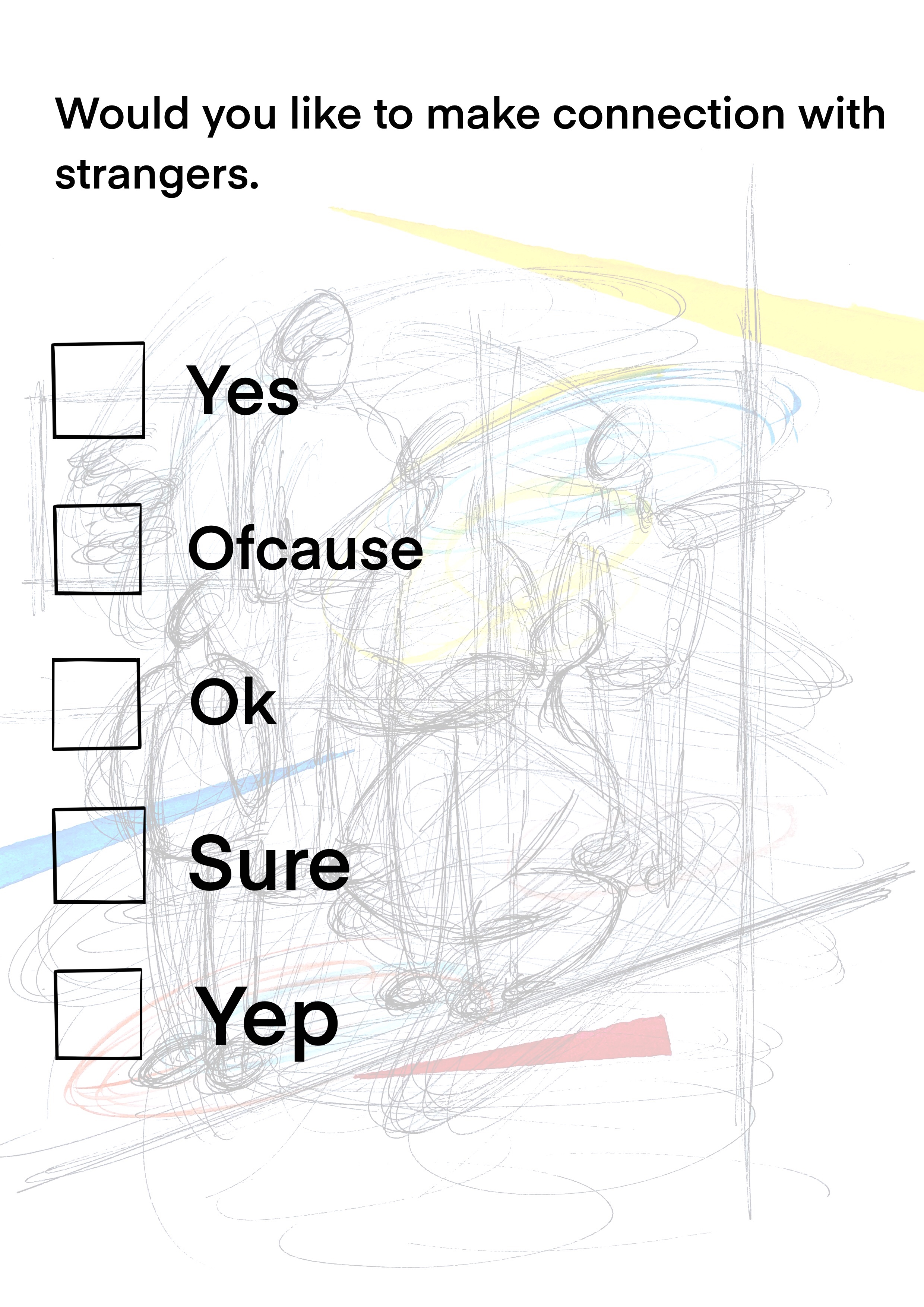
To a Certain extent, build relationships between people, hoping to establish communication between strangers through my intervention.

Proposal Research

Project Title: ALLOTTED BREAK(S)-Public Share

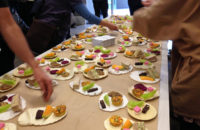
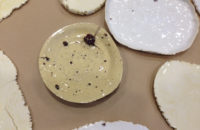
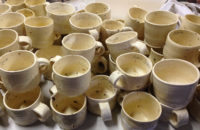
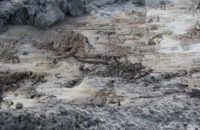
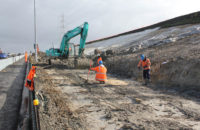
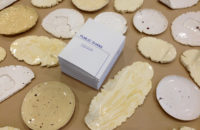
Held during the morning tea session at the Engaging Publics/Public Engagement symposium, Auckland Art Gallery, 13 September 2014. Using clay from Auckland’s SH16 Northwestern motorway construction site in Te Atatu, a series of plates were produced for the symposium, which were used to serve morning tea upon and for the 110 symposium participants to take away.

With this clay and working out of Kirsten’s pottery studio, we made a series of small plates used to serve morning tea at the Auckland Art Gallery Engaging Publics symposium on Saturday 13 September 2014 at 10.30am. These plates were gifted to the symposium participants. At the morning tea they chose a plate, shared in the food and took the plate away.

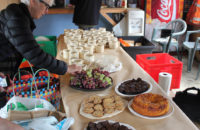
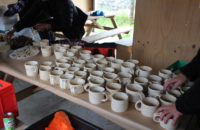
For the second part of the project we made mugs for a morning tea with 60 Fulton Hogan workers. This event took place on-site on Wednesday 29 October 2014 at 10am in the Te Atatu site break room.

In my opinion, this project is very interesting. It is divided into two parts. First, the participants join together to make teacups and other objects with clay. This part can be understood as a process of passive or active participation of the participants. Then the second part uses the prepared things to share the food. This process is the final presentation. These two parts can make participants feel the joy of their harvest after labour. I think they must have discussed some stories that happened during the project during the final sharing process. This is a process of sharing.

Project Title: Asamble

Growing up under a series of military dictatorships in Argentina, Amalia Pica later witnessed the restoration of democracy and the joys and difficulties that come with post-totalitarian attempts at collective grassroots organizing. Asamble (2015), like much of the artist’s work, examines how form determines the ways in which we come together. Initially performed outside of Argentina’s House of Congress in Plaza de los Dos Congresos, Buenos Aires, the piece continues this line of inquiry by exploring the circle as an ancient form of gathering; its title is a truncation of the Spanish word for “assemble.” Imagined for a public square or meeting place, the work features citizens of the place in which the performance is staged each carrying a chair brought from home. Although the individuals are assembled in a circular formation, their attempts to congregate are thwarted by the repetitious rhythm of the choreography. The result is a hypnotic meditation on the circle and its status as a universal emblem of assembly.

How form determines the way we are together is a great topic. This work aroused some thoughts. How will I bring strangers together? How will the form I show affect them? What kind of form would be better? In this project, the author asked participants to take a chair from their homes to join. So what should I ask the participants to participate in my project? Own text? story? Feel? and many more

Project Title: Total Trattoria

7 Mar – 26 Apr 2008
The Aram Gallery, London, Uk

The Aram Gallery has commissioned London-based designer Martino Gamper to create Total Trattoria – the ultimate expression of his Trattoria al Cappello concept.

Developing further his idea, Total Trattoria, which opened on 7 March 2008, completes the concept and puts it on show to the public for the first time.

Gamper has designed every single element of the dining event ranging from the kitchen and its storage areas to the cutlery and the tables and chairs to the glassware. A series of thirteen individual tables that connect to form one large dining table snakes around the gallery to seat 25 guests. The 25 chairs around the table are all different but are constructed from the same set of component parts, designed by Gamper.

The pieces include the results of many collaborations between Gamper and a wide variety of makers including engraved glasses placed on clusters of leather coasters, blown-glass water jugs and limited edition placemats designed by Gamper’s collaborators in the Trattoria events, Maki Suzuki, Alex Rich and Kajsa Stahl.

The exhibition graphics and communication, also designed by Suzuki, Rich and Stahl, includes a specially designed catalogue. 

This project combines many different items, and what effect this will have is unknown. Putting this mode of thinking into my project, what kind of reaction will I have when I bring together many different strangers? How to connect strangers in my way.

https://www.martinogamper.com/project/total-trattoria/

Project Title: Indigestion

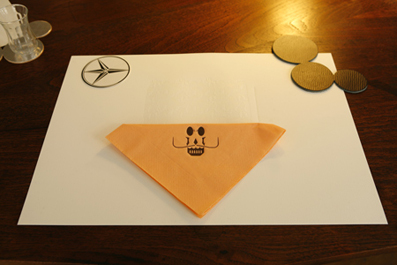
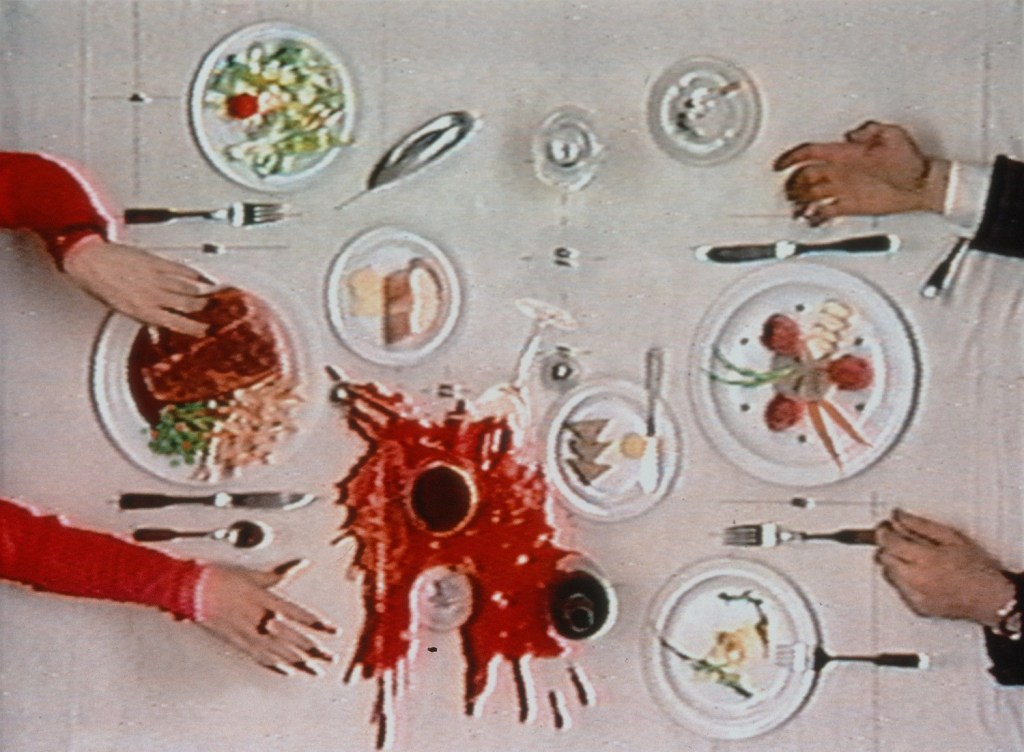
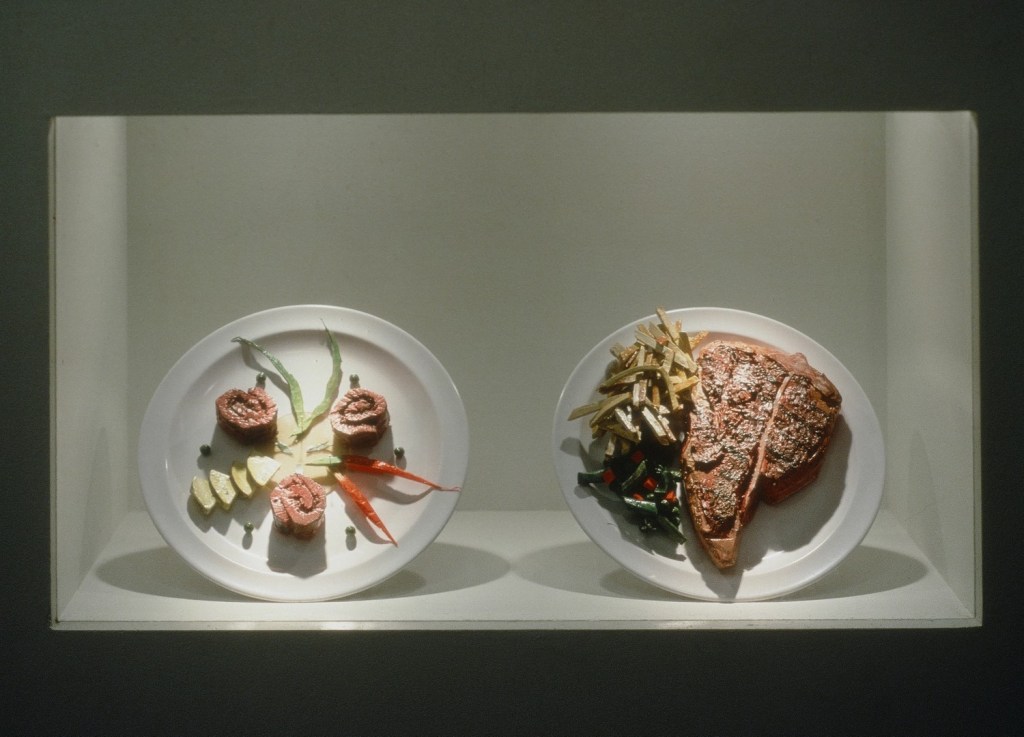
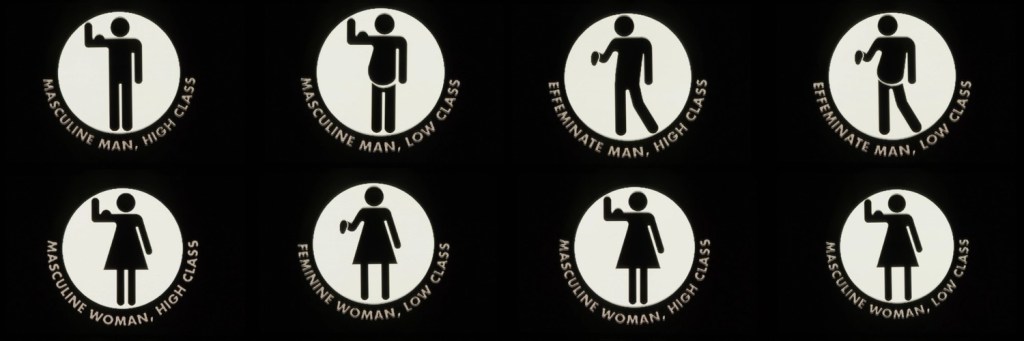
The interactive media installation intersects two electronically linked modes: an interactive video and a virtual environment. The video consists of a dining scene projected onto a horizontal screen/dinner table that a viewer can join as a guest. An archetypal film noire narrative is played out between two characters of ambiguous relation seated at the table; only their hands enter the screen. An adjacent touch screen offers the viewer a choice of characters from a variety of gender and class stereotypes. The viewer can change dining partners mid-conversation and, while the narrative always moves in the same direction, the multiple branching dialogues are nuanced by each combination of characters. In an adjacent space, a participant using a Polhemus motion-sensing device can navigate in real time through the computer-generated, magnified space of the same dinner table. The image is split onto two large screens on opposite sides of the room and seen in 3-D. The mobile and magnified viewpoint across this mega-landscape reveals a micro-drama played out in the details. The technologies of each room work in tandem to produce multi-layered information. ‘Choice’ is offered to lure the subject into an interrogation of the democratic aspirations of interactive technologies and critique reductive binaries such as masculine/ feminine, high class/low class, fact/fiction, and real/ virtual. The script is by Douglas Cooper.

I prefer the presentation form for this project. Normally, when we want to actively join a project in space, we first need to be interested in the project and willing to take the initiative to understand it. If the presentation of the project is too ordinary, then onlookers will not want to join, because they have already Saw the ending. If the presentation format is very special, there will be many people willing to join because they also want to see what interesting stories will happen in the end.

https://dsrny.com/project/indigestion

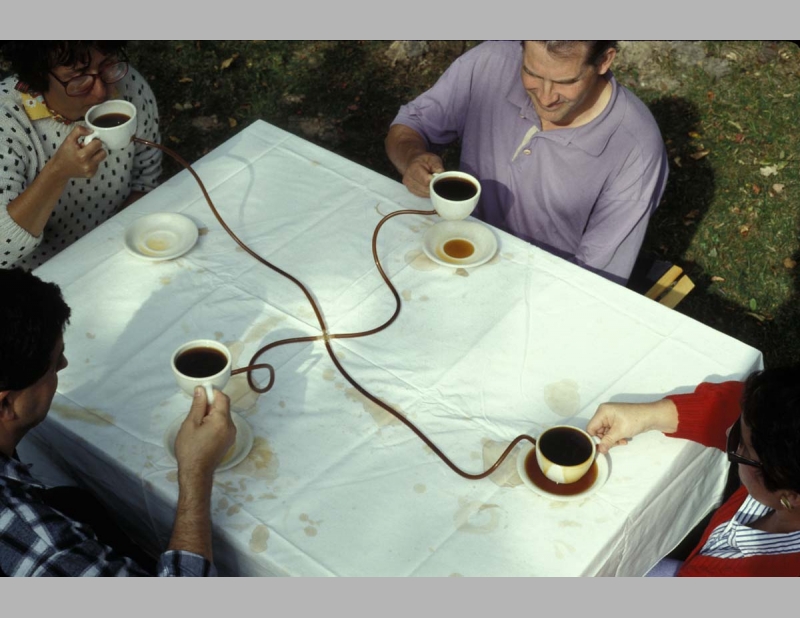
Project Title: Coffee Seeks Its Own Level    1990

Coffee Seeks its Own Level was inspired by the principle “water seeks its own level”. I had been working on a series of projects using basic scientific principles learned in high school as a means to explore architectural issues.    

Coffee Seeks its Own Level choreographs group dynamics. If one person alone lifts his cup, coffee overflows the other three cups. All four people need to coordinate their actions and lift simultaneously.

This device is very interesting. Participants must work together in one direction to drink it. This is a passive process. It requires participants to work together, communicate together, and have the same goals.

http://www.allanwexlerstudio.com/projects/coffee-seeks-its-own-level

Social Spaces Research
Auckland Art Gallery

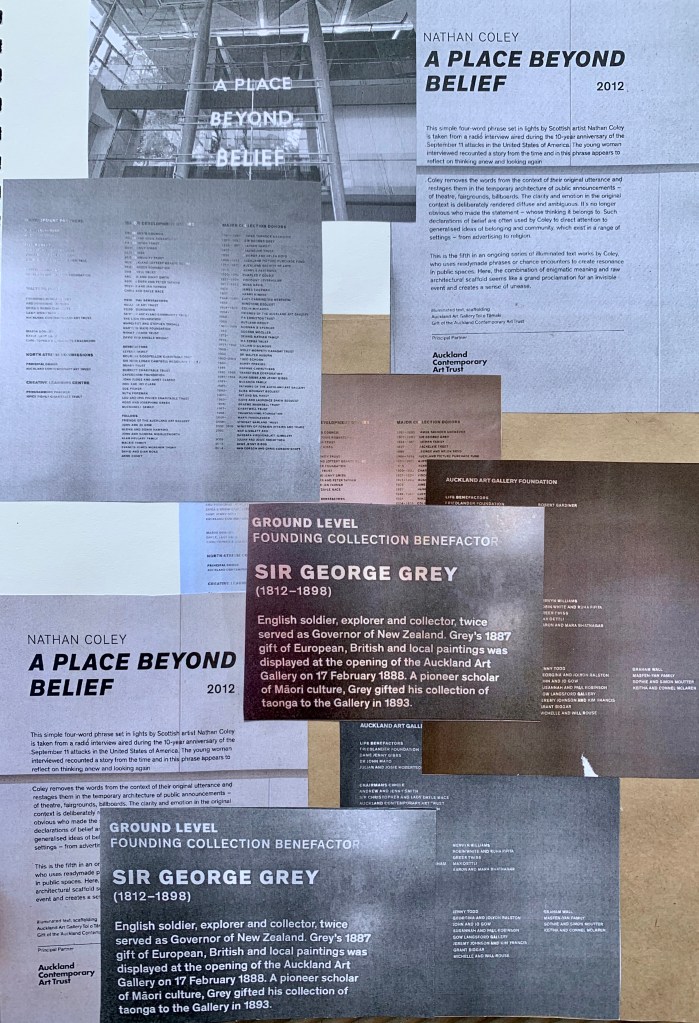
The Gallery’s doors opened for the first time on Friday 17 February 1888. Sir George Grey’s gift formed the core of the early collection, and we shared the building with Auckland’s Free Public Library. From these beginnings focussing on European and British art, we now have more than 17,000 works in the collection, and our redeveloped building provides purpose-built spaces for regularly changing exhibitions.

Auckland Art Gallery has grown its collection of artworks with acquisitions, gifts, bequests and long-term loans. Major collection donors have included James Mackelvie, who with Sir George Grey was a founding patron, and in the present day, the Chartwell Trust and Julian and Josie Robertson.

The collection includes major holdings of New Zealand historic, modern and contemporary art. These artworks plot a visual history of New Zealand, beginning with the first contact between Māori and European explorers in the 1600s. Outstanding works by Māori and Pacific Island artists are a powerful feature of our holdings, and the international painting, sculpture and print collections connect us with the world beyond the Pacific. The diversity of mediums and artistic practices in the collection also continues to grow. Our oldest work of art is a sandstone figure from the walls of a Hindu temple in North India. It dates from the 10th–12th century. And our newest is likely to be a commissioned artwork we are creating with an artist right now. Taken together, our holdings are widely considered to comprise New Zealand’s pre-eminent public art collection.

How will develop my project?

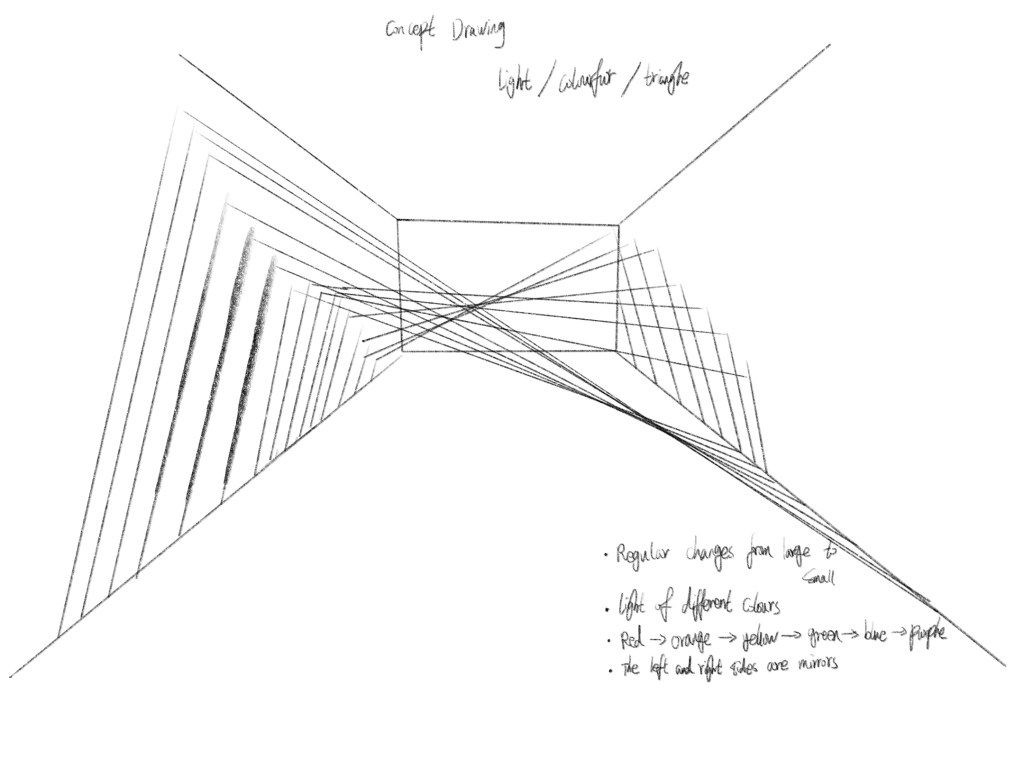
After the part one, I got some feedback from classmates and teachers and I also did self-reflection. In general, I should try more possibilities to show my understanding of social space. Second, explain my work in the form of words, which may make the viewer more aware of my thoughts. In part two, I still choose Auckland Art Gallery as my social space. When I visited this space for the first time, I felt the charm of this space, and I want to make this space more vivid through my intervention.

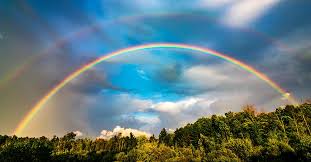
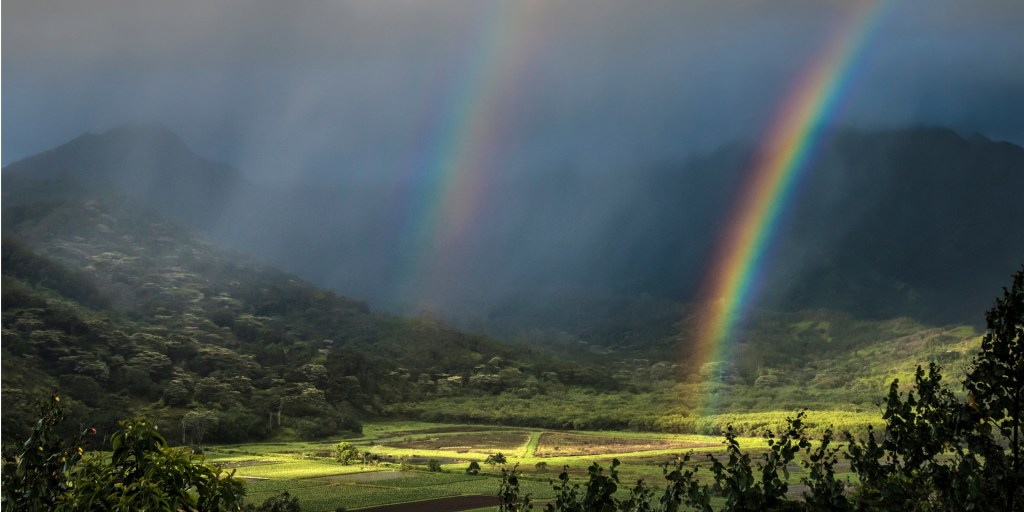
In second part, I will use art installation to complete my work. In this way, the colours of nature are brought into the gallery. Develop with the three natural phenomena of aurora, rainbow and aperture. Because these natural phenomena cannot be seen everywhere. These phenomena are kept in the gallery for a short time through artistic means, not through photos but more personal experience. When I fist conceived this part, I through of expressing it in ways such as smell and sound, etc. But in the end I decided to create a realistic scene to achieve my idea, because when a person is in a certain scene, the brain will show the sounds, smells, etc. heard in this scene. For example, when you think of cafes, you will think of loud discussions, the smell of coffee. So I think it’s a good choice to create a scene for personal experience. In the fourth and fifth proposals, create human-to-human communication and human with space communication through interference. I will use the lazy sofa and post-it wall message to achieve my goal. Create a platform for people to communicate in the gallery.

5 proposal (draft)
Feedback/thoughts after 1:1

When I finished a one-on-one conversation with Rachel, I found a serious problem. My intervention cannot be completed in the gallery. it can only be done outside the gallery. I will consider my intervention done in the external environment and combine with the surrounding environment such as park, street, etc. All in all, many external factors are ignored by me, which brings a lot of difficulties to my work. I will readjust my intervention plan.

Week 7

Statement (Draft)

My social space is Auckland Art Gallery. After the part one, I got some feedback from classmates and teachers and I also did self-reflection. In general, I should try more possibilities to show my understanding of social space. Second, explain my work in the form of words, which may make the viewer more aware of my thoughts. In part two, I still choose Auckland Art Gallery as my social space. When I visited this space for the first time, I felt the charm of this space, and I want to make this space more vivid through my intervention.

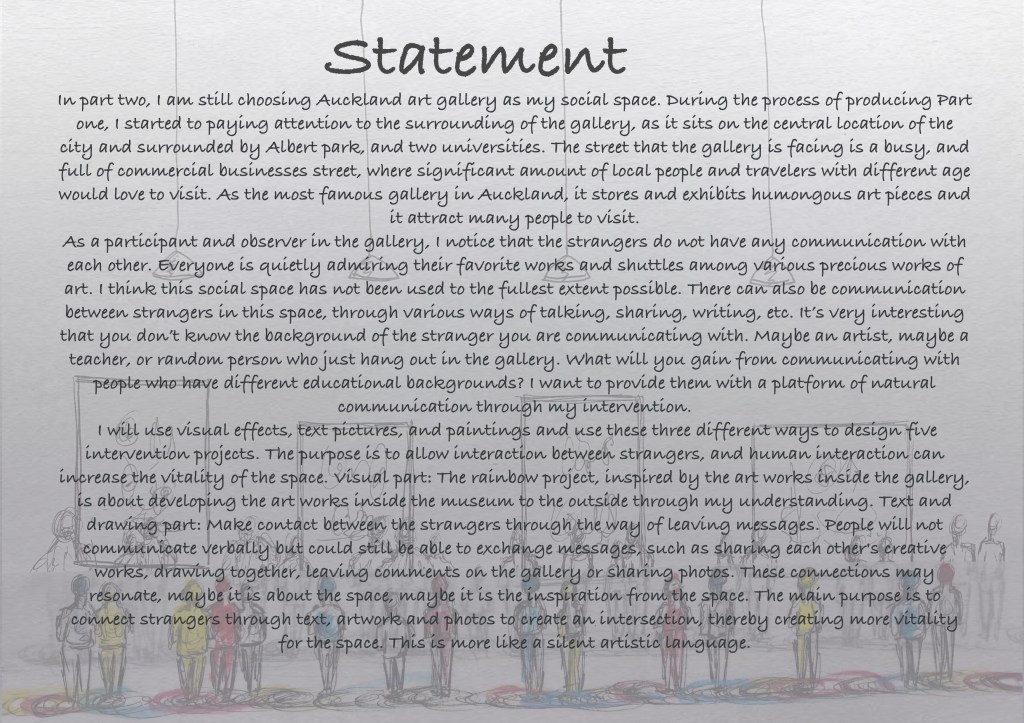
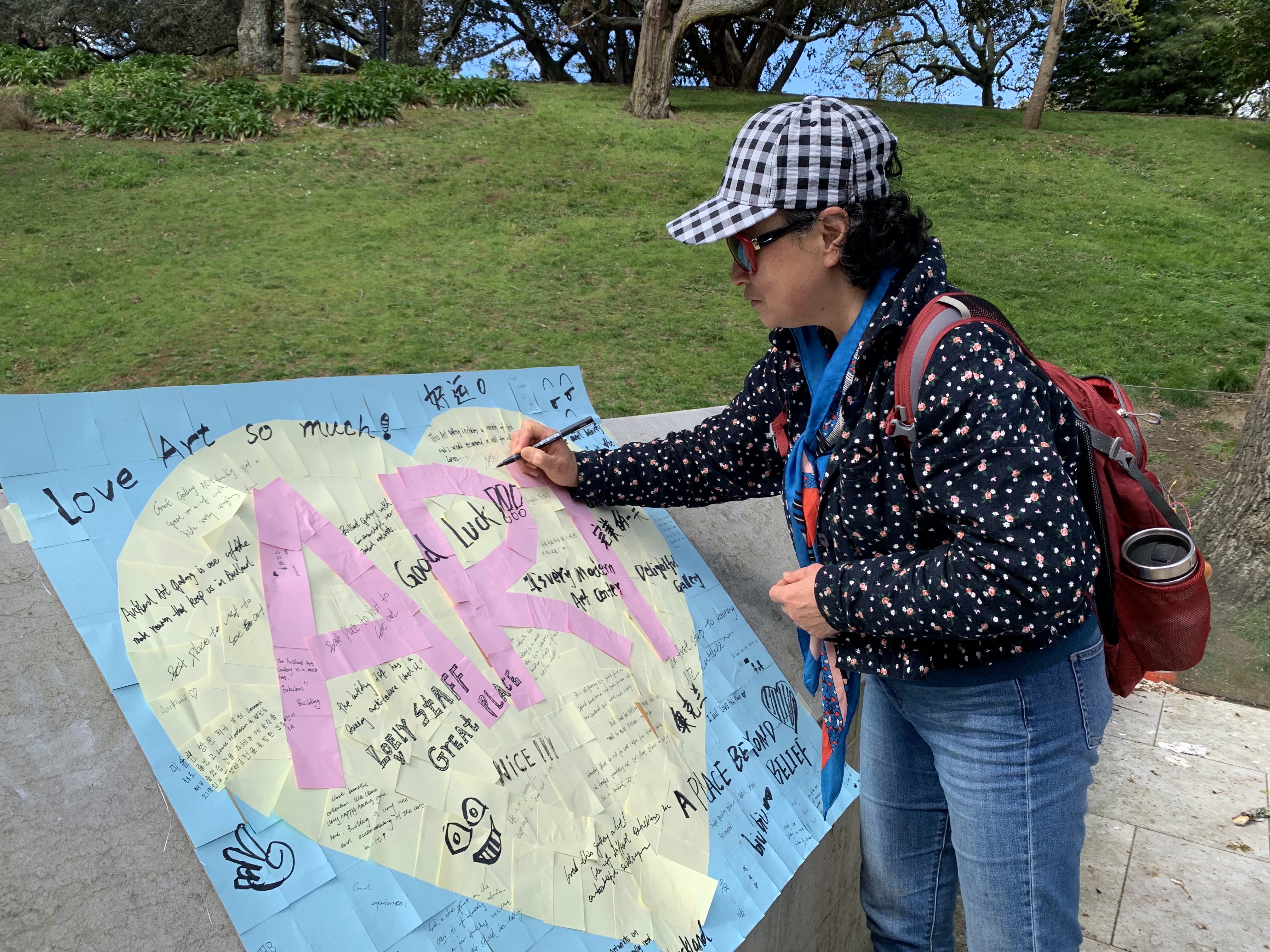
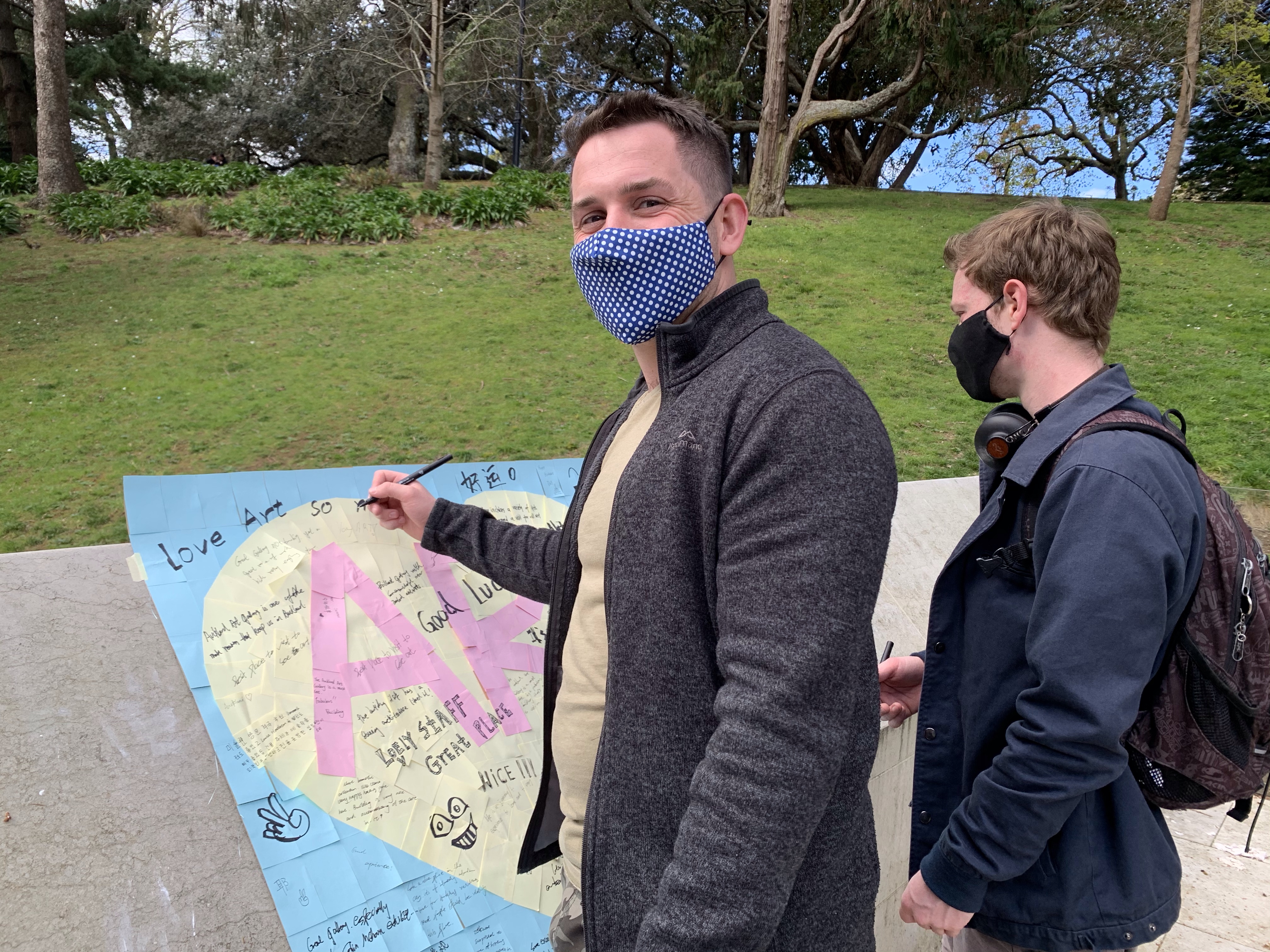
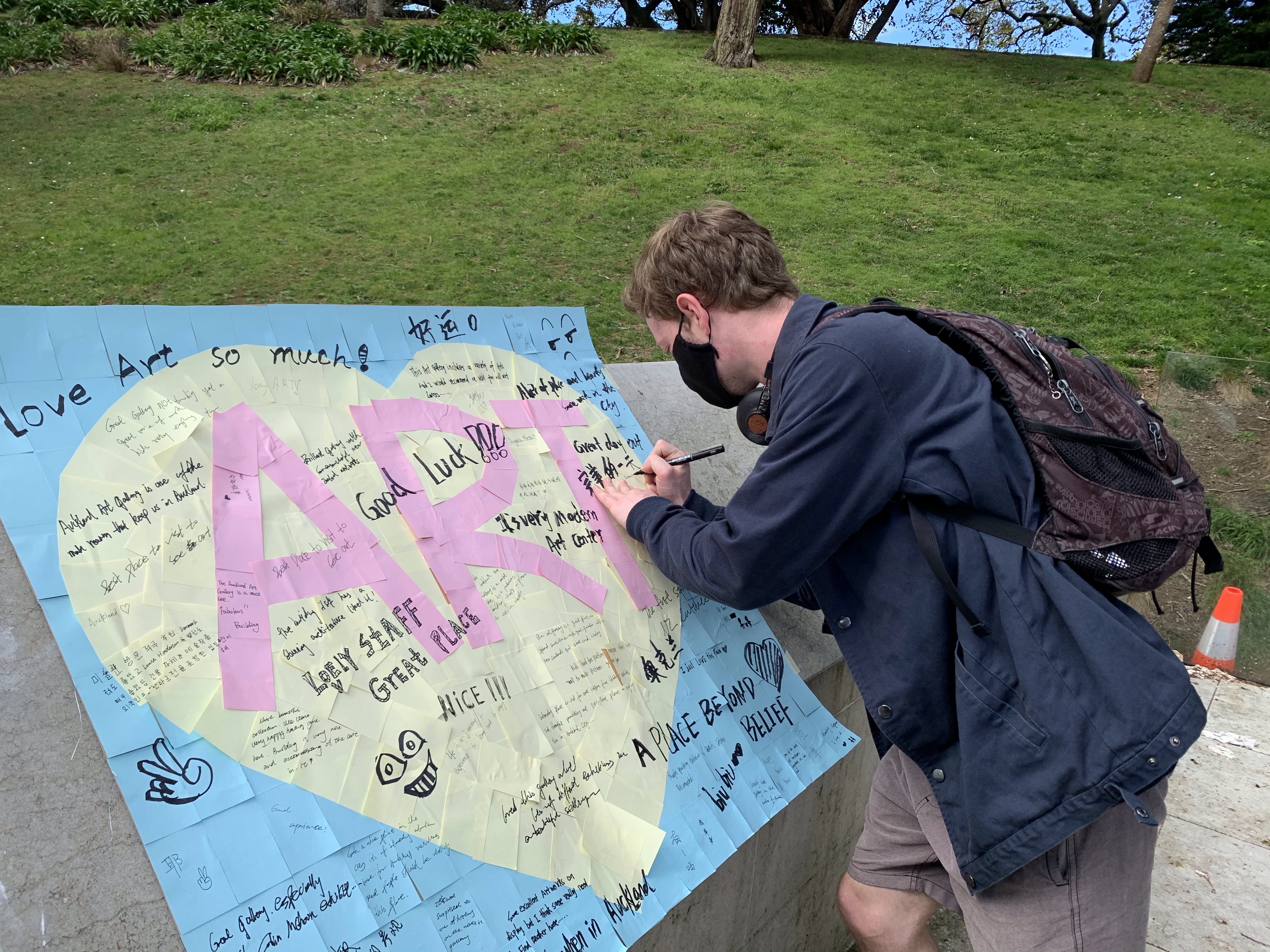
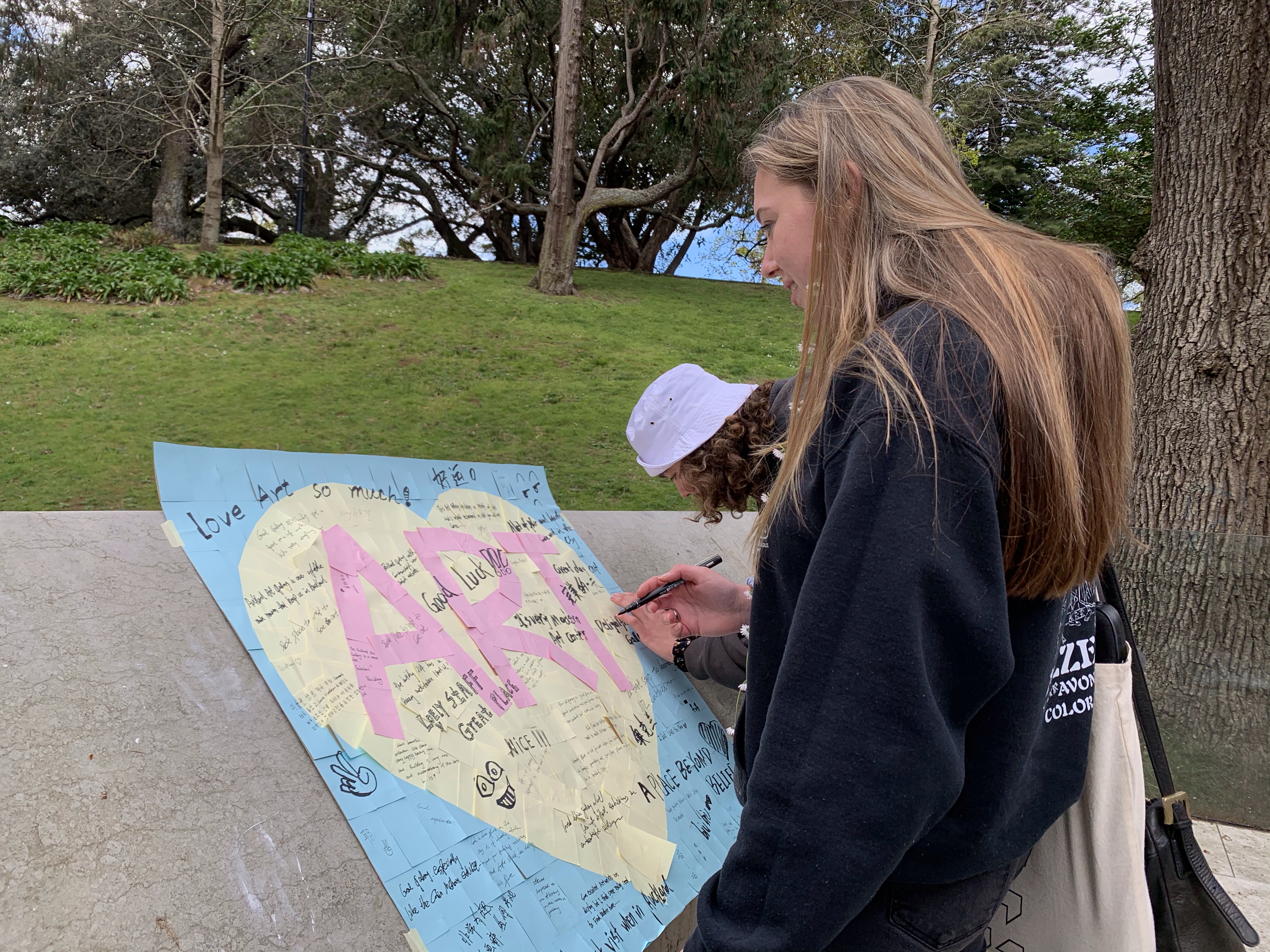
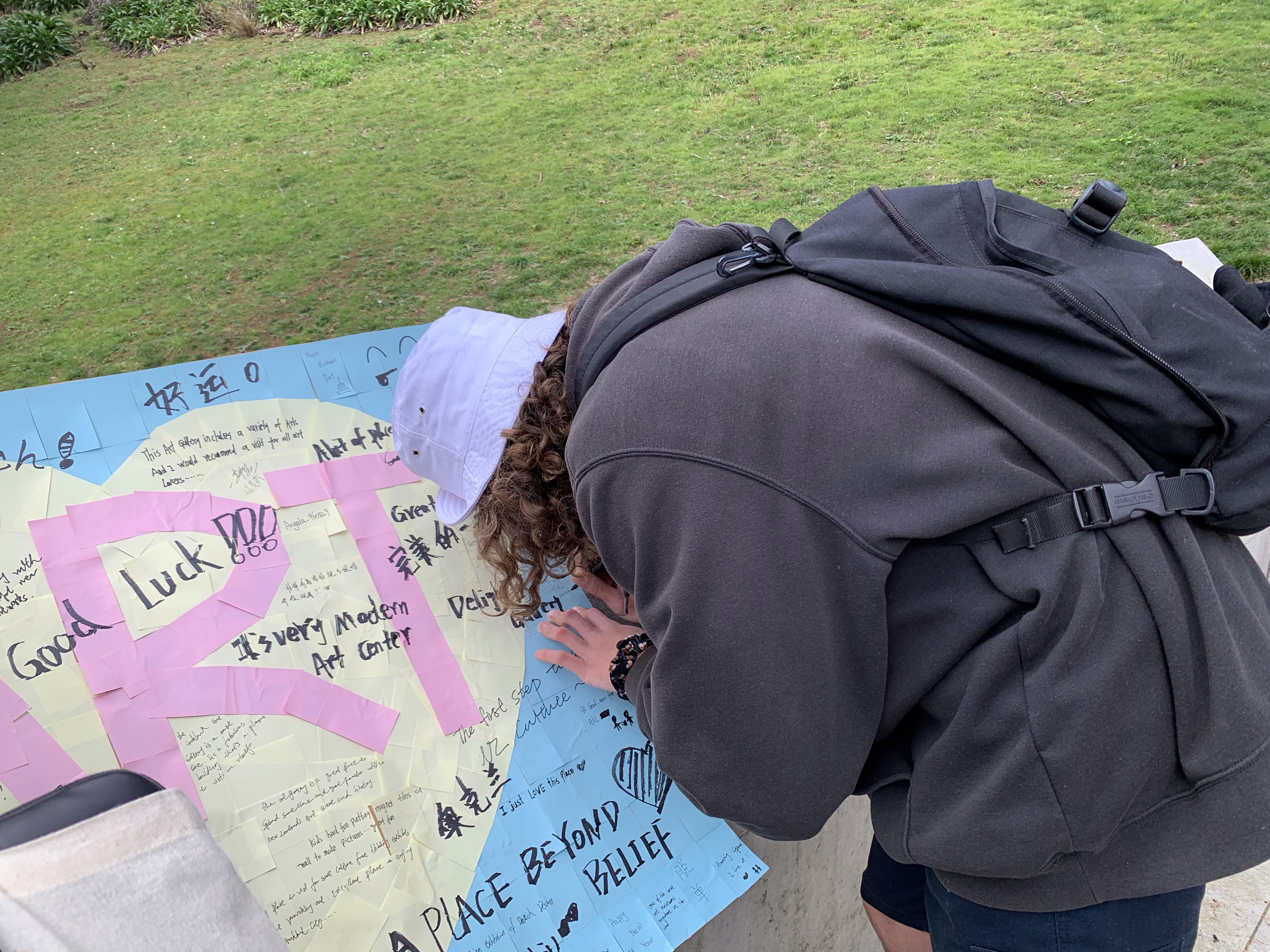
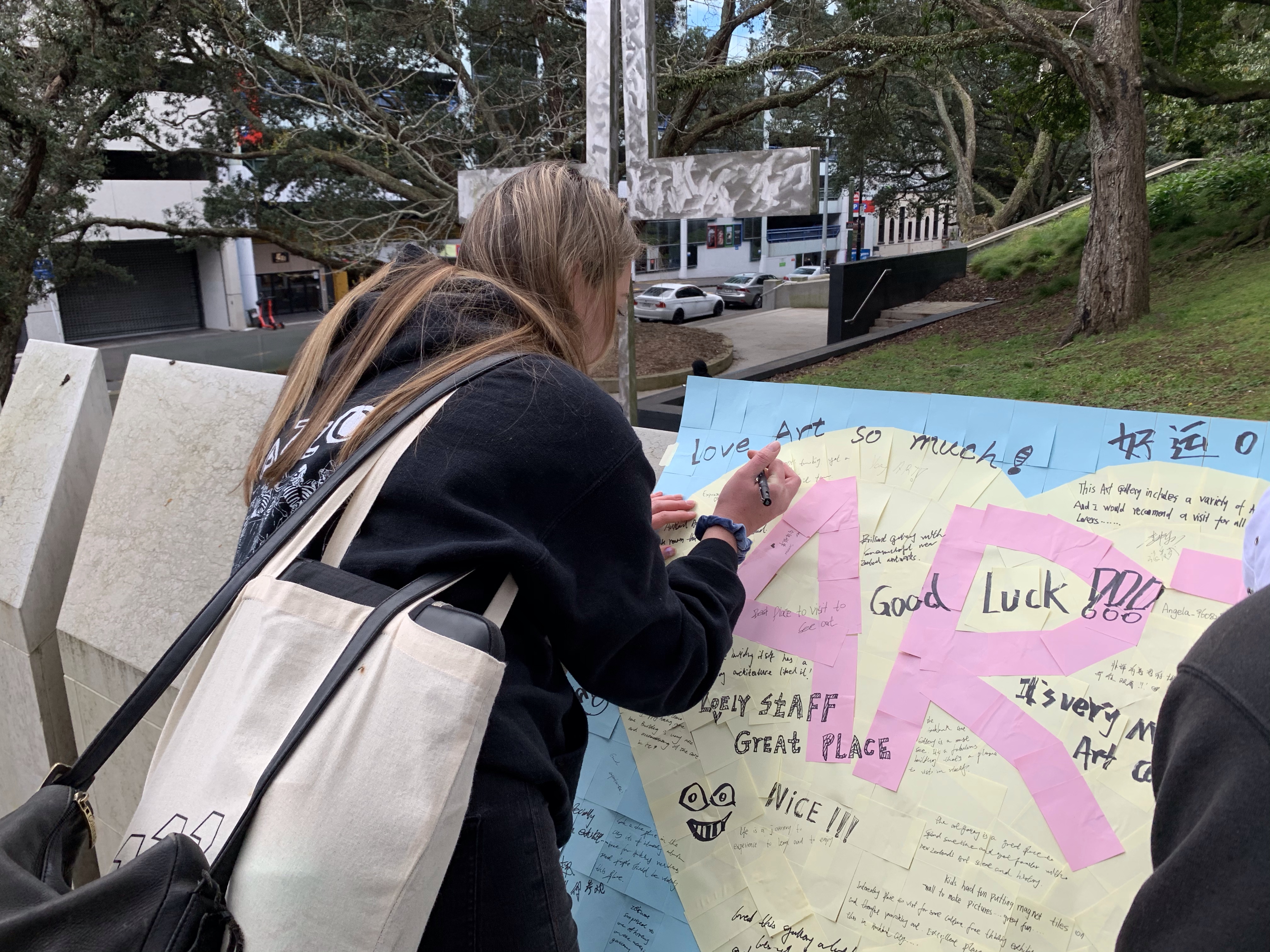
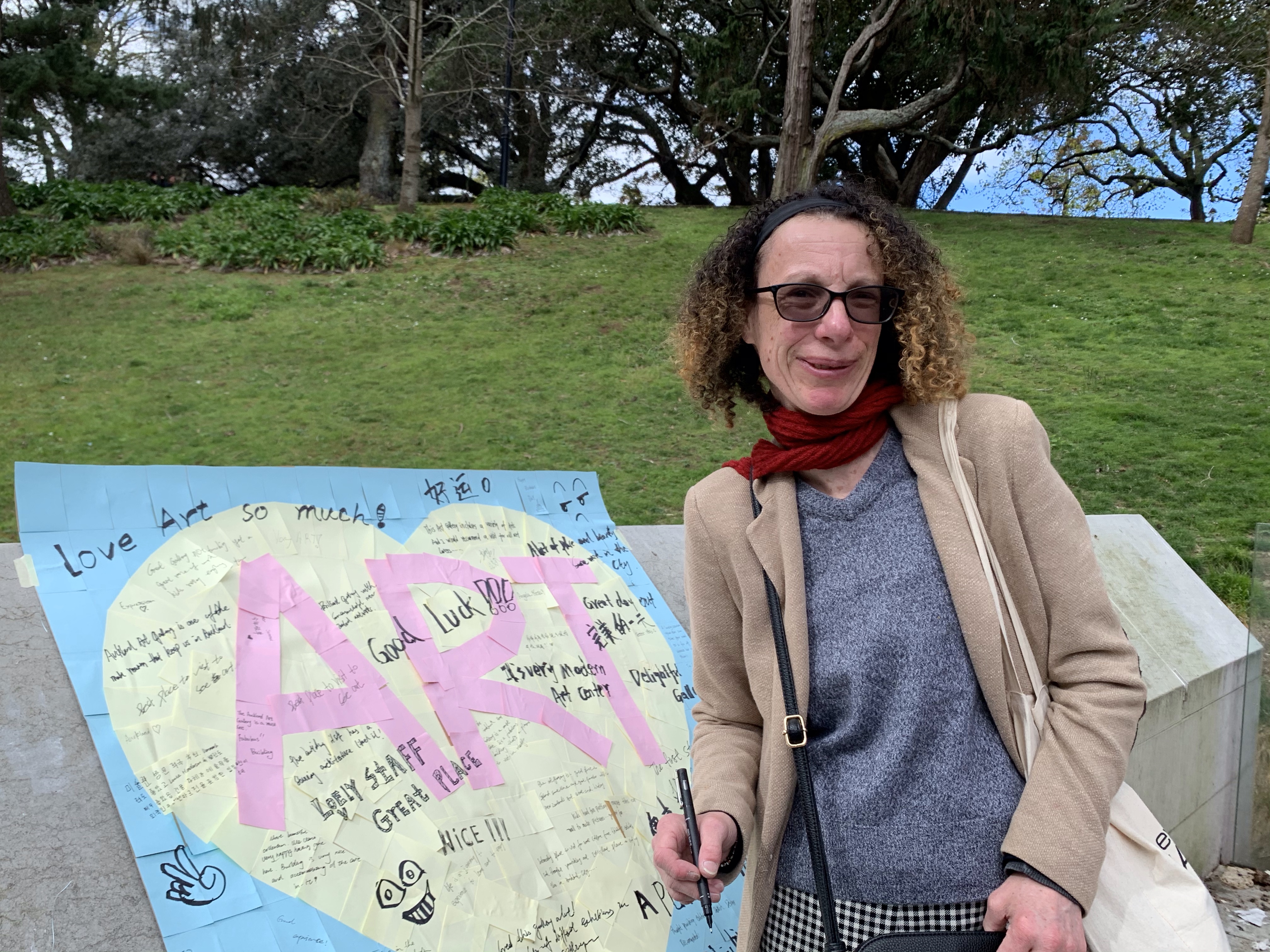
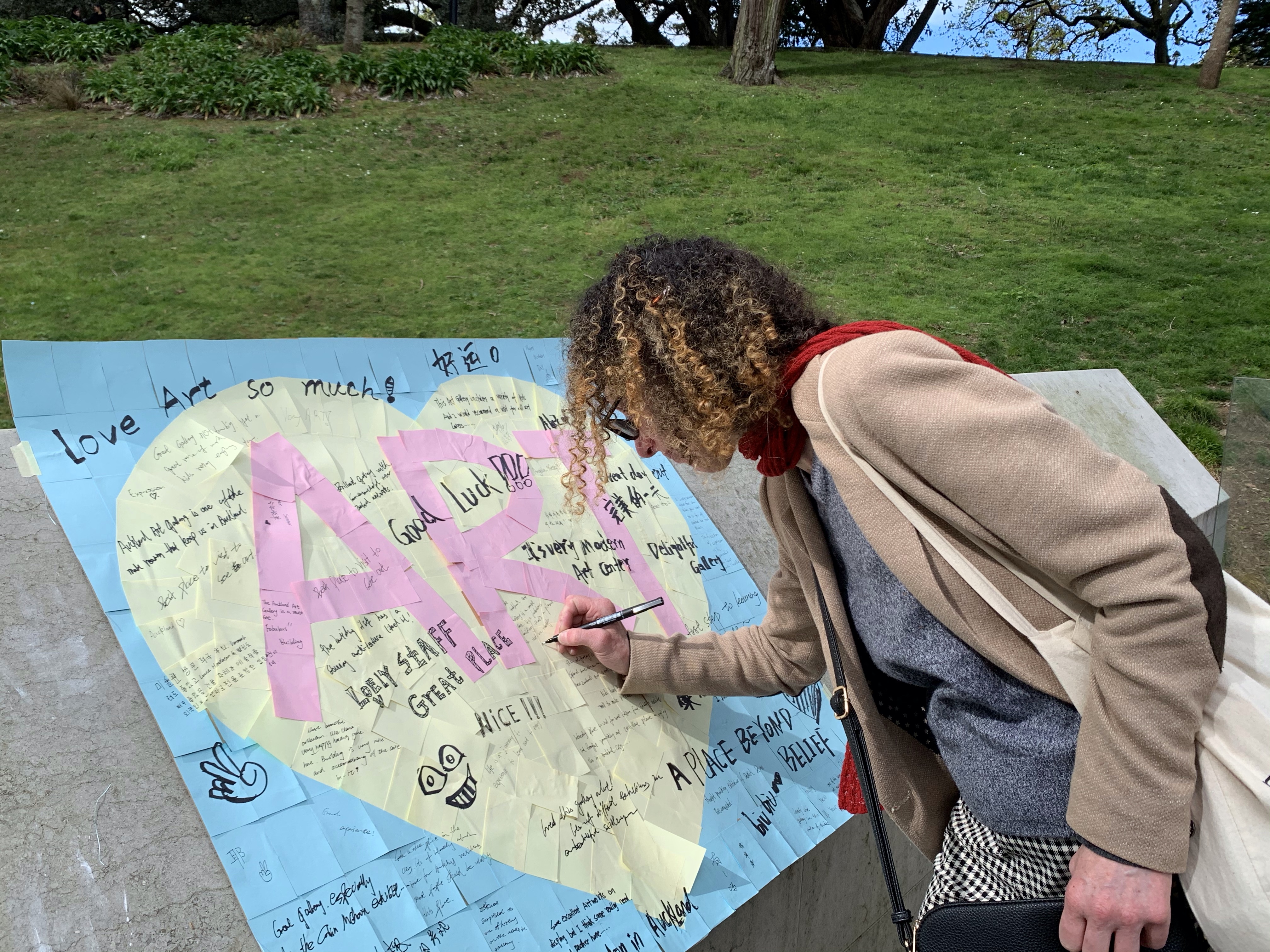
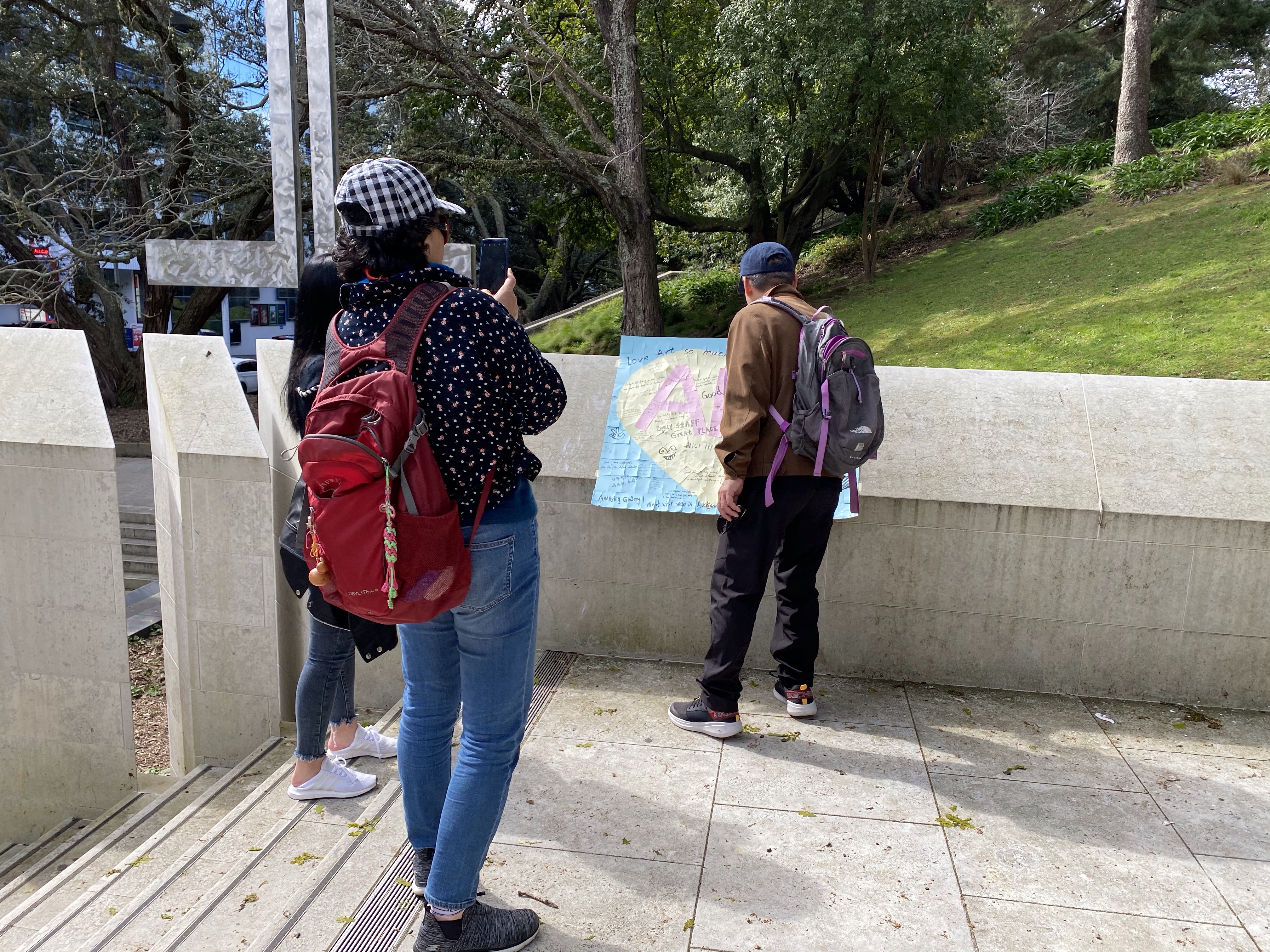
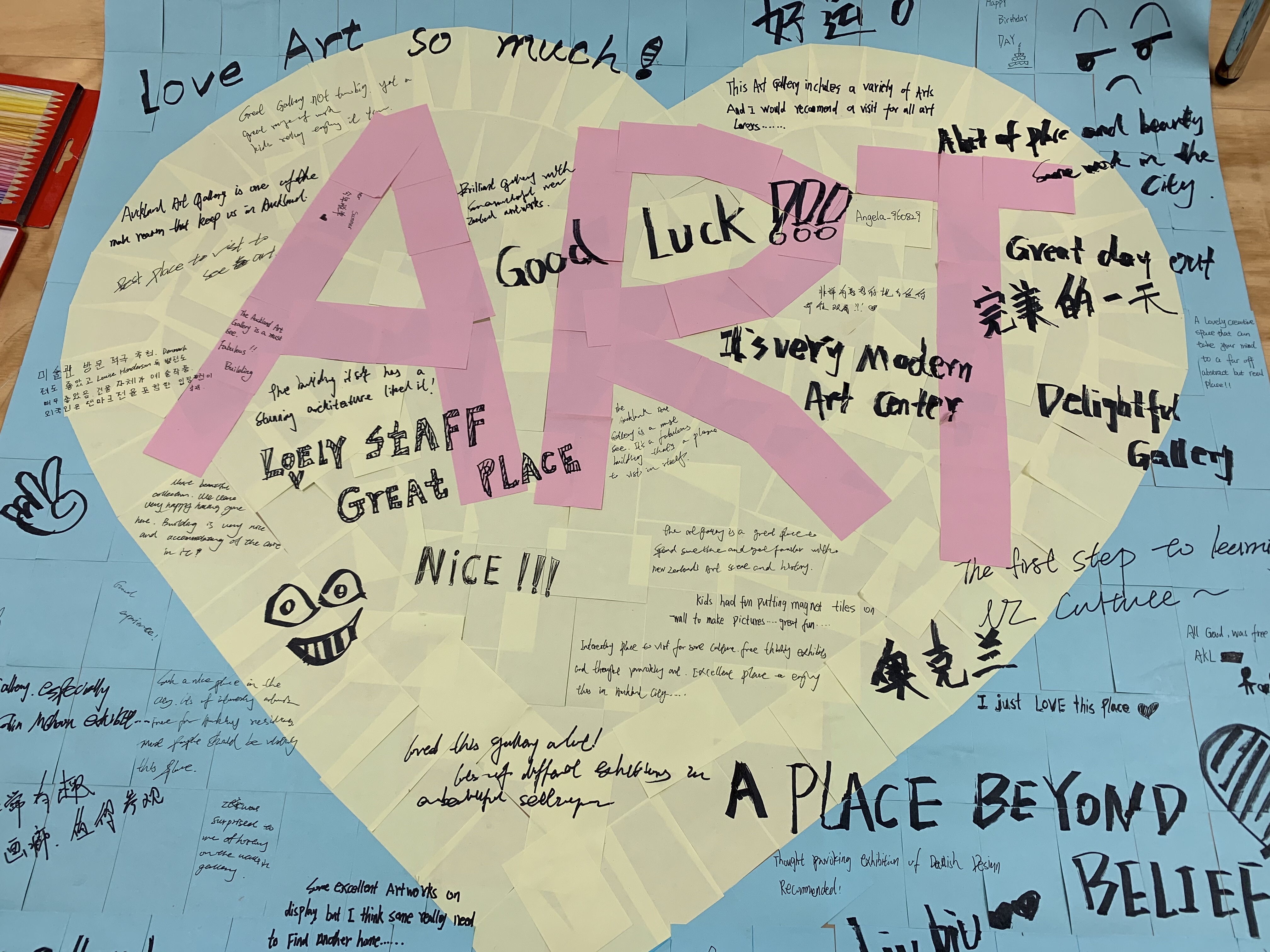
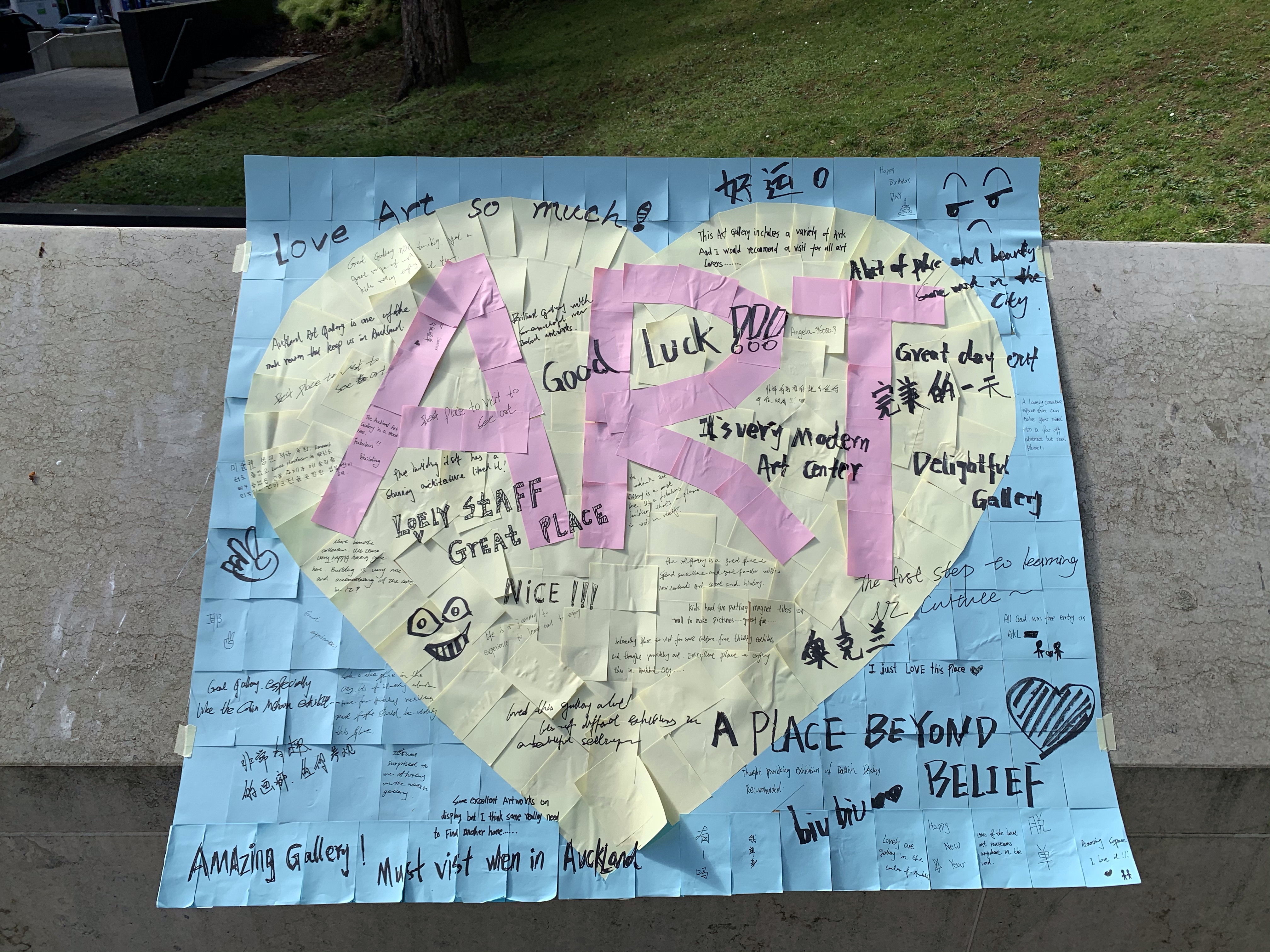
As a participant and intervener in this space, I noticed that is no communication and interaction between strangers. I will set up some projects to intervene in this problem. Make contact between strangers and all interventions will connect the people in the internal space with the external space. Make contact with people in the space by leaving messages, but people will not talk verbally but let more people communicate through message. For example, sharing each other’s creative works, stranger’s comments or photos for the gallery, and post-it wall. This connection may resonate with each other, maybe it’s about or this space. The main purpose is to connect strangers together through text, art, and photos to create more vitality for this space. This is more like a silent artistic language.

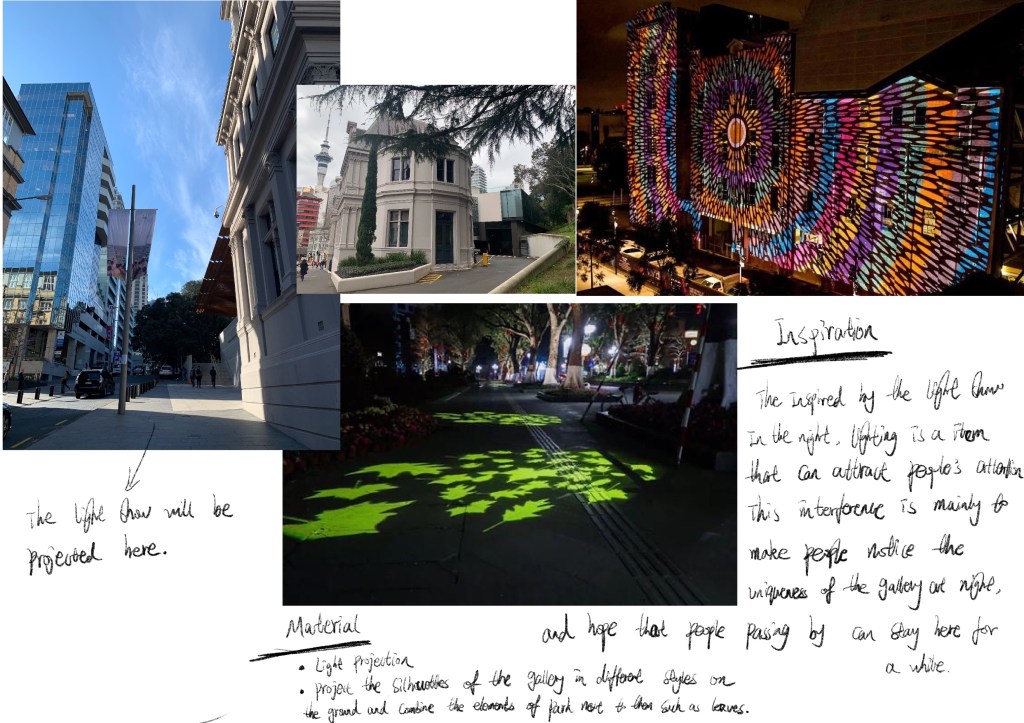
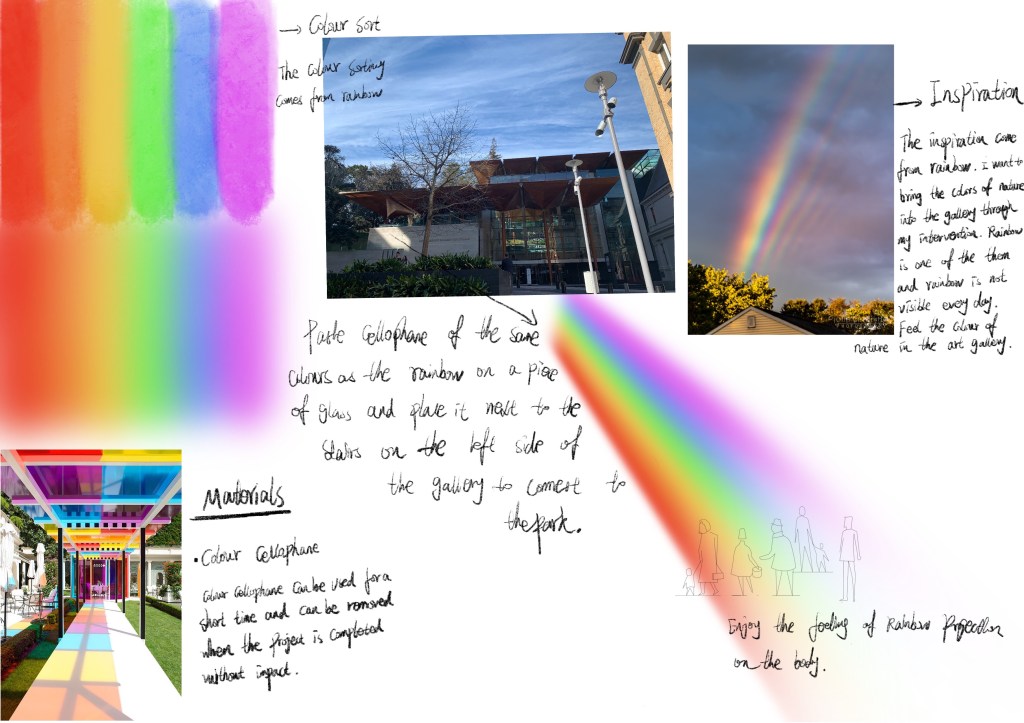
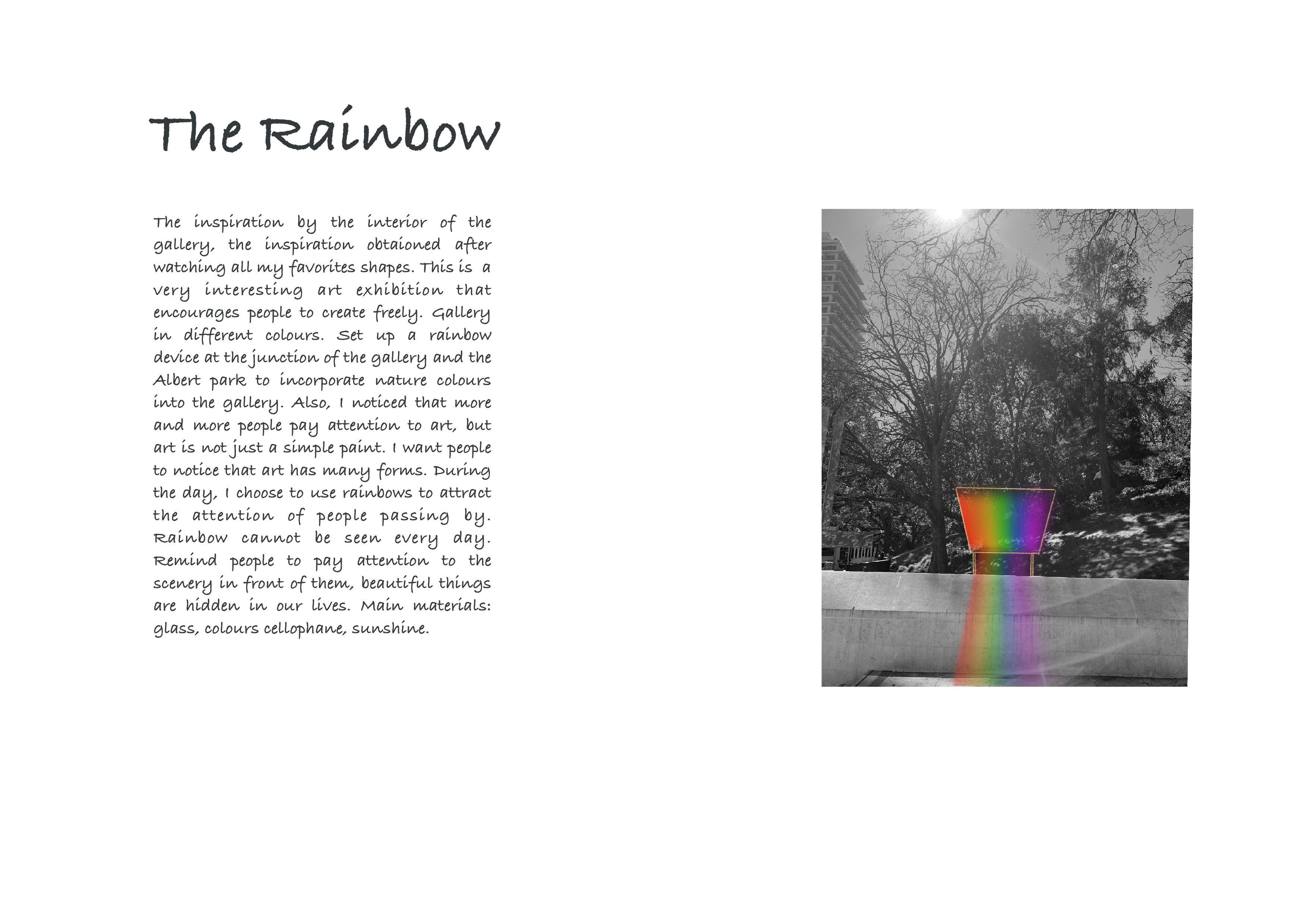
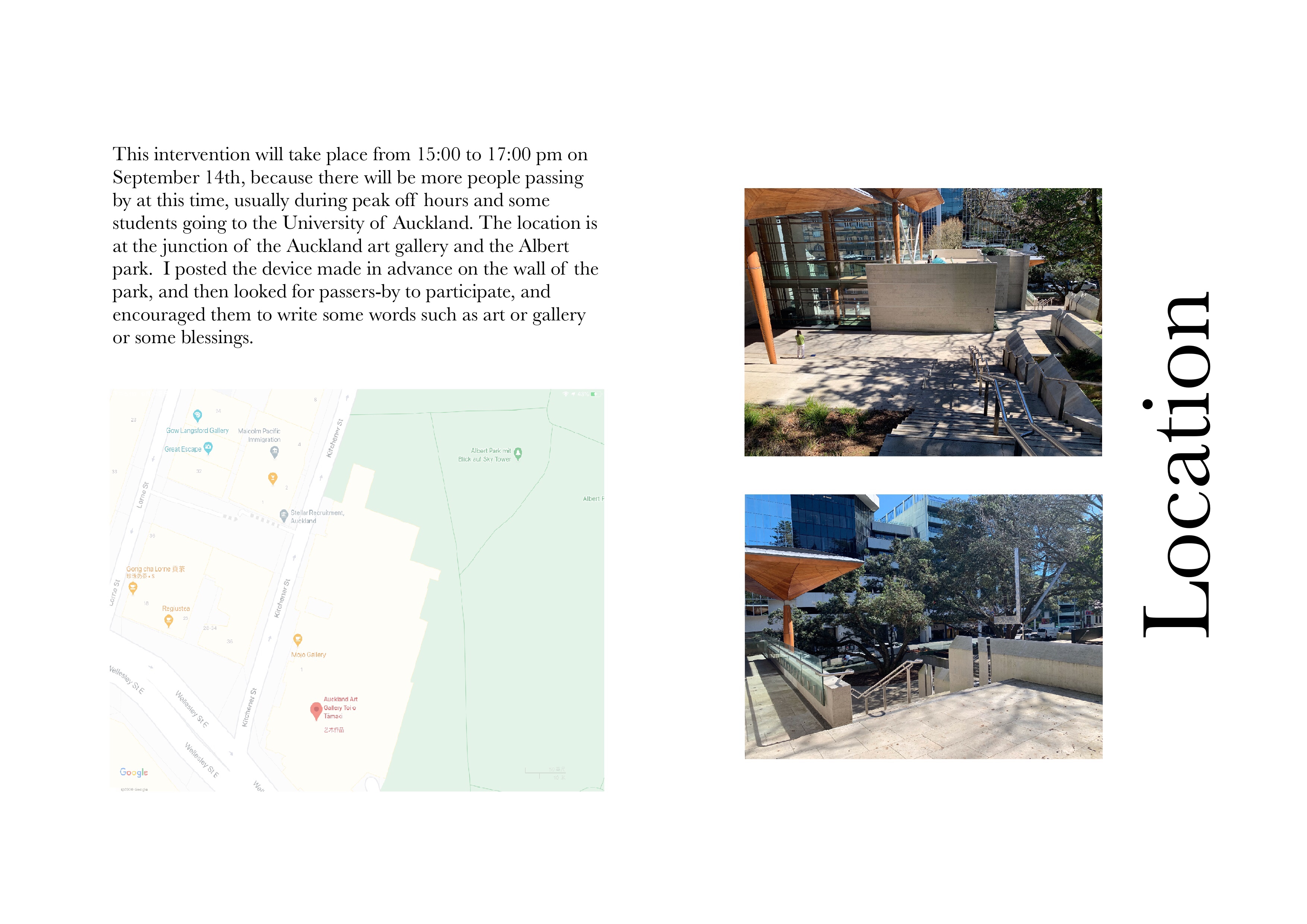
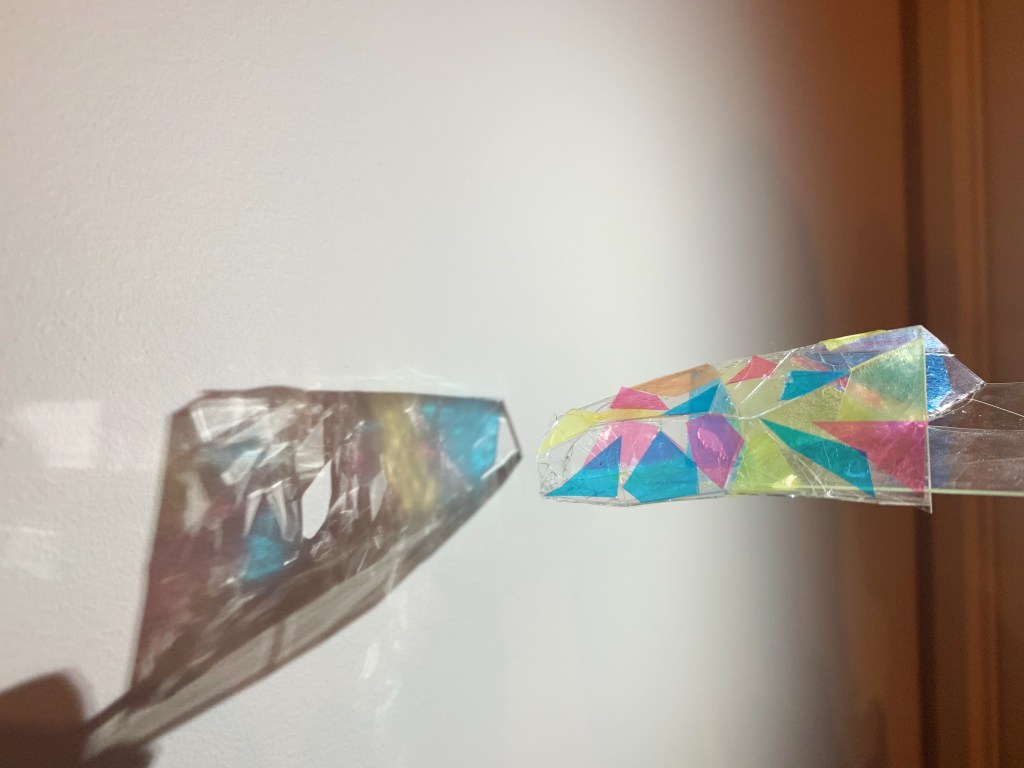
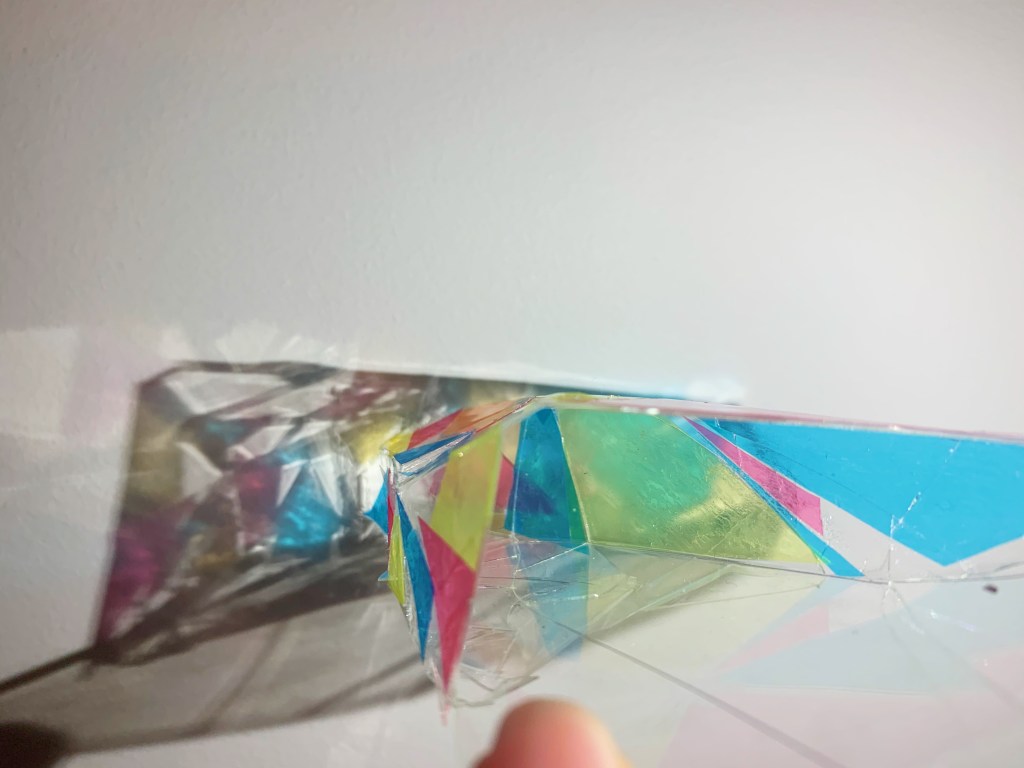
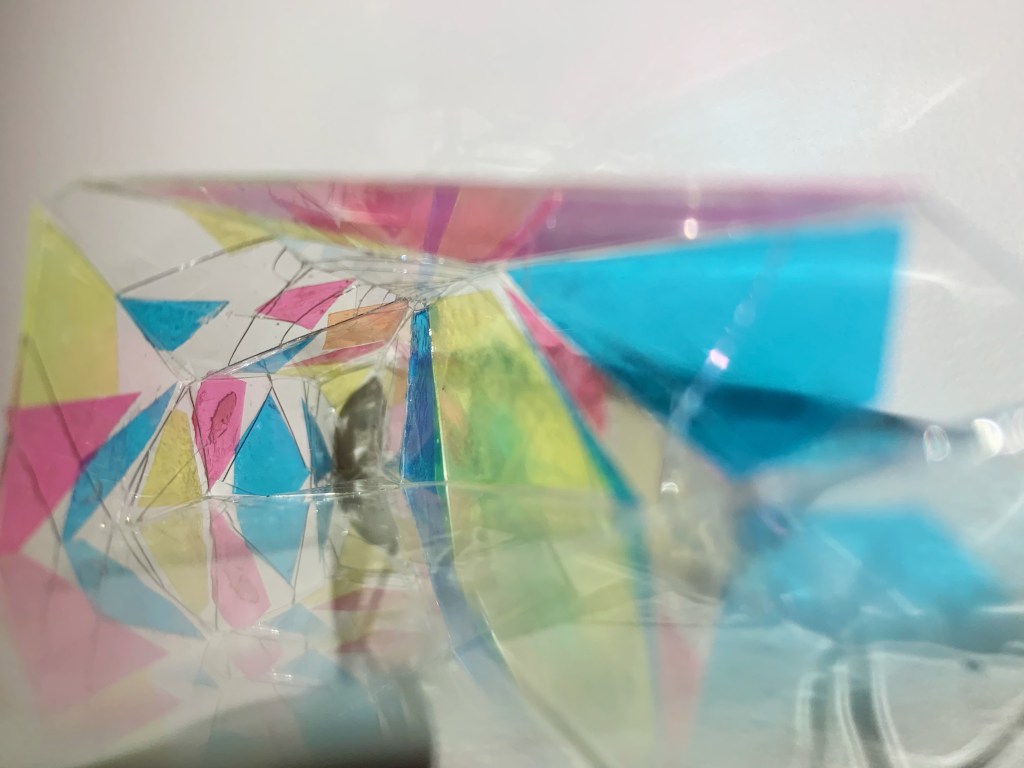
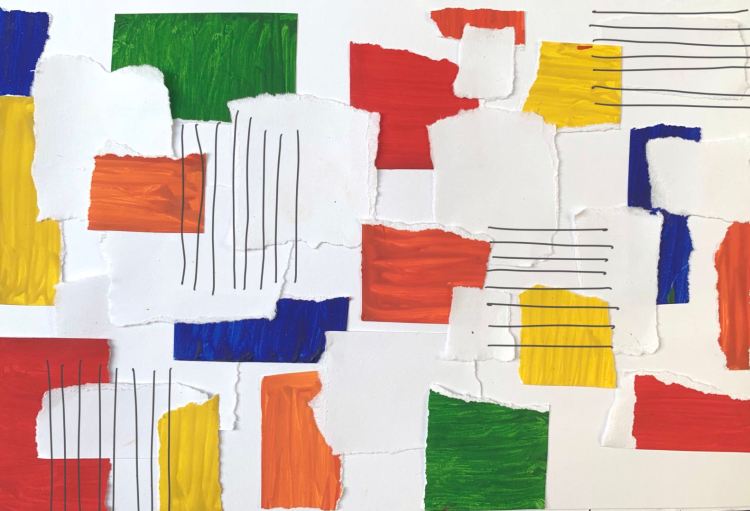
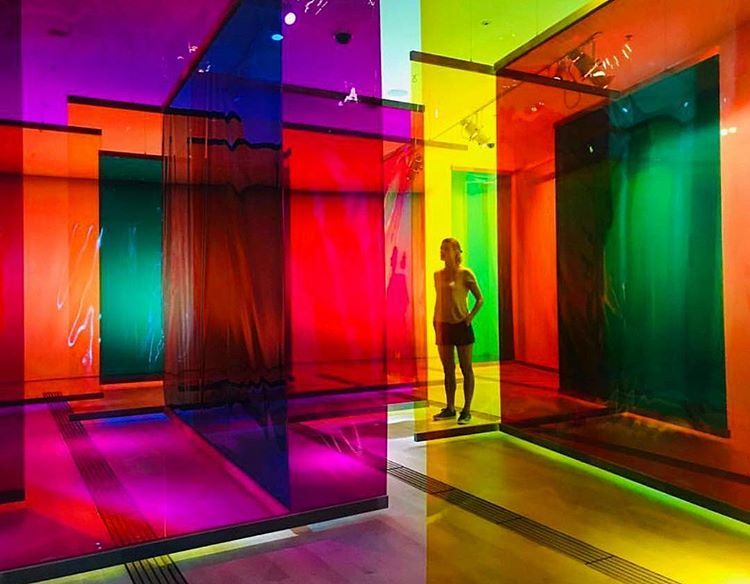
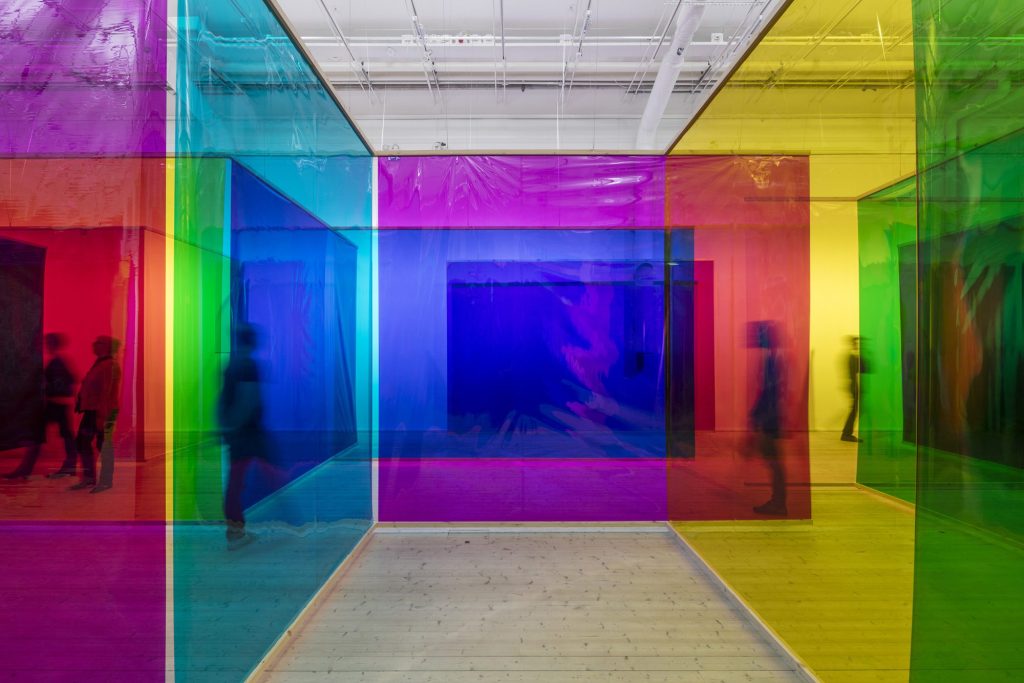
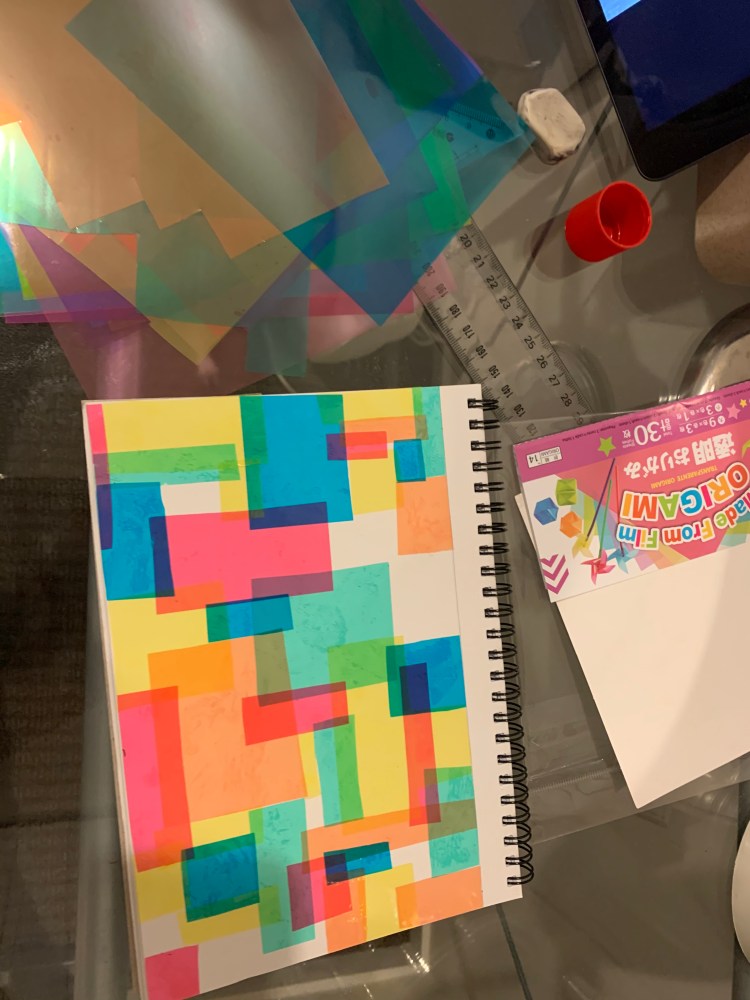
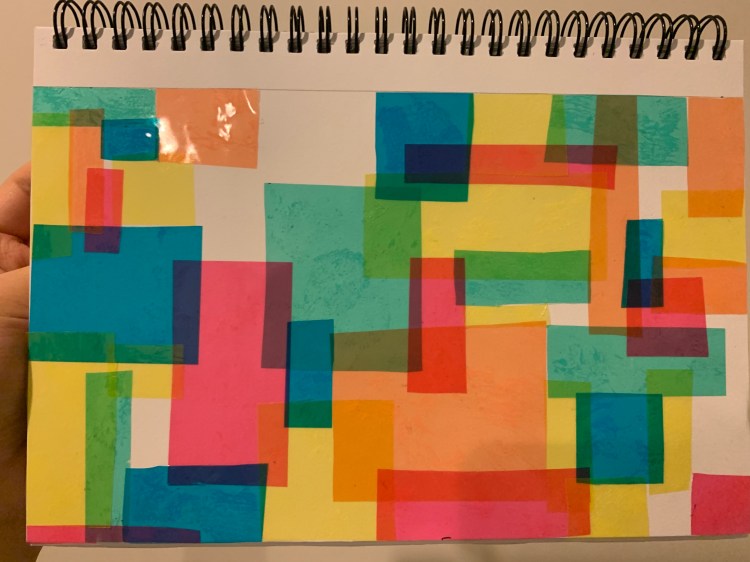
Considering that my interference cannot be implemented internally, my third and fourth proposals combine the external environment. Gallery in different colours. Set up a rainbow device at the junction of the gallery and the Albert park to incorporate nature colours into the gallery. Also, I noticed that more and more people pay attention to art, but art is not just a simple paint. I want people to notice that art has many forms. During the day, I choose to use rainbows to attract the attention of people passing by. Rainbow cannot be seen every day. Remind people to pay attention to the scenery in front of them, beautiful things are hidden in our lives. Main materials: glass, colours cellophane, sunshine.The light is the most attractive thing at night, so at night I design a light show and projected it on the street outside the gallery. But the lights projected will be different styles of the gallery that will show the charm of the gallery in different ways. The main purpose is to attract people passing by to stop and enjoy.

Proposal (Draft)

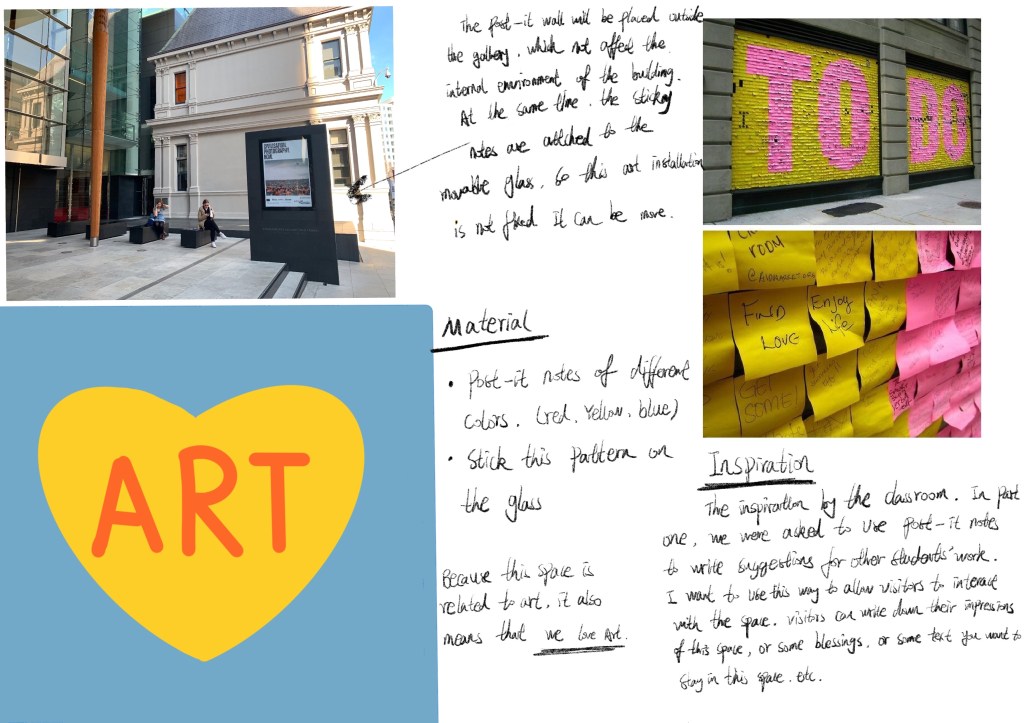
1. Post-it wall

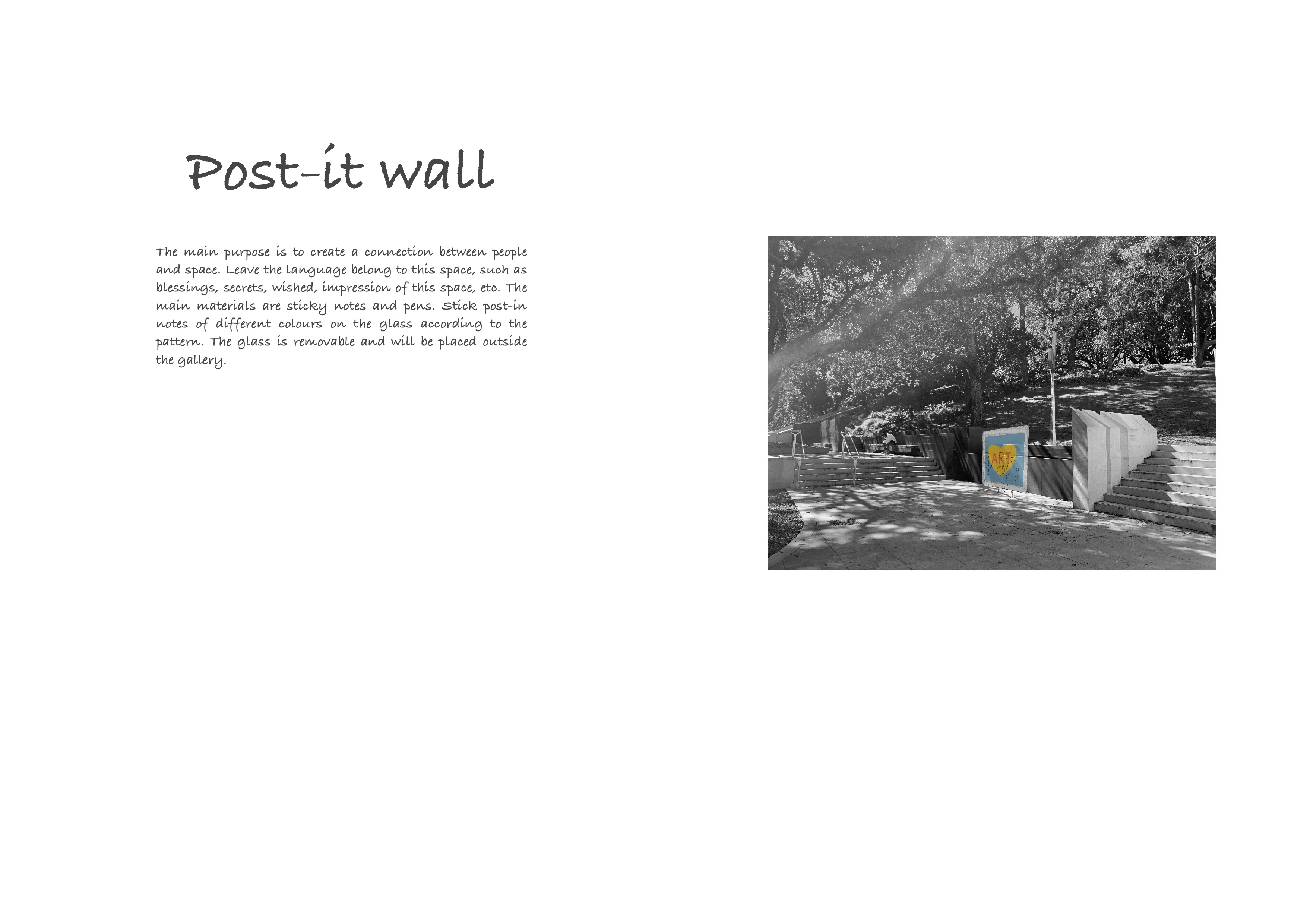
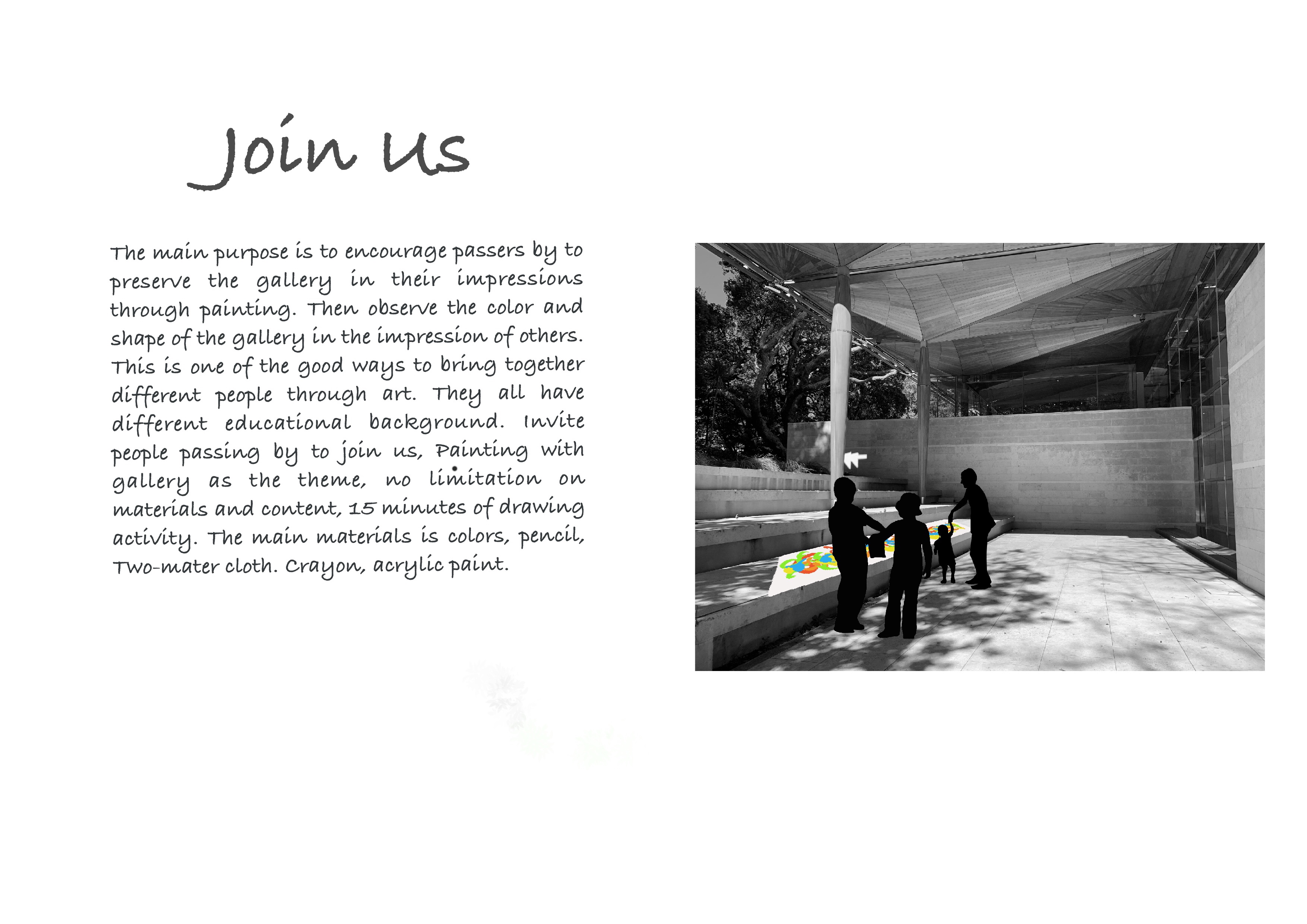
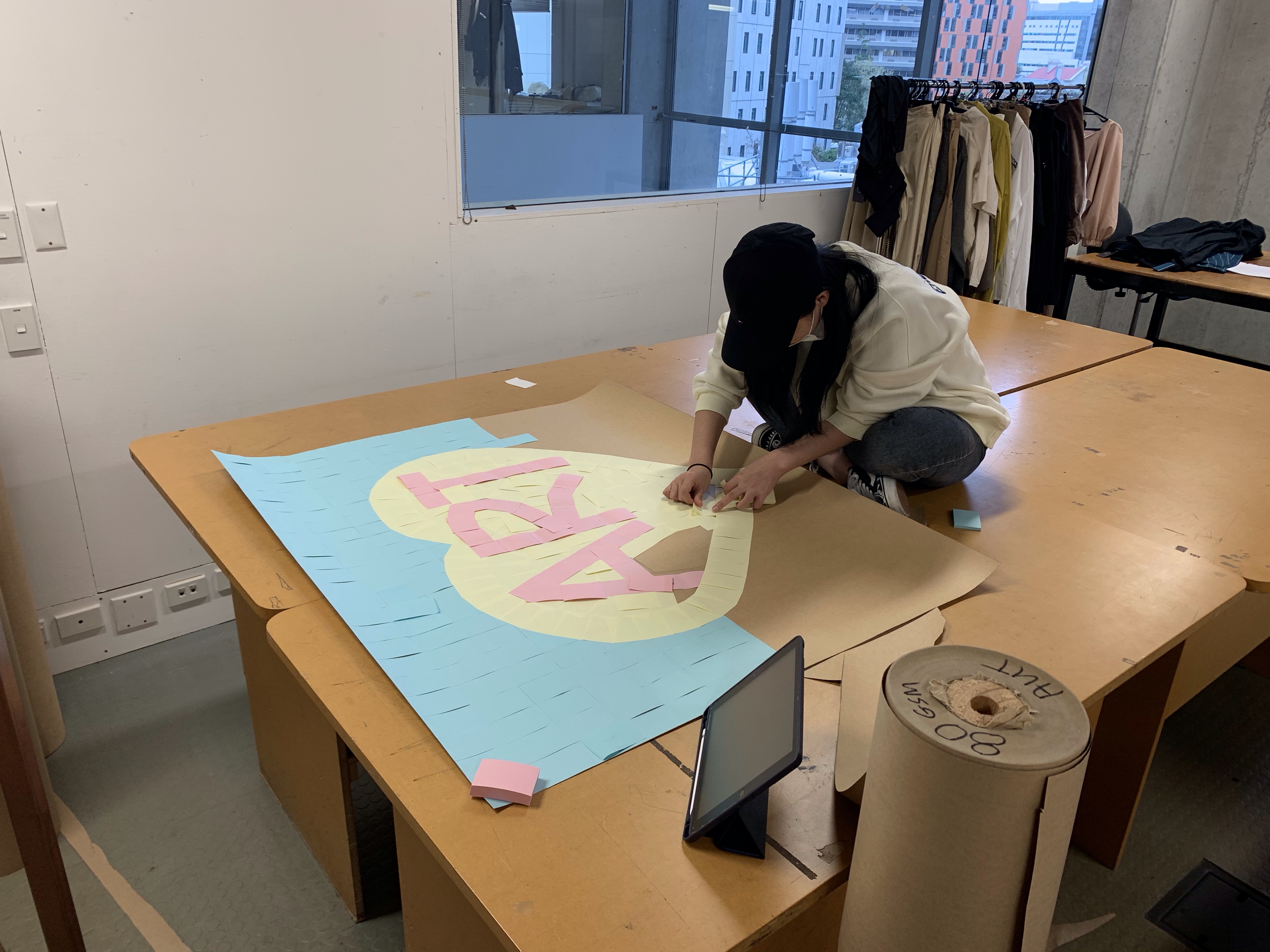
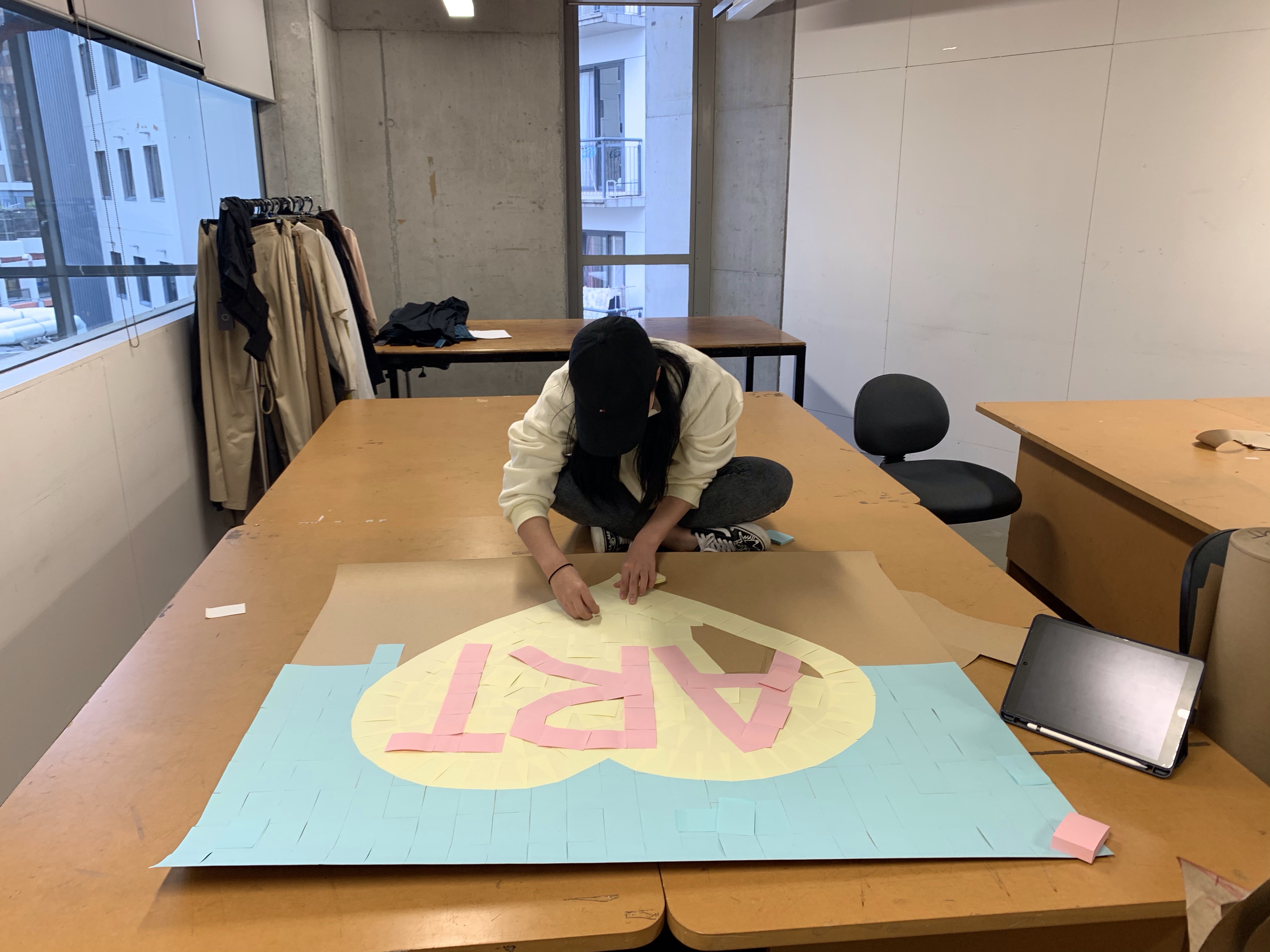
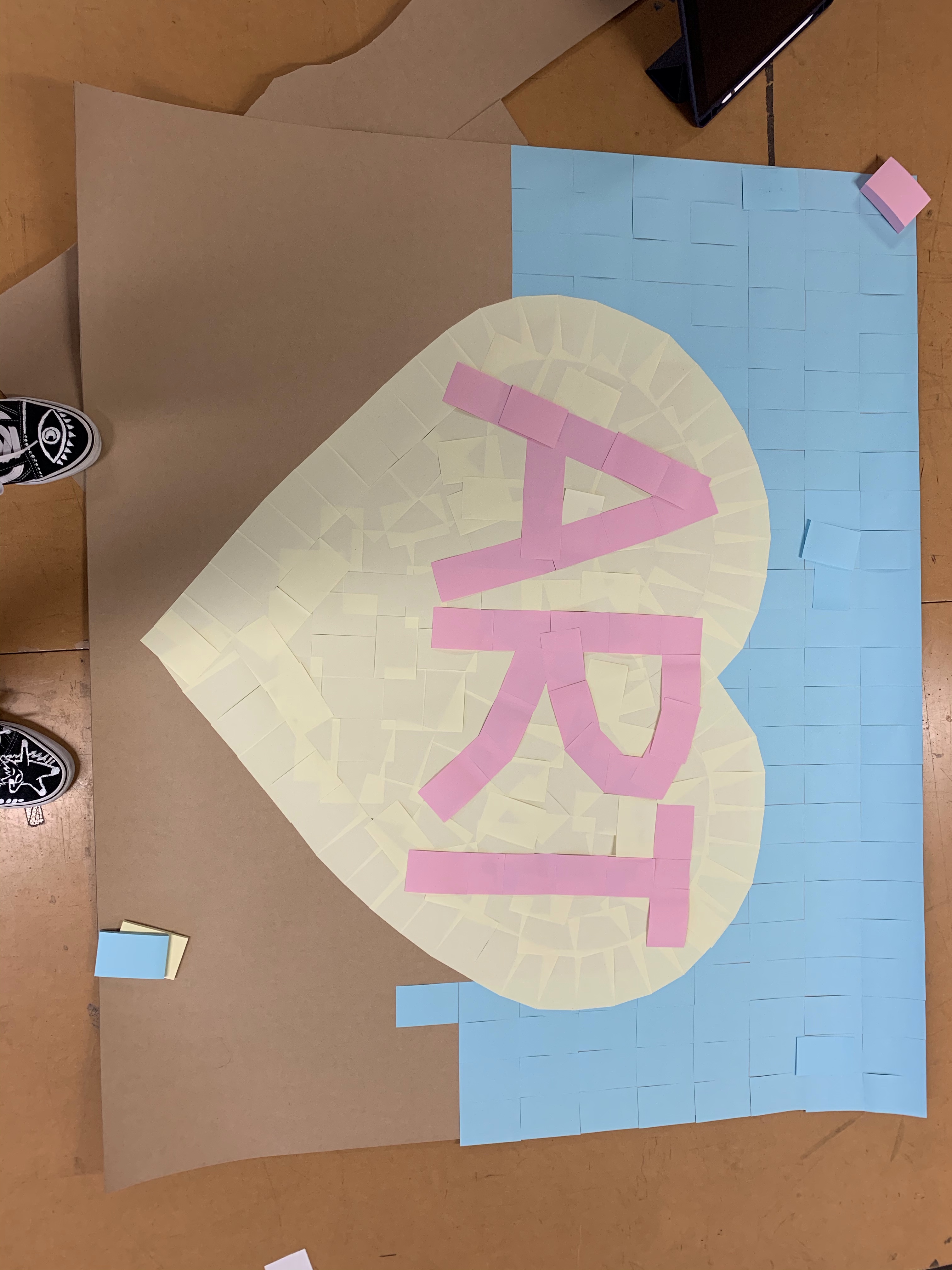
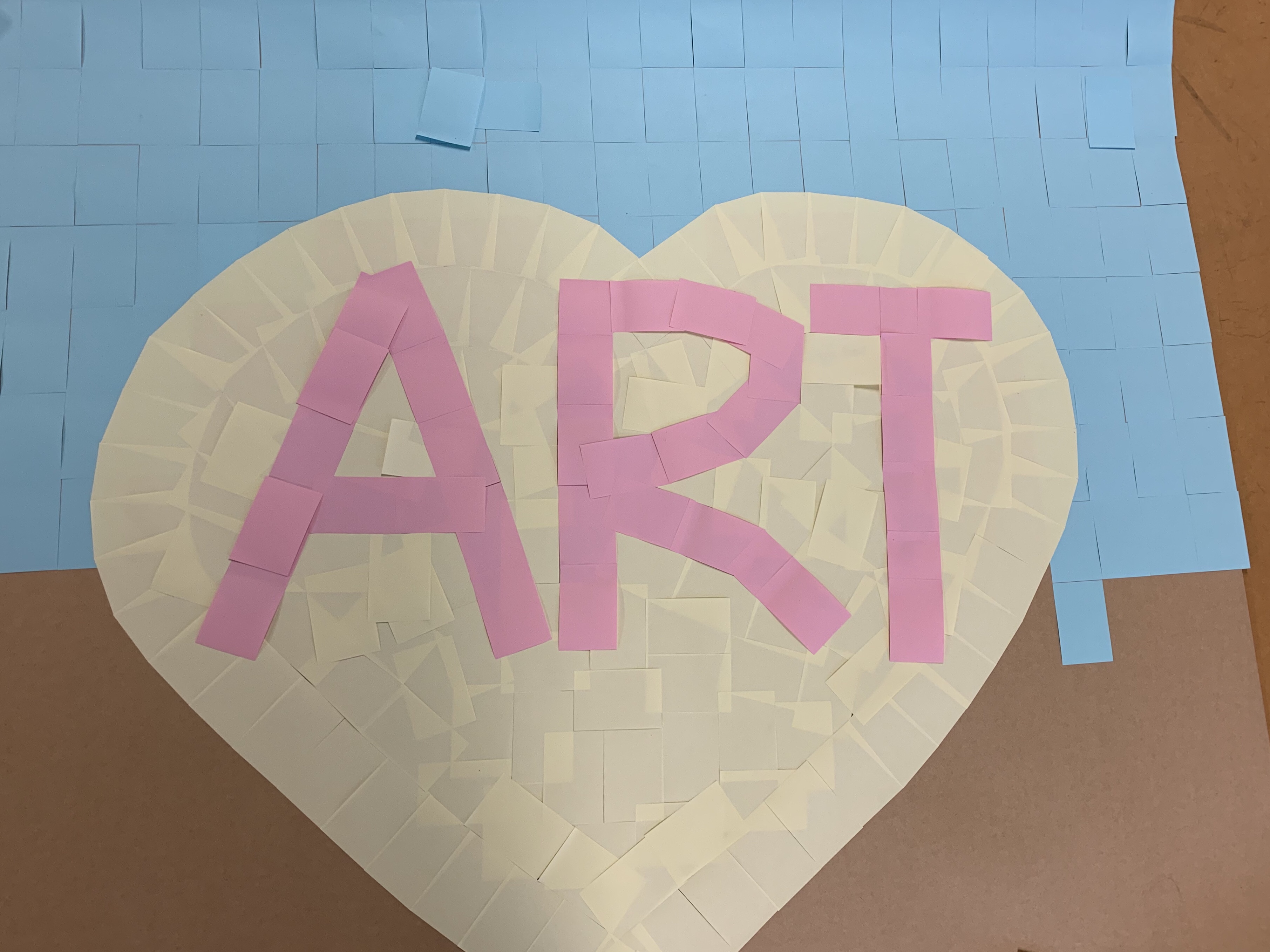
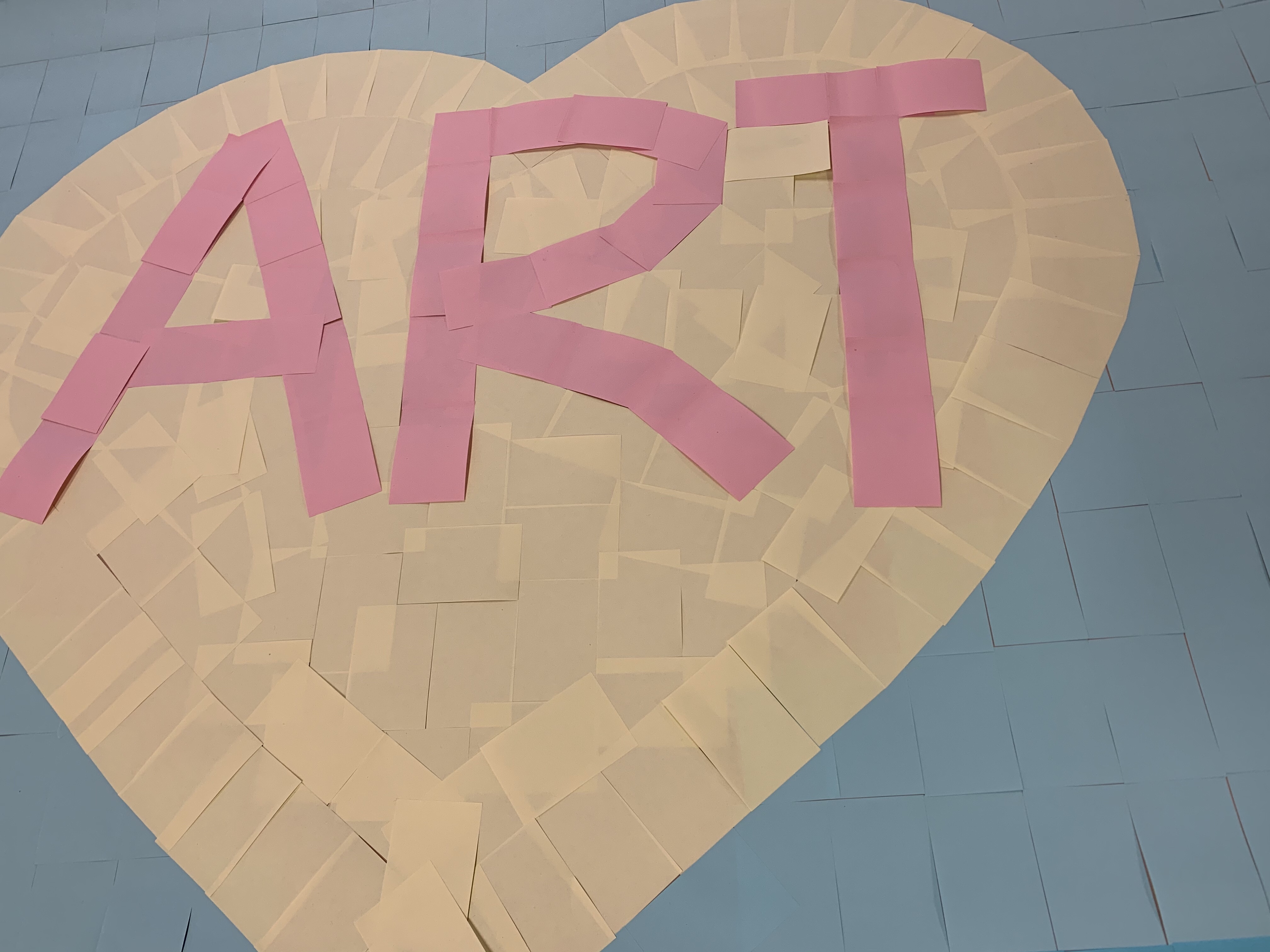
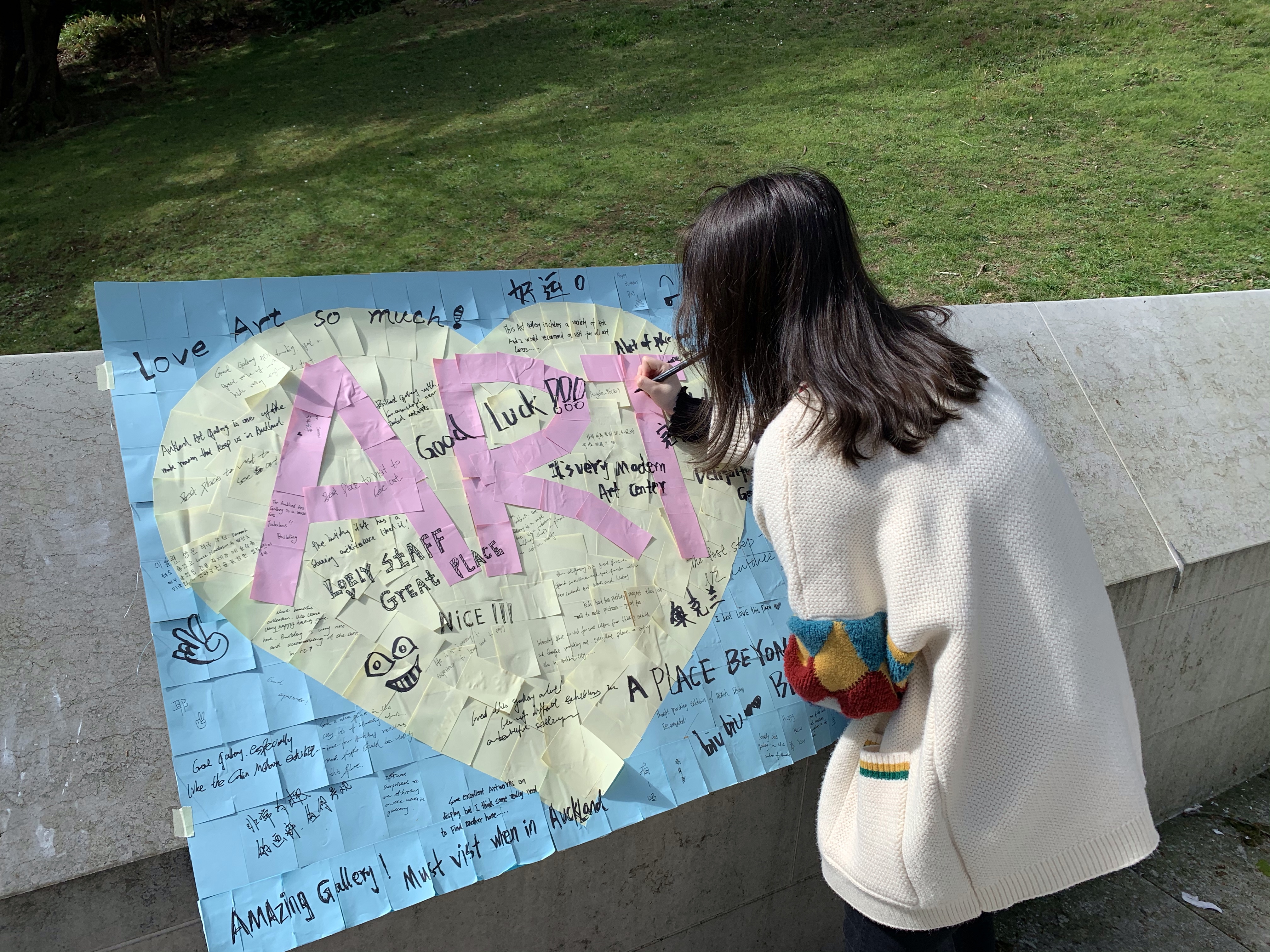
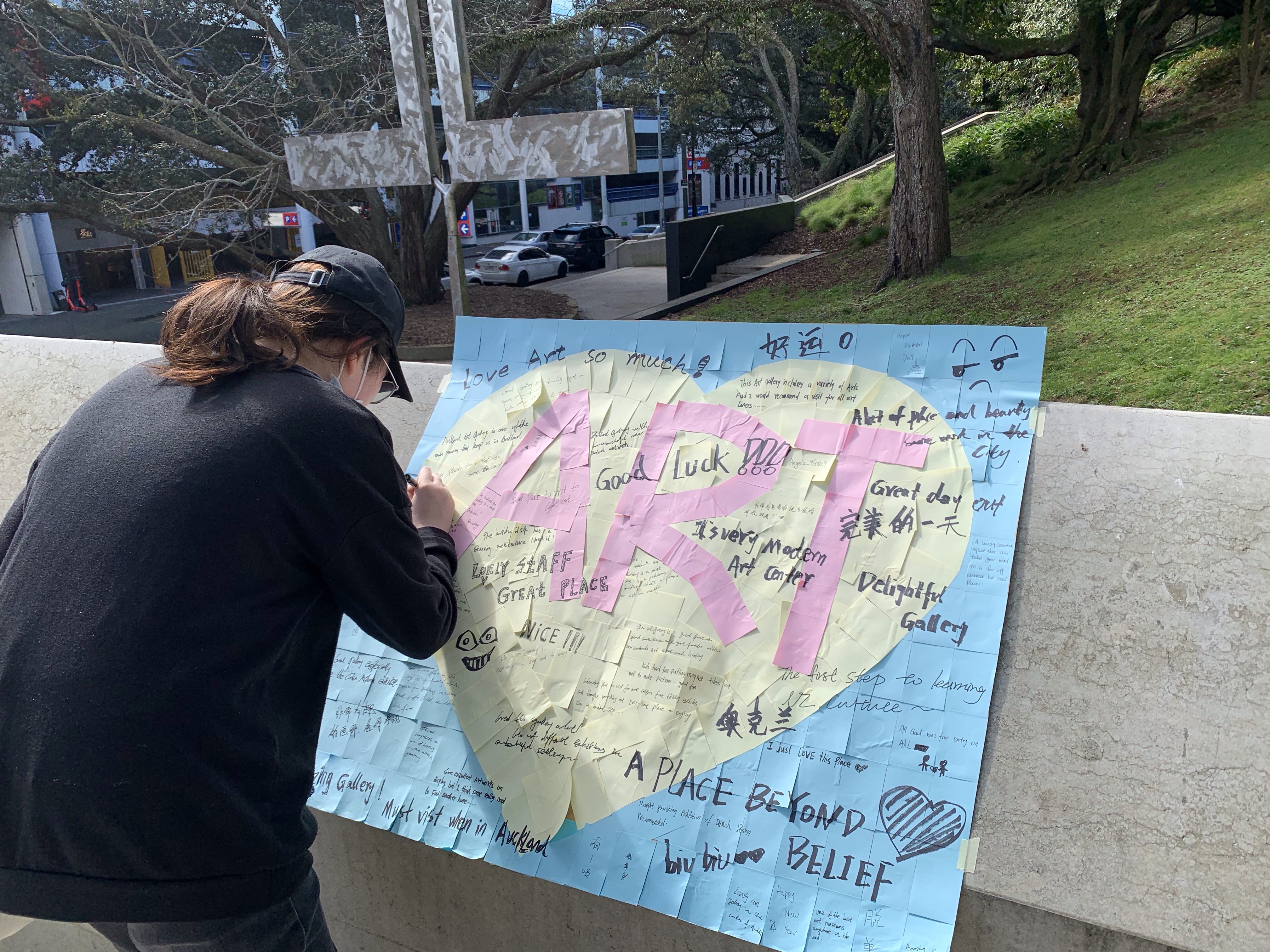
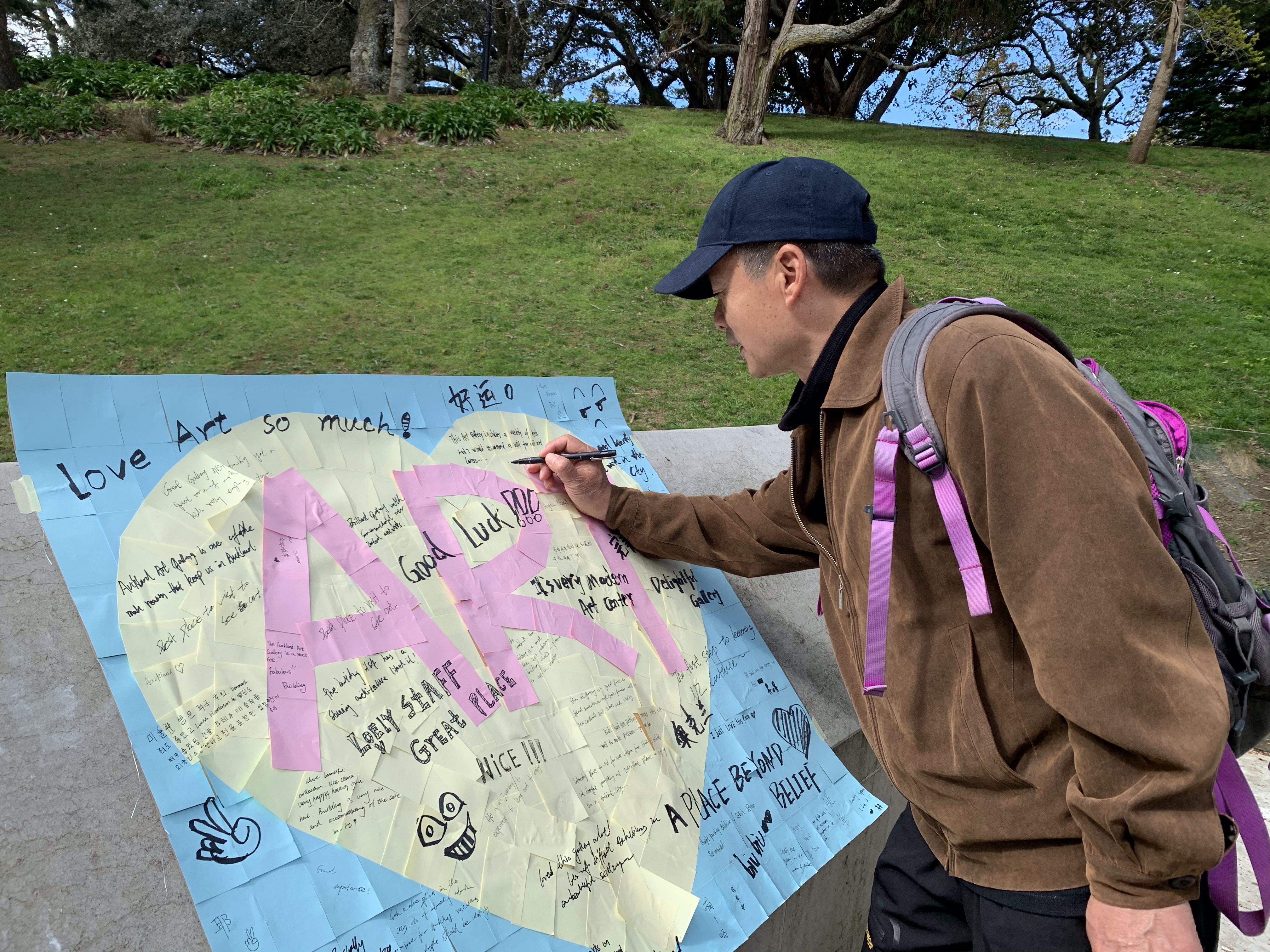
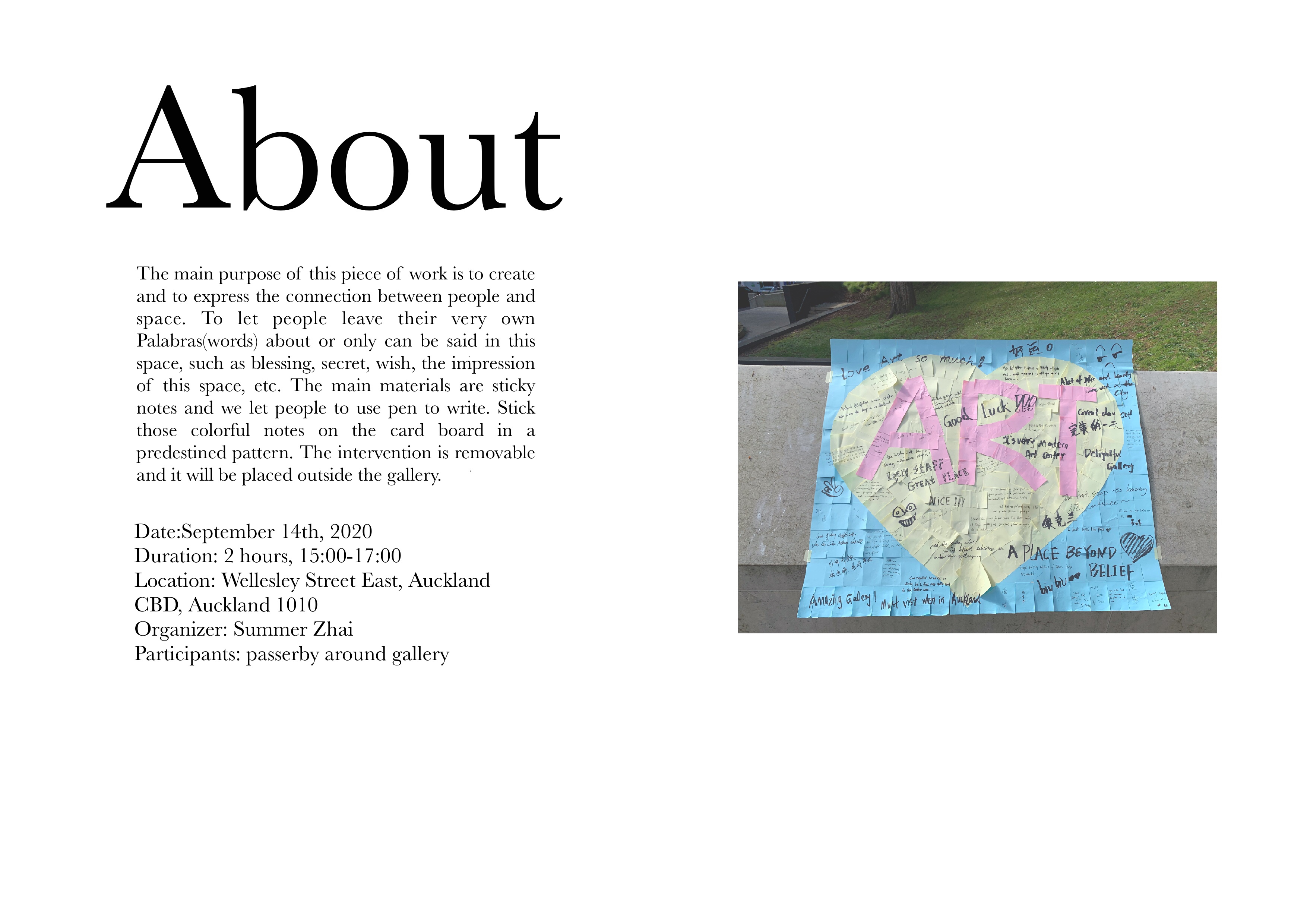
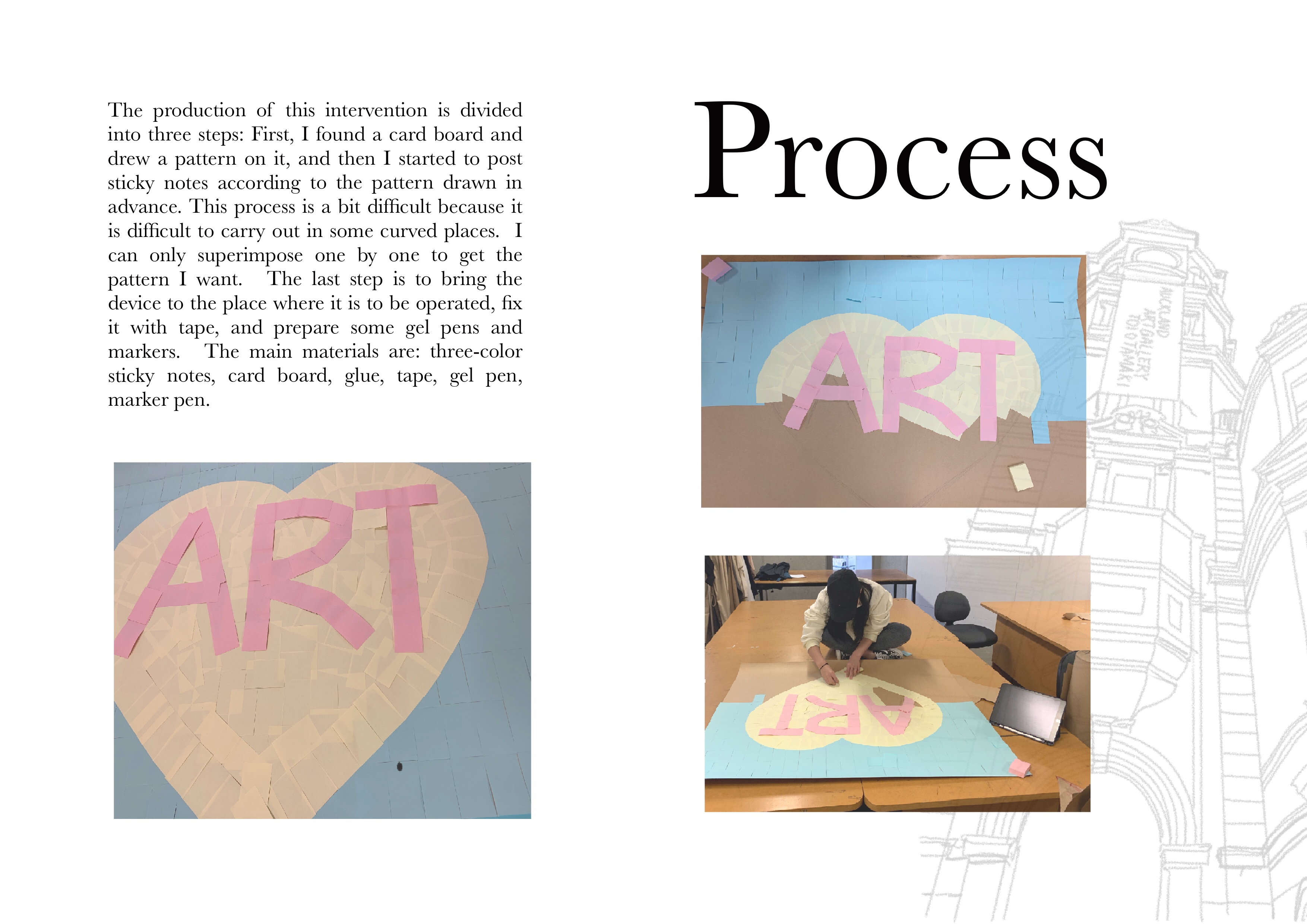
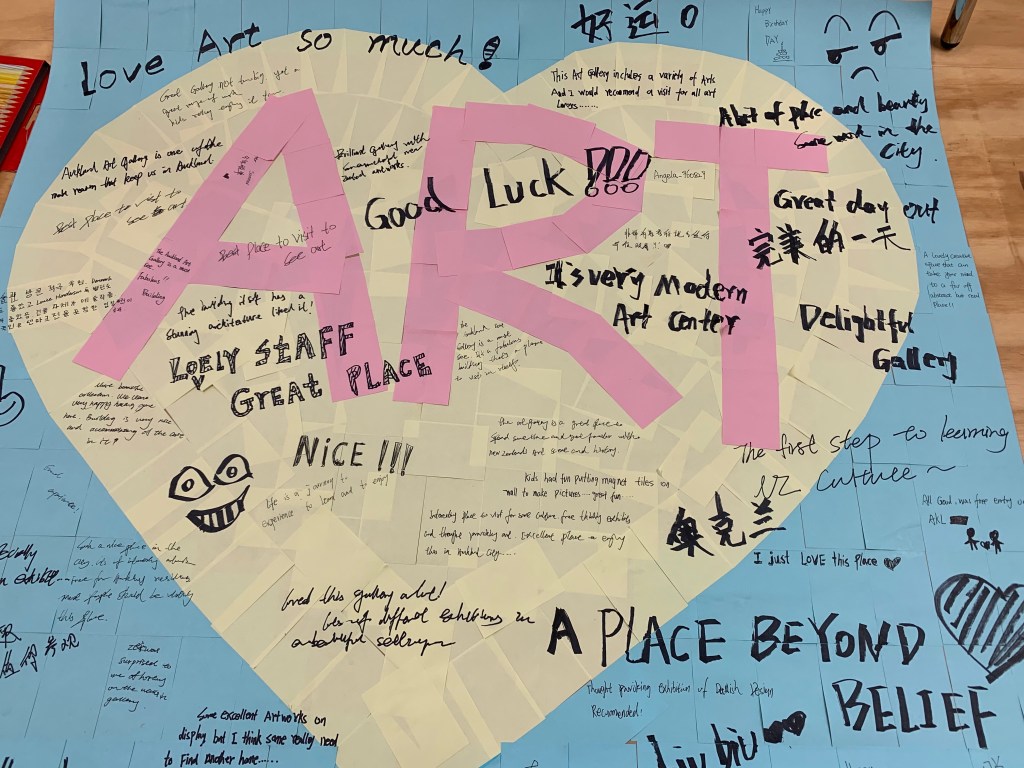
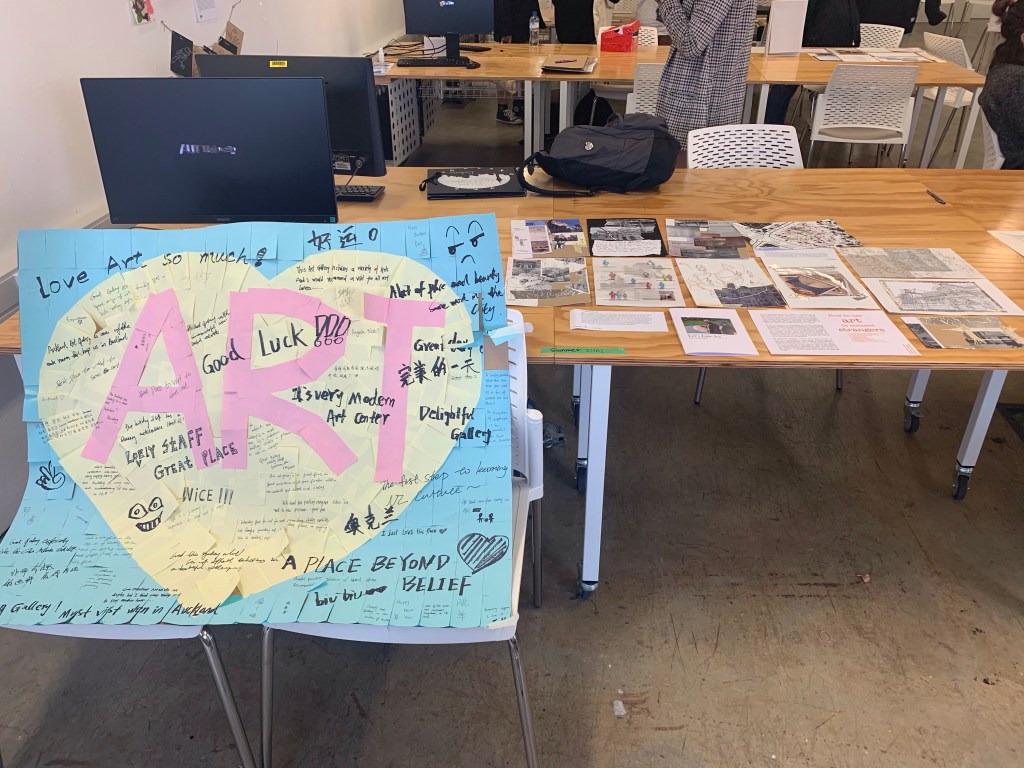
The main purpose is to create a connection between people and space. Leave the language belong to this space, such as blessings, secrets, wished, impression of this space, etc. The main materials are sticky notes and pens. Stick post-in notes of different colours on the glass according to the pattern. The glass is removable and will be placed outside the gallery.

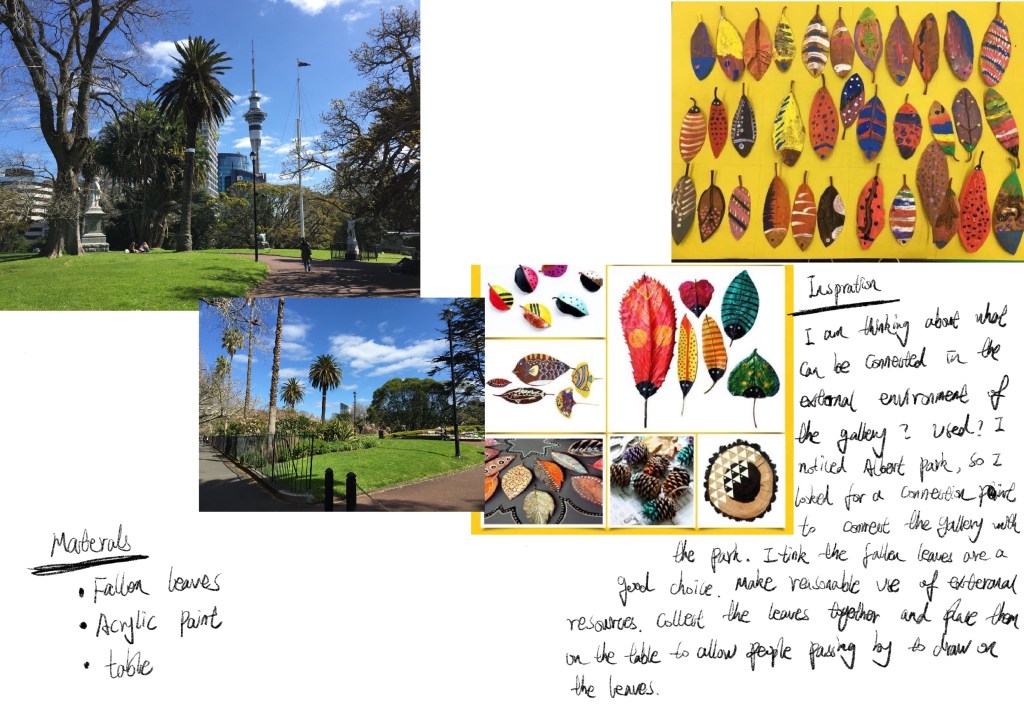
2. Creative painting

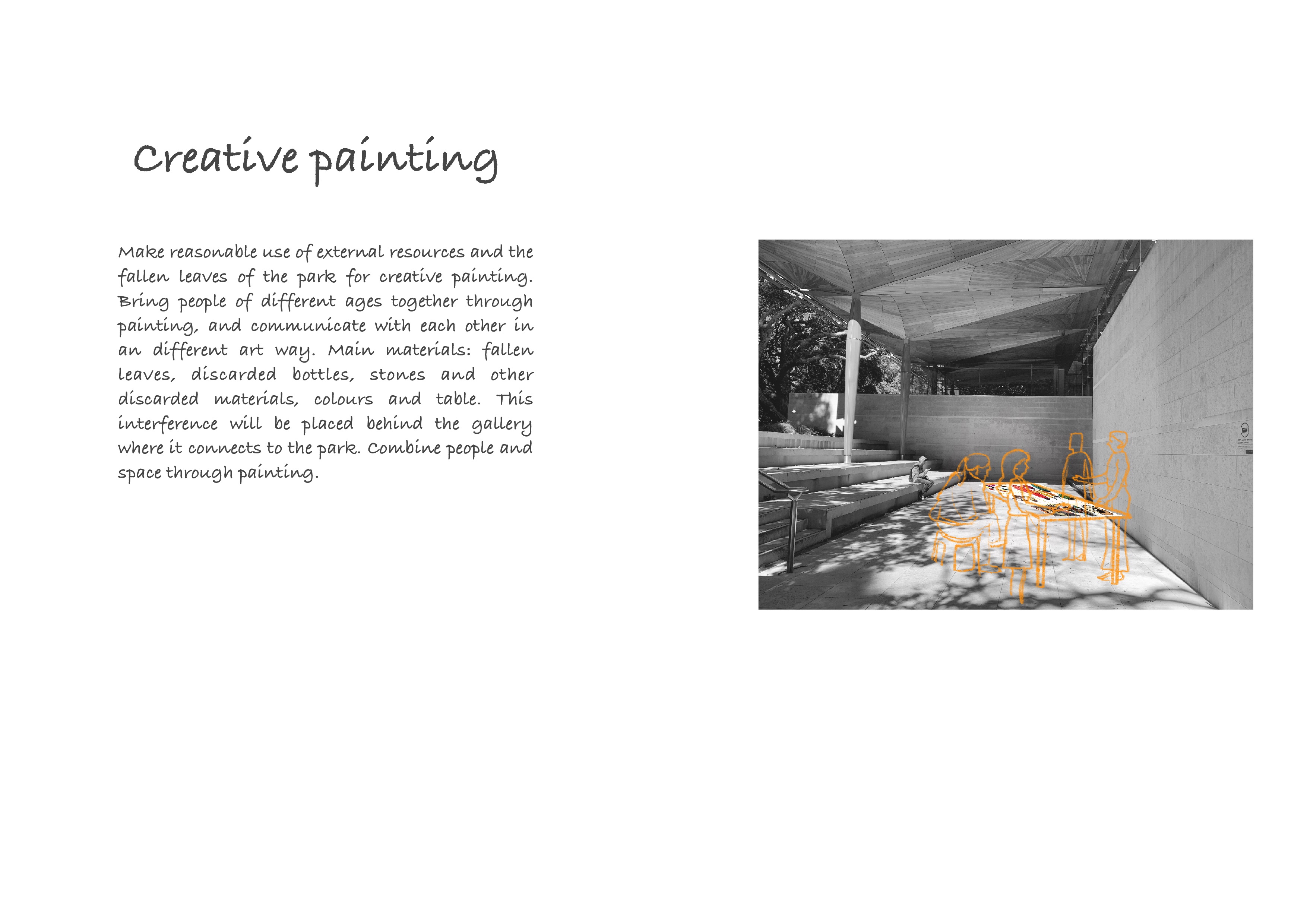
Make reasonable use of external resources and the fallen leaves of the park for creative painting. Bring people of different ages together through painting, and communicate with each other in an artist way. Main materials: fallen leaves, discarded bottles, stones and other discarded materials, colours and table. This interference will be placed and the park. Combine people and space through painting.

3. Signs

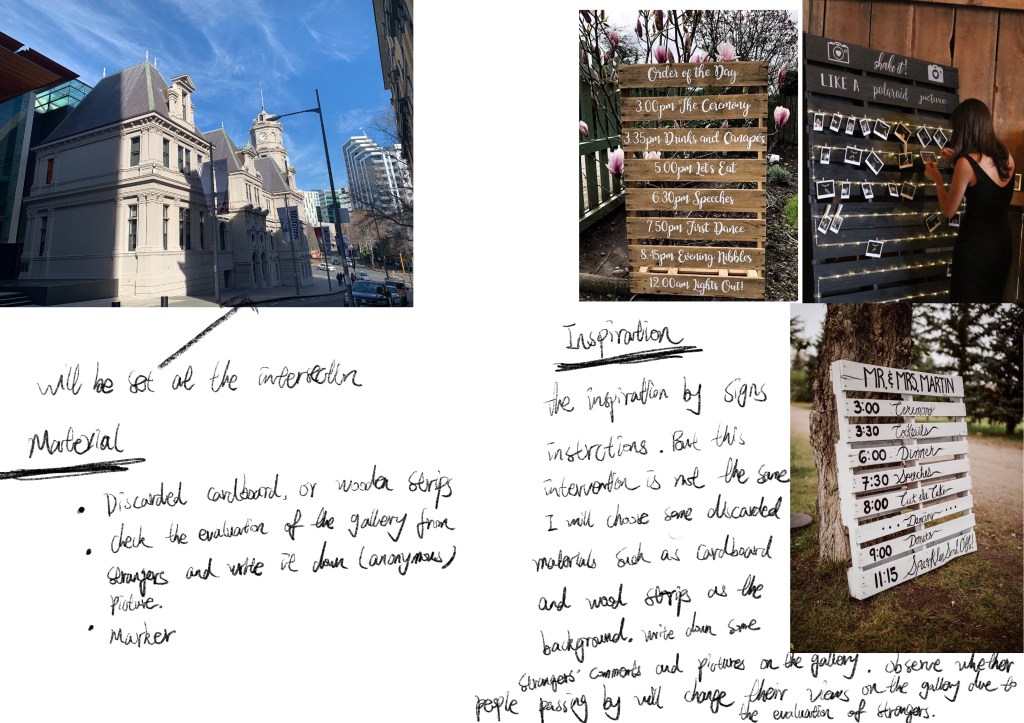
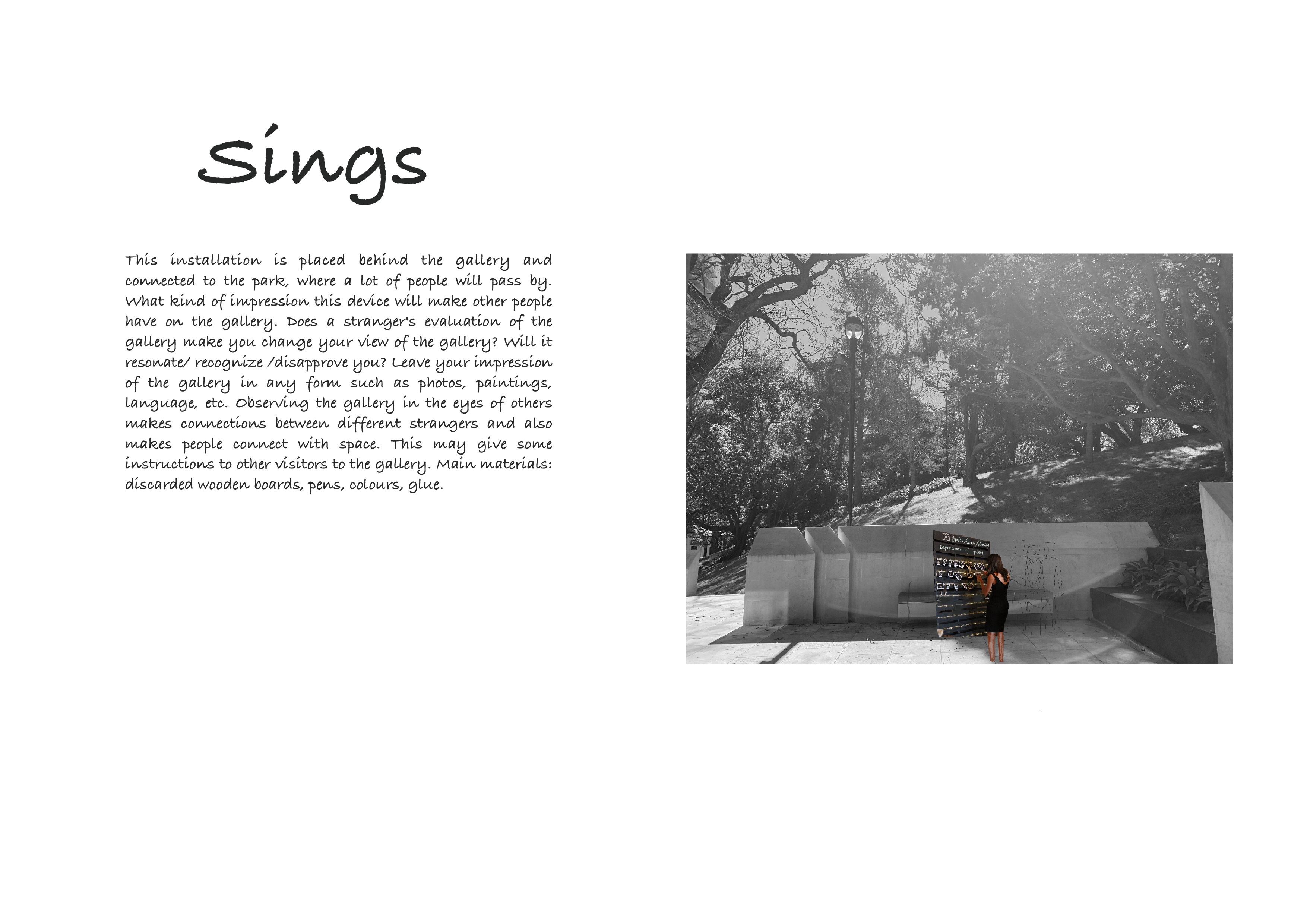
Does a stranger’s evaluation of the gallery make you change your view of the gallery? Will it resonate/ recognize /disapprove you? Leave your impression of the gallery in any form such as photos, paintings, language, etc. Observing the gallery in the eyes of others makes connections between different strangers and also makes people connect with space. This may give some instructions to other visitors to the gallery. Main materials: discarded wooden boards, pens, colours, glue.

4. Mini Light Show

The gallery in different colours. The light is the most attractive thing at night, so at night I design a light show and projected it on the street outside the gallery. But the lights projected will be different styles of the gallery. The main purpose is to attract people passing by to stay a while and appreciate the gallery in different environments. Main materials: light

5. The Rainbow

Gallery in different colours. Set up a rainbow device at the junction of the gallery and the Albert park to incorporate nature colours into the gallery. Also, I noticed that more and more people pay attention to art, but art is not just a simple paint. I want people to notice that art has many forms. During the day, I choose to use rainbows to attract the attention of people passing by. Rainbow cannot be seen every day. Remind people to pay attention to the scenery in front of them, beautiful things are hidden in our lives. Main materials: glass, colours cellophane, sunshine.

Final Statement

Final Proposal

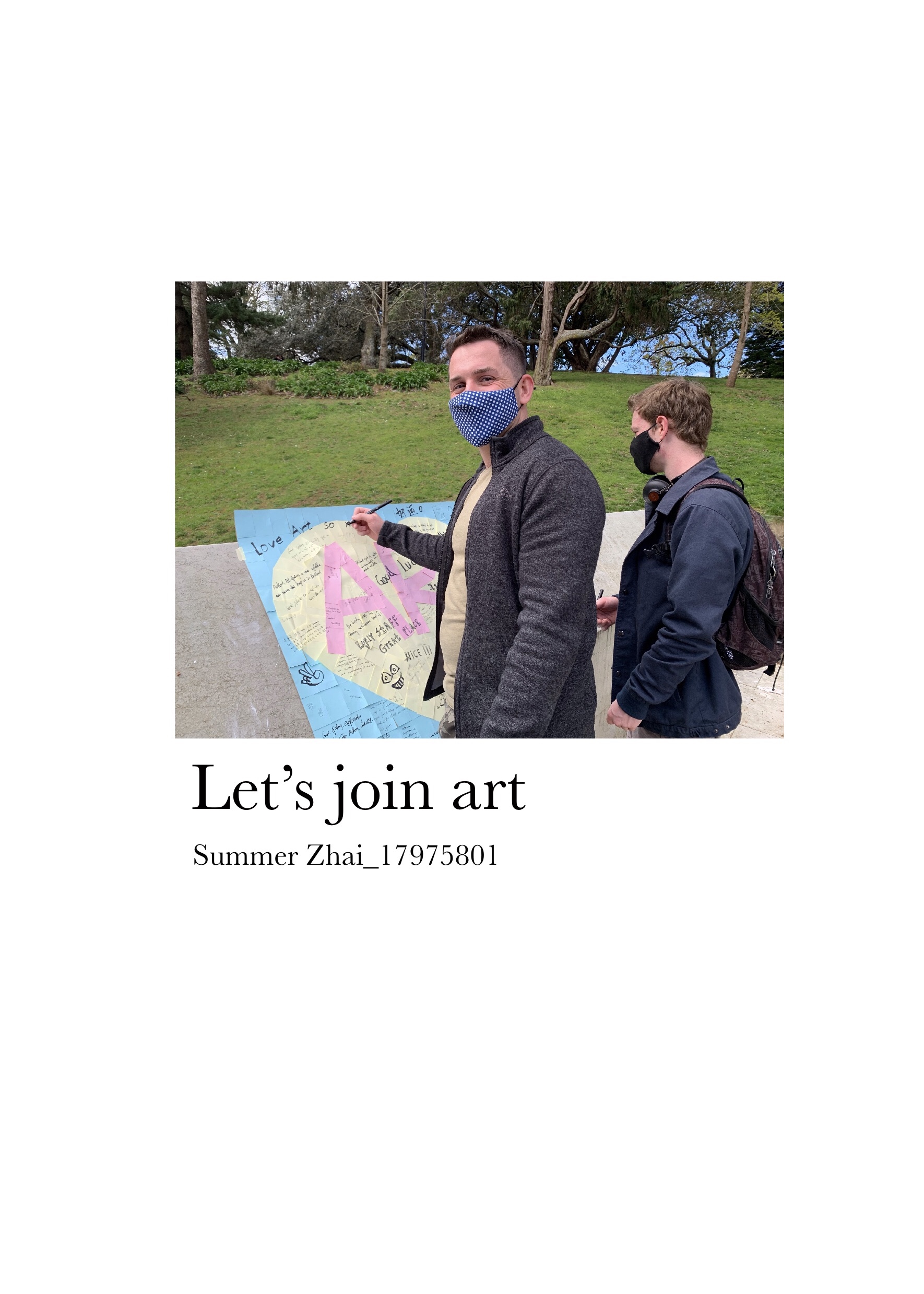
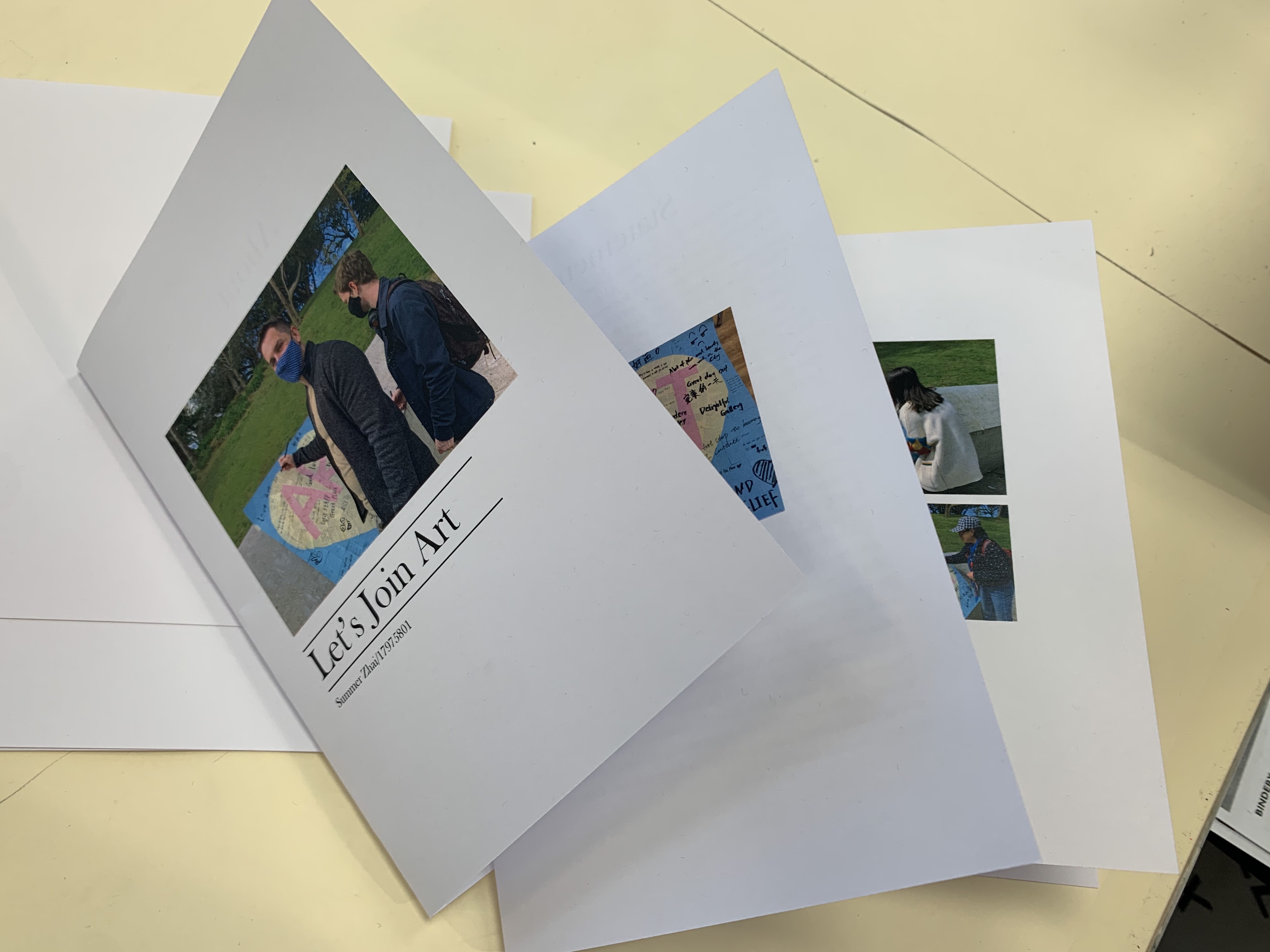
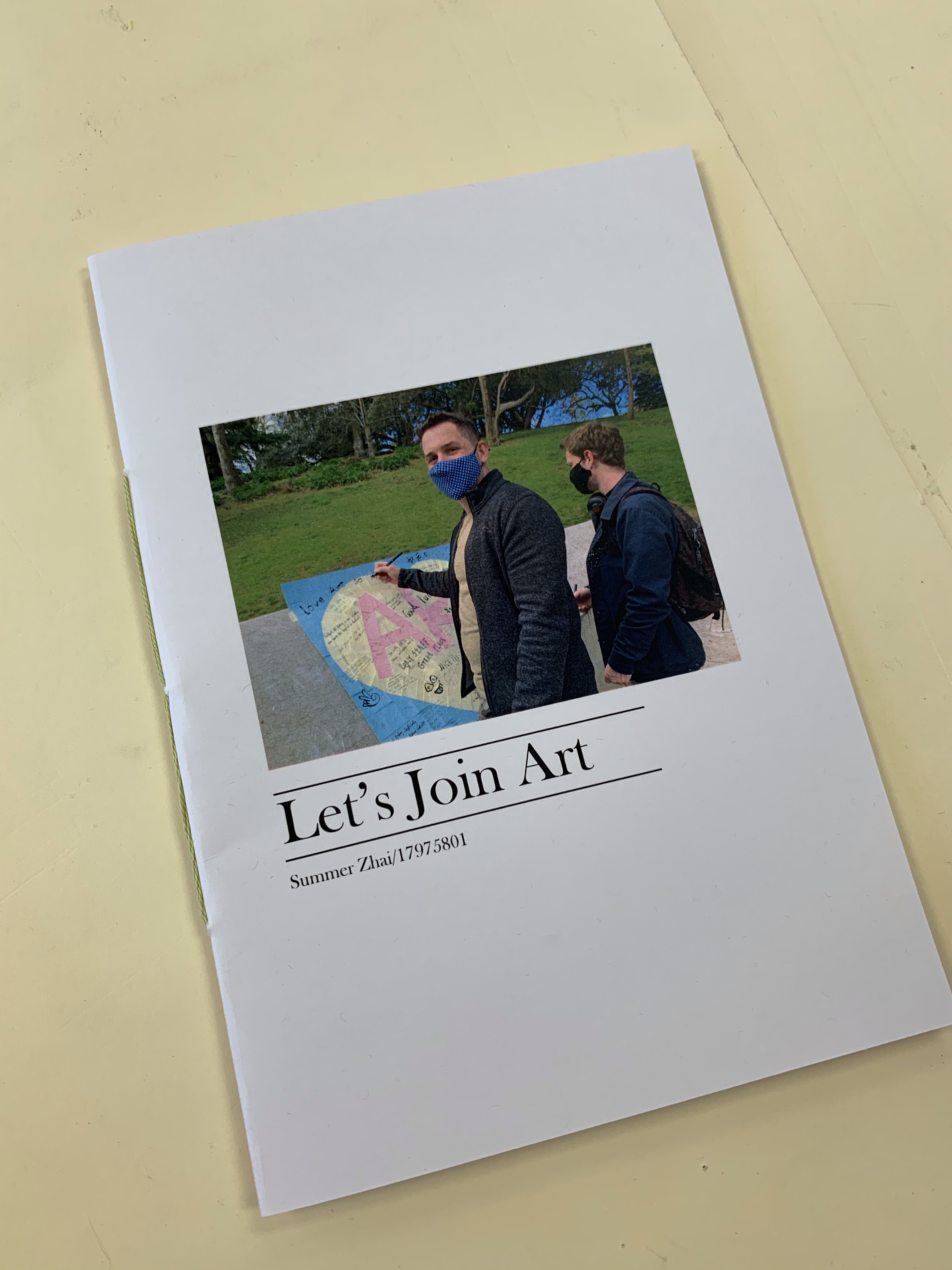
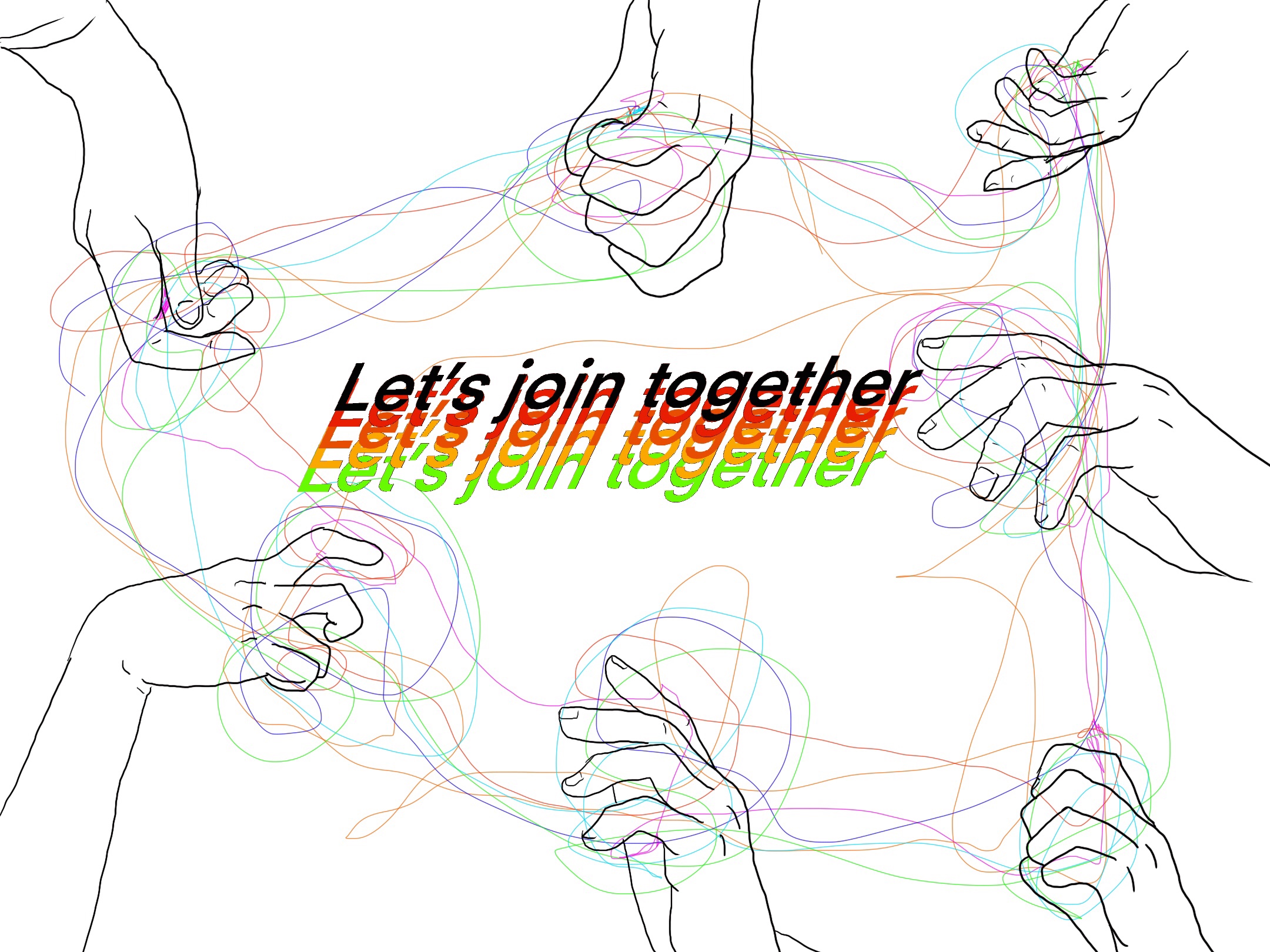
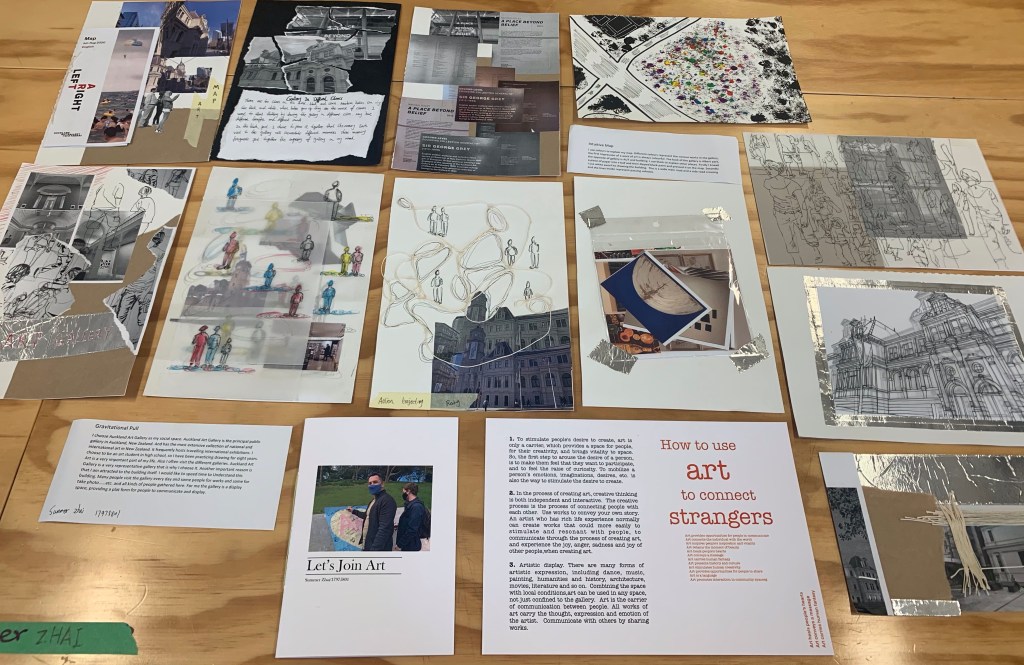
Let’s Join Art

Final work

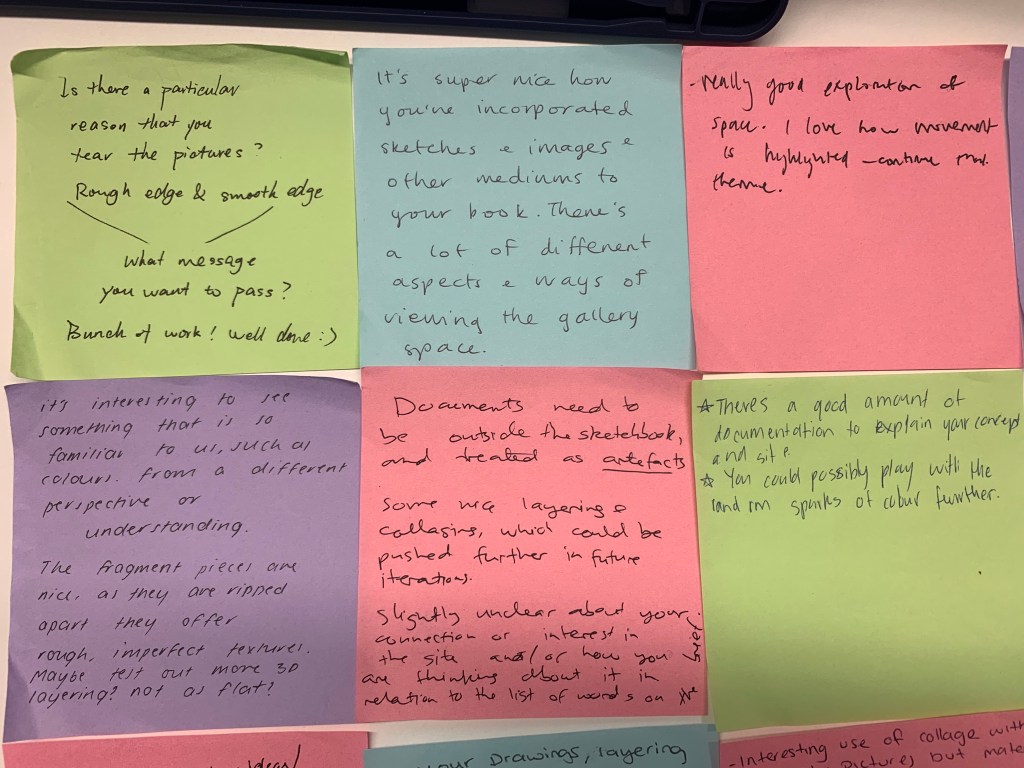
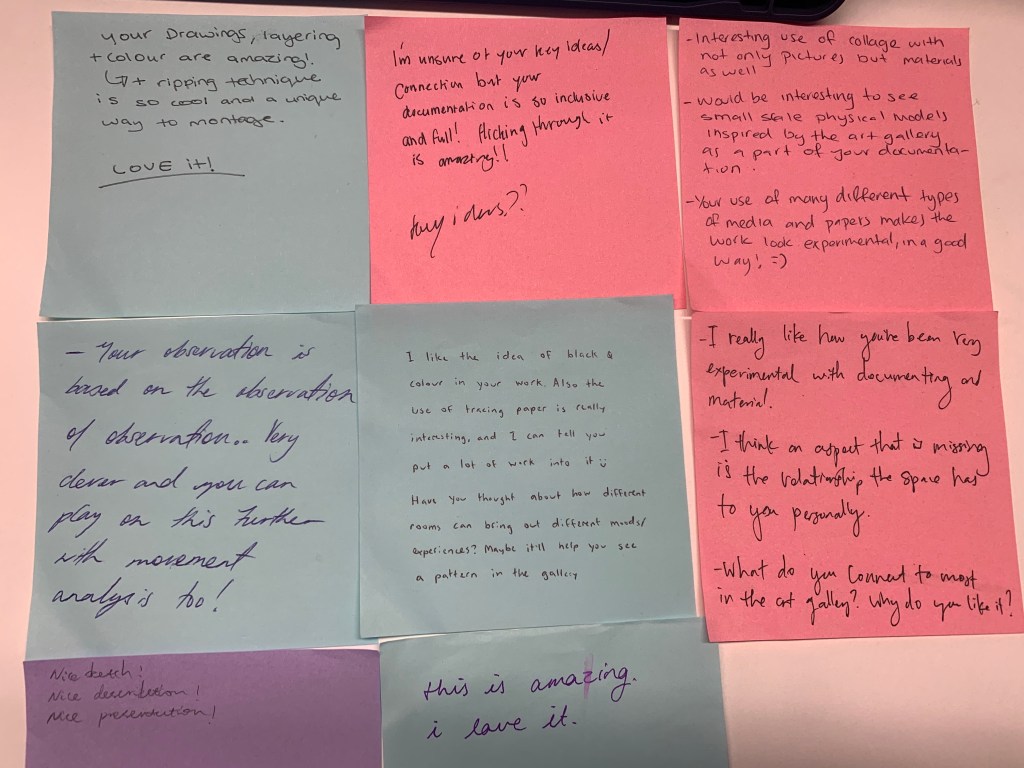
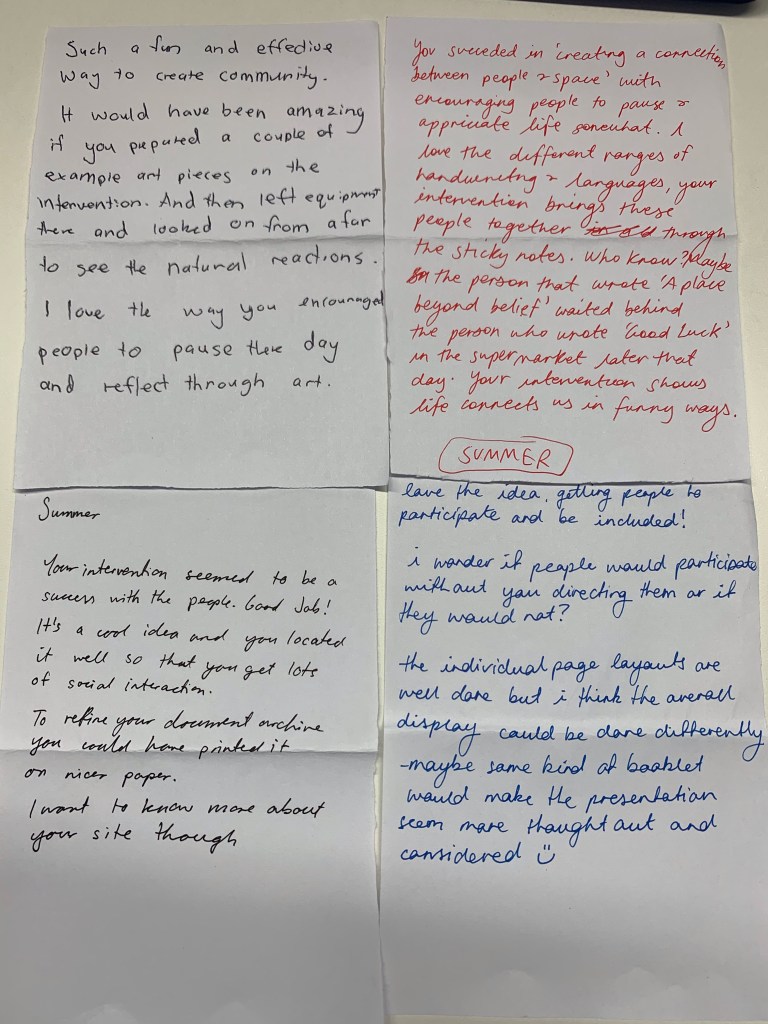
Feedback

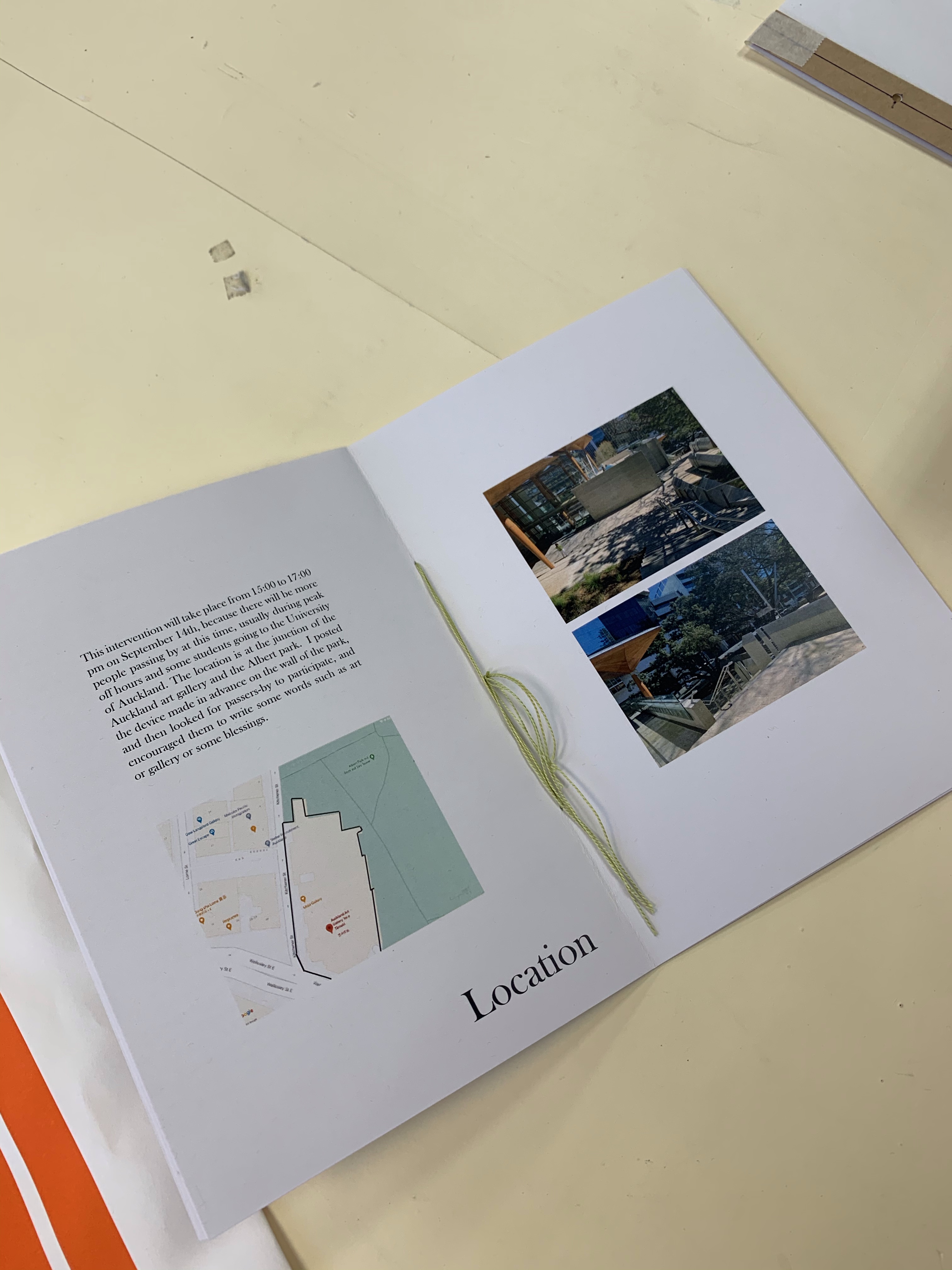
After the second presentation, I got some feedback and improved my homework. First, the layout is more concise and smooth, the font is unified, and better paper is used to complete it. The overall effect is like a brochure. easy to understand.

Part three

Why choose the topic of art?
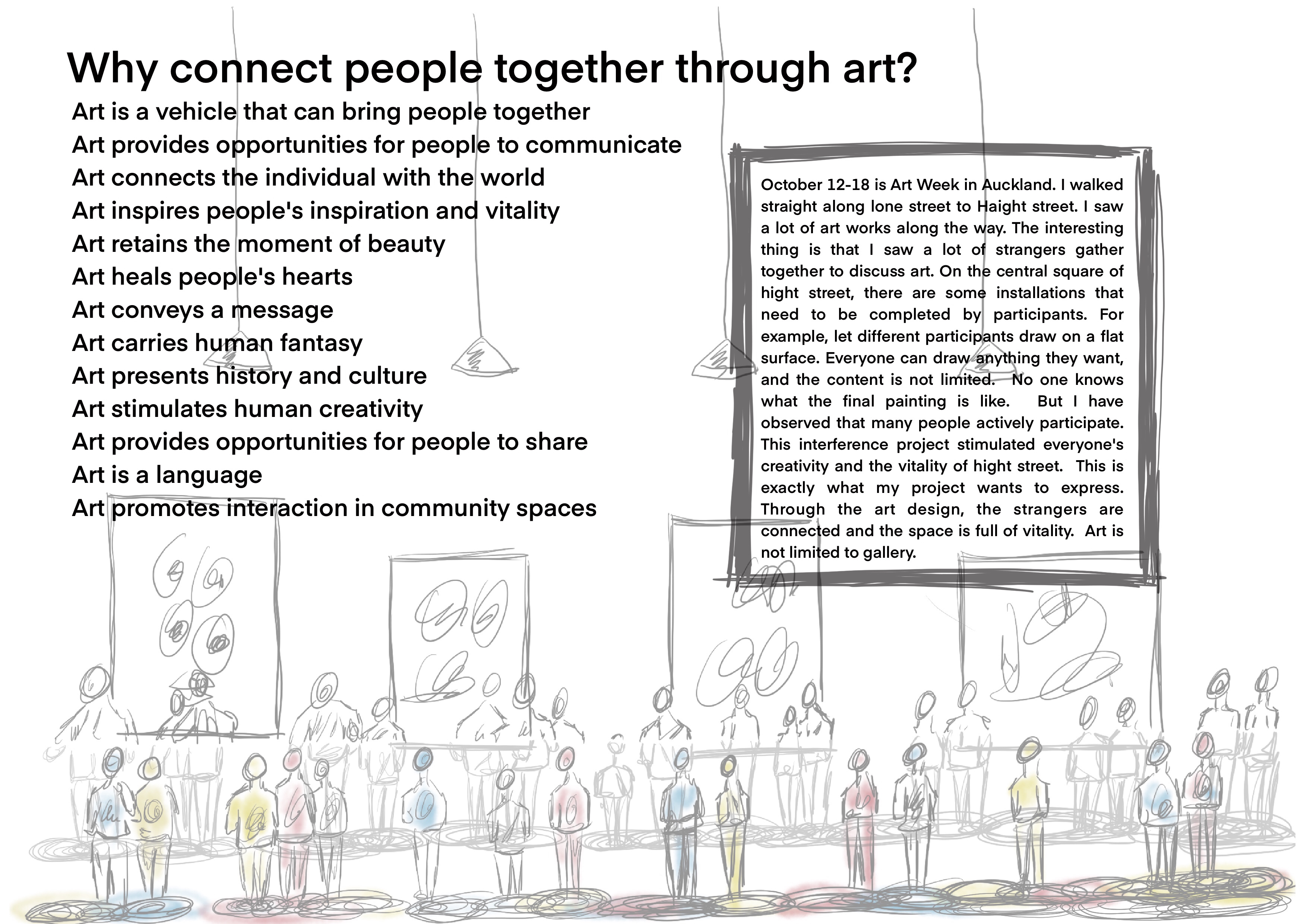
The space I chose is the art gallery, where many people who are interested in art gather here, but there are many ways to express art, not just in the gallery. I want to bring together different strangers through more artistic techniques so that people have more space and ways to communicate art.

What is art?
There are many forms of artistic expression. In my understanding, the scope of art is very wide, including dance, music, painting, humanities history, architecture, film, literature and so on. Through art, the artist reflects his spiritual world, reflects the real-life, and reflects the current social situation.

What did I learn from part two?

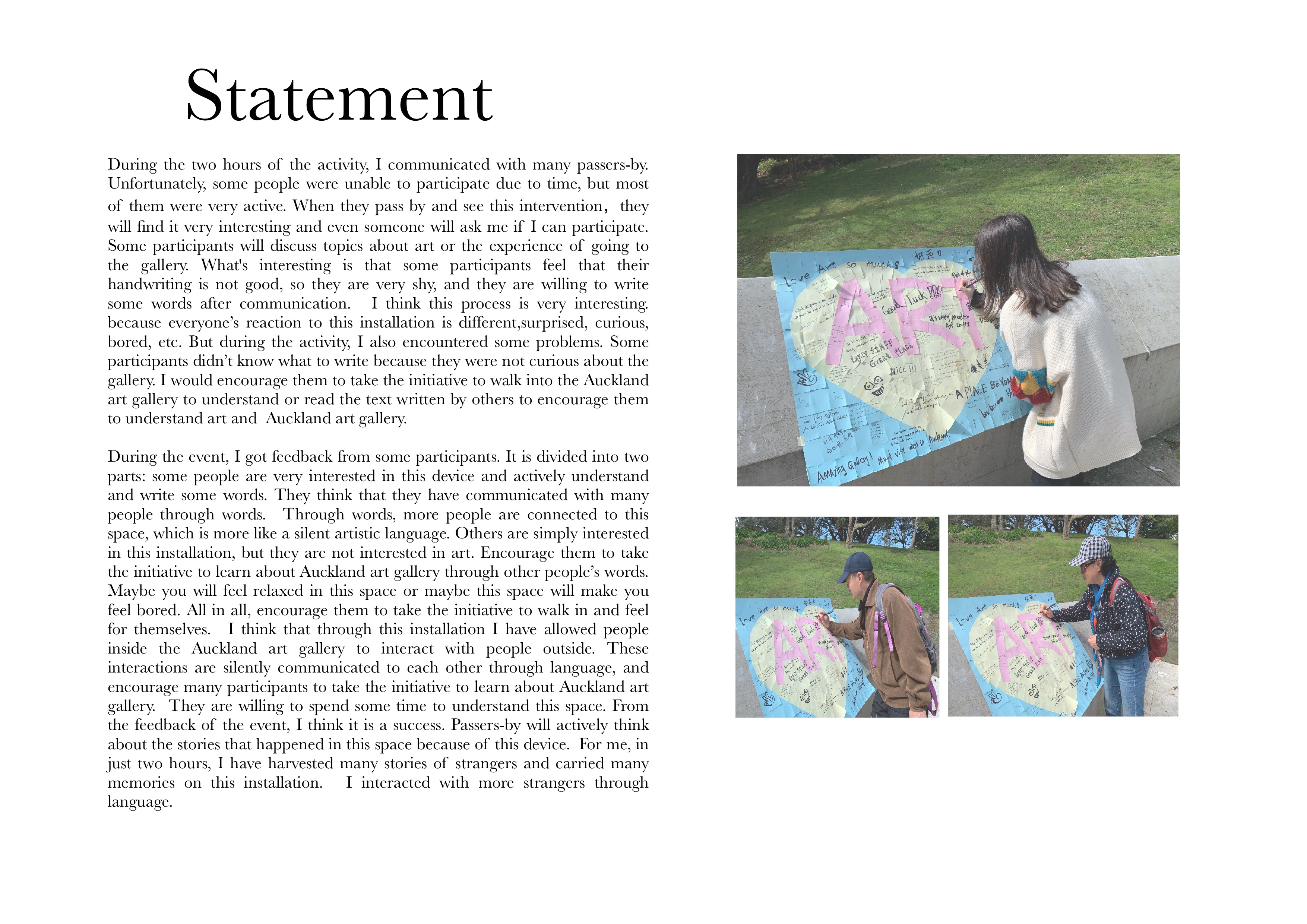
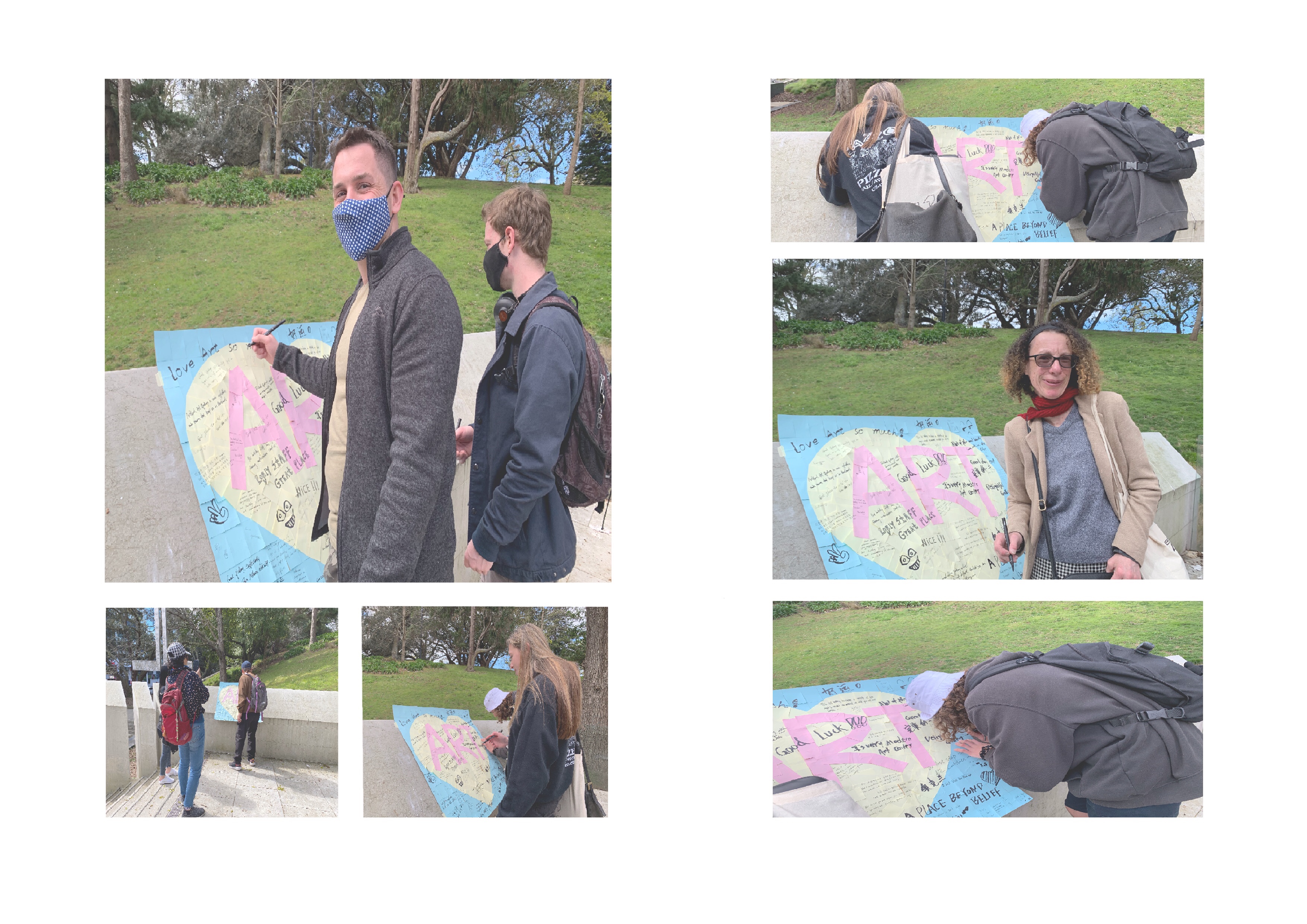
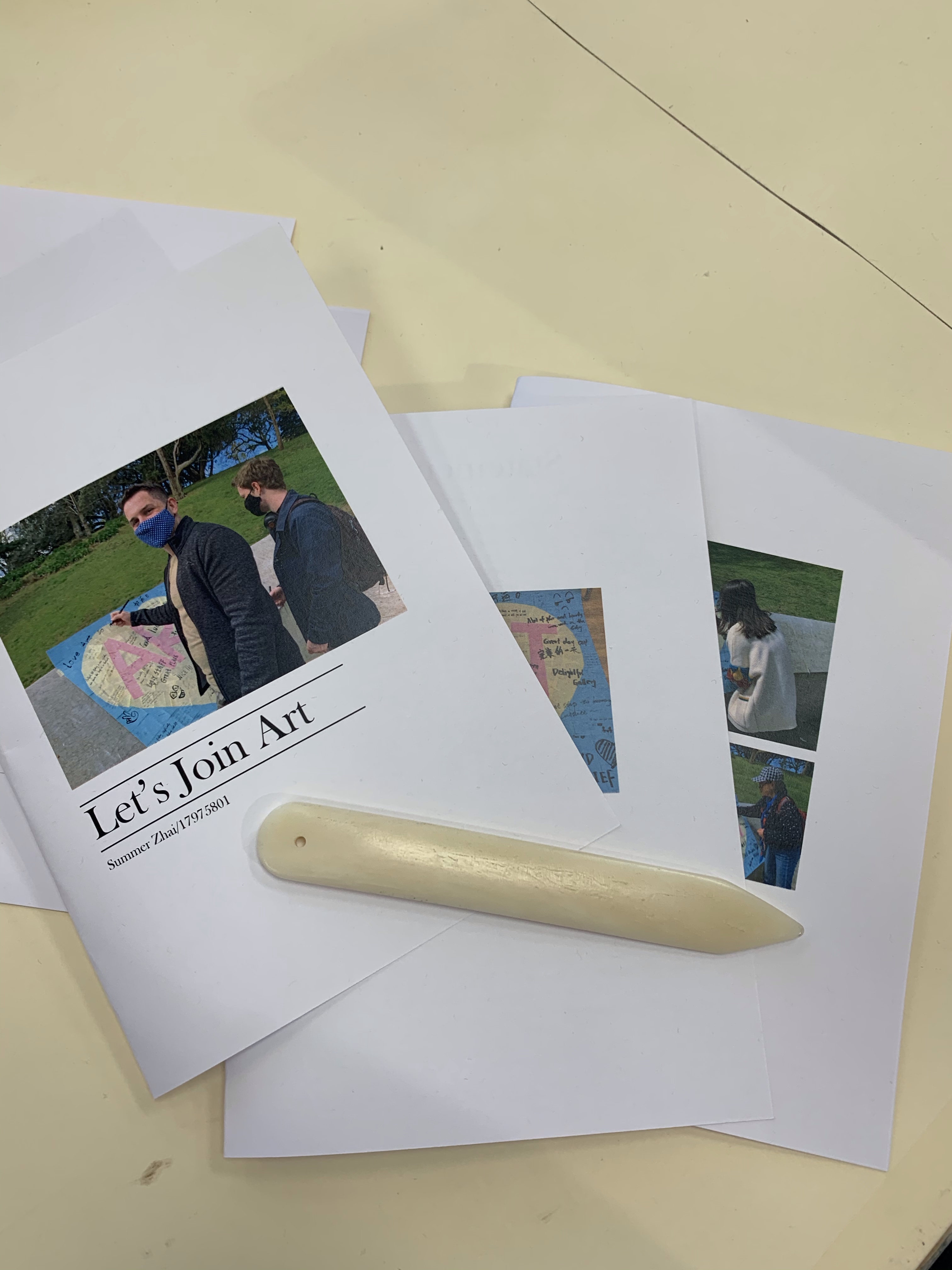
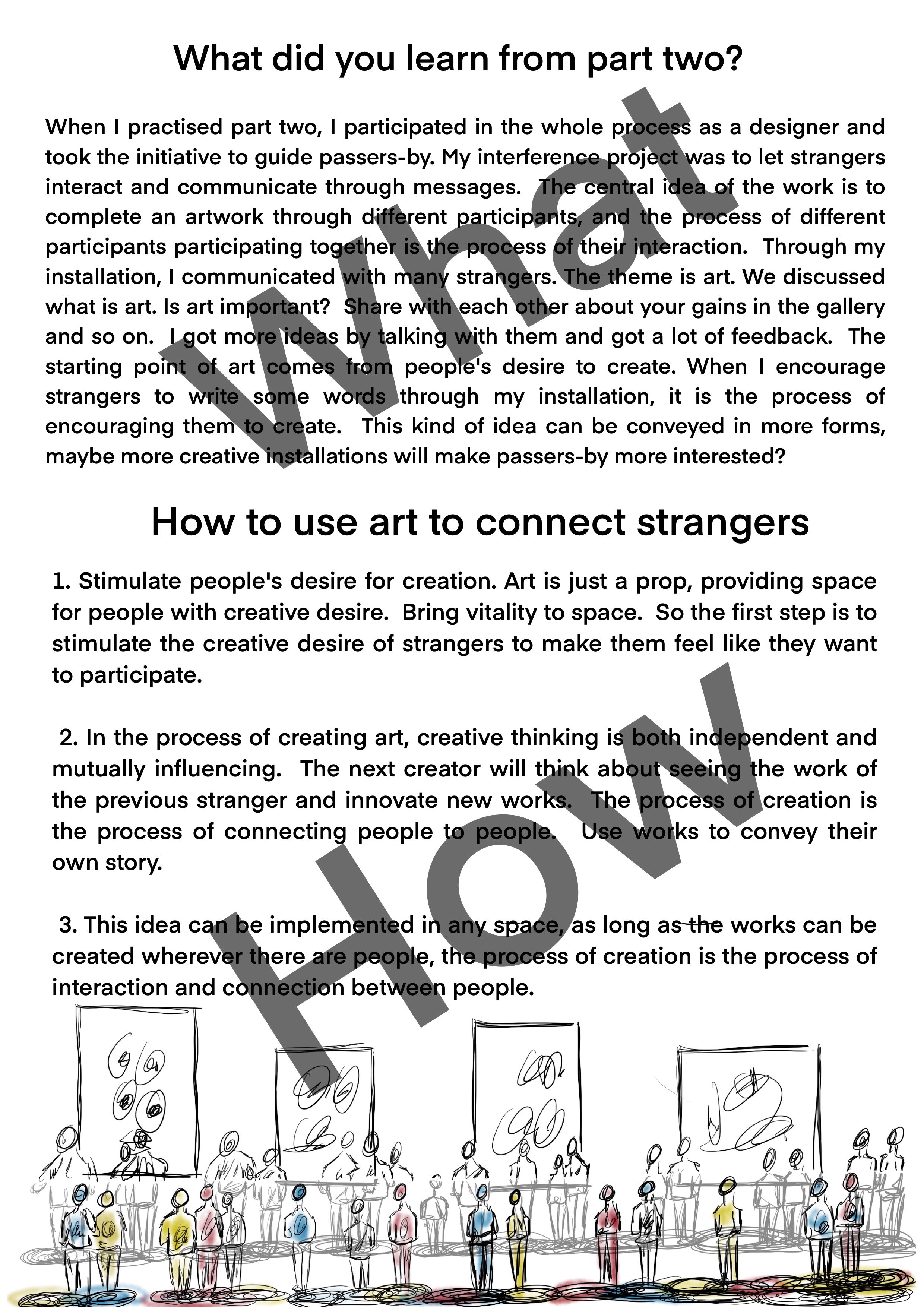
When I practised part two, I participated in the whole process as a designer and took the initiative to guide passers-by. My interference project was to let strangers interact and communicate through messages. The central idea of the work is to complete an artwork through different participants, and the process of different participants participating together is the process of their interaction. Through my installation, I communicated with many strangers. The theme is art. We discussed what is art. Is art important? Share with each other about your gains in the gallery and so on. I got more ideas by talking with them and got a lot of feedback. The starting point of art comes from people’s desire to create. When I encourage strangers to write some words through my installation, it is the process of encouraging them to create. This kind of idea can be conveyed in more forms, maybe more creative installations will make passers-by more interested?

What is manifesto?

A manifesto is a published declaration of the intentions, motives, or views of the issuer, be it an individual, group, political party or government. A manifesto usually accepts a previously published opinion or public consensus or promotes a new idea with prescriptive notions for carrying out changes the author believes should be made. It often is political or artistic in nature, but may present an individual’s life stance. Manifestos relating to religious belief are generally referred to as creeds.

Analysis

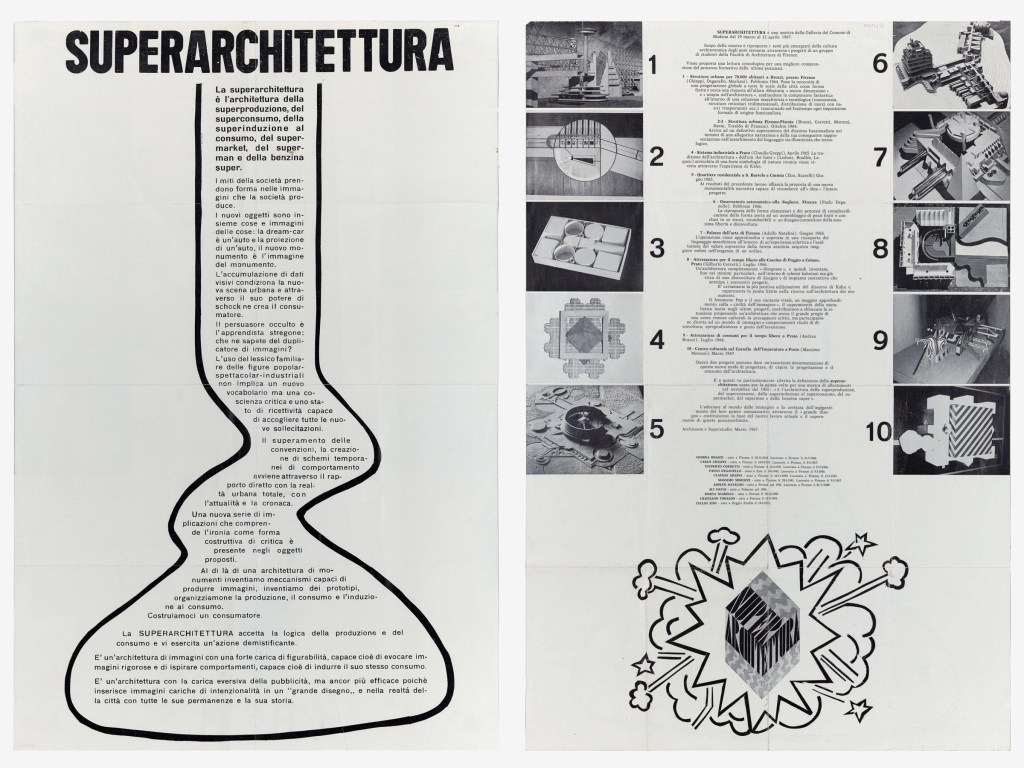
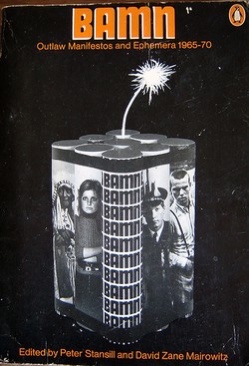
The overall layout is very clear and has a unique design effect. The picture is uniform in tone and marked with a serial number.

The styles of the two declarations are very similar. Also highlight the obvious fonts to express the theme, and use two different fonts to reflect their own style. The content is clear and the layout is simple. And the use of simple colors makes the overall style more unique

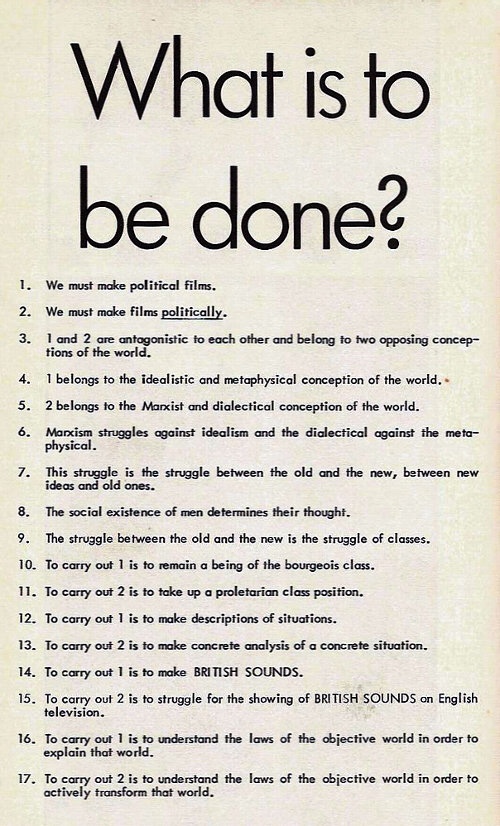
The ten school rules from the principal are simple in layout, and the overall layout uses the same type of text with clear content. Very simple design but very powerful with text.

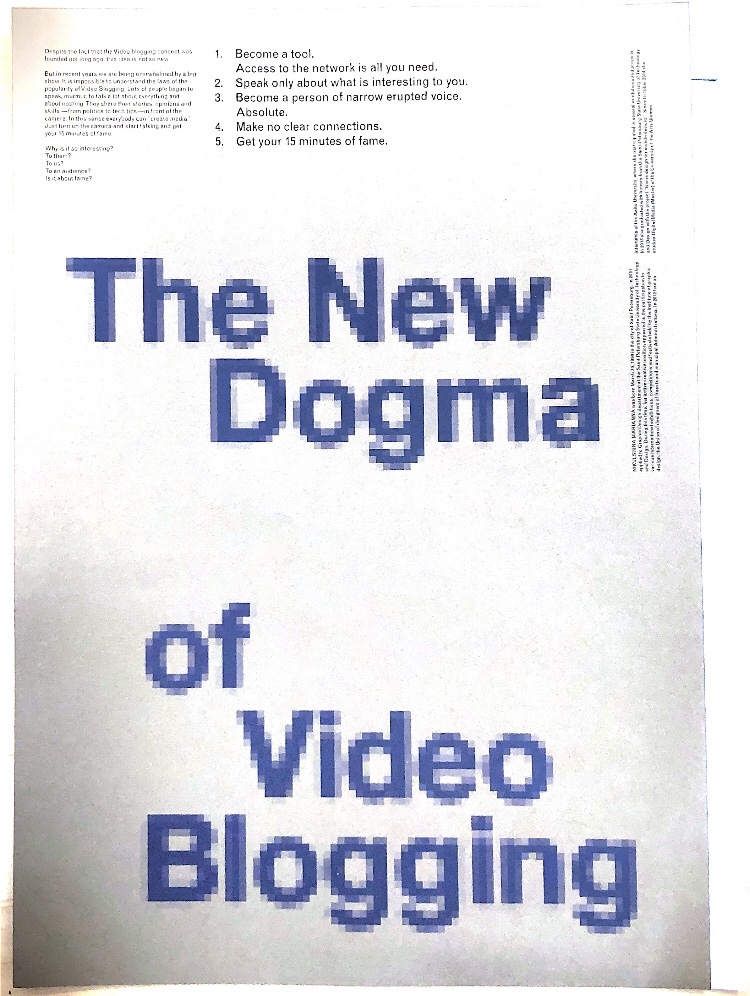
The manifesto is an advertisement. This manifesto doesn’t look so serious and relaxed. I think this is its own style. To some extent, this unique design makes this declaration very unique and powerful.

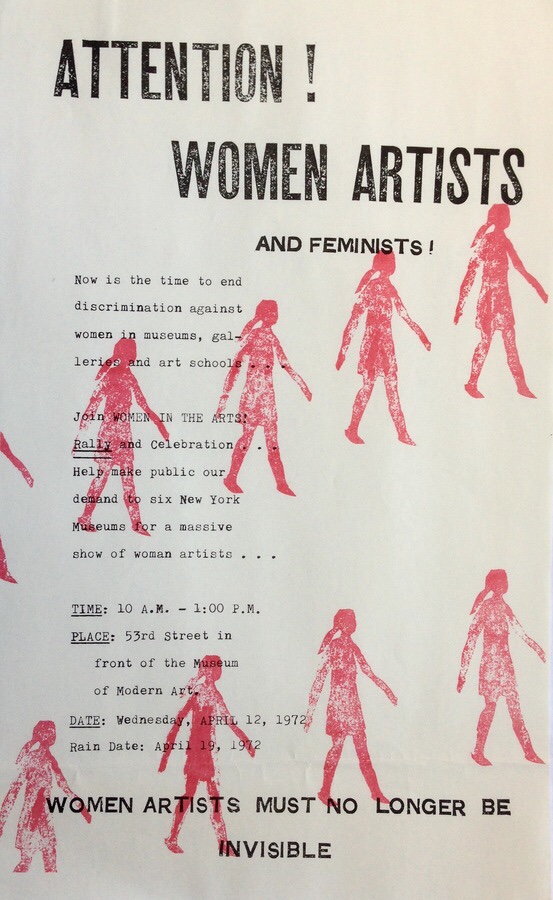
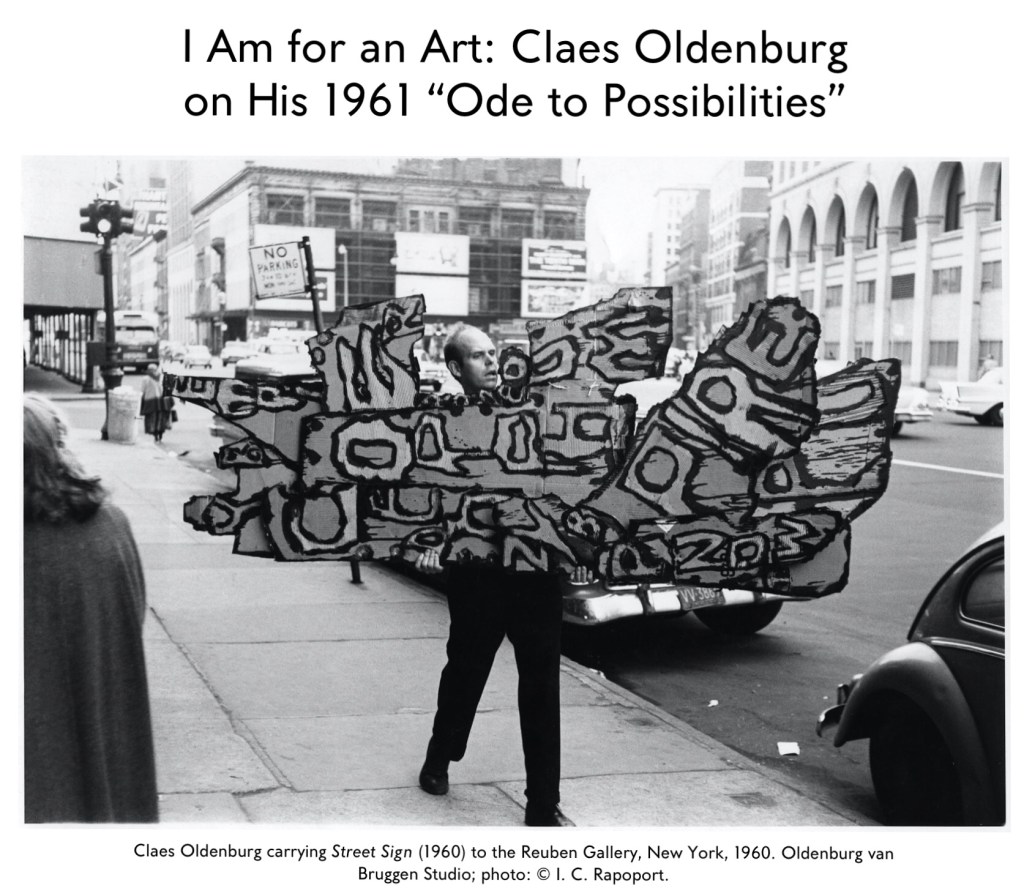
This is another form of the declaration, which has many forms. This is a form of revival in 1962. There is very little text, but the picture has a certain strength and is very clear. This looks more like a poster

This declaration is a classic style. The layout is simple, and the title is used to interpret the meaning of this declaration. The content is powerful and it is conveyed in a simple and direct way. There is no picture to support, the overall tone uses normal black

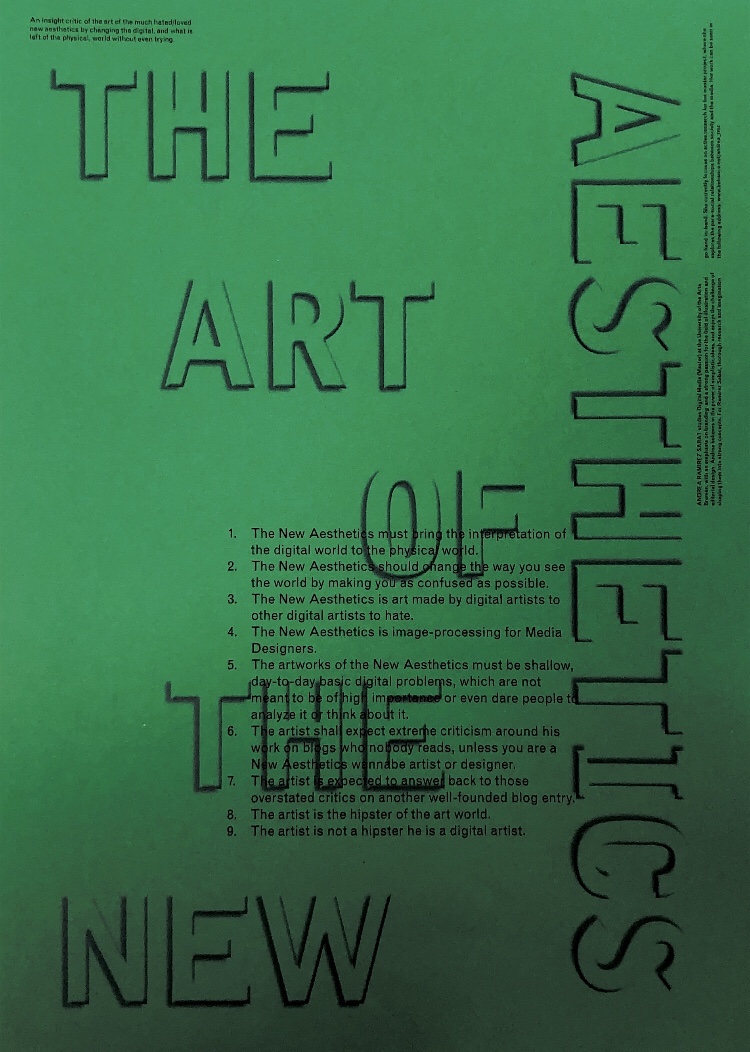
This declaration is very similar to the previous one. But the difference is that it uses different font sizes and typography to attract people. Words are powerful, and there are languages that can trigger people’s thinking. Without pictures, use simple and powerful text to support.

This declaration is very unique, the overall tone makes people feel very cute, but watching the content by yourself is very powerful. Some cute stickers are designed in the blank space. The color of the font matches the content. This is a declaration that people will not feel offended. Cuteness is its charm.

The text of this declaration comes from handwriting. It is difficult to distinguish, so I think the font is very important, it directly affects the viewer’s impression of him. But I like the overall style very much, it’s relaxed, and the colors are simple.

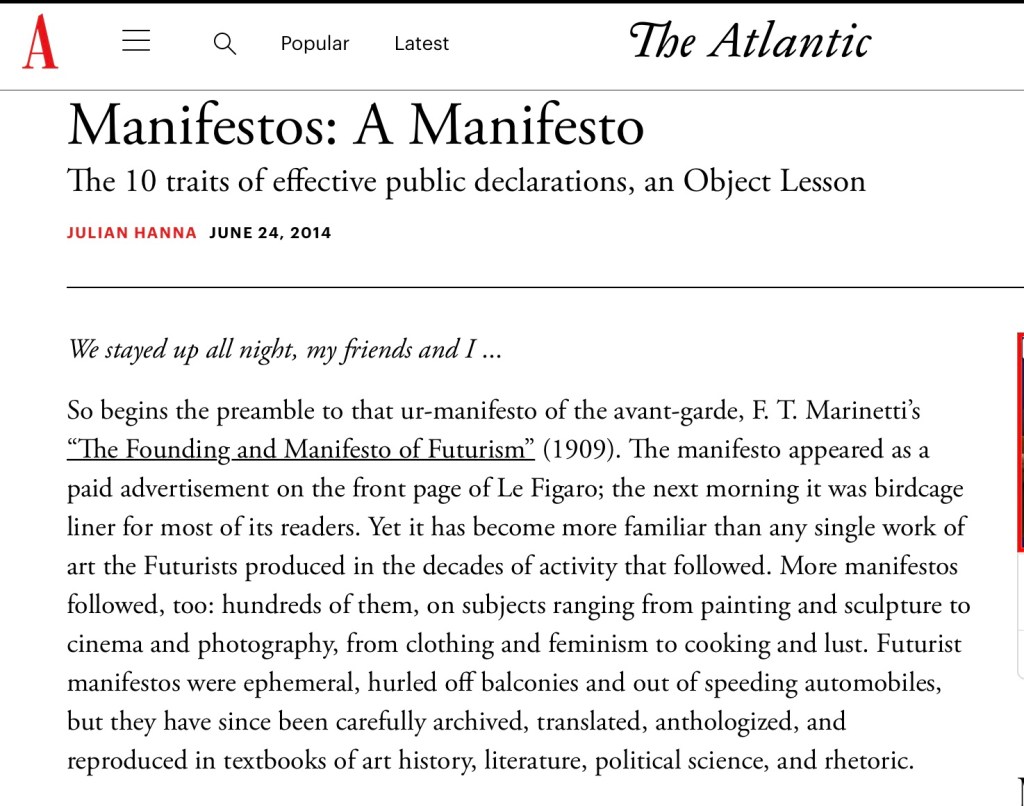
https://www.theatlantic.com/entertainment/archive/2014/06/manifestos-a-manifesto-the-10-things-all-manifestos-need/372135/

So what makes a good manifesto?

1. Manifestos usually include a list of numbered tenets.

2. Manifestos exist to challenge and provoke.

3. Manifestos are advertisements.

4. Manifestos come in many forms.

5. Manifestos are better very short than very long.

6. Manifestos are theatrical.

7. Manifestos are fiction dressed as fact.

8. Manifestos embrace paradox.

9. Manifestos are always on the bleeding edge.

10. Manifestos are magic (almost).

This declaration is a bit difficult for me to distinguish, and I cannot distinguish its content simply and quickly. But this form is very unique and I like it

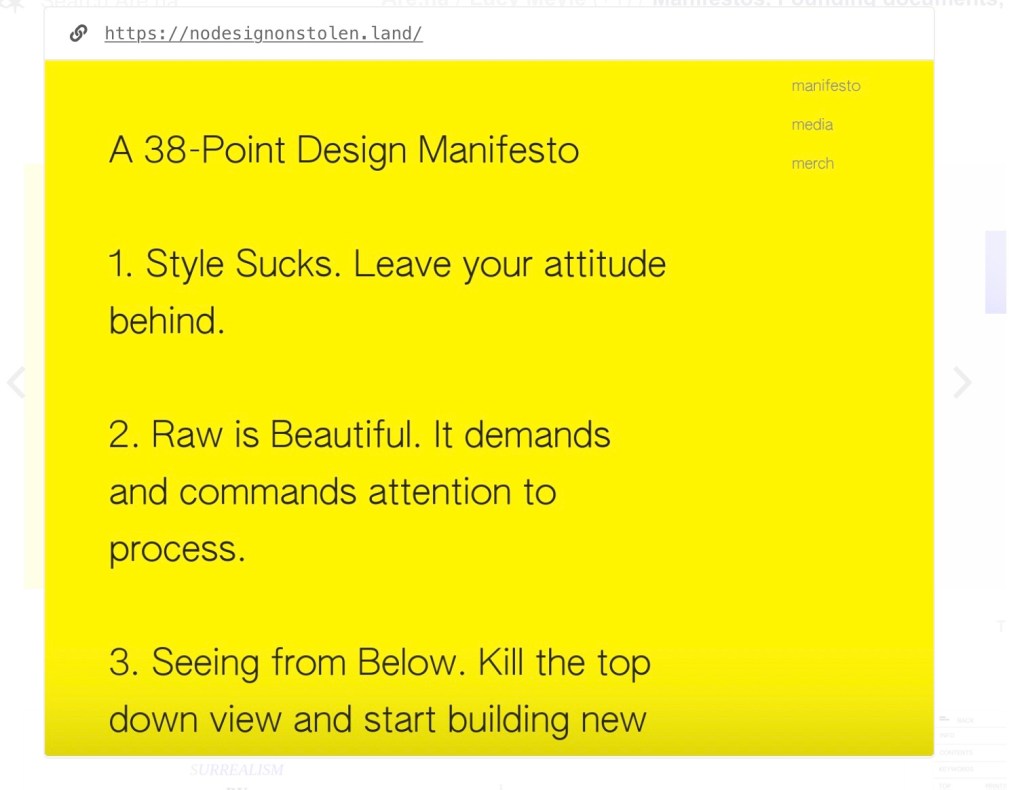
https://nodesignonstolen.land/

What should I pay attention to after studying these manifesto?
First of all, the content of the manifesto must be powerful, and every sentence should be short.
The use of fonts must be combined with the overall layout.
Uniform style, picture and text, tone
The picture must have power.
Typesetting can be simple and easy to understand.
The content is clear.

An Archive of Manifestos

These are the first three declarations. It is a pity that they were very failed. After talking with Rachel, she gave me some suggestions. First of all, these three pictures are not a declaration, because the content is too simple. I should have a clear subject and write clearly what my declaration will do? What is the theme? What is the purpose? Secondly, I should write some simple but powerful words around my subject.

After this part I realized that I didn’t have enough manifesto, I should look for more information to see more manifesto. Write down my feelings and thoughts, etc. I should learn more about text, pictures, colors, typography, etc. to design my manifesto.

Four of the manifesto drafts

This is the second time menifesto talked to Rachel. Unfortunately this part is still a failure. The content is not clear enough, I just explained what is art? But there is no clear goal on how art will be used? And the background of this menifesto coincides with the text. This will affect the reader’s view.

I will continue to find manifesto to learn. Learn how other authors write simple and powerful words and learn how they typeset. I think the harder part for me is to write simple but powerful words. In this part, I am still very confused and don’t know how to continue to develop. I will continue to study and explore in depth. I think that in the next step I should clarify my theme and develop around my theme.

This is the third text discussed with Rachel. This is a good start. My subject is clear and well developed, but in this manifesto I have elaborated on my project too much. This will not be applied to my project. I should continue to develop. And in the first half, I elaborated on my reflection on part two, which should not appear in manifesto. There are some minor issues that I should correct. I am very happy to finally start to develop in a good direction. The typography should continue to improve.

Final Menifesto

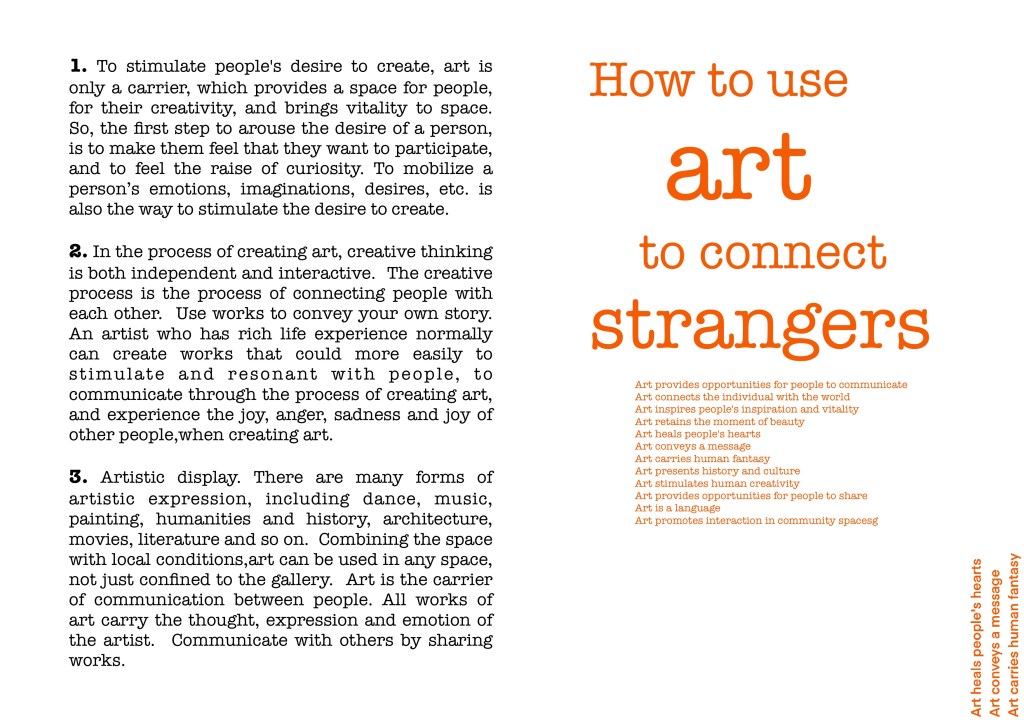
In the final manifest, I reorganized my ideas, adjusted the overall layout and removed some pictures that would affect the text. The overall style is very simple, but I made new adjustments to the font. I used two different colors. The orange heading will be more eye-catching. Let readers know what the subject of this manifest is? The black body part is described step by step, and the content can be clearly understood.

Presentation

Spatial Fabrication Studio 2020

Week 3 – Site Visit

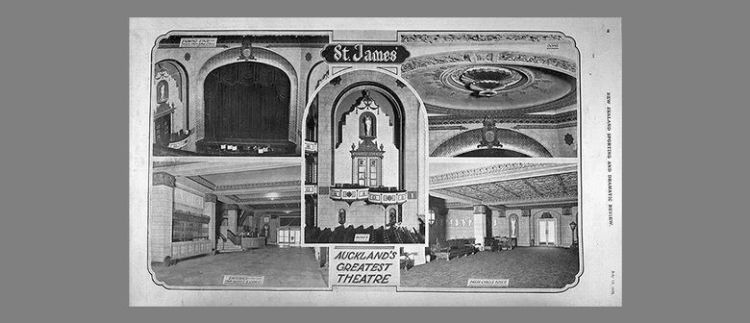
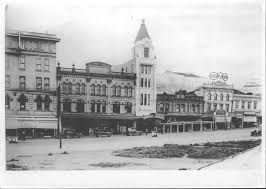
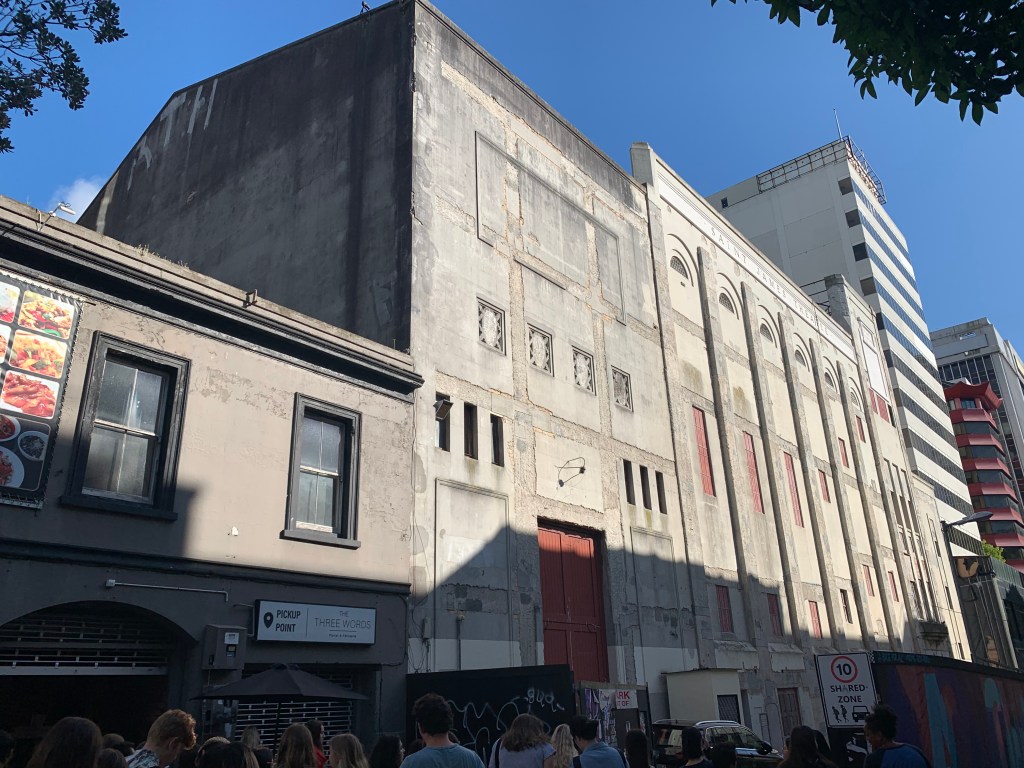
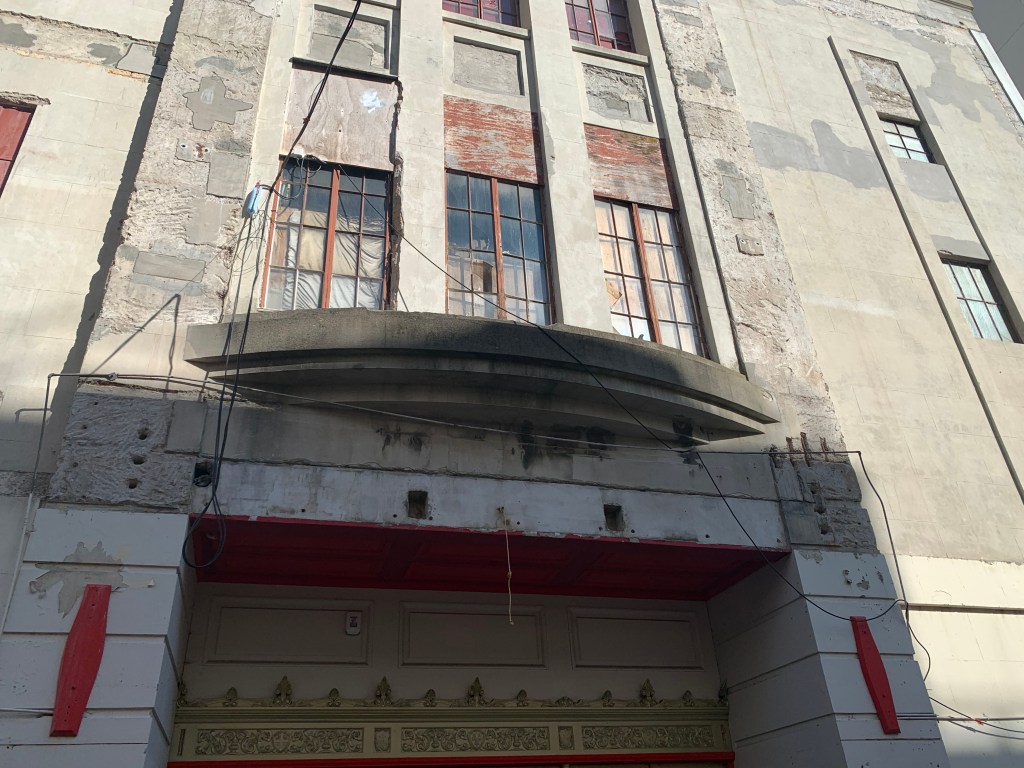
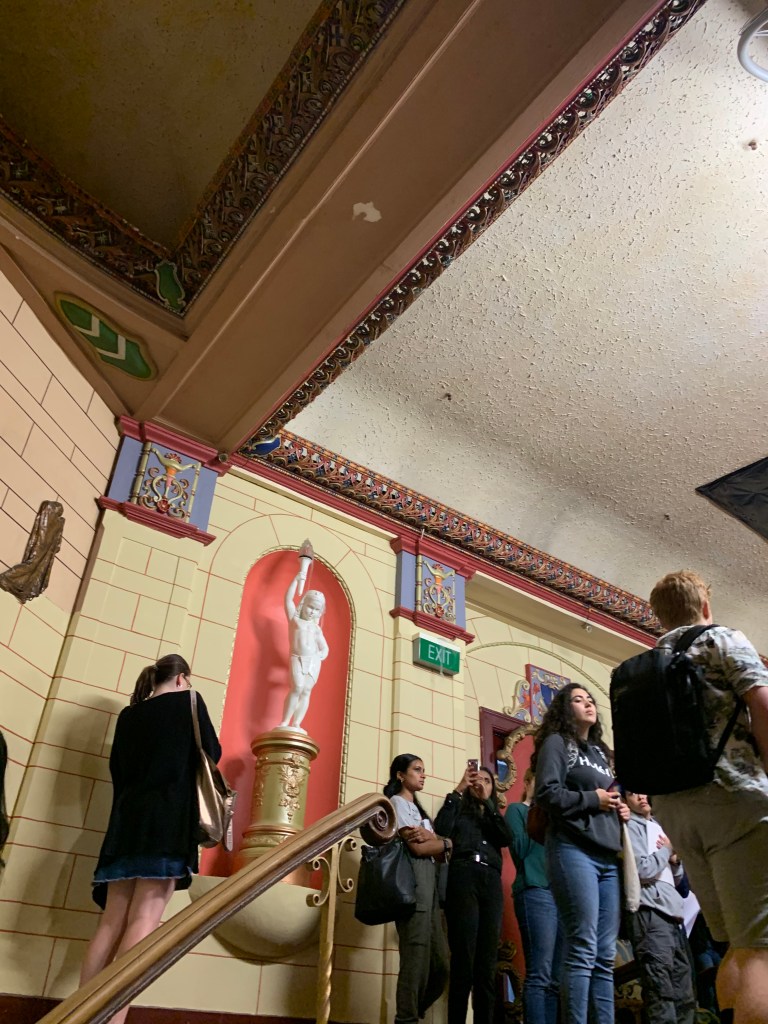
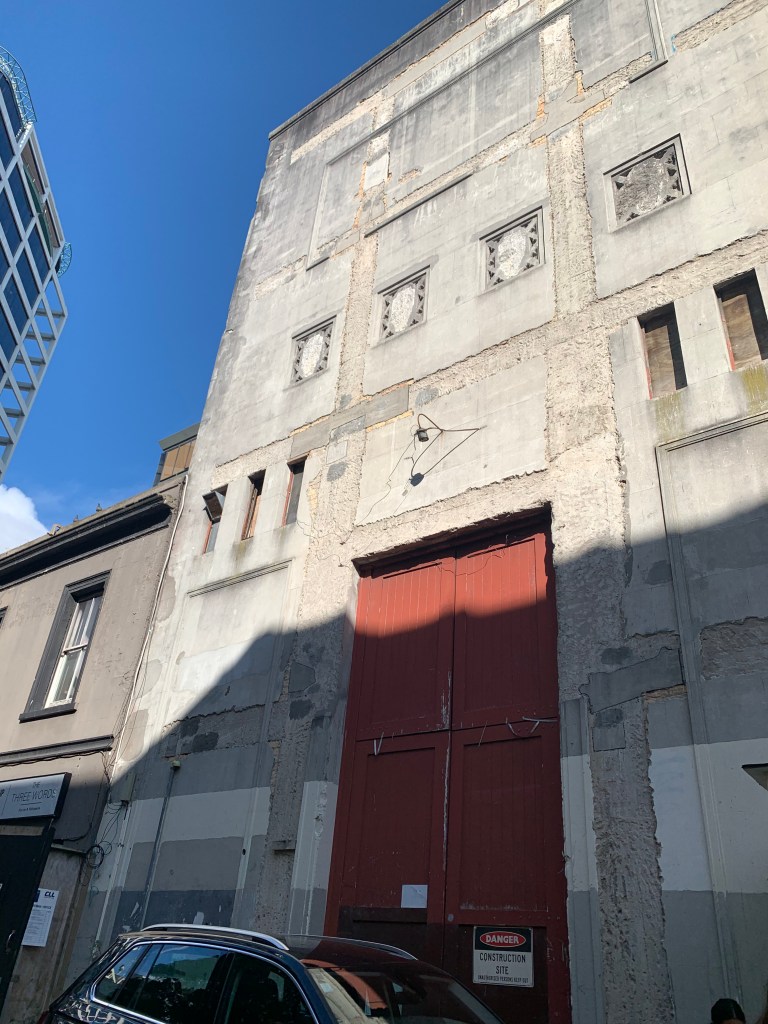
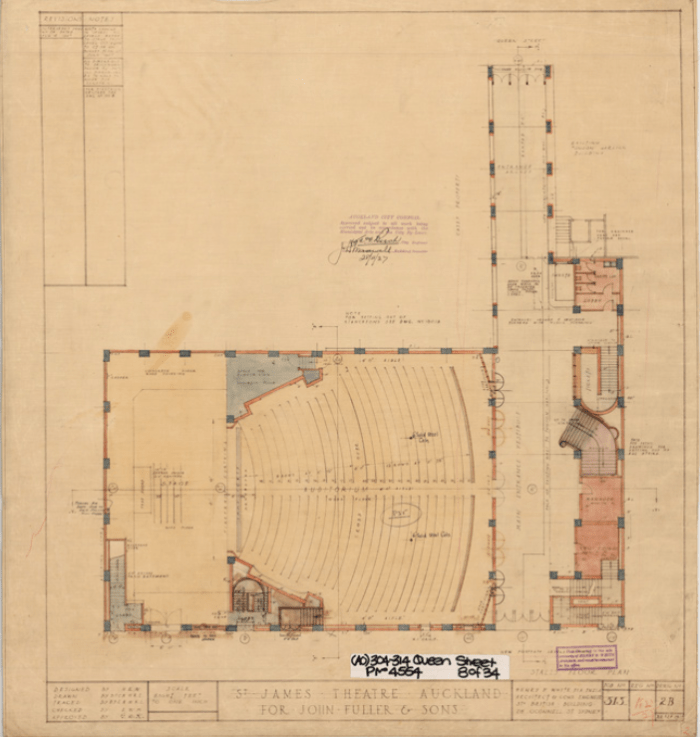
The St James Theatre is a heritage stage theatre and cinema located on Queen Street in Auckland, New Zealand. Built in 1928, it was a replacement for the older Fuller’s Opera House and was originally designed for vaudeville acts. Its architect Henry Eli White also designed many other famous theatres in Australia and New Zealand including the St James Theatre in Wellington and the State Theatre in Sydney.

The theatre has been closed since 2007 after a fire raised concerns about safety and compliance. Purchased by Relianz Holdings in 2014, it is a restoration project with an Auckland Council contribution of $15 million. Buildings on the adjacent sites were demolished by late-2016 to make way for the St James Suites, a 39-level, 309-apartment project.However, in July 2019, no work had been done on the theatre since 2015 after funding for the apartment complex was lost.

The theatre is classified as a “Category I” (“places of special or outstanding historical or cultural heritage significance or value”) historic place by the New Zealand Historic Places Trust.

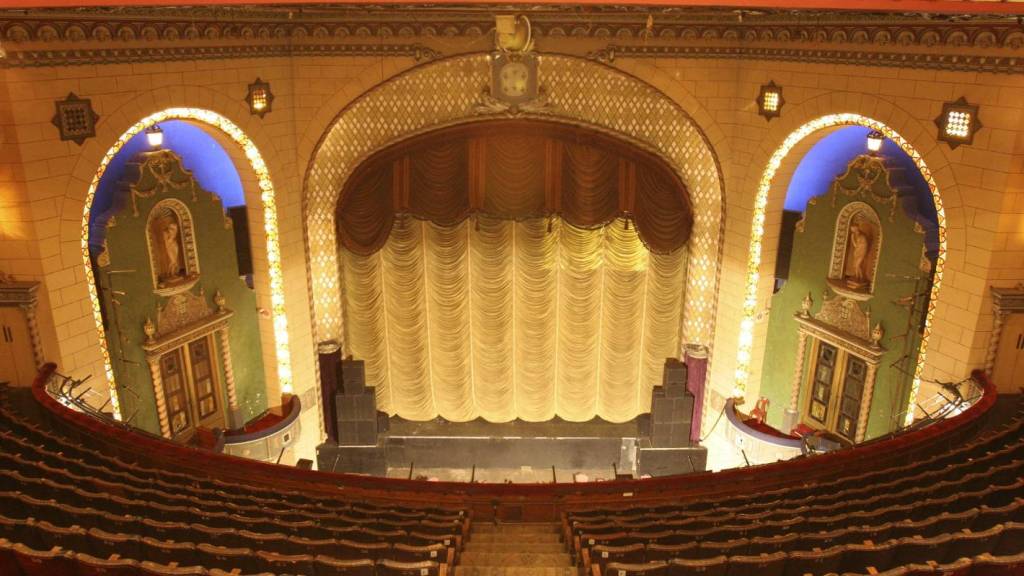
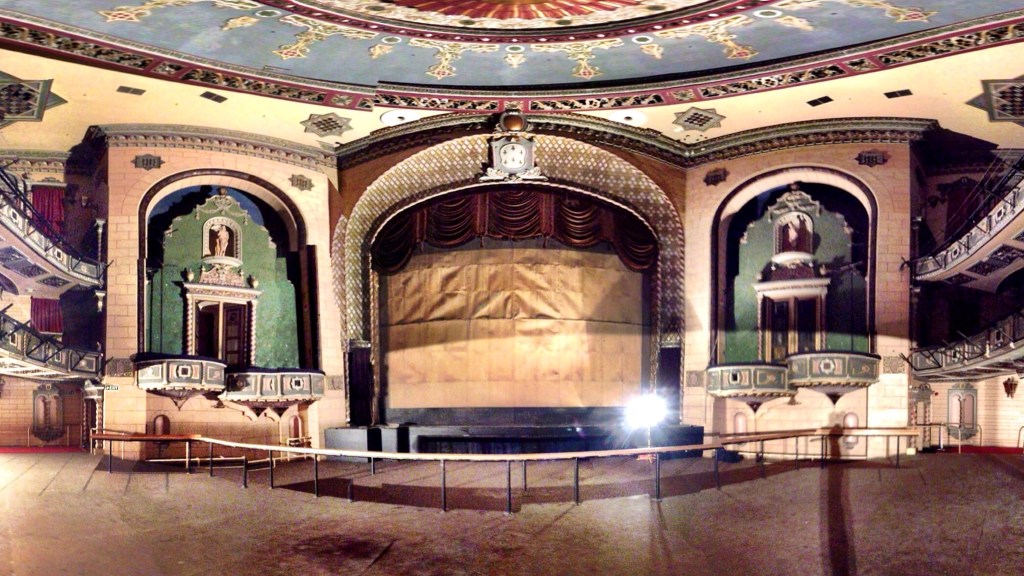
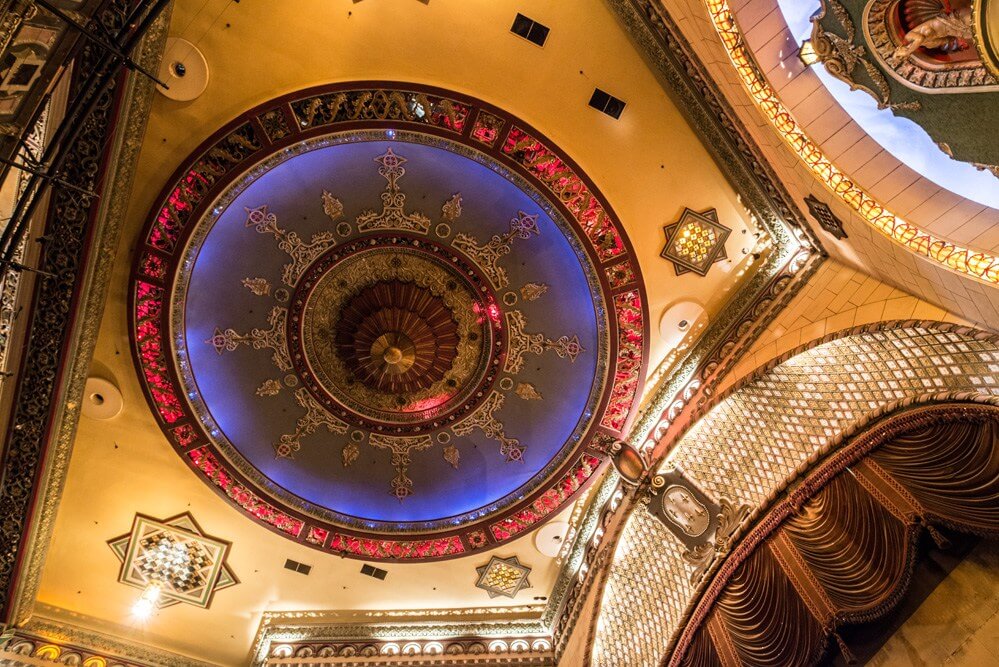
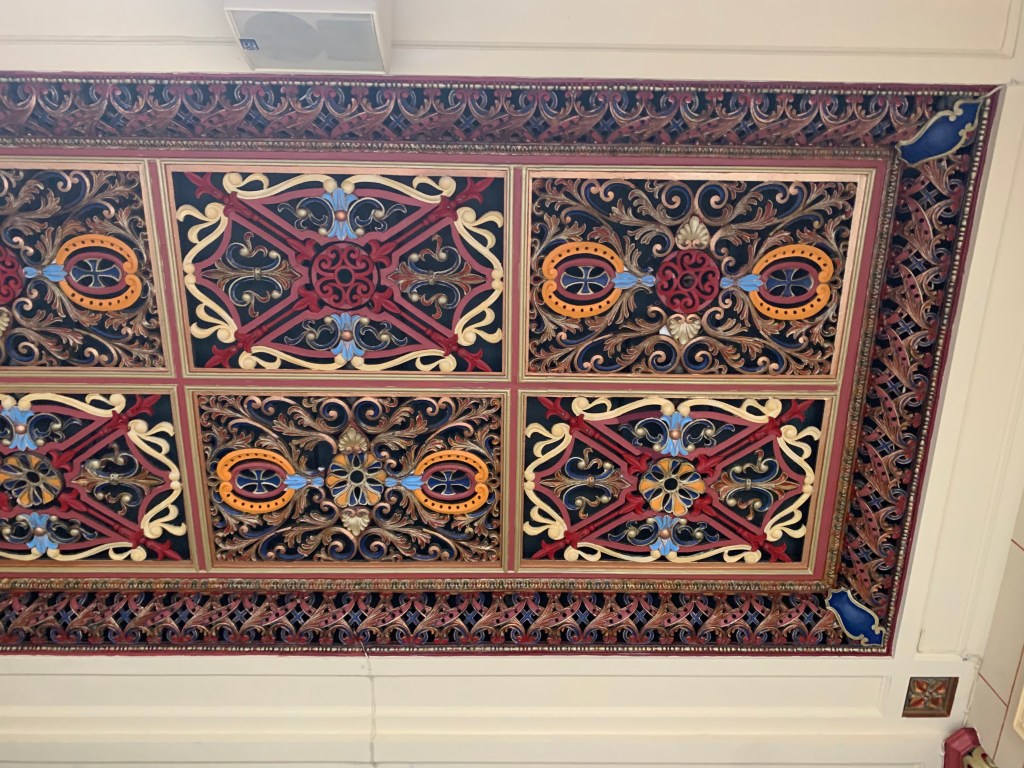
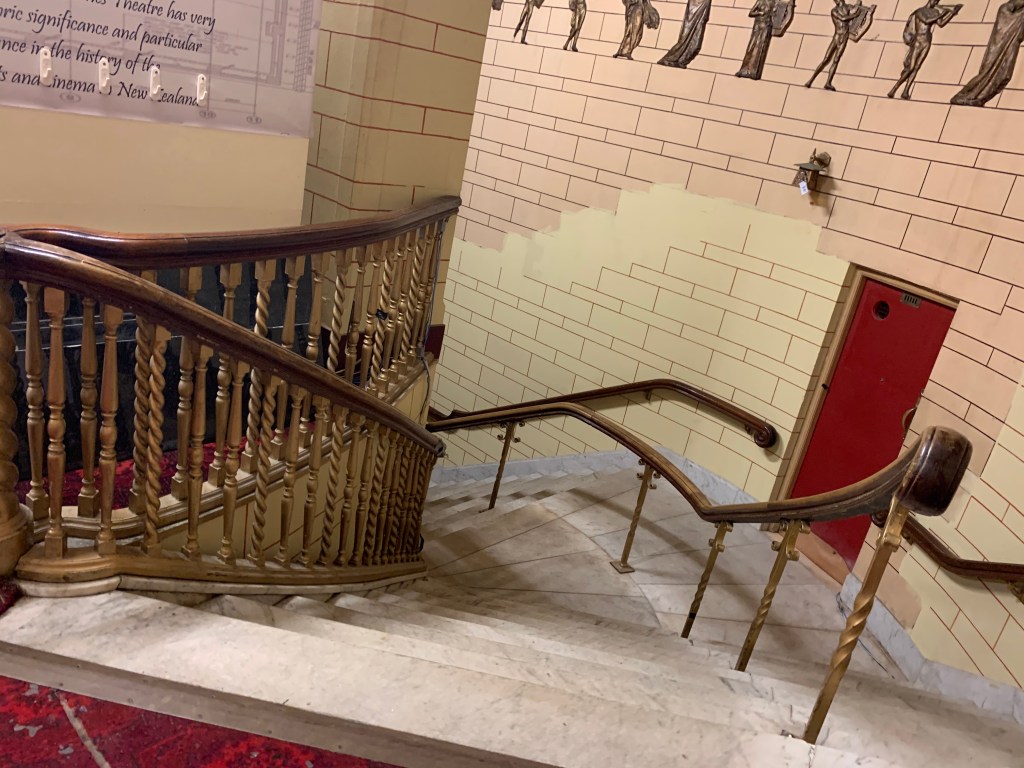
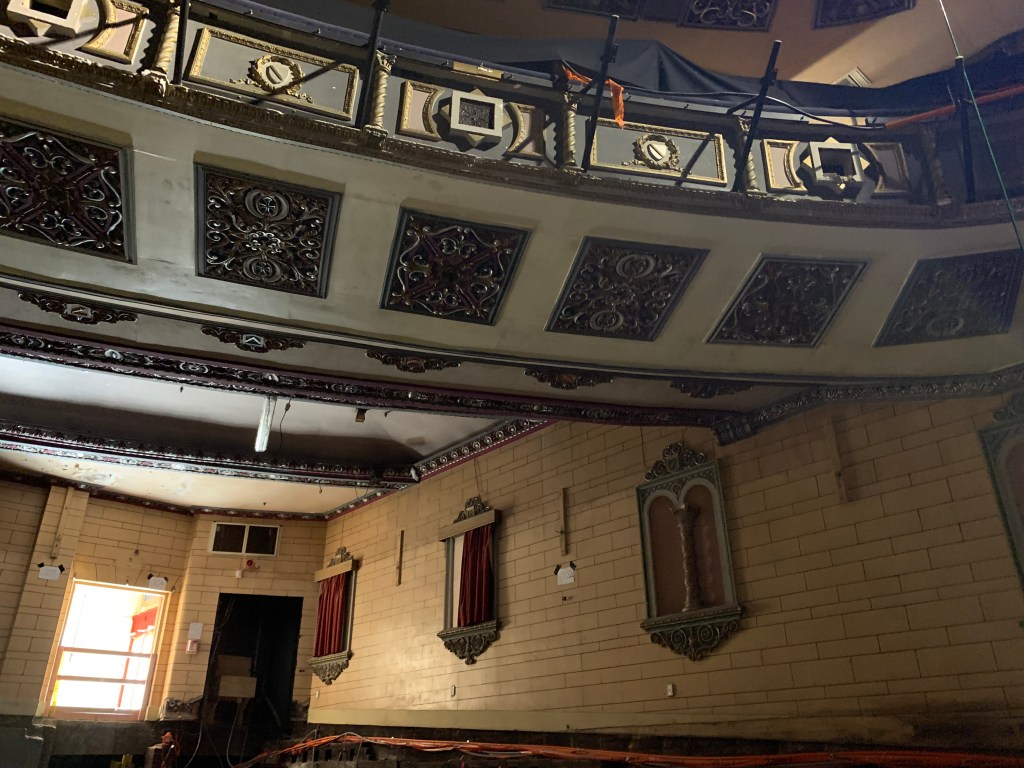
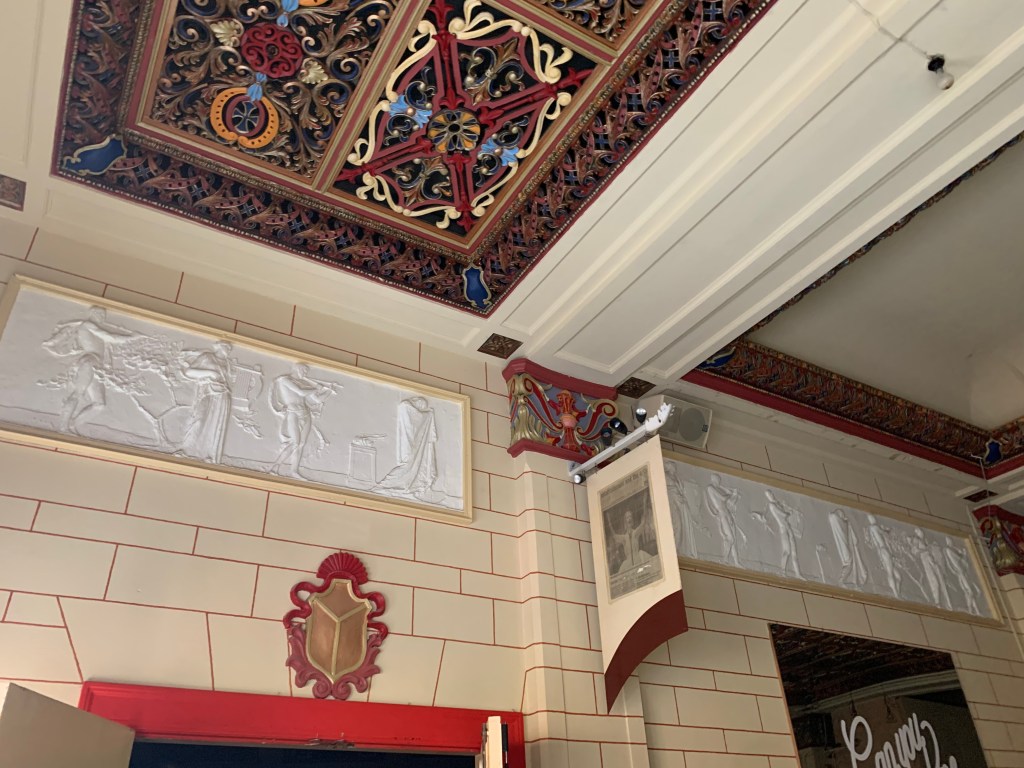
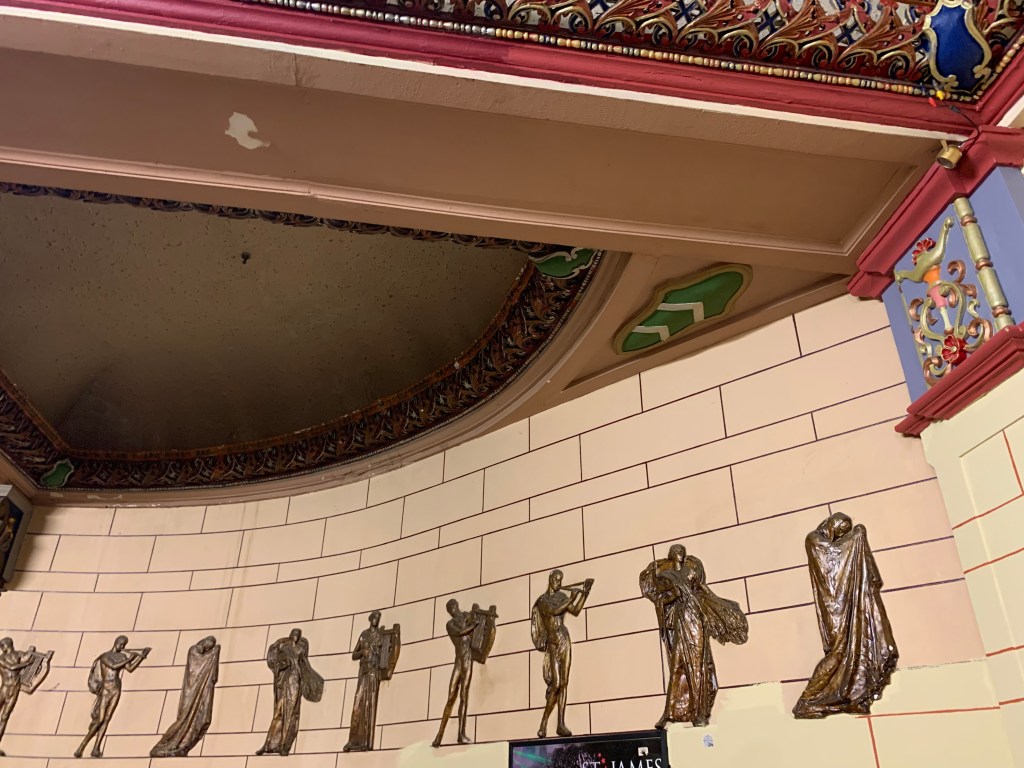
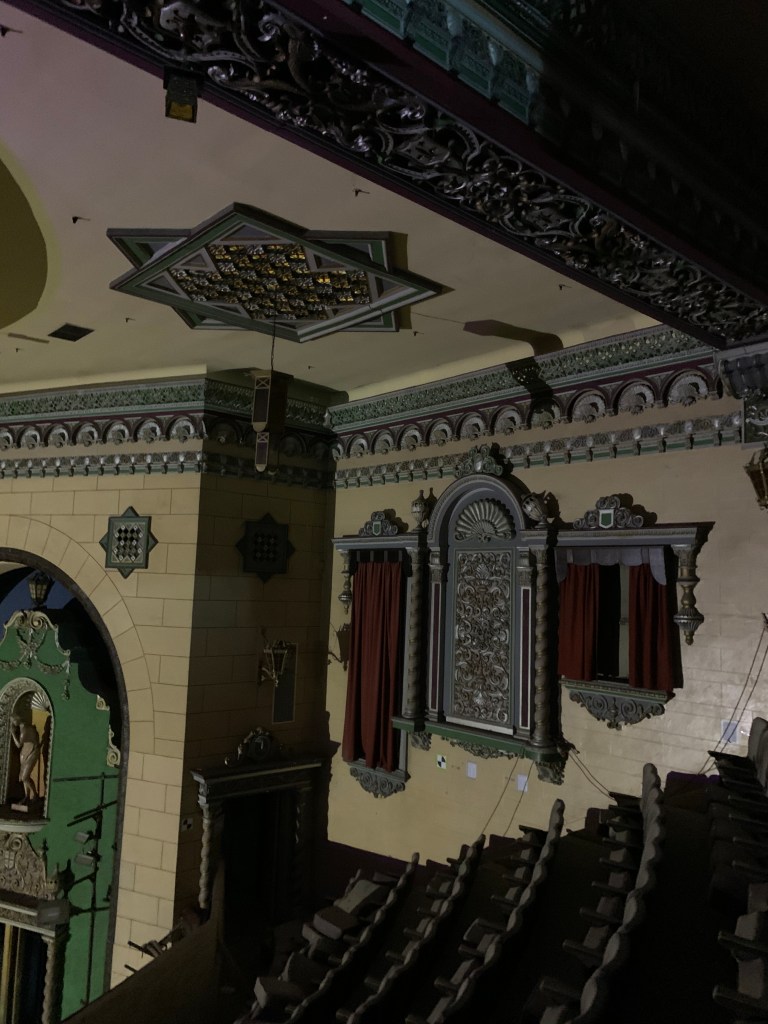
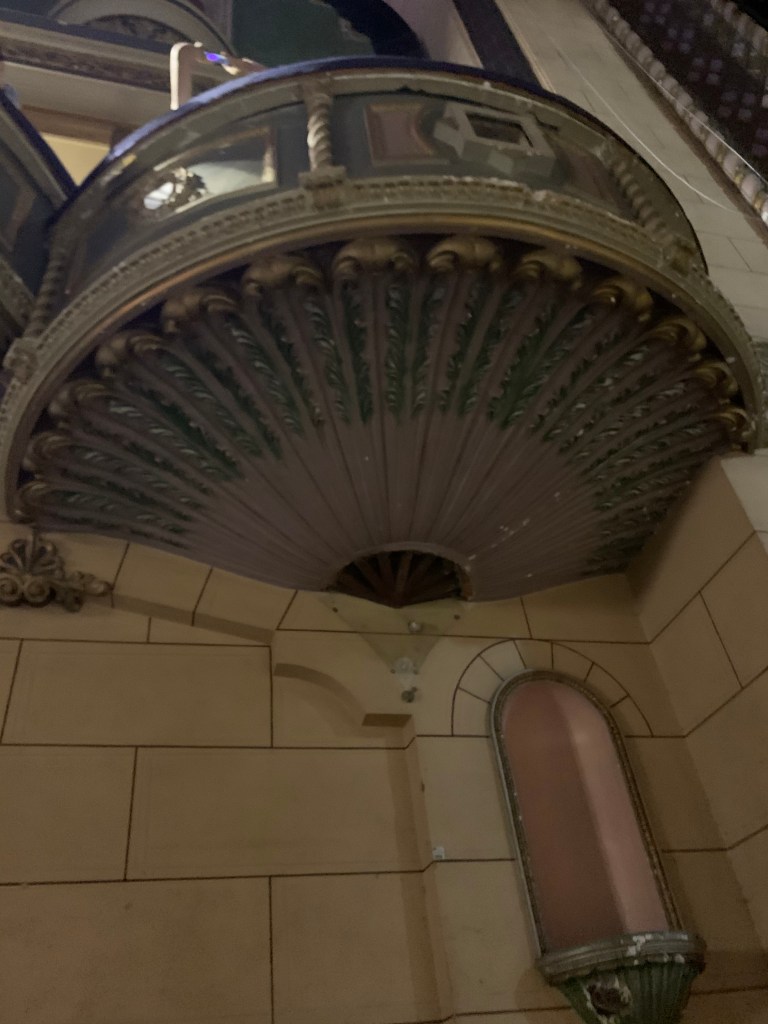
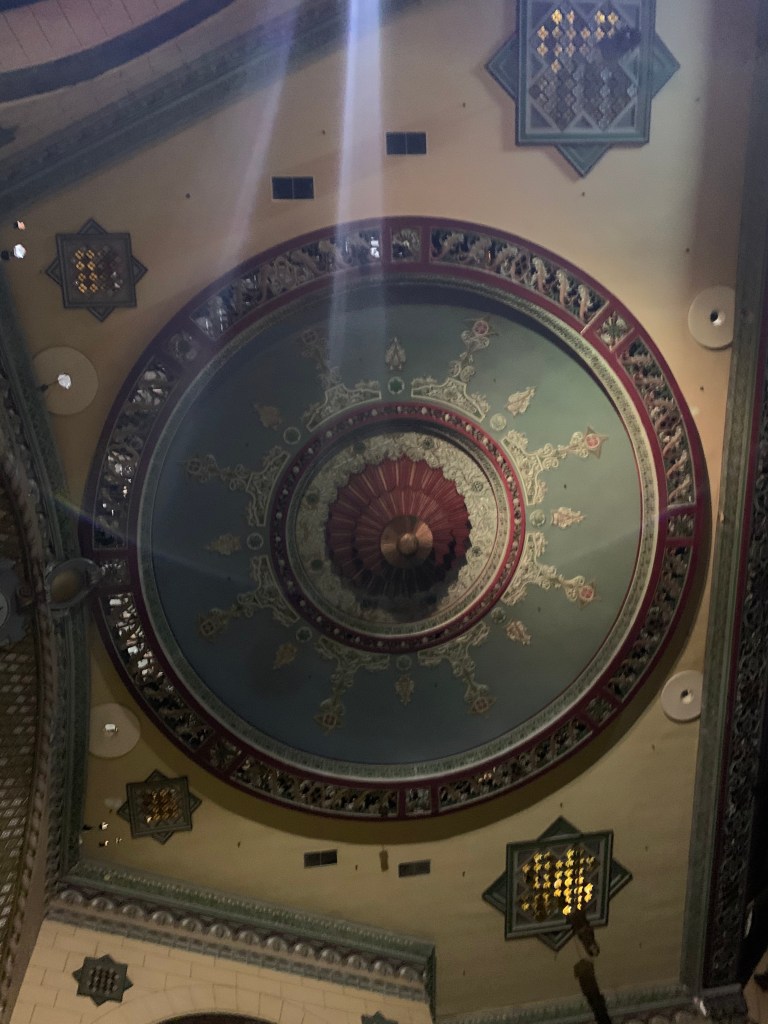
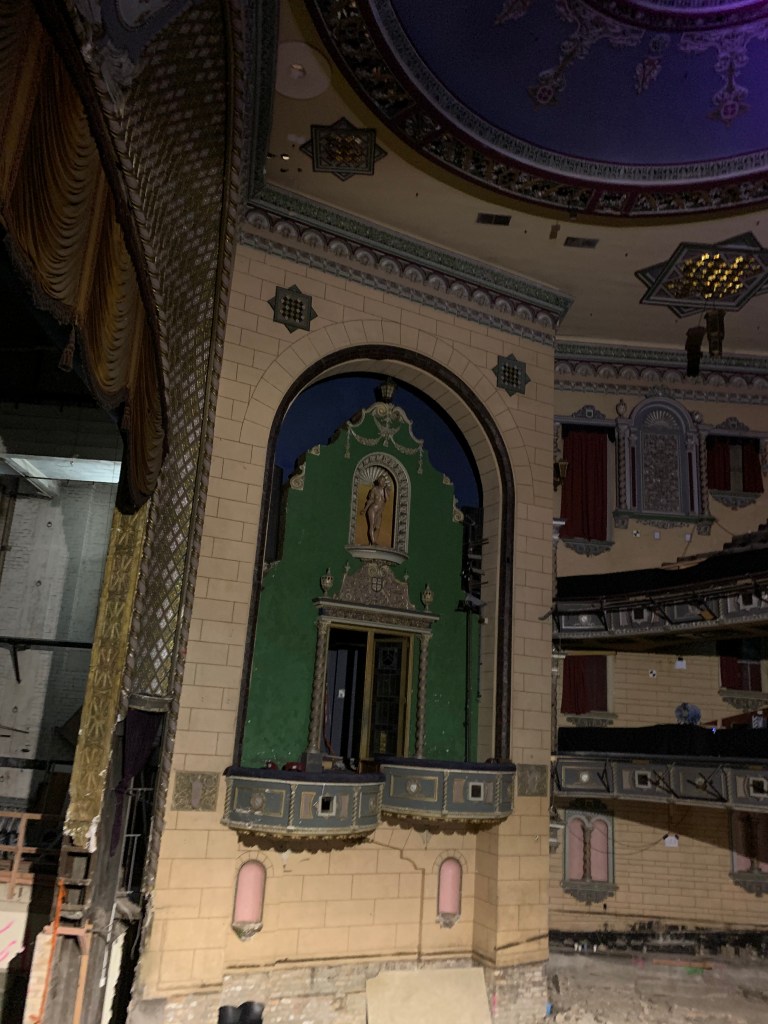
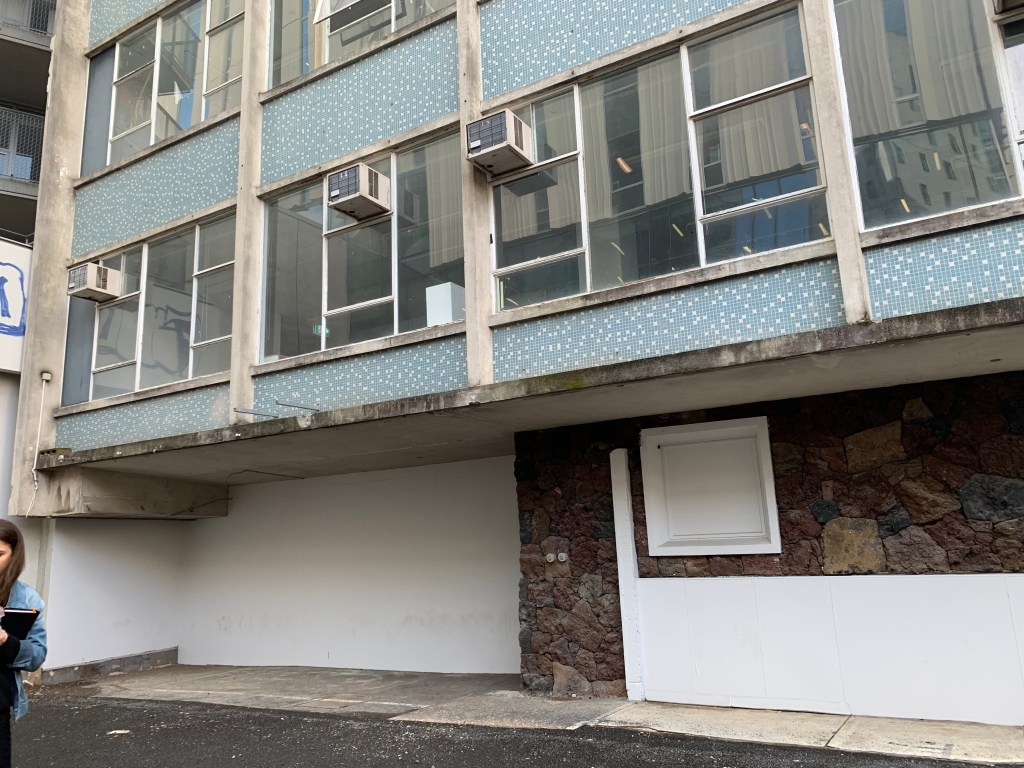
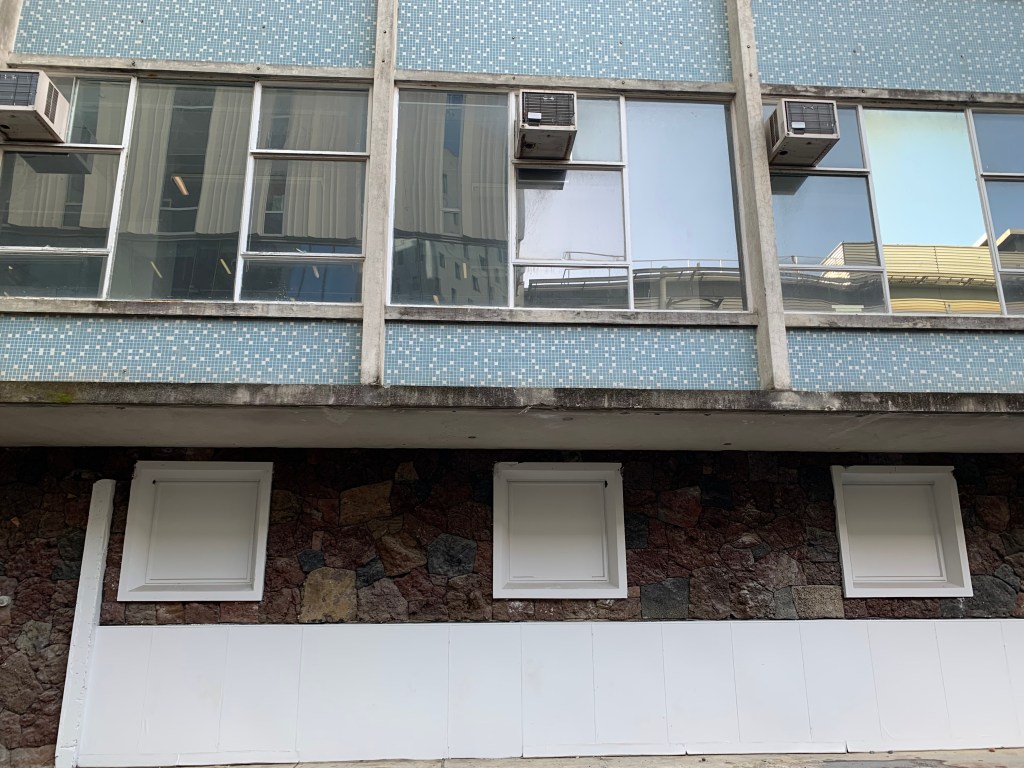
This week we visited the St James theatre. The first impression is that this is a very challenging project. Because this theatre has a long history and I entered the theatre immediately I felt its culture atmosphere. What impressed me was the frescoes on the roof and the decorations on the walls. The main colour is red, the colour is vivid and the pattern is clear. When I entered the grandstand, I was once again attracted by the design of the roof. The circular pattern enveloped the center of the grandstand. The bright colours on the interior walls intersect with the light to produce different effects.

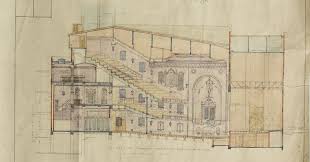
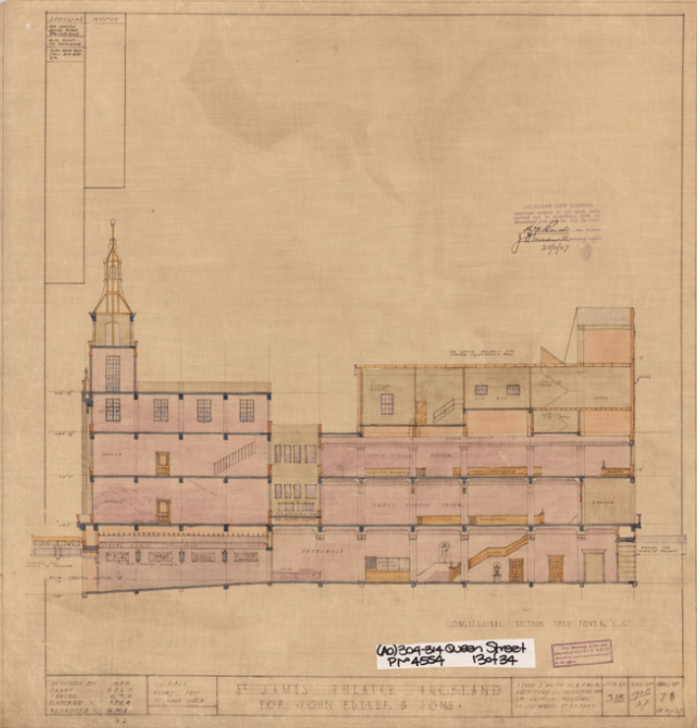
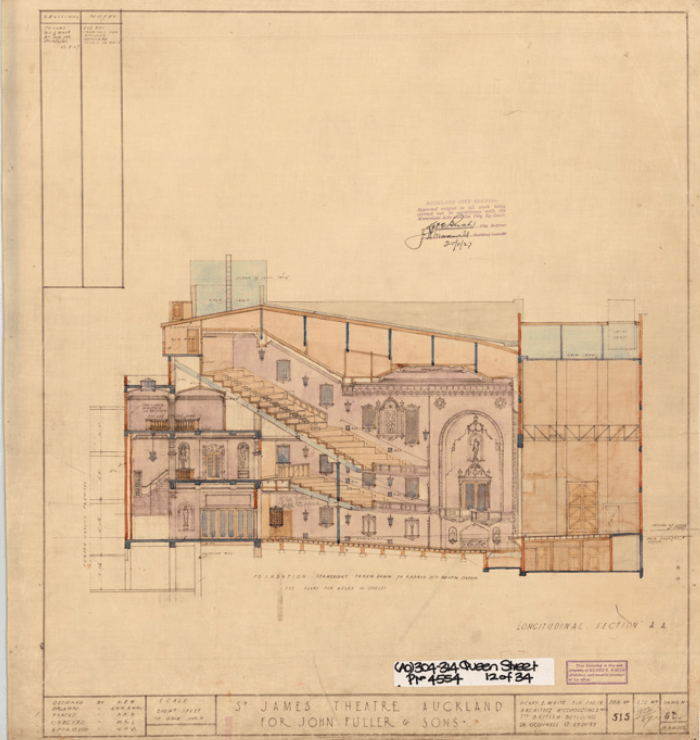
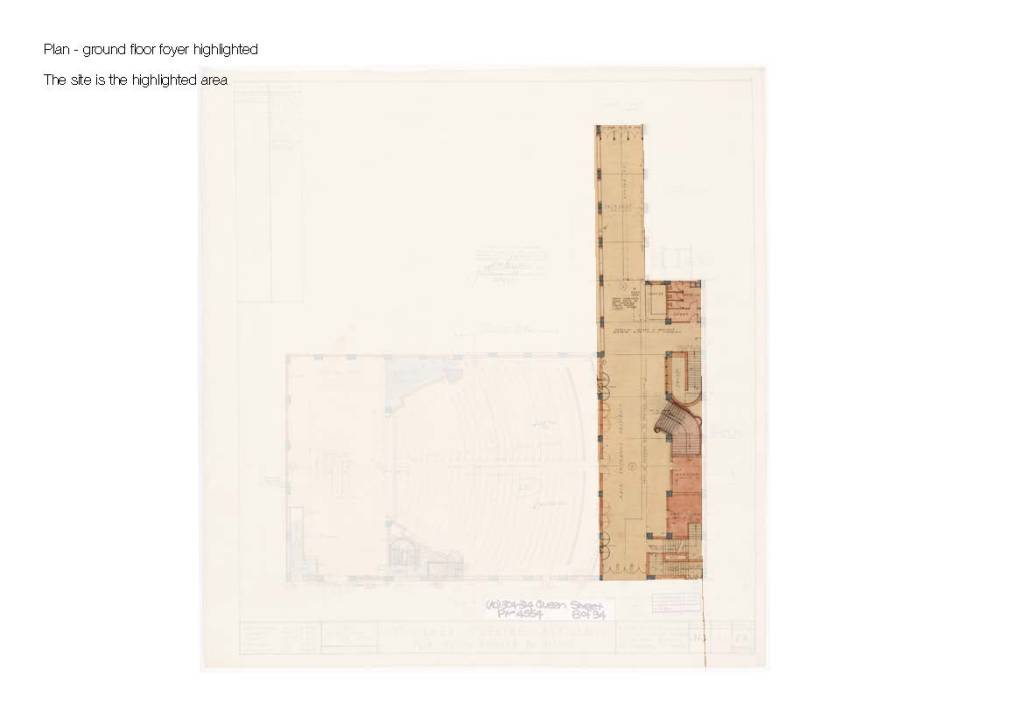
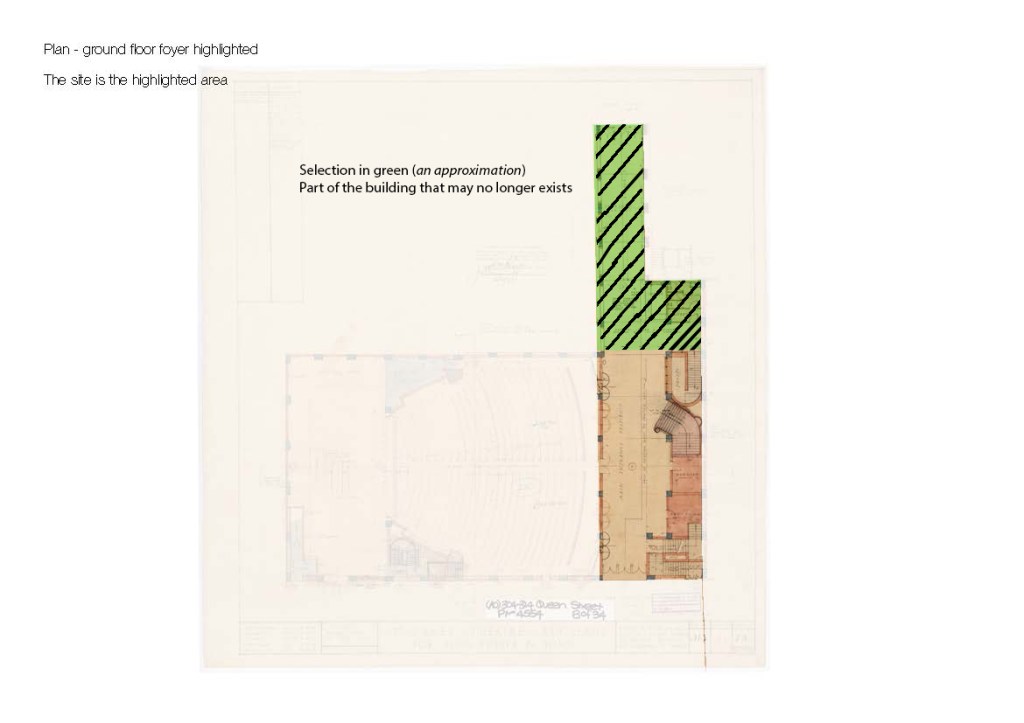
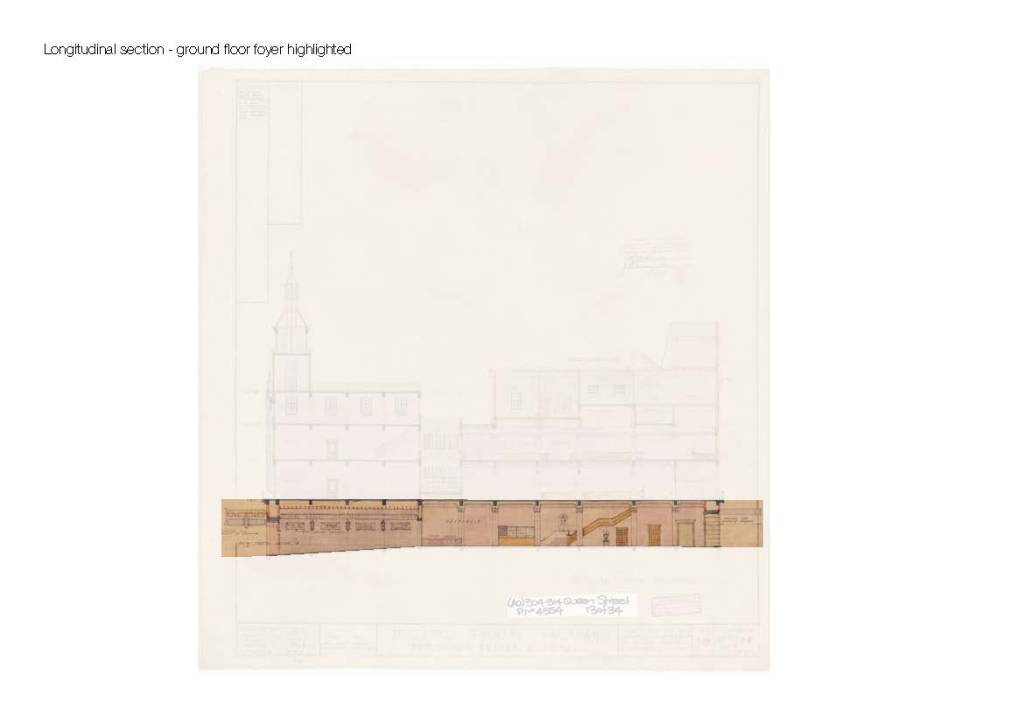
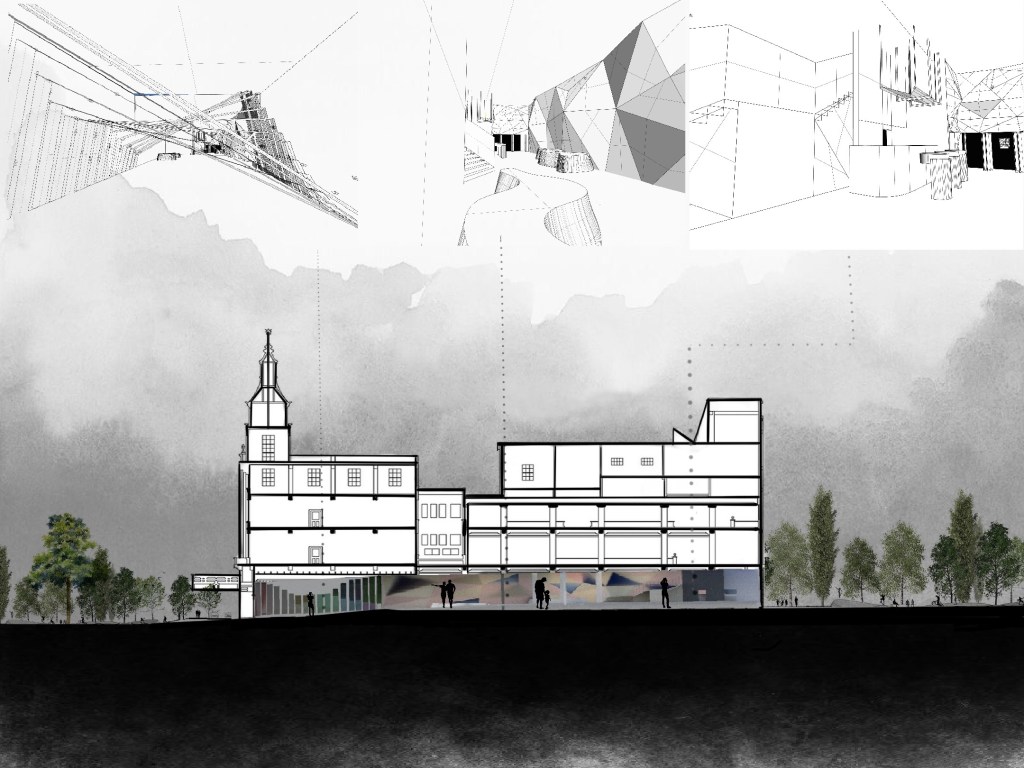
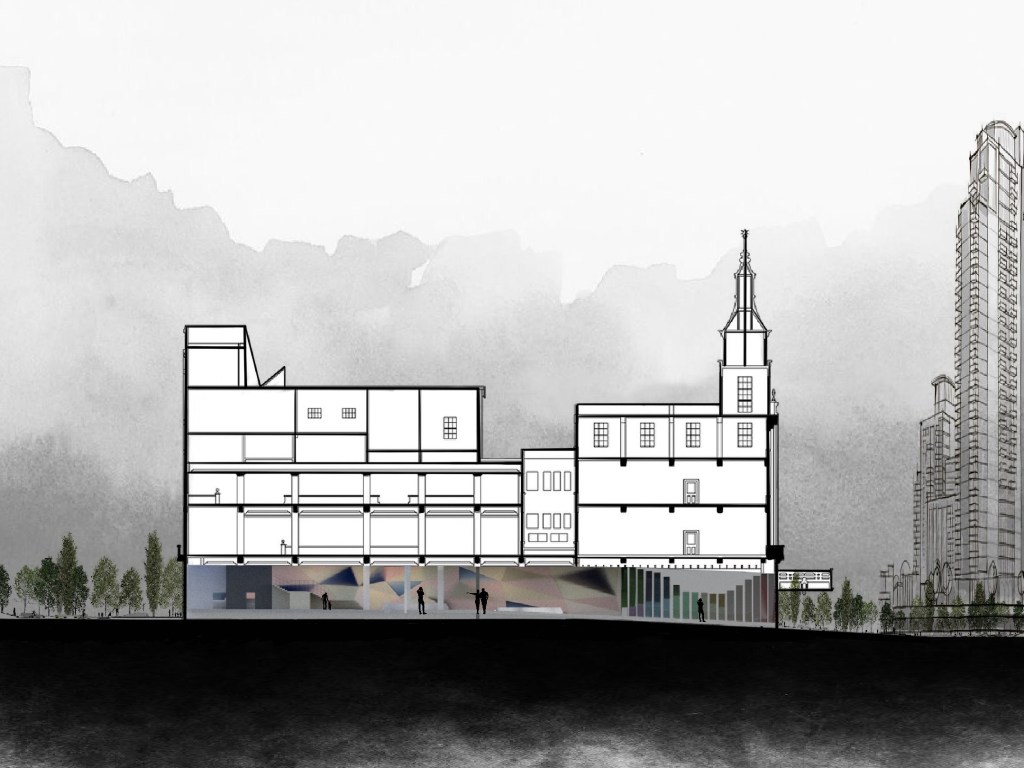
Original Plan & Section

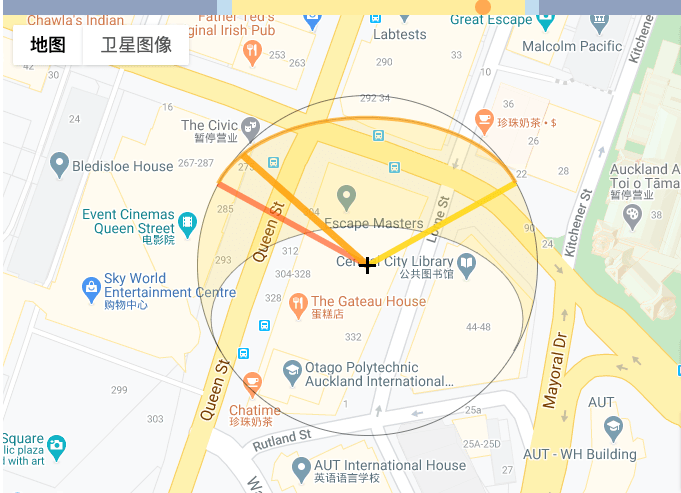
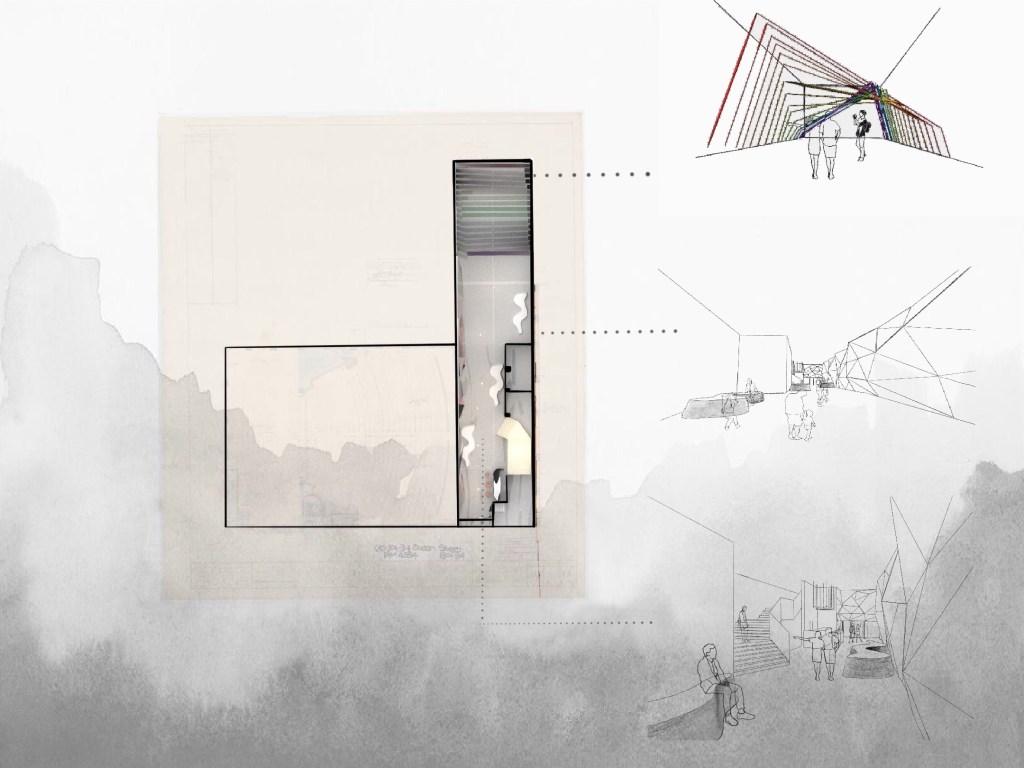
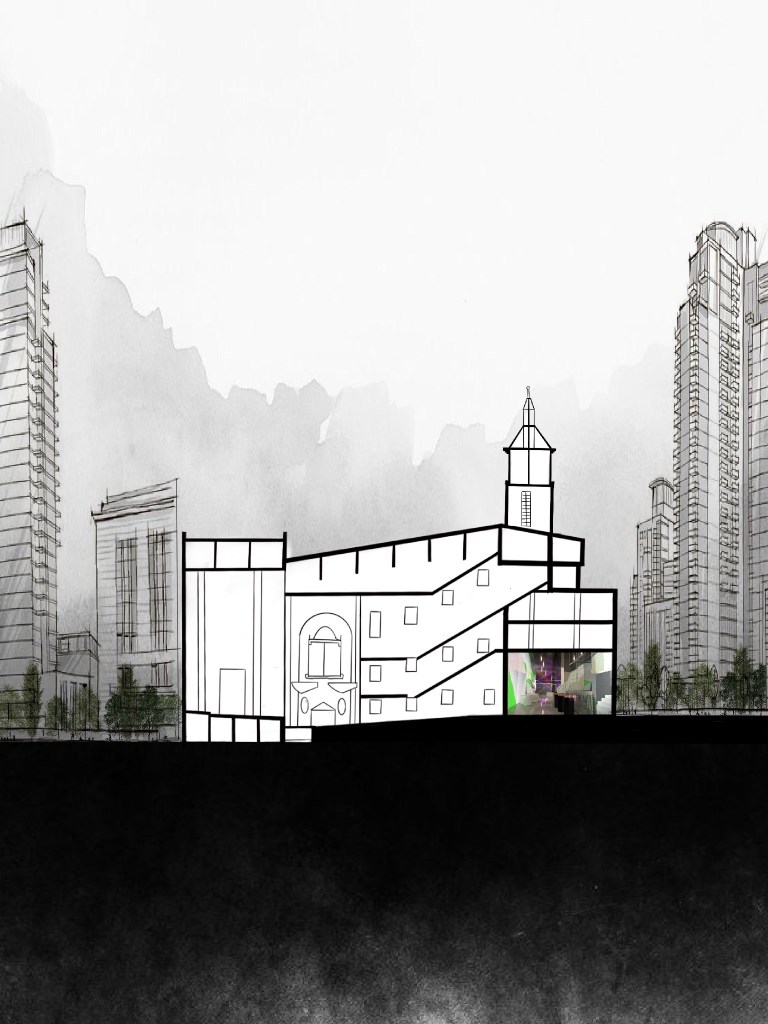
The space we are working on

Sun direction in Auckland 

00:00—05:59 — Night
05:59—06:31 — Astronomical twilight
06:31—07:03 — Nautical twilight
07:03—07:32 — Civil twilight
07:03 — Dawn
07:32—07:35 — Sunrise
07:35—17:09 — Daylight
12:22 — Solar noon
17:09—17:12 — Sunset
17:41 — Dusk
17:12—17:41 — Civil twilight
17:41—18:13 — Nautical twilight
18:13—18:44 — Astronomical twilight
18:44—00:00 — Night

Reference: http://sun-direction.com/city/43287,auckland/

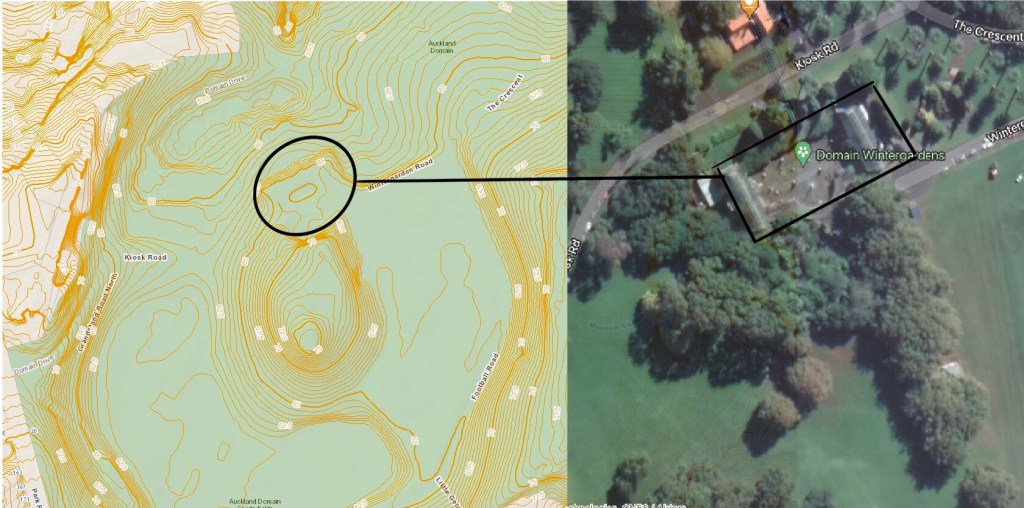
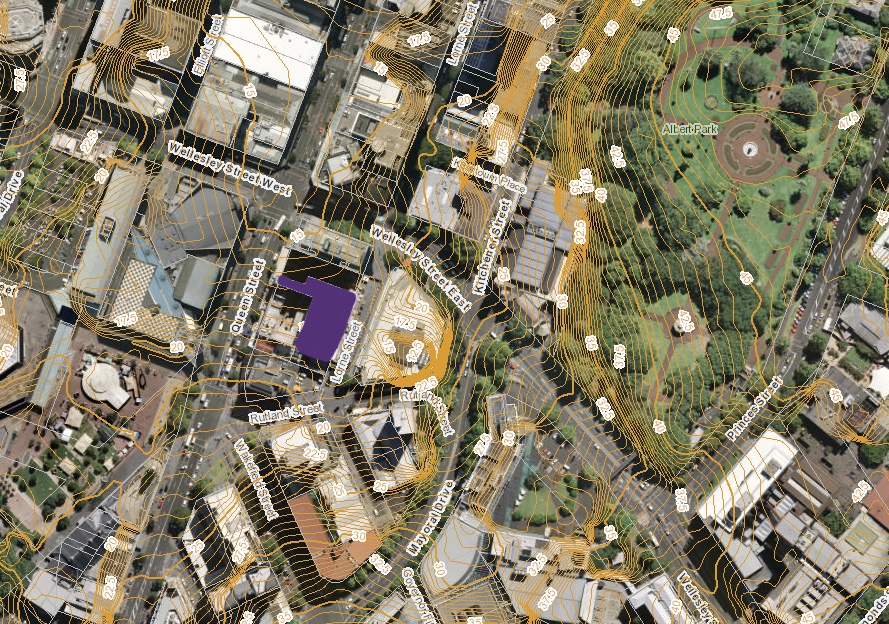
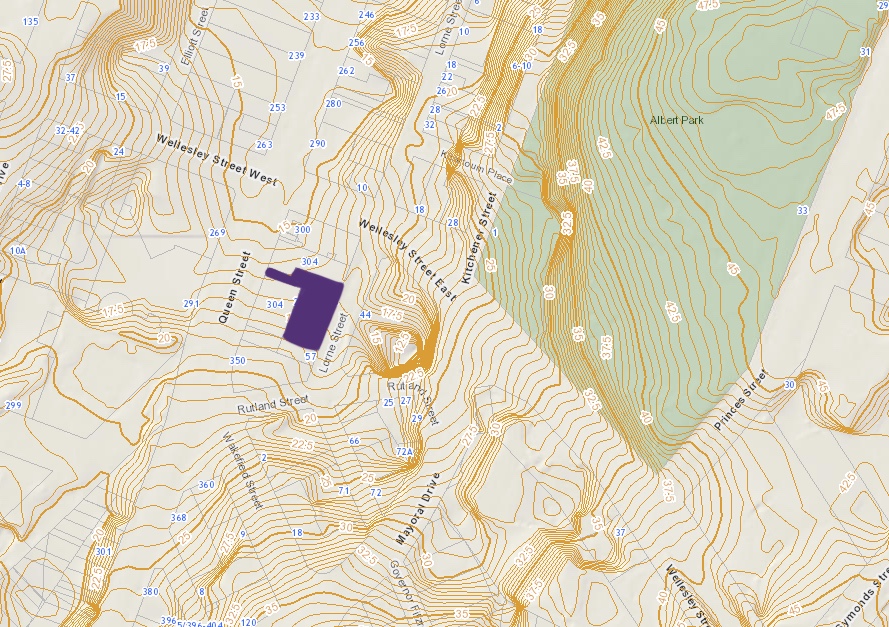
Contour

Reference: https://geomapspublic.aucklandcouncil.govt.nz/viewer/index.html

Week 4- Artist Research and Model Making

Patryk Stasieczek (b. 1984) is a visual artist living in Vancouver, BC. He holds a Master of Applied Arts from Emily Carr University of Art + Design where he investigated the ontological relationships between photographic acts, objects and experiences. He also holds a Bachelor of Fine Arts in photography and philosophy from Concordia University in Montréal, QC. He is the active director and co-curator of Gallery 295, a young gallery located in the heart of Vancouver’s art district that focuses on emerging contemporary photographic practices and dialogues. He also works as a photographic lab technician at The Lab, and is currently a sessional instructor at Emily Carr University of Art + Design.

He has exhibited nationally within Canada, participating in exhibitions at Access Gallery, Galerie Les Territoires, Charles H. Scott Gallery, Eastern Bloc, FIELD Contemporary, and the FOFA Gallery. His work has been published both nationally and abroad, and was featured on the cover of Hong-Kong based Pipeline Magazine’s 2014 Juried Photography Issue. In 2015 he was nominated for Henry Art Gallery’s BRINK award.

Olafur Eliasson (Icelandic: Ólafur Elíasson; born 1967) is a Danish–Icelandic artist known for sculptures and large-scale installation art employing elemental materials such as light, water, and air temperature to enhance the viewer’s experience. In 1995 he established Studio Olafur Eliasson in Berlin, a laboratory for spatial research. Olafur represented Denmark at the 50th Venice Biennale in 2003 and later that year installed The Weather Project in the Turbine Hall of Tate Modern, London.

Olafur has engaged in a number of projects in public space, including the intervention Green river, carried out in various cities between 1998 and 2001; the Serpentine Gallery Pavilion 2007, London, a temporary pavilion designed with the Norwegian architect Kjetil Trædal Thorsen; and The New York City Waterfalls, commissioned by Public Art Fund in 2008. He also created the Breakthrough Prize trophy. Like much of his work, the sculpture explores the common ground between art and science. It is molded into the shape of a toroid, recalling natural forms found from black holes and galaxies to seashells and coils of DNA.

Because they are very good at using bright colours that is why I choose these two artist. This is very attractive to me. When I entered the theatre I noticed that the overall tone of the theatre is very bright, so I think that these colours can be used for new designs.

Model Making

First model

I want to create a gradual change process from high to low. I mixed different colours and applied them on transparent PVC, then cut them into irregular shapes and pasted them on a new PVC.

Second Model

The model was made according to the style of the artist, and the main material used colored cellophane. The main purpose is to experience the changes caused by the superposition of different colors. The spatial change and color change of four cubes with different colors through different angles. This model successfully brought color into the room and observed the color and shape of the shadow.

Third Model

Through the development of the artist’s style, the main materials used glass and colored cellophane, the main purpose is to bring color into the interior space and develop the interior space to the extreme. The space of the model changes gradually from large to small, and the change in the sense of space can be felt from the entrance. It mainly uses geometric mosaics of different sizes and shapes, and the color matching is also irregular. The overall model and shadow can make people feel dreamy.

Week 5- Slow Surface 1

Groups Chosen Surfaces (Group 11)

Group Surfaces Collage

These are some manuscripts. At first I didn’t know how to design my surface, so I tried to draw some manuscripts with three-primary colour (red, yellow, blue) for inspiration.

Surface Design

First surface design

The inspiration for this surface comes from the surface collage of our group but I incorporated other patterns to develop. I use rectangles and squares of different sizes to splice and draw different patterns in the area. Part of these patterns come from the surface of our group and part of them come from some surface patterns that I often see.

Second surface design

I think the previous surface design is a bit too complicated, so for this one I selected two elements that I think are important and added colours to compare.

Different colours presented in different shades.

Third surface design

Continue to develop through the second surface, the surface materials used colours, white paper, pen. I tried to express it by stitching and the details of each piece are unique also each piece of paper is torn off. I kept the edges and corners so every details are different. The line comes from the surface I am looking for, the colours comes from the artist I choose.

Fourth surface design

The design concept of this surface comes from the three primary colours. I chose black as the background at the bottom, because I think black is different from all colours. For the design of the upper layer, I used a stitching design, torn up a complete picture and then stitched together and preserved the details of the edges.

Fifth surface design

I used PVC colour cardboard as the material splicing design. The superposition of different colours will produce different colours, some of which are deep and light. I think this is the charm of stitching, so I will continue to use it in my design.

Sixth surface design

This was developed through the fifth surface. I incorporated the feeling of water-soluble pigments into the outermost layer. Because the outermost edge of the watercolor has a very obvious edge line from the inside to the outside, this texture is very similar to the texture on the desktop. Also, put the pictures in different tones for comparison

Week 6 – Slow Surface II

Regulations

Toilets

Elevators and Stairs

Week 7-Threshold Moment

Door Handles Research

The inspiration is came from simple curves, this draft has shown the development of my ideas and inspiration. The design of door handle is to fit the shape of palm, flexible combined with palm line. The thickness of the door handle can ensure that the user feel comfortable when opening the door and will make sure the door handle won’t slide. The design that use thumb to pull outward as supporting point, will increase the comforts. 

Final door handles design

I used light blue glasses and metal as materials. Firstly, the bottom of the door handle is a semicircle design, the inspiration is came from the last surface. Among them, there is the feeling of ink dripping gradually spreads from deep to shallow. Therefore, in used two semi-circle to design a whole circle. I used light blue glasses materials semi-circle at the bottom, to match with the overall tone color of the interior. The door handle used metal materials. Gold metal makes people feel comfortable visually. Warm-toned is a better choice in winter. 

Week 8– Starting Intervention

Mapping Exercises

What can be used going forward > what the intervention is your designing > who the user/viewer/ occupant is? How will they use the space? What will they need? What will they experience? – you may have to make more than one map.

What is next?

  1. Plan, Section, and Perspective view.
  2. The space for public.
  3. Confirm accessible elevators and toilets.
  4. Confirm materials and test all materials.
  5. Building all space with Rhino.
  6. Confirm light.
  7. Site map.

Design Pitch

My artist is Olafur Eliasson, he works in a space research laboratory and he is involved in many public space projects. What’s more interesting is that many of his works are related to nature and use colour. From his works, I can clearly feel the change of light, shadow and colour.What attracted me most was his use of all colours and very attractiveness. When I visited the theatre, I noticed that the overall tone of the interior is very bright, So I think his work can give me some inspiration.

I designed this space as a public space. The main purpose is to create a dreamy and happy space. Let all people who passing by or resting here can feel happiness, relax and dreamy feeling. In this fast-paced era we have all kinds of pressure but also have our own dreams. The purpose of my design is that you can dream freely in this colorful space, without the pressure of reality, without considering the real world, and without hard work. Briefly get rid of the pressure of reality.

I will use color glass as main materials, because the glass itself and the shadow of glass will give people an unrealistic feeling, the light and shadow it refracts are unreal and dazzling. I will use different color glass and the superposition of color from different angles will create new colors and every angle and shadow will be different.

Light research

The lights can attract attention and sight. At the entrance, I will design colorful lights to attract visitors. The above pictures show the design effect of lighting. I will design it as a triangle, which will be consistent with the theme of my interior.

Colour Research

rainbow is a meteorological phenomenon that is caused by reflection, refraction and dispersion of light in water droplets resulting in a spectrum of light appearing in the sky. It takes the form of a multicoloured circular arc. Rainbows caused by sunlight always appear in the section of sky directly opposite the sun.

Rainbows can be full circles. However, the observer normally sees only an arc formed by illuminated droplets above the ground, and centered on a line from the sun to the observer’s eye.

In a primary rainbow, the arc shows red on the outer part and violet on the inner side. This rainbow is caused by light being refracted when entering a droplet of water, then reflected inside on the back of the droplet and refracted again when leaving it.

Rainbows span a continuous spectrum of colours. Any distinct bands perceived are an artefact of human colour vision, and no banding of any type is seen in a black-and-white photo of a rainbow, only a smooth gradation of intensity to a maximum, then fading towards the other side. For colours seen by the human eye, the most commonly cited and remembered sequence is Newton’s sevenfold red, orange, yellow, green, blue, indigo and violet, remembered by the mnemonicRichard Of York Gave Battle In Vain

Coffee counter Research

The bar can provide visitors with wine, beverages, coffee and other drinks. It is also a service desk, providing services and information consultation for visitors

Model Making

This is the first model. I used laser paper and waste cardboard as materials. I cut the discarded cardboard into triangles of different sizes, and then attached laser paper to these cut triangles and spliced ​​them. Because when I use rhino to start rendering, I found that the material can not render the effect that I wanted. Therefore I made the model, the right side of my design is stitching by different sizes triangles which give the space a sense of hierarchy Mirrors are used on the left wall and roof. Through the refraction of light, the light of the laser glass on the left wall is reflected to the other wall. This will make the entire interior space more spacious in terms of visual effects. However, I explained this idea in the second and third pictures. When I put the model in front of the mirror and can obviously feel the effect after reflection. Althought there were some difficulties while I modeling, it is really not easy to splice different triangles from different angles, however the effect were great success.

This model was made to express the direction of the light at the entrance and the sense of space that can be shown. The lights will be presented as triangles. Gradually change from large to small and then gradually increase. Viewed from the entrance is very deep and spacious. The purpose is to attract people’s attention, and shining things often catch people’s attention. Attract people into the room through the lights and feel the charm of the room. The walls and roof on both sides still use mirrors. Because I have experienced this transformation, people passing by will be attracted, and stop to watch the camera. I think this is a good idea to attract people to approach the room.

Week-10 First model making

Use triangles to try to conceive my work. The origin of the triangle understanding is obtained from the works of the artist. Then continue to develop the triangle. Because in all structures, the triangle is the most stable.

Top View
Front view
PERSPECTIVE

This is the initial model, the process of making the model is not easy, because I need to grasp the angle and direction of each triangle. I used same elements on both sides in this model. However, i found that the indoor becomes crowded after rendered and using the same elements will make the whole space very monotonous. There is nothing that catches the eye. And I even had a big challenge that there are no material that i want in rhino. This will cause the model can not express my thought. Therefore i try to develop this model deeper and deeper. It may be better to try to express the same element in different ways. During the conversation with Kaylee, I got some suggestions. She thought I should try more materials, and the overall style is too similar to my artist. Therefore I will try to do more tests and research to find the most suitable materials and express in different ways.

Reaction in different colour systems

This is a dreamy space where people can walk and take pictures freely, sit and rest at will, etc. I tried to create an atmosphere of this space through the refraction of light. Create a strong spatial-visual effect through the join triangle of different sizes, and make the space atmosphere more romantic and more dreamy through the light of laser glass. For the roof material, I use a mirror to create a strong sense of space through the refraction of light and the reflection of the mirror surface. I used a simple white concrete floor, which allows light to be projected on the ground. And you can clearly see the changes in time. The color of the lamp will change regularly. It changes every ten minutes. Different colors of light will produce different visual effects.

Materials

Mirror
Glass and laser paper
LED Reflective Lamp

Colour Palette

The main color used by the artist
The main material color of my design

Final model making

Abstract

In this project, we are asked to re-design the foyer space of St James building.I start thinking according to the artist model, most of Olafur Eliasson’s works are about nature. And the colors he uses are very bright, energetic and balanced, very in line with this theme. Because of the COVID-19, I want to bring real-life feelings into my design. This project I want to convey a space about dreams. In real life, people are always affected by various things, such as environment, social, things, etc. In this fast-paced era, we need a space to freely release pressure. However, this project I want to show a dream world, like a house in a fairy tale, shining, dreaming, beautiful and warm. This is an artistic public space where people passing by or visiting can feel relaxed, happy, and happy. No need to think about the real world, temporarily get rid of the pressure of reality and fully enjoy this color space.

An article on installation art in the course of spatial theory caused me to think. The artist cleverly combines people and space to make both of them merge into one to produce interaction. Therefore at the entrance to Queen St, I used colorful lights to attract people’s attention and guide people to approach the space and feel the dreamy atmosphere. Shiny things tend to attract attention, therefore I used this series of elements throughout the space. In the entire wall on the right side of the internal space, I have used irregular splicing of triangles of different sizes and glass and laser paper as material. The laser paper will emit different light at different angles under the light. Make the whole space full of shining light. The origin of the triangle understanding is obtained from the works of the artist. Then continue to develop the triangle. Because in all structures, the triangle is the most stable. The entire wall and roof on the left are made of mirror. The reflection through the mirror creates an infinite sense of space in a limited space. At the entrance to Lorne St, I designed a coffee bar to provide some convenience or guidance for people in the room. The indoor lighting will also change regularly. Red, orange, yellow, green, blue and purple. These colors are all from nature, developed from the colors of the rainbow.

V -ray rendered image

TOP VIEW
FRONT VIEW
RIGHT VIEW

The design on the right side of the wall is a join triangle of different sizes, mainly using laser glass. The design of the left side of the wall and the roof mainly uses mirrors, which can create an infinite sense of space. The colorful shadows can create a dreamy atmosphere, and the reflection of the mirror will make the space deeper. Create an infinite sense of space in a limited space.

The inspiration for the entire design comes from the works of my artist. This is a fast-paced era, we live under various pressures. I hope this space can help people relieve some pressure. This space is much like a glass house in a fairy tale when I was a child. Lights are set at the entrance to attract visitors, the interior space achieves a dreamy visual effect through the reflection of light and the reflection of the mirror. The main purpose is to allow visitors to forget the troubles and pressures in real life after entering this space. This is very similar to an art installation. Nowadays, many exhibitions focus on nature and fantasy. The space is also designed through mirror extension and light reflection. In this supernatural space, people will forget themselves and be silent in this space. Most people take pictures of this moment.

I encountered a lot of problems in the process of rendering, and there is no such material in Rhino. I am trying to solve this problem by other methods

Presentation Audio

https://drive.google.com/file/d/1600Mrjf7b_chjWGe2C_2aCupRzs7GeAp/view?usp=sharing

Hand Drawing

PERSPECTIVE
PERSPECTIVE
PERSPECTIVE
Entrance to Queen St

perspective view

Plan and Section

Theory

Week One

Readings:How to Encounter a Puddle by Anny Li and Index of Agency by Sophie Chien

1. What is Li’s overall idea about puddles? How does she connect the practical (photos, experiences) with the theoretical (ideas in the text)?

The author’s thinking through the puddles on the roadside and recorded it through photography. She analyzes the surrounding environment and pictures of the puddles and connects with low theory. The result is that the two are similar.

2.How might you sum of Chien’s ideas about agency? How does she connect the practical (diagrams of spaces, experiences) with the theoretical (ideas in the text)?

Designers can manipulate people’s behaviors by creating spaces. In fact, the sight that people see in a space can be specially designed.

3.Each writer poses questions within the text. What do you think the purpose of these questions are in Li’s piece? in Chien’s? How might we answer them?

I think the purpose of these two articles is to keep us exploring and thinking about everything in our life.

4.How are they engaging with the different/similar ideas of movement within cities and spaces?

Li: Li’s point of view is that these environments are created in buildings controlled by people.

Chinen: Chinen’s point of view is that manipulate human activities through design space and all the environments we are in are by design. This is different from li’s point of view.

5.What is the purpose of, or impression you get from the images within each text? How important are they in your understanding of their ideas?

The picture is an important basis for supporting the author’s point of view.Reader’s can better understand the author’s point of view through the photo. The picture accurately provides the readers with a sense of presence, realism.

6.There are some key theoretical texts or ideas mentioned in each piece of writing. Research them (briefly) and come up with a one or two sentence definition.

low theory: Breaking the standard of success, which may change our perception of the world and create different ways of thinking.

Ekistics: Ekistics is the use of scientific models to study human settlements and combines research in various fields.

Agency + spatial agency: Spatial Agency proposes a much more expansive field of opportunities in which architects and non-architects can operate. It suggests other ways of doing architecture.

Personal as political:The personal is political, also termed The private is political, It underscored the connections between personal experience and larger social and political structures.

Decentralised network: A decentralized network is a “trustless environment,” where there is no single point of failure.

Week Two
Readings: Too Close to See: Notes on Friendship, A Conversation with Johan Frederik Hartle by Celine Condorelli and Support Structures: An Interview with Mark Cousins by Celine Condorelli


1.How would you define a ‘support structure’?

I think it is divided into two levels: materials level and social spiritual level. Material level: connection, support, bear, connect the internal support and external support of the object through a reasonable physical structure to ensure the stability of the object. Social spiritual level: support someone.

2.What are some examples of ‘support structures’? Physical, political, conceptual, etc

Physical:bridge, building, furniture, ladder.

political: elections, statements by supporters.

conceptual:family, friends, supporters.

3.What are some conditions or requirements for a structure to be considered a support?

The structure must be reasonable and have sufficient stability and strength.

4.What is the relationship between the supporter and the supported?

The relationships between the supporter and the supported is mutual trust, the supporter recognizes the supported and the supported needs the support of the supporter.

5.How might we connected the format of the texts (as conversations) to her notions of support?

This talk is mutually supportive and both sides are actively discussing and expressing opinions around this view and responding to each other’s ideas.

6.What is Condorelli’s creative practice?

Her work spans architecture and art, exploring relationships, mechanisms and structures which often go unnoticed.

7.Can you identify the threads of connection between her writing and her making? What are they?

Divided into two parts of making and thinking is a relationship of mutual support. She believes that the process of thinking is an essential part of making and making process is also a way to thinking.

8.She identifies ‘friendship’ as having a political dimension. What does she mean by this? How does she discuss this in the text?

She believes that friendship is a political relationship of loyalty and responsibility that just like supporter and supported who are mutual. They need to cooperate to create something new.

9.How would you define ‘friendship’? What about ‘solidarity’?

Friendship: friendship is a two-way emotional relationship that must be maintained together, with mutual trust and respect.

Solidarity: solidarity is produced by multiple emotions condensing together to achieve a combination of common ideals or common goals.

Week Four

John Dixon Hunt, “Reading and Writing the Site” (1992)

1.What is “second nature”, according to the Roman writer Cicero? What other term could be used as a synonym for “second nature”, according to John Dixon Hunt? Why is this kind of nature a “second” nature? What is “first”? (pp. 131-32)

Second nature: something that is so familiar that it is done without having to think about it. Such as a habit, characteristic, etc, not innate. Playing games, brushing your teeth, speaking your language… are all second nature. First nature: is primal, predatory, survival instinct.

2.What is “third nature”? Why do you think this is “third”? i.e. why is “third nature” said to “go beyond” or be an advance or development upon “second nature”?

“Third nature” is ideology and cultural artifacts. “Third” makes human behavior more advanced and promotes the development of human culture and technology. “Third nature” is development through the “second nature” , just like the development of the “first nature” to the “second nature”.

3.What does John Dixon Hunt say is the main point he is trying to make when he brings up the terms first, second, and third nature? What do these terms tell us about the human relation to nature? (132)

Humans have been changing their state by controlling nature. Nature can bring benefits to humans and humans have been trying to control nature.

4.What is the “picturesque”? (p. 132) What does this word mean in common parlance? What does it mean in relation to the history of landscape design? Look it up online and find out as much as you can about it.

Picturesque is an aesthetic ideal introduced into English cultural debate in 1782 by William Gilpin in Observations on the River Wye, and Several Parts of South Wales, etc. Temple misinterpreted wild irregularity, which he characterized as sharawadgi, to be happy circumstance instead of carefully manipulated garden design. The picturesque style in landscape gardening was a conscious manipulation of Nature to create foregrounds, middlegrounds, and backgrounds in a move to highlight a selection of provocative formal elements—in short the later appropriation of Humphrey Repton. 

5.What is the “sublime”? (p. 132) What does this word mean in common parlance? What does it mean in relation to the history of art and philosophy? Look it up online and find out as much as you can about it.

The theory of sublime art was put forward by Edmund Burke in A Philosophical Enquiry into the Origin of our Ideas of the Sublime and Beautiful published in 1757. He defined the sublime as an artistic effect productive of the strongest emotion the mind is capable of feeling. He wrote ‘whatever is in any sort terrible or is conversant about terrible objects or operates in a manner analogous to terror, is a source of the sublime’.

6.What is a garden? How does John Dixon Hunt define the garden, on p. 133? (Clue: What does the word “milieu” mean? What is its etymological/original meaning? Look this up.)

The garden is a place to rest and play mainly for plant viewing, with a beautiful and picturesque environment. Dixon believes that the garden is an art space and belongs to the “third nature”.

Rebecca Solnit, “The Orbits of Earthly Bodies” (2003)

1.What is the great irony about living or holidaying in the countryside that Solnit points out in the first few paragraphs of her article?

The irony is that although the author is in a rural environment, her life still depends on the car.

2.Solnit is trying to burst some of our illusions about the countryside. What are some of the common illusions that we have about living or holidaying in the countryside?

Of cause, in the countryside we will see some original ecological nature, compared to urban life, rural life is a little slower and calmer and will be very relaxing. This often makes people feel a return to nature.

3. What are ranchettes? What does Solnit mean when she says that “ranchettes seem to preserve the frontier individualism of every-nuclear-unit-for-itself; they’re generally antithetical to the ways in which community and density consolidate resources”? (334)

A small ranch or a large home lot, often on the outskirts of a major metropolitan area and just past the planned neighborhoods, consisting of 40 acres and a house and possibly a barn or other outbuildings.

4.What is the “new urbanism”? (334 bottom) Look this up online and find out as much as you can about this movement. Why is Solnit ambivalent about the new urbanism?

New Urbanism is a planning and development approach based on the principles of how cities and towns had been built for the last several centuries: walkable blocks and streets, housing and shopping in close proximity, and accessible public spaces. 

5.According to Solnit, how have we tended to define nature? What’s wrong with this way of defining nature? (p. 335)

“ we have tended to define nature as things to look at, and we think we’re natural when we’re looking at nature “, this way of defining nature does not treat us as part of it and separates it.

6.Why do you think Solnit compares city activities (shopping, people-watching) to hunting and gathering in the wilderness? (p. 335 middle) Why do you think she says that New York City might be the most natural space in all of America? (p. 335 top) What is she trying to do to the way we think of cities?

For people living in the city, these are our daily natural activities. Perhaps our life environment is nature itself.

7.What’s the problem with the term “pedestrian-scale”? (335 middle)

“humans are pedestrians when not fitted with vehicular prosthetics.”  

8.Why do you think Solnit included a found quote from a Pottery Barn catalogue as her epigraph? What does the epigraph tell us about the point she is trying to make in the essay?

Solnit may have included this quote to express her love for the countryside, I think regardless of the evaluation of rural life or urban life, we already have own ideas.

Week Five

Reading:Politics of Installation by Boris Groys

1.How does Groys describe the relationship between the ‘field of art’ and the ‘art market’?

Groys proposes that art is frequently equated with the art market, and the artwork is primarily identified as a commodity.
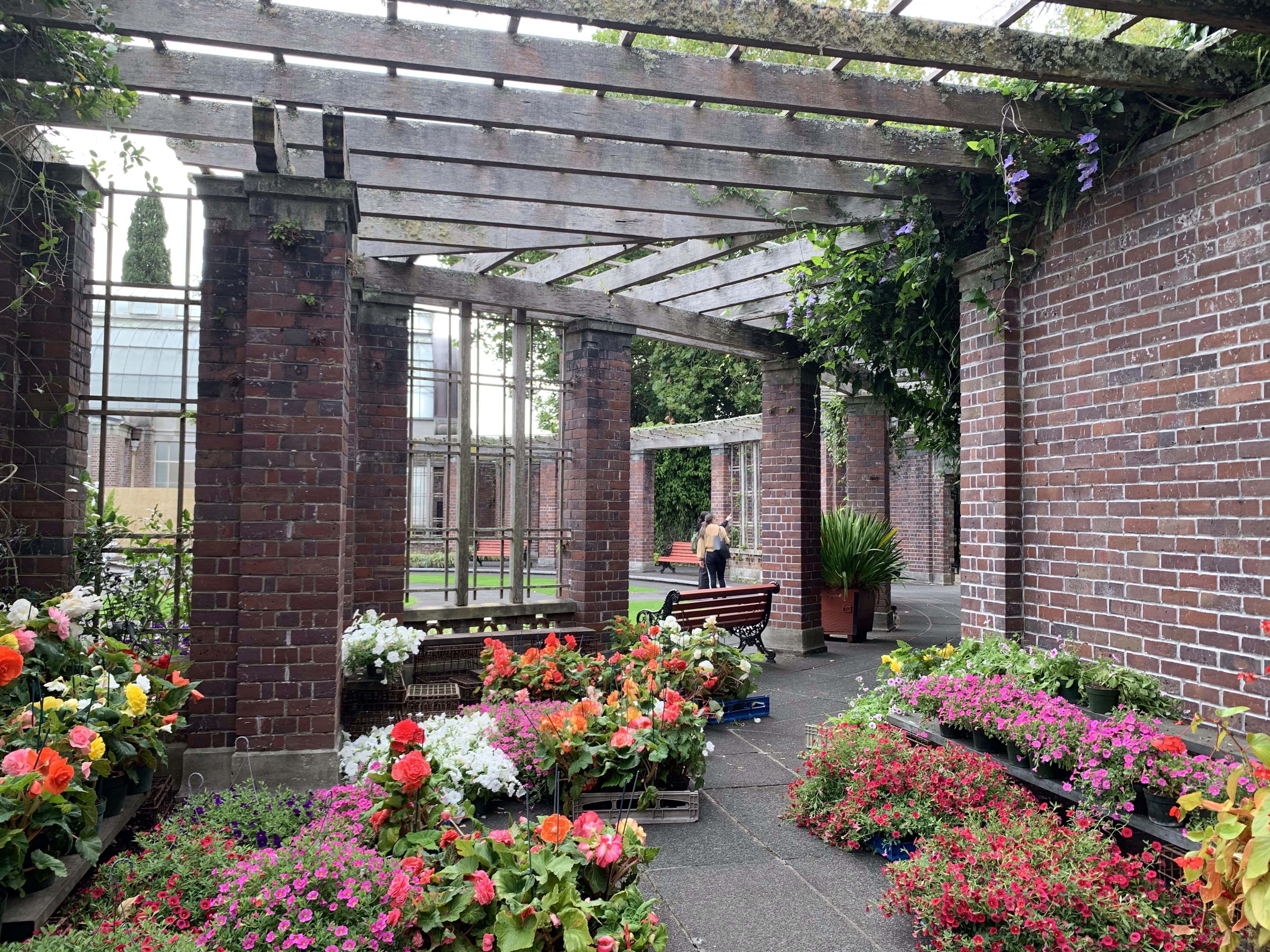
2.What is the main two concepts that he seeks to differentiate through an ‘analysis of difference’ at the bottom of page one?

Groys analyzed two characteristics of standard exhibitions and art installations.

3.How is an art exhibition and an art installation different in Groys’ view? How does he describe the viewer/audience in relationship to each?

 “A conventional exhibition is conceived as an accumulation of art objects placed next to one another in an exhibition space to be viewed in succession.” Groy proposes that the viewer itself is not within the scope of art, the audience is just looking at the artwork in front of him. “The artistic installation is a way to expand the domain of the sovereign rights of the artist from the individual art object to that of the exhibition space itself.” Obviously the art installation is a space and the viewer itself is also a part of this art space.

4.How would you describe an ‘exhibition’? How does Groys describe the ‘exhibition space’?
Exhibitions are a special way of communication. Artists display artworks to viewers through exhibition. “The only function of such a space is to make the art objects that are placed within it easily accessible to the gaze of the visitors.” Groys believes that the exhibition is the accumulation of artworks and the only function of exhibition is to bring visitors closer to the artworks.

5.What is the role of a ‘curator’, both in the past and in the present time?

The role of the curator is to bring artwork into public space for visitors to watch and vist. The opposite way breaks the freedom of art.

6.What do you think a “defunctionalized design fragment” is?

It is a part of design.

7.When, in Groys’ view, did artists begin to seek autonomy/freedom/sovereignty for their work?
During the Modern era

8.How does Groys describe the ‘installation’ as a space?
“The installation operates by means of a symbolic private of the public space of an exhibition.” The art installation is private and the artist is free in this space. Artist can choose any form of installation to design.

9.What does an installation do to a space, that an exhibition does not?

Installation art is a whole art work. Everything in the space is part of design, but the exhibition is just the accumulation of individual works. “transforms the empty, neutral, public space into an individual artwork” 

10.In relationship to last week’s lecture (Landscape Part II), do you see any relationship between ‘installation’ and colonisation or land ownership?

Artists create in their own area is private and free.

11.What different kinds of ‘freedom’ does Groys write that artists and curators embody? Is it always the same or has it changed over time/ in different situations?

These two different kinds of freedom. artist:the sovereign, unconditional, publicly irresponsible freedom of art-making. curator embody:the institutional, conditional, publicly responsible freedom of curatorship.

12.What does Groys write is the relationship between democracy or democratic access to installation art?

The installation gives the artist maximun freedom. When the closed space is open to democracy, the space has been transformed into a platform for public discussion, democratic practice, communication.

13.How does Groys see installation art as reflecting contemporary society? Can we see spatial design and architecture in a similar light? Why/Why not?

The installation space is where we are immediately confronted with the ambiguous character of the contemporary notion of freedom that functions in our democracies as a tension between sovereign and institutional freedom.

Week Six

Reading: Radical Interiority: Playboy Architecture 1953-1979 by Beatriz Colomina

1. How does Colomina say Playboy Magazine affected reader’s tastes or desires for interior space?

Readers were encouraged to think they could have a piece of the idealized interior in their own lives. this continuously expanded world of design is itself a sexual fantasy, a space the reader is skillfully seduced into. The more detailed the description, the more intensely the reader desires to get in. 


2.Who were some prominent Modernist designers? What do their designs have in common?

Georges Nelson, Harry Bertoia, Charles Eames, Eero Saarinen, Roberto Matta, Archizoom, Jo Colombo, Frank Gehry, etc.


3.What is the social context of the beginnings of Playboy Magazine in 1953? What else was happening
(or had happened) in the world at the time?


4.How did that change between 1953-1979?

The role of design for Playboy becomes even clearer.


5.Why do you think Playboy Magazine is described by Colomina as making “it acceptable for men to
be interested in modern architecture and design”? Why do you think that it might have been seen
prior to this as “unacceptable” in the public consciousness?

Readers were encouraged to think they could have a piece of the idealized interior in their own lives. A cycle of desire was built up as Playboy kept feeding the fantasy with more and more detail about the objects.  consciousness


6.How does the desireable contemporary interior differ from the “Playboy Interior”, or from the
Modernist interior?

The architect stands at the edge of the future, visualizing the possible trajectory of design. The playboy never goes outside but dreams of flying towards the future in his sealed domestic capsule. 


7.What does Colomina say makes the Playboyb Interior feel ‘futuristic’, or ‘seductive’?

The more detailed the description, the more intensely the reader desires to get in. To subscribe to Playboy is to get a set of keys to a dreamlike world, a magical interior.


8.What interior design trends from the era feel ‘current’ and what trends feel ‘dated’?


9.What magazine/publication/platform would you describe as having a big influence on interior design
and taste now?

ARCHITECTURAL DIGEST, DWELL MAGAZINE, ELLE DECOR


10.How do you think social/cultural/political shifts have altered how we want to live in or design our
interior spaces now?

I think that our environment is closely connected with society, politics, and culture. Designers usually use cultural and historical backgrounds as reference designs into the space.

Week Eight

Reading: Wiggle Room by Sara Ahmed

1.Who is Sara Ahmed?

Sara Ahmed (30 August 1969)[1] is a British-Australian scholar whose area of study includes the intersection of feminist theory, lesbian feminism, queer theory, critical race theory and postcolonialism.


2.How does Ahmed begin the text? If you noted down the ‘sections’ of this piece of writing, what
would those sections cover or talk through?

Start with a simple definition and describe some stories for readers to understand and gradually deepen


3.How would you define ‘wiggle room’?

Informal scope for freedom of action or thought


4.She connects ‘wiggling’ with the will, or willfulness. How does she say that connection came about
for her?

She used her own experience to describe,” I think of less roomy shoes, and I think of my toes with sadness and sympathy: they would be cramped, less able to wiggle. Less wiggle room: less freedom to be; less being to free.”


5.Ahmed uses specific definitions of words and their historic uses as a way ‘in’ to an idea. Can you find
an example of this?


6.What does she say is the difference between wiggling and wriggling?

“And a body might wiggle and wriggle. These two words “wiggle” and “wriggle” both imply sudden movements, but they have a different affective quality; at least for me. Wiggle is often defined as quick irregular sideways movements. Wriggle can mean to turn and twist in quick writhing movements. Wriggle also has a more sinister sense: when you wriggle out of something, you get out of something by devious means. In “deviation” there is an implication of deviance. Bodies that wriggle might be crip bodies, as well as a queer bodies; bodies that do not straighten themselves out.”


7.How would you describe Ahmed’s writing? Formal, personal, casual, etc?

I don’t think it’s formal writing, it’s more like recording your own views on this matter
8.What effect does this have on the reader (on you!)?

Using stories or experiences may make readers empathize and understand your point of view
9.A too-small room is a key metaphor that Ahmed uses to talk about ‘wiggling’ – why might it be
interesting to think of as spatial designers?


10.What else could be considered as a ‘space’ to wiggle within or what else could be considered
something to wiggle ‘against’?


11.Ahmed references a number of other people’s texts – who is Judith Butler? Who is Jane Bennett?
Who is Eve Sedgwick?

Judith Pamela Butler[2] (born February 24, 1956) is an American philosopher and gender theorist whose work has influenced political philosophy, ethics, and the fields of third-wave feminist, queer,[3] and literary theory.
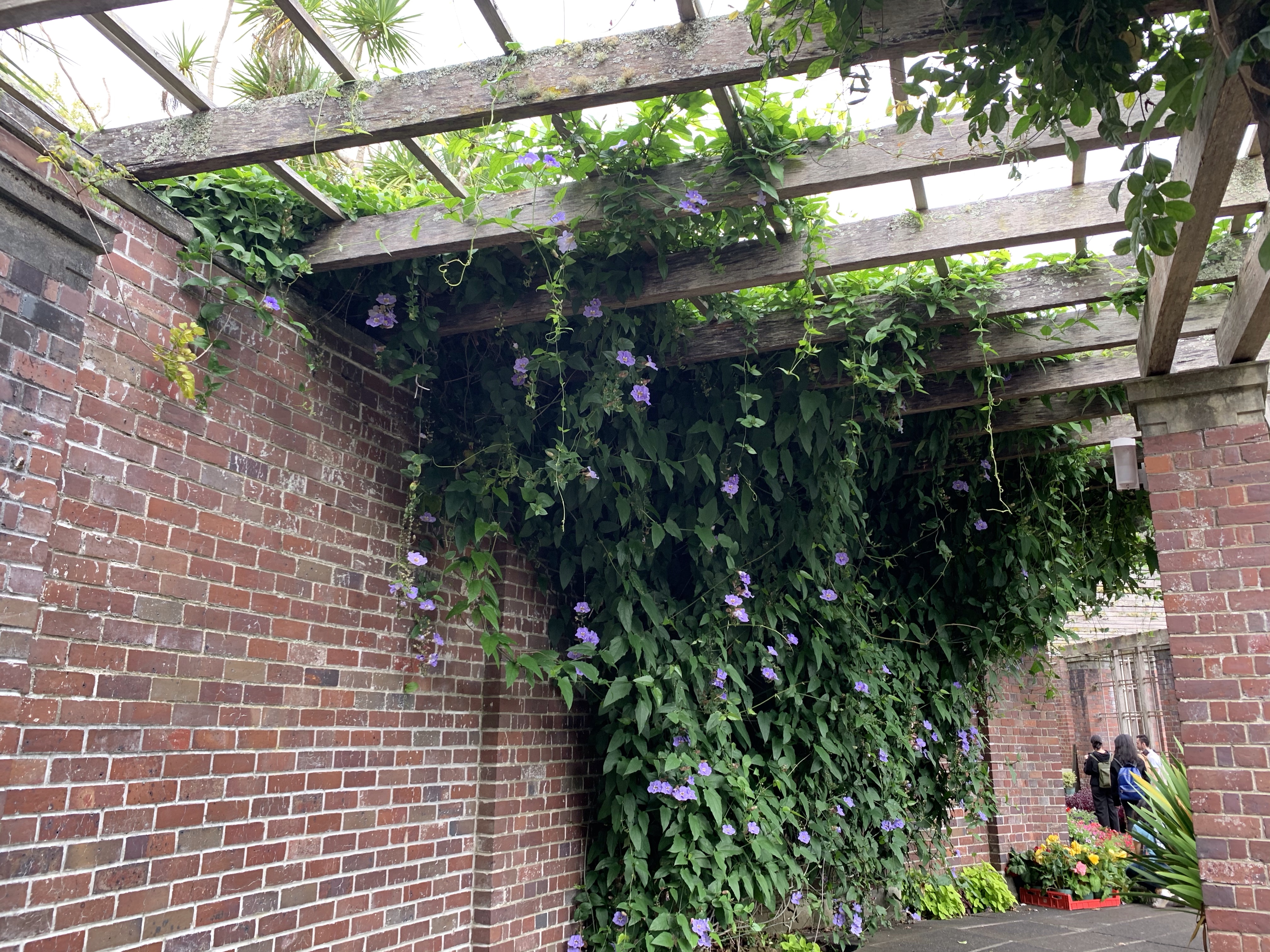
Jane Bennett (born July 31, 1957)[2] is an American political theorist and philosopher. She is the Andrew W. Mellon Professor of the Humanities at the Department of Political Science, Johns Hopkins University School of Arts and Sciences.[3] She was also the editor of the academic journal Political Theory between 2012-2017
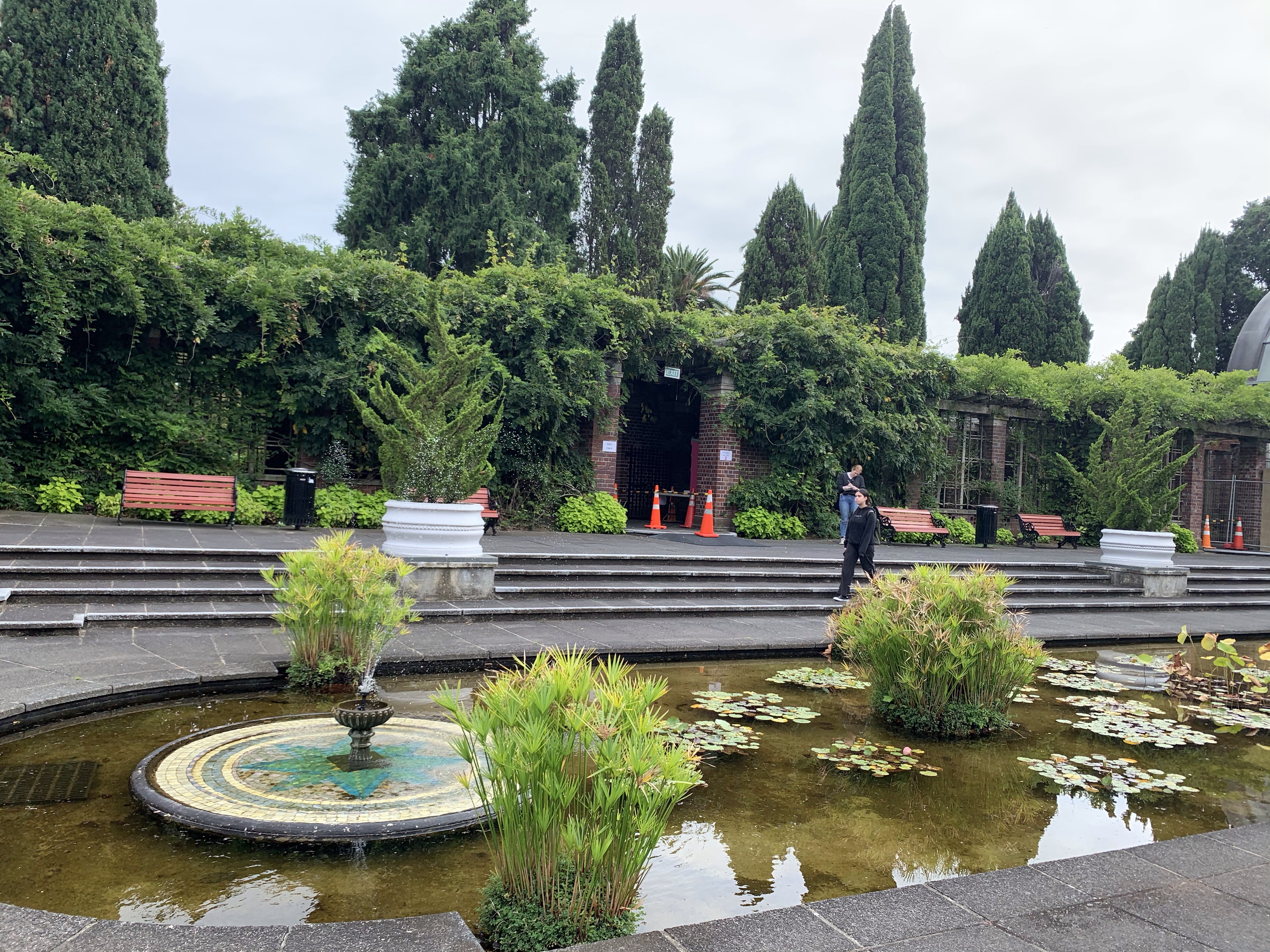
Eve Kosofsky Sedgwick (/ˈsɛdʒwɪk/; May 2, 1950 – April 12, 2009) was an American academic scholar in the fields of gender studies, queer theory (queer studies), and critical theory. 
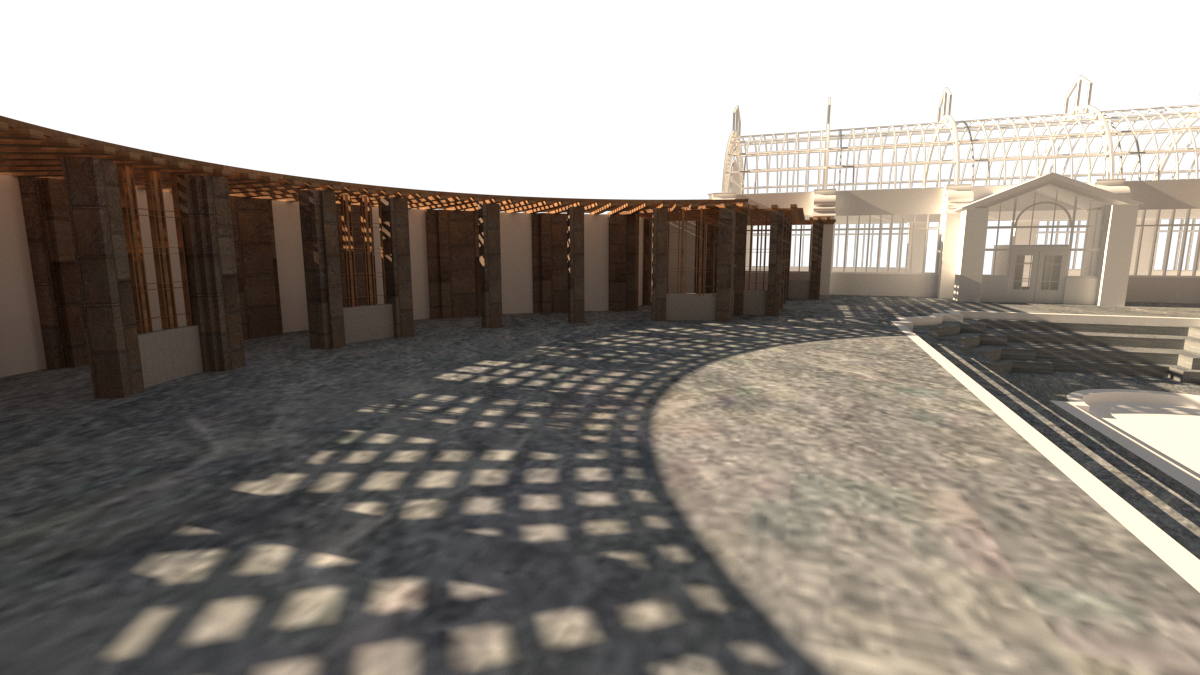

12.What are some words/phrases that Ahmed uses that you don’t understand? Note them down to
bring up in the tutorial.
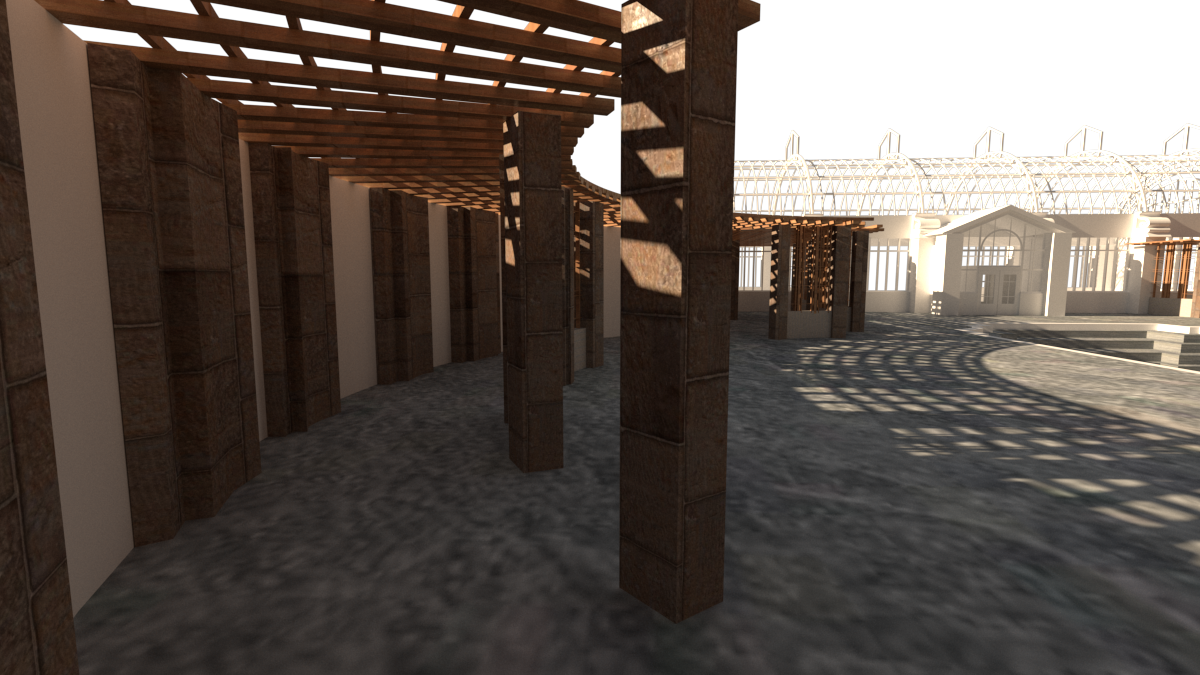
Week Ten

Doreen Massey, “A Global Sense of Place” Discussion Questions

1) Can you think of any recent geopolitical events that are examples of, or the result
of, what Massey calls a “longing” for a time when “places were (supposedly)
inhabited by coherent and homogeneous communities”? (146-47) Can you think
of any examples from the more distant past?


2) Why are “place and the spatially local… rejected by many progressive people as
almost necessarily reactionary”? What’s wrong with attempting to reclaim a
(supposedly) long-lost coherence between place and community? (151, 146- 147)


3) In what way is “the currently popular characterization of time-space
compression… very much a western, colonizer’s, view”? (147)


4) What does Massey mean when she says that “time-space compression needs
differentiating socially”? (148)


5) Massey instructs us to think of people who are do engage in global travel and yet
are in fact deeply disempowered. What kind of people or phenomenon is she
thinking of? What’s her point in bringing this up? (149)


6) In what way can “[d]ifferential mobility…weaken the leverage of the already weak”?
What does Massey mean by this?


7) Massey poses her million-dollar question at the top of p. 152. See if you can locate
it.

8) Why is Massey allergic to the typical geographer’s obsession with drawing
boundaries? (152, 155)


9) Why is it misguided to imagine that “places have single, essential, identities”?
Why is it misguided to identify place with community? (152, 153, 154)


10) In what way does Massey ultimately exhort us to conceive of the specificity of
place? How should we picture the specificity of place, if we are to picture it in a
progressive way? (154-55)


11) Should we, in the end, get rid of the notion of place specificity? (155-56)

Spatial Design Studio

Project Design: BATH HOUSE

Week one-Bath House Site

Introduction:In this term, we were continuing along the theme of ‘intimate space’ and start new designing with the theme bath. We will design from the WW building due to WZ building of AUT. Before we started designing, we visiting the environment inside and outside and conducted filed measurements of the building and get some pictures. Also, got some historical information. For example, it was a swimming pool itself before being developed by the AUT building. We will design the bath in the interior for outside forest design. In this project, the bath-house for the public and inside load-bearing walls cannot be removed. But we can continue to extend downwards. In this project, I will around this three-point to design that the close environment, feel a comfortable and cultural union.

WM building outside
WW building outside

When we start the design, this wall can be move. To ensure that there is enough sunshine in the bath-house, I will remove the wall. In our life, we often feel troubled by lack of indoor lighting. So I think interior lighting is very important. This will be the focus of my design.

WW building inside
WW building inside
WW building inside

Week two-Research

Auckland Bathing History:Parnell Baths

Public baths were constructed in Auckland during the 1880s and this led to a growing interest by adults in swimming.Parnell Baths were Auckland’s first salt water baths. Constructed at Judge’s Bay in 1914 by the council, the baths have become an iconic and well loved location for swimmers of all ages. The baths opened during the summer season of 1914-1915. Since the pool is unheated, the baths are closed for part of the year year and when they reopen in around November time, people eagerly await the first dip in the icy waters. Up until the 1940s, improvements were made to the baths and it wasn’t until the 1950s that major works were undertaken. This re-modelling of the baths in the 50s created the outdoor seaside feel, that has made this such a landmark location.

Parnell Baths today
Parnell Baths today

http://heritageetal.blogspot.com/2013/10/parnell-baths-seafront-bathing.html

Personal Bathing Experience

Two years ago, I have experienced hot spring culture of New Zealand in Rotorua. The first impression is that it’s natural. The hot spring is located high. People can sit in the pool and see the distant scenery. The inside of the pool is made up of many different stones, People can sit on the stone. There are many trees around the pool. In the functional area, there is a shower room, toilet, changing room, sauna, recreation area.

Hot spring in China are usually built in the mountains, this is to make people more relaxed and close to nature.

Forestry in New Zealand

80% of our trees, ferns and flowering plants are endemic (found only in New Zealand).

About 10–15% of the total land area of New Zealand is covered with native flora, from tall kauri and kohekohe forests to rainforest dominated by rimu, beech, tawa, matai and rata; ferns and flax; dunelands with their spinifex and pingao; alpine and subalpine herb fields; and scrub and tussock. 

  • Beech forests are the largest remaining indigenous forest type in New Zealand, mainly because beech forests are found on mountainous land not generally regarded as the best for agriculture.

New Zealand has five species of beech, each prefer different soil and climate conditions.Hard Beech (Fuscospora truncata) and black beech (Fuscospora solandri) are found in the lowland areas of the North Island and northern South Island.

Red beech (Fuscospora fusca) prefers the foothills and inland river valley floors particularly where soils are fertile and well drained. Silver beech (Lophozonia menziesii) prefers higher, wetter conditions.

Silver beech is the most widespread tall tree in Fiordland.

Mountain beech (Fuscospora cliffortioides) grows in the mountains and on less fertile soils than silver beech, often forming the tree line at high altitudes.

Beech forest

https://www.doc.govt.nz/nature/native-plants/beech-forest/

  • Cabbage tree: The cabbage tree is one of the most distinctive trees in the New Zealand landscape, especially on farms. They grow all over the country, but prefer wet, open areas like swamps.

Growing 12 to 20 metres high, cabbage trees (Cordyline australis) have long narrow leaves that may be up to a metre long. It has lovely scented flowers in early summer, which turn into bluish-white berries that birds love to eat.

Cabbage tree

https://www.doc.govt.nz/nature/native-plants/cabbage-tree-ti-kouka/

  • New Zealand Ferns

Ferns are mostly a tropical group, and New Zealand has an unusually high number of species for a temperate country. We have about 200 species, ranging from 10 m high tree ferns to filmy ferns just 20 mm long. About 40% of these species occur nowhere else in the world.

https://www.doc.govt.nz/nature/native-plants/ferns/

  • Kauri:Kauri forests once covered 1.2 million ha from the Far North of Northland to Te Kauri, near Kawhia and were common when the first people arrived around 1,000 years ago.

https://www.doc.govt.nz/nature/native-plants/kauri/

  • nīkau palm:The nīkau palm is the southernmost member of the palm family, a group that is usually tropical or sub-tropical. There are over 1,100 palm species around the world, including some of the world’s most useful plants such as the oil palm, banana, coconut, and sago palm. Although a number of palms have been introduced to New Zealand and are planted around our towns and gardens, the nīkau palm is our only native palm species.

A nīkau palm usually grows about 10-15 m tall. It is easy to recognise in the bush with its circular trunk, which is ringed with evenly spaced scars from fallen leaves. The fronds are up to 3 m in length.

https://www.doc.govt.nz/nature/native-plants/nikau-palm/

Research

Auckland’s main water sources

Auckland’s water is largely derived from dams in the Hunua and Waitakere ranges, about 80 percent, with the Waikato River making up the rest.

Much of Auckland’s water supply comes from dams such as Mangatangi (Built 1977), Mangatawhiri (1965), Cosseys (1955), Wairoa (1975) and Hays Creek (1967) which are in the Hunua Ranges in South Auckland. The water from these dams are treated at Ardmore Water Treatment Plant in South Auckland.

Auckland also has Waitakere and Waitakere Saddle (1910), Upper Nihotupu (1923), Lower Nihotupu (1948), Upper Huia (1929), & Lower Huia (1971) dams which are treated at three water treatment plants in West Auckland: Huia, Huia Village, and Waitakere. We also source from the Waikato River which is treated at Waikato Water Treatment Plant in Tuakau (2002) as well as source from groundwater supply at Onehunga, Muriwai, Hamiltons Road (Algies Bay/Snells Beach), Waiuku, and Bombay.

https://www.greaterauckland.org.nz/2017/06/27/three-waters-infrastructure-auckland-need-part-2/

Week three-Group Work

Base and Building

In the class, we start making our base and building. Because we lost our first base, we must start production again. Start measuring the building’s data first and then determine the size and height of the base. We use waste cardboard to overlap until we reach the height we want.

Group Work

We cut the position of the forest and the bottom of the building so that the bottom of the pool can extend to the ground underground. The bottom of the forest and pool will match the ground more.

Week four-Forest Making

When I start making the forest model, I picked some moss, fallen leaves and dry branches in the forest mad the tree. The cardboard at the bottom was what I picked up at the supermarket. To be close to nature, I designed a forest from high to low. Gradient levels allow people to see different landscapes from different angles. In the middle of the forest, there is a small road stone on both sides to guide the road.

This one is the first text model since there is no previous production forest experience. So I think this does not look like a forest. The first impression of the forest is very lush and there are has a lot of different vegetation inside. On the roadside, I found a lot of small stones to make my path.

This one is the final forest model, I used the first text model to the development. I used a lot of moss and out more hay on the ground. I got some new ideas and production experience from the first failed experience. Making trees of different sizes at different levels, which will make the effect better.

Week four-Model Making

designer works
designer works
designer works

The work of other designers has given me a lot of inspiration and I am looking forward to combining different cultures.

I modified it many times before the final design was released. And I used different colours of colour lead to clearly mark different areas. But what has plagued me in that I need to design several pools. Because I want the people to feel very relaxed inside and not feel crowded. Second, the free indoor landscape design is very important to me. In the end, I decided to design a door on the side close to the forest. The people can walk into the forest and feel the nature.

Indoor plants

Indoor plants can improve indoor air quality and contribute to human health.

Removing the outer wall, I used a wooden strip and transparent paper to make a sliding door. The first is to ensure that there is plenty of sunshine in the room. Second, the largest door can make the internal people feel more close nature. In the end, I decided to make four pools. The location near the window can see the best scenery and the privacy will be very good. The largest pool temperature in the middle is hot and the innermost small pool is cold. Different temperatures and size give people more choices. In the functional area, I design the toilet together in two disabled toilets and four toilets. The right-most design dressing room is next to the shower room. This makes it very convenient.

I use the bamboos to make privacy design on the edge of the two pools near the window. The different styles make the insiders have higher privacy and the shadows will look good under the sun. Second, these branches are not high. People who do not affect the interior see the scenery outside. Close to the pool, I designed some stones and green plants. They will be stacked with stones of different sizes. Some in the pool are some by the pool. People can sit on the stones in the pool.

1:100 TEXT MODEL

Week six-Presentation preparing

In this project, I will combine Japanese hot spring culture with Maori culture. Japanese hot spring culture is very famous in the world. Before I started to conceive, I browsed a lot of Japanese hot spring culture and design, Which made me very attractive. Combine my previous hot spring experience in Rotorua I started the Original design.

1:100 FINAL MODEL
1:100 FINAL MODEL
first floor plan

I realized some problems after our first presentation was completed. The design of the four pools makes the interior space very crowded and messy.

Week seven- Model Making

1:100 Final Model
1:100 Final Model
1:100 Final Model

I tried to develop the interior pattern with a new angle, remove a pool and re-establish a main pool, Re-planning the toilet area. Make the indoor space as big as possible. So I made the new model. During my development of the new model, I found that I ignored the reception area before. In new model, I choose wooden and stone to design reception area. There are two reason that nature stones will show nature as much as possible and When the sun is projected onto the shadow of the wood, it will be very attractive.

1:100 Final Model with Pocket Forest
outside of bathhouse

Outside of bathhouse connect forest and people can come out from the door or the internal sliding door. This is to let people have different experiences and get close to nature.

Inside of bathhouse

The shadow of bamboo projected on the ground will be very attractive and allow people to feel the sun. People can feel the passage of time through the change of shadow.

Inside of bathhouse
Inside of bathhouse
Inside of bathhouse
Locker area

There are two all gender toilet, changing room, shower room and one toilet for the disabled. Locker is next to the changing room. This layout is to make it easier for customers to use.

TOP VIEW

Week eight- Materials choose

Research of materials

The interior walls use travertine-coffee which makes people feel close to the natural environment.

Travertine-coffee

Travertine is a stone that began as Limestone with a hardness rating comparable to Marble.

Available in a range of neutral earthy tones, Travertines key characteristics are the holes within the stone which are caused by carbon dioxide evasion as the stone is setting.

Coffee Travertine has quite large variances – some pieces are more cream, others more orange and others more brown which gives it a very Mediterranean feel.

Suitable for indoor &outdoor applications.

Suitable applications:

  • Pool Coping
  • Paving
  • Tiles
  • Cladding

The ground used irregularly spliced stones of different sizes to make people feel outside. The colour of stone is the same colour system with the wall.

CRAZY PAVING(BLUE STONE)

The wood of reception area I used Australian oak to design.

AUSTRALIAN OAK
SPECIES NAME

Eucalyptus regnans & delegatensis

OTHER NAMES

Mountain Ash, Alpine ash, Australian oak, Victorian Ash, Tasmanian Oak

COUNTRY OF ORIGIN

Victoria, Australia

MAINLY USED FOR

Flooring
Interior joinery & furntiure
Mouldings, panelling

Sliding door wood I use kwila and frosted glass combined.

KWILA
SPECIES NAME

Intsia Bijuga

OTHER NAMES

Intsia Palembanica, Merbau, Vesi, Ipil

COUNTRY OF ORIGIN

Indonesia, Papua New Guinea

MAINLY USED FOR

Landscaping & heavy construction
Flooring
Decking
Exterior joinery & construction
Interior joinery & furniture
Mouldings

Bamboo is used outside the pool to better reflect the Japanese hot spring culture and close to nature.

BAMBOO
BLUE STONE

Bluestone is a basalt; a volcanic rock that has formed and hardened over millions of years. It offers a natural palette of grey, blue and charcoal tones.

Suitable applications:

  • Pool coping
  • Paving
  • Tiles
  • Cladding
  • Cobbles (splitface, tumbled, sawn)
  • Stone-top furniture

The white tile on the toilet floor will be used for better cleaning and keep it clean.

White Tile

This stone will be used on the walls of toilet because the material itself looks very natural, Which makes the interior look more advanced and mystery.

Siah Black Vein-cut Travertine

Click to access AXOR_2017.pdf

Fluid shower column with 250 mm shower rose and Stilo handshower, integrated water elbow with lower bracket. Available in Chrome and Brushed Nickel (BN).

Click to access AXOR_Uno_brochure_.pdf

https://flowimports.co.nz/brand/axor

Lighting

I chose the floor lamp and the light bar on the ceiling and it is a warm colour.

Research

Temperature of bath

The most relaxing and soothing baths are warm baths in temperature from 90 to 98 degrees Fahrenheit. A comfortable zone is 98 to 100 degrees for most people. The Japanese believe in keeping their water over 104 degrees.

Sketch

The depth of the pool is 1.1 meters. This is to prevent the water from exceeding the heart and avoid feeling uncomfortable.

Sketch

The water temperature should be between 38° C and 42° C.

https://hypertextbook.com/facts/2005/LouisWilliamTullo.shtml

Week nine-ten-Perspective drawing

Hand Drawing

Abstract:In this project, I combine Japanese hot spring culture with Maori culture. Japanese hot springs are very famous in the world. Before I started designing, I browsed some designer works and were attracted by Japanese spa design,Combine my previous hot spring experience in Rotorua to start the original design.

I have developed around the three themes of nature, comfort, and culture. Japanese-style sliding doors allow people in the room to walk into the pocket forest to feel nature and make people feel relax. The extensive use of natural stone was inspired by the previous spa experience. The use of natural materials can create a sense of nature to the utmost. The Pocket Forest is designed to match the design of the bathhouse, with the main purpose of allowing people to see different scenery at different heights. Close to nature design can make people relieve stress and fatigue to the greatest extent.

Floor plan 1:100
Section
Reception Area

Entry into the space – wayfinding.

Inside of bathhouse

Looking from the entry into the bathing area.

Looking from the point of view of a bather into the pocket forest.

outside of toilet

Within the hand washing area.

Disabled toilet

Within the toilet.

Shower room and Changing room

Within the changing room, shower room.

Rhino

INSIDE VIEW
Inside of bathhouse
Reception area
Inside View
NIGNT VIEW
NIGHT VIEW

Xiaxia Zhai(Summer)/ 17975801

Project three: Sleep/Wake

Spatial Design

Final Work

Different: This space must be different another one. For example, design, material, idea, etc.
Privacy: Everyone needs privacy not just in a room if this space that he living not conceal that will affect the lives of the occupants.
Connect: Try to make public space that can help strangers meet, and in this space, they can see each other, and they can talk any time.
Shadow: Like a first light in the morning that will make us happy. If people can see the beautiful shadow in their own space, that will be great.
Attractive: It not just attractive exterior strangers make strangers feel relax and comfortable that is important, both of having beautiful inside and outside.

A1 Drawing

Second Layer
A1 Section

From project two to development project three, I got a new idea about a line. When I start drawing A1 drawing, I found the structure of this building is related to lines. So I try to connect shadow with the line to development project three.

Site Map

I just drew what I saw — for example, line, shadow. And I try used shadows to development.

I put some sketch picture about the process of my conceptualizing the model. Connect project one and project two got this draft about this project model.

Perspective

Model Making

Abstract

The project originated from freedom and bondage. Connect light and shadow I got this model. I try to express an emotion or a kind of mental state in my work when I start to design. During the day, something we have to do. We ‘re bondage by life. The other is freedom during the night, and we have private time, we can do whatever we want. Freedom and bondage are relative, and that’s my understanding of sleep and wake. The space for two strangers. So I create new public space to connect them that is important. This will avoid loneliness, get out of their world by socializing. To sum up, I want break this state of life. So I choose irregular design.

Processed with VSCO with 1 preset
First Model
First Model
Final Model

In the black model, I made open bar they can cook or drink in it. They can even lie on the ground and talk and look at the stars. Transparent stairs can be freely stretched.

Final Model

Light/ shadow that is very important for my work. For example, White and black are the same as day and night or light and shadow. So this one same as project two, I choose white and black.

Design this space for two strangers. It not just exterior attractive strangers. It is very important for strangers to get along happily in the same area and relax. Also, I made public space that can help strangers meet, and in this space.

bathroom

In the bathroom, The circular and irregular bath area can hold two people and is private.

There’s a public table outside the bathroom. They can work.

Artist Model


Reference:
Daniel Libeskind. (2009). Studio Daniel Libeskind. USA.

He is good at connecting rectangular bodies of different shapes and does not feel abrupt, such as the trapezoid and triangles, irregular orthostatic and unequal triangles. It is also important that his work has a powerful sense of line, splicing irregular and uneven patterns and adding elements of the line. This new idea has helped me a lot. Simple, impactful, robust design, practical, these four points are significant for my design. I got this information from his work.

Xiaxia Zhai (Summer)

Project Two: Sleep/Wake

Spatial Design

Week Four: Mapping Site

Albert Park

The annular marking on a tree indicate its age, there’s a lot of old trees in Albert Park. Also Albert Part is a grand park of historical importance. So I used tree rings to express the history of Albert Park. Also, I paint a map of the park used this pattern. Each part is a piece of grass.

Art Gallery
Art Gallery

Light/Shadow: When I start to think project two, first I think two terms about the project. White and black are the same as day and night or light and shadow. So in my model, I choose white and black. When I first visit to the art gallery, I saw the shadow at first. The shadow of the window cast on the wall that is very attractive to me. So I try connected project two use light and shadow.

Week Five: A1 Drawing

First Layer
Second Layer
  • Second layer: about the second layer I just drew what I saw. It’s all about shadows. For example corner of wall, window, light, ceiling. I drew one of my favorite corners, on the other side.
Third Layer
  • Third layer: In the third layer I try used shadows development. The window casts a shadow on the ground that gives me the inspiration. So I try using the shape of the window to design model. There are some drafts next to it.
A1 Section

I tried to draw the feeling of the shadow. Paint a pencil full of black as the background and then wipe out the shape of an object with a rubber.

Week Six-Seven: Model Making

Artist Model

Felice Varini. (2012). from http://www.varini.org/varini/02indc/indant.html.

When I saw his work, I got some idea. I think it a crisp visual impact, Make building spatial with a used simple shape. Because I want to make some very strong of infinite space, in my work. I got some pattern from his work.

Working drawing

I drawing model draft first, before start making model. Actually, about this model, I don’t know what I want making. So I just try to draw some pattern. The shadow of the window cast on the wall that attractive to me when I entered the room. I think the shadow maybe helpful so I recorded it.


Model Draft

In the model, the shadow was my main inspiration, this is a first model. When I start making the model, I drawing plan first and then development. The model shaped is like a “W” that sleep on the one side, wake on the other. But I think it is too simple also is not very comfortable. The reason is space feels a little closed. If I live here maybe I’ll feel depressed. I continue development new model use model shadow.

Final Model

Abstract: The project originates from light and dark, connect day and night of project one. In our life, a lot of people have feelings of isolation and loneliness. But the shadow will always be with us. So I choose shadow to design this project. The model and paintings all are black and white. The shadow of the window cast on the wall that attractive to me when I entered the room. So I used the window shadow to design the model. The shape of the model is like a three-dimensional window. Between light and shadow, I used cellophane to connect the two side together because I hope this space is free. Transparent material doesn’t make people feel depressed. So I want to create the limitless space on the limited space. If everyone can feel free, clean and relaxed in this space that I want.

1:50 Scale Model
Final Model
  • Shadow: compare with model one this model shadow is more stereoscopic. In the first one, I ignored the design of the model just think about the shape of the shadow. Also, the shadow is flat, no stereoscopic.
  • About making process: I use cellophane to connect the two side. Intercept an equal of wood and secure it with a glue gun and then to wrap the shape of a window with wool. Last step, dye both sides with acrylic pigment. In fact, it’s not an essay because it’s very hard to fix.
The Shadow
The Shadow
Light/Day/Wake

Some details about day/wake. The angle you see from the window.

Shadow/Night/Sleep

The shadow of the night, the shadows will appear at night and will accompany us. In our life, a lot of people have feelings of isolation and loneliness. But the shadow will always be with us.

Summer Zhai (Xiaxia Zhai)

Project One: SLEEP/WAKE (concept)

Week Three-Presentation

final work

Abstract: The project originates from the night, the dawn, and the day we are experiencing every day. In the project, you will find the drawing consists of two parts.One is the bondage during the day, and the other is the freedom during the night. The model as well is made up of two parts, namely, freedom and the lacking of it. Both the two parts are structured by primary use of iron wire, fish wire, paper balls, white and black backgrounds. As for the main idea of the project, the author intends to express distinctive living actuality during both daytime and night, and the model which is just like the globe tries to embody the sort of living state. What’s more, the universe inspires me to make use of balls in the design. The balls in different size metaphorically symbolizes the planets in the universe.

Week Two: Model Making

Model

We are experiencing every day that Night, Dawn, day are our daily life. Before I want use 3 paper of A2 to drawing those three scenes. But now I’m going to merge the three scenes into a paper of A2. It almost like the earth we are living in here and activity in here and my inspiration came from the universe. Different dimension of circles like different planets and different places.

Week One : A2 Drawing

draft

When i think Sleep/ Wake space, first I think 11 terms about this space: safety, comfortable, sweet, love, relation, especial, attractive, light, environment, quality, active,  but I think relation, activity, especial, light, active those 5 terms are more important.

Relation: The point where each line meets that indicate relationship. Every space, every place, everybody, every family has a link. So in my work I think each link represents a relationship.

Activity: In this picture or space. I hope everybody can feel free. Because free space will makes people feel more comfortable. Strive for maximum freedom in a limited space that’s what I want. Also this is a private space.

Especial: I hope this space is especial and attractive. The sleep/wake space that I want are different other people.

Light: This work I use night, dawn, day represents a light also most of people think in our daily life or living space light changes and use is a matter of especial importance.

Active: When we wake up, most of people prefer to stay in positive space. So if this space have has more love that will be happiness.

summer zhai

Design a site like this with WordPress.com
Get started